• Enter your email address to subscribe to this blog and receive notifications of new posts by email.

    Join 241 other subscribers
  • Noshing on

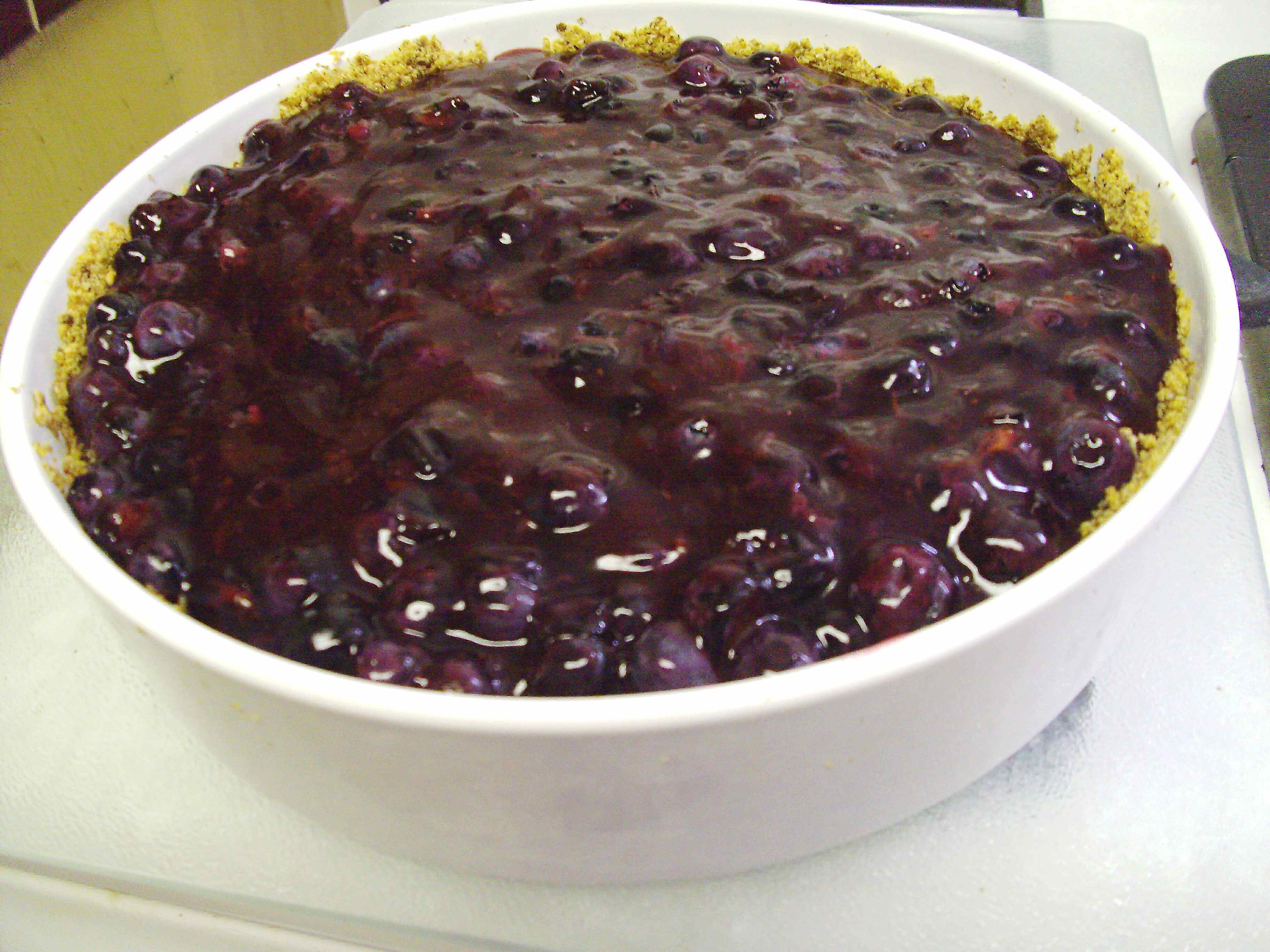
    raw blueberry pie with microwaveable filling and graham cracker crust

    This mostly-raw blueberry pie is a snap to make and very versatile--the filling microwaves in a few minutes, and you don't even have to bake the zippy gingered graham cracker crust--perfect for a hot Fourth of July and all summer long.

  • Recent Posts

  • Contents

  • Archives

  • Now Reading

  • See also my Book Reviews

  • Copyright 2008-2024Slow Food Fast. All writing and images on this blog unless otherwise attributed or set in quotes are the sole property of Slow Food Fast. Please contact DebbieN via the comments form for permissions before reprinting or reproducing any of the material on this blog.

  • ADS AND AFFILIATE LINKS

  • I may post affiliate links to books and movies that I personally review and recommend. Currently I favor Alibris and Vroman's, our terrific and venerable (now past the century mark!) independent bookstore in Pasadena. Or go to your local library--and make sure to support them with actual donations, not just overdue fines (ahem!), because your state probably has cut their budget and hours. Again.

  • In keeping with the disclaimer below, I DO NOT endorse, profit from, or recommend any medications, health treatments, commercial diet plans, supplements or any other such products.

  • DISCLAIMER

  • SlowFoodFast sometimes addresses general public health topics related to nutrition, heart disease, blood pressure, and diabetes. Because this is a blog with a personal point of view, my health and food politics entries often include my opinions on the trends I see, and I try to be as blatant as possible about that. None of these articles should be construed as specific medical advice for an individual case. I do try to keep to findings from well-vetted research sources and large, well-controlled studies, and I try not to sensationalize the science (though if they actually come up with a real cure for Type I diabetes in the next couple of years, I'm gonna be dancing in the streets with a hat that would put Carmen Miranda to shame. Consider yourself warned).

Ferran Adrià for the rest of us?

Library run–big display–white coffee table book with silverware on the cover–The Family Meal: Home Cooking with……Ferran Adrià?

I had to pick it up. I had to.

It’s not that I don’t believe the inventor of gelatinized “pearls” of just about any liquid from vinegar to champagne and mushroom soup can cook food that might actually satisfy in under 300 minicourses. Somebody’s got to make dinner, after all. Man cannot live on foams with three flavors, one of them sea urchin, alone.

The immediate impression was “wow!”—loads of clear, bright overhead step-by-step photos that actually replace standard written instructions. A few captions in balloons over the corners of the photos, but it all looks simple, doable, and good-tasting. You start to get a sense of elation, along the lines of, “Hey! This is real food—from El Bulli! I can handle it!” Short ingredient lists back up at the top—very pared down. And all recipes scaled—only a restaurant chef could manage this with ease—for four different levels of cooking—dinner for two, intimate dinner party for 6-8, something bigger for 20 or so, and banquet for 75. This could be pretty handy, you think.

But then I started to look through a little more carefully and wonder. You could, I suppose, prepare things the way he shows in the pictures—but the pans are sometimes an odd choice for home cooking. Big baking sheet set over the burners for browning garlic in oil—an awful lot of garlic simmering away there, actually. It looks right in the baking sheet, because that’s what he’s used to and you’re only seeing one corner of the pan in the photo. And I can see that setup in a restaurant quantity, but on my small stove? At the dinner-for-two-or-three level?

The sauces are good, basic—too basic, or just classic?—and you can make them in big enough batches to keep in the fridge or divvy up for the freezer so you don’t have to start from scratch each time. That’s pretty good cooking technique and commonsense. But then you peer down at the photos and see Adrià boiling his garlic cloves—twice, in changes of water—and also his basil Continue reading

Paula Deen and the diet that bites you back

This week’s “revelation” that Paula Deen, “the Butter Queen” is now a Type II diabetic was a surprise to nearly nobody. Deen, who revealed a harrowing backstory in her memoir of a bootstrapped career in catering, has enjoyed a surprising rise to fame on television. Two weeks ago, following in Emeril Lagasse’s footsteps, she appeared as Grand Marshal for the Rose Parade right here in Pasadena.

Of course, her otherwise ordinary “Southern Cooking” has been exaggerated out of all recognition with extra excess butter and sugar and mayonnaise, and so for years now cads like Anthony Bourdain have called her a scourge on the culinary scene (well, actually, he called her a lot worse than that, but he’s Anthony Bourdain. I’m paraphrasing politely, even though I kind of agree, at least foodwise).

With the revelation that she’s Type II, which everyone knows and fears due to their own increasing girth, Deen is bound to be the butt of predictable jokes this week and next, or until the next big Kardashian “revelation” that newspaper readers apparently care deeply about, or at least they do according to the reality TV networks footing the ad bills. (Even the New York Times has wasted column inches on this kind of drivel this year. Journalistic standards are dropping all over the place, I tell ya.)

But tell the truth, y’all: she ain’t the only one responsible. Not by a long shot. Read any “major” chef’s cookbooks and magazine offerings, other than perhaps those of Nobu, who deals mainly in raw seafood unadorned by carbs or noticeable layers of fat, and you’ll quickly realize that MOST of them exaggerate the salt, sugar and fat content of their dishes well beyond reason. Very few of them deal out plain vegetables on the plate. Very few deal out meats or fish without big sauces.

The other big, big feature stories on food in the New York Times this week:

1. Mark Bittman doing a quasi-deep bankruptcy commentary on Hostess that manages to recount his entire childhood consumption of Twinkies and co. in loving, fine-grained detail. He still attempts to sound self-righteous about it by the end because the ingredients include “ultra-processed flour”.

2. David Tanis of Chez Panisse, waxing lyrical about French lentils (du Puy or Die) as a salad with vinaigrette, hard-boiled eggs (so far, so good), some lettuce and….big fatty slabs of pork belly on top. Five or six of them per plate.

3. “The Miracle of Bo Ssam”–which turns out to be David Chang of Momofuku’s recipe for pork shoulder slathered in salt and brown sugar–twice–and cooked down for six hours in the oven. Caramelized barbecue. In fact, “crack” barbecue, to match Momofuku Milk Bar’s world-famous (to bloggers, anyway) “crack” pie made with most of the same ingredients.

Now people. With all of that going on, with Thomas Keller still boiling his vegetables in brine and poaching his lobster bits in butter, with the Culinary Institute of America instructing its naive young students to salt, salt some more, and salt yet again to achieve that perfect degree of salting in each dish (Coronaries ‘R’ Us), and with Congress sucking its collective thumb about local schools’ move this year to exclude french fries and pizza from the “vegetable” categories in their cafeterias—–

Does anyone really think that Paula Deen is NOT a woman of her time?

She’s nowhere near the worst–she’s just not as fashionable as all the tatted-up young bucks who get picked for Top Chef. She’s also not dishy, like Nigella Lawson, whose cookbooks, which started out about 10-15 years ago emphasizing lighter fare like Vietnamese salads with chiles, have also drifted drastically in the direction of high-calorie “indulgence” foods–some of them utter unmitigated goo-fests (avocado, mayo, roquefort? peanut butter, corn syrup, marshmallow fluff, chocolate bars? puff-pastry chicken pot pies-for-one?). Lawson makes the national news, at least in the UK, when she comes back out in public looking svelte again after puffing up too far past the point where male reviewers are still drooling. Will her next book of recipes slim down commensurately?

Unlike the more fashionable TV chefs on her network, Paula Deen is middle-aged and looks it. She’s fat, she’s gray though beautifully coiffed, she’s politely made up and decently dressed–no orange signature clogs–and she smiles. Maybe a little dippily, but if you didn’t know who she was, Continue reading

There’s something wrong when a veggie burger is worse for you than cheesecake

Recently spotted in the Los Angeles Times Food Section “Dear SOS”

Veggie burgers from North Peak

Dear SOS: My family and I just got back from a trip to Traverse City, Mich., where I had the absolute best veggie burger I’ve ever had. Is there any way you could coax North Peak Brewery Co. to give up its recipe for its Black Bean and Portobello Mushroom Burger?

Dear —–: This burger even had some non-vegetarians going for it. The restaurant also sometimes serves it with provolone cheese and sliced avocado along with a dab of basil pesto aioli on toasted ciabatta rolls.

Total time: 1½ hours, plus cooling time Servings: 8

The recipe starts out with a 9-ingredient pico de gallo homework item–let’s just agree it’s basically salsa, and it gets mixed into the beans and other stuff at midpoint in the cooking process–which is long. One and a half hours? Yikes. But then check out the rest of the ingredients for the veggie burger itself:
Veggie burgers and assembly
  • 4 cups cooked black beans, from about 2½ (15-ounce) cans (drained)
  • 1/4 cup honey
  • 1/4 cup molasses
  • 2 teaspoons salt, more to taste
  • 1 tablespoon cumin, more to taste
  • 1/4 cup plus 1 tablespoon olive oil, plus more for sautéing the burgers
  • 1/2 cup finely diced onion
  • 9 ounces portobello mushrooms, cut into ¼-inch pieces (about 4 cups)
  • 1 cup pico de gallo
  • 3 cups panko bread crumbs
  • Semolina flour for dusting
  • Sliced cheese, if desired
  • Sliced toasted ciabatta rolls

And then — guess the nutrition stats?

Each burger (without cheese or garnishes): 604 calories; 21 grams protein; 103 grams carbohydrates; 11 grams fiber; 13 grams fat; 1 gram saturated fat; 0 cholesterol; 16 grams sugar; 1,227 mg sodium.

Whoa. 604 calories for a single veggie burger. 103 grams of carbohydrate–more than a meal’s worth just by itself. Honey, molasses and panko turn what might have been a reasonable amount of carb from a serving of black beans into something that reminds me of the old sketch from Garrison Keillor’s A Prairie Home Companion on NPR: “Here’s my secret. I just add sugar to the same tired dinner and wow! suddenly everyone loves it!” … or words to that effect.

No doubt the honey and molasses also go a long way toward disguising the fact that each burger contains more than 1200 milligrams of sodium. Where’s that coming from, anyway? the canned beans–400  mg or so per serving. The added salt–a quarter-teaspoon or about 560 per serving. Breadcrumbs–more salt. Add a ciabatta roll and cheese and you’d be above 1500 mg easily.

At this point, despite their long laundry list of ingredients, the MorningStar Griller’s Vegan burgers I used to eat are looking a little more decent nutritionally–about 300 calories apiece and 280 or so mg. sodium. So if they could do it, why couldn’t you?

In theory, at least, you could make veggie burgers a little less dangerous and cheesecake-like if you just skipped the added syrups and salt, and cut the large excess of frying oil for the mushrooms and other sundries by simply microwaving them to precook. That is, choose a sensible recipe instead of something ridiculous.

Oh yeah. But then it would just be, you know, veggie burgers. Not keeping-up-with-the-chain-restaurants versions with the pumped-up sugar-salt-and-fat formulas. I ask again, is there any hope?

What do you make on New Year’s Morning?

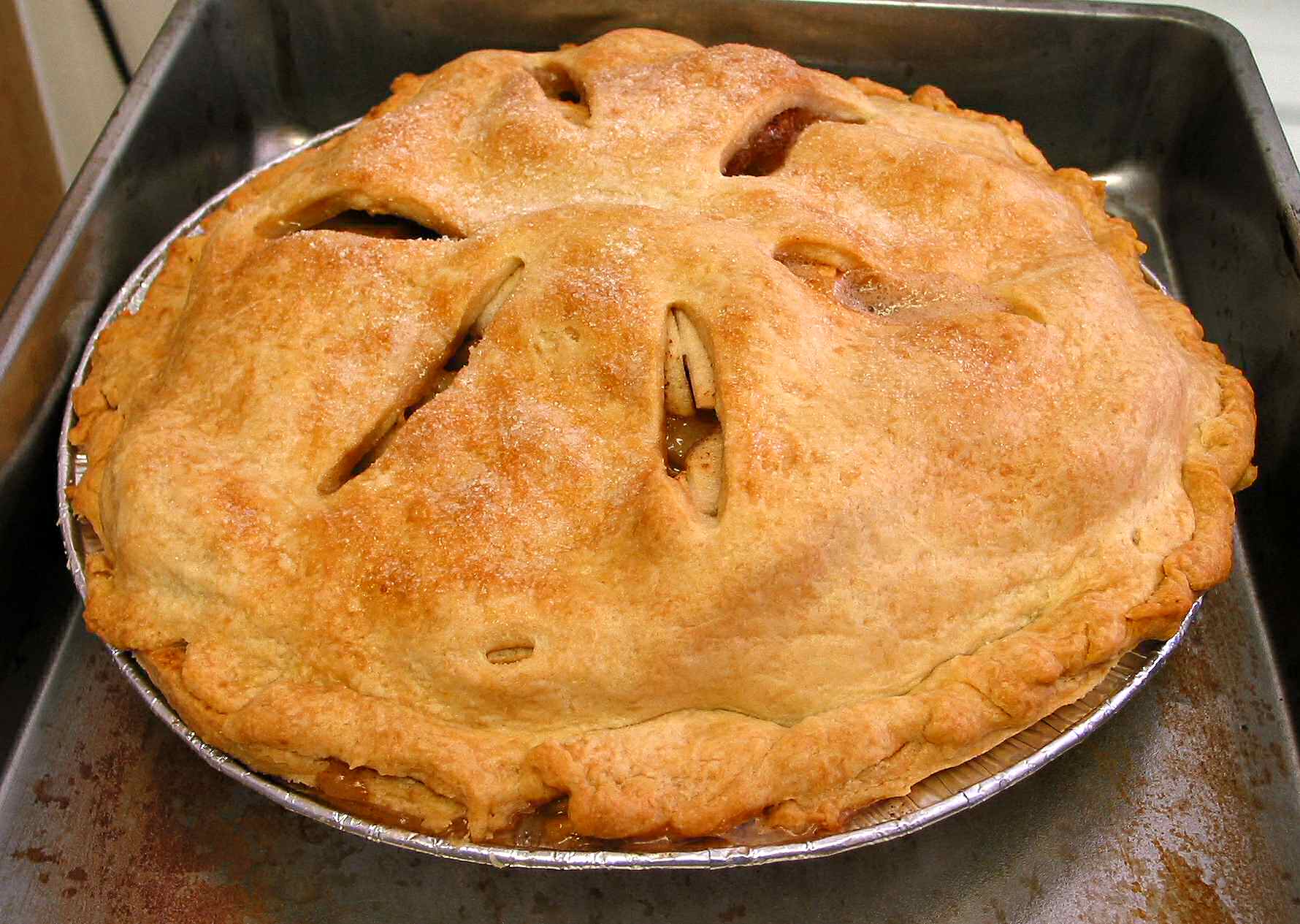
Apple pie for New Year's Day

If you’re me–as I was, this morning, and will be until I can find someone better and clearly cooler to be–you make pie to take for a brunch at the house where a childhood friend is visiting. We had a great visit at her mother-in-law’s and my daughter got to meet my friend’s kids and trade rolled eyes while us uncool parents hung out and swapped tales of child-raising woe and pride–all the usual things.

But this morning–there’s no denying it–was a little rough. I got up about two hours later than I’d hoped to, after worrying much of last night about what kind of fool was I to offer to bring apple pie for 15 when I’d never made an actual apple pie before, just pumpkin pie and various apple cobblers–which probably wouldn’t add up to the same thing. And my friend and her husband are the “accomplished cook” sort of couple that makes such a gambit even riskier. Sort of like going to that 30th class reunion, only crossed with a cook-off. I’m not southern enough to enjoy the prospect very gracefully.

So at 9 a.m. I was up, cranky, and snarling (effectively, as it turns out) at my nearest and dearest that if they wanted breakfast they were on their own; I had pie to figure out and only about 2 hours or so to do it in before we had to leave, and maybe I could be convinced to brew coffee after the pies were in the oven, but until then they were cordially invited to seek out the Starbucks and leave me to my fate. Which was about a pound of flour, 3 1/2 sticks of butter, 3/4 cup of sugar, some cinnamon and cloves and 11 huge Granny Smith apples.

I think I made more dough than I’ve ever made before in one recipe–double crust for two pies. Only other double-crust pie I’ve ever made was the medieval tart for my daughter’s class a month or so ago (and I was panicked enough that she had to remind me that it had worked out fine, so what was the big deal?).

When you scale up like that, will your recipe still work? will it be too tough or uneven? too dry? too stretchy? will it roll out right? –too much worrying for one morning before benefit of caffeine, I’ll tell you that.

I had actually checked out about 5 different baking books to compare notes on dough and apples and how much sugar for how many apples–and on and on. You will say–correctly–that I probably shouldn’t have bothered. Apple pie has got to be one of the big basics, and despite the fact that every one of the books had about the same ratios, none of them were exactly alike, and they all looked fine.

I don’t usually get like this, and if it had been an apple crisp, I certainly wouldn’t have worried about any recipes at all. But pie. Pie is a standard, and apple pie even more of a standard. Everyone knows what it’s supposed to look and taste like. It’s the only food Americans really get French about.

There’s nothing to do about that, except to take the chance and pick your friends wisely, so they’ll be thrilled you brought a homemade pie or two. Which is what I did. And it turned out much better than I had any right to expect. So if you’ve never tried it, and you actually like apple pie–this is not bad. Not bad at all.

The only other hidden wisdom in this post is how to schlep your pies, still hot, across Los Angeles at noon on New Year’s Day. Think Priority Mail ™–the Continue reading

LA County gets school lunch program wrong

The LA Times recently reported that the public school cafeteria revamp the county worked so hard on for this year is a dead flop; kids are dumping whole trays of the healthier dishes they approved of in focus groups over the summer.

But there’s a catch: the dishes, which replace the concession-stand burgers-fries-pizza formula, were prepared well over the summer. The students say a lot of the stuff they’re being served now in the guise of “healthy” whole-grain salads and so on in the actual cafeterias is inedible: undercooked or burnt rice and other grains, undercooked meat, moldy bread, milk and other sealed cartons past their due dates, and so on. And when the students brought it to media attention, some of the cafeterias responded by removing the due dates.

The story was so eye-catching the New York Times picked it up last week to throw the issue to its own readers for comment. (Or you could say it regurgitated it–near the truth; the major newspapers seem to be following each other a little too closely these days. What is this, Reader’s Indigestion? what’s the nation coming to???)

The comments–well, as always for newspaper free-for-alls, they’re not generally on the ball. Most bashed the school board for being too liberal and trying to shove ethnic variety dishes like pad thai down the throats of poor kids trained on burgers and fries and pizzas. A lot of them were bemoaning the complete success of the fast food concessionaires in conditioning our kids not to like or even tolerate real food. A few–those who can read and think?– pointed out the spoiled or miscooked food problems mentioned in the LA Times but not in the NY Times digest version.

They all seem to have missed the most serious point, though: the school district may have retooled the menus, but they haven’t restored proper working kitchens to the school cafeterias. There’s no proper cooking facility behind that wall–certainly not for a thousand or so kids in each school. A lot of the new dishes are still being prepared offsite, just as the pizzas and burgers and fries were. Those prepared onsite are handled by staff used to doing nothing more complicated than heating up a bunch of frozen boxes from a concession company using minimal “kitchen” facilities.

The fault in the LA Unified School District healthy food menu plan lies partly in its complexity and partly in its execution. Upscale restaurant-style dishes might not be the best way to go for a first run at better food, and not just because they might repel students used to commercial stodge. They’re a bad starting choice because they’re more complex than the minimally experienced and underequipped cafeteria workers can handle on site, and the facilities that produce them clearly haven’t got their protocols down for “quinoa salads for 1000”.

The freshness factor is another problem. With “just reheat” trays of frozen pizzas, burgers and fries, no one has to think about sell-by dates. Heck, the sodium level is so high they probably don’t even need to freeze the meals. We’ve all seen the blog post where the woman let a Happy Meal sit on one of her shelves for an entire year…and nothing appeared to have changed in all that time. Real food with expiration dates? The school cafeterias are now out of their depth.

But by the same token, the schools shouldn’t have to throw in the towel so easily and go back to pizza, burgers and fries.

What would have been easier to get right–better balanced, and with better buy-in from the students–might have been “build your own” sandwich and/or salad bars.

You see the complicated versions  at any Whole Foods or Souplantation. But pick one theme per day–brown-bag sandwiches, Italian subs or hoagies, felafel and pita, soft tacos… Offer two or three nutritious and fairly familiar choices for protein fillings, one of them vegetarian. Two or three raw, fresh vegetables as accompaniment and a choice of sauces or toppings, and fairly simple bread. Then you’ve got the makings of something students can deal with and find appetizing as well as nutritious, but without a lot of complicated prep.

You don’t have to provide a zillion choices for lunch every day. You don’t have to salt or bread the dickens out of the fillings, and you don’t have to provide sweetened, oversalted sauces for them. Fewer ingredients and processes are better. Just make sure the food is fresh.

I wish to god the school cafeterias and the board members who debate what they serve would stop trying to imitate the  chain restaurants or the upscale restaurants–or indeed any restaurants. It’s lunch, not a field trip downtown to the California Science Center, where the brand-name burger chain running its concession stand/cafeteria sends the smell of frying grease wafting up to every one of the exhibits to make sure you know what you’re really supposed to be paying attention to.

Why don’t school cafeterias do regular sandwiches anymore?


Fruitcake and the Jews

A week or so ago, just before the Chanukah madness, my husband brought home what he assumed were The Goods from the local Vons (Safeway chain affiliate on the west coast)–a classic fruitcake, green and red candied citron glowing evilly amid chunks of walnut and raisins and other less identifiable bits and topped with syrupy pecans and glacéed cherries. Tacky as hell, we know. We love fruitcake anyway.

Why do Jews like fruitcake more than Christians do? You know, the kind of indestructible fruitcake everyone jokes about passing off to some unsuspecting cousin after having received it 20 years earlier and having kept the tin in the closet all that time underneath some shoes. The kind the British refer to as “doorstop”. The kind all modern cake blogs decry when they present their own lighter, cakier, less fruity and less chewy version as “fruitcake you’ll actually like.” THAT fruitcake.

Well. Private Selection or not, the cake from Vons was…I don’t know if there are new legal restrictions on using rum or bourbon or other booze as a baking ingredient these days (or ice cream flavor; hard to find Rum Raisin anymore). Maybe it’s a California-does-rehab thing, or just a huge downgrading of quality, but it. Was. Awful.

No rum. No bourbon or other appropriate flavoring. Instead, the loaf was permeated with an aggressively soapy flavor/odor (we couldn’t even tell which), horridly artificial and perfumy like fruit-scented liquid hand soap. Or that overpowering Dove soap I always hated as a kid. You couldn’t even taste the raisins or walnuts, which by all accounts, including visual inspection, were present.

We were, perhaps for the first time ever, not tempted to eat any more, not even to try a tiny second taste the next day to see if it was really as bad as we thought the first time. Just passing the open packet on the table was enough to convince us the bar of Dove that must have fallen into the batter was still giving that loaf its younger-looking complexion. After several days of forlorn looks in its direction, we actually threw it out.

In any case, I’ve been looking for a trustworthy recipe for fruitcake ever since and not succeeding much. In a place where there is no fruitcake, strive thou to make taka a fruitcake. (Not exactly sure what the “taka” part means in Yiddish; the way my mother says it, it means something like “especially” or “such a”, but less polite and more ironic, as you might use it when pointing out how incredibly garish and over-the-top the neighbor’s Christmas lights are with the Continue reading

Pecans, Profits, Poverty: reason to remember the gleaners

From the New York Times today:
In Georgia, Pecan Thieves Find Windfall, at $1.50 a Pound

Now I know stealing is stealing, and scrumping is scrumping, but there’s a decent argument in here somewhere for leaving some of the fallen nuts for the poor to gather–even if it’s to sell to local nut brokers at a dollar-fifty a pound. The farmers claim their losses are growing this year–small wonder!–but one of the biggest growers estimates he’s selling 7 million pounds and the thefts total to about 10,000 pounds. Less than one percent. The article quotes $3 per pound as standard wholesale–all I can say is, out here in California our best local price is $9 per pound for shelled pecans (I don’t bother with the ones still in the shells; I’m not that good).

Some of the thieves are stealing amounts large enough to be serious theft–1400 pounds in one case–and cutting fences to break in. You get no argument from me for calling the sheriff on them. But most are genuinely poor–laid off and out of work, trying to make 15 or 20 bucks with the bit they can gather in a bucket or sack from the edges of the local pecan groves. Yes, that starts to add up if you have 50 people doing it, and yes, it’s more than one person would expect to be able to eat because they were hungry, but perhaps the talk of theft should be reconsidered and turned around to a discussion on gleaning, and not trimming the corners of your fields but rather leaving the last bits of the harvest for the poor to gather. The amount of money these small-scale gatherers can expect to make by selling to the local nut brokers is paltry and nowhere near in competition with the price the growers can get per pound.

Ironically, if the growers let locals pay a significant discount price per pound–50 cents a pound? 75 cents? to gather fallen nuts themselves after the main harvest, as many apple orchards do, they might reduce the incentive for break-ins, reduce their financial losses from theft and security costs, and save themselves some labor and wear-and-tear on their expensive ground harvesters. And they might still be seen as generous.

Stuffed onions in a hurry

Stuffed onions ready for steaming in the microwave

With a microwave and a frying pan, you can make stuffed vegetables like Mehshi Basal quickly, and they taste even better than with long roasting. These are just rolled and ready for a few minutes of steaming in the microwave.

Just after Rosh Hashanah I posted my first-ever attempt at an elaborate Syrian Jewish dish of sweet-and-sour stuffed eggplants with quince, and because I had more stuffing than I needed, I went for seconds with Aromas of Aleppo on the spot and tried out the Mehshi Basal, or stuffed onions with tamarind sauce, which was actually even better. It was easier to put together and I was patting myself on the back when we tasted the results.

Still, given that I was using a lentil stuffing in place of ground beef, I was a little dismayed at how long the traditional braising and roasting took to cook the onions all the way through–an hour and a half at least, and that was after stuffing them. A second attempt in November, this time exclusively with stuffed onions for a congregation brunch, did no better on time, and I came away thinking that roasting was an extremely inefficient way to cook these–might even have toughened them inadvertently.

Why, you have to ask, should I make such a big deal about stuffed onions–they’re a party trick, after all, not standard cooking. But we discovered we really liked them, and they’re a pretty good kind of party trick. They were a surprise hit at the brunch. If I hadn’t snuck myself one while setting up in the kitchen, I’d have missed out altogether.

Actually, I think they fascinated everyone as much for the magic trick as for the flavor. People who’d never tasted them before kept coming up to me–and even my daughter–to ask, “How do you get the filling into the onions???”

If they hadn’t been so time-consuming I could have made double the amount and they’d still have disappeared. Or I could throw them together easily just for us on the odd weeknight as a treat–but one with some iron and fiber in it–instead of the standard pasta or rice.

So in the time since, I’ve finally rethought the process and come up with something that requires no oven time and cuts the actual cooking after stuffing them down to about 20 minutes or so–as long as you already have some cooked lentils (microwaved to perfection in about 10 minutes of cooking time and 30-4o minutes of standing time) and tamarind sauce (or “mock tamarind” sauce, a 5-minute microwave-assisted blend of prunes and/or apricots with water and some lemon juice, plus-or-minus tomato paste, applesauce and other flourishes you don’t really need for this) to hand.

I know, you probably don’t have these things sitting around. But this recipe might change your mind. Lentils are good stuff even on their own, and the stuffing here is a knockout.

Even genuine tamarind sauce isn’t so bad anymore, assuming you don’t or can’t just buy a prepared concentrate. I’ve sped the process up from an hour-plus to a few minutes just by nuking it, pulsing in a food processor, and this time, neither filtering it quite so aggressively as I did back in September NOR bothering to boil the stuff down to a sticky residue. It’s so much less painful, and I think it even tastes better, with more of the fruit character left in. See my notes at the end of the post for how to do it the quickie way (in modest jam-jar quantities, not quarts).

Anyway, back to the stuffed onions. I’m actually proud of myself for this one, and I’ve tried it three times in a row so I can vouch for it–the last time, I put my daughter to work stuffing the onion layers, and she did a great job.

For this method all you need are a microwave oven, a frying pan and a food processor. Instead of boiling the onions for 20 minutes to separate the layers, you microwave them in a drizzle of water for 5. Instead of braising the stuffed Continue reading

Medieval in LA: Sweet Spinach Tart

sweetened spinach tart for medieval feast

My daughter’s middle school social studies class has been preparing for this all month: today was the Medieval Feast. Lords, ladies, jesters, knights–and she chose to be the master chef. Others brought bags of apples and peas.

We baked a big Tart of Spinnage (courtesy of The English Huswife, 1615, by Gervase Markham) with adaptations. 1615–that’s Shakespeare and Elizabeth I, the early modern era, not the medieval. Still, some of the recipes were probably conserved, and some of the styles of flavoring as well. The fact that sugar is added to this one is reminiscent of Elizabeth I’s infamous sweet tooth, but it also makes the normally savory spinach a dish more in keeping with the earlier recipe collections so favored by Renaissance Faire participants.

Medieval recipes from the 1300s and 1400s indicate heavy use of cinnamon, ginger, mustard, pepper, galingale, and grains of paradise for the aristocratic classes, at least for their feast dishes. Fruits were routinely added to both meat and fish “Parma” tarts–those tarts, full of eggs, were probably much like today’s quiches.

But the recipe my daughter’s teacher e-mailed me had no eggs. The binder, an interesting choice, was “cast cream” or sour cream. Sour cream bakes up well in cheesecakes–labaneh, a Middle Eastern/Near Eastern version, is a lot thicker and bakes up even more nicely. I’ve made mini-cheesecakes from nothing but labaneh, sugar and lemon rind stirred together and baked in cookie crusts, and they came out beautifully. So I wasn’t too worried about the tart filling firming up enough.

The original recipe also contained no spices other than sugar (maybe I mean “flavorings” rather than “spices”), pepper and salt. Spinach, sour cream, sugar, pepper, salt…bland? Odd? Would the signature combination of vegetable and sweet get lost in the mix? No knowing. But for a medieval version, especially for a classroom tasting, we were going to have to do something slightly different, more purposeful.

A spinach tart with sugar? It was going to be a gustatory challenge for the class and its guests, a flavor combination we no longer encounter very much. Might as well make it interesting, and preferably good.

Which is why I adapted it to a sweetened tart of greens like Swiss chard. Versions of this are still served today in Nice (tourte de blettes or Swiss chard tart) and parts of Italy (torta di verdura or tart of greens) as a dessert. The filling often contains raisins and pine nuts as well as Parmesan cheese, and the pastry is often sweet and dusted with confectioner’s sugar before serving.  If it were awful, surely people like David Lebovitz wouldn’t be putting versions of it on their blogs. Novelty value can take you only so far. And his version contains a layer of apples on top of the chard…

The last thing I thought about was the learning experience for my daughter, the nascent (though not Re-nascent) master chef. The recipe her teacher sent home indicated “pastry shells”. As though you could go to the store and buy them.

No baking powder or soda allowed in the medieval era. No food processor. So my daughter cut up the butter and cut it into the flour with a pastry blender–once she realized the blades weren’t actually sharp–and then mashed it together with her hands, which was a lot more efficient. She made the spinach filling we decided on–very close to the assigned recipe, but with a bit of cinnamon and nutmeg, and a grating of lemon peel. In place of raisins, she put the extra bits of apple in the filling.

patting out the filling

She fit the pastry to the pan, pricked it out, filled it, and topped the spinach with a layer of finely sliced Granny Smith apples–most apples were probably tarter in those days than they are now.

slicing apples for the spinach tart

Dame Felidae demonstrates her knife skills

Then she placed the top layer of dough onto the tart, pinched it shut, slashed it in her own design and “endored” or gilded it with egg yolk/water glaze. We baked it in a (horrors! modern!) oven and thawed the “spinnage” out in the microwave before squeezing it, but other than that I think we were pretty much in the spirit. Continue reading

A Slow Food Fast Thanksgiving

Pumpkin pie in the microwave

I’m not sure how to take all the following good news–it’s been such a strained year that the sudden release of pressure is going to make me zip around the room, once the coffee kicks in.

1. My mother-in-law has threatened to favor the brand-new kosher butcher in her town this holiday season so that we can eat the turkey too this year (and maybe not fight about it). She promised not to smear said turkey with butter. We’ll cross our fingers. But at least we won’t have to cook. I’m keeping that firmly in mind.

2. As of this week, my daughter’s finally on an insulin pump and fairly thrilled about it, so she can navigate dinner AND dessert at my in-laws’ without breaking down and crying that she only gets two tablespoons of pie for a reasonable serving. We are still encouraging her to count carbs and not go hog-wild or she’ll be zipping around the room until midnight.

3. The school concert’s in less than two hours. Is that really enough time to do everything, or at least something? Naaaah. Well, maybe coffee and something other than the news.

4. We still have to schlep up Interstate 5 for about 6 hours tomorrow, starting “early” (i.e., an hour and a half after the time my husband announces this evening as the absolute latest), passing the Harris Ranch and its attendant aromas, which can be more than slightly offputting if you’re not an avid horticulturist. But at least when we get to my in-laws’ we don’t have to cook. As I said, I’m keeping that firmly in mind. I know I already said it, but it’s so important I figured it was worth saying twice.

Despite my firm resolve after last week’s marathon kiddush that I will strive Not To Cook (could I possibly be Peg Bracken’s unacknowledged lovechild? Unfortunately, no. However, my mother was a devotee of the Don’t Cook Too Much school of thought, and I’m starting to appreciate that. Really I am.)…where was I? Oh yeah…I will probably bring at least two lemons, some thyme and rosemary, a head of garlic and a couple of bags of fresh cranberries with us on the road. Call it flavor insurance. For whatever reason, my in-laws, who have developed what can only be called fanatical devotion to Italian food of every possible kind (having both grown up in white bread country), always run out of these basic essentials about halfway through, and my mother-in-law tends to tell my father-in-law to go back out and pick up extras just as the stores are closing…

The cranberries, I’m well aware, aren’t Italian. They’re for making 5-minute microwave cranberry sauce with about half the sugar of regular. My mother-in-law tends to try out her fancier cranberry chutneys and relishes every year, and every year they contain things like chardonnay–which is fine for the grownups but I’m no grownup. Her chutneys have more than 10 ingredients and sit stirring on the stovetop for at least 45 minutes. I don’t know how she does it–I’d go stir-crazy. I’m just not that good.

So anyway–I wish you all a great Thanksgiving at somebody else’s house, so you don’t have to cook or do the dishes. My idea of heaven.

But if you absolutely have to cook, here are a couple of posts for speeding up a few of the obligatory or not-so-obligatory Thanksgiving items–most can go in a microwave (I always, always think that’s worthwhile. Well, usually). A few of these are dairy, so use your discretion.

5-Minute Cranberry Sauce

Microwave Pumpkin Pie

Basic instructions for microwaving green beans, brussels sprouts and other vegetables

Creamed Spinach Variations

“Marbella”-style cooked vegetable relish with artichoke hearts, olives, tomatoes and prunes

Turkey Breast with Ta’am (flavor) –not microwaved, not a whole bird, but it is a lot quicker and tastes unusually good if you have a small crowd. DO keep it covered in the oven to prevent it drying out.

Some options for vegetarian centerpiece dishes… (ideas more than recipes)

Spice mixes because sometimes you want to liven up the party…

Syrian Jewish stuffed vegetables (baby eggplants and onions) with an incredible lentil filling (NOTE–this one is “not exactly quick”; well, maybe for the eggplants microwaving would be enough, but the onions still take some serious roasting even after microwave assistance.  However, it is delicious and impressive.)

Microwave gingerbread and microwave flan (and a recommendation for mead…)