
• Enter your email address to subscribe to this blog and receive notifications of new posts by email.

    Join 241 other subscribers
  • Noshing on

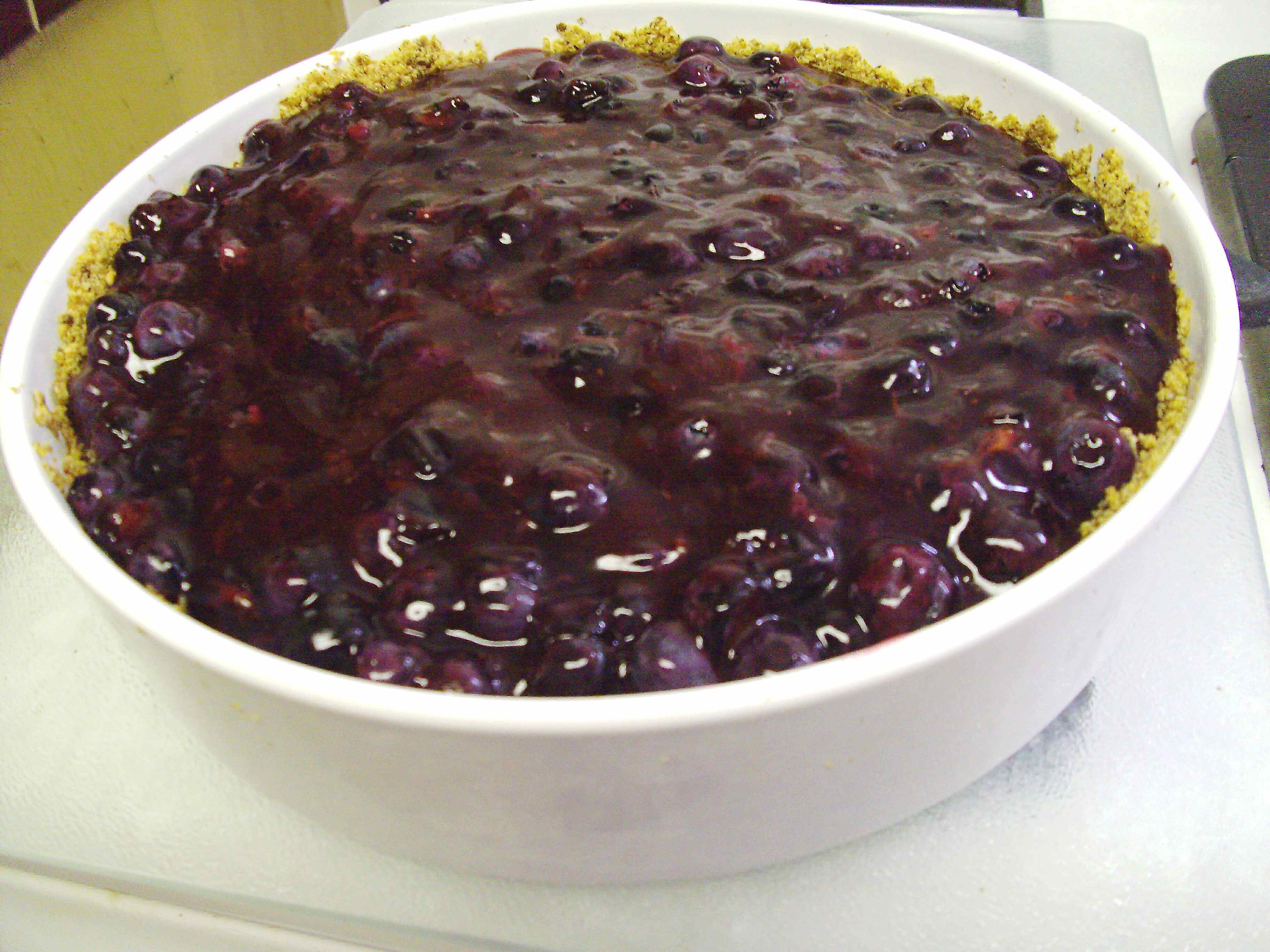
    raw blueberry pie with microwaveable filling and graham cracker crust

    This mostly-raw blueberry pie is a snap to make and very versatile--the filling microwaves in a few minutes, and you don't even have to bake the zippy gingered graham cracker crust--perfect for a hot Fourth of July and all summer long.

  • Recent Posts

  • Contents

  • Archives

  • Now Reading

  • See also my Book Reviews

  • Copyright 2008-2024Slow Food Fast. All writing and images on this blog unless otherwise attributed or set in quotes are the sole property of Slow Food Fast. Please contact DebbieN via the comments form for permissions before reprinting or reproducing any of the material on this blog.

  • ADS AND AFFILIATE LINKS

  • I may post affiliate links to books and movies that I personally review and recommend. Currently I favor Alibris and Vroman's, our terrific and venerable (now past the century mark!) independent bookstore in Pasadena. Or go to your local library--and make sure to support them with actual donations, not just overdue fines (ahem!), because your state probably has cut their budget and hours. Again.

  • In keeping with the disclaimer below, I DO NOT endorse, profit from, or recommend any medications, health treatments, commercial diet plans, supplements or any other such products.

  • DISCLAIMER

  • SlowFoodFast sometimes addresses general public health topics related to nutrition, heart disease, blood pressure, and diabetes. Because this is a blog with a personal point of view, my health and food politics entries often include my opinions on the trends I see, and I try to be as blatant as possible about that. None of these articles should be construed as specific medical advice for an individual case. I do try to keep to findings from well-vetted research sources and large, well-controlled studies, and I try not to sensationalize the science (though if they actually come up with a real cure for Type I diabetes in the next couple of years, I'm gonna be dancing in the streets with a hat that would put Carmen Miranda to shame. Consider yourself warned).

Post-Passover and the Unholy Host(ess)
gratinghorseradish

Grating horseradish (at least for a small quantity) is not really the big deal I once thought because I saw a superhostess friend of mine struggle with it every year. While you’re admiring my diligence and handmade everything, just like my friend but slightly saner, please go ahead and dig the groovy paper plates. The only way to do Passover, or any obligatory celebration, in my humble opinion.

Last week a friend at shul asked me, tongue in cheek, whether we could use an extra couple of boxes of leftover matzah. What can you say to an offer like that?

I asked him if he wanted to trade with us–we both seemed to have the same amount and brand.  He sighed and said that even his chickens, which eat almost any kind of scraps, are still sick of matzah at this point. So’s our cat (do not ask why cats think matzah is interesting. It makes no more sense than why they go after taco chips).

This is all by way of explaining why I haven’t been blogging so much lately. Is there still something new to discover about Passover cooking? Other, I mean, than the tentative trend to re-include legumes and rice. This year, unpleasantly, the bag of rice I bought turned out to be rancid (you don’t need me to explain this. The sour or barny smell will clue you in if you ever get a bag that’s off, and no it won’t rinse or cook out. Take it back to the store).  Was it a Message from the Almighty ™ or just a bad bag of rice? Only the potato knows. In any case…

The week before Passover, I tend to feel a lot more like Bart Simpson than usual. Even my hair gets spikier (though not blond, never blond). I envision Bart standing before the chalkboard at Pesach, having committed yet another farfetched classroom sin. Only my litany goes something like this:

  1. I will eat mostly vegetables.
  2. I will not eat any foods containing hidden matzah after the seder.
  3. I will not eat foods adding up in practice to six eggs a day OR anything made mostly of potato–except for an actual  plain steamed potato.
  4. I will not just scarf canned coconut macaroons when I don’t know what I really need to be eating or am too lazy to find it.
  5. I will not let my husband buy fake Passover cheerios for a zillion bucks a box when five full boxes of whole wheat matzah are staring at me, I have sliced almonds AND steam-defatted organic coconut shreds in the freezer, AND brown sugar and cinnamon, and that’s all you need to make matzahnola from scratch in five seconds flat. Or we can just eat plain yogurt with a spoonful of jam or some berries.
  6. I will eat yogurt.
  7. I will make soup.
  8. I will resist the temptation to buy yet another fresh unopened can of potato starch. I still have 95 percent of last year’s.
  9. Next year I am launching the Paschal answer to the Washington Post‘s Peeps Competition. I think I’ll call it The ‘Roon Run. Dioramas made from canned macaroons in any configuration, with or without goggle-eyes, toothpicks, pipe cleaners, construction paper in many forms  and (of course) glitter. Almost like the real thing, only not purple, pink or yellow…

Sigh. Now that Pesach is over, except for the three boxes of matzah we still have and which we are supposedly allowed to eat any time of the year….I can add one or two more items to my chalkboard manifesto.

Number one, I will not cook seventy-two times a day. For anyone. Which is what it often feels like when your husband and child are both at home the whole week, or nearly.

And really, what great things was I making? Mostly the same stuff I always make, only with potatoes instead of pasta or rice.

Well, there were a few improvements this year:

Zucchini latkes–Grate a zucchini or two and about a quarter of an onion or just add a couple of chopped scallions into a bowl, then a clove of garlic, then crumble some feta and add chopped basil or a bit of thyme, stir in an egg and a spoonful of matzah meal, and fry in patties in olive oil. Quantities? Quantities are for finicky people who actually follow recipes. I’m not sure I qualify anymore.

More refined whole-wheat Passover blintzes: Whole wheat matzah cake meal still tends to be a bit gritty if you use it straight, and it doesn’t have as much cohesiveness as you’d like for crêpes. I found I could grind it finer successfully by dumping half a cup at a time in my poor abused coffee grinder and whizzing it a few seconds.

Crêpes for 10 blintzes should be about half a cup of “Turkish grind” whole wheat matzah cake meal, a spoonful of potato starch, a cup of milk and two eggs mixed in. Then you have to let the batter sit because matzah meal is so much drier than regular flour that it will thicken much further than you expected. Add more milk to thin it out to a drizzle, about the texture of cream. A spoonful of sugar and a small shake or pinch of nutmeg will give it that French flair.

What else? Oh yeah:

Hrein. Horseradish. I’ve never made it by hand before, and whenever we go over to a super-cook friend’s house for Passover, she makes a blenderful of excessively potent horseradish and says how tough it was to grind up, so I always figured it was more trouble than it was worth. The fresh roots always look awful and muddy, too. But this year there wasn’t any horseradish in the supermarket without either dairy or odd ingredients. So I bought one of the huge foul-looking muddy roots on sale in the produce section.

I have a very sharp paring knife, and the peeling went much easier than advertised. I cut a two-inch chunk of the peeled root and grated it on the small holes of my trusty cheap plane grater (note, not “microplane”, which might not hold up under the pressure)  by hand over a plate. It took only a minute or so. I piled the shavings into a cup, poured just as much apple cider vinegar over them as they could absorb, added a pinch of salt (Joan Nathan and most others say add a pinch of sugar and some black pepper as well, but I didn’t bother), and stir and cover and chill.

Verdict: pretty good!

–  –  –  –  –

But back to the chalkboard litany. My second hard-won lesson, which I assure you I will exercise much past the final sundown of Passover, is to pick my guests carefully. 

I got an eye-opener as to why hostesses with the mostess use white tablecloths and cloth napkins and those awful cut-glass olive dishes when they have people over. Turns out it’s not just to be fussy. No. All that formal crap I always hated is very important protective armor to keep the guests in line via mild intimidation and prevent them from taking advantage of you. Same strategy as used by all the major French restaurants.  To wit:

We had friends over for the 7th night. Stressful enough without it also being a seder they had suggested–and somehow it ended up being at our house! Which meant I had to do the cleaning and yelling at my nearest and dearest to help get the bathrooms and living room cleaned up somewhat in advance of the guests’ arrival…and it meant doing most of the cooking! How did I let this happen?!

It would never have worked at all if our friends hadn’t been reasonably unpicky, and to be honest in the aftermath, it mostly turned out okay. It was still stressful in unpredictable ways, though, ways I am planning to learn from for my daughter’s bat mitzvah celebrations in a couple of months.

What exactly went wrong? Despite a simple but pretty decent menu for 6 Continue reading

Pinned for Purim!

Thanks to Yael Shuval for choosing my Low-Carb Hamantaschen for her board at Pinterest.com.

Three years ago I developed almond-meal based hamantaschen for my daughter, who had been diagnosed with Type I diabetes only a couple of weeks earlier and needed something that was low enough in carb that (at the time, anyway) she could actually have one or two when all the other kids were having theirs and without having to get an extra shot of insulin.

Almond meal has only about one-fourth as much carbohydrate per cup  as wheat flour, so it seemed like a good substitute. To our surprise, although the dough was a little finicky to work with, the hamantaschen came out tasting pretty good, and they were indeed pretty low carb, about 4-5 grams per mini-hamantaschen. Granted, they were also pretty small, but it was a symbolic triumph in the first few weeks and made us all feel like being diabetic wasn’t going to be the end of having fun.

Now that my daughter is on an insulin pump, getting an extra shot is no big deal, though in our experience the pitfall is that it’s now just a little too easy, especially for a preteen, to “eat anything you want, at any time, without thinking about it, as long as you program the insulin for it” which is one of the less responsible marketing messages in Medtronic’s brochure for teenagers (note: the pump itself is pretty good, but it still doesn’t mean you don’t have to be careful about what you’re eating). Those sour gummy heart candies the teacher handed out for snack earlier this week and left on my daughter’s desk, for instance….well, candy never seems like as much food as it really is, and I think my daughter gained a valuable lesson when she added up what she’d really eaten…she wouldn’t be the first one.

It’s always good to have a general plan in place for holiday eating so you don’t overdo the treats or eat an entire meal’s worth of carb in just a few cookies or candies or whatever…what can I say, we’re working on it.

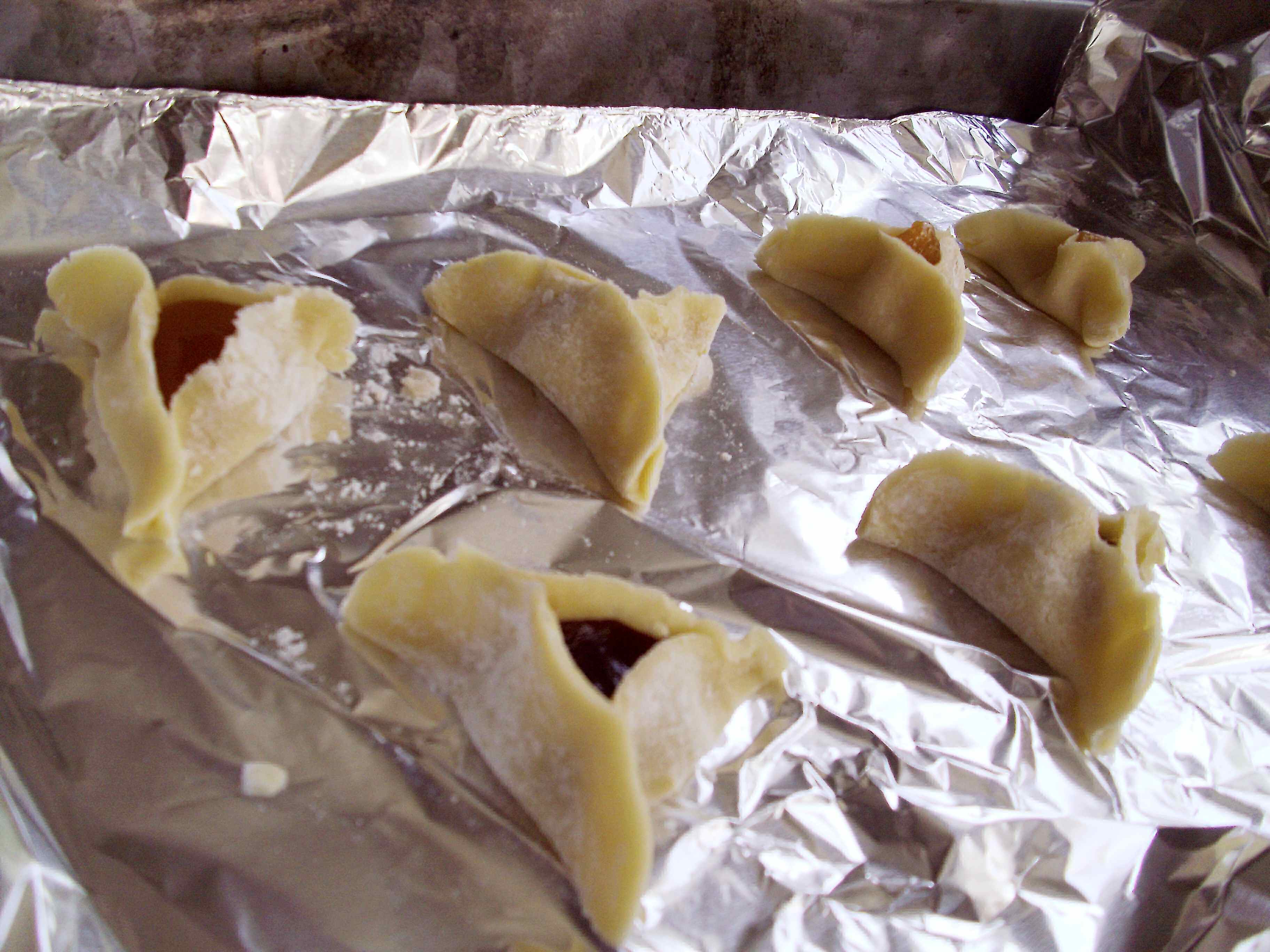
Still. In the last year or two I’ve mostly gone back to making standard hamantaschen based on Joan Nathan’s classic cookie-dough recipe, which I like a lot and which looks and tastes much, much better than the dry, pasty-white horrors at the annual Purim carnival.

hamantaschen1

What I like about the standard flour-based recipe, other than that it tastes and looks good and is easy to work with, is that I can roll the dough out very thin and get crisp, delicate hamantaschen that are a decent cookie size but still hold together nicely and are not extravagantly carb-laden, particularly if the fillings are reasonable and you don’t eat ten at a time (the big challenge). They’re not as low-carb as the almond meal ones, but they still work out okay–about 7 grams apiece for a 1.5-2″ cookie. They taste good even made with pareve (nondairy) margarine instead of butter.

The LA-area idea of hamantaschen usually involves M&Ms, colored sprinkles, anything completely artificial. I bet gummy sour hearts (this afternoon’s culprit) would be a huge hit too. I don’t think they’ve heard of either prune or poppyseed out here in at least a generation.

Traditional fruit or nut fillings are a much more decent bet for carb, and they taste better (and look nicer too, because I’m not 6 years old and don’t insist on rainbow colors anymore). They’re also easy to make from scratch in a microwave or on the stove top so that you can decide how much sugar to put in them. Continue reading

You must read this. Take an hour if you have to.

Today’s New York Times has an excerpt from investigative reporter Michael Moss’s forthcoming book on the processed food industry’s push to engineer addictive foods. It’s a long article, more than 12 pages, but well worth the read.

The Extraordinary Science of Addictive Junk Food – NYTimes.com.

Food news lately

Has been entertaining in the extreme but not too encouraging…

Horsemeat in British lasagne? should we be encouraged or horrified that they’re even buying and eating frozen packaged lasagne? As the scandal unfolds this month, supermarkets from Tesco’s to Sainsbury’s have been pulling frozen meat products off their shelves. Even Burger King was hit. Thriller subtitle: It Probably Came From Poland (and France, though they’ll never admit it). Trust the Irish to have discovered it first through DNA testing–they’re mad on horse racing and everything else equestrian. The British MPs are caught at an awkward moment, when some of them were just about to downgrade their national food safety agency’s regulatory and oversight powers. According to The Guardian, citizens are voting with their pocketbooks: sales at chi-chi butcher shops and vegetarian take-out places have skyrocketed.

See a lab test of calorie claims in action at the New York Times  this week. The  “Calorie Detective,” as Casey Neistat calls himself in his video, teamed up with researchers from St. Luke’s-Roosevelt Hospital Obesity Research Lab in New York. They put five items–a Grandpa’s Original packaged yogurt muffin from a bodega, a self-made burrito from Chipotle’s taco bar, a Subway turkey sub, a Starbuck’s frappuccino, and a supermarket wrapped “spicy tofu” vegan sandwich on whole wheat–in a blender (separately) and then in test tubes for the calorimeter. Which of them comes off worst? it’s a tossup between least accurate and most caloric for the class of item–both items claiming loudly how “healthy” they are–but the true worst is that these five items are what Neistat says he might typically eat in a day. ONE day.

Paying the piper too young

This winter break we traveled east to celebrate with friends who are as close as family. Our daughters hit it off immediately as they do every couple of years when we manage to get back together. But the contrast between them had become striking in only two years away: our daughter, although (or perhaps because) she’s Type I diabetic and has to pay attention to what she’s eating, is growing up basically healthy. Our friends’ daughter, a few months older, is shorter but 25 pounds heavier and her mother told me she’s spent the past year taking her to a slew of medical specialists to figure out why she’s suddenly having so much pain in her legs and feet.

This girl is wonderful and energetic, full of beans, a live wire, and smart as a whip, but she doesn’t last long on the the gym floor at school, and worse yet, she had to leave the dance floor at her own celebration just as the dj was getting started because her feet and legs started hurting so much she had to sit down within minutes. The night before, she’d taken four ibuprofens for pain in a single day–just from walking around at school and later at the hotel.

So far nobody’s found much except low vitamin D and iron. The spine guy, the neurologist, nobody’s found anything they think could be doing this. The pain clinic is apparently all too ready to dish out a laundry list of pills nobody should be taking at age 13–among them antidepressants, despite the fact that they haven’t found a cause for what is obviously physical pain, and that nobody’s actually diagnosed major clinical depression. My friend is beyond worried for her daughter and exasperated at what is looking like the classic runaround from an otherwise very highly regarded medical system.

Continue reading

Halvah update–I think I’ve got it

Just before we left for Boston (22 degree weather, anyone? anyone?–too much Ferris Bueller on the first week of school break), I revisited the Halvah Conundrum: how to make halvah that has the right texture when no one’s ever described it properly in a recipe. Last time’s attempt, which made use of a food processor, wasn’t too bad but the texture was still crumbly and tough–overworked, most likely.

Then I read a comment on another food site that recommended working the tehina/sugar syrup mixture like fudge by kneading the mixture in one direction as it cooled to get it to the right semicrystalline texture. I’d seen footage of a career fudge maker paddling the mass of chocolate and sugar syrup on a marble slab until it stiffened up, and thought the Syrian halvah manufacturing process (mechanized boxing glove in a vat of tehina and hot syrup) looked like a similar idea. So I thought kneading the mixture might strike the right balance between halvah that came out too limp and oily and the meringue-like stuff I’d produced last time–too aerated, and when pressed together, too tough and crumbly.

So  this time I skipped the food processor for blending the sugar syrup with the tehina and flavorings. I stirred the vanilla and lemon juice and powdered clove into the tehina while the syrup was cooking in the microwave. I’d forgotten to scale down the amount of lemon juice for a smaller amount of tehina–maybe this helped a bit, actually, because adding a small amount of water-based liquid to tehina stiffens it and makes it a bit doughy. Maybe that little bit of extra lemon juice helped give the mixture a start on developing the volume it needs without overworking or drying it out too much?

I stirred the hot, thickened sugar syrup into the tehina mix in thirds using a hand whisk, thinking that maybe not all of the syrup would become overworked if I did it in stages. After all the syrup was in the mixing bowl, I folded the limp oily brown mass (my heart was sinking when I saw this, but I bravely continued) back onto itself several times with a fork, essentially kneading it in the bowl, 10-20 turns, maybe half a minute worth of time, just until it turned a little lighter and stiffer, but not as stiff as meringues. I started with only a third of a pound of tehina, so for a full recipe, it would probably take a bit longer.

Then I pressed it flat into a container with a lid and stuck it in the fridge overnight. The next day I cut into it–I could cut thin slices! and it was almost like deli halvah! It’s still not quite as light and crystalline, it’s still a bit chewier, but it’s definitely closer. Next time: try the egg whites beaten in with the tehina, and then the hot syrup mixed in…

[April 20, 2014: A new question on halvah, with a few updates from me]

David S:

Debbie, I have been down a similar path in trying at times over several years to create halvah like Achva’s (my fave). But it has been textural failure after textural failure. Each time, the result is worth eating and tasty, but that elusive texture…can’t get it. So, I am thinking that the saponaria may be an important detail. The problem is, I have been unable to find it in reasonably small amounts (an ounce or two would prob. last a long time, but I see it for sale only by the 1lb container and it’s not cheap). And, if I did find some, it’s not clear how much should be used–1/4 to 1/2 tsp for a pound of halvah? If you know where I might buy small quantities, please let me know. I live in the San Fran. Bay Area, and usually about anything can be found around here, but saponaria (powder, I presume) is a tough one.

Oh–and the lemon juice: I don’t see that ingredient listed in commercial halvahs. Is it just for flavor, or is it a functional ingredient?

Achva’s ingredients for vanilla halvah: Sesame Seeds, Glucose Syrup, Sugar, Vegetable Fat (Palm), Natural Spice – Saponariae Root, Natural Identical Vanilla.

Btw, I have tried using glucose instead of regular sugar, and no luck. The Achva above is a mix of glucose and sugar. Odd that more fat is added!! It’s not as if sesame paste is a low-fat product to start with. I wonder if this is palm kernel oil, added for its solidity? I don’t recall seeing this ~10 years ago on their label.

Thanks for your detailed blog–it’s reassuring to know others are struggling with this too.

Hi David! Thanks–I’m never sure whether I fall into the “interesting experiment” category of foodieism or the “just plain weird”, but I appreciate it.

I’ve finally managed to find a YouTube video on a Turkish (I think) halvah maker who shows the saponaria root extract mixed in  with the hot syrup first–it makes a very white, thick ribbony foam like Swiss (or Italian) meringue (that’s probably why some halvah recipes I’ve seen use whipped egg whites, come to think of it) or marshmallow. Then they pour a large dollop of that mixture (in the half-gallon or 2-liter range) over a big working vat of tehina that must be 3 or 4 gallons (12-16 liters) and start folding it in with his hand–looks like a real workout for the guy doing it. He has a silicone hot glove on his mixing hand and keeps turning the work bowl as he mixes. It takes about 5-10 minutes for him to incorporate all of it gently and it starts cooling down to thick ribbons of stuff that dissolve back into the mass before the whole thing suddenly starts to look like bread dough.

That said, I’ve also seen a few recipes lately with no saponaria or egg white and that use a blender or food processor and the pictures of the resulting halvah look fine with a lot less work–as did the stuff in “Aromas of Aleppo”, so I think they either found the sweet spot on how long to boil the syrup or they were lucky and someone showed them or they don’t mind if it’s not deli-perfect in texture. Or maybe they’re lying and bought their perfect 3-inch-high slabs from a local deli. (jealous, moi?)

What else–oh. The lemon juice is for flavor, so taste and see if you like it, I suppose. I think it tastes pretty good with the ground clove and the vanilla and keeps it from being too blandly sweet. It’s not detectable as “lemony” unless you double or triple the amount, which I have done just to see if adding a little more juice to the tehina and stirring would stiffen it and give it a little more structure ahead of adding the syrup. Even then, it wasn’t bad. The palm oil is a very inexpensive fat/filler ingredient that’s gaining ground in processed food everywhere, mostly in baked goods but sometimes in spreads as well. I disapprove on principle because it dilutes the tehina flavor, plus it’s high in saturated fat, even though it’s vegetarian. One reason (other than simple interest in playing with my food…) why I wanted to try making it from scratch.

DebbieN

[December 9, 2013: This question came in too late to post as a comment to this page, but I thought it was worth adding here–DebbieN]

On 2013/11/27
Elena

Hi, Debbie!
I want to try a home-made halva too. and I have all ingredients ( include soapwort), but I would prefer to create some sugar-reduce variation. What do you think – is it possible to reduce quantity of sugar syrup in your recipe?

On 2013/12/9

Hi Elena,
I don’t know–I don’t have instructions for a version with soapwort (I’m impressed that you can get it where you are). I’m still struggling to get the texture of my halvah right even this much later, and I still haven’t tried a version with whipped egg whites folded into the tehina before adding the syrup. Without egg whites or soapwort, just sugar syrup and tehina and flavorings, I wouldn’t try substituting for all the sugar–something tells me you need some sugar there to create the microcrystalline structure. But on the other hand, the Israeli brand Achva does make an artificially sweetened version that sells in our local Armenian grocery alongside their regular halvah, the standard cans of Joyva, and the (to my palate) slightly-too-sweet Cortas and Ziyadi (I think?). So theoretically it’s possible to go lower-sugar.

One way would be just cutting down on the sugar proportion and perhaps cooking the syrup to a slightly higher stage (ie a little beyond soft ball)–though it might seize up when you stir it into the tehina, unless you heated the tehina somewhat before mixing. Some recipes do call for heating the tehina to 120 F, which might keep the hot syrup from “shocking” and seizing up hard. Or else you might cut down a little on sugar syrup for the amount of tehina and add artificial sweetener to the tehina mixture before stirring in the syrup.

With soapwort, you might get more structure with less sugar syrup, so you could probably add artificial sweetener more effectively, but I don’t have a recipe for it and don’t know how to work with it. If it’s not too expensive and you’re willing to risk it or you’ve made halvah successfully before, try reducing the sugar syrup by 1/3 and adding sweetener to the tehina, keeping everything else the same. I would do this for a sample recipe amount, maybe just half a cup of tehina and proportional sugar syrup. Don’t risk a whole pound of tehina and 2 cups of sugar!

One thing I have discovered (yesterday, in fact) is that if the halvah comes out too soft and sticky, like limp caramels, you can put it in a microwaveable bowl, microwave it a minute or two until it just foams up and turns a lighter creamier color, and then beat air into it a few times with a fork until it just begins to stiffen like mashed potatoes. Unfortunately mine seized up and turned to sandy crumbs just after that point, but it still came out closer to right once I packed it together and let it cool.

Best of luck–DebbieN

Rugelach and the Chanukah Fairy

Doesn’t that sound like the perfect title for an equal-opportunity holiday-themed kiddie book? Too bad my daughter’s too old for it now, and so are my nephews. Plus no one under 30 knows how to pronounce rugelach anymore. The “ch” always makes for Adam Sandler jokes because it’s so obviously Hard to Pronounce and even more obviously Not English–you use your throat to talk? Gross joke alert! The young and self-conscious have even taken to respelling Chanukah Hanukkah, just to avoid getting laughed at by their friends. Or their parents.

You may be asking what on earth rugelach have to do with Chanukah–and I’m a little late discoursing about Chanukah this week, since it just ended. However, let me warn you, they’re entirely relevant to the holiday treats vs. self-control dilemma.

Rugelach rolls slashed, baked and ready to be cut apart

Forming long rolls, slashing them partway before baking and then slicing them after is a quicker and easier way to form rugelach, especially with a very soft, delicate and hard-to-handle dough. It also lets the dough bake into crisp layers without letting the jam leak out. These two rolls are half the batch.

Fresh cheese (cream cheese, farmer’s or pot cheese) and sour cream are symbolic of Chanukah just as much as frying latkes or sufganiyot (doughnuts) in olive oil. During the war with the Assyrian Greeks in ca. 165 BCE that led to the rededication of the Temple (the event that sparked Chanukah), a Jewish woman named Judith invited the Assyrian Greek general Holofernes into her tent for what he thought was dinner and a movie–and she served him rich cheesecake (sometimes the story says “cheese pancakes”–maybe blintzes? who knows) to make him thirsty and then offered him a lot of undiluted wine. After that, the tryptophan got to him as she’d hoped (they didn’t have turkey back then) and he fell asleep. She chopped off his head (possibly to save the Jews, probably to stop the snoring) and Famous Western Painters from Rubens to Klimt have been painting her portrait ever since.

Puts another spin on the supposed tameness of homestyle baking, don’t it? Also serves as a warning on the more-is-more approach to pigging out. But old-style rugelach are designed to prevent both tameness and pigging out.

Now rugelach–the real thing–are what Pop Tarts never aspired to be (see Jerry Seinfeld’s Pop Tart joke in development at the New York Times online). That is, rugelach are self-limiting (an anti-commercial value) not because there are only two in the package but because they are serious pastry and taste like it.

The real thing is rich and flavorful enough that a few bites, one or two rugelach, are plenty even though they’re small. And before you ask why, it’s the use of cream cheese in the dough; the  tang makes the flavor seem a lot richer with a little less fat than an all-butter pastry dough. And it makes the dietary badness self-limiting: you really know when you’ve had enough.

One or two–delightful, blissful, they don’t do it like this anymore, it’s really Old School, my grandmother used to make these, how do you get them so flaky? Three–these are delicious, these are so evil, you’ve got to try the chocolate apricot one, I’ve already had so many! Four–klunk, groan (head hits knees in queasy stupor). It never fails.

Despite the Americanization and factory production of rugelach (even Starbucks sells a tame untangy version of them occasionally, or they used to), rugelach are a Jewish bakery specialty with a very simple dough that gives unbelievably rich, flaky, almost strudel-like results if you do it right. And luckily for me, it’s easy to do right. But it’s still too dangerous to do often.

And yet I’ve found myself making several batches this “holiday season”–one for my daughter’s piano recital, using the classic (and palming off the leftovers on the hosts so I wouldn’t have them at home), one for an experimental “lite” version that almost, but not quite, worked. It had flake, it lacked character. Sort of like the bland Americanized versions. What can I tell you? The lack of tang can’t be made up with salt and sugar–the tang is really what does it, which is why I went back to the classic and won’t revisit it again until next year.

…Although a woman in my congregation says she has a recipe that uses cottage cheese instead of cream cheese and is really good, I am choosing not to believe her.

Note on the dietary badness factor: If you go with either of these doughs and the fillings as directed in the recipe (i.e., you don’t double the sugar or use very sugary jam), a single rugelach comes out with about 6 grams total fat and 6 grams carbohydrate, about 65 calories, and about 20 mg. sodium. The degree of saturated fat depends on which recipe you use.

Classic Rugelach Dough (makes 44-48)

The classic recipe for the dough is:

  • 2 sticks (8 oz., 1/2 lb.) unsalted butter
  • an 8 oz package cream cheese
  • 2 c. flour

So basically equal and large amounts of butter and cream cheese. Soften them both and beat them together (a food processor is fine). Put the blended fats in a big mixing bowl and fold in the flour very gently with a wooden spoon, a couple of forks or the like, and don’t mix too thoroughly,  just barely enough for everything to come together as a very soft crumbly dough you can press into a ball. Put the dough in a plastic bag and pat it into a disk, divide it into four parts with a knife, and chill in the fridge or freezer about an hour until it’s firm enough to roll out. Easy, right?

Some people decorate the basic recipe with extra salt or sugar or, G-d help us, vanilla (Gale Gand puts in all three, why I don’t know). But really, the basic is the best. It gives you a nonsweet, very savory base for a sweet filling, and it’s anything but boring. It does NOT need jazzing up any more than French or Danish puff pastry does. And it builds character to make a pastry that doesn’t bow to middle-American excess. We have plenty of our own excess, thank you very much.

But cream cheese AND butter. A pound of fats for only two cups of flour, and almost all of it’s saturated. Yikes.

So I got to thinking (it had to happen sometime last week). Could I make the dough a little less rich and still great? Subbing in a reduced-fat labaneh from Karoun Dairies for the cream cheese? Maybe–but there’d be some water in it. Might not flake right. Hmm. Try it anyway, report back. Continue reading

More “breathable foods” weirdness

A couple of days ago, Entertainment Tonight posted a new video tidbit on “breathable” food  from the same Harvard professor, David Edwards, who invented the AeroShot “breathable caffeine” cartridge that has drawn some serious FDA attention of the negative sort.

ET’s anchor breathlessly posed the  question, could this become The Next New Diet Fad in Southern California, when what the LeWhaf vaporizer was invented for was the “aesthetic experience” of breathing food flavors. This according to Edwards, whose Paris-based design lab, Le Laboratoire (names aren’t really his thing?) offers a number of vaporized cocktails at a small sit-down bar.

When I wrote about the first set of inventions, I said I thought it might be an interesting molecular gastronomy-style taste experiment (at least if the flavors were something more sophisticated than “lime,” the flavoring in the AeroShot cartridge), depending on what was being used to create and propel the vapor.

The ET video presents an interview with a young up-and-coming chef who’s offering cocktails of various kinds served in the Le Whaf vaporizers–to be inhaled through a special straw. The accompanying visual looks, frankly, like someone about to use a bong or snort a line of coke, but that could just be the way ET’s camera crew are used to shooting bar scenes…

The chef they interviewed doesn’t serve these vaporized cocktails, not all of which are standard drinks in the daily repertoire (some of them look like beef broth) as a low-cal diet offering but rather as a sideline to enhance some other dish. Very molecular gastronomy. Still he concedes, when pushed, that he can’t see how it would have calories.

(From his doubtful expression, they must have edited out the part where the Barbie Doll reporter shoved a mike in his face repeatedly and insisted with desperation that the vapor must make it calorie-free, it just MUST. She’s the one who tried the AeroShot caffeine spritzer on-camera in the studio to demonstrate the concept, and quickly uttered the dutiful “Mmmm”,  but the video jumped at that point, so I wonder if she really sampled it or not. At least she didn’t start coughing…unless they cut that part too…)

And yet I wonder if ET hasn’t hit on something here–no, not the diet fad. One can’t live on pâté-flavored air alone. One must also vaporize some champagne to go with it, preferably Krug. Could possibly clog the nozzles otherwise.

No. In the frenzy to discover the new French technology that magically removes all calories, ET seems to have let the chef describe the mechanism at the bottom of the vaporizer. Here you are, at a cocktail bar, leaning over the open mouth of a carafe, straw in mouth, ready to inhale cocktail-flavored vapor…produced, about 12 inches from your face, by three ultrasound probes at the bottom of the carafe. Continue reading

Frankenbeanies: Gigantes, take II

Giant favas or gigantes are really as big as they look

Giant favas or gigantes really are as big as they look.

No kidding. That’s a soup spoon on the right, up there in the photo. These giant fava beans are huge–which is part of the fun of cooking them.

Because I had so much trouble getting the nice-looking pre-peeled dried giant favas to cook last week (and the time before), I went and got the bulk giant favas with the brownish-greenish-pinkish peels left on this time. And I was right. Buying the ones with the peels still on means that the dried beans stay relatively fresh and cook up a lot better–and faster–than the pre-peeled ones.

To peel them, dump the washed and sorted beans into a big bowl of very hot-to-boiling water and let them sit about an hour. The peels will start to wrinkle around the edges and turn leathery-soft. A sharp little paring knife makes it easy to crack into them and pop them off. Then soak them overnight in cold water. (Or soak the beans first and then take the peels off. Whatever’s easier.)

These beans were clearly fresher than the pre-peeled ones–in the morning, the bean water smelled almost like fresh apple juice. Bizarre. Anyway.

Rinse and cover with fresh cold water. And then you can actually microwave them 10 minutes (for a pound of peeled gigantes in a bowl with water to cover by about an inch and a lid on top) and let sit half an hour and they’ll be about halfway there, then nuke again for 5-7 minutes once or maybe twice, with 20 minutes in between. Or you could simmer them on the stove about an hour.

Or of course you could buy them in cans, but where’s the fun in that?

Giant favas

Fresh fava beans are the province of spring. Dried ones–the ultra-large size favas–are pale gigantic beans with a flavor like roast chestnuts, only without the sweet. These are the ones for Greek-style winter stews (gigantes plaki) or, as a friend in Jerusalem makes on cold and rainy December weekends, a very slow-braised stew of giant favas with chicken and vegetables.

Here in Pasadena it’s still hovering in the 90s midday, long after Yom Kippur has come and gone. So there’s no incentive to cook anything for more than 15 minutes at a time if you can possibly help it. And gigantes or giant favas (I’m not absolutely sure they’re the same bean, so for reference–what I’m using are the peeled giant favas, about an inch across) take a very long time to cook through to tenderness, even after soaking overnight.  The challenge, actually, is to cook them enough without having them fall apart like overcooked potatoes. Oven-baking or crockpotting would probably work, but it’s hours of time.

So most of the dried-fava recipes I can find are for favas that have crumbled and been puréed for soup or hummus or paté. But the stewed favas–that’s what I wanted. Only I wanted them on their own, meatless, tomato-less, pure, as it were, because I had an idea of marinating them a little for a side dish and serving them room-temperature. Something like marinated artichoke hearts, but subtler.

There are few “slow food fast” shortcuts for this, unless a pressure cooker would work well enough without blasting them to bits. I might have to get one and try it–when everyone’s out of the house, just in case my purple thumb tendencies kick in.

You still need to soak them very thoroughly overnight, a minimum of 12 hours and maybe better, 24 hours (in the fridge) before starting to cook them, because at least two batches of Sadaf peeled giant favas have shown a distinct reluctance to take up water the way most reasonably fresh dried beans do, even though a lot of the beans were split in half. Were these two bags of favas just incredibly old and dried out? Are giant favas just naturally tough? I don’t know.  I don’t know. Maybe I have to go with the bags of unpeeled favas instead?–maybe those dry out a little less inside and cook up more tender once you get the peels off (after cold-soaking and before boiling). One can only hope.

And substituting giant lima beans that a lot of Greek cookbooks recommend as a substitute in plaki would obviously give more tender results, plus they don’t require laborious peeling, but the flavor would be pretty different. The giant favas are what I want, and no other.

Nevertheless–once the favas were soaked as best possible and rinsed again, I cooked them partially by microwaving 10 minutes in water to cover by an inch and letting them sit. I didn’t want to do it a second round, as I would for chickpeas, because they had the kind of tough obstinacy that reminded me that microwaving can actually make some cooked beans tougher–black beans in particular. At least the raw bean taste was gone, but they still required 2 hours of simmering gently and partially covered on the stovetop, to become something approaching tender. Frustrating.

Some of them broke up. I think it’s practically inevitable. But some of them were huge and very impressive. Once they were as done as they were going to be, I drained them most of the way.

The marinade I use for microwaved artichoke hearts is just lemon juice, garlic, salt and olive oil–the artichoke hearts donate enough juice as they cook to mellow out everything else a little. Favas–no. Plus I wanted something richer and less strident for the flavoring.

So I pulled a bottle of cheap but dry rosé (for want of chardonnay or the like, and rejecting the ever-present reds so as not to stain the beans) out of the fridge and poured some of it into a frying pan to boil off a little of the alcohol and pick up some of the other marinade flavors: a fat clove of garlic, the juice of a lemon, olive oil and a couple of sprigs of rosemary off the bush I’ve managed not to kill this year. I let this simmer together a few minutes to take the edge off the raw garlic and wine flavors and steep the rosemary a little, and then poured in the boiled-up fava beans and just a little of their broth to simmer a few more minutes before pouring the whole thing out to cool.

A little more olive oil would have been good if I’d had it (the bottle ran out after about a tablespoon)–I was actually hoping it would help soften the beans further but I didn’t really have enough for oil-stewing (the Greek cookbooks I have all recommend about half a cup in a batch of about a pound of dried beans) and I’d have had to stew the thing a lot longer to get anything resembling a silky texture, I suspect. But the flavors permeated the beans very nicely–rosemary has an irreplaceable perfume that even wild thyme doesn’t reach even though that would be pretty good too. Together, the rosemary and wine balance the surface brashness of garlic and lemon and bring out the unusual flavor of the giant favas without the need for salt. It’s good hot, but it’s even better the second day, hot or cooled.