• Enter your email address to subscribe to this blog and receive notifications of new posts by email.

    Join 241 other subscribers
  • Noshing on

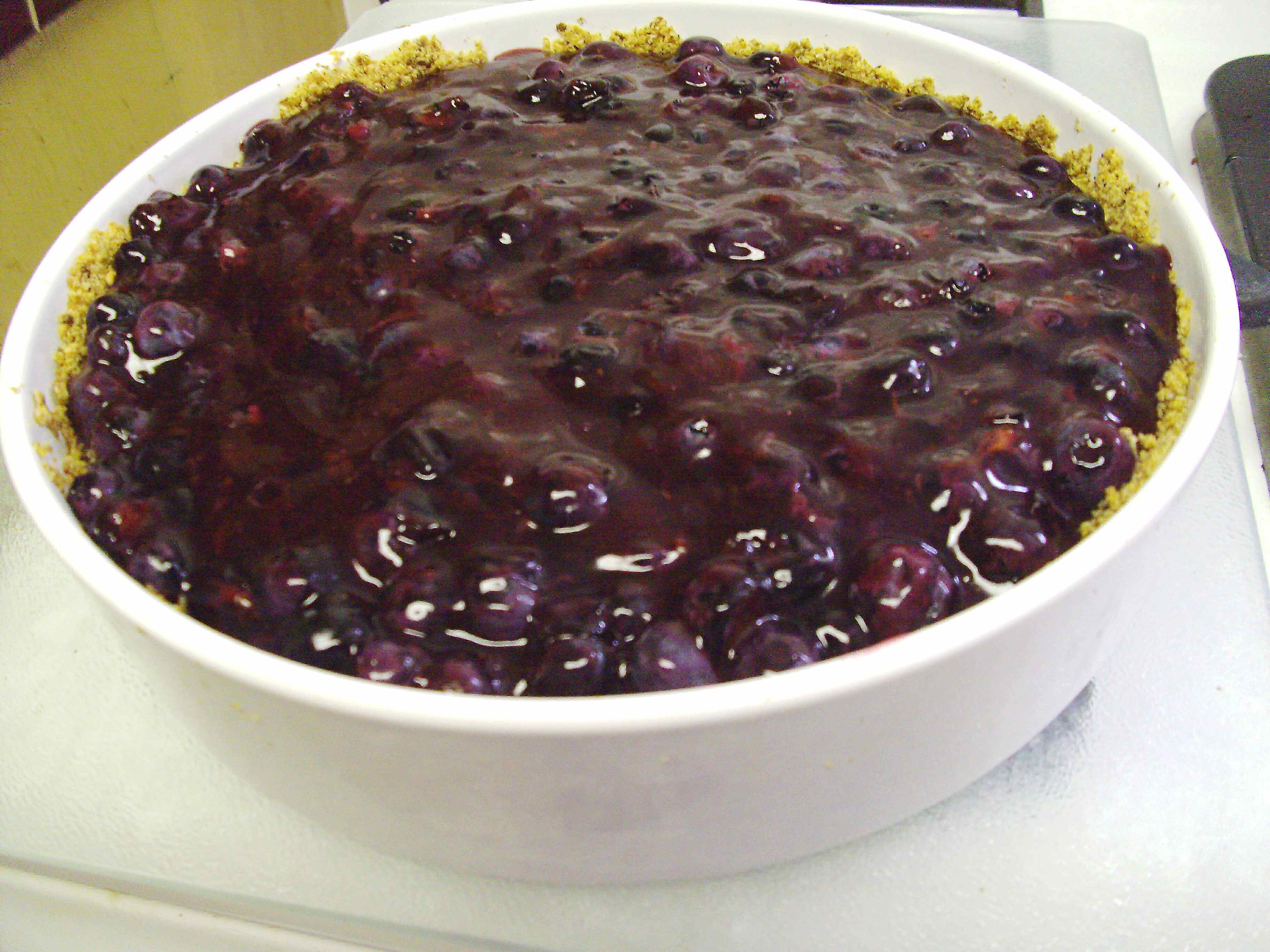
    raw blueberry pie with microwaveable filling and graham cracker crust

    This mostly-raw blueberry pie is a snap to make and very versatile--the filling microwaves in a few minutes, and you don't even have to bake the zippy gingered graham cracker crust--perfect for a hot Fourth of July and all summer long.

  • Recent Posts

  • Contents

  • Archives

  • Now Reading

  • See also my Book Reviews

  • Copyright 2008-2024Slow Food Fast. All writing and images on this blog unless otherwise attributed or set in quotes are the sole property of Slow Food Fast. Please contact DebbieN via the comments form for permissions before reprinting or reproducing any of the material on this blog.

  • ADS AND AFFILIATE LINKS

  • I may post affiliate links to books and movies that I personally review and recommend. Currently I favor Alibris and Vroman's, our terrific and venerable (now past the century mark!) independent bookstore in Pasadena. Or go to your local library--and make sure to support them with actual donations, not just overdue fines (ahem!), because your state probably has cut their budget and hours. Again.

  • In keeping with the disclaimer below, I DO NOT endorse, profit from, or recommend any medications, health treatments, commercial diet plans, supplements or any other such products.

  • DISCLAIMER

  • SlowFoodFast sometimes addresses general public health topics related to nutrition, heart disease, blood pressure, and diabetes. Because this is a blog with a personal point of view, my health and food politics entries often include my opinions on the trends I see, and I try to be as blatant as possible about that. None of these articles should be construed as specific medical advice for an individual case. I do try to keep to findings from well-vetted research sources and large, well-controlled studies, and I try not to sensationalize the science (though if they actually come up with a real cure for Type I diabetes in the next couple of years, I'm gonna be dancing in the streets with a hat that would put Carmen Miranda to shame. Consider yourself warned).

Fifty, or “Sugar Shock, Part II”

I’m back, though a little bummed out. I didn’t post anything at all in September. There’s a reason for that. No, it’s not because I turned 50 last month (which I did). No, it’s not because I rebelled and declared against cooking anything ever again (which I almost wish I had, even though most of what I cooked was pretty good).

It’s because my routine physical showed up with a higher-than-normal-for-nondiabetics A1c even though my fasting blood glucose was under 100. The A1c measures the fraction of hemoglobins (the red blood cell proteins that include iron atoms and transport oxygen) with glucose molecules stuck to them. There’s always some level of glycosylated protein in the bloodstream, but above a certain threshold it means your average blood glucose for the previous 3 months or so has been over 100.  Not a good thing at 50. And when I borrowed my daughter’s old glucose meter and tested myself before breakfast a couple of days in a row, I saw why my A1c had been up–my fasting glucose was now hovering about 105, 110, even though it didn’t happen to be up on the day I tested at the lab.

Don’t that just figure, I thought. Happy birthday to me.

So I’ve been pretty PO’d and somewhat panicked. I do NOT want to become a full-blown diabetic. One in the family is more than plenty, thanks. Even though all the finest news outlets announced today that Tom Hanks is now diabetic. Not a huge comfort.

I think of myself as eating a generally healthy diet. I know full well how to count carbs, having had to for the past 4 years. My blood pressure’s good. I walk nearly every day. I know how to balance a meal.

But the Type II diabetes prevention and management advice I can find in the popular diabetes magazines and cookbooks (and online sites), even the ones endorsed by the American Diabetes Association, always seems to be ludicrously lax and useless compared with what we already have to do at home.

I’ve spent the past month reading up and seeing why the popular diabetes cookbooks and magazine recipe sections seem so useless–or even deceptive. Next post, coming up this week. You won’t believe what I found in most of them (other than all the pharmaceutical and sweetener ads, of course).

But for now, back to basics. Can I do the simple common-sense stuff they tell you (without actual instructions) at the doctor’s office to back away from diabetes risk?

Marion Nestle has pointed out that in large studies, the factors with the highest Continue reading

The Carmen Maura special

(The gazpacho edition)
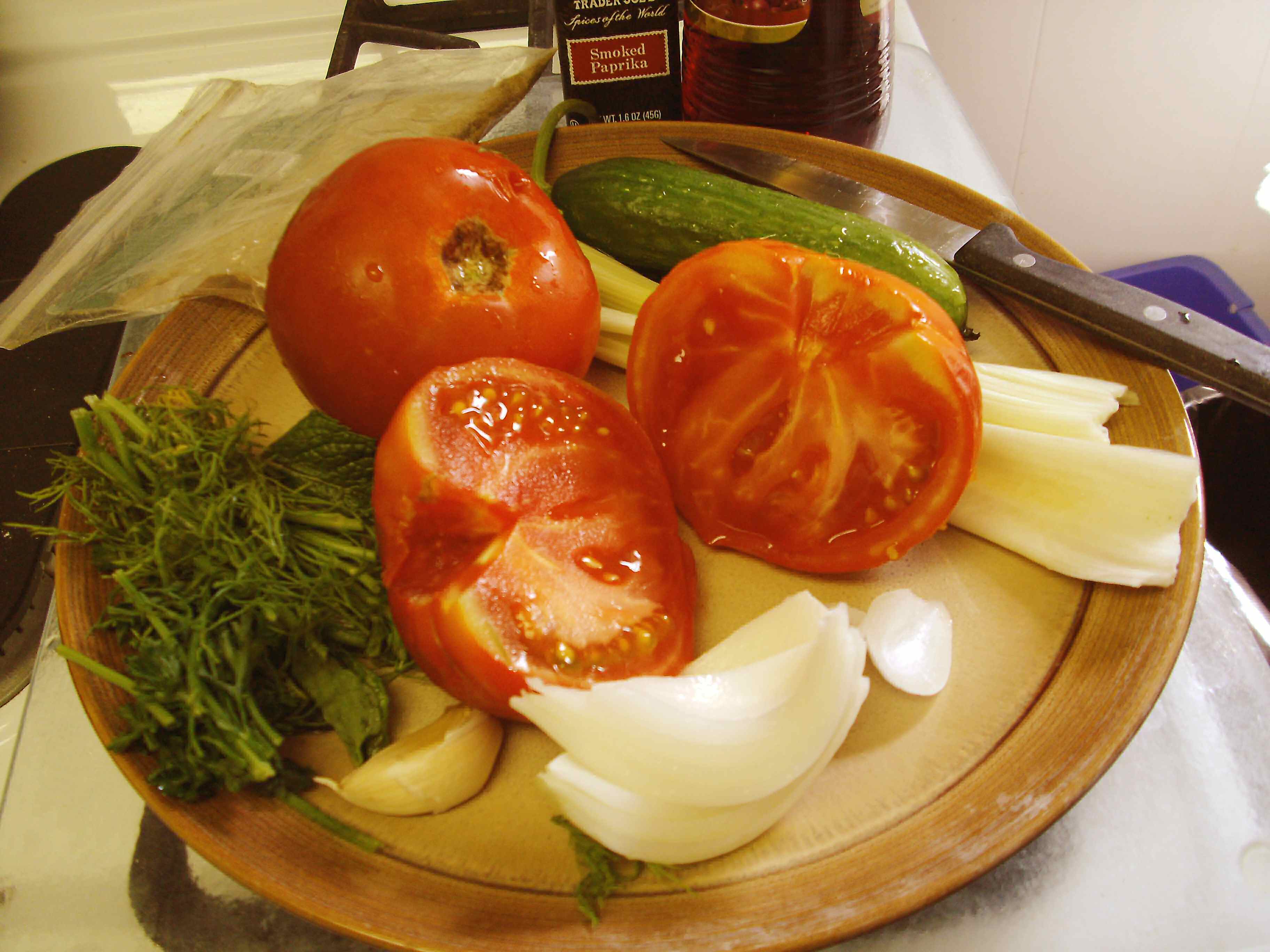
gazpachoingredients

My gazpacho has some extra ingredients like herbs and chile flakes–but nothing from the medicine cabinet!

So okay, five or six posts in a row–all summer long, in fact–with no recipes. Oy. I’m sure that says something about my summer between my daughter’s bat mitzvah in late June and the day she started back to school.

Contrary to the impression of no cooking, no cooking, especially in 100 degree heat (a sane approach to life if ever there were one) I have actually done some cooking, just not a lot of new dishes. So this post is just to catch up in summary form…

The bat mitzvah Saturday night dance party for instance–I made the cake for it, a huge monster of a Sacher torte. And yes, it was Duncan Hines devil’s food cake made with applesauce instead of oil for the layers, because it’s still better than from scratch, and a lot faster. None of my friends cook at all, I’m sorry to discover, and they were all bizarrely impressed that I didn’t get my cake from Costco, so despite how dismayed and embarrassed I was that they were fawning over a box mix cake, I took it as graciously as I could and didn’t tell them. It was actually a good cake, but huge. Four, count ’em four, boxes worth of DH for a very large 4-layer cake. Way too much. Apricot fruit spread between layers, killer chocolate ganache–from scratch, but easy–on top (another post will be dedicated to the shocking true story of ganache and its many creative uses, but it’ll have to wait until it cools down out here), plus a little creative decorating with strawberries and grapes by two friends when the upper layer split on the way to the forum, right before I could frost it, and I didn’t have the brains to just flip the whole thing over.

You know how that goes: you’ve rushed over to get there before the guests arrive, you’re wearing your grubbiest can-get-chocolate-frosting-on-and-no-one-notices black teeshirt and brown pants, you’ve forgotten your party clothes and your camera. Your friends see you looking harried and sweaty in the back kitchen, wielding a tub of ganache at a cracked cake and the chocolate fumes just get to them. They rush around sticking fruit on top like it’s kindergarten craft time again. They’re hard to stop once they get going, to tell you the truth. People really liked the cake anyway, and we had leftovers for the next 10 DAYS…still working it off.

TIP: don’t stick green grapes on top of chocolate ganache, they really don’t go all that well tastewise even if they looked fun at the time.

What else in the way of summer cooking? A bowl of dough in the fridge, turned into pitas and calzones (once the sun went down far enough that I could stand to turn the oven on for 20 minutes at a hop). Did that several times.

Frittatas–omelets for the three of us with mushrooms, onions, marinated artichoke hearts and feta, or spinach and feta, or just feta and feta…a lot of those, this summer, with about half the yolks removed and not missed at all. Makes a 10-minute supper, and you get your Julia Child mojo on when you go to flip it. You get to tell everybody to give you some room and keep the cat out of egg flippin’ range. Very impressive.

What else? Hummus–yet again, I know. Although I’ve made two batches this summer using chickpea flour instead of actual cooked chickpeas. Chickpea flour is raw, so you have to mix it up with water to a thick batter and then microwave it a couple of minutes, until it’s cooked through–it’ll be pretty thick, maybe even solid, but it’ll have lost the raw-bean taste when it’s done. Then I blended it in a food processor with water, garlic, lemon juice, cumin and tehina–which was fine, actually, and very smooth…until I packed it into the fridge and took it out the next day. It had set up like tofu, sliceable and slightly gelatinous! A little weird, no doubt about it. But still edible! and quick, dammit, very quick.

Other things–eggplant parmigiana, twice or three times, and really good. No apologies necessary.

Extra eggplant slices with a surprisingly good low-sodium chipotle salsa from Trader Joe’s and some low-fat mozzarella, microwaved and slid onto toasted ciabatta or fingerbread. Worth doing again, maybe even in casserole form–half salsa, half marinara, kind of a smoky parmigiana? Could be all right.

But it’s summer, you say. Where is all the fruit? You’re not wrong. Nectarines, plums of all shapes and colors, a few apricots, a few cherries, strawberries, and figs…all of them, eaten raw. But in the way of cooking (minimally, anyhow) I made a fantastic “raw blueberry pie” a week ago, cutting back a little on the sugar in the recipe I had from the San Jose Mercury News from years back, and using the microwave to cook the “jam” part (water, potato or cornstarch, sugar, 1 cup of blueberries, stirring madly every 30 seconds to avoid the starch turning into a rubber lump, and lime juice after the fact, once it thickened) before mixing in the other 3-4 cups of blueberries raw and sticking the whole thing in a graham cracker crust and chilling it.

But summer is mostly about tomatoes. Even in California, it is really, really HARD to get good tomatoes at the supermarkets, even in summertime (don’t even ask about corn, the prices are a disgrace to the nation). Unless you go to the Armenian corner grocery (where I’m headed yet again in about 5 minutes) to pick up bags and bags of huge, ripe Fresno tomatoes for salads. For about six or seven dollars, I can get ten or even more large beefsteak-style tomatoes…and these actually taste like something. They’re not the ones that go to the supermarket, because they just don’t last. They go to the small ethnic markets because they’re too ripe, and everyone knows that the regulars don’t shop small when it comes to tomatoes, peppers, eggplant and so on. They’ll get snatched up, no problem.

So what do you do when you get a couple of tomatoes that were pretty seriously ripe to begin with and are starting to split or get poked by the stems of the other tomatoes only a couple of days later?

I make gazpacho, because it’s a 5-second soup, it’s cold, it only takes what I have in the fridge, and I know I can eat half a cup at lunch every day this coming week and feel full for hours, especially in this heat. It’s the perfect diet food.

Well that, plus the fact that it makes me feel (momentarily, anyhow) like Carmen Maura in Women on the Verge of a Nervous Breakdown. It’s probably the most famous (mis-)use of gazpacho at the movies, and very funny. Continue reading

Beating sugar shock

A new dietary sugar intake study from the University of Utah shows what happens when mice eat the kind of diet many Americans now eat:  25% of total calories in added sugars and high-fructose corn syrup (HFCS). The results were chilling: females died at twice the rate of controls, while males lost fertility and territorial instinct. And as the researchers pointed out when the corn and sugar associations tried to downplay the significance and shuffle blame, city mice tend to eat what humans near them eat. Yeah.

So of course, as the mother of a diabetic kid with a known and prominent sweet tooth (that goes for both of us, but we also love vegetables, or we’d never survive), I have to ask, how do you keep your added sugar calories under maybe 13% instead of 25%?

I don’t have a simple answer to this, particularly as I’ve discovered that most of my friends don’t cook anymore, if they ever did. Most of them think making soup means opening a can and dinner means ordering pizza. Snack, and occasionally breakfast too, is a power bar (shudder). All vegetables are precut, and many die in the fridge of sad neglect. They have good intentions; Whole Foods rubs its hands with glee when they see them wander in.

And although they’re smart, they have a very hard time wrapping their heads around the differences between added sugar, “naturally”-sourced or “unprocessed” brown sugar, sugars naturally present in whole unprocessed foods…agave syrup, power bars, “sugar-free” cookies…blah blah blah…all the gimmicks, in other words.

They don’t really understand the noncommercial measure that counts most for actual diabetics: total grams of carbohydrate in the current meal. Because that’s what you have to calculate and dose insulin for. Not just the sugars.

But even then, you don’t calculate for the whole day’s eating and just give one big dose based on a guess of what you might eat later. You calculate meal by meal and give a dose of short-acting insulin for that meal.

Calculating added sugar calories against total calories in a day is really difficult when you’re the mouse, so to speak. That’s the way nutrition researchers think about measuring the effects of your diet. It’s not the way people think as they’re getting ready to eat.

Especially if you’re eating out or you don’t have every food label right in front of you or you don’t walk around every minute with a meticulous food diary.  It’s like doing taxes when all you want to do is choose and eat a decent lunch.

WHAT DOES WORK?

I’d say, thinking like a diabetic. Or rather, in this case, like a diabetic’s mom.

  • First, definitely go meal-by-meal. Be sane.
  • Second, in any given meal–or snack–estimate the sugar grams as a fraction of the total carb grams, not the total calories, which can come from fat as well as carb. Too confusing.
  • Third, just count all the sweet stuff together. The whole idea of comparing added sugar vs. total consumed sugar is a pain in the tush to figure out. Once it’s in your system, it’s all sugar, and popular New Age-y fantasies about agave syrup and Hawaiian brown sugar and palm sugar being “natural” and “healthier” tend to fog things even worse.
  • Count fresh fruit, plain milk and yogurt-these are also in the form of sugar, not starch–and just figure that fresh fruit, milk and yogurt are the best choices (duh) per serving because they’re less concentrated in sugars than candy, pies, cakes, cookies, snack bars, power bars and …. syrup.
  • And then really look at the nutrition labels for anything packaged or processed. Including vegetables. If nothing else, it’ll be obvious why I rant against carrot juice instead of whole carrots, for example…

The first step for any of this, though is to know how much carb you’re actually eating.

Step 0. Know thou thy carbs. Continue reading

What’s my beef with burgers?

As usual, I’m slightly behind the times on all the really exciting and futuristic food news. But a conversation I had yesterday with an older volunteer at my local library brought back the article and my (as usual) sarcastic thoughts on the way forward in American food culture. The man I talked to grew up in Arcadia, about 10 minutes southeast of Pasadena, back in the 1950s when it was still mostly farmland, and he rode a horse to school–and was often sent home with it early because it started fertilizing the school grounds at a copious rate. Nowadays, they’d have to pay good money for the stuff.

This gentleman, about my mother’s age, was talking about the younger generation, his grandkids, and while he admired how adept they seem to be with sophisticated technology, he shook his head at the fact that his grandson was the only kid last year in his kindergarten class who had any idea where tomatoes come from, because his family was the only one that had a garden or (perhaps) ate vegetables that didn’t miraculously appear, wan, grainy orangeish slices, mixed with pickle slices, on top of a hamburger in foil paper. “It’s all burgers now,” the man shook his head. “That’s all anyone seems to eat anymore–hamburgers and hotdogs. That’s not food.”

It was exactly what I’d been thinking all summer long, looking at the magazine covers and newspaper food sections. Which is why I view the biggest food story of the year a little differently than most biochem-trained enthusiasts….

Two weeks ago, an Austrian nutritionist, an American journalist, and a cell biologist in the Netherlands shared the first public taste  of a hamburger made from beef tissue cultured in laboratory from cattle stem cells.

Ordinarily we’d all be running around in circles throwing our hands up in the air and, depending on our political bent, either chanting “This is the Age of Aquarius” or else screaming “Soylent Green is People!” Or possibly “It’s Alive! It’s Alive!” (quickly followed with a heavy-booted reprise of “Puttin’ on the Ritz”).  I mean, it’s a big deal. Right? It is.

Yeah. Well. So, what is it, really, this synthetic stem cell-derived miracle burger? Synthetic beef, lab-cultured in (yes) flasks of nutrient sera as the starting stem cells differentiate into beef-style shoulder muscle (read, brisket?) cells and some fat cells.  The animal rights people are thrilled and dreaming of scaleup that could eliminate the need for stockyard cruelties, the vegetarians say they’d be first in line to try it, and…apparently no one yet has asked what exactly is in the nutrient serum to grow the little strings of muscle tissue.

Is it a vegetarian-sourced solution of amino acids and so on or does it (as I suspect) derive from the more usual beef and other animal broth, made (inexpensively for laboratory consumption) from boiled-down hooves and skins and various meat scraps? Maybe it ain’t time to celebrate that aspect just yet.

But still, it’s a big step forward. Isn’t it?

I mean, an actual New Age synthetic beef alternative using the latest advances in cell biology. Very exciting.

Except…they’ve used all this very sophisticated technology to develop…a hamburger.

For this test, the 20,000 or so individual strands of muscle tissue they managed to harvest (after a five-year developmental process funded by by Sergey Brin, cofounder of Google, no less, and 3 months or so of growing this particular sample) were patted lovingly into shape and fluffed out to reasonable volume and held together with the help of some salt, some breadcrumbs, and some egg powder. And some beet juice for realistic coloring because the strands were a little more yellow than pink, somehow. And then the sample was cooked and eaten plain by the lab director and his two volunteers.

Who complained that it was really hard to judge the flavor of the synthesized beef without any of their favorite toppings on board. No jalapenos or cheese or pickle relish, no salt and pepper, no aged gouda, no ketchup. They both skipped the lettuce and tomato they were offered, to say nothing of the bun. And they couldn’t judge the meat on its own. Continue reading

Movie Review: Family, fermented

The New York Times has a review today of a new French film in current release, You Will Be My Son, about an egotistical master vintner in Burgundy and the son whose winemaking instincts he scorns.

I’m thrilled this is going to be in theaters in the U.S., because I saw it last June on the plane home from Montreal, in French, and it was so well acted I thought the airline must have made a mistake–you know, putting in a good movie by accident instead of Alvin and the Chipmunks, various cheap CGI-driven “futuristic thrillers”, all the stuff that went straight to DVD and that you don’t really want to pay Netflix or Blockbuster an additional 5 bucks to see.

Much along those conventional lines, and starkly in contrast to You Will Be My Son, is a wine movie I highly recommend–skipping, that is, and which I also saw on a plane back from London several years ago. Believe me when I say that if Bottle Shock was the “hidden gem” of the selection as the in-flight magazine claimed, the rest of the movies available must have been just unwatchable.

Bottle Shock was supposed to be based on Judgment of Paris, George Taber’s nonfictional account of an upset between Californian and French premium wines in a 1976 blind tasting, but came out looking more like “Daisy Duke Does Napa”. With Alan Rickman thrown in (age 57ish then, and eating KFC onscreen, incompetently) in the role of the 29-year-old wine buff who set up the competition. And the late Dennis Farina, in a pink ascot, substituting for the wine buff’s 30-year-old female business partner. And Sam Rockwell’s ’70s longhair wig was like a bad toupee gone wild.

OK, do go find a clip or so of Bottle Shock (or is it Bottle Schlock?)  for those times when you’re punchy and want something that will give you that entertaining “clawing my eyes out” sense of superiority over an unbelievably putrid movie. With big-name movie stars ™.

No, really, don’t do it. Don’t do it. See You Will Be My Son instead. Part family drama, a little bit thrillerish, twisted and fascinating without any of the American movie must-have cliches, it will keep you on the hook long after you’ve left the theater. And the actors are subtle, intelligent, individual and believable. The whole thing is gripping and so different from the current insipid-explosive American style you’ll want to go raid the library for better-made oldies like All the President’s Men and The Manchurian Candidate.

Only one sour note: Skip the New York Times review itself. In his attempt at selling the appeal, which he didn’t really need to do, the reviewer stuck in a lot of the plot details, to the point where I feel the need for a spoiler alert. You Will Be My Son doesn’t need all that–it’s solidly made and it works well from the beginning. Go see it.

Sour grapes, aging grapes

Well, we never said they were Paul Masson, but really:

According to the LA Times last week,  a large Australian winemaker is ditching $35 million worth of their Napa-produced Beringer wines that have passed their “sell-by” date but haven’t been sold and distributed yet. Apparently they’re the exception on the US market, but it’s still pretty disconcerting to think of all that table wine going to smash.

Beringer is drinkable enough but supposedly doesn’t age like better-made wines, according to the parent company. I don’t see why not, unless it isn’t really wine–is that what they’re claiming? Can’t be. So in reality, it probably has enough tannins to age at least a little if you leave it alone in a decently cool dark corner unopened for 3 or 4 years. At least the cabernets and merlots, I would think. Might show a little improvement, if given a chance.

But the company is probably looking at the bottom line–they ain’t movin’, so why should we pay storage for another 3 years, because the supermarket chains won’t buy it that they’ve become better wines deserving of a higher price? And at the million-bottle level, I can see that argument. I can. Storage is expensive. And they can claim a business loss.

For home consumers, though, I’d say it’s worth taking a chance. One of the most interesting wine-tasting experiences I’ve ever had was the opening of 20-year-old bottles of California wines a friend had inherited from her late father. He’d been one of those early nuts–an enthusiast in Northern California in the 1960s and 1970s, when local winemaking was still in its infancy and not all that well thought of. Whenever he tasted something better than screwtop, he bought a case or so, opened up one or two bottles and put the others up to age in a part of the basement that had been dug into the side of a hill. The wines were okay to start with, maybe a bit better than that, and the makers became better known and better at their craft over time. But what started out as vin ordinaire did, after 5, 10, 15 years, transmogrify into something much more graceful, sophisticated, and  interesting in a number of cases.

Those wines have no match in the supermarket selection of 2- and 3-year-old bottles. So as an ordinary down-at-the-heels consumer without a fat trust fund, you probably can’t get anything like them without aging your own. Just because the wineries insist their wines are sold ready-to-drink-now doesn’t mean they have no further potential or that aging is a thing of the past. It just means the bigger companies don’t see much profit in it. But of course the small wineries up and down California always keep a few “library wines” for their customers to try–that’s how they end up selling a $15 or $20 bottle’s older cousin for $50, $150 or even more.

What for those of us living in apartments or lacking cooled hillside cave basements of worth? I’ve always been more ready than the average cook to play with my food and eat my mistakes as long as they don’t risk rampant botulism or salmonella. So this might seem tacky or harebrained: I’m not advocating those Continue reading

Say “Celà n’est sûre[-gelée-]ment pas le cas”

Following on reports this spring that Polish (and probably other-sourced) horsemeat made it through France and into British frozen supermarket lasagne, now we get word of even more devious (and frankly depressing) culinary misdeeds in today’s Washington Post online:

French restaurants acknowledge serving factory-frozen food

A surprising number of cafés are apparently serving up microwaved meals instead of cooking them in-house. Even the éclair, which doesn’t take a lot of time to cobble together, even for an amateur like me, is no longer safe. The profit margin is too high on these items, and the savings in cooking staff are phenomenal. In a down market, what else would you expect?

But it’s a big embarrassment for a country that’s traded primarily on its gastronomic leadership for decades since WWII. No, WWI. No, wait–probably since the Napoleonic era. Or before the Revolution. Cyrano de Bergerac does a soliloquy based on cream horns and other such items, if I recall.

Well, to tell you the truth, though, I’m not sure whether I’m shocked or relieved. Judging from what my family and I were able to eat in 2006 in Paris, I’d say that in a few cases (cafés within walking distance of museum exits, chosen in part for meltdown-avoidance) frozen might even be a step up from one or two of the overpriced restaurant meals we had (a horrid, horrid “salade niçoise” featuring canned green beans comes to mind). Those few meals were, and I can be generous when I have to, mediocre in a way that would be excusable in suburban America on travel but which were much less than okay given that it was Paris.

Mostly we ate food that wasn’t (comparatively, anyhow) too expensive (we skipped the meat dishes, since we keep kosher) and couldn’t be frozen well enough to fool customers who know how to cook. So omelets cooked where we could see them, felafel served with freshly chopped red cabbage, open-faced sandwiches, breads from a bakery that smelled like yeast and flour, not like plastic bags, and so on. The frozen items tended to be ice cream, which is supposed to be frozen. But that was a year or so before the big bank crashes, the collapse of the housing bubble in America and “too big to fail” and even the Madoff scandal. And even then things weren’t quite as glam, at the moderate end, as we’d been primed for.

And on the other other hand, what does it mean that so many French restaurants have resorted to this kind of tactic, microwaving (and charging for) tuna steaks with ratatouille accompaniment, as in the article? What, other than money of course, and the effects of a deep recession that’s hit France pretty hard this past year.

What it means, in part, is that (also according to the article) flash-freezing techniques are now at a point, at least in France, where they can keep the food acceptable in quality and that the suburban factories where these dishes are put together and frozen are doing a pretty fair job, fair enough to fool even moderately experienced diners (not just tourists). And that the “restaurants”–who knows if they’ll get to keep that title now that they’ve been exposed–have figured out how to be at least marginally competent at microwaving so they don’t just ruin the food.

Better if they were cooking fresh. Or, from the perspective of an avid microwaver, better if they were using their microwaves for something more sophisticated than defrost-and-warm. Better, since so many of the younger working French no longer cook for themselves very much, if the restaurants, cafés and bistros took their role as gastronomic role-model and rallying point a little more to heart. Certainly they shouldn’t be pretending to cook from scratch and charging commensurate prices.

But I wonder–is the food they’re serving significantly better in quality than America’s mass-produced frozen meals-for-one? It might just be, since it’s a more recently introduced phenomenon in France, and it’s been designed to pass muster as though it were cooked fresh. For such a fraud to be successful, the flash-frozen food cannot be like American tv dinners. It just can’t. It might be that many of these factory-produced dishes are still a lot less processed than the miseries perpetrated by Swanson, Kraft, Stouffer’s and so on over here. So maybe we need to take another look at their techniques and demand better quality in the frozen food section here, foods that don’t have aroma of oversalted wet cardboard clinging to them once thawed.

Emergency eclairs

Note: this is not my photo–I have not been to the balcony of Notre Dame lately. I merely share their dismay. [Source: Brittanica Online, with gentle modifications for parody purposes]

You may be wondering what to do if you drop half your éclair over the balcony of the Eiffel Tower, or worse yet, Notre Dame, while pondering your options for the afternoon’s conquest…YSL first, or peut-être Dior?…ooh-la-la-oops!

AAAAAGGGGHHHH!

Screaming will not get your éclair back, though it is a good start. You need to get down to ground level and purchase another tout de suite!

No, this is not really me channeling Miss Piggy at her “Who, Moi?” finest. I don’t have the lavender satin opera-length gloves for it, for one thing. I’ve just been watching too many of the various Muppet movies with my daughter lately.

Plus, and let’s be honest about it, the one time I ever tried on a long blonde wig (for a college skit), I took one look in the mirror and fell down on the costume department floor laughing until my ribs hurt. It was 20 minutes until I could breathe again. Picture Danny deVito (his eyebrows, anyway) peering out from under that wig, hoping to stand in for La Porcette,  and you understand why Frank Oz can never, ever go on vacation.

I have not been to Paris in seven years, and when we were there (for an engineering conference, with our then-kindergartner) we did not actually eat any éclairs. We also did not shop at Pierre Hermé, nor at Hermès, nor anyplace that wasn’t either a museum, an RER or métro stop,  a café or a tchotchke booth along the Seine. Other than for food, if it cost more than 15 bucks (or 11 euros, as for example, the tiny 3-inch-long stuffed unicorn at the Musée du Moyen Age, which we paid for hastily during a shall-we-say-jetlag-inspired meltdown), it was out of the question. I actually spent two full hours–ON VACATION IN PARIS–sitting forlornly in a coin-op laundromat down the alley from our hotel, hoping I had enough change to get all the horrible perfumed detergent back out of our clothes, while my husband and daughter went to the park. Not exactly the Paris experience I’d imagined way back in my high school French class.

So what am I doing imagining that I could climb up OR down the Eiffel Tower in chic heels (instead of the more believable sneakers and backpack with the entire belongings of my family plus bandaids and extra sandwiches…), waving an éclair around with incredible nonchalance and somehow not lose it (which I’ve never actually done; I’m a fervent believer in pastry) or break an ankle (which I have actually done, wearing flats), or both, with loads of people looking on?

Who knows–daydreams like these are the kind of thing mentioning Paris does to one when one blogs about food or fashion. Practically obligatory. It’s fun to imagine a life where such trivial matters can leaven, not to say inflate, my expectations. And, of course, where I’m not the one who has to schlep all the emergency supplies up however many flights of stairs. And back down.

Let’s face it, I’m a natural pessimist and (therefore) fan of both the Muppets and Matt Groening. Tell me true, now, doesn’t the gargoyle on the right look like the original inspiration for that sad shrimpy one-horned character in Life is Hell? He’s even wearing my backpack.

Real life is hard, gritty for more serious reasons than high-heeled éclair mishaps, and it’s filled with nagging of the now-ex-7th-grader. Ahem! These are things we just have to get through because there’s no great alternative (…yet. I’m working on it, believe me.)

Eclairs, on the other hand, are not actually difficult to make. And eating them makes one feel a lot less like life is hell, particularly if one skips the high heels and eats them barefoot.

And on the other other hand, baking anything in Los Angeles, even in winter, may well make one feel that one is actually living in hell, at least while the oven’s on. And right now it’s June.

How to cope? Toaster oven? Microwave?! The eagle squawking in shock above left may not approve of my methods, but he’d find it hard to argue with the results. Especially if you’re in the mood for just a couple of éclairs Right Now, and you have ice cream on hand so you can skip the custard chilling and filling bit and go right to profiterole heaven.

The pastry for éclairs, called pâte à choux, or choux paste (shoe paste! I knew there was a connection to the sudden appearance of high heels in my daydream), takes only a couple of ingredients: flour, water, butter, sugar, eggs. Maybe a pinch of salt too, okay.

Everyone and their uncle (or aunt) who’s ever written a Frenchy kind of cookbook has a recipe for éclairs, but who do you know anymore who’s ever actually made them? Right.

But actually, they’re pretty easy to make. At least as easy as brownies from a mix, and they seem fancier. You boil the butter, sugar and salt with the water, dump in the flour and stir until it looks like stiff mashed potatoes, then take it off the heat and beat in the eggs one at a time and voilà, there you have the dough–shiny yellow stuff to pipe out or dollop out onto a greased and floured baking pan and bake at high temperature for about 30 minutes until they’re really puffed and brown and don’t collapse anymore when you let them cool.

David Lebovitz has the classic recipe on his web site — a cup each of flour and water, 6 T butter, 2 t sugar, 1/2 t salt, and 4 large eggs. Pierre Hermé of exotically-flavored-macaron fame has a richer one with more butter and 6 eggs for the same amount of flour. And I’m sure they’re wonderful. But I can’t help messing around.

First off, I want fewer than 24 éclairs–what do you do with the rest of the dough? (turns out you can pipe it and freeze it, then bake straight from frozen sometime later, or else freeze the baked shells. OK. But still.) So I cut David’s basic proportions in half. Limit the damage to the avoirdupois, I always say. Fewer situps required.

Second, the butter. I know éclairs are the ultimate Unalterable Classic French Recipe but…here starteth the messing around. Like I say, I can’t help it. Continue reading

Little Green Footballs

…and Other Lessons from the Fillo Stratum

cheese and pesto triangles

Two or three weeks ago I got a frantic email from the assistant at my daughter’s Hebrew school: could I lead a cooking session for the 8th graders for an hour that Sunday?

Teens and preteens are not my specialty–I have a friend who’s really terrific with them; she’s an 8th grade and high school teacher and would rather deal with kids than write. I’m the other way around, and my own kid’s turning 13 very soon. Very soon.

Suffice it to say, my answer probably should have been, “Who me? Are you off your nut? Cook with preteens in only an hour?”

And then I thought–but wait. Fillo. It’s inexpensive (a big plus), it’s  easy enough to fold, it’s almost (if you squint) kind of a craft.  Like origami. Make some tasty and quick fillings for it (though no nuts–schools have gotten annoyingly leary of anything with nuts. How are you supposed to teach baklava? Eh? Eh???) and let the kids go to town, a couple of sheets of fillo apiece in the synagogue kitchen. An hour should do it, and it’s a cool, sophisticated food to know how to make–very different from the standard summer camp challah with blue or green food coloring.

So…I bought a couple of packets of fillo (about $2.69 for a roll of 20-24 sheets), a couple of pounds of loose-frozen spinach, an onion, some garlic, a bottle of olive oil and another bottle of canola oil (for the sweet fillings), a packet of dried apricots, a packet of dried figs, some farmer cheese (mistake, doesn’t taste that good; stick with ricotta) and some feta. And some dill and scallions I had at home. Also a lemon or two. I left the fillo in the fridge overnight to thaw slowly the way you’re supposed to, and not the way I usually do (i.e., take the thing out of the wrapper and let it sit an hour on the counter and then wonder why it cracks when I rush to unroll it).

I made the fillings the Sunday morning in a microwaver’s frenzy of immense efficiency:

  1.  Nuke a stick of unsalted butter in a bowl, pour it into a snaplock container.
  2. Thaw the spinach on a plate–4 minutes on HIGH. Take it out.
  3. Dump the dried apricots in a bowl with water to cover and a saucer on top–3 minutes. Meanwhile, start squeezing the spinach dry, and I mean dry, in handfuls over the sink. Nothing worse than soggy spanakopita. Except maybe soggy pizza.
  4. Take the apricots out, put in the bowl of figs with the stems cut off, some water and a lid, 3 minutes for them.
  5. Blend the apricots with a little sugar and water and lemon juice to make a thick paste. Get it out of the food processor and pack it in a disposable container with a lid.
  6. Do the same thing for the figs, only no sugar necessary.
  7. Rinse out the food processor, stick the scallions, wild thyme, fresh dill and basil in and chop them fine, drop in the spinach, a fat clove of minced garlic, and the feta. Pack that too.
  8. Grab all the bags with the goods and don’t forget the oils and the butter and the fillings and the extra feta and farmer’s cheese just in case there’s time to make some cheese-only filling there and somebody wants it. …

I hustled, I got to the synagogue kitchen on time, I set up stations around a stainless steel work table–foil sheets at each place, paper bowls with a dab of melted butter and a pour of oil, plastic baggies to go over everyone’s hands instead of pastry brushes, the carefully unrolled fillo under plastic wrap. The oven–on. The fillings–ready to rock. And then I waited. And waited.

An hour really would have been enough time for that class. But none of the kids showed up for the first 20 minutes because it was also the day the photographers were herding all the classes out into the basketball court area for graduation photos. So when they finally straggled in, all eight–and surprisingly, three of them were boys–I made them wash their hands and then set them to work.

The first thing I did was hand out individual sheets of fillo and pointed out that they were nearly as thin and tearable as tissue paper. They were all surprised when they saw it. None of the kids, who’d been cooking all year and who had attended a lot of bar and bat mitzvah celebrations, had seen fillo “in the raw”.

I got them started on spanakopita triangles–also known sometimes as bulemas (Greek root found here; you’ve heard of bulimia, right? Didn’t mention that connection, of course. You would never want to get into that with a batch of preteens. Don’t get too disturbed, though. The rough translation as used in Hebrew is “appetizers” or “things to gobble”. Of course, in Israel “bulmus” is also what they call anything like the American after-Thanksgiving shoppers’ frenzy or otherwise a run on the stock market…so much for appetites gone hog wild…)

I naturally thought fillo triangles would be a cinch for the boys especially–you do it the same way you fold a paper football and try not to get caught in class. Only with a little more butter and olive oil involved, and hopefully no punting in the kitchen, because I wasn’t gonna clean it up for them when the spanakopita went flying.

Here came the second generational surprise, though: none of the kids, not even the boys, had any idea how to fold a basic paper football! They’d never done it. Paper airplane? I asked desperately.  Continue reading

What she said

I’m shocked, shocked I tell you. I’m about to admire and recommend an article by LV Anderson of Slate.com.

Against foodies: Alison Pearlman’s Smart Casual reviewed

Yes. LV Anderson, the Slate columnist/editor of “You’re Doing It Wrong” infamy, the one who so often makes unnecessary, fussy, time-consuming and sometimes even adverse recommendations for how to “fix” some fairly common and popular foods like chili or muffins. Or guacamole. I’ve disrespected quite a number of her columns over the past year or two, and so have many Slate readers.

But her review of local (LAish) professor Alison Pearlman’s new book on the shallowness of foodieism is really good. It’s thoughtful, sharp and thorough without being annoying.

Anderson has clearly been stuck in an awkward niche for a year or more; her cooking tips are not much to write home about but her book review is, so I’m doing it.