• Enter your email address to subscribe to this blog and receive notifications of new posts by email.

    Join 241 other subscribers
  • Noshing on

    raw blueberry pie with microwaveable filling and graham cracker crust

    This mostly-raw blueberry pie is a snap to make and very versatile--the filling microwaves in a few minutes, and you don't even have to bake the zippy gingered graham cracker crust--perfect for a hot Fourth of July and all summer long.

  • Recent Posts

  • Contents

  • Archives

  • Now Reading

  • See also my Book Reviews

  • Copyright 2008-2024Slow Food Fast. All writing and images on this blog unless otherwise attributed or set in quotes are the sole property of Slow Food Fast. Please contact DebbieN via the comments form for permissions before reprinting or reproducing any of the material on this blog.

  • ADS AND AFFILIATE LINKS

  • I may post affiliate links to books and movies that I personally review and recommend. Currently I favor Alibris and Vroman's, our terrific and venerable (now past the century mark!) independent bookstore in Pasadena. Or go to your local library--and make sure to support them with actual donations, not just overdue fines (ahem!), because your state probably has cut their budget and hours. Again.

  • In keeping with the disclaimer below, I DO NOT endorse, profit from, or recommend any medications, health treatments, commercial diet plans, supplements or any other such products.

  • DISCLAIMER

  • SlowFoodFast sometimes addresses general public health topics related to nutrition, heart disease, blood pressure, and diabetes. Because this is a blog with a personal point of view, my health and food politics entries often include my opinions on the trends I see, and I try to be as blatant as possible about that. None of these articles should be construed as specific medical advice for an individual case. I do try to keep to findings from well-vetted research sources and large, well-controlled studies, and I try not to sensationalize the science (though if they actually come up with a real cure for Type I diabetes in the next couple of years, I'm gonna be dancing in the streets with a hat that would put Carmen Miranda to shame. Consider yourself warned).

Veg-phobia II: Summer Edition

My daughter is at camp for two weeks, the longest she’s been away from home, learning to deal with meals and insulin on her own (with the camp nurse’s help). After six months of calculating and eight weeks of giving herself shots, I know she’s ready to do it, and the nurse is ready, and her counselors are ready. And I overprepared and brought more supplies than she’ll need (my daughter has nicknamed this “Mom-anoia”).

I brought everything and a little bit more–including carrots and celery sticks and low-fat cheese sticks, and a loaf of whole wheat bread for activity carbs. I felt like I was turning into my grandmother, who used to bring shopping bags full of real bagels and corn rye on the plane with her from New York whenever she and Grandpa visited us in small-town Virginia.

But really. The nurse laughed at first when I asked a couple of weeks ago if the camp kitchen had vegetables as an option for campers who needed a non-junk snack (I’d looked at the sample menus online and they looked a bit Boy-Ar-Dee to me), but then she admitted the camp doesn’t really serve a lot of vegetables and suggested I bring them for her to store in the infirmary fridge. They don’t have anything whole wheat either. I think she stopped laughing and started sounding rueful about a third of the way through her reply. “We have fruit,” she said half-heartedly, knowing immediately that it wouldn’t really do for a diabetic.

The food at camp is a smack in the face with the wet rag of reality: this is how the rest of the country eats today. And don’t get me wrong, it’s a great camp in every other respect, with a long track record all over the Americas and people of my generation who still feel immensely grateful to have gone as kids. We were very fortunate to get a scholarship for it.

So what’s gone wrong with the food? It’s like school cafeteria food in the ’70s, but without the kale or the stewed tomatoes, the half-hearted iceberg lettuce salads or the lima beans. Take all that away and you have spaghetti, turkey burgers, the occasional chicken or tuna fish, grilled cheese, pizza, some form of potatoes or corn, and fruit. Some protein, a surprising amount of fat, hidden and otherwise, highish salt and a lot of starches on top of starches. It’s also “all you can eat.” But what are you really getting that’s worth seconds? No fiber. No vitamins. Few minerals. Nothing green. Per the Sylvia cartoons, “We feature all-white meals.”

Vegetables? Salad if you’re lucky. Broccoli? Nearly unheard of. Tomatoes? only occasionally. Red cabbage, carrots, celery or any other noshing vegetable of worth? Um, not this summer.

And it is summer. Best time of year for greens. This is when it’s all happening at the farmers’ markets all over the country, and your local newspaper is probably exhorting you to get out there and try it. And did I mention this is California, prime place for vegetabalia all year round?

How did this happen? To a well-educated, professional and middle-class part of the population, no less? The nurse tried to explain to me, “This is what they’re used to at home. The kitchen figures the kids won’t eat them.”

Disheartening in the extreme. But she’s right about the way families tend to eat these days. We saw it firsthand when some dear friends of ours came to visit Continue reading

The Hummus Debate

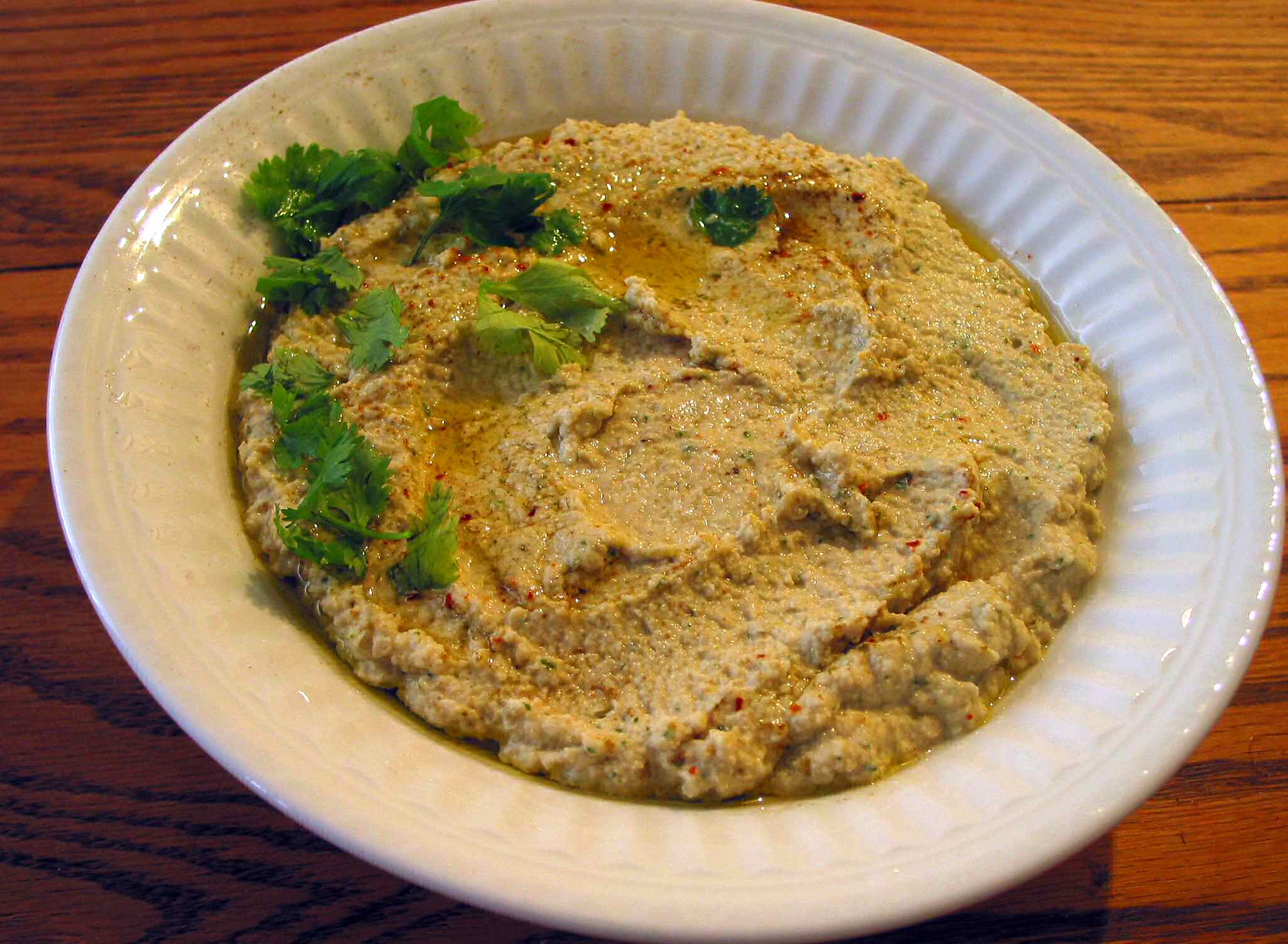
Hummus from scratchHummus is a highly politicized food these days, a situation most eaters outside Lebanon, and at a guess, most inside as well, consider slightly ridiculous. “Owning” hummus has become a point of national pride for a few higher-ups in Lebanon, which has in the past year or two followed Greece’s feta-labeling strategy and tried to appropriate sole credit for authentic hummus. At its more light-hearted, this struggle for hummus supremacy takes the form of an annual stunt in which chefs produce a hummus bowl almost the size of an Olympic swimming pool (or at least an Olympic-sized wading pool) and the triumphal photo makes the international news. But those who really take the Lebanese official origin issue seriously and grimace whenever hummus is served somewhere else are, as far as I can see, only hurting themselves.

The trouble with demanding official status is that both feta and hummus long predate the borders of the countries trying to claim them. Both are simple enough to make and so consistent from batch to batch that they don’t really exhibit much in the way of “terroir” the way aged cheeses, wines, vinegars and so on might. Feta–equally good, equally real, equally part of the native fare–is made in a lot of places neighboring modern-day Greece. Places like Bulgaria, which don’t have as much political clout in either the EU or the Slow Food organizations, and which don’t get half the international tourism. Also places further away, notably Denmark and France, which still have reasonably large sheep’s milk production. Greece may actually have succeeded for the moment in the food labeling tug-of-war, but it’s made the country look somewhat silly and petulant, unwilling to face the fact that they’ve closed the barn door at least a century after the sheep got out. Will they profit from the exclusive labeling? doubtful–and it might have been better ambassadorship to claim credit for spreading feta’s popularity and offer more recipes and products made with it.

Much to the chagrin of whoever decided in the past couple of years that hummus should be exclusively Lebanese, this simple spread is made and eaten in lots of other countries. In Egypt, it’s made with a half-and-half mixture of favas and chickpeas. And Israel, which is probably the “other country” being targeted most directly by the Lebanese hummus campaign, has eaten, breathed, and slept a more or less chickpeas-only version of hummus as an essential food (along with felafel) for longer than the state has been independent.

Unlike the partisanry in Lebanon (not that Israel has no partisanry of its own), when it comes to food, everyone in Israel–Jewish, Muslim, Christian or Druse–gives credit with a certain degree of pride that hummus is Arab food, especially if they’ve made it themselves rather than trotting down to the corner grocery to buy the bland ready-made version from a vat in the deli at the back.

That’s because everyone likes to eat it. It’s also because being a good host is really important and something of a formal habit and a chance to show off just a little–actually, I think that’s still true all throughout the Middle East. Everyone expects friends and neighbors and friends-of-friends to drop by at a moment’s notice, without invitation, especially on the weekend. The least you can do is have a bag of roasted sunflower or pumpkin seeds and a pot of hideously sweet mint tea to bring out if they show up to schmooze after supper, but in the afternoon, better if you can bring out a platter of pita, vegetables, and a bowl of hummus.

Hummus is simple Arab fare at its best–humble, nutritious, appetizing, and (now that we have food processors) easy to make a lot of so you can bring out a wide platter of it for your guests and drizzle a little olive oil and some za’atar or sumac or cumin or paprika over it for the finishing touch–right before everyone tears pita and dips in. The ceremonial thing is what makes it good hosting and is part of the fun.

Here in the US, most people buy their hummus in little plastic containers at the supermarket–not elegant at all, and a lot of money for what you get. Kind of depressing, even. Look at the ingredient list and it’s as long and discouraging as any other processed food–that’s so it can be shipped nationally and stored for a week or two in case it doesn’t all sell out the first day. Look at the nutrition label and you see highish salt, lowish protein and fiber. It’s been fluffed out with canola oil to stretch the expensive ingredient, tehina (sesame paste), and there’s not so much in the way of chickpeas even though they’re supposed to be the base.

While I’m not so much against the fluffy smooth stuff (it tastes ok, if all you’re expecting is a spoonful or two of party dip), I prefer homemade because it’s denser and more nutritious, with more iron and protein from the chickpeas, something you could eat packed in half a pita for lunch and not be starving within an hour. Continue reading

Prunes and Lentils III: The Lentil Variations

Today’s (and last week’s, and the week before’s) topic is STILL the lentils-and-prunes challenge.

Before I get on a roll about lentils, I should mention that the first Prunes and Lentils post was my 101st post for this blog. I don’t know if we should celebrate, but why not. Woo-hoo! Good enough. Consider it celebrated.

It’s taken me a full two weeks to put up this post because this is where the rubber meets the road, or at least where the lentils meet the prunes. The moment of courage. And I don’t know whether it’s going to be great or whether people will go back to wondering why anyone ever let me in a kitchen. (That’s easy: because no one wanted to do the cooking  themselves.)

Ordinary brownish-green lentils are kind of a workhorse ingredient in European, Mediterranean and Near East cooking (also in Indian and African cooking, though red lentils are better known). Unlike restaurant chain buffalo wings, lentils are actually rich in protein and iron, and they aren’t surreptitiously pumped up with sugar, salt and fat to entice you to overeat. The Center for Science in the Public Interest is not likely to sue, because a bag of lentils doesn’t come with a deceptive toy to con the kids. (See? we can be topical and up on the hot news of the moment even while discussing an arcane Slow Food subject like lentils).

And lentils are CHEAP–the whole point of starting this Prunes and Lentils challenge in the first place. Somehow even the big supermarkets that push shoppers to the middle aisles to buy boxes instead of actual food always carry dried store-brand lentils over near the bags of rice and split peas and kidney beans and such. It’s one of the few middle-aisle purchases that are worth it.

I don’t know if lentils have even kept up with inflation over the past 20 or 30 years, because they’re always something like $1-$1.25 for a one-pound bag. Same as when I was a student on a $20 a week food budget. And a pound makes 5-10 meals, not just one serving.

Actually, the recent agroeconomics of growing lentils in the US makes unexpectedly interesting behind-the-scenes reading for policy wonks like me. Lots of people are now clamoring for the US to change the crop subsidy laws to encourage more nutritious crops than corn, soy and wheat. Lentils are still a minor crop, but apparently the USDA introduced new marketing loans and other incentives for lentils, peas and chickpeas under the Farm Act revisions of 2002 and 2008, and exports for pulses have risen by about 45% in the last few years to India, Spain, the Philippines, and other major lentil and chickpea consumers. The rest are bought for animal feed and international food aid programs, especially those for sub-Saharan African nations.

That’s because lentils still fly under the radar here. The average annual consumption in the US is still just about a pound per person. Up from 0.8 pounds in 2008, so a 20 percent jump, but still. One pound per person in a year. If my continuation of the Prunes and Lentils Challenge posts has no other benefit to humankind, I would hope that it inspires you to buy and cook–and eat–at least one additional pound per year in a creative and satisfying way. Pass it on–Two pounds per year? At a cost of $2-3 total? We can but dream…

Of course, now that bean cuisine has become a point of pride for Meatless Mondays and other trends in eating green (if not eating local), lentils don’t just come dry in bags or bulk anymore–not glamorous enough, perhaps? If you’re upscale, you can get them precooked in little cans at your Whole Foods or steamed in vacuum packs at your Trader Joe’s, but those chic packages are much, much more expensive per meal and don’t taste as good. I frankly wouldn’t bother unless you’re on the road or camping or something and don’t have a kitchen at your disposal. Dried lentils don’t need a presoak to cook up within about half an hour even on the stove top, and they’re so easy to cook in a microwave (and avoid the watched-pot-never-boils problem) that the extra expense and time trying to find the precooked ones is usually not worth it. (And what about all that extra plastic and metal packaging? Be righteous–buy ’em dry.)

If you cook up a whole pound bag at once, you can use it throughout the week or (better, for a lot of people) freeze half of it with a bit of cooking liquid in a microwave container and save yourself some time the next time you want a batch. I keep thinking of that old “Cook Once, Eat Twice–That’s Italian!” lasagna ad (can’t remember if it was for noodles or sauce) from the 1970s. It’s a bit old-fashioned, but still a good idea for  when you’re too tired to cook for real.

In this post, I’ve got 3 or 4 main “strategic” ideas for the prunes and lentils challenge, along with more recipes and variations than should really go in a single post (and THREE more prune accompaniments as well), so just roll your eyes, bear with me, and if you decide never to let me in your kitchen, I’ll understand (plus I’ll never have to do the dishes–win/win!).

So first things first–gotta cook that bag of lentils (and recycle the bag). This recipe is probably longer than the actual process but it contains valuable Continue reading

Prunes and Lentils II: Prune Sauces for Savory Dishes

Following on from Sunday’s post (have you recovered yet? Should I be selling Tums futures?) I should add that NOWHERE in Karen Page and Andrew Dornenburg’s The Flavor Bible can a mention be found of prunes paired in any way, shape, or form with lentils. Don’t have the faintest why not. They do state that plain old green lentils have more flavor than red or brown.  They also pair prunes with olives, mushrooms, gorgonzola and walnuts as well as sweet spices and red wine. Somewhere in that crossroads there’s got to be some confluence of flavor, but wherever it is, they haven’t considered it.

Others have, however–notably Nathan Lyon of the Discovery Channel, ABC’s “Beat the Chef” show in Australia from a few years back, Hello! magazine (OK, copying straight from the California Prune Board’s UK division–wait a minute, they HAVE a UK division?!–and borrowing its press photo)…Oh well.

The benefit to considering prune sauces is that you can serve them with a lentil dish if you’re ready for that or to lift a more familiar savory dish with meat, fish or poultry.

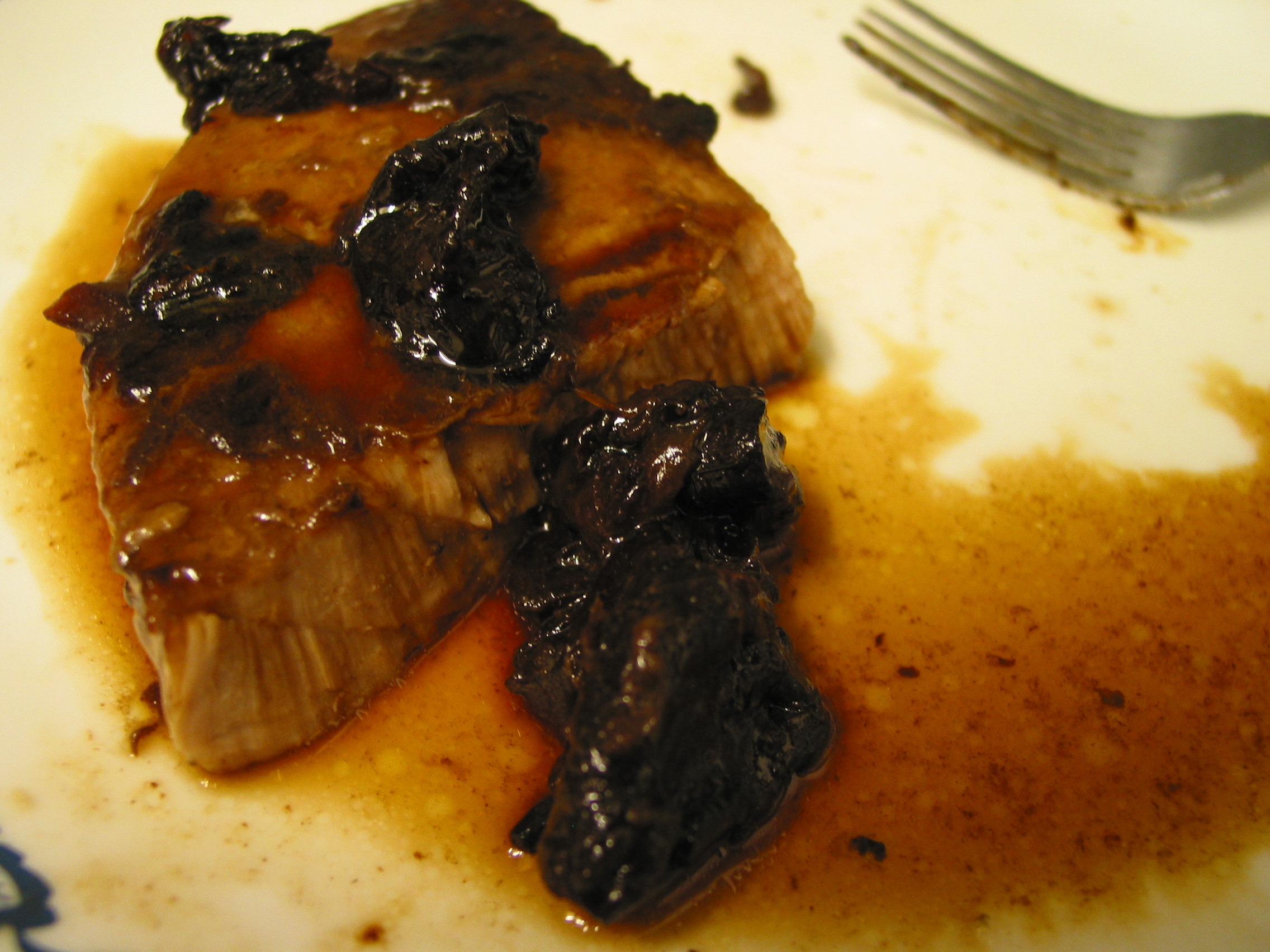
Pan-seared tuna steak with microwave prune and wine chutney

Pan-seared tuna steak with microwave prune and wine chutney

And yes, I said “lift”. Make of it what you will, but any one of the sauces below is better than whatever Hello! magazine has to offer, even if it were original.

Stéphane Reynaud’s Prune Sauce (excerpted for consideration from French Feasts, 2009)

This was designed to go with a simply pan-fried foie gras for six–probably 3-4 oz per person, which seems like a hefty kind of serving, even though I do like liver.  But the sauce–why 18 prunes? 3 per person? and it seems a heavy load of spice for a small amount of wine. Also he has you rest the stuff overnight at room temperature before finishing it. Not sure why–to thicken up, probably, like Elizabeth David’s recipe for peach jam, which also sits out overnight after the first boil-up before resuming.

  • 18 pitted prunes
  • 1 c red wine
  • 1 t ground cinnamon
  • 1 t quatre-épices
  • 2 star anise pods
  • 2 T light brown sugar
  • 2 1/2 T butter, chilled

Boil the prunes 5 min with the wine, spices and sugar, cover and leave O/N at RT. Remove the prunes and reduce the spiced wine to a syrupy sauce. Whisk in the butter, then return the prunes to the sauce.

Microwave Prune Chutney with Wine

My microwave version started out as Reynaud’s wine-based sauce and suddenly morphed, as I was grabbing things out of the fridge for it, with a half-remembered cranberry chutney recipe my mother-in-law served a number of years ago at Thanksgiving. This turns out to be a potent combination, aromatic and sharper, no doubt, than Reynaud’s sauce, with a definite suggestion of saltiness about it–but no actual salt. I don’t recommend eating it straight–too pungent for me, though it’s uncannily close to the relish my mother-in-law served and pretty decent with poultry and stuffing or rice and so on–but cooking 5 minutes or so extra in a saucepan over direct heat or with the food you’re saucing and some extra wine turns it into something pretty special. The whole cloves in particular (which you can take out before using the sauce) do something incredible for any meat or steaky fish you cook with this sauce. Like brisket but just…better, more sophisticated, elevated to the level of cuisine. In fact, put some of this prune sauce with cloves in your next brisket too. 

Makes about 1 cup

  • ½-1 c leftover dark red wine–syrah, aglianico, something inexpensive but rich
  • 8-10 pitted prunes, quartered
  • grating of fresh ginger (1/4 t)
  • grating of 1/2 decent-sized clove garlic or 1 small clove
  • 1/4 red onion, chopped
  • 1-2 t. wine vinegar
  • sprig of thyme
  • pinch of fennel seed
  • 4-5 whole cloves, loose if you can stand picking them out or else stuck through a scrap of onion

Toss the onions with the vinegar and let sit a few minutes while chopping the prunes into quarters–it cuts down on the bite. Mix the onions, prunes, and the rest of the ingredients except the cloves in a soup bowl with a microwaveable lid that can placed on with a gap for steam to escape. Poke the cloves into a larger scrap of onion and add that to the bowl so you can fish them back out easily after cooking. Microwave 1-2 minutes loosely covered on HIGH or until it’s boiling, let sit 5 minutes, stir, microwave again. The prunes will have taken up a lot of the liquid, the onions should be cooked through and garnet-colored, and the wine should be reduced and a bit syrupy.

.  .  .  .  .

From France to China, then:

One year I was determined to make a low-sodium substitute for fermented black bean sauce with roast salmon. I soaked some prunes in a little boiling water and mashed them to a paste, then dressed them up with garlic, ginger and a few other things. It turned out, to my surprise, like homemade hoisin–-dark, glossy, tart and aromatic, less sweet than the commercial stuff, a little smoky from the sesame oil and scallions, with the suggestion of salt Continue reading

Mahi Mahi with Artichoke Hearts

Mahi mahi with marinated artichoke heartsA lot of people seem to have reached Slow Food Fast recently by searching for mahi mahi with artichoke hearts, and all I had up about it was the picture above, so I thought I would post the actual recipe. Admittedly, it’s not very much of a recipe, what you see is what you get.

But the artichoke hearts aren’t just for decoration, they have lemon juice and olive oil as well as garlic, and they shield the top of the mahi to keep it moist and tender while it’s cooking–essential for any steaky fish that tends to dry out if you overcook it even slightly.

This recipe is pretty much just what it looks like in the picture, so I’m not going to give actual quantities–they just depend on how much fish you want to make. I do mine in the toaster oven (about 3 fillets or a little less than a pound) to keep from wasting huge amounts of heating (and in LA right now, cooling afterward). So maybe 15-20 pieces of marinated artichoke heart and a couple of chopped olives will cover things well enough.

For this I use my microwave-marinated artichoke hearts, which only take a few minutes start to finish and store well in the fridge. But if you’re doing mahi for a thousand, obviously you want to invest in the BIG  econobarrel jar of Cara Mia…

Mahi Mahi with Artichoke Hearts

  • Mahi mahi fillets, fresh or thawed frozen, rinsed gently under cold water
  • marinated artichoke hearts–enough to cover the fillets to your liking, not enough to break the bank
  • fresh sprigs of rosemary or thyme if possible; dried or frozen if that’s what you have
  • a few Kalamata, Alfonso, Gaeta or other good brined olives, pitted and quartered or chopped
  • decent olive oil for drizzling
  • squeeze of lemon juice
  • fresh-cracked black peppercorns optional

Preheat the oven to 375-400 F, or if you’re cooking in the toaster oven, figure 350F starting when you put the fish in, since it’s smaller and the heat’s closer to the fish.

Lay the rinsed fillets in a single layer in a foil-lined pan, and cover with a layer of marinated artichoke heart quarters. Scatter olive pieces and herbs evenly over the top, drizzle on olive oil and lemon juice, and grind pepper over the top if you like.  Cook uncovered for 15 minutes, check for doneness by cutting into one of the center fillets with the side of a fork or by trying to pierce one–if it’s still raw, it’ll resist, and if it’s cooked it’ll separate or flake. Try not to overcook, you want it cooked through but still juicy as it separates. If it’s only a little bit pink in the middle when you check, shut off the oven and leave the fish inside for another minute or so to finish in the residual heat.

The Dirty Roots of Veg-phobia

In one of my favorite Doonesbury cartoons, a very old one from the early 1970s when hippies still had a trace of hip about them, it’s Zonker’s turn to cook dinner, and he serves his housemates a big bowl of salad.

Mike Doonesbury peers into the bowl suspiciously and says, “Hey Zonker, the lettuce is dirty!”

“Yes, but it’s clean dirt! Ecologically pure dirt! No chemical additives–you’ll love it!”

Mike and Bernie opt for McDonald’s.

Somehow, though, the way they agree on it suggests the understanding of the early 1970s: McDonald’s was cheap, it was easy to find in your town, but it wasn’t really dinner, it was what you did when there was nothing decent in the fridge.

For decades now, government health agencies, the American Cancer Society, the American Heart Association, and whole parades of morning talk show guests have been advocating that Americans eat at least five servings of fruits and vegetables a day, and juices don’t count. The studio audience members, mostly soccer mom-looking women, only with impeccable makeup and pristinely unwrinkled clothes, bob their heads on cue at this wisdom.

But nobody’s gotten serious about how veg-phobic most people suddenly become when they actually approach the vegetable aisle in the supermarket, and no one’s taking enough pictures of what’s really in the fridge or on the cutting board most nights in most houses. All I can say is that many, many of them, if they buy vegetables at all, buy prepared or precut vegetables instead of bulk. Why?

Bulk vegetables–a whole head of cabbage or lettuce or broccoli or cauliflower, a bunch of celery or carrots–are bulky. Heavy. Hard to lift and hard to maneuver into those thin plastic produce bags.

They’re also round. They take up a lot of space in the refrigerator. They don’t stack neatly and they don’t necessarily fit into the shallow, measly vegetable drawer that comes with today’s Lean Cuisine-friendly slimline refrigerators.

They require washing, and here I wonder if we’re getting to the part people are most squeamish about. There’s…there’s (I can’t say it) … there’s DIRT on them!

Why washing it off scares people so much these days I have no idea, but maybe it’s all that liquid hand sanitizer and overly perfumed liquid hand soap that have poisoned the atmosphere this past 10 years or so. When your soap company can convince you to buy watered-down soap in a decorator squirt bottle, your friendly produce-packing plant can probably sell you overpriced broccoli florets in a small plastic bag.

Sweet Potato Ice Cream

Some time back I was bemoaning the lack of reasonably priced butternut squash at the height of the season in my local markets–I was clearly spoiled by last year’s bargains, or so I figured. So when I tried making pumpkin ravioli at home, I substituted yams, which were a lot more plentiful and much less expensive per pound.

But as it turns out, there’s more to the missing squash mystery than I realized. Just before Thanksgiving last year, Libby’s sent out a public warning that they were facing deep shortages due to heavy rains during harvest in central Illinois, where most of their pumpkins are grown. Heavy rains and soggy fields meant harvesters couldn’t get out every day to pick, and a lot of pumpkins mildewed on the vine and had to be plowed under. Oregon’s organic pumpkin growers, who had an unusually good crop, were able to  step in as an alternate source for buyers running short, but organic pumpkins are still only a few percent of the national consumption each year.

Following on a short crop in 2008, the Midwest is looking for a better harvest this fall, but right now the shortage is pretty noticeable on store shelves. A global produce outlook web site even posted a recent factoid that, at the moment, Libby’s remaining inventory of 100% packed pumpkin stands at something like six cans. Six.

According to the article, people have been bidding up to $30 a can on eBay for those extras you probably squirreled away in the corners of your pantry and never got around to making.

But it still doesn’t explain why winter squash was so scarce and expensive in California this past year–unless our supermarkets were importing all the way from Illinois as well. Hmmmph.

Where’s the Charlie Brown Theme Song when you really need it?

In any case, yams and sweet potatoes nearly the size of footballs have been pretty plentiful in Southern California, and cheap with it. There’s very little waste on a sweet potato–just the peel, usually (or buy organic, if you can find them, and scrub them well before cooking so you can eat the peel too).

So I’ve been finding a place in my refrigerator for them and microwaving them in a lidded pyrex bowl or casserole with a little water in the bottom for about 8-10 minutes (for a big one). Because I don’t like the prospect of nasty kitchen accidents, if I can’t cut into them easily right away I wait to split these monsters in halves or quarters about 6 minutes into the cooking time, when they may not be fully cooked yet but at least they no longer require an axe.

Sweet potatoes and yams substitute pretty well in standard pumpkin pie recipes, but you generally have to bake twice as long as for the canned pumpkin, which has had a lot of the water cooked out before it was packed. They also make  good fillings for large ravioli–pretty easy with wonton or gyoza wrappers, and microwaveable too.

But…it’s now June in Los Angeles, which means “June Gloom” overcast cool weather in the morning, burning off to the mid-90s by lunchtime. And my daughter looks at the huge quarters of yam cooling on the counter and says, suddenly, “I wish we could have pumpkin ice cream instead.” I think about it and decide I wish that too.

I have buttermilk, regular milk, sugar and a variety of pumpkin pie-type spices on hand. I don’t think I’ll need eggs because the sweet potato has so Continue reading

Technique: How to Squeeze an Eggplant

Long ago, I threatened to post the unlovely but effective method of peeling cooked eggplants that I learned the hard way, in a kibbutz kitchen. We used to make baba ghanouj routinely for a thousand members–something like 50 to 75 baked eggplants went into it each time, mixed in a stand mixer the size of a wheelbarrow with a base that was cemented into the floor. You can’t be fooling around with spoons and forks when you’re working on that scale. Instead, we cooled the eggplants in a huge colander and then started squeezing them out as though they were pastry bags or tubes of toothpaste.

It takes a bit of practice…to say the least. But each eggplant only takes about half a minute to empty into the colander, and once you get the method down, the skin stays together and is just about completely clean inside. Very effective. Not very dignified, though, unless you do it enough to get good at it.

However, since I have no vanity whatsoever, I finally took some pictures (not easy to shoot while actually squeezing the eggplants, so don’t expect photogenic–eggplant is only pretty raw…) and have steeled myself to walk you through it. Wear goggles and a hairnet the first time if you’re afraid of flying goop, or make your little sister do it first. And don’t forget to rinse your hands (and arms) well right afterward, because the juice is still a bit caustic and will make them itch after awhile. Anyway, the following is for if your little sister refuses to take the bait.  Click directly on any of the pictures if you want a closer view.

How to Squeeze an Eggplant

First, microwave your eggplant(s) (best if you’re only doing up to 3; any more and it’s worth roasting them for a whole hour in the oven at 400F). Scrub them well, cut off the cap (watch out for thorns!), rub or sprinkle a little salt on the damp skins, and set them to microwave 10 minutes on HIGH, until they’re soft and collapsed.

whole eggplant before microwaving for baba ghanouj

Whole eggplant prepped to microwave for baba ghanouj

Eggplant after microwaving

After microwaving 10 minutes, the eggplant has collapsed

Next, let the eggplant cool enough to handle–this is probably the most important part. Trying to squeeze out a scalding eggplant leads to explosions of scalding eggplant goop, plus the peel usually toughens a little as it cools, which makes ruptures a little less likely.

–Am I making it sound good yet? No?–hang in there.

Poking the eggplant

The all-important poke

Set the cooling eggplant cut-end-down in a colander over a bowl to drain off some of the juices. If you have the asbestos-like fingers for it, you can poke a hole in the cut end while it’s still hot and earn yourself untold macho points as long as you only wince after you’ve slunk off to the bathroom. Never let ’em see you cry. If you’re not that brash, you’ll have to poke a hole in the cut end once it cools. That’s the easy part.

Once the eggplant’s cooled enough to wrap your hands around it, it’s showtime. Keep the cut end facing down.

Grab the eggplant like a pastry bag, cut end down

Grab the eggplant like a pastry bag, cut end down

Cup your hands around the fat round end at the top and very gradually push in and downward, closing your hands over the top, Continue reading

The Cheap Vegetables–Snack Edition

A food marketing study released findings a few days ago about the top 10 fastest growing snack food preferences for kids 2 to 17 years old. Yogurt came out as number one, then potato chips, then–very surprisingly to me–fresh fruit. The others down the rest of the list were a soggy but predictable mash of candy, chips, “donuts” [sic], and other junk foods, though I think cheese cubes were in there somewhere. If yogurt and fresh fruit are in the top three, though, the news must be good, right?

Um. Maybe. But both of them are sweet or sweetened (in the case of most flavored yogurts, very heavily sweetened compared with plain)–so they kind of fit in with the candy, donut, carb-carb-carb kinds of snacks in the rest of the list.

What’s missing from the top 10 list? Plain milk, pasta or beans, bread and jam, the simpler unpackaged, unprocessed, or unbranded stuff you could bring from home, are all missing. But most of those are hard to take to school, and none of them are crunchy, which is a big part of the pleasure of snack. Actually, few of the packaged snacks are crunchy any more either. It’s a sad state of affairs, but there is a simple way to restore the full joy of snacktime.

Because mostly what you don’t see on the marketing study list are vegetables. Raw, crunchy vegetables, low in calories, starches and sugars, fats and  sodium, are high in potassium and fiber and vitamins, easy to prepare (another chorus of “just wash and nosh”) and perfect for snack. A handful of red cabbage or a couple of carrot or celery sticks along with a piece of cheese or a few nuts will keep kids from hunger for a lot longer than the carb-laden snacks on that list, and they’re a lot less expensive–on your wallet or your kids’ waistline.

Parents at school complain all the time that vegetables are too expensive, too time-consuming, take too much preparation by hand, and are not convenient to deal with, and their kids “won’t eat them”. But I wonder if that’s true, because whenever I go at lunchtime, I see many of those same kids enjoying the vegetables that come out of the school garden. They aren’t whining and they don’t appear to be suffering, and nobody seems to be sneering at anyone else that their lunch has Brand A taco chips and all the other poor schlub’s mother packed was vegetables. They’re all waving broccoli or lettuce leaves around, holding them up for comparison, and using them as props for one or another comic performance before chomping into them with savage glee.

And I know an ordinary bunch of celery–even a head of cauliflower–is the same price or cheaper than an econo bag of Doritos. Even at the big brand supermarkets. Celery. Carrots. Red or green cabbage. Raw green beans or if you’ve got the extra cash, snow pea pods. Broccoli or cauliflower. Lettuce wedges. Tomatoes. Cucumber. Bell pepper. None of these are hideously expensive, all of them taste good raw, and all of them store well washed, dried gently, and kept in the fridge.

So what’s stopping the parents from packing vegetables as lunchbox fare? The fact that they have to wash them to get the dirt off? Get their hands wet doing it? Maybe peel some of the vegetables? Find a knife to cut them up with? Use them up within a week or so of buying them? I honestly don’t know, but a lot of the parents seem whinier than their kids. Maybe they should all learn to just wash and nosh.

It only takes a minute or two to deal with a full head of broccoli or cauliflower, or a bunch of celery, and it’ll last you several days’ worth of school and work snacks at a cost of under $2. The most prep required is for carrots, if you start with an actual bunch. Not that I’m advocating the prepacked “baby cut carrots” bags, which are more expensive, but if you really hate peeling and cutting up carrots, you could go this way and still do better than chips and snack packs and the like.

All I can tell you is, if the vegetables are fresh and crunchy, most kids will get into them as long as their friends are doing it too, and there’s no great way to overeat them (except maybe for carrots). And some vegetables are just plain fun–red cabbage in particular is handy for revealing secret invisible baking-soda messages, and if your kids eat it at recess they can compare purple tongues with their friends afterward.  Can’t do that with taco chips.

Oranges as a savory

Artichoke-Orange Salad

Oranges in a savory compote with artichoke hearts

A few weeks ago, I ran across a food article by Amanda Hesser, in which she recounted her recent experience of being served a green salad with red onions, Greek olives, and oranges in it. What struck me was the way she fumed at length over having missed out for so long on this simple culinary classic.

I grew up in a Jewish household in the early 1970s, at about the time when felafel and hummus and tabouleh started making their way west into American Jewish cooking. These, along with pita, tomato-cucumber-pepper type salads and eggplant everything, were part of the larger Jewish cultural revival after the Six-Day War. Jewish cookbooks started embracing the Lebanese, Sephardic, North African, and Persian influences on Israeli food as a complement to the more familiar Ashkenazi fare. Orange salads just seemed to fit in.

In any case, orange salads have been published in Jewish and Mediterranean-leaning cookbooks for at least 25 years–notably Paula Wolfert’s Couscous and Other Good Food from Morocco, one of my first cookbook purchases once I came back from my own year as a kibbutz volunteer.

Three orange salads

The simplest orange salad I make is a basic green salad with oranges rather than tomatoes, and it goes well with oil-and-vinegar or mustard vinaigrette. Another, more of a fruit salad, is orange and/or grapefruit segments or slices mixed with a dressing of a cup of yogurt, a spoonful of ordinary red wine vinegar, a spoonful of sugar, and curry powder to taste, maybe half a teaspoon or so, enough to make it yellow-orange and aromatic, not enough to be bitter.

Another more elegant take on the green salad is something I made a few times in my early cooking days for buffet lunches at my synagogue–orange slices sprinkled sparingly with orange blossom water and a grinding of cardamom, laid down in overlapping rows on a bed of vinaigrette-dressed romaine in a tray, and red onion rings, sliced Kalamata olives, red bell pepper rings, crumbled feta, and chopped fresh basil strewn over the oranges. It was a bit much for serving at home, but it made a beautiful buffet dish, and it always got eaten.

So oranges can serve quite nicely in fresh salads, but what about in hot dishes? There’s the rub.

Orange peel I have no trouble imagining in hot savories–a number of Chinese classics use it (beef with orange peel, etc.), and so does duck à l’orange. Cooked oranges, on the other hand, always disappoint me–somehow the structure collapses, the color fades, and so does the bright acidity. They end up pulpy and stringy and less than half as good as fresh raw pieces would have been. But people persist in cooking with them–so I thought I would give a different Paula Wolfert cookbook a try.

The Slow Mediterranean Kitchen: Recipes for the Passionate Cook
(2003) features one really unusual orange-based savory: an Algerian Jewish sweet-and-sour compote of artichoke hearts and orange sections glazed in orange juice. With garlic and olive oil. Hard to imagine–does garlic go with oranges?–but so close to my standard marinated artichoke hearts, at least theoretically, that I decided to chance it and see. Continue reading