
• Enter your email address to subscribe to this blog and receive notifications of new posts by email.

    Join 241 other subscribers
  • Noshing on

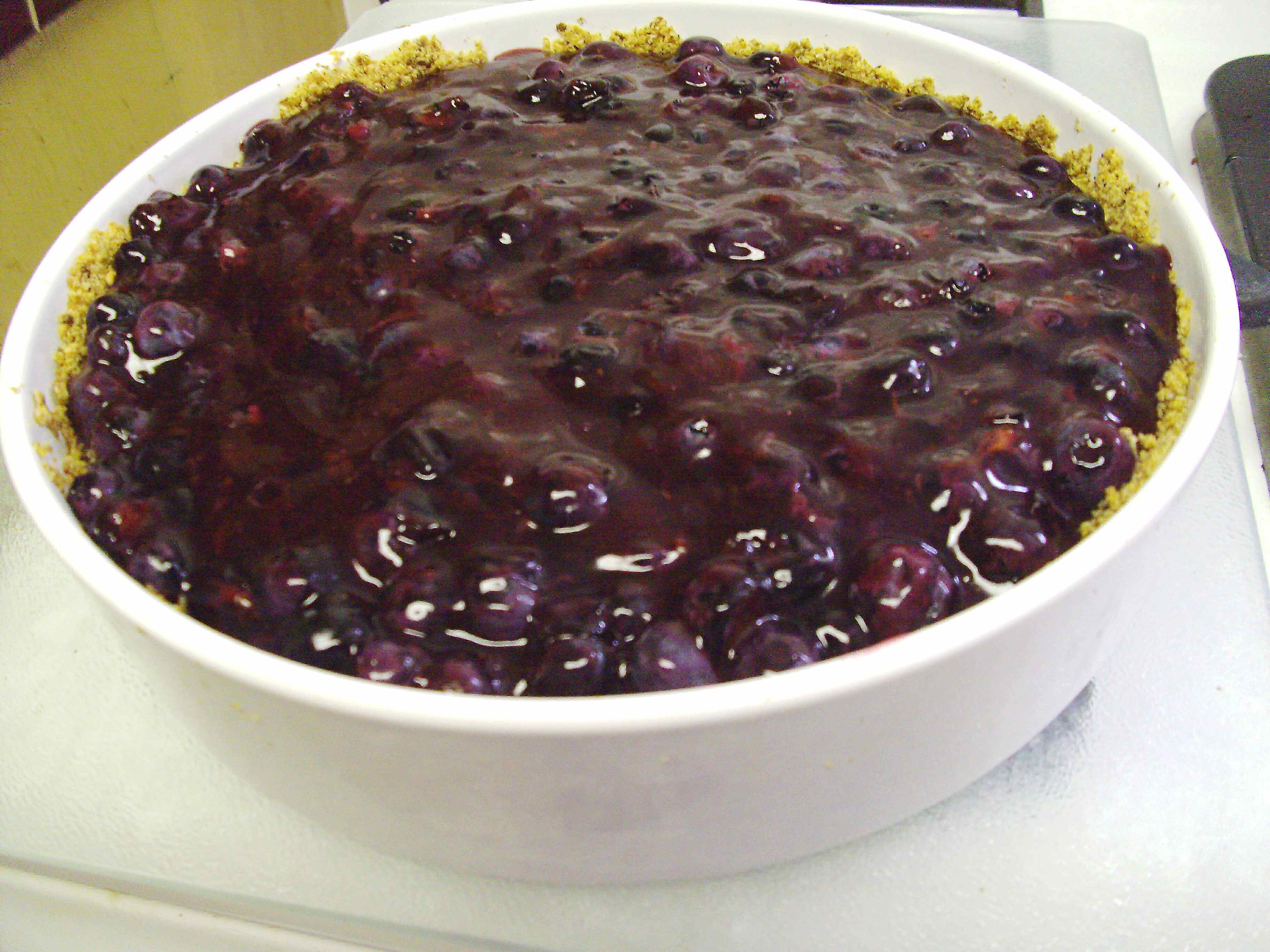
    raw blueberry pie with microwaveable filling and graham cracker crust

    This mostly-raw blueberry pie is a snap to make and very versatile--the filling microwaves in a few minutes, and you don't even have to bake the zippy gingered graham cracker crust--perfect for a hot Fourth of July and all summer long.

  • Recent Posts

  • Contents

  • Archives

  • Now Reading

  • See also my Book Reviews

  • Copyright 2008-2024Slow Food Fast. All writing and images on this blog unless otherwise attributed or set in quotes are the sole property of Slow Food Fast. Please contact DebbieN via the comments form for permissions before reprinting or reproducing any of the material on this blog.

  • ADS AND AFFILIATE LINKS

  • I may post affiliate links to books and movies that I personally review and recommend. Currently I favor Alibris and Vroman's, our terrific and venerable (now past the century mark!) independent bookstore in Pasadena. Or go to your local library--and make sure to support them with actual donations, not just overdue fines (ahem!), because your state probably has cut their budget and hours. Again.

  • In keeping with the disclaimer below, I DO NOT endorse, profit from, or recommend any medications, health treatments, commercial diet plans, supplements or any other such products.

  • DISCLAIMER

  • SlowFoodFast sometimes addresses general public health topics related to nutrition, heart disease, blood pressure, and diabetes. Because this is a blog with a personal point of view, my health and food politics entries often include my opinions on the trends I see, and I try to be as blatant as possible about that. None of these articles should be construed as specific medical advice for an individual case. I do try to keep to findings from well-vetted research sources and large, well-controlled studies, and I try not to sensationalize the science (though if they actually come up with a real cure for Type I diabetes in the next couple of years, I'm gonna be dancing in the streets with a hat that would put Carmen Miranda to shame. Consider yourself warned).

The Birthday Project: New Year, New Food

I was born halfway between Rosh Hashanah and Yom Kippur, so on any given year, I could be stuck eating honeycake or none at all on my birthday. I think I’ve had maybe two actual birthday parties in my life. It’s a concept my daughter, born in June, doesn’t get.

But occasionally I luck out–and this year was one of the best. My husband asked what I wanted and I had a real answer–a cookbook I’ve been lusting after at the library and that costs only slightly more than my probable library fines if I don’t return it.

So this is it–feast your eyes, I’ll turn the pages:

Aromas of Aleppo by Poopa Dweck

And this is the project that sold me on it:
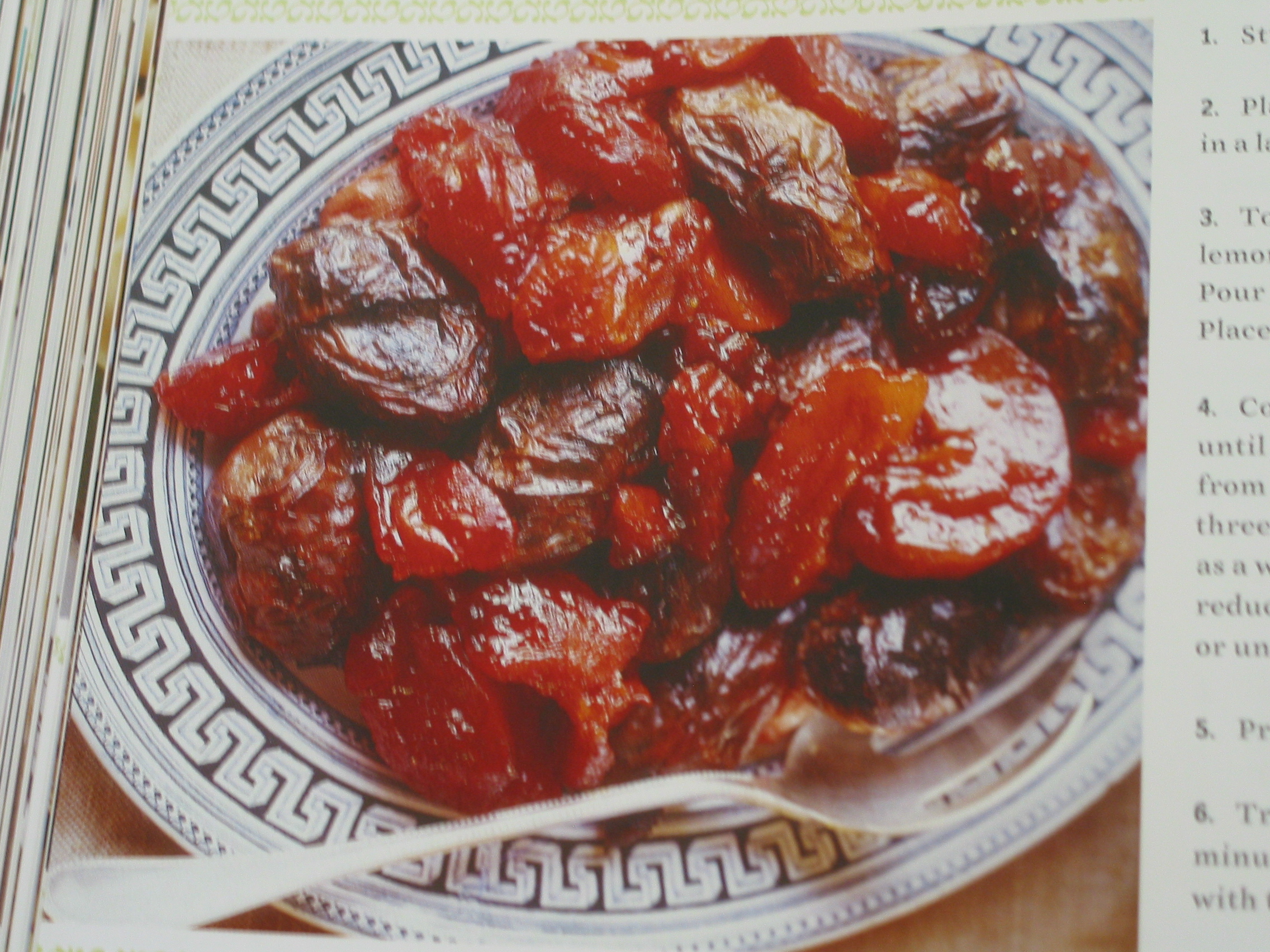
Stuffed Eggplant with Quince

Stuffed Eggplant with Quince

Poopa Dweck, a cousin by marriage to Claudia Roden, has edited the New York Syrian Jewish community’s version of a sisterhood cookbook (every synagogue in America’s sisterhood seems to have put out at least one of those) for something like 20 years, only people in her community actually used it frequently. My birthday gift is the 2007 culmination of Dweck’s experience, and it’s just a very beautiful cookbook to leaf through–visually but also for the possibility that when you try the dishes, they’re actually going to work.

It doesn’t take much reading for me to realize that despite the unfamiliarity of some of the flavors–allspice in meat stuffings, tamarind-based sauces–this is the best kind of traditional Jewish home cooking, the kind that has your favorite great-aunts outdoing each other for Pesach, Rosh Hashanah, and other big celebrations. So, somewhat exotic in flavoring but utterly familiar in spirit. (And actually, as I discovered in another Syrian Jewish cookbook, A Fistful of Lentils, by Jennifer Felicia Abadi, a few dishes, like stuffed cabbage with a sweet-and-sour sauce, and manti, a kind of ravioli, are pretty similar to Ashkenazi holishkes and kreplach.)

Like all Jewish great-aunt dishes for the holidays, this dish of stuffed eggplants and quinces comes with two required homework items: the beef and rice stuffing, and tamarind concentrate. The beef I’m not worried about–my first try on this is going to be vegetarian, because I’m not planning on heading out to the kosher butchers in the Valley. I can use a green lentil and rice filling that I already know will taste fine with those flavorings of allspice and cinnamon and onion. Maybe a hit of garlic too, and maybe a bit less salt than for the beef–as I discovered a few weeks ago, with the green lentil sausages, lentils don’t hide the salt flavor as much as beef might.

The other item, tamarind concentrate, turns out to be inexpensive but somewhat unlovely to make–though still something of an adventure. Especially for a blog called Slow Food Fast.

Here’s what’s on page 42 of Aromas of Aleppo for how to work the tamarind pulp into something that will give up its flavor to a sauce:
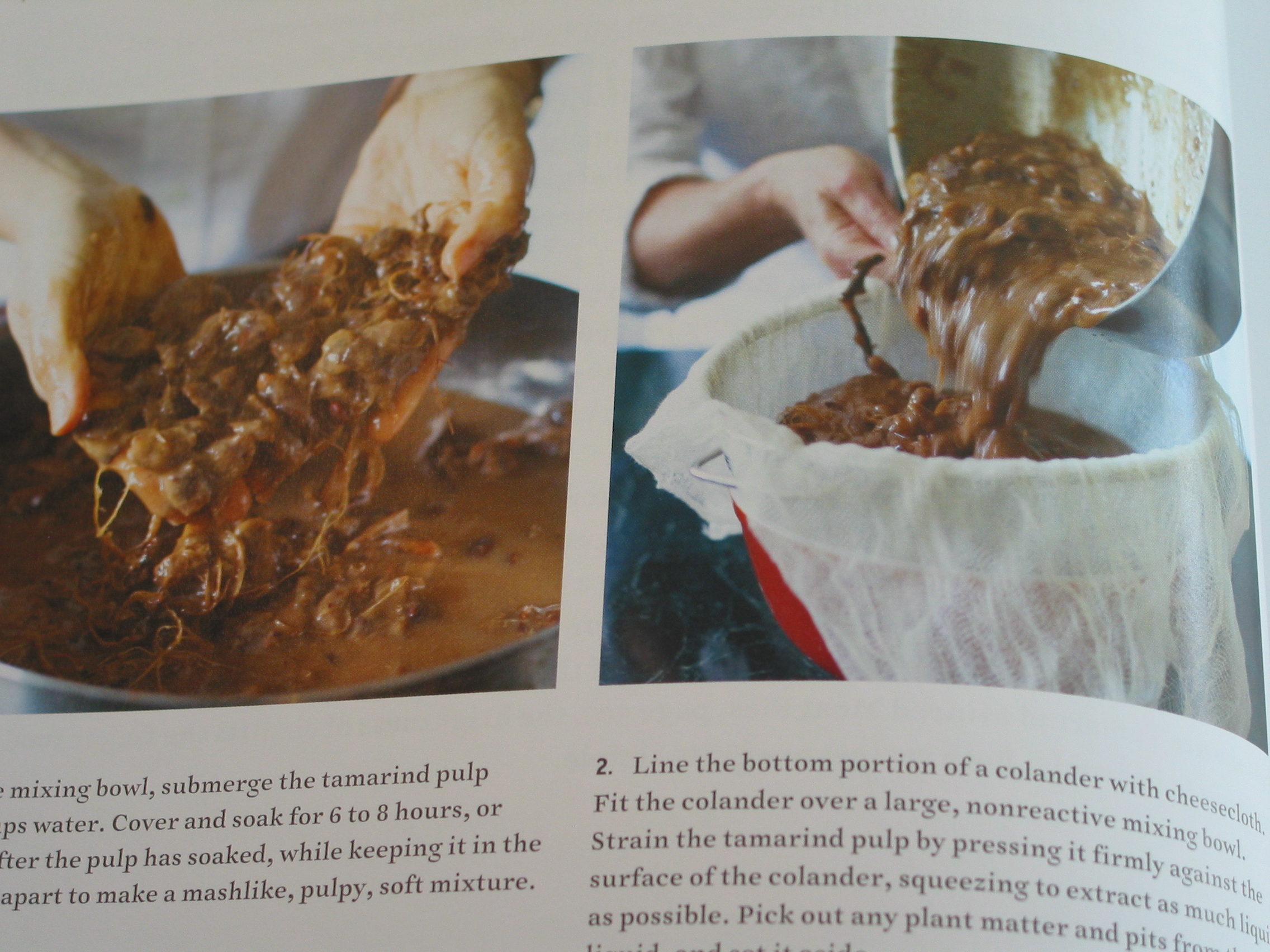
Poopa Dweck's Aromas of Aleppo--instructions for making tamarind concentrate

Working the tamarind pulp

Now, I’m not all that squeamish, but bleaaghhh. First ya gotta soak the stuff overnight, then ya gotta get in there and mish around–I dunno. I decided to speed it up where I could…

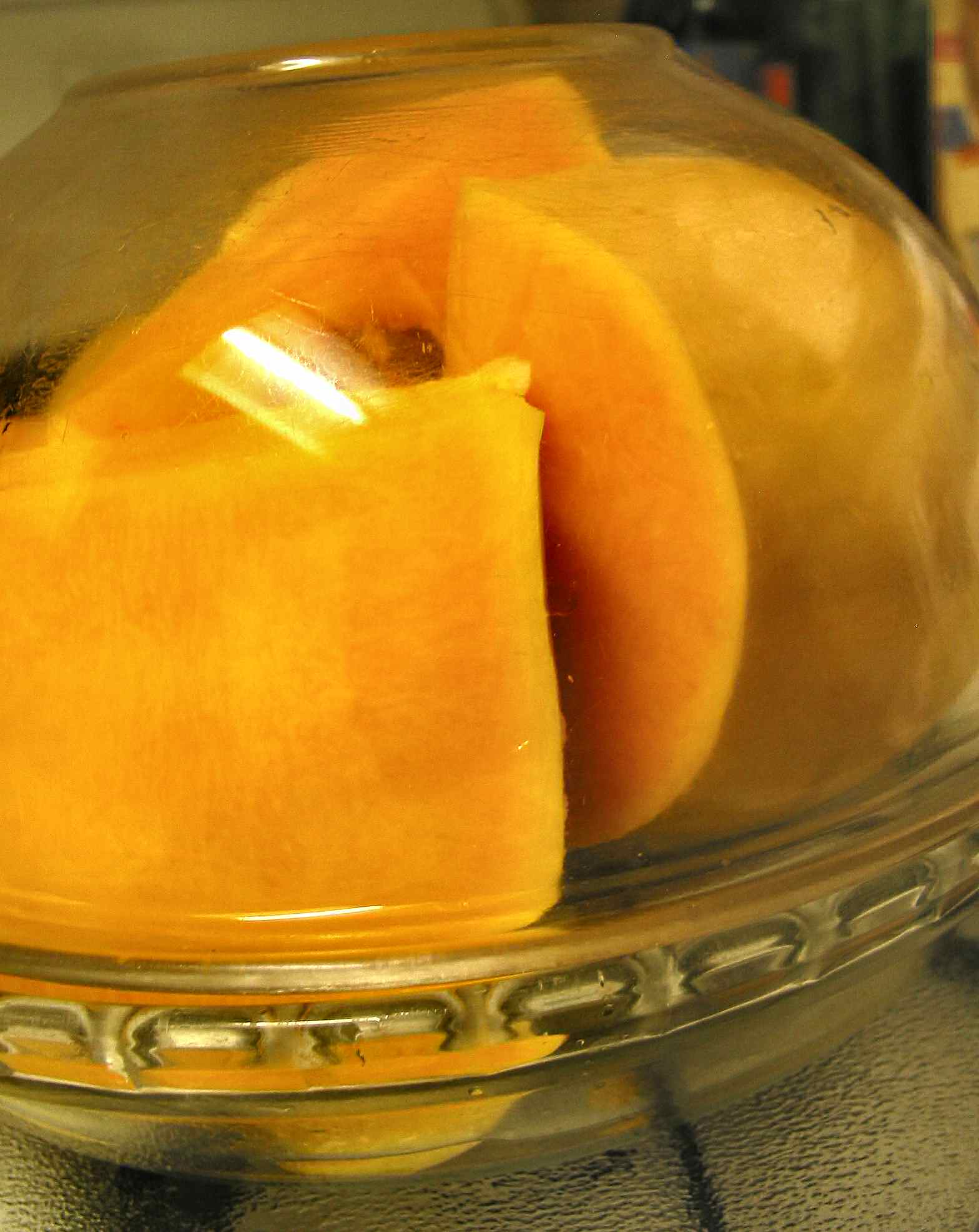
I thought about the little 1-lb. brick of pressed seedless tamarind pulp I’d bought from my Armenian greengrocers for this dish. It just seemed like a tougher version of dried prunes or apricots, which I usually soak up successfully enough in a few minutes by heating them with water in the microwave. Would it work here or would it ruin the flavor? I cut off a chunk, submerged it in water in a microwaveable bowl, and tried it.

Tamarind pulp rehydrated in the microwave

Five minutes of microwaving, covered, plus about 20 minutes sitting time–it was definitely done. And really, really incredibly tart, a surprise given tamarind’s distinctly plummy aroma. Success! But no wonder they call it “ouc” (pronounced OO-rgh, according to Dweck)–that was my immediate reaction when I tasted a tiny sip. It’s THAT sour. My second reaction was that I should probably say Shehekheyanu–the blessing for any new venture, especially for holidays and the first taste of a new fruit in the year.

I realized only afterward that I should have done the whole brick while I was at it–I was about to discover why Dweck calls for preparing three pounds of pulp at a time, not a couple of ounces.

Next step–squishing the pulp in the water to extract as much flavor as possible before filtering through cheesecloth and reextracting the pulp left behind in fresh water…no. Just no. I am not a cheesecloth girl–it never, never cuts neatly, even with Fiskars shears.

So, I was thinking, I have a microwave for a reason. I also decided I have a food processor for a reason, and this is definitely it. I stirred once with a fork first to make sure there really weren’t any pits in there, as advertised on the package front. Then I poured it all into the food processor, and gave it a whirl. That worked too. I seemed to be on a roll with the speed-it-up-immensely daydream.

Filtering the tamarind liquid

Filtration–I’ve used overlapping coffee filters in a colander whenever I make paneer in the microwave, and it worked pretty well here too–maybe better than Dweck’s photos, which show a cloudy filtrate coming through the cheesecloth. Mine was clear and amber–maybe too clear? Was it going to taste authentic without the silty stuff? I could only hope. It sure was sour, even dilute as it was. Continue reading

Microwave Tricks: Stripped-Down Chiles Rellenos

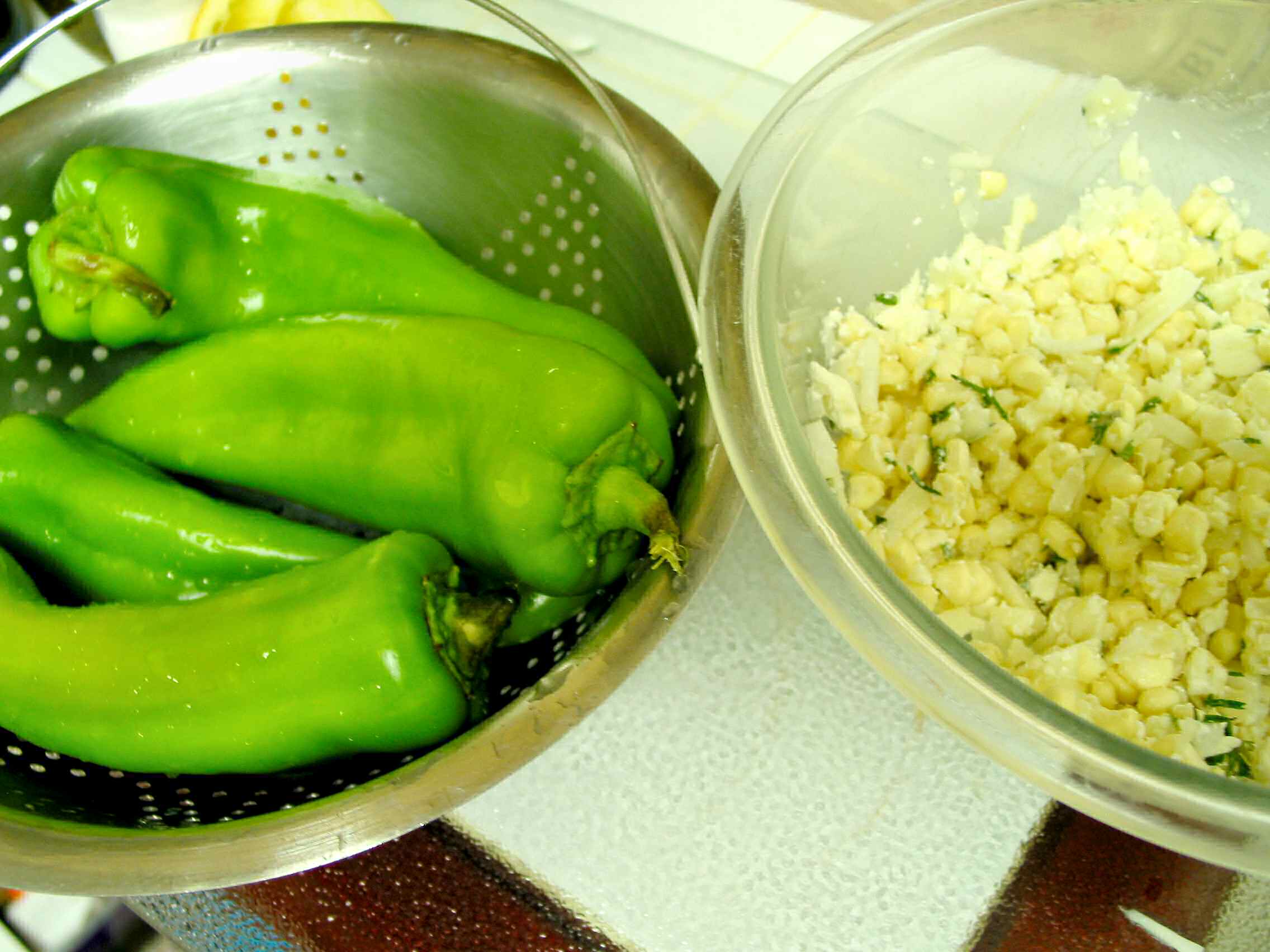
Anaheim chiles with corn and feta for stuffingI know, Diana Kennedy (The Cuisines of Mexico, 1971, and onward) probably wouldn’t do it this way–or maybe she would, at home, for herself? Naaah. She’s still pretty particular. Eighty-seven years old, and doesn’t seem to have slowed down noticeably in her quest to rescue the disappearing dishes of Mexico. Her latest, Oaxaca al Gusto (2010)  is a huge coffee table cookbook, beautiful and unfortunately for me, so full of rare Mexico-only ingredients, not to mention pork and lard, that I don’t know if there’s much I can really cook from it. I’m scouring it now for possibilities, but in the meantime…

Friday afternoon was vegetable-shopping day again, because we go through good tomatoes like a pack of sharks after a swimmer’s leg, and unfortunately our own backyard gardening adventure is turning out to be more like the $50 tomato kind of thing. To make up for packing our daughter out with my husband on his errands all afternoon instead of on mine (because I desperately needed some time off for bad behavior), I decided to do a little better than the usual dinner. Of course, they had a decent time, and so did I. Gotta do that more often.

So while they were gone I stopped at my greengrocer and bought a ton of ripe tomatoes that actually have flavor at 99 cents a pound (we have one left), a couple of eggplants for 65 cents apiece, some tart green plums, and these Anaheim chiles, which were beautiful and at $1.19 a pound, cheaper than the bell peppers this time. If you’re not completely clued into eating with the seasons, sometimes the pricetag gives a gentle hint of how the growers are thinking about any given vegetable that week.

Normally I wouldn’t buy Anaheim chiles–they’re pretty mild, but still hotter than bell peppers, which we usually eat raw, and the chiles are really better cooked. But when I saw them, all I could think about was stuffing them with feta for a quick pick-me-up side dish to go with mahi mahi and rice.

Some stuffed chiles are authentically made with Anaheims, I was encouraged to find (thumbing through one of my two, count ’em, two copies of Kennedy’s first book). But the ones that make good-looking cookbook photos are made with pasilla or poblano chiles–darker green, plumper to hold more stuffing, and with thinner walls. Also a little hotter, and often soaked up from their dried form. Baked in tomato broth or else stuffed with meat picadillo, coated in egg, baked, and dressed with a walnut/sour cream sauce (chiles en nogado) with pomegranate seeds sprinkled on top–a Moroccan-origin dish, maybe, with that egg cloak and the pomegranate seeds?

The other thing Kennedy specifies is to char, bag-steam and peel the peppers before using them, which makes the egg cling a lot better and probably makes them a bit more digestible. Very classic, but let’s face it, with all this stuff, including the sauces: I’m not that good, and I’m kind of impatient. What I really wanted for supper was quick stuffed peppers, gooey on the inside but not so messy outside– so as to avoid wearing it. (A girl’s gotta know her limitations. Maybe next time, if I can find an oilcloth bib my size?)

I’m not so interested in long baking in tomato broth or soaking fresh walnuts in milk for the moment–maybe sometime when I want to get the whole dish together, because I’m sure it’s delicious, especially if someone else is making it and heating up their own kitchen in July. But right now, time is ticking, it’s nearly supper, and Beauty and the Beast are about to show up in the driveway (my husband is beautiful for taking on the Beast, even if he grumbles while doing it.)

So I’m definitely not about to char and peel the peppers–what a pain, plus to me it makes them kind of slimy and slithery and not what I want to eat. Unlike Tom Colicchio, who consistently makes a fuss about it on Top Chef, I don’t mind the fact that pepper skins have a little bitter alkaloid edge to them. It’s part of what makes them peppers, and it helps them keep their crunch.

And, of course, I’ve had the experience of walking into someone’s house when they’d just been charring peppers on the gas burner, and it smelled an awful lot like dope. Not lovely, and not at all like them.

So anyway, these are not proper chiles rellenos by any normal standard. They just taste good, they’re not slimy, and they don’t take more than 15 minutes tops. My kind of dish.

In addition to the usual feta and mozzarella, I still had a few half ears of leftover corn on the cob from my daughter’s birthday party last weekend. They were still good, but there weren’t enough to share out for supper, unless–well, corn and peppers also go together (usually as a soup, but why not here too?)

Aside: That was surprisingly one of the easiest celebration dinners I have ever put together in my life — pan-grilled salmon fillets, tomato/basil salad, raw vegetables with bleu cheese dip, and microwaved corn on the cob. I was going to make a cheesecake but decided at the last to buy a Trader Joe’s frozen one for expedience and served it with strawberries and blueberries. It was surprisingly good, inexpensive, and quite moderate on carbs and calories for commercial cheesecake. Of course, because my daughter’s friends are all about 11-13 years old, at least one couldn’t eat the corn due to braces but didn’t know how to shuck the kernels off with a knife, one immediately declared she wasn’t into vegetables (I was mellow enough to shrug and say it was fine), and one couldn’t hack cheesecake so I scrounged her up an impromptu dessert of chocolate bar and cinnamon grahams because we had literally nothing else in the house dessertwise. Oy. And they all stayed up till 4 am, but at least they were quiet and sneaky about it. My goals for a good sleepover.

So anyway, I had made 6 or 7 ears of corn, broken in halves, and steamed them in the microwave in a big pyrex bowl for about 8 minutes. The leftovers were fine reheated during the week with a drizzle of water on a plate in the microwave for 30 seconds or so. But I still had a couple and decided to use the kernels for the chile stuffing, and they were delicious.

Stuffed Anaheim Chiles with Cheese (specific amounts given for 3 chiles, because that’s what I made for us Friday and again on Sunday with new corn, so this actually works out, but you can and should scale up, obviously, and I wish I had made enough to serve them a second time without starting all over.)

  • Anaheim chiles, 1 or 2 per person
  • corn kernels (1 ear or about 1 c. kernels made enough for 3 chiles, generously stuffed)
  • feta cheese, crumbled (1-2 oz)
  • low-fat mozzarella, chopped fine (1 oz/stick)
  • finely chopped onion (1/4 med yellow onion)
  • garlic clove(s), grated/minced/mashed (1 med clove)
  • za’atar (wild thyme), thyme, oregano or sage, chopped or crumbled in if dry (to taste; I used 1 t. or so chopped fresh za’atar–do what looks and tastes right for your quantities)

Wash the chiles, cut off the cap and remove the seed core as best possible without splitting the flesh (rinse with water to get out the seeds way down inside). It’s not really a disaster if the pepper splits–just wrap it around the stuffing and press it together, more or less, but it looks prettier and handles better if you keep the pepper whole.

Microwave the peppers on an open plate 3-4 minutes to start them cooking. Mix all the other ingredients together well with your hands–it’ll be pretty moist and crumbly, but you want the garlic and onion well distributed. Cool the chiles just enough to handle. Stuff the chiles with the mixture by hand, pressing it in with your thumbs as you go to make sure  some filling reaches the tip end. Microwave again on HIGH on an open plate 3-4 minutes for 3 chiles, arranged with the tips  toward the middle of the plate and the wide stem end toward the outside, or maybe 5-6 minutes for 6, or until the peppers are getting tender and the cheese has melted.

Don’t forget to wash your hands well with soap after handling the chiles–I find that even though the Anaheims are mild-tasting, my fingers still get a little of the classic burning sensation as an aftereffect when I handle them.

Stolen!

Toucan-beaked finjanim (coffee pots) from the Ethnographic and Folklore Museum in Akko, Israel

Brass finjanim (coffee pots) and tin plates from the pioneer days in Israel. Exhibition at the Ethnographic and Folklore Museum, Akko, Israel

Can’t decide whether I’m more heartbroken or flattered–maybe just surprised?

The Wall Street Journal 

a) has a food section (who knew?)

b) which is currently featuring a 4-part series of recipes by Yotam Ottolenghi.  (I’m actually in favor, and hoping for his book Plenty for my birthday–my husband  floated the suggestion a few weeks ago and I was really flabbergasted that he’d even heard of Ottolenghi. Must have been listening to  something on NPR.) Why is Ottolenghi favoring the WSJ, though, of all food column venues?

c) Said series is calling itself “Slow Food Fast” — the goniffs; can I charge them for it? wouldn’t you? — but it probably shouldn’t.

I’m not just saying that for my own sake (though that’s a big part of it, don’t get me wrong. I’m–the heck with neutrality–too annoyed to be giving a link to this).

Ottolenghi’s recipes aren’t really either slow-slow (stews, beans from scratch, etc.) or incredibly fast (microwave)–a lot are lightly fried or grilled, with a sharp mix of flavors, a lot of herbs, middle Eastern sauces and a tossed salad of some kind on the side. Soft-boiled eggs in a salad, corn latkes with a salad, pan-grilled mackerel on a pita with pistachio pesto and Greek yogurt (bet he’d rather have labaneh but can’t find it in New York or London)–etc.

Which makes them good eating, Israeli and Arab style. But not really slow food done fast.

Most Israeli cooking that’s still Israeli (and not nouveau-Italian, complete with oversized bowls of pasta and seven different cappuccino/macchiato/etc. kinds of coffee drinks) falls into three categories.

The old-fashioned stuff is long-cooked roasts or stews for meats and poultry, maybe stuffed vegetables or an eggplant or spinach casserole or couscous or pilaf. Traditional Romanian, Hungarian, and Moroccan restaurants and some home chefs (usually older women) serve these sorts of long-cooked dishes, but there’s no real shortcut for them.

Israeli street food (not western, engineered “fast food” like McD’s) mostly appears at lunch counters and road stops that specialize, but again the ingredients are real. Felafel, shawarma (even though they’re mostly using a mixture of turkey and beef instead of lamb these days), lahmajoun (ground-meat pizzas). Or else burekas, trays and trays of puff-like flake pastry layered with cheese or eggplant or potato or mushroom filling, and you stop in for lunch and have a huge slab of one with maybe a bit of salad on the side and some tea. All of these take some preparation–the fast part is you walking up to the counter and getting takeout.

In between these extremes are cafés that serve individually-cooked dishes–more informal than casseroles and stews, less casual and more varied than street food. Grilled or fried vegetables (peppers, onions, eggplants, tomatoes, zucchini, pumpkin? potatoes?–more eggplant) and beans, grilled fish or chicken, hummus and baba ghanouj, assortments of cooked salads,with a fresh salad and dishes of olives, turnip and eggplant pickles. A lot of olive oil and garlic and lemon and cumin, yogurt, vegetables, and water-flour-yeast-salt kinds of flatbreads. Street food stand sauces like tehina, salat turqui, harissa, and hilbe (sour yellow fenugreek sauce, kind of mustardy) are still part of it, but so are vinaigrettes and more complex flavorings, and a lot of fresh herbs make an appearance.

This is Ottolenghi’s kind of cooking, and I love it, but it’s neither slow food nor slow food done faster. It’s rustic, village-style food, even though he’s dressed up his version for London diners. At its best you feel like you could walk into the restaurant and fit in fine whether dressed for a theater evening or still dusty from hiking with a water bottle still hanging off your backpack. As though if you walked to the back you wouldn’t be that surprised to see the chefs squatting down over a little pine fire in the courtyard, grilling the food Bedouin-style,  on the back of a broad, battered skillet or skewered on a long thin stick.

They’re not really doing that in Tel Aviv or Haifa, of course, but desert camp cooking is still a key part of the local food lore. People still grill things like chicken hearts and livers outside on little pine fires in their courtyards at home with great pride. Or char eggplants and peppers directly on the gas stove–sort of smelly but undeniably authentic. They point out  za’atar, hyssop and other forageable herbs on wilderness hikes; they know how to make a quick camper’s flatbread of flour and water and a few sprigs of foraged maluakh (a salty plant found in the Negev) over the back of a frying pan. And they know how to brew botz — Turkish coffee–with a flourish.

It’s a part of Israeli life I fervently hope won’t disappear with all the new software companies and car dealerships and cappuccino joints that have popped up over the last couple of decades.

As for the use of my blog’s name, I’m thinking I should take the attitude Monty Python did one time when Margaret Thatcher made free with their Dead Parrot Sketch in a political speech for the Eastbourne by-elections: they announced that given the results of the elections, they thought it not only served her right, but that she had suffered adequately and publicly from her folly that they could save themselves the barristers’ fees for a lawsuit.

Me? I’m waiting til Tuesday. Somewhere else in the WSJ online was an editorial actually praising John Boehner’s plan for the debt ceiling. Feh.

Microwave Tricks: Roast Eggplant Salad

Roast Eggplant, Onion and Pepper Salad

Ready for the microwave


This is what I made this afternoon for a potluck (before I realized the hostess meant for us to bring our own suppers to her pool party). Yes it’s easy–barring the onion crying session…I’ve included the recipe way back about 2 years ago in the first eggplant post I ever did, but it’s worth a recap:

Microwaved Roast Eggplant Salad

Slice one or two large firm eggplants into rounds, sit them in a pyrex dish, stuff slivers of bell pepper and onion between them, pour a little olive oil over the whole thing, and nuke 10-12 minutes on high. Then if that doesn’t look roasted (it won’t, but sometimes I just transfer everything to a plastic bag once it’s cool, mash a clove of garlic and toss it in, and stick it in the fridge overnight to marinate), preheat the oven to 350 F. Chop a fat clove or two of garlic and mix with another few tablespoons of oil, rub the mixture onto the eggplant, and put the pan in the hot oven for half an hour. Let it cool and serve it on sandwiches, with hummus or cheese, as an antipasto, etc.

Bravo to LAUSD

Some actual good news on the school lunch front appeared in the LA Times  yesterday:

L.A. Unified removes flavored milk from menu

The Los Angeles public school district, one of the largest in the nation, had to vote its bigger contracts for things like milk early, so they made the announcement yesterday. They’ve also announced they’re going to drop breaded, fried wastes of space like chicken nuggets and offer more vegetarian options, more farm-to-school contracts for actual fresh produce, all the good things we’ve been waiting decades to see again.

This is all in deep contrast with the frosty reception Jamie Oliver’s “Food Revolution” show has received from actual LA schools in the past few months. And there’s a reason for it that you don’t have to dig too deep to get to. A lot of the fine upstanding revisions to the LAUSD school lunch menus and cafeteria revamps have not actually gone through for budget-crunch reasons. Some of the salad bars were never installed and implemented. As with many pieces of legislation, the intentions were good, or sounded good, but the money never showed up. Benefit: zero.

And a friend of ours who’s a school principal says the federal food subsidy program for poor students–there are an awful lot of them in his school, as in many of the LA area schools–is woefully underserving those kids. Some wouldn’t get a meal at all if they didn’t eat at school, and the food they get today is barely worth the name.

If the LAUSD can actually manage this year’s resolutions right, it’ll be a big step forward. The chocolate milk wars in the city board offices have been surprisingly intense–proponents of keeping the sugared chocolate and strawberry-flavored drinks argued that if they were pulled, most kids wouldn’t drink milk at all, 60 percent drink the flavored milks when available and that there’d be a big drop in milk consumption.

Proponents of going to plain (and Lactaid, and soy, to accommodate everyone, this is California after all) countered with the ugly fact that  the amount of sugar in the flavored milks puts them just about in the range of Coke, and argued that if fast food choices weren’t waved so constantly in the kids’ faces and the cafeterias offered real food instead, rather than alongside, the kids would eat more real food. And they’d get used to plain milk quickly enough.

I can attest to this phenomenon. We don’t keep fast food or junk food in the house, and I’ve been serving fresh vegetables and whole foods rather than prepared or processed things out of a box most of my adult life. I don’t get too many complaints, not only because my husband’s no cook, but because that’s what there is to eat and it’s the way we grew up eating at home.

Our daughter came along and started out with plain unsweetened yogurt, vegetables, bread and plain oatmeal or the lower-salt store brand versions of Cheerios. Also, for reasons that aren’t particularly clear even now, she had a thing for Indian food, spices and all. The maitre d’ at our favorite restaurant laughed when he saw this two-year-old kid tucking into a hot cauliflower dish and saag paneer. He remembered me coming in for a serious feast with my husband when I was very, very pregnant and hoping it would either induce labor or at least last me until I was in shape to come back. I’d never considered that she’d like to eat what I ate while pregnant–I’m still not sure it’s true, but I figure Indian families would have more experience with seeing how their kids develop a taste for vegetables and varied spices. Even now, she likes a wider variety of non-sweet flavors than her friends. I like to think it’s because she’s gotten to taste them, and because we like to experiment.

Part of the comparatively low-sugar diet for her was self defense–she was an up-like-the-rocket, down-like-the-stick kind of toddler if she ate many sweets at a time, even then. Years before, my sister’s older son had gotten stuck in a serious chocolate milk habit at that age, because my sister had given it first as a treat, then as a regular drink, then for comforting him or to appease temper tantrums, then to get him to do the things he should have been doing with or without milk. She had a hell of a time getting them both back out of the vicious cycle. I’m not as organized and can’t fool myself, so I took it as a warning.

My daughter got sweets occasionally, but mostly she was eating the kinds of foods we ate and now that she’s diabetic AND eleven at the same time (pity me!), I’m extremely grateful that she got the taste for nonsweet foods early in life. She only really wants junk foods if they’re right in front of her, or hungers out loud for what she knows are exaggeratedly high-carb items if her blood glucose is a bit high. When she’s in good shape, she goes for vegetables and fruits and cheese and Continue reading

French Food with Jewish Roots (and vice versa)

Joan Nathan's "Quiches, Kugels, and Couscous" (Alfred Knopf, 2010)About…a month ago, already? Two? Oy! I decided my next serious food post was going to be a review of Joan Nathan’s current bookQuiches, Kugels, and Couscous: My Search for Jewish Cooking in France (Alfred Knopf, 2010). And I’ve been looking through this book for much of that time, trying to figure out what to say first and what I’d want to cook from it that I haven’t tried before.

An initial read attracted me very much: Nathan, who worked as an aide to Teddy Kollek back in the 1970s, when he was still the gregarious and widely-admired–in fact the last widely admired and liked–mayor of Jerusalem, came back to the States as interested in people as in food, and has balanced the two focuses in most of her cookbooks ever since.

In this book, she starts out by visiting her French cousins and branches out to meet all sorts of people–deli owners, a gefilte fish maven, Holocaust survivors and one of the farm women who sheltered some of them during the war, the new wave of North African Jews from Morocco to Egypt who arrived in France after the mass expulsion from Arab countries in the 1950s;  the Provençal Jews who trace their ancestry back to pre-Inquisition Spain and Portugal, the Alsatian Jews whose dishes, despite coming from the heart of the original Ashkenazi community, are not as familiar as I would have expected.

Throughout the book she’s collected personal stories of all kinds, visiting home cooks, restaurant chefs, purveyors of spices and other specialty items that Jews initiated and led the European trade for–particularly chocolate and coffee. And she has dug up a few surprises as well.

Paul Bocuse, for example, is widely considered the grand old man of French haute cuisine, so much so that a major international competition is named for him. Nathan discovered that he keeps one stockroom Continue reading

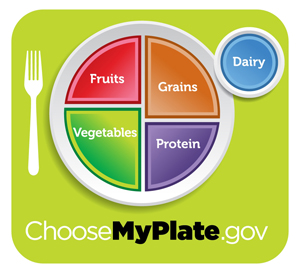
The new MyPlate icon–fantastic or plastic?

Everyone in the food press seems to be weighing in on the new replacement for the much-cursed USDA Food Pyramid in all (both?) its glorious confusion and obfuscation of real nutritional goals that might have (and should have) undermined the beef, corn, pork, corn, sugar, corn, and soy industries if they’d ever been presented honestly.

So where does that leave us? With ears of fresh corn that are more than 50 cents apiece in Los Angeles supermarkets, and the new…

USDA MyPlate logo

Already, the USDA’s MyPlate web site is in a certain amount of branding trouble (and of course, that’s what counts most in America): the Texas DMV had already bagged “MyPlates.com” for its vanity license plate division (highly unappetizing), and Livestrong.com already has its own well-established “MyPlate” food calculator and fan base. And those items come up first on Google searches. As in, the whole first page or more. The government site ranks way down the list and had to water down the impact of its original name choice with “choose” just to get a URL. Can it elbow out the competition just by bolding the “MyPlate” part?

What really counts are the food and nutrition opinion maker comments, though. And a lot of those are detracting in a nitpicking way that I think kind of misses the point.

The first thing they all have to say is that the plate looks dumbed down. Forgive me, but wasn’t the Food Pyramid’s unreadable and unusable design a large part of the problem? The MyPlate icon is simpler and more direct, and it names real food groups, not “Big Mac” or, on the haute side of things, any of Ferran Adrià’s foams. No wonder foodies and populists alike are wondering what it has to do with them.

A small sampling of the main arguments:

MyPlate: The Food Pyramid for dummies? (LA Times): Dr. Andrew Weil and others discuss what’s still wrong with the new icon. Weil says “fruits” could still include fruit juice, which is usually a useless sugar bomb in comparison with whole fruit, and he worries that the protein section, which comes with a guideline to eat 8 oz. of fish per week, might encourage unthinking people to increase their mercury intake since swordfish is on the guideline menu, as are some of the generally overfished popular species of fish. Weil’s not wrong about the fruit juice vs. actual fruit, but his hand-wringing about fish is really geared for well-off readers who can afford to eat much of it. All the fishes he names are Continue reading

Microwave Tricks: Make-Ahead Stuffed Shells

Stuffed shells in the microwave

Stuffed shells (shown here with plastic wrap for the fridge) cook up really quickly and easily in a microwave

This was the second try at a quick supper while juggling too many other things at once. The first half box of pasta shells I cooked in the microwave as I usually do but they ended up staying in the water much too long while I was busy elsewhere (lecturing my kid about waltzing out of the house without letting us know–Oy! I thought we had this down by now, but 10 is 10, with a lot of eye-rolling and forgetfulness and sudden impatience for all the ordinary rules).

When I returned to the kitchen, the bowl of shells had long since cooked, softened, soaked and turned to pasty shell-shaped mush–too far gone to rescue. Bleagghhh…I threw them out and started over. Luckily, a microwave cuts the time it costs to boil the water for a new batch, and I’d already made the stuffing and had some tomato sauce ready. This time, I decided to pay attention, and it came out fine.

If you have fewer distractions or better time sense than I do so you can catch your pasta before it falls apart, you can put together a number of good filled pasta casseroles like this one all (or at least mostly) by using your microwave, and they might take less than half an hour from start to finish. Two other examples–the very similar spinach lasagne I make with eggroll wrappers (same spinach/ricotta/feta filling, same microwave marinara but don’t cook the eggroll wrappers before layering them, and use two wrappers at a time, since they’re so thin), or even butternut squash or sweet potato ravioli with wonton or gyoza wrappers and a mozzarella-based cheese sauce. Once the shells are cooked al dente (still a little chewy, but not hard), the dish goes together in about 5 minutes and cooks just to heat it through.

Stuffed Shells in the Microwave

  • 1/2 lb or so dried large pasta shells for stuffing (about 20 shells or 1/2 box)
  • 1 recipe Microwave Marinara or about 1 c. of your preferred tomato sauce
  • pinches of fennel seed, dried or fresh thyme or oregano, and/or hot pepper flakes
  • shredded mozzarella for topping (optional)

Filling:

  • 2 c. low-fat or skim ricotta
  • 2 oz. or so crumbled feta
  • 1/2 lb defrosted/cooked spinach
  • 1/4 onion
  • 1 fat clove garlic, grated, minced or mashed
  • a few leaves shredded basil and/or thyme or marjoram
  • pinch or grating of nutmeg
  • 6-8 microwave-marinated artichoke hearts, optional

Put the shells in a big pyrex mixing bowl (2.5 qt or liter), fill with water to about 2 inches above the shells, cover with a microwaveable plate and microwave on HIGH about 9 minutes, or until the water is bubbling but not boiling over. Leave the shells in the microwave another 5 minutes to absorb and check for doneness–you may need another 2 minutes or so. When they’re just cooked through but still firm, drain them gently so they don’t tear apart.

In the bottom of a microwaveable casserole (in my case, a pyrex deep dish pie plate), spoon about 1/4 c. tomato sauce and spread it around. Sprinkle on the fennel seed, oregano and/or hot pepper flakes if using, or just mix them into the sauce before you start.

Mix all the filling ingredients together by hand. Stuff each shell with a soup spoonful of the filling and set it in the casserole–you can fit about 20 stuffed shells into a deep dish pie plate, maybe more if you pack them tighter than I did. Carefully spoon the rest of the sauce between the shells and if it seems too dry on top or your shells are parcooked and kind of stiff, drizzle a few spoonfuls of water, maybe 1/4 c. total, on the sauce but not on the shells themselves. If you’re using mozzarella to top the shells, sprinkle it on now and add a pinch of oregano if you like it. Cover the casserole with a microwaveable plate or lid and microwave 7-8 minutes on HIGH or until heated through. The cheese should be melted on top and the shells should be tender.

You can reheat the casserole the next day very easily–check to see if it feels dried out at all, and drizzle in a tiny amount of water (spoonful or so) if it does, then cover with a microwaveable plate and heat for 5 minutes on HIGH.

DIABETIC/CARB COUNT NOTES:

Barilla says their shells are 37 grams of carbohydrate per 5 shells, or about 7 grams apiece. Ricotta has about 3-4 g. carb per 1/4 c. serving (about 2-3 shells’ worth), so for 5 shells maybe 5-7 g. carb. If you use my microwave marinara, it has just tomatoes and a bit of onion, none of the commercial added sugars or starch thickeners, so negligible carb count per serving.

Total: about 45 g. per 5 shells, or about 8-9 g/shell.

Chickpea Crepes: Protein Inside-Out

Ever since Thanksgiving I’ve been thinking about the challenge of coming up with a proper vegetarian centerpiece for major celebrations–one with a single, unified dish cut up to share, something with protein, not just vegetables or grains, something with great complex flavor and no artificial ingredients.

This is apparently a tall order. For months now I’ve scoured vegetarian and vegan cookbooks in hopes of some serious suggestions and come up nearly blank. Perhaps it’s because most vegetarian cooking in America is based on southeast Asian vegetarian cuisines, which don’t emphasize centerpiece or “main” dishes as much as assortments of several smaller ones, none of which necessarily take the lead. Or because a lot of the nondairy, non-egg vegetarian cooking consists of beans, rice, tofu, seitan and vegetables–not a bad thing, but not usually pretty or convincing as a centerpiece and occasionally incomplete on protein or complex flavor (there’s an awful lot of salt or soy sauce in some of these cookbooks). The few centerpiece dishes with a meatloaf-style filling wrapped in puff pastry or phyllo or potatoes seem to include premade seitan (high in salt) and/or things like mushrooms or eggplant or spinach and nuts with a fair amount of starch for binder, which means you’re repeating starches between the filling and the wrapper and not providing much protein.

One solution might be to put the protein, or at least some of it, in the wrapper itself, so the filling can be flavorful vegetables and so on but not have to come up to the concentrated protein level of meat.

Chickpea flour crêpes are one such possibility, and they’re very easy to make. A bit stronger in flavor than ones made with wheat flour, they hold together well in the frying pan and come out thin, springy and wrappable without the need for eggs. They also take well to a Continue reading

Not Stone Soup

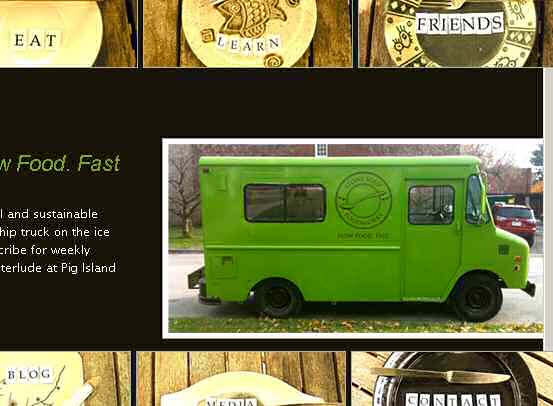
Stone Soup Foodworks of Ottawa

Stone Soup Foodworks of Ottawa, which also uses the slogan "Slow Food. Fast"--what can you do?

If you’ve come to Slow Food Fast looking for the little green Ottawa soup truck, I have bad news and good–I’m not them. (Don’t know whether that’s good or bad, but I’m in Los Angeles, so it’d be a bit of a schlep.)

The good news is that I have found the link to Stone Soup Foodworks for the lost and hungry Canadians among you and it looks pretty good. Like David Ansel of The Soup Peddler in Austin, Texas, Stone Soup’s Jacqueline Jolliffe is getting on a roll with “soupscriptions” as well as on-the-spot takeout soups, salads, etc. made of real ingredients, mostly local and organic.

Why soup? Because soup made from real ingredients, not packets and cans, is more than most people want to tackle at home, I think. Good soup, as both Ansel and Jolliffe say, takes time to develop. And especially in winter, a cup of real soup at lunch helps you push aside the irritations of the day for awhile.

Both Ansel and Jolliffe are doing something entirely different from what I do here on Slow Food Fast–they cook complex and difficult soups in large batches and sell them to subscribing and loyal customers who only have to pay for takeout by the cup or heat up a delivered quart of soup to have something good. That’s their idea of “slow food, fast.”

My idea of slow food fast is to cook a week’s worth, say perhaps 8-10 servings’ worth, of decent, inexpensive, from-scratch vegetable or bean  soup in as little time as possible, preferably in less than 20 minutes all told, with as much help as a microwave oven can reasonably give (which turns out to be a surprising amount, so why not) and without relying on salt to build flavor. And I want it to taste good.

Mostly, I want you to be able to do that yourself at home without feeling like it’s too much work or time and too many steps to cook and eat fresh real food–particularly fresh, inexpensive bulk vegetables–on a regular basis.

If you like to cook slow (say, on the weekend), you can do the artisanal thing at the stovetop for an hour or two. But if you want to get done in a hurry without having to babysit your pots and pans, microwaving is a pretty good, mostly safe, and comparatively very energy-efficient way to go, if you play to its strengths. You can let the flavors develop overnight in the refrigerator (and they generally will) instead of cooking and cooking and cooking just to get to the point where the vegetables are cooked through and then cooking some more to get the flavors to meld.

Case in point: Jolliffe makes a Thai butternut squash soup for Stone Soup Foodworks that looks delicious on the newsroom interview–but she has to cook her onion base down for 40 minutes, and either roasts the butternut squash for an hour in a conventional oven or–this is what she did on camera–buys sacks of precooked and puréed organic winter squash from a local farm. Granted you can do that–in the US, we’d probably just open a can of packed pumpkin, which you can now get organic fairly cheaply in most places, especially after last year’s shortages at Libby’s.

butternut squash ready to microwave

butternut squash ready to microwave

I guess the decision rests on her storage accommodations for the soup truck. But if she were to use a microwave, she could cook a fresh butternut squash–a big one–in about 10-12 minutes and then decide whether to purée or chunk the flesh for her soups, maybe pan-roast Continue reading