• Enter your email address to subscribe to this blog and receive notifications of new posts by email.

    Join 241 other subscribers
  • Noshing on

    raw blueberry pie with microwaveable filling and graham cracker crust

    This mostly-raw blueberry pie is a snap to make and very versatile--the filling microwaves in a few minutes, and you don't even have to bake the zippy gingered graham cracker crust--perfect for a hot Fourth of July and all summer long.

  • Recent Posts

  • Contents

  • Archives

  • Now Reading

  • See also my Book Reviews

  • Copyright 2008-2024Slow Food Fast. All writing and images on this blog unless otherwise attributed or set in quotes are the sole property of Slow Food Fast. Please contact DebbieN via the comments form for permissions before reprinting or reproducing any of the material on this blog.

  • ADS AND AFFILIATE LINKS

  • I may post affiliate links to books and movies that I personally review and recommend. Currently I favor Alibris and Vroman's, our terrific and venerable (now past the century mark!) independent bookstore in Pasadena. Or go to your local library--and make sure to support them with actual donations, not just overdue fines (ahem!), because your state probably has cut their budget and hours. Again.

  • In keeping with the disclaimer below, I DO NOT endorse, profit from, or recommend any medications, health treatments, commercial diet plans, supplements or any other such products.

  • DISCLAIMER

  • SlowFoodFast sometimes addresses general public health topics related to nutrition, heart disease, blood pressure, and diabetes. Because this is a blog with a personal point of view, my health and food politics entries often include my opinions on the trends I see, and I try to be as blatant as possible about that. None of these articles should be construed as specific medical advice for an individual case. I do try to keep to findings from well-vetted research sources and large, well-controlled studies, and I try not to sensationalize the science (though if they actually come up with a real cure for Type I diabetes in the next couple of years, I'm gonna be dancing in the streets with a hat that would put Carmen Miranda to shame. Consider yourself warned).

An Appreciation of Lox

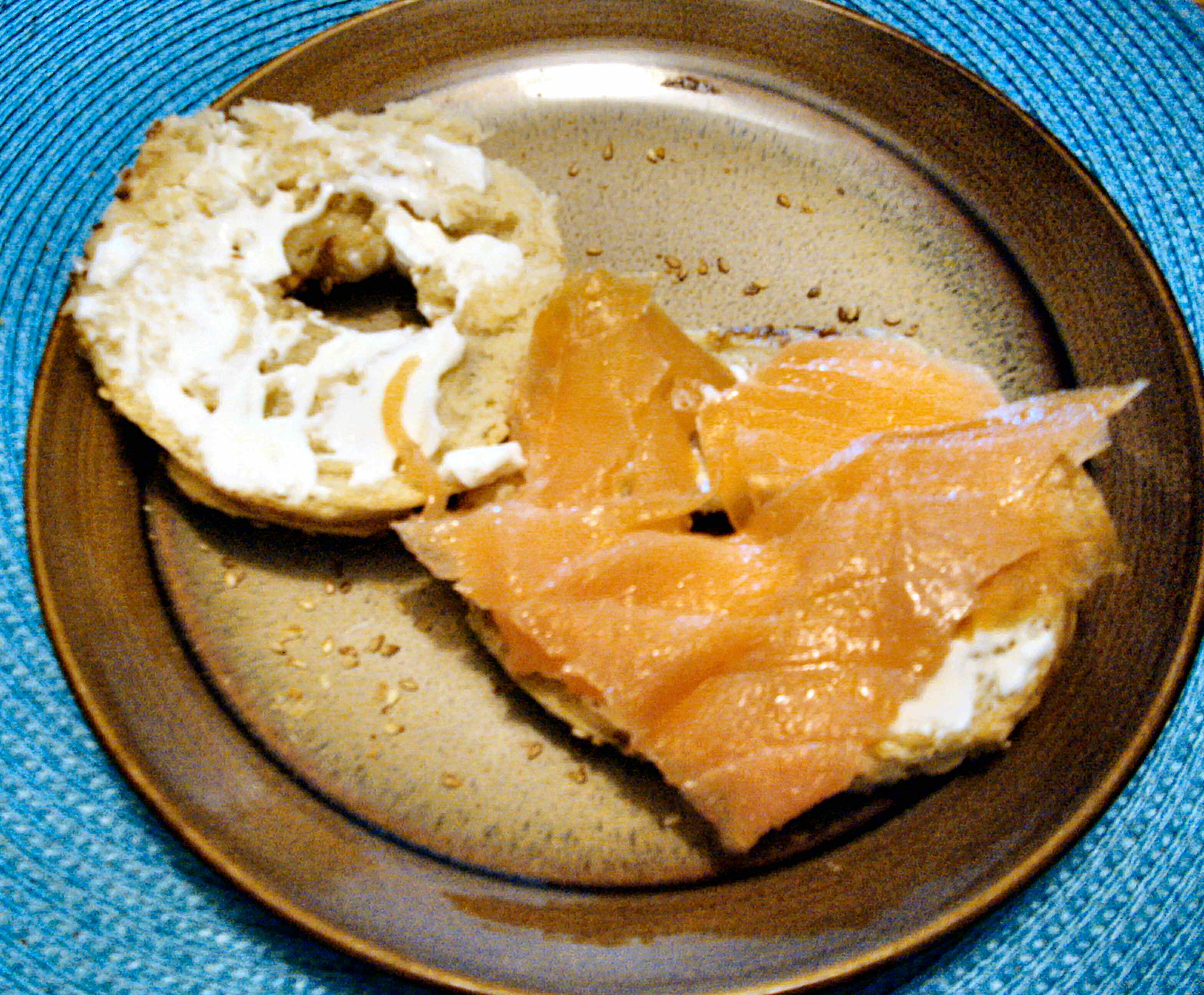
bagel with nova lox

Homemade bagel with nova from a local Los Angeles smoked fish company


For its annual Mother’s Day brunch, the Men’s Club at our synagogue always serves a surprisingly lavish spread with the woiks–lox, bagels, fruit salad, eggs and mimosas. Although I’m not a huge fan of big and slightly-kitschy gatherings featuring big and slightly-kitschy piano acts, I really deserved someone else making me a lox-and-eggs Sunday brunch right about then. But at the last minute I had to miss it in order to hock my kid about her last oversized ridiculous semester projects for 8th grade (due the next day, naturally). Better mothers complained to the principal, who just smiled nicely but did nothing useful. I just figured we’d get through it all so my daughter never had to be an 8th grader again. It worked–salutatorian, even–so, moving on but not required to give a speech: win/win.

But the lost lox! and the not having to cook or do dishes for Mother’s Day! Then I agreed to chaperone a school science camping trip the last week before graduation and  ended up with sand, grime, KP duty, outdoor showers, iffy Boy Scout Camp-style food, and not just one but 32 whole teenagers preoccupied with their hair and late to class.

So now that it’s all over I’m in serious need of payback.

My local Armenian greengrocer has locally-smoked nova lox (they have sable, too–I was tempted) and I had a bowl of dough in the fridge just sitting there waiting to be used up–so I made a few impromptu bagels the last Sunday morning of the school year, as soon as I’d gotten all the sand back out of everything and my kid was done with classes for the year. The bagels weren’t quite as dense as they ought to be because I used my standard pizza/pita/calzone dough instead of the genuine classic, but they did well enough because the dough was several days old, cold-proofed and straight from the fridge, and I boiled them before baking. And there was lox. Throw in a few once-over-medium eggs and some shmear and some fruit and hot coffee and you’ve got the ideal late-spring/early-summer breakfast, even if you have to make it yourself.

Now I know lox is a high-salt item–even the Nova. I anticipate it not for the salt, which I always think we could do with a little less of, but because it’s lox. A delicacy. Something to enjoy on the rare occasion when you get to celebrate. Something to treat with respect.

I’m not going to apologize for enjoying it, either. In the modern world of food publishing, people are forgetting how to do that. Even Jews. Maybe especially Jews, some of whom act as though our traditional deli and “appetizing” (bagels, cream cheese and smoked fish of all kinds) is suddenly something to shove under a rug or apologize for liking on the grounds that it’s not organic or locally sourced or Whole Foods or food-mag-trendy enough, and because it doesn’t include bacon or pancetta. Or kale.

The idea that enjoying lox simply because it’s lox isn’t cool enough anymore has gained a lot of traction in the past few years of foodieism. A couple of years ago, Martha Rose Shulman committed a serious travesty in the New York Times with “Lavash Pizza with Smoked Salmon” (she didn’t even call it lox). Toasted lavash is perfectly good for other things, but not for lox. Too fragile, and frankly too flavorless. I mean, why not rice cakes, as long as you’re being tasteless? But it wasn’t just the bread choice.

Somehow Shulman had abandoned the Joy of Lox. Shulman actually called her lox on lavash “a great way to work more salmon, rich in omega-3 fats, into your diet.” I have to ask, are most of us really having that much trouble “working in” more salmon? More to the point, does any lox fanatic really want to be thinking about fatty acids of any kind while eating it?

But at least she wasn’t agonizing over it as too Jewish. Mark Bittman pulled this inexplicable self-flagellation-in-print a few weeks ago in the New York Times, apologizing publicly for eating lox and bagels on a Sunday morning. In New York, yet. (Maybe it’s because he moved to Connecticut?) He’s kvetching about skipping his morning run, his usually-so-virtuous-but-betrayed-just-this-once-by-shameful-genetic-temptation stance on (gasp) farm-raised salmon, his devouring of shmear, which he says is too bland for the calories to like officially. He even had the nerve to blame his decision to eat it all on a sudden mental breakdown. And then he went further and called bagels and lox “comfort food.” As though it were in the same low-grade category as mac and cheese or mashed potatoes from a box.

Vey ist mir! I mean, come on. I’m pretty sure Woody Allen still eats lox without apologizing for it.

Bittman should be apologizing for being ashamed of enjoying lox (all the while glupping it). Along with apologizing for promoting pancetta and guanciale while professing a greener and more affordable diet. And for forgetting to add garlic to his recipes. That’s almost worse than deprecating lox.

More recently, Melissa Clark met with one of the scions of Russ & Daughters, which by now you’d think was the only serious lox and whitefish emporium left–it’s the subject of a documentary I just missed at the last LA Jewish film festival. The two laid out a spread for at least thirty or forty very lucky people, by my standards, but I think they were doing it mostly for a few family and friends–maybe 10-15 people–and posing it all on the table for the camera. It was beautiful but way too much. At least, though, she was both thrilled and nostalgic, the right way to be when faced with a complete beauty pageant of smoked fish.

Altogether, I could only think Shulman, Bittman and Clark all grew up in big cities with too much lox around. Because when I was a kid in the small-town South, we could only get lox twice a year when one or another set of grandparents came down from New York.

Other people’s grandparents bring toys. Ours brought pastrami, corned beef, half-sour kosher dills, pickled green tomatoes, real bagels, serious breads you just couldn’t get down South, and lox. All of them were special, not just to us but to our grandparents–real deli was part nostalgia, part roots, part pride, part simply great eats.

Pastrami and corned beef to go with the pickles and the tough, chewy pumpernickel and rye with the union label pasted on the end (you were supposed to fight for it)–these were the working people’s foods of their youth on the Lower East Side and the Bronx,  and they still loved them. And so did we.

My mother’s parents, born in the shtetls of Poland and Ukraine, came to America as children and, thank G-d [only instance of poverty being worthwhile], couldn’t afford to go back when their parents got homesick.

Fast forward to the ’70s: My Grandma Thel, short, plump but ladylike, coiffed, and wearing those pale oxford pumps I used to think of as librarian shoes, would step off the little regional plane in Charlottesville loaded down with huge grocery bags full of chewy, crackle-crusted bagels, Jewish kornbroyt or “corn bread” (a heavy European wholegrain sourdough; no actual cornmeal except what’s dusted on the baking sheets to keep the loaves from sticking), rye bread laced with bitter caraway seeds, sometimes a babka, and always, a huge half-wheel of her own light chocolate-flecked sponge cake (for which I’ve inherited the recipe but haven’t tried it yet–will post when I get it right). I hope the other passengers were smart enough to be jealous. The aromas alone should have clued them in. Grandpa Abe, of vishniak fame, was a lucky man.

On the drive home from the airport, Grandma Thel would tell me and my sister how she just managed to argue another customer at Andell’s or Goodman’s out of the last loaf of kornbroyt with seeds because she was bringing it down to her very special grandchildren so we would grow up knowing the real thing, and that the other lady Continue reading

Taking the chaos out of batch cooking

When my husband and I were much younger, we stayed a week with the children of some friends who wanted to go off skiing on spring break. In preparation, the mother batch-cooked a huge dutch oven each of chicken breasts and brisket for the week–just for their two young children and us. She left elaborate instructions about how to reheat it (I’m not sure she trusted us to know how to cook anything). I can tell you that even in my 20s I thought that was an awful lot of meat, and by the end of the week we were really, really tired of it. Even the kids.

On the other hand, a friend out here who has something in the range of adult ADD has a hard time cooking anything that takes longer than about 5 minutes because she’s so easily distracted she forgets to eat. Keeping track of multiple cooking steps  is genuinely daunting to her, as it is for many people with ADD and ADHD. She’s taken the expensive brown-rice-bowls and organic-microwaveable-freezer-meals-for-one route (keeping brand names out of it for the moment) but wishes she could find a better and cheaper way to deal with dinner. I suspect she wishes my east coast friend could supply her with a couple of dutch ovens’ worth of meals…

I bring up these two friends because lately I’ve started running across Meals-for-a-Month how-to books. They pop up every once in a while in the cookbook aisles of your favorite bookstore (or the 641 section of your local library). They’ve been reappearing since at least the early 1970s, when a major recession under Nixon led people to rethink their household budgets. Now these books are back in “For Dummies” and “Everything” versions, complete with tie-ins to About.com and other popular web portals.

The basic premise sounds ideal: shop and cook just once a month, the books promise, and you get a month of frozen real-food reheat-and-serve meals at your convenience, and you still save money. I keep hoping there’s some kind of solution in them for people short on time, cash and kitchen tolerance, but so far I’ve been disappointed.

Read one of these books and you quickly realize why almost no one follows them for long. First, if you hate to cook, you’re going to hate cooking marathons even more. Especially if they look like all-kitchen circus-style nightmares of boiling chicken and roasting AND stewing beef and slicing ham and cheese while also cutting vegetables while mixing sauces while separately packaging just enough gingersnaps for each package of the sauerbraten (assuming you even like sauerbraten or know what it is anymore) and finding the right sized bags and labels and and and and….

If you batch-cook the way these books suggest (in the intro section “game plan” complete with NFL-style charts), your once-a-month cooking scheme will probably take you all weekend (shopping alone is a full day) and wear you out from dawn til dusk. One weekend a month. I bet this is where most people flipping through to see if it’s the solution to their dilemma quietly shut the book, put it back on the shelf and edge away as quickly as possible.

These books also seem to replicate the worse aspects of frozen tv dinners, only without the convenience. The food’s too elaborate and long-cooking–mostly heavy meat stews and casseroles taken straight out of the 1950s Americana repertoire, and the scale-ups still only stretch to two or three meals for a family of four. If you go that route, you’d need ten recipes, and a huge freezer.

Also, there are no, and I mean no, shortcuts. I’ve looked. Each main dish is an hour or more by conventional methods. The reheats alone typically take at least half an hour and some extra cooking steps–and this is after having thawed the packages overnight in the fridge. Have the authors never heard of a microwave? Wasn’t avoiding repetitive, excessive cooking the whole point of once-a-month cooking? Do you really want to have to plan so much and follow so many steps–especially if you’re on the ADD end of things? Or even if you aren’t.

It would make so much more sense to simply buy a big resealable bag of frozen chicken parts and some bags of frozen vegetables and large cans of beans and tomatoes and boxes of spaghetti and relearn some cheap, easy and fast-cooking techniques from your college student repertoire. Wouldn’t it?

Needless to say, this is not the way people who traditionally have to cook big on a tight budget cook. Most people don’t have as much money at any one time as they’d need to pay for a month’s worth of food in a lump sum, nor do they generally have a dedicated extra freezer to fit it all in.

But batch cooking itself can work out and still treat you gently on a more modest scale. You just need to choose what makes sense to cook in multi-meal batches, and not do every possible big job all at once.

Unless you hunt and dress venison for the winter or have a garden with enough produce that you need to harvest and put up in bulk at the end of summer to keep it from spoiling, you don’t really need to do marathon-style cooking. Continue reading

Post-Kiddush: our leftovers are better than yours

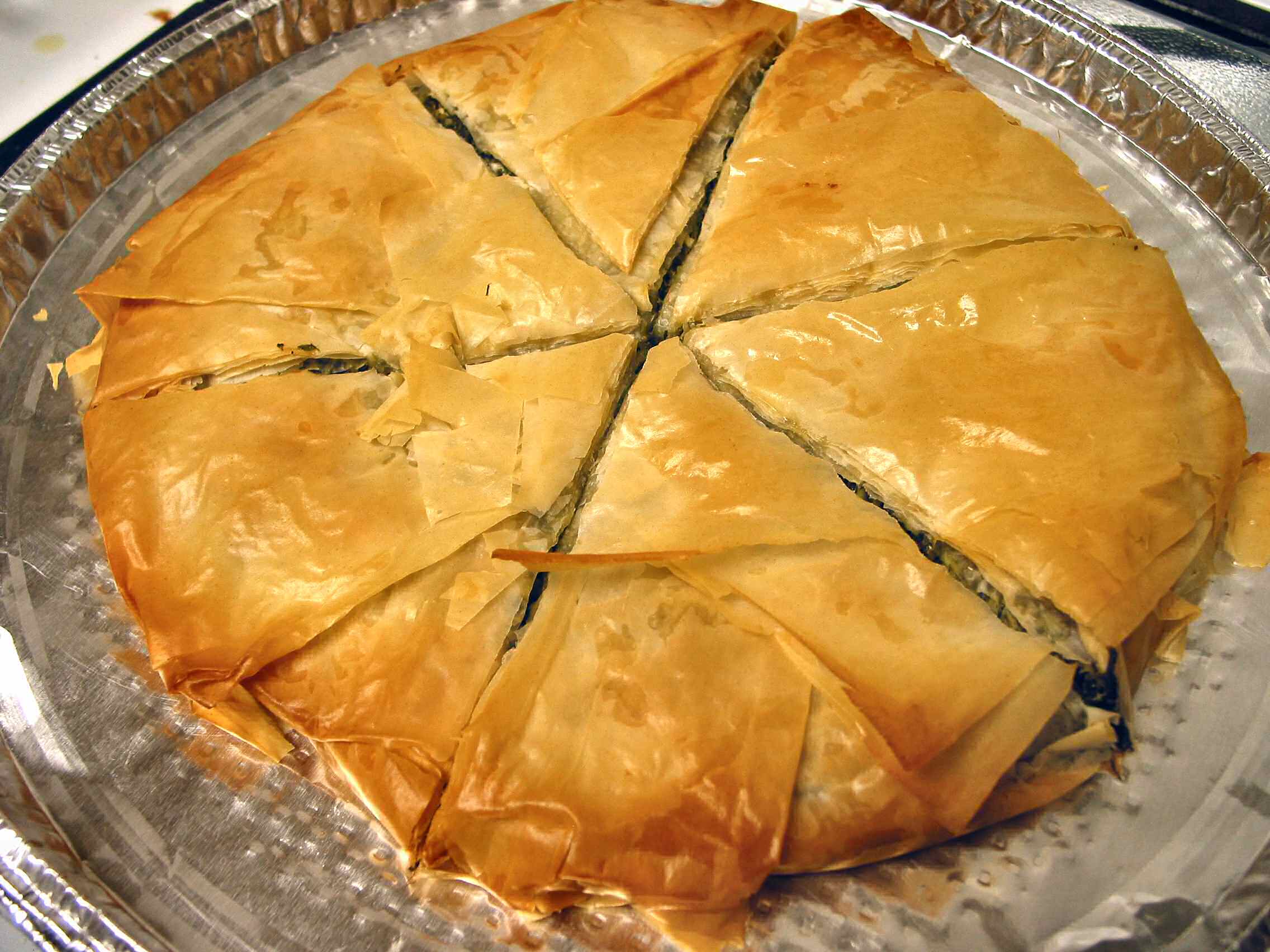
Round spare spanakopita just for us after the big kiddush

Round spare pinwheel-style spanakopita just for us at home. The big ones for the brunch had three pounds of spinach apiece (and were cut in small diamonds), but they still went together pretty fast–except for squeezing all that spinach dry…

This weekend I did it again–I made the kiddush, or in common speech a lunch buffet, for my congregation’s Saturday morning service. My husband kind of volunteered us for this week and because he doesn’t cook, most or all of the cooking, shopping, chopping and schlepping landed on my shoulders.

Last time he volunteered us, it was for our anniversary, and  I was ready to skip ahead to the divorce until I got over it, because it’s a lot of work to cook for 60 or so people who like to eat. And kibbitz. Especially when the 60 suddenly turns into 80-plus and having to use the synagogue kitchen with the more complicated and confusing rules on only a week’s notice. As they did this time…..

Soooo….a two-day hell of shopping and then marathon cooking-and-juggling in my little galley kitchen. The microwave got a serious workout. So did the food processor and the oven. Sometimes all at once. And it was raining hard for three days, so bringing things over to the synagogue kitchen as I went got a little tricky. I triple-wrapped the chocolate cake and stuck it in a USPS Priority Mail box so it wouldn’t get left out in the rain. Same idea for the spanakopita trays.

A few hints about cooking big and real for a synagogue brunch, learned the hard way by moi and passed on for your edification and safety (and sanity):

1. You can buy a 6-lb can  of chickpeas for massive half-gallon batches of hummus (Mid-East brand, maybe Goya as well). Cost? about $5. But–as I found out, and I’m glad no one was filming the process–industrial-sized can equals industrial-strength steel. A dinky hand-operated can opener is no match for such an item. I got just far enough to be able to pry open a kind of spout but there were tears and long-fluent-repetitive-all-throughout-the-house swearing sessions involved.

Still….

2. If you have a good corner greengrocer, you can buy quantities of eggplant for cheap–eleven or twelve eggplants made for a large tray of roast eggplant and onion slices (with garlic slivers and za’atar sprigs and olive oil) plus a large vat of baba ghanouj. Only the five eggplants I nuked for the baba ghanouj didn’t feel like cooperating fully when it was time to peel them. Might have been easier to peel first, then nuke, since it was all going into the food processor eventually. Next time…

3. Whole smoked whitefish for whitefish salad comes two ways–cold-smoked or hot-smoked. What’s the difference? I asked the counter guy at my favorite Armenian grocery. “Cold-smoked is a little less hard,” he said. So I bought it, thinking he meant the hot-smoked was tough as shoeleather and twice as chewy. I was wrong. Cold-smoked actually means the fish is smoked raw, like lox, only a little drier and tougher. But you don’t necessarily want to put it in whitefish salad that way. Man, it still had the scales on too. I couldn’t get it off the bones for love or money, and there were a lot of bones.

However, the microwave came to the rescue. I cut the fish in half and Continue reading

Starting with Breakfast

“The Well” blog at the New York Times has posted a new interview with pediatric endocrinologist Dr. Robert Lustig about his new book, the Fat Chance Cookbook, and about the possibilities for treating obesity in children with a better, less processed diet.

Two or three takeaways from the interview surprised me by echoing things I’ve either thought or written about here since my daughter became a Type I diabetic four years ago.

Almost always, we see an obese kid come in with an obese parent. And when the kid loses weight, the parent loses weight, because the parent actually changed what’s going on in the home.

We do something called “the teaching breakfast.” Every kid comes in fasting because we’re drawing blood. So they’re all hungry. They go to the teaching breakfast with their parents – it’s six families all at a communal table – and our dietitian spends an hour with them. The dietitian narrates exactly what’s on the table and teaches the parent and the kid at the same time….We make sure four things happen. No. 1, we show the parent the kid will eat the food. No. 2, we show the parent that they will eat the food. No. 3, we show the parent that other kids will eat the food, because they have other kids at home and they have to be able to buy stuff that they know other kids will eat. And No. 4, we show them the grocery bill, so they see that they can afford the food. If you don’t do all four of those, they won’t change.

Also, and I think this is my favorite:

…my wife is Norwegian… When she’s mad at me, she bakes…My wife has learned by experimenting that she can take any cookie recipe, any cake recipe, and reduce the amount of sugar by one third, and it actually tastes better…. And you can taste the chocolate, the nuts, the oatmeal, the macadamia – whatever is in it.

Right on!

Back to the top, though, I’ve got to say I love the idea of the teaching breakfast. My one concern is the reality of time cost for families with school-aged children, because eggs and vegetables, two of the (sometimes) inexpensive staples of the UCSF clinic’s teaching breakfast, take more time to prepare than a bowl of cereal, and require more cleanup. On weekdays, that might be a real challenge, especially for families with two working parents and/or long drives to school. A lot of the families I know in this situation (long drives and no school buses being a common problem in Southern California) are used to tossing their kids in the car with some kind of makeshift breakfast to eat on the way–often resorting to bagels, pop tarts, or bananas, none of which are great choices.

Perhaps if the dietician showed some simple microwaveable 5-minute meals like oatmeal or an easy vegetable-filled frittata (with some of the yolks left out) that can be made the night before and refrigerated? The plain yogurt with fresh fruit idea is also quick and simple but not especially cheap–these days a quart of plain non-Greek yogurt goes for $2.50 at Trader Joe’s, almost the same as a gallon of milk, and costs even more at the local Ralph’s (west coast Kroger affiliate), but it serves only 4 if each serving is a whole cup. Cereal with milk is a lot cheaper–but it could certainly be better cereal, high in fiber and low in sugar and salt, and measured by the cup or on a scale before pouring it into the bowl to make sure you don’t get more than you think you’re getting.

Cutting up fruit and vegetables takes time that parents usually feel they don’t have. And berries, which don’t need cutting up, are relatively expensive fruits, even when frozen. So showing parents a couple of “instantly grabbable” ways to serve the less expensive fresh (or fresh-frozen) fruits and vegetables instead of Froot Loops might be key.

A simple “just wash and nosh” approach would probably be a good start. I know I generally rail against buying precut, expensive little baggies of manicured (and dried out) vegetables in the supermarket, but the big bags of “baby carrots” that don’t require peeling and are finger-food size would be an okay starting point to get kids and parents to think about vegetables as a good snack or even breakfast choice. My daughter lived on them for lunches (along with a PBJ on whole wheat and an apple) for most of her grade school years, and even though she has (and will probably always have) a mean sweet tooth, she still seeks out raw green beans, wedges of red cabbage, roma tomatoes and broccoli or cauliflower branches to break off, rinse under the tap and nosh on after school.

Leftover Logic

Two weeks ago The Guardian‘s business section published the following salvo against glam-food waste: “Food’s latest hot trend: leftovers”. Some of the interviewed chefs, who grew up eating leftovers in the ’70s, have apparently joined forces with the Women’s Institute in York (shades of “Calendar Girls” and Helen Mirren’s shaky attempt at a Yorkshire accent) for a project to reduce food waste as supermarket prices continue to rise and rise.

Some interesting quotes in the article, and interesting questions on frugality–the columnist claims household food waste is down about 13 percent in the UK since last year, which is pretty telling about the economy. She and the people she quotes attribute the current lack of knowledge on how to use leftovers to a sharp decline in cooking skills that coincides with the surging popularity of perfect, coffee-table-worthy food fantasy cookbooks.

Is it really the fault of photo-heavy cookbooks, food magazines, blogs and tv cooking shows that only perfect produce makes the cut, and everything with a blemish on it must automatically be thrown out? Possibly…but the article also cites another trend–the heavy push of boxed microwave-meals-for-one that leads so many people to fear cooking and believe they could never be talented enough to cook from scratch.

Of course, if you never touch an uncooked bulk vegetable or a piece of raw meat, you never risk making a mistake in the kitchen. But the other side of the coin is that the produce in the magazines will never show up on your table. Because the frozen tv dinners really don’t come out looking or tasting as good as the pictures in the magazines.

If you do cook, the idea of using up what you have in the fridge can be nearly as daunting as having to pay for fabulous (and expensive) first-rate pre-sorted extra-polished pre-cut vegetables. In a branded bag. Can you eat less-than-perfect-condition food mag-quality decorator vegetables and still be safe?

Yes, you can. Obviously, when you go to buy vegetables, you want the best and freshest ones you can get for a reasonable price. Nothing you buy should be leaking or moldy or worm-ridden or otherwise clearly spoiled. But short of that, quite a lot of produce can be eaten just fine without having to be picture-perfect.

No one in the professional or amateur food enthusiast world ever talks about how to handle imperfect, wrinkled or slightly old vegetables, but they should. Because no matter how they look when you buy them, if you actually buy enough vegetables and enough variety for a week, some of your produce is going to start drying out or going a little less crisp or whatever in the later days. And you don’t necessarily need to throw it out because of that. Most of it you can probably still use and it will still be fine.

Local corner greengrocers often sell the oversized, undersized, riper or otherwise less-perfect-looking vegetables for a fraction of what they go for in big chain supermarkets. Customers at my local Armenian grocery routinely stagger out with huge bags of red peppers, onions, green beans, cabbages, eggplants, zucchini…all at a dollar a pound or less. Probably most of those vegetables are less than shiny-perfect. It doesn’t matter. The customers who lug them home are going to cook them up in large batches and short of actual spoilage, they’ll use them up.

And I myself did it today–foraged around in the fridge for the eggplants I bought last week. They were just starting to show brown dimples at the flower end. Not lovely but not a disaster. Then I found the less-than-great winter Roma tomatoes, a few of which were already starting to show little smudges of black at the stem ends because I’d had to store them in the fridge–no room on the counter, and I had them in a plastic bag that kept the moisture in more than was really good for them. Damn! I weeded out two that were clearly beyond saving–cracked and leaking slightly, not good–and took the others out to inspect. How bad were they?

Now the eggplants were only a little bruised or dimpled in a few places. Peeling off a little of the skin at those points revealed that the flesh inside was still okay. No worse than a bruised apple. Cut them up, microwave them, drain off the juices and fry them for eggplant-and-chickpea stew, and they’re just fine.

The tomatoes are a little scarier, no question. No one wants mold on their vegetables. But except for showing the tiny beginnings of mold at the stem ends, the six tomatoes I had left seemed fine and firm, dry and uncracked. Throw out six tomatoes at this time of year? I decided not to. I washed them carefully on the theory that the peel, if it’s unbroken, is working hard to seal out dirt and contamination and any mold spores on the surface can therefore be washed off. I sliced off the tops about half an inch below the stem ends–giving them a margin of safety at least in my mind.  Then I dared to taste a bit of the tomato below that. Also fine–or as fine as winter tomatoes get, anyhow. No sight, smell or taste of bitterness anywhere, and not mushy or discolored, and they tasted reasonably fresh. So I cut up the tomatoes and put them in the stew.

And everything was fine, and no one got sick or started convulsing (or screeching at the top of their larynxes) like Robert Plant at the height of his Led Zep days. This was fortunate, because we don’t yet have the larynxes back in shape after Losangelitis week, not to mention the stomach muscles, the tight jeans (well, the jeans are a little tight but not on purpose–we’re workin’ on it! hate those sit-ups) or the massive and tossable hairdo. Then again, neither does Robert Plant these days. So I don’t feel that bad about it. And neither should you.

Celebration Update: “Mashup” Does Not Mean “More Potatoes”

Two or three Thanksgivings ago I railed (as I often do) at the lack of imaginative and good-looking (both aesthetically and nutritionally)  vegetarian offerings for Thanksgiving main dishes. I wasn’t having a whole lot of luck being impressed by what I saw in the newsstand food glam magazines, vegetarian and vegan cookbooks, food blogs, my local newspaper food section, or even the freezer section of my local Whole Foods. So I came up with a list of suggestions for vegetarian centerpiece dishes.

This year, we had the double-double challenge: Thanksgiving fell on the first day (though only the second evening) of Chanukah for the first time in over 100 years (1860s was the last time?) and won’t again for another 77,000 or so (well, some sources say there’ll be another Thanksgivukkah moment in about another 100 years and then the big schlep out to 77K. Either way, for most of us, this is “that moment”).

For me, mashing up Thanksgiving and Chanukah just this once gives us some ideas for rethinking the kneejerk popular way of celebrating the big important holidays in general. Maybe even exploring what’s so vital about holidays and family and clearing away some of the thoughtless excesses.

Chanukah came so early this year that we had nearly no chance at buying or making tons of presents before having to schlep ourselves up the I5 to my in-laws’, so none of us was expecting anything but silly socks, a paperback or so, and maybe a stop in Solvang for Danish marzipan-based sweets on the way back home. That’s all to the good–Chanukah was never really meant to be a “more presents all the time” kind of holiday, it’s about freedom of religion, freedom from outside oppression, and gratitude for the miracle of having enough resources to go around. Thanksgiving is about those things too.

Unlike most years, I didn’t find a two-page checklist that Martin Luther would be jealous of, listing all the acceptable giftees our daughter wanted, posted on the fridge. Partly that’s because we wouldn’t be home to see it, and partly because she already had her bat mitzvah in June and she’s old enough now to feel like it’s more than plenty in the way of gifts. Plus by now she knows me–I have a strong tendency to roll my eyes and cross most of the stuff off the list with the familiar yearly litany of:

“Library…library…library…library…not wearable at school or synagogue, so what’s left, the mirror?…we have an unusually skilled cat and I don’t really want to think about hamsters in that context, do you?…library…library…not until you practice piano…I know I promised you could get your ears pierced eventually…maybe next month…”

It’s just a matter of practice. And a willingness to channel Sylvia (one of my favorite cartoon characters,  by the great Nicole Hollander).

Anyway, I have no idea if any of my ideas the last time I riffed on vegetarian centerpiece dishes gave someone else ideas–I hope so–but recently I ran across a vegan cookbook with dishes that look like they’d be just right for a celebration. It’s too late to recommend for Thanksgiving or Chanukah, but maybe for Christmas and onward? Continue reading

Advertising Vegetables–is it really so hard?

Michael Moss of the New York Times tells what happened when he challenged a prominent ad agency to come up with a campaign for broccoli. Fresh actual broccoli, no brand name. Which I’ve been hoping for years someone would do, but as I read his article, my heart sank. All the veg-phobia and all the typical slanders against broccoli raised by the vegetable-avoidant generation (now adults) quickly rose to the surface in the ad agency focus groups. Turning a corner on that would be an extreme makeover indeed.

So a little help on how to deal with the great green broccomonster:

Say “Celà n’est sûre[-gelée-]ment pas le cas”

Following on reports this spring that Polish (and probably other-sourced) horsemeat made it through France and into British frozen supermarket lasagne, now we get word of even more devious (and frankly depressing) culinary misdeeds in today’s Washington Post online:

French restaurants acknowledge serving factory-frozen food

A surprising number of cafés are apparently serving up microwaved meals instead of cooking them in-house. Even the éclair, which doesn’t take a lot of time to cobble together, even for an amateur like me, is no longer safe. The profit margin is too high on these items, and the savings in cooking staff are phenomenal. In a down market, what else would you expect?

But it’s a big embarrassment for a country that’s traded primarily on its gastronomic leadership for decades since WWII. No, WWI. No, wait–probably since the Napoleonic era. Or before the Revolution. Cyrano de Bergerac does a soliloquy based on cream horns and other such items, if I recall.

Well, to tell you the truth, though, I’m not sure whether I’m shocked or relieved. Judging from what my family and I were able to eat in 2006 in Paris, I’d say that in a few cases (cafés within walking distance of museum exits, chosen in part for meltdown-avoidance) frozen might even be a step up from one or two of the overpriced restaurant meals we had (a horrid, horrid “salade niçoise” featuring canned green beans comes to mind). Those few meals were, and I can be generous when I have to, mediocre in a way that would be excusable in suburban America on travel but which were much less than okay given that it was Paris.

Mostly we ate food that wasn’t (comparatively, anyhow) too expensive (we skipped the meat dishes, since we keep kosher) and couldn’t be frozen well enough to fool customers who know how to cook. So omelets cooked where we could see them, felafel served with freshly chopped red cabbage, open-faced sandwiches, breads from a bakery that smelled like yeast and flour, not like plastic bags, and so on. The frozen items tended to be ice cream, which is supposed to be frozen. But that was a year or so before the big bank crashes, the collapse of the housing bubble in America and “too big to fail” and even the Madoff scandal. And even then things weren’t quite as glam, at the moderate end, as we’d been primed for.

And on the other other hand, what does it mean that so many French restaurants have resorted to this kind of tactic, microwaving (and charging for) tuna steaks with ratatouille accompaniment, as in the article? What, other than money of course, and the effects of a deep recession that’s hit France pretty hard this past year.

What it means, in part, is that (also according to the article) flash-freezing techniques are now at a point, at least in France, where they can keep the food acceptable in quality and that the suburban factories where these dishes are put together and frozen are doing a pretty fair job, fair enough to fool even moderately experienced diners (not just tourists). And that the “restaurants”–who knows if they’ll get to keep that title now that they’ve been exposed–have figured out how to be at least marginally competent at microwaving so they don’t just ruin the food.

Better if they were cooking fresh. Or, from the perspective of an avid microwaver, better if they were using their microwaves for something more sophisticated than defrost-and-warm. Better, since so many of the younger working French no longer cook for themselves very much, if the restaurants, cafés and bistros took their role as gastronomic role-model and rallying point a little more to heart. Certainly they shouldn’t be pretending to cook from scratch and charging commensurate prices.

But I wonder–is the food they’re serving significantly better in quality than America’s mass-produced frozen meals-for-one? It might just be, since it’s a more recently introduced phenomenon in France, and it’s been designed to pass muster as though it were cooked fresh. For such a fraud to be successful, the flash-frozen food cannot be like American tv dinners. It just can’t. It might be that many of these factory-produced dishes are still a lot less processed than the miseries perpetrated by Swanson, Kraft, Stouffer’s and so on over here. So maybe we need to take another look at their techniques and demand better quality in the frozen food section here, foods that don’t have aroma of oversalted wet cardboard clinging to them once thawed.

Emergency eclairs

Note: this is not my photo–I have not been to the balcony of Notre Dame lately. I merely share their dismay. [Source: Brittanica Online, with gentle modifications for parody purposes]

You may be wondering what to do if you drop half your éclair over the balcony of the Eiffel Tower, or worse yet, Notre Dame, while pondering your options for the afternoon’s conquest…YSL first, or peut-être Dior?…ooh-la-la-oops!

AAAAAGGGGHHHH!

Screaming will not get your éclair back, though it is a good start. You need to get down to ground level and purchase another tout de suite!

No, this is not really me channeling Miss Piggy at her “Who, Moi?” finest. I don’t have the lavender satin opera-length gloves for it, for one thing. I’ve just been watching too many of the various Muppet movies with my daughter lately.

Plus, and let’s be honest about it, the one time I ever tried on a long blonde wig (for a college skit), I took one look in the mirror and fell down on the costume department floor laughing until my ribs hurt. It was 20 minutes until I could breathe again. Picture Danny deVito (his eyebrows, anyway) peering out from under that wig, hoping to stand in for La Porcette,  and you understand why Frank Oz can never, ever go on vacation.

I have not been to Paris in seven years, and when we were there (for an engineering conference, with our then-kindergartner) we did not actually eat any éclairs. We also did not shop at Pierre Hermé, nor at Hermès, nor anyplace that wasn’t either a museum, an RER or métro stop,  a café or a tchotchke booth along the Seine. Other than for food, if it cost more than 15 bucks (or 11 euros, as for example, the tiny 3-inch-long stuffed unicorn at the Musée du Moyen Age, which we paid for hastily during a shall-we-say-jetlag-inspired meltdown), it was out of the question. I actually spent two full hours–ON VACATION IN PARIS–sitting forlornly in a coin-op laundromat down the alley from our hotel, hoping I had enough change to get all the horrible perfumed detergent back out of our clothes, while my husband and daughter went to the park. Not exactly the Paris experience I’d imagined way back in my high school French class.

So what am I doing imagining that I could climb up OR down the Eiffel Tower in chic heels (instead of the more believable sneakers and backpack with the entire belongings of my family plus bandaids and extra sandwiches…), waving an éclair around with incredible nonchalance and somehow not lose it (which I’ve never actually done; I’m a fervent believer in pastry) or break an ankle (which I have actually done, wearing flats), or both, with loads of people looking on?

Who knows–daydreams like these are the kind of thing mentioning Paris does to one when one blogs about food or fashion. Practically obligatory. It’s fun to imagine a life where such trivial matters can leaven, not to say inflate, my expectations. And, of course, where I’m not the one who has to schlep all the emergency supplies up however many flights of stairs. And back down.

Let’s face it, I’m a natural pessimist and (therefore) fan of both the Muppets and Matt Groening. Tell me true, now, doesn’t the gargoyle on the right look like the original inspiration for that sad shrimpy one-horned character in Life is Hell? He’s even wearing my backpack.

Real life is hard, gritty for more serious reasons than high-heeled éclair mishaps, and it’s filled with nagging of the now-ex-7th-grader. Ahem! These are things we just have to get through because there’s no great alternative (…yet. I’m working on it, believe me.)

Eclairs, on the other hand, are not actually difficult to make. And eating them makes one feel a lot less like life is hell, particularly if one skips the high heels and eats them barefoot.

And on the other other hand, baking anything in Los Angeles, even in winter, may well make one feel that one is actually living in hell, at least while the oven’s on. And right now it’s June.

How to cope? Toaster oven? Microwave?! The eagle squawking in shock above left may not approve of my methods, but he’d find it hard to argue with the results. Especially if you’re in the mood for just a couple of éclairs Right Now, and you have ice cream on hand so you can skip the custard chilling and filling bit and go right to profiterole heaven.

The pastry for éclairs, called pâte à choux, or choux paste (shoe paste! I knew there was a connection to the sudden appearance of high heels in my daydream), takes only a couple of ingredients: flour, water, butter, sugar, eggs. Maybe a pinch of salt too, okay.

Everyone and their uncle (or aunt) who’s ever written a Frenchy kind of cookbook has a recipe for éclairs, but who do you know anymore who’s ever actually made them? Right.

But actually, they’re pretty easy to make. At least as easy as brownies from a mix, and they seem fancier. You boil the butter, sugar and salt with the water, dump in the flour and stir until it looks like stiff mashed potatoes, then take it off the heat and beat in the eggs one at a time and voilà, there you have the dough–shiny yellow stuff to pipe out or dollop out onto a greased and floured baking pan and bake at high temperature for about 30 minutes until they’re really puffed and brown and don’t collapse anymore when you let them cool.

David Lebovitz has the classic recipe on his web site — a cup each of flour and water, 6 T butter, 2 t sugar, 1/2 t salt, and 4 large eggs. Pierre Hermé of exotically-flavored-macaron fame has a richer one with more butter and 6 eggs for the same amount of flour. And I’m sure they’re wonderful. But I can’t help messing around.

First off, I want fewer than 24 éclairs–what do you do with the rest of the dough? (turns out you can pipe it and freeze it, then bake straight from frozen sometime later, or else freeze the baked shells. OK. But still.) So I cut David’s basic proportions in half. Limit the damage to the avoirdupois, I always say. Fewer situps required.

Second, the butter. I know éclairs are the ultimate Unalterable Classic French Recipe but…here starteth the messing around. Like I say, I can’t help it. Continue reading

What she said

I’m shocked, shocked I tell you. I’m about to admire and recommend an article by LV Anderson of Slate.com.

Against foodies: Alison Pearlman’s Smart Casual reviewed

Yes. LV Anderson, the Slate columnist/editor of “You’re Doing It Wrong” infamy, the one who so often makes unnecessary, fussy, time-consuming and sometimes even adverse recommendations for how to “fix” some fairly common and popular foods like chili or muffins. Or guacamole. I’ve disrespected quite a number of her columns over the past year or two, and so have many Slate readers.

But her review of local (LAish) professor Alison Pearlman’s new book on the shallowness of foodieism is really good. It’s thoughtful, sharp and thorough without being annoying.

Anderson has clearly been stuck in an awkward niche for a year or more; her cooking tips are not much to write home about but her book review is, so I’m doing it.