
• Enter your email address to subscribe to this blog and receive notifications of new posts by email.

    Join 241 other subscribers
  • Noshing on

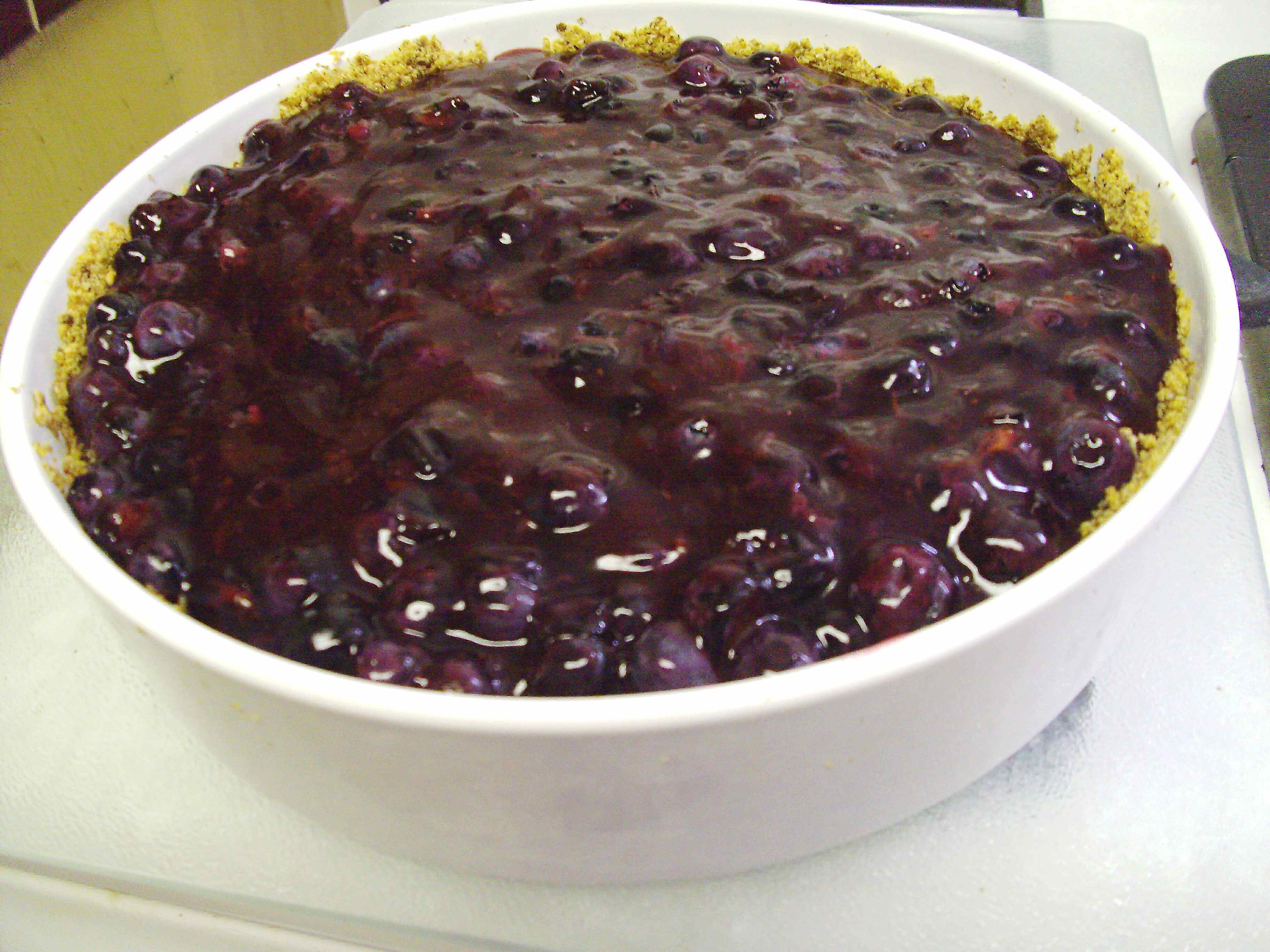
    raw blueberry pie with microwaveable filling and graham cracker crust

    This mostly-raw blueberry pie is a snap to make and very versatile--the filling microwaves in a few minutes, and you don't even have to bake the zippy gingered graham cracker crust--perfect for a hot Fourth of July and all summer long.

  • Recent Posts

  • Contents

  • Archives

  • Now Reading

  • See also my Book Reviews

  • Copyright 2008-2024Slow Food Fast. All writing and images on this blog unless otherwise attributed or set in quotes are the sole property of Slow Food Fast. Please contact DebbieN via the comments form for permissions before reprinting or reproducing any of the material on this blog.

  • ADS AND AFFILIATE LINKS

  • I may post affiliate links to books and movies that I personally review and recommend. Currently I favor Alibris and Vroman's, our terrific and venerable (now past the century mark!) independent bookstore in Pasadena. Or go to your local library--and make sure to support them with actual donations, not just overdue fines (ahem!), because your state probably has cut their budget and hours. Again.

  • In keeping with the disclaimer below, I DO NOT endorse, profit from, or recommend any medications, health treatments, commercial diet plans, supplements or any other such products.

  • DISCLAIMER

  • SlowFoodFast sometimes addresses general public health topics related to nutrition, heart disease, blood pressure, and diabetes. Because this is a blog with a personal point of view, my health and food politics entries often include my opinions on the trends I see, and I try to be as blatant as possible about that. None of these articles should be construed as specific medical advice for an individual case. I do try to keep to findings from well-vetted research sources and large, well-controlled studies, and I try not to sensationalize the science (though if they actually come up with a real cure for Type I diabetes in the next couple of years, I'm gonna be dancing in the streets with a hat that would put Carmen Miranda to shame. Consider yourself warned).

Lightening Up Apple and Almond Cake

Since Nigella Lawson’s Feast came out a few years ago, her “Damp Apple and Almond Cake” has been praised by food bloggers, morning tv show hosts, and just about everyone else who’s tried making it.

Most of her dessert recipes are not for the health-conscious. In the past 10 years, most of her food has become if anything a lot heavier and gooeyer and richer, migrating from Thai and Vietnamese summer salads with sharp clean flavors to avocado AND bleu cheese AND sour cream WITH taco chips, or chocolate bar AND non-natural peanut butter AND whipping cream AND caramel as an ice cream sauce. Or chicken pot pie WITH a lot of bacon in it and no vegetables AND a store-bought puff pastry top (a whole sheet goes for a mere two servings). I can’t think how far she’ll take things next.

But the  “Damp Apple and Almond Cake”–despite the less appetizing connotation of “damp” in American speech (I think “moist” would probably be the equivalent word over here, or at least I hope so. It would at least conjure up fewer images of seeping rot under the stairwell)……….. okay, where was I with all the parentheses? Oh yeah.

What people have to say about this recipe is that it works as written, and it’s really good. No mean thing these days.

So okay. I have almond meal, I have apples, I have a fresh lemon, and I have some decent vanilla for a change (the Kroger stuff I bought for my daughter’s birthday cake back in mid-summer was shamefully weak). And I have eggs. That’s basically what you need to make this cake.

But it’s blazingly, disgustingly hot, 100+ Fahrenheit, yet again in Pasadena. And–AND–I look at the original recipe (serves 10-12) and realize that while the almond meal is a good move–much, much lower carb than flour–the recipe requires 8 eggs. Eight. E-I-G-H-T. Which puts it in the European spongecake class of baking. My grandmother made a similar thing, only with flour and chocolate chips, and probably 12 eggs, for a huge wheel of a cake.

And the directions call for simmering the apples down to a thick applesauce, then cooling and blending in the food processor with a huge, heavy amount of almond meal and a fairly high amount of sugar and all the eggs, and it’s a “dense” cake. No wonder.

Three and a quarter cups of almond meal. Dense. And almond meal tends to require a little less sugar than flour-based cakes to register sweetness–maybe that could be cut down too?

Those eggs–do you need all the yolks? Do you need all eight eggs for that matter? And while you’re at it, why not take advantage of what eggs do best, since it’s a European-style cake with no other leavening. Separate them and whip the whites to fold into the batter.

So here was what I came up with on a hot September pre-Rosh Hashanah afternoon.

Lightened-Up Apple Almond Cake

  • 3 fairly big Granny Smith apples, peeled and sliced or chopped (~23-25g carb each or ~75)
  • 2 c. almond meal (see Trader Joe’s for a decent-priced 1-lb bag at about $4) (20 g carb/cup or 40)
  • 2 T. flour or matzah cake meal (~10 g carb)
  • 1 c. sugar (200 g carb)
  • 3 yolks
  • 4 egg whites
  • 1 t. vanilla
  • juice of a lemon
  • 1-2 oz. orange juice (optional) (~3-5 g carb)
  • grated rind of half a lemon
  • grating of nutmeg
  1. Put the apple slices or chunks on a microwaveable dinner plate and microwave on HIGH 3 minutes.
  2. Blend the almond meal and sugar in a food processor until very fine (whiz several seconds, good enough)
  3. Add the yolks, apples, flour or matzah meal, lemon juice and rind, vanilla, orange juice and nutmeg and blend well.
  4. Whip the egg whites separately in another bowl large enough to pour in the batter from the food processor. When the whites are stiff (can be done easily enough by hand in only a minute or so with a big balloon whisk, just tip up the bowl and hold it at a slight angle in your other hand, or else use your method of choice), start pouring the batter into them a little at a time and folding with the whisk. I know this is backward from the usual method but it works out ok and saves a third bowl…
  5. Pour into a deep-sided microwaveable casserole or a deep dish pyrex pie plate (chancy, may spill over a bit).
  6. Set a microwaveable soupbowl upside down in the middle of the microwave turntable. Center the casserole or pie plate on top, and microwave uncovered 7 minutes on 70% (for an 1150ishW oven). Stop if it seems to be overflowing and wait a minute before continuing. When it stops rising and settles back in the plate, you might cover with a dinner plate and microwave another minute or so on HIGH until you’re convinced it’s cooked all the way down to the bottom.

Cool and slice–the total carb count is about 325 for the recipe, so 1/16th should be about 20 grams, 1/10th, if you can eat that much, is 33 grams, etc. It’s light, soft, substantial and rich-tasting, and 1/16th slice was pretty good tonight for all the testers at my table. And it only took 4 eggs and a cup and a quarter less almond meal. And about half the sugar of Nigella’s recipe but all the apples.

Lightened-up microwave version of Nigella Lawson's "Damp Apple and Almond Cake"

Not a looker in the microwaved version here, which doesn't brown the top, and I didn't decorate with slivered almonds or lemon slices, but the flavor's so intense and tangy that the 1/16th wedges here were perfect for a quick light dessert.

Verdict—Really, really good, and when I do it again maybe I’ll have cool enough weather to try out the oven so it’ll brown as well (about 25 minutes). I would probably go for a deep-sided casserole or even a soufflé dish. Then I could top it with slivered almonds as in Lawson’s version, and perhaps capture a little more of the rise from the egg whites without it collapsing down afterward.

In a regular oven it’s best to oil the pan and dust it with a little almond meal, but I didn’t have to for the microwave–probably for the same reasons it doesn’t brown on top, it also doesn’t cause a lot of sticking on the bottom.

Another change I might make next time would be to add just a couple of drops of almond extract–not enough to overpower the lemon and apples, just enough to play up the almond meal. This time around when I reached for the little bottle I discovered it was bone dry–hence the nutmeg, which actually worked out quite well.

But all in all, and despite the fact that it LOOKS like a typical Passover choke cake, it really isn’t. It’s very moist and even this way the flavor was wonderful and satisfying. So b’te’avon (bon appétit in Hebrew) and kudos to Nigella Lawson, and maybe this will encourage you (and her) to lighten up a little.

Prunes, Lentils, and “Cookin’ Cheap”

When I was a kid, PBS, which had made a gourmet name for itself with The French Chef, decided that if one chef was good, six or seven had to be better. Suddenly the public and cable airwaves were  bursting with the Frugal Gourmet, the Galloping Gourmet, Yan Can Cook, Cookin’ Cajun, various shows with Pierre Franey and Jacques Pépin, and one…ummm…less glamorous show called Cookin’ Cheap.

This was hosted by Larry Bly and Earl “Laban” Johnson, Jr. out of Roanoke, VA–-not too far from where I grew up–and featured two viewer-submitted recipes per episode, which the guys bravely cooked and sampled on the air. At the end of each show, just like Julia Child, they sat down at the table for the tasting… and decided whose recipe had come off worse.

Now, Cookin’ Cheap was not for tenderfoots–if you couldn’t handle ingredient lists that included whole sticks of margarine and self-rising flour, or bring yourself to shop in one of the ordinary supermarket chains that had never heard of organic anything (this was the South in the ’80s), you would have done better not to watch. But if down-home cooking delivered with a touch of schadenfreude was your thing, it was a great little show.

Unfortunately, my favorite early episode doesn’t seem to be available anywhere on the ‘net. But the clip above, the Cookin’ Cheap 2.0 (YouTube) version of about a third of Episode #609, will give you some idea. (see copyright disclaimer below…)

In my actual favorite episode, Bly and Johnson hit their personal limit with a recipe that had them both making faces and apologizing to the audience that “there’s cheap… and then there’s too cheap.”

The dish in question was “Lentils ‘n’ Prunes” (you can guess the entire ingredient list). And it was indeed cheap. Unfortunately lentils, though incredibly cheap and nutritious, cook up kind of gray, especially on a semi-rural public TV station with early-’80s (i.e., yellow-ocher) set lighting. Trust me when I say the addition of mashed prunes did nothing for them aesthetically or otherwise. How on earth could they have put this on the air?

Of course, these guys didn’t have to take the blame for the recipe, and it was great entertainment to see some of the strange things your neighbors might be cooking at home and writing in to the show about with high hopes of being selected. I understand the Food Network is now copying Bly and Johnson’s reality-cooking formula shamelessly for the fall lineup…

[Actually, I didn’t realize the show had such a good run, but it started locally in 1981 and only ended its nationally syndicated run in 2002. Johnson passed away a few years before the end, but he managed to publish the Cookin’ Cheap Cookbook in 1988. Bly kept the show going with Johnson’s friend and successor Doug Patterson and has since made a couple of rescued episodes available on DVD. And the show still has fans on YouTube and — surprisingly just this March–in the New York Times.

Disclaimer: YouTube removed the first clip I linked to for copyright violation–so my apologies to Bly; the intent in linking here isn’t to rip anyone off but to highlight a too-little-known show. Because the original Roanoke station managers were too shortsighted to save the episodes (they apparently trashed them!), Bly was only able to rescue a couple of episodes for the DVD, and I think some of the others posted at this point were recorded at home from TV.]

Ah, well. Times change, horizons broaden, and we aim to challenge our palates in a sophisticated world beat kind of way even with limited cash and ingredients. The wolf may be at the door, we may be on the rice and beans yet again to make up for unreimbursed conference travel, but we are determined to do it in style–that means Indian, Moroccan, Mediterranean–French? Well, at least by not mixing plain lentils and prunes together in a hideous gray mash.

…I’m not actually sure how the French feel about lentils with prunes, or what they’d do about it if you suggested it. But I have a huge bowl of cooked lentils to deal with from a 1-lb. bag at $1.29. And a 1-lb. bag of non-sorbate pitted prunes at $2.99. Less than $5 total. And a number of ideas about how to deal with each of them, separately or together. Enough ideas that I’m probably going to have to split this post so it doesn’t turn into War and Prunes.

This, I think, is going to become my How to Cook a Wolf Challenge, 21st Century Edition.

Because I have fantasies (not many, and relatively tame though entertaining) of the Iron Chef America and Top Chef hosts announcing, for the next quickfire competition, a challenge to find three or four good ways to combine lentils and prunes in dishes where they’re the main ingredients and for which the total bill for the tasting menu comes to something like $10, including spices (prorated as used…) Can’t you just see the contestants’ faces? Take a moment to enjoy their obvious panic. The restaurant industry hasn’t trained them for this.

But seriously. What was actually behind this Cookin’ Cheap dealbreaker, other than the obvious frugality factor plus the even more obvious digestive humor that follows prunes and lentils wherever they roam?

Is there any way on earth that prunes and lentils could really go together?

Well…yes, as a matter of fact. You don’t run across prune and lentil recipes everyday, but good-tasting and intriguing variations, or at least the components of them, exist in a number of respected cuisines around the globe. Even French. For very little more than it cost the Cookin’ Cheap guys, Continue reading

Sweet Potato Ice Cream

Some time back I was bemoaning the lack of reasonably priced butternut squash at the height of the season in my local markets–I was clearly spoiled by last year’s bargains, or so I figured. So when I tried making pumpkin ravioli at home, I substituted yams, which were a lot more plentiful and much less expensive per pound.

But as it turns out, there’s more to the missing squash mystery than I realized. Just before Thanksgiving last year, Libby’s sent out a public warning that they were facing deep shortages due to heavy rains during harvest in central Illinois, where most of their pumpkins are grown. Heavy rains and soggy fields meant harvesters couldn’t get out every day to pick, and a lot of pumpkins mildewed on the vine and had to be plowed under. Oregon’s organic pumpkin growers, who had an unusually good crop, were able to  step in as an alternate source for buyers running short, but organic pumpkins are still only a few percent of the national consumption each year.

Following on a short crop in 2008, the Midwest is looking for a better harvest this fall, but right now the shortage is pretty noticeable on store shelves. A global produce outlook web site even posted a recent factoid that, at the moment, Libby’s remaining inventory of 100% packed pumpkin stands at something like six cans. Six.

According to the article, people have been bidding up to $30 a can on eBay for those extras you probably squirreled away in the corners of your pantry and never got around to making.

But it still doesn’t explain why winter squash was so scarce and expensive in California this past year–unless our supermarkets were importing all the way from Illinois as well. Hmmmph.

Where’s the Charlie Brown Theme Song when you really need it?

In any case, yams and sweet potatoes nearly the size of footballs have been pretty plentiful in Southern California, and cheap with it. There’s very little waste on a sweet potato–just the peel, usually (or buy organic, if you can find them, and scrub them well before cooking so you can eat the peel too).

So I’ve been finding a place in my refrigerator for them and microwaving them in a lidded pyrex bowl or casserole with a little water in the bottom for about 8-10 minutes (for a big one). Because I don’t like the prospect of nasty kitchen accidents, if I can’t cut into them easily right away I wait to split these monsters in halves or quarters about 6 minutes into the cooking time, when they may not be fully cooked yet but at least they no longer require an axe.

Sweet potatoes and yams substitute pretty well in standard pumpkin pie recipes, but you generally have to bake twice as long as for the canned pumpkin, which has had a lot of the water cooked out before it was packed. They also make  good fillings for large ravioli–pretty easy with wonton or gyoza wrappers, and microwaveable too.

But…it’s now June in Los Angeles, which means “June Gloom” overcast cool weather in the morning, burning off to the mid-90s by lunchtime. And my daughter looks at the huge quarters of yam cooling on the counter and says, suddenly, “I wish we could have pumpkin ice cream instead.” I think about it and decide I wish that too.

I have buttermilk, regular milk, sugar and a variety of pumpkin pie-type spices on hand. I don’t think I’ll need eggs because the sweet potato has so Continue reading

Microwave Cheesecakes

Microwave cheesecakeThis week we celebrated Shavuot, the feast of first fruits and giving of the Torah at Mt. Sinai. Shavuot has only two solid traditions I can remember from childhood: studying all night (three ultra-dedicated guys from my congregation would hang out and do it for the rest of us, kind of like the Jewish Scholarship Marathon), and eating cheesecake. Which is a pretty good tradition, actually.

I go for the serious New York-style tall, lemon-tinged cheesecakes that are rich and just dry enough to have a fluffy crumb to them. The only one of these I ever made myself was the glorious one from (once again) Joan Nathan’s The Jewish Holiday Kitchen. It was huge, it was beautiful, it took two whole hours of baking with the oven on and off, and I was just barely smart enough to wrap it tight in a double layer of heavy-duty tinfoil  right before carrying it out to the car for a brunch setup. Because of course it took a nosedive onto the parking lot pavement–but the foil held up! And the cheesecake was only a little bashed! And we covered it pretty liberally in sour cherry jam, and everyone ate it happily, and no one kvetched. A miracle!

The story of how G-d gave the Torah law to the Jewish people on Mt. Sinai, is kind of hard to picture. Supposedly it was all so shockingly loud and bright people started to hear colors and see sounds (or else the lightning was so close it started to short out their neural circuits). But what is clear is that  everyone was so awed and shocked they stopped arguing, at least for a few minutes.

So of course it has everything to do with today’s topic, which is still cheesecake. It’s an established fact–feed cheesecake to your people and you’ll get a few minutes of blessed silence. It’s quicker and cheaper than group electroshock therapy, too, and it tastes better.

So I’d wanted to make a cheesecake for Shavuot, but not take two hours about it, especially in May in Los Angeles. Also, cheesecake is  a traditionally loaded food–one look and you can hear your gallbladder calling you.  But it’s a real challenge to make a decent-tasting, genuinely low-fat version that isn’t just “use neufchâtel and cut out 3 calories!” Or else hideously tough or gelatinous or watery or flavorless or grainy or otherwise weird.

Drained nonfat yogurt–no. Tough, tangy AND watery after baking. Ricotta–not bad, especially for Roman-style cheesecake, but bland and a bit grainy. Gelatin’s out for me because it’s not a kosher ingredient. Fat-free cream cheese–I’m just not a fan, it’s too salty and processed-tasting somehow. Not fresh. And on the web I’ve seen everything from tofu to tehina (sesame paste)–I can’t imagine, but to each his or her own.

Still, I think with the microwave I’ve got the time thing solved in a way that will work for a number of different versions. A while back I discovered you can take pretty much any standard New York-style cheesecake recipe (eggs, flour, cream- or other suitable cheese, vanilla, lemon juice), put it in a microwaveable baking dish, cover and nuke it through in a couple of minutes without ruining the texture. It’s probably better without a crust, but if you prebake the crust then pour the filling, cover, and nuke while it’s still hot, it might prevent sogginess.

The only versions that might be really troublesome would be ones with yogurt, which is usually too thin and watery even when drained, or else cottage cheese, which works in a conventional oven but not the microwave. For some strange reason cottage cheese curd liquefies into a buttermilk-like mess in the microwave rather than setting up. Frustrating. But ricotta works pretty well, cream cheese–of course, labaneh–astoundingly perfect, and even…nonfat powdered dry milk (NFPD) with buttermilk. Odd but true. So it will work with a range of adaptations from full-fat to ultra-lean, and the rest is up to your tastebuds. Continue reading

Oranges as a savory

Artichoke-Orange Salad

Oranges in a savory compote with artichoke hearts

A few weeks ago, I ran across a food article by Amanda Hesser, in which she recounted her recent experience of being served a green salad with red onions, Greek olives, and oranges in it. What struck me was the way she fumed at length over having missed out for so long on this simple culinary classic.

I grew up in a Jewish household in the early 1970s, at about the time when felafel and hummus and tabouleh started making their way west into American Jewish cooking. These, along with pita, tomato-cucumber-pepper type salads and eggplant everything, were part of the larger Jewish cultural revival after the Six-Day War. Jewish cookbooks started embracing the Lebanese, Sephardic, North African, and Persian influences on Israeli food as a complement to the more familiar Ashkenazi fare. Orange salads just seemed to fit in.

In any case, orange salads have been published in Jewish and Mediterranean-leaning cookbooks for at least 25 years–notably Paula Wolfert’s Couscous and Other Good Food from Morocco, one of my first cookbook purchases once I came back from my own year as a kibbutz volunteer.
Three orange salads

The simplest orange salad I make is a basic green salad with oranges rather than tomatoes, and it goes well with oil-and-vinegar or mustard vinaigrette. Another, more of a fruit salad, is orange and/or grapefruit segments or slices mixed with a dressing of a cup of yogurt, a spoonful of ordinary red wine vinegar, a spoonful of sugar, and curry powder to taste, maybe half a teaspoon or so, enough to make it yellow-orange and aromatic, not enough to be bitter.

Another more elegant take on the green salad is something I made a few times in my early cooking days for buffet lunches at my synagogue–orange slices sprinkled sparingly with orange blossom water and a grinding of cardamom, laid down in overlapping rows on a bed of vinaigrette-dressed romaine in a tray, and red onion rings, sliced Kalamata olives, red bell pepper rings, crumbled feta, and chopped fresh basil strewn over the oranges. It was a bit much for serving at home, but it made a beautiful buffet dish, and it always got eaten.

So oranges can serve quite nicely in fresh salads, but what about in hot dishes? There’s the rub.

Orange peel I have no trouble imagining in hot savories–a number of Chinese classics use it (beef with orange peel, etc.), and so does duck à l’orange. Cooked oranges, on the other hand, always disappoint me–somehow the structure collapses, the color fades, and so does the bright acidity. They end up pulpy and stringy and less than half as good as fresh raw pieces would have been. But people persist in cooking with them–so I thought I would give a different Paula Wolfert cookbook a try.

The Slow Mediterranean Kitchen: Recipes for the Passionate Cook
(2003) features one really unusual orange-based savory: an Algerian Jewish sweet-and-sour compote of artichoke hearts and orange sections glazed in orange juice. With garlic and olive oil. Hard to imagine–does garlic go with oranges?–but so close to my standard marinated artichoke hearts, at least theoretically, that I decided to chance it and see. Continue reading

Adventures with Cheese, Part II: Paneer in the Microwave

Paneer is the fresh white curd cheese used in Indian dishes like saag or palak paneer, aloo mattar paneer, and so on. Panela or queso fresco are okay substitutes, if you can get them, and they taste a lot better than tofu.

But you can also make paneer very easily (if a bit messily) at home in a few minutes, if you have a pyrex bowl, a microwave, and a colander. If milk is going cheap in your neighborhood market this week or you have half a gallon that you really need to use up quickly before you go on vacation, making paneer isn’t a bad way to do it.

You’ll get about 5 oz fairly dry curd for a quart of milk, so not a great yield, but it’s pretty versatile. Whole milk makes a richer cheese than skim, obviously, but both work okay. Press the curd hard when you drain it and it’s sliceable. Press lightly and it’s spreadable. If you use a quart of buttermilk on its own rather than mostly milk, you can blend in a little garlic and some herbs and a drop of olive oil to the drained curd, and you’ve got something close to Rondelé cheese spread.

And don’t just toss out the whey–it still has a lot of soluble smaller proteins and calcium in it, so it’s worth keeping if you can use it within a day or so. You can use some of the warm whey instead of water to make a moist, chewy-textured Italian-type yeast bread (whey is extremely good for rosemary focaccia). Or puree the whey with some lightly cooked broccoli or cauliflower or canned pumpkin, a bit of onion or garlic, and some marjoram and/or thyme for a quick fresh cream-of-vegetable soup.

Paneer from scratch (makes about 5 oz, can scale up if you prefer)

  • A quart of milk
  • 1 cup of buttermilk if you have it
  • juice of a lemon

1. Pour everything into a 2.5 qt. pyrex mixing bowl, mix, and microwave on HIGH about 5 minutes, until the milk solids separate from the clear yellow whey. The solids should float in a mass and be pulling away from the sides of the bowl.

2. Take a colander or strainer over another large bowl, line it with a couple of layers of cheesecloth or 3-4 overlapping round paper coffee filters, whatever works for you. Carefully pour the whey over first, keeping the curd back in the bowl with a serving spoon or spatula for as long as possible, until you’ve poured most of the whey through (otherwise it takes forever to drain…). Then drain the curd on the filters and press it until it’s fairly firm and could be cut into cubes without crumbling apart.

Microwave tricks: Quiche in 15 minutes

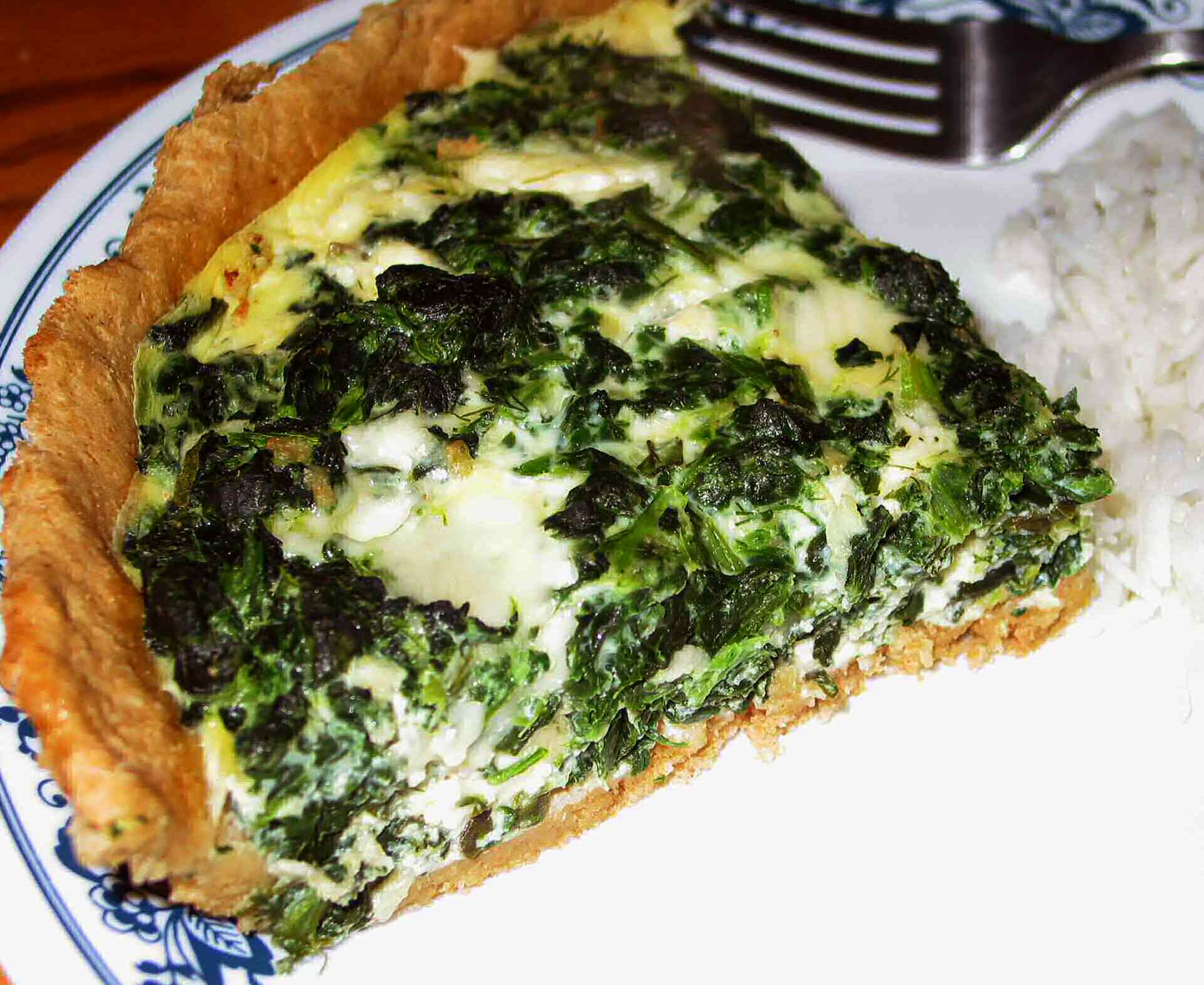
Spinach quiche in 15 minutesNo. Not kidding. Not even a little. This actually works, and comes out tasting much better than I ever expected. It rescued dinner last night, to tell you the truth.

I’ve made a lot of strange things with a microwave oven in my time. Honeycake, rice, taco chips (not recommended–it worked beautifully but I’m pretty sure that’s what shortened the life of my last microwave), pasta, dulce de leche, lasagne, baba ghanouj, beans, dolmas, flan, marmalade, rolls, even paneer from scratch. Sometimes I really need a quick method, sometimes I’m just fooling around to see what’s possible, but much of the time it actually works. Usually the first try is good enough that it’s worth either repeating as-is or fine-tuning to get it closer to what you want. This one I didn’t have to fiddle with at all–it just worked.

If you’ve got a reasonably modern microwave (1000 to 1200 W), a pyrex pie plate, a microwaveable dinner plate and the basic ingredients for quiche, you’re in business. All with real and very ordinary quiche ingredients, and no odd cooking methods other than the use of a microwave instead of a standard oven.

The olive-oil-based pie crust itself I made and parbaked in a regular oven for 10 minutes while I prepared the filling and custard. Continue reading

Cheese sauce, better than instant

Cheddar cheese sauce, easier than instant

This cheddar cheese sauce for pasta or vegetables goes together beautifully in about 5 minutes from start to finish, and tastes like cheddar with savory accents, not processed cheez-flavored glue. None of the ingredients come from a box.

And on the other hand, you don’t have to make a roux of butter and flour first, you don’t have to stir out the lumps when you add the milk, and you don’t have to worry about grating your knuckles in with the cheese. Give this one a try.

Home made 5-minute cheddar cheese sauce

  • 2-3 oz sharp or extra-sharp cheddar
  • 1 oz low-fat mozzarella (optional)
  • 1/8 to 1/4 med yellow onion
  • small clove garlic, minced/grated/mashed
  • 2 T (heaping soupspoonful) flour
  • 1 c. skim milk
  • grating or pinch of nutmeg

Grind the cheese, onion, garlic and flour in a blender or food processor until the cheese and onion are finely grated. Blend in the milk. Pour the mixture into a saucepan or frying pan and heat on a medium flame while stirring with a spatula or wooden spoon. The cheese will melt and the flour and milk will thicken within a minute or so. Grate on the nutmeg, stir in, serve over pasta or broccoli-type vegetables. If you have to wait for the pasta or vegetables to finish cooking, take the sauce off the heat as soon as it comes together, and reheat a moment or two while stirring to revive it once you’re ready to serve.

Matzah Brei–blintzes?

Matzah Brei Blintzes

Thursday morning I broke down and decided to cook  breakfast for my daughter instead of leaving it at matzah, jam, yogurt and fruit. I’m not a big fan of matzah brei, a poor substitute for french toast in which the eggs never really seem to absorb very well and you’re left swallowing the hard corners of the matzah. Neither crisp nor soft, it always seems like a wrong turn to me.

On the other hand, I didn’t have any matzah meal in the house for pancakes (how much extra matzah product do you really need when you’re trying to eat less of it?) So I broke down and took a couple of sheets of the whole wheat matzah from the latest box and prepared to do battle.

I think I’ve mentioned once or twice that I hate waiting for water to boil. But a pyrex pie plate with half an inch of water in the bottom takes only 2 minutes to heat up fairly well in the microwave. And it has room for the matzah, which I broke up into halves. But whole wheat matzah doesn’t soak up all that well, even after several minutes in hot water. It’s the tougher bread of affliction. What now?

I fished out a dinner plate and covered the pie plate with it, stuck it all back in the microwave, and hit stun for another minute. To my surprise, it worked–really worked. The matzah didn’t fluff up or anything–but it was soft and pliable and even a bit elastic, something like just-cooked lasagne noodles. No hard corners. I drained off the hot water and poured on the egg-milk soak, which didn’t really soak in much even though the matzah was now soft. Sigh.

My daughter came around a corner, looked at me fishing one of these matzah halves out of the pie plate, and said, “I wish we could have blintzes” and I thought–well, these actually bend–could we? Why not?

Matzah brei blintz ready for frying

Matzah brei blintz, ready for frying

Continue reading

Not Gefilte

For most American Jews, gefilte fish is one of the standard, unchanging preludes to the actual dinner part of the Passover seder. And normally I have no problem with that, especially with hrein, or horseradish. By the time the recitation of the Haggadah and the explanation of the items on the seder plate are done, everyone is joking about (or egging on their kids to pipe up and ask) the Fifth Question: When do we EAT??? And gefilte fish is the first answer.

It’s worthwhile to be hungry enough for once to feel, rather than just nodding as someone tells you self-righteously, that such a modest dish, made with fresh fish in the days when most of our grandparents and great-grandparents were too poor to eat it often, can be something to look forward to.

Gefilte fish is basically an oversized quenelle of ground whitefish and pike, filled out with eggs, onion, and matzah meal to stretch it. Simmered in fish stock for a couple of hours with or without added sugar, cooled to let the broth gel, served room temperature or cold, with horseradish as contrast.

But since most of us don’t make our own gefilte fish at home anymore, it’s usually bland, salted (and sometimes sweetened) ovals of stuff pulled from a pricey store-bought jar–no longer what you’d consider fresh, and no longer economical. And it’s usually about twice as big as any normal/sane appetizer for a meal that’s going to include brisket, chopped liver, meatballs, eggs, chicken and/or turkey, and other big proteins.

Can it be made well fresh? Yes, actually, and a number of Jewish cookbooks–Joan Nathan’s among the leaders–tell you how. But do I want to cook it myself, or eat it any other time than at someone else’s seder? No. Flat out, no. Not only is it a two-hour-plus process, it’s a big chore. All for a mediocre, bland kind of fish dumpling.

The other problem this year is that my daughter is now diabetic, and for the first time I’m going to have to help her count carbs so we can give her the right amount of insulin for a seder meal that will probably last over two hours. It’s tricky enough to do that accurately for a restaurant meal–desserts, which come last and for which the menu isn’t usually even presented until you’ve already eaten the meal, are by far the hardest foods to estimate by sight.

But traditional Ashkenazi-style seder dishes like gefilte fish and matzah ball soup are stuffed full of surprise carbs too, and you can’t be sure how much they contain unless you’re the cook. And that’s not counting the mandated matzah and haroset. All you can say is, all that matzah meal really starts to add up. Will my daughter overrun her carb count before she ever gets to the meal itself, with a chance to risk it on (more matzah-filled) desserts?

If I cook some kind of fish during Pesach week, I want it to be fresh and without much in the way of carbs. Most of all, I want it to taste good. Actively good. Continue reading