

• Enter your email address to subscribe to this blog and receive notifications of new posts by email.

    Join 241 other subscribers
  • Noshing on

    raw blueberry pie with microwaveable filling and graham cracker crust

    This mostly-raw blueberry pie is a snap to make and very versatile--the filling microwaves in a few minutes, and you don't even have to bake the zippy gingered graham cracker crust--perfect for a hot Fourth of July and all summer long.

  • Recent Posts

  • Contents

  • Archives

  • Now Reading

  • See also my Book Reviews

  • Copyright 2008-2024Slow Food Fast. All writing and images on this blog unless otherwise attributed or set in quotes are the sole property of Slow Food Fast. Please contact DebbieN via the comments form for permissions before reprinting or reproducing any of the material on this blog.

  • ADS AND AFFILIATE LINKS

  • I may post affiliate links to books and movies that I personally review and recommend. Currently I favor Alibris and Vroman's, our terrific and venerable (now past the century mark!) independent bookstore in Pasadena. Or go to your local library--and make sure to support them with actual donations, not just overdue fines (ahem!), because your state probably has cut their budget and hours. Again.

  • In keeping with the disclaimer below, I DO NOT endorse, profit from, or recommend any medications, health treatments, commercial diet plans, supplements or any other such products.

  • DISCLAIMER

  • SlowFoodFast sometimes addresses general public health topics related to nutrition, heart disease, blood pressure, and diabetes. Because this is a blog with a personal point of view, my health and food politics entries often include my opinions on the trends I see, and I try to be as blatant as possible about that. None of these articles should be construed as specific medical advice for an individual case. I do try to keep to findings from well-vetted research sources and large, well-controlled studies, and I try not to sensationalize the science (though if they actually come up with a real cure for Type I diabetes in the next couple of years, I'm gonna be dancing in the streets with a hat that would put Carmen Miranda to shame. Consider yourself warned).

A Handful of Farina Breads

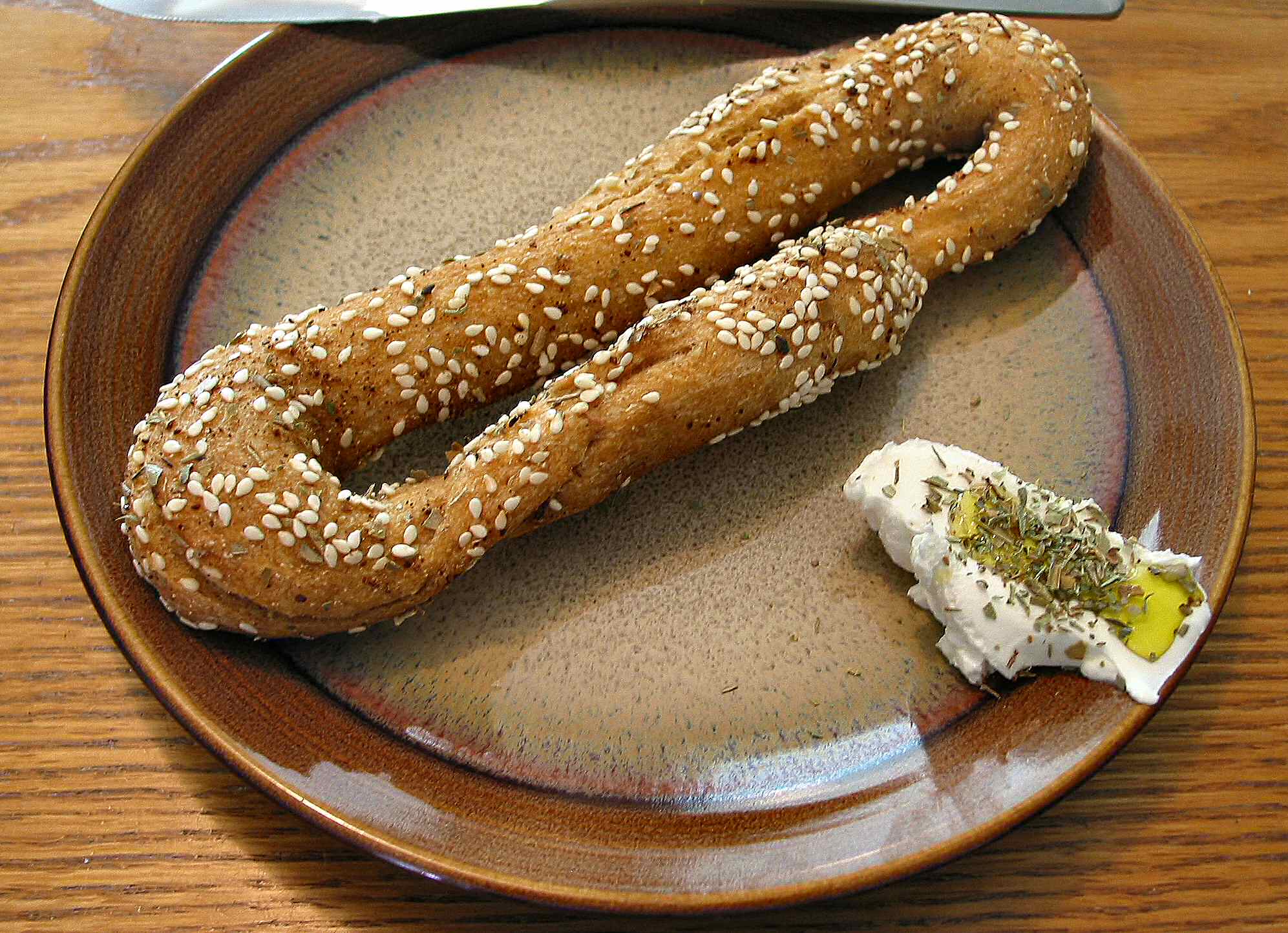
Simit bread or "beigele" with labaneh and herb spread

It’s been a couple or three weeks since my last post. I am currently in the desperate process of using up as much hametz, which is flour-yeast-bread-beans-lentils-rice-pasta-fillo-dough-oatmeal-etcetera, as possible before Passover. Right after Purim  I discovered I still had about 5 sacks of dried beans and lentils cleverly saved up and a sack of whole wheat flour and a 2-lb. bag each of bulgur AND farina! And a pound of wild rice. And a new bag of soy flour. Most of all which I couldn’t donate to the food shelter because it was either bulk or partly opened. Yeesh. What’s a girl to do?

Well…we’re certainly going to find out in the next couple of posts, aren’t we?…Even my suddenly-vegetarian daughter–yes, the very same one who kept bugging me about why I wasn’t cooking enough chicken for her last year–is wondering whether she has the stomach for more black bean burritos in the next two or three weeks (her conclusion: as long as there’s chipotle salsa around, what’s the problem?) My husband is looking at both of us cross-eyed.

Okay, then. Project #1 (well, after the pot of black beans, anyway; those were pretty standard and don’t call for a post): bread.

Long, long ago, in a kibbutz kitchen far, far away, I made some bread for my parents, who were coming to Israel for a visit during the year I was there. December in Israel–drizzly and cold some days, bright and cool others. You never know what you’re going to get.

But I’d missed my parents dearly for half a year. To celebrate seeing them I had in mind something like one of the blackish poppy-filled strudel I’d seen in a Romanian bakery in the middle of Haifa’s downtown “Hadar” shopping district amid the felafel stands and bookstalls. Only I wanted something not sweet, and with a better dough. A savory bread, like a bialy but with poppy seeds. So onion and maybe a little parsley or dill, now that I’d worked in the side kitchen for 5 months and knew the Hebrew names for both herbs.

I decided on a basic bread dough, flour-water-yeast-salt with a bit of oil. I rolled it out flat into a long rectangle and filled it with chopped, fried onions, parsley, dill, thyme and salt (it actually had too much salt, to my embarrassment, but my mother loved it anyway) and a couple of handfuls of poppy seeds. Then I rolled up the column of bread, twisted it around itself into a longish double rope, glazed it with egg yolk and baked it. It was pretty good and looked impressive. And it was really easy. My mother ate it all week sightseeing while my dad was at his conference.

Those days are gone, but a recent trip my husband took brought back the memory along with a couple of loaves of multigrain herb bread from a traditional German bakery he discovered in Tehachapi. The breads lasted an entire week at room temperature (of course, our humidity’s so low in Pasadena that this may be an exception) without seriously high salt in the dough, and every time we passed the dining room table, the aroma of dill and thyme and scallions and sourdough made us want to tear off a chunk to eat just as-is.

Two weeks ago was Purim, the feast of lots (as in drawing lots to determine someone’s fate, not lots as in lots-of-hametz-to-use-up). It’s the holiday from which we get the term “the whole Megillah”–the Megillah being the Scroll of Esther, a long Scheherezade-style story set in Persia and very long to read out loud in one sitting to a large congregation while they cheer the heroes and boo the villain (also Scheherezade-style, it’s the wicked vizier–am I giving anything away? It’s always the wicked vizier, except when it isn’t. And did I mention it’s kind of long? Okay, then).

So anyway, I decided to make some of this scrolled bread to give as Purim shalachmones–food baskets sent to friends, but didn’t get that far this year. Hamantaschen was about the limit of my ability, since it’s also get-your-kid-into-a-decent-school-for-next-year lottery time.

Usually these days the mishloach manot (same term, without the Yiddish accent) are candy bars, bagged snack foods, and maybe some raisins or an orange to round out the “3 different foods” custom. Occasionally you still see hamantaschen but the junk food factor has really taken over very sadly, I gotta say, even if it’s Israeli junk food. I mean, okay, felafel-flavored Bisli is fun once, but it’s really not much better than Cheetos, except that the wrapper is a good exercise for my daughter’s Hebrew reading skills (especially once she figured out which word meant “carbohydrates” on the nutrition label).

Nobody on the west coast even makes poppy seed hamantaschen anymore, to say nothing of prune lekvar filling, the two classics of my childhood. It’s a cultural deterioration I aim to remedy. Maybe next year–but for now, this weekend, with a container of poppy seeds still in the freezer, I’m thinking about making the bread, since it’s delicious, also involves poppy seeds and is unlike anyone else’s. And because I have flour and yeast to use up before Pesach, which is now right around the corner.

So I started pulling the flour off the shelf and realized I’d used up all the bread flour for hamantaschen but I still had a good 3-4 pounds of whole wheat, which wouldn’t make a good bread all by its lonesome. And on the other hand, I had both bulgur and farina–bulgur for tabbouleh or a wheat version of polenta, but farina–2 pounds of it. Well…it’s wheat and fairly fine. Maybe if I ground it up a bit further in the coffee grinder? I did, though the end result seemed less than convincing that I’d made any difference in it at all. Still pretty grainy. Dumped it into the food processor anyway along with an equal amount of whole wheat flour, some yeast, a little salt, and enough water for a fairly stiff but elastic ball of dough once it was processed.

The dough was pretty heavy to lift out and the farina absorbed a lot of water but it did seem to be developing some stretch, at least. I let it rise overnight in the fridge and started testing it out the next day. Continue reading

There’s something wrong when a veggie burger is worse for you than cheesecake

Recently spotted in the Los Angeles Times Food Section “Dear SOS”

Veggie burgers from North Peak

Dear SOS: My family and I just got back from a trip to Traverse City, Mich., where I had the absolute best veggie burger I’ve ever had. Is there any way you could coax North Peak Brewery Co. to give up its recipe for its Black Bean and Portobello Mushroom Burger?

Dear —–: This burger even had some non-vegetarians going for it. The restaurant also sometimes serves it with provolone cheese and sliced avocado along with a dab of basil pesto aioli on toasted ciabatta rolls.

Total time: 1½ hours, plus cooling time Servings: 8

The recipe starts out with a 9-ingredient pico de gallo homework item–let’s just agree it’s basically salsa, and it gets mixed into the beans and other stuff at midpoint in the cooking process–which is long. One and a half hours? Yikes. But then check out the rest of the ingredients for the veggie burger itself:
Veggie burgers and assembly
  • 4 cups cooked black beans, from about 2½ (15-ounce) cans (drained)
  • 1/4 cup honey
  • 1/4 cup molasses
  • 2 teaspoons salt, more to taste
  • 1 tablespoon cumin, more to taste
  • 1/4 cup plus 1 tablespoon olive oil, plus more for sautéing the burgers
  • 1/2 cup finely diced onion
  • 9 ounces portobello mushrooms, cut into ¼-inch pieces (about 4 cups)
  • 1 cup pico de gallo
  • 3 cups panko bread crumbs
  • Semolina flour for dusting
  • Sliced cheese, if desired
  • Sliced toasted ciabatta rolls

And then — guess the nutrition stats?

Each burger (without cheese or garnishes): 604 calories; 21 grams protein; 103 grams carbohydrates; 11 grams fiber; 13 grams fat; 1 gram saturated fat; 0 cholesterol; 16 grams sugar; 1,227 mg sodium.

Whoa. 604 calories for a single veggie burger. 103 grams of carbohydrate–more than a meal’s worth just by itself. Honey, molasses and panko turn what might have been a reasonable amount of carb from a serving of black beans into something that reminds me of the old sketch from Garrison Keillor’s A Prairie Home Companion on NPR: “Here’s my secret. I just add sugar to the same tired dinner and wow! suddenly everyone loves it!” … or words to that effect.

No doubt the honey and molasses also go a long way toward disguising the fact that each burger contains more than 1200 milligrams of sodium. Where’s that coming from, anyway? the canned beans–400  mg or so per serving. The added salt–a quarter-teaspoon or about 560 per serving. Breadcrumbs–more salt. Add a ciabatta roll and cheese and you’d be above 1500 mg easily.

At this point, despite their long laundry list of ingredients, the MorningStar Griller’s Vegan burgers I used to eat are looking a little more decent nutritionally–about 300 calories apiece and 280 or so mg. sodium. So if they could do it, why couldn’t you?

In theory, at least, you could make veggie burgers a little less dangerous and cheesecake-like if you just skipped the added syrups and salt, and cut the large excess of frying oil for the mushrooms and other sundries by simply microwaving them to precook. That is, choose a sensible recipe instead of something ridiculous.

Oh yeah. But then it would just be, you know, veggie burgers. Not keeping-up-with-the-chain-restaurants versions with the pumped-up sugar-salt-and-fat formulas. I ask again, is there any hope?

Stuffed onions in a hurry

Stuffed onions ready for steaming in the microwave

With a microwave and a frying pan, you can make stuffed vegetables like Mehshi Basal quickly, and they taste even better than with long roasting. These are just rolled and ready for a few minutes of steaming in the microwave.

Just after Rosh Hashanah I posted my first-ever attempt at an elaborate Syrian Jewish dish of sweet-and-sour stuffed eggplants with quince, and because I had more stuffing than I needed, I went for seconds with Aromas of Aleppo on the spot and tried out the Mehshi Basal, or stuffed onions with tamarind sauce, which was actually even better. It was easier to put together and I was patting myself on the back when we tasted the results.

Still, given that I was using a lentil stuffing in place of ground beef, I was a little dismayed at how long the traditional braising and roasting took to cook the onions all the way through–an hour and a half at least, and that was after stuffing them. A second attempt in November, this time exclusively with stuffed onions for a congregation brunch, did no better on time, and I came away thinking that roasting was an extremely inefficient way to cook these–might even have toughened them inadvertently.

Why, you have to ask, should I make such a big deal about stuffed onions–they’re a party trick, after all, not standard cooking. But we discovered we really liked them, and they’re a pretty good kind of party trick. They were a surprise hit at the brunch. If I hadn’t snuck myself one while setting up in the kitchen, I’d have missed out altogether.

Actually, I think they fascinated everyone as much for the magic trick as for the flavor. People who’d never tasted them before kept coming up to me–and even my daughter–to ask, “How do you get the filling into the onions???”

If they hadn’t been so time-consuming I could have made double the amount and they’d still have disappeared. Or I could throw them together easily just for us on the odd weeknight as a treat–but one with some iron and fiber in it–instead of the standard pasta or rice.

So in the time since, I’ve finally rethought the process and come up with something that requires no oven time and cuts the actual cooking after stuffing them down to about 20 minutes or so–as long as you already have some cooked lentils (microwaved to perfection in about 10 minutes of cooking time and 30-4o minutes of standing time) and tamarind sauce (or “mock tamarind” sauce, a 5-minute microwave-assisted blend of prunes and/or apricots with water and some lemon juice, plus-or-minus tomato paste, applesauce and other flourishes you don’t really need for this) to hand.

I know, you probably don’t have these things sitting around. But this recipe might change your mind. Lentils are good stuff even on their own, and the stuffing here is a knockout.

Even genuine tamarind sauce isn’t so bad anymore, assuming you don’t or can’t just buy a prepared concentrate. I’ve sped the process up from an hour-plus to a few minutes just by nuking it, pulsing in a food processor, and this time, neither filtering it quite so aggressively as I did back in September NOR bothering to boil the stuff down to a sticky residue. It’s so much less painful, and I think it even tastes better, with more of the fruit character left in. See my notes at the end of the post for how to do it the quickie way (in modest jam-jar quantities, not quarts).

Anyway, back to the stuffed onions. I’m actually proud of myself for this one, and I’ve tried it three times in a row so I can vouch for it–the last time, I put my daughter to work stuffing the onion layers, and she did a great job.

For this method all you need are a microwave oven, a frying pan and a food processor. Instead of boiling the onions for 20 minutes to separate the layers, you microwave them in a drizzle of water for 5. Instead of braising the stuffed Continue reading

A Slow Food Fast Thanksgiving

Pumpkin pie in the microwave

I’m not sure how to take all the following good news–it’s been such a strained year that the sudden release of pressure is going to make me zip around the room, once the coffee kicks in.

1. My mother-in-law has threatened to favor the brand-new kosher butcher in her town this holiday season so that we can eat the turkey too this year (and maybe not fight about it). She promised not to smear said turkey with butter. We’ll cross our fingers. But at least we won’t have to cook. I’m keeping that firmly in mind.

2. As of this week, my daughter’s finally on an insulin pump and fairly thrilled about it, so she can navigate dinner AND dessert at my in-laws’ without breaking down and crying that she only gets two tablespoons of pie for a reasonable serving. We are still encouraging her to count carbs and not go hog-wild or she’ll be zipping around the room until midnight.

3. The school concert’s in less than two hours. Is that really enough time to do everything, or at least something? Naaaah. Well, maybe coffee and something other than the news.

4. We still have to schlep up Interstate 5 for about 6 hours tomorrow, starting “early” (i.e., an hour and a half after the time my husband announces this evening as the absolute latest), passing the Harris Ranch and its attendant aromas, which can be more than slightly offputting if you’re not an avid horticulturist. But at least when we get to my in-laws’ we don’t have to cook. As I said, I’m keeping that firmly in mind. I know I already said it, but it’s so important I figured it was worth saying twice.

Despite my firm resolve after last week’s marathon kiddush that I will strive Not To Cook (could I possibly be Peg Bracken’s unacknowledged lovechild? Unfortunately, no. However, my mother was a devotee of the Don’t Cook Too Much school of thought, and I’m starting to appreciate that. Really I am.)…where was I? Oh yeah…I will probably bring at least two lemons, some thyme and rosemary, a head of garlic and a couple of bags of fresh cranberries with us on the road. Call it flavor insurance. For whatever reason, my in-laws, who have developed what can only be called fanatical devotion to Italian food of every possible kind (having both grown up in white bread country), always run out of these basic essentials about halfway through, and my mother-in-law tends to tell my father-in-law to go back out and pick up extras just as the stores are closing…

The cranberries, I’m well aware, aren’t Italian. They’re for making 5-minute microwave cranberry sauce with about half the sugar of regular. My mother-in-law tends to try out her fancier cranberry chutneys and relishes every year, and every year they contain things like chardonnay–which is fine for the grownups but I’m no grownup. Her chutneys have more than 10 ingredients and sit stirring on the stovetop for at least 45 minutes. I don’t know how she does it–I’d go stir-crazy. I’m just not that good.

So anyway–I wish you all a great Thanksgiving at somebody else’s house, so you don’t have to cook or do the dishes. My idea of heaven.

But if you absolutely have to cook, here are a couple of posts for speeding up a few of the obligatory or not-so-obligatory Thanksgiving items–most can go in a microwave (I always, always think that’s worthwhile. Well, usually). A few of these are dairy, so use your discretion.

5-Minute Cranberry Sauce

Microwave Pumpkin Pie

Basic instructions for microwaving green beans, brussels sprouts and other vegetables

Creamed Spinach Variations

“Marbella”-style cooked vegetable relish with artichoke hearts, olives, tomatoes and prunes

Turkey Breast with Ta’am (flavor) –not microwaved, not a whole bird, but it is a lot quicker and tastes unusually good if you have a small crowd. DO keep it covered in the oven to prevent it drying out.

Some options for vegetarian centerpiece dishes… (ideas more than recipes)

Spice mixes because sometimes you want to liven up the party…

Syrian Jewish stuffed vegetables (baby eggplants and onions) with an incredible lentil filling (NOTE–this one is “not exactly quick”; well, maybe for the eggplants microwaving would be enough, but the onions still take some serious roasting even after microwave assistance.  However, it is delicious and impressive.)

Microwave gingerbread and microwave flan (and a recommendation for mead…)


Microwave Tricks: Getting more chocolate power from cocoa

Chocolate pot from the movie "Chocolat"

The infamous chocolate cauldron, image © Miramax

In the movie Chocolat, the riverboat captain tells the chocolatier that his favorite of all her confections is none other than the prosaic cauldron of hot chocolate she keeps on the hob to thaw out her customers. When she pours out a cup, it’s so thick it’s like hot molten chocolate bars. Hard to imagine how anyone could swallow more than a spoonful of it in reality, but you immediately believe it’s superior to the thin, miserly stuff that’s been passed off as hot chocolate in your childhood. And you’re right.

And on the other hand, how could anyone in their right mind want to down a cup of melted chocolate bars? Too rich, and for me, much too fatty. And with much too much cleanup–the last image that stuck in my mind from Chocolat was actually not the hot chocolate Juliette Binoche handed Johnny Depp and Judi Dench but the thickly encrusted cauldron that had been cooking chocolate all day long. Scary, and what a waste of chocolate for one scene!

So I don’t go for that myself, or at least not on such a grand scale. Though if you want that kind of recipe–go to David Lebovitz’s blog and look for Parisian (or worse yet, with even more chocolate, Belgian) hot chocolate. He’s got two kinds of Mexican hot chocolate drinks too.

Cocoa powder, the ordinary day-to-day stuff of American hot chocolate mixes, seems so much less potent and chocolaty than all the fancy recherché chocolate bars with the cocoa solids percentages, the exotic Latin American or African source names, the single-source, fair-trade, wine-label-styled descriptions. Cocoa powder is so prosaic (unless it’s Scharffen-Berger or Valrhona or another premium brand). How could it possibly be good enough for a high-class, French-style cup of hot chocolate?

Granted, cocoa powder–dutched, natural, either way–it’s pure cocoa solids. But it doesn’t really give you the full chocolate experience if you just mix it into things. Something’s missing.

Most professional chefs and chocolatiers will probably tell you it’s the cocoa butter that’s missing. And they’re not entirely wrong–fat does carry flavor and keeps the more volatile, delicate aromas in the chocolate from evaporating off too quickly or breaking down under heat.

But if that were the entire reason, cocoa powder, stripped of all its fat and stored in warehouses and supermarket shelves for months at a time, would be flavorless and dead by the time you got it home from the store, and we know that’s not the case.

When you make brownies or chocolate cake with cocoa powder, there comes a point in the baking when you suddenly smell the chocolate wherever you are in the house at that moment. Before you even realize you’re smelling it, before any Continue reading

Artificial sweeteners–false promise for lower carb counts?

Last Saturday night my family visited a couple from our congregation and had dinner in their sukkah. When we broached the question of what there would be for dinner so my daughter could get an idea of how much insulin to take, the husband announced that he too was diabetic–Type II, for several years. What followed was a bit of a culture clash.

I’m sure he meant to be encouraging as he declared that through a combination of self-discipline and exercise and not eating more than a very limited number of carbs per day (and they really were about half of what our daughter is supposed to eat) that his A1C tests were down in the normal range and he only had to test his blood sugar twice a week. Which of course is fine and nearly ideal for a Type II diabetic if it actually works.

I’m not entirely sure how my daughter took all of this, but he went on to dismiss another Type I diabetic we know as “paranoid and overdoing it” because she tests 6 or 7 times a day, which he assumed was unnecessary since he didn’t need to do that.

He had the shining confidence of someone for whom not much had ever gone awry and, having no idea how lucky he was, assumed it was down to his own skill rather than the fact that he had a working pancreas, wasn’t growing anymore, and wasn’t a girl. All big factors for blood glucose control. Clearly he’d never had a bad low with shakes from an overdose or hormonal surge, or a really sharp unexpected high from a shot that just didn’t get where it was supposed to go.

I was more tactful than I’ve ever been in my life when I pointed these things out. You wouldn’t have recognized me, I swear!

Oddest of all was his insistence that the real secret was his use of artificial sweetener, which let him enjoy all kinds of great desserts. I was puzzled–baked apples sprinkled with xylitol? Surely the apples themselves were pretty carby–as well as pretty sweet on their own. The carb difference between using artificial sweetener, a tablespoon–or even two–of table sugar for the pan, or just leaving the apples to bake without sweetener, would be pretty minimal per serving.

And indeed our host only took two wedges for himself.

The other dessert–and it did taste decent–was chocolate ice cream sweetened with xylitol. Given that the ice cream in question was a plain flavor from my usual brand, I was able to compare it with the ordinary version for carb with reasonable confidence.

It was plenty sweet–maybe sweeter than normal, for that matter. But for carbs?

There was no difference. 17 grams per 1/2 cup serving, xylitol or no.

Which brings up a sobering question: why use artificial sweeteners if they don’t lower the carb count significantly? Continue reading

Stuffed Eggplants with Quince, A Vegetarian Odyssey

Stuffed Eggplant with Quince and Stuffed Onion Rolls

I did it. It was 90+ degrees outside yesterday afternoon and felt a lot hotter inside when I started cranking the oven to try this dish right away rather than wait for the weekend, but I’m just no good with delayed gratification.

If I have the mini-eggplants and I have the quinces and I have the tamarind concentrate (homemade! two days ago! it’s practically crying out to be used already!) and I have the “hashu” filling for the vegetables sitting in the fridge smelling wonderful, then it just doesn’t matter that Rosh Hashanah dinner is in what, maybe 3 hours, and I still haven’t braided the challot, to say nothing of baked them. Obviously I’ve gotta try this extra-credit dish out RIGHT NOW.

Actually, I figured the house was going to be heating up anyway once I started baking the challot, so why not get it all over with at once?

There was a more serious reason to try it. Today in services I was still thinking about Dweck’s book and her recounting of her parents’ horror in 1947, when, about to return from a vacation in Europe, they learned the government back home had started massacring whole Jewish communities in reaction to the announcement that the UN had accepted Israel as a Jewish state.

The Syrian Jewish community fled wherever they could–just as my family did under the pogroms in the Ukraine back in the 1880s and 1920s. Dweck maintains that the reception the Syrian Jews got in the US from those of us who were already here was so aloof–they didn’t speak Yiddish, they didn’t look the same, they did a few things differently for kashrut and prayers–that her community kept to themselves ever after.

I can believe it, unfortunately–the period right after World War II and the Holocaust was one of paranoia and circling the wagons for American Ashkenazim.

Eastern and Western Jews had similar discomfort with each other in postwar Europe. Reading between the lines a little in Claudia Roden’s and Colette Rossant’s memoirs, the two, who had just lost everything, thought their new Ashkenazi neighbors were cold and inhospitable and indifferent to their exile; the Ashkenazi neighbors and relatives, meanwhile, thought the wealthy young Egyptian arrivals were horribly spoiled and indifferent to the European disaster they had just missed. Altogether, the Ashkenazi, Sephardi, and Mizrahi communities were in closer touch before World War I than they were after the 1940s.

I can only hope that now, 60 or 70 years on, we have more in common and more regard for each other, no matter where we came from. Israel’s great mix of cultures has been a good influence, even though it originated in hardship, and perhaps today we are in better shape to appreciate what we have in common than we have been for nearly a century.

When I look through Dweck’s family’s photos, I see so many people who look astonishingly like several members of my family–my dad and my sister especially. The dignified lady presiding at the seder table on the front cover is a shockingly exact adult version of a girl I knew from my synagogue’s youth group–it’s the sturdy mouth and chin and the set of the eyes, certainly, but also the irrepressibly thick and curly hair (the 1920s formal chignon has it all over my friend’s 1970s braids, which took her hours to corral her hair into). The formal photographs of families in the 1920s, all the daughters dressed beautifully but in the same fabric the mother is wearing, sailor suits on the boys, stern dignified expressions all–I’m pretty sure each of my grandmothers had at least one of those in her collection. The 1930s-era engagement portrait with pearls and bobbed hair–so modern! Pin it up next to the one of my dad’s parents, who married in 1939 and looked so incredibly naive and young then. The family gatherings at Pesach, grandma presiding over the white lace tablecloth and all the seated cousins glancing behind them at the camera from over their shoulders–there’s probably one or two with my mother as a toddler on someone’s lap in Brooklyn and another of her as a teen, whipping her glasses off and blinking myopically for the photo. It could be any of our families. It could have been us in Syria and Egypt and Turkey, it could have been them in the Ukraine or Germany or Poland. We none of us have entirely safe histories, and none of us are entirely separate.

In any case, Dweck’s book is important to me not only for capturing her community’s traditions, tastes and history but for reaching out to the rest of us and giving us a chance to share it, compare it with our own, and reconsider what it means to be part of the Jewish world now.

So–and this is not to trivialize but to explain, since we sometimes live and remember through food, especially at the holidays–it was a great time to try out a challenging dish (challenging for me, anyway) from her book and serve it last night to my family for Erev Rosh Hashanah. I cook from scratch, I cook a lot, but I’ve never really done  the legendary great-aunts-at-Pesach kind of slow cooking where everyone groans in pleasure and declares “nobody does it like this anymore” when they taste it. I’ve only once cooked a whole turkey, and I’ve rarely tried anything else that took more than an hour and a half to cook. It’s a transformative experience, one that teaches me a lot about my great-aunts and great-grandmothers, both in the shtetls with the wood-fueled pripitschoks and communal ovens, and here in America with modern kitchens and big lace-covered tables. Trying this long-cooked dish gave me the chance to experience both my family’s past celebrations and Dweck’s at the same time.

To my very great pleasure, her recipe worked the way it was supposed to on the first try and tasted like the effort was worth it, even though her instructions are pretty simple and brief. That’s a huge achievement.

So–if you’re ready for this, keep reading–otherwise, glance at the pictures and skip to the bottom…

The “Stuffed Eggplants with Quince” Experience

First of all, let me just say that I LOVE my local Armenian corner grocers for a lot of reasons, but the fact that they have all the ingredients for Dweck’s dishes (other than kosher meat, that is) is a big, big plus.

I would have tried microwaving–and I still will–instead of a 2-hour braise, but I wasn’t sure how it was supposed to taste, whether microwaving would cook the raw rice in the filling well enough, and how the sauce was supposed to interact with the stuffing and the eggplants. I knew from a previous hard-luck experience that quinces don’t do especially well (or even well at all) in the microwave and really need long stewing under conventional heat to get tender and turn bronzy pink and sweet. So all in all, I decided following the directions in Aromas of Aleppo might be the wiser course for a first try. Even though, from my usual 15-minutes-tops perspective on conventional-heat cooking, Poopa Dweck’s method is glacially, almost outrageously, slow.

Basically, you core the baby eggplants, stuff them with hashu (beef-and-rice filling, rice and tomatoes, or in my case lentils-and-rice), and layer them in a saucepan with quince slices. Then you dilute some tamarind concentrate and add a bit of sugar and salt, pour the sauce over the pan and heat for 10 minutes on the stove until the eggplants start to sweat, add water to come about 3/4 of the way up , simmer half an hour to reduce the liquid and cook the rice in the filling, then transfer to the oven to braise covered for about 40 minutes and then uncovered for another 30. It’s a lot like making brisket, actually.

Dweck gives two allspice-laden recipes for the filling, one for ground beef with rice, the other a rice-and-tomato filling that’s close to what I use for dolmas. I opted to follow the ground beef recipe but substitute an equal weight of cooked green lentils for the meat and add a little garlic. It would work, I was pretty sure, and in fact it turned out to be the best, most delicious part of this recipe–which, skipping to the punchline, was pretty terrific and worthwhile, even for the work Continue reading

Food that’s fit to print–but is it fit to eat?

It’s the next “brilliant” thing. In the wake of Grant Achatz, Ferran Adrià et al, the now common your-photo-in-icing cake decorations made using an inkjet printer and soy-based and other edible inks have given way to 3D printable food–or at least that’s what the researchers at Cornell are calling it.

Hydrocolloid Printing: A Novel Platform for Customized Food Production (PDF)

Hydrocolloids are suspensions of fine particulates in liquids–in common terms, gels. Also pastes, like cake frosting or masa. Basically uniform goos. The Solid Freeform Fabrication (SFF) unit squirts the stuff through a computer-programmable injector needle onto a platform based on the design you feed in, and it goes in layers so you get an engineered form. Cool, right? Food, any shape you want, and they contend it can be any flavor too.

But it has to be made of goo. And it can’t clog the needle. And it’s not all that new–the Italians have been extruding pasta shapes for over a century. French pastry chefs did all the heavy lifting with choux paste and fondant flowers even longer ago. And in modern times Wilton makes all those fancy-looking metal tips for pastry bags that they sell in the craft chain stores and that will likely be tried out once and then sit forever in the back of your kitchen drawer.

But pastas, pastries and frostings are all about goo as a starting material. These guys are talking about fish.

Most of all, it isn’t all that appetizing, particularly when you see that they’re trying to sell you on a machine that can make what they’d like you to think of as a tomato with a goo composed of 1% gelatin, 8% xanthan gum and some tomato flavoring. Haven’t we had enough of synthetic tomatoes? Isn’t that what the heirloom movement is all about?

Apparently not. Here are the last couple of paragraphs of the paper I linked to above. See what you think.

It should be noted, however, that even if subtle differences are perceptible, it is not necessary in all cases to perfectly reproduce the original food; there is still great value in simulating the original food.

Regardless of whether a hydrocolloid approach is taken to food-SFF, or some other molecular gastronomic platform is employed, the potential future applications of food-SFF remain the same. From culinary professionals to laypeople, individuals from all walks of life will be drastically affected by food-SFF. Artistic boundaries will be pushed in fine dining and industrial producers will explore mass-customization. Laypeople will have housework time reduced and benefit from direct culinary skill injections. Web 2.0 will tackle the next great frontier as people from all over the world experience food in new ways, while forming social bonds and mass-collaborating.

Now that major barriers have been broken, such as high printer cost and proprietary restrictions, the stage is finally set for tremendous growth of food-SFF. Few things are more central to humanity than food, and therefore [it] should come as no surprise when food-SFF gains prominence as one of the 21st century’s important domestic technologies.

excerpted from:

Hydrocolloid Printing: A Novel Platform for Customized Food Production
Daniel L. Cohen, Jeffrey I. Lipton, Meredith Cutler, Deborah Coulter, Anthony Vesco, Hod Lipson

http://creativemachines.cornell.edu/sites/default/files/SFF09_Cohen1_0.pdf, accessed 9/12/11

Now tell me, is this future palatable to you? Or do you somehow, almost inconceivably, not relish the thought of a xanthan gum conglomerate taking over the world’s food supply and driving us fresh-food conspiracists underground? Dan Brown, where are you?

Green Lentil Sausages

A month or so ago I had been intrigued with a recipe on “Is This My Bureka?” (see sidebar for link) for Romanian mititei, a spicy cross between meatballs and sausages, and wondered whether I could make a vegetarian version with green lentils. Not because I can’t eat beef–I can if it’s kosher–but because I generally don’t like handling meat. (I don’t mind fish nearly as much; don’t ask about the logic, it’s just a preference.) All my meat dishes are still in storage, four months after the move. That’s not accidental–I hate switching over the dishes even more than I dislike handling meat.

So in any case, I tried it. Green lentils are on my list of easy-to-microwave, ultracheap nutritious staples. I cooked up about half a pound of dried lentils in water to substitute handily for a pound or pound and a half of ground beef. The mixture I made was heavy on garlic, pepper, and a variety of spices ground in the coffee mill. It was a lot lower on salt than BurekaBoy’s because I tasted it with a couple of pinches of salt–between 1/4 and 1/2 teaspoon–in the mix and that was more than plenty. Scared to think what a teaspoon and a half would have done. Maybe ground beef requires more, or maybe the lentils don’t absorb and hide the salt flavor as much.

The green lentil mixture was delicious even before cooking–with vegetarian sausage, burger or meatloaf recipes, unless you have raw eggs or uncooked flour in your mix, you can taste for seasonings pretty safely. If you do have eggs or raw flours in the mix or are making a sausage recipe with meat, poultry or fish, cook a spoonful first in the microwave and then do the taste test.

Unfortunately, though, the paste didn’t hang together as well as I’d hoped–cooking it didn’t help much. It was still delicious and spicy, but it just crumbled. And although I could live with it, I’ve been thinking about it ever since.

So my recent purchase of a bag of vital wheat gluten and my first foray into the mysterious world of seitan set me off. What if I added a little gluten to the lentil mix instead of the other way around? That way it would stick together and still be mostly lentils. The proteins would be balanced better by combining a pulse (lentils) with a grain (wheat). It would have loads of flavor without needing soy sauce or salty broth. It would be microwave-steamable, and probably fryable or grillable too. And I could still taste it safely before cooking to ensure there was the right amount of excessive garlic present.

And–half a cup of gluten wasn’t quite enough for the three or four cups of cooked lentils I used. Still kind of dry and crumbly when I made a few small patties and cooked it two ways (microwave and frying pan). I added a little more gluten to the rest of the uncooked mixture. Three-quarters of a cup of gluten per 3 or so cups of lentils was better–I could see the threads of gluten forming as I kneaded it together in the bowl.

The patties were still dryish and of course lentil gray-green, though this version hung together better when cooked. It still tasted good, very peppery and garlicky, with a hint of the allspice, fennel, coriander seed and other spices I’d put in. But because of the dryish texture I wasn’t sure I could recommend it fully–it was definitely a case of “Dance 10, Looks 3” at that point.

I cooked up the rest of the mix by microwave steaming, followed by a light pan fry in olive oil, and bagged them into the fridge. The next day, there they were–still a bit soft and crumbly, but hanging together better with a little more chewiness to them. Still not pretty but they tasted good. Waste not, want not, I thought. Pretty is for some other day. Continue reading

Ice cream, enhanced

Sometimes your kid sees a new flavor of Dreyer’s ice cream at the store and decides she has to try it because “It’s Black Raspberry, Mom!” and it’s on sale. But mostly because it’s a trendy light purple (“Orchid or thistle?” I asked, calling on my distant memories of the Binney & Smith guide to the universe.  “Lavender” she retorted. I caved to her superior fashion sense.) It was made with real raspberries–that’s a plus, I suppose. And it came in a “half-the-fat” version, and it was enough on sale that I could get a safety flavor as well.

It’s been over 100 degrees here in Pasadena this week, so ice cream is practically a medical supply.

When we got it home though, it tasted sweet and kind of dull. The fruit flavor was there but not particularly strong, and the overall effect–particularly the smell, for some reason–reminded me suddenly of those horrible “berry-flavored” motion sickness lozenges my mother used to foist on us just before long car trips. Bonamine? I’m still shuddering forty years later.

My daughter, blissfully free of Bonamine-induced associations, still thought it had merit, though, so we kept the lavender-tinted ice cream and I wondered whether anyone else would eat it without having to be threatened. What was wrong with it and could it possibly be fixed?

I’ve been potschkying around with store bought ice cream pretty much ever since I was old enough to buy it for myself–adding extra cocoa powder and some mint or almond extract to chocolate, leftover coffee and cinnamon to vanilla, and on and on. Not many people do this, or do this enough, I’ve discovered. You have to wonder why not, because most non-super premium ice cream in America is a little, or a lot, bland.

In fact, the only flavor I never messed with was Ben & Jerry’s Coffee Heath Bar Crunch, which was perfect and sublime and needed no help ever, other than a spoon. My husband and I were such devotees that when we had a chance to spend a late-summer week in Vermont and New Hampshire one year (way back when, in our 20s), we made sure to stop in at the factory in Stowe for a tour. CHBC was such a supreme flavor that I only gave it up when Ben and Jerry both retired and a new CEO took over. Somehow, the next pint I bought tasted a little off–weak on coffee flavor or something, hmmm…I looked at the ingredients and sure enough, they’d changed the formula and flavorings. It had also been monoglycerided down, even though the fat count was still in the stratosphere. I’m sure my ice cream snobbery saved me from a decade of extra arterial damage, but I’ve been sullen and resentful ever since (or at least that’s the explanation this week).

So anyway–back to the prosaic purple ice cream. It needed something–tartness–to liven it up, and probably would have been better as a frozen yogurt. Come to think of it, would yogurt work? Naah. Messy. Plus refreezing time. Lemon? Maybe, maybe not–it might end up seeming too sweet. Then I found a lime in the fridge–from who knows how many weeks ago; it had already lost its green, but it was still fine inside. Sometimes where lemon’s pure acidity underscores the sweetness and makes it more apparent, lime’s aromatic edge undercuts it and makes the flavor seem fresher. Works for ginger ale, works for blueberry jam…

A squeeze, a stir–from lavender to…raspberry pink (what else?) and I have to say, a BIG improvement in flavor. Much more like actual black raspberry. That’s all it took? Why couldn’t they have done that at the ice cream factory? But they didn’t.

I have another reason for punching up my storebought ice creams, and it’s not just boredom or fidgetiness (though those are obviously tops).

A long-ago-and-far-away gelato-eating expedition in Florence (it didn’t start out that way, but it’s the fulltime occupation in the summer–even more of a medical necessity when you’re wandering outside all day as a tourist) taught me the difference between Italian and American standards for ice creams: Americans expect big portions and don’t really pay attention to the flavor. Bland and sweet is acceptable. Italians are happy enough with small 1/3 cup portions as long as the flavors are wild and adventurous and vivid. If you can taste it well with one of those tiny gelato spoons, a gram at a time, it’ll last you.

Makes you wonder whether the lack of flavor punch in American ice cream (and maybe our other food as well) is the reason we typically eat biggish portions at a sitting, or seek out seconds. If it doesn’t taste like much, you eat it without paying attention, and end up not feeling like you’ve really eaten it. Interesting and vivid flavor seems like a good idea for health and portion control as well as pleasure–if you’re going to have ice cream, after all, you may as well taste it. Otherwise you could just suck on ice cubes.

So–a few suggestions for upping the flavor of store bought ice creams.

Go for plain flavors as your base

Try to find ones that are relatively low in carb and fat for a half-cup serving. Low here means about 15 grams of carb per half-cup, and maybe 2-3 grams of saturated fat.

Not only don’t the dressed-up flavors with loads of mix-ins need (or take well to) further tinkering at home, they’re not always as high in quality. Dreyer’s (Edy’s on the east coast), seems to try to keep the nutrition stats consistent across the line–ice creams with lots of mix-ins and/or caramel-type ribbon swirl are a bit higher in carb, up to maybe 22 grams per serving.

To keep things consistently low, though, the components or the ice cream itself have to compensate–so Reese’s Cup-style peanut butter and chocolate chip swirl has iffy peanut butter and iffier quality chocolate chips (well, so do the real Reese’s ™–don’t know whether authenticity is such a good thing in this case), plus the ice cream’s a bit icy, maybe even a little stale-tasting on occasion. You’d get more intense flavor from vanilla bean ice cream with a few squares of good dark chocolate chopped in and some peanuts or a bit of peanuts-only peanut butter.

Make flavors you can’t buy

Sometimes these are ones you grew up with, like Rum Raisin–I think only Haagen Daz still makes this. People got kind of prissy about feeding ice cream with rum flavoring in it to kids, I guess. Or raisins got too expensive.  So did pistachios, except in super premium ice creams.

No one makes ginger, or lemon-ginger, even though I’m pretty sure those were two of Bon Appétit‘s and Gourmet‘s big summer standbys for at least a decade (and I know because I once bought a decade’s worth of each magazine from my friends-of-the-library auxiliary at about a dime an issue. The seasons change, the same 10 recipes repeat…)

And no one makes Sabra (chocolate orange), or fig, or liquorice, or marzipan, or rose. Or pear. Or chocolate hazelnut with sour cherries.  Or even just plain bittersweet chocolate. There are home recipes for all of Continue reading