• Enter your email address to subscribe to this blog and receive notifications of new posts by email.

    Join 241 other subscribers
  • Noshing on

    raw blueberry pie with microwaveable filling and graham cracker crust

    This mostly-raw blueberry pie is a snap to make and very versatile--the filling microwaves in a few minutes, and you don't even have to bake the zippy gingered graham cracker crust--perfect for a hot Fourth of July and all summer long.

  • Recent Posts

  • Contents

  • Archives

  • Now Reading

  • See also my Book Reviews

  • Copyright 2008-2024Slow Food Fast. All writing and images on this blog unless otherwise attributed or set in quotes are the sole property of Slow Food Fast. Please contact DebbieN via the comments form for permissions before reprinting or reproducing any of the material on this blog.

  • ADS AND AFFILIATE LINKS

  • I may post affiliate links to books and movies that I personally review and recommend. Currently I favor Alibris and Vroman's, our terrific and venerable (now past the century mark!) independent bookstore in Pasadena. Or go to your local library--and make sure to support them with actual donations, not just overdue fines (ahem!), because your state probably has cut their budget and hours. Again.

  • In keeping with the disclaimer below, I DO NOT endorse, profit from, or recommend any medications, health treatments, commercial diet plans, supplements or any other such products.

  • DISCLAIMER

  • SlowFoodFast sometimes addresses general public health topics related to nutrition, heart disease, blood pressure, and diabetes. Because this is a blog with a personal point of view, my health and food politics entries often include my opinions on the trends I see, and I try to be as blatant as possible about that. None of these articles should be construed as specific medical advice for an individual case. I do try to keep to findings from well-vetted research sources and large, well-controlled studies, and I try not to sensationalize the science (though if they actually come up with a real cure for Type I diabetes in the next couple of years, I'm gonna be dancing in the streets with a hat that would put Carmen Miranda to shame. Consider yourself warned).

Instant Pickles, Hold the Salt

Fast-marinated cucumbers, half-sour kosher dill style

One of the things that kept me motivated for blogging SlowFoodFast after the first fine careless rapture was my indignation at how popular over-the-top salting was becoming in popular food magazines, cookbooks, blogs and TV shows as chefs became celebrities, and how dangerous I knew it was for most people to eat that way regularly. A large part of my career a couple of decades ago was exploring the history of dietary sodium in cardiovascular research and writing about the DASH Diet.

What I’ve missed the past few years is just how many people, particularly younger ones, are starting to take up the challenge of cooking low-sodium and blog about their trials and successes. There’s a whole community out there, and they’re cooking pretty well. It is definitely possible, and generally easy once you get past the “how do I read a label and cook from scratch” aspect.

I just ran into Sodium Girl (aka Jessica Goldman Foung)’s blog-based cookbook, “Sodium Girl’s Limitless Low-Sodium Cookbook”. Diagnosed with lupus and kidney failure in her early 20s, she turned around her diet by dropping her sodium intake drastically to give her kidneys a rest in the hope they’d regenerate, and it worked. She’s been innovating with low- and near-to-no-sodium versions of favorite foods ever since, working with the National Kidney Foundation and other organizations. Her book, like her blog, is attractively photographed, full of cheerful writing and surprise takes on favorite foods.

One of the substitutions she makes that I have to approve of is a molasses-and-vinegar-based “faux soy sauce”. So I wasn’t the only one!

Another of her successful experiments is pickles. She goes for sugar-and-vinegar-style pickles, which makes sense, since they have no added salt in them, but I can’t help it–I have always cringed at sweet pickled anything. If it’s supposed to be a pickle, for my money, it’s gotta be a half-sour kosher dill and nothing but (or else an Indian lime or mango achaar pickle, or Moroccan preserved lemons, but that’s another story and still pretty high-salt at this writing. I’m working on it, but not yet holding out a lot of hope…)

Anyway, looking through Foung’s book reminded me of a simple, hearty and low-to-very low sodium version of my favorite pickles in the world. Continue reading

Pastry again: vinegar adds the tender touch

Most people, if faced with a quick baking dilemma, probably go to the supermarket and buy cookies or brownie bites or something.  And it makes sense, kind of, although with a food processor, you can make pretty good cookies and brownies in less time than it would take you to fight over holiday parking, much less elbow your way through the store.

The corresponding shortcut for most people who do bake would probably have to be pie crust–to say nothing of puff pastry dough. For years I’ve been looking for ways to make a pastry dough that is close to puff pastry–flaky and light and puffy–without being as heavy on saturated fats and calories. Not the easiest combination.

Fillo (purchased, I’m not enough of a DIYer to make my own yet and my kitchen’s too tiny for rolling and tossing a huge thin sail of dough the right way)–fillo is good for a lot of things, but it’s so obviously itself and not pie dough, tart dough or puff pastry. It’s also pretty salted–I always have to comparison-shop to remember which commercial version has the least sodium per ounce (they vary within brands, because some are intended for savories and the others for sweet pastries. I think the savory ones are much too salty and use the less-salted ones for spanakopita and so on as well as for baklava).

After having made a variety of pie doughs–standard flour-butter-salt-water, olive oil tart dough, rugelach butter-cream-cheese dough, and even a puff pastry recipe with about half the fat called for in the classics–plus croissants that I finally got right–I can say my latest experiment is something of an eye-opener for me.

All of these worked okay as doughs, but except for the olive oil tart dough, which I use routinely for quiche, none are really all that light-tasting or actually light in terms of fat content and overall calories. And rolling them thinner than the standard 3/8 inch (thinner equals less dough and fewer calories per serving…) sometimes leads to a tough pastry. The fact that I tend to use bread flour instead of all-purpose or cake flour is probably at fault as well, I’m sure, but I’m mostly a bread baker and not exactly a perfectionist, so how many different sacks of flour do I really want hanging around my cramped galley kitchen at any given time?

A week or two ago I checked out an older cookbook (late ’80s) on Armenian food and tried to puzzle out the Armenian, Lebanese, Turkish and Russian influences–it’s a real mix. I was looking for a recipe for bureka dough, and this book had one.

The recipe for spinach burekas had an accompanying (and aging, over-tinted ’80s-style) photo of a browned and flaky dough wrapped around a log of improbably-green spinach filling on a platter lined with too-green lettuce and too-orange tomato slices underneath. But other than the color enhancements, the spinach log, kind of like a spinach Wellington, looked pretty nice.

To my great surprise, the dough was quite similar to some of the ones Joan Nathan had in The Jewish Holiday Kitchen.  The key ingredient differences from my standard pie doughs are:

1. slightly more butter for the amount of flour than for standard pastry dough (to be expected–you want it flakier, you probably need more fat in the dough) though a lot less than for rugelach or puff pastry

2. a little vegetable oil as well

3. an egg. Nathan’s “muerbeteig” egg dough for a plum pie calls for a hard boiled egg yolk, of all things, but the one here is raw. I’m not sure what it’s for, exactly. Perhaps for leavening or some other structural purpose–maybe it helps the dough puff into layers and hold them better with less hard fat than puff pastry requires?

4. a quarter-cup of dry white wine–which I didn’t have, only red, which would have turned the dough gray…so I substituted half apple cider vinegar and half water–the vinegar because Nathan had used it in a dough with egg. Why wine or vinegar? I think–don’t quote me–it’s the acidity, which breaks down gluten a little and tenderizes the dough. Certainly it did in this case compared to my usual experience.

So anyway–this dough came out surprisingly well. It doesn’t puff anywhere near as much as puff pastry–at least not while rolled out as thin as possible, and I haven’t tried it thicker–but it’s light, crisp and tender at the same time and not heavy or greasy. It’s unsweetened and mostly unsalted and would be equally good for savory pastries, Wellingtons and other encased main-dish things (like pot pies, coulibiac of salmon, and spinach-type fillings) where it’s the top layer or a wraparound, and for sweet ones like the impromptu almond paste and apple tartlet at the bottom of this post. Continue reading

Celebration Update: “Mashup” Does Not Mean “More Potatoes”

Two or three Thanksgivings ago I railed (as I often do) at the lack of imaginative and good-looking (both aesthetically and nutritionally)  vegetarian offerings for Thanksgiving main dishes. I wasn’t having a whole lot of luck being impressed by what I saw in the newsstand food glam magazines, vegetarian and vegan cookbooks, food blogs, my local newspaper food section, or even the freezer section of my local Whole Foods. So I came up with a list of suggestions for vegetarian centerpiece dishes.

This year, we had the double-double challenge: Thanksgiving fell on the first day (though only the second evening) of Chanukah for the first time in over 100 years (1860s was the last time?) and won’t again for another 77,000 or so (well, some sources say there’ll be another Thanksgivukkah moment in about another 100 years and then the big schlep out to 77K. Either way, for most of us, this is “that moment”).

For me, mashing up Thanksgiving and Chanukah just this once gives us some ideas for rethinking the kneejerk popular way of celebrating the big important holidays in general. Maybe even exploring what’s so vital about holidays and family and clearing away some of the thoughtless excesses.

Chanukah came so early this year that we had nearly no chance at buying or making tons of presents before having to schlep ourselves up the I5 to my in-laws’, so none of us was expecting anything but silly socks, a paperback or so, and maybe a stop in Solvang for Danish marzipan-based sweets on the way back home. That’s all to the good–Chanukah was never really meant to be a “more presents all the time” kind of holiday, it’s about freedom of religion, freedom from outside oppression, and gratitude for the miracle of having enough resources to go around. Thanksgiving is about those things too.

Unlike most years, I didn’t find a two-page checklist that Martin Luther would be jealous of, listing all the acceptable giftees our daughter wanted, posted on the fridge. Partly that’s because we wouldn’t be home to see it, and partly because she already had her bat mitzvah in June and she’s old enough now to feel like it’s more than plenty in the way of gifts. Plus by now she knows me–I have a strong tendency to roll my eyes and cross most of the stuff off the list with the familiar yearly litany of:

“Library…library…library…library…not wearable at school or synagogue, so what’s left, the mirror?…we have an unusually skilled cat and I don’t really want to think about hamsters in that context, do you?…library…library…not until you practice piano…I know I promised you could get your ears pierced eventually…maybe next month…”

It’s just a matter of practice. And a willingness to channel Sylvia (one of my favorite cartoon characters,  by the great Nicole Hollander).

Anyway, I have no idea if any of my ideas the last time I riffed on vegetarian centerpiece dishes gave someone else ideas–I hope so–but recently I ran across a vegan cookbook with dishes that look like they’d be just right for a celebration. It’s too late to recommend for Thanksgiving or Chanukah, but maybe for Christmas and onward? Continue reading

Emergency eclairs

Note: this is not my photo–I have not been to the balcony of Notre Dame lately. I merely share their dismay. [Source: Brittanica Online, with gentle modifications for parody purposes]

You may be wondering what to do if you drop half your éclair over the balcony of the Eiffel Tower, or worse yet, Notre Dame, while pondering your options for the afternoon’s conquest…YSL first, or peut-être Dior?…ooh-la-la-oops!

AAAAAGGGGHHHH!

Screaming will not get your éclair back, though it is a good start. You need to get down to ground level and purchase another tout de suite!

No, this is not really me channeling Miss Piggy at her “Who, Moi?” finest. I don’t have the lavender satin opera-length gloves for it, for one thing. I’ve just been watching too many of the various Muppet movies with my daughter lately.

Plus, and let’s be honest about it, the one time I ever tried on a long blonde wig (for a college skit), I took one look in the mirror and fell down on the costume department floor laughing until my ribs hurt. It was 20 minutes until I could breathe again. Picture Danny deVito (his eyebrows, anyway) peering out from under that wig, hoping to stand in for La Porcette,  and you understand why Frank Oz can never, ever go on vacation.

I have not been to Paris in seven years, and when we were there (for an engineering conference, with our then-kindergartner) we did not actually eat any éclairs. We also did not shop at Pierre Hermé, nor at Hermès, nor anyplace that wasn’t either a museum, an RER or métro stop,  a café or a tchotchke booth along the Seine. Other than for food, if it cost more than 15 bucks (or 11 euros, as for example, the tiny 3-inch-long stuffed unicorn at the Musée du Moyen Age, which we paid for hastily during a shall-we-say-jetlag-inspired meltdown), it was out of the question. I actually spent two full hours–ON VACATION IN PARIS–sitting forlornly in a coin-op laundromat down the alley from our hotel, hoping I had enough change to get all the horrible perfumed detergent back out of our clothes, while my husband and daughter went to the park. Not exactly the Paris experience I’d imagined way back in my high school French class.

So what am I doing imagining that I could climb up OR down the Eiffel Tower in chic heels (instead of the more believable sneakers and backpack with the entire belongings of my family plus bandaids and extra sandwiches…), waving an éclair around with incredible nonchalance and somehow not lose it (which I’ve never actually done; I’m a fervent believer in pastry) or break an ankle (which I have actually done, wearing flats), or both, with loads of people looking on?

Who knows–daydreams like these are the kind of thing mentioning Paris does to one when one blogs about food or fashion. Practically obligatory. It’s fun to imagine a life where such trivial matters can leaven, not to say inflate, my expectations. And, of course, where I’m not the one who has to schlep all the emergency supplies up however many flights of stairs. And back down.

Let’s face it, I’m a natural pessimist and (therefore) fan of both the Muppets and Matt Groening. Tell me true, now, doesn’t the gargoyle on the right look like the original inspiration for that sad shrimpy one-horned character in Life is Hell? He’s even wearing my backpack.

Real life is hard, gritty for more serious reasons than high-heeled éclair mishaps, and it’s filled with nagging of the now-ex-7th-grader. Ahem! These are things we just have to get through because there’s no great alternative (…yet. I’m working on it, believe me.)

Eclairs, on the other hand, are not actually difficult to make. And eating them makes one feel a lot less like life is hell, particularly if one skips the high heels and eats them barefoot.

And on the other other hand, baking anything in Los Angeles, even in winter, may well make one feel that one is actually living in hell, at least while the oven’s on. And right now it’s June.

How to cope? Toaster oven? Microwave?! The eagle squawking in shock above left may not approve of my methods, but he’d find it hard to argue with the results. Especially if you’re in the mood for just a couple of éclairs Right Now, and you have ice cream on hand so you can skip the custard chilling and filling bit and go right to profiterole heaven.

The pastry for éclairs, called pâte à choux, or choux paste (shoe paste! I knew there was a connection to the sudden appearance of high heels in my daydream), takes only a couple of ingredients: flour, water, butter, sugar, eggs. Maybe a pinch of salt too, okay.

Everyone and their uncle (or aunt) who’s ever written a Frenchy kind of cookbook has a recipe for éclairs, but who do you know anymore who’s ever actually made them? Right.

But actually, they’re pretty easy to make. At least as easy as brownies from a mix, and they seem fancier. You boil the butter, sugar and salt with the water, dump in the flour and stir until it looks like stiff mashed potatoes, then take it off the heat and beat in the eggs one at a time and voilà, there you have the dough–shiny yellow stuff to pipe out or dollop out onto a greased and floured baking pan and bake at high temperature for about 30 minutes until they’re really puffed and brown and don’t collapse anymore when you let them cool.

David Lebovitz has the classic recipe on his web site — a cup each of flour and water, 6 T butter, 2 t sugar, 1/2 t salt, and 4 large eggs. Pierre Hermé of exotically-flavored-macaron fame has a richer one with more butter and 6 eggs for the same amount of flour. And I’m sure they’re wonderful. But I can’t help messing around.

First off, I want fewer than 24 éclairs–what do you do with the rest of the dough? (turns out you can pipe it and freeze it, then bake straight from frozen sometime later, or else freeze the baked shells. OK. But still.) So I cut David’s basic proportions in half. Limit the damage to the avoirdupois, I always say. Fewer situps required.

Second, the butter. I know éclairs are the ultimate Unalterable Classic French Recipe but…here starteth the messing around. Like I say, I can’t help it. Continue reading

Halvah update–I think I’ve got it

Just before we left for Boston (22 degree weather, anyone? anyone?–too much Ferris Bueller on the first week of school break), I revisited the Halvah Conundrum: how to make halvah that has the right texture when no one’s ever described it properly in a recipe. Last time’s attempt, which made use of a food processor, wasn’t too bad but the texture was still crumbly and tough–overworked, most likely.

Then I read a comment on another food site that recommended working the tehina/sugar syrup mixture like fudge by kneading the mixture in one direction as it cooled to get it to the right semicrystalline texture. I’d seen footage of a career fudge maker paddling the mass of chocolate and sugar syrup on a marble slab until it stiffened up, and thought the Syrian halvah manufacturing process (mechanized boxing glove in a vat of tehina and hot syrup) looked like a similar idea. So I thought kneading the mixture might strike the right balance between halvah that came out too limp and oily and the meringue-like stuff I’d produced last time–too aerated, and when pressed together, too tough and crumbly.

So  this time I skipped the food processor for blending the sugar syrup with the tehina and flavorings. I stirred the vanilla and lemon juice and powdered clove into the tehina while the syrup was cooking in the microwave. I’d forgotten to scale down the amount of lemon juice for a smaller amount of tehina–maybe this helped a bit, actually, because adding a small amount of water-based liquid to tehina stiffens it and makes it a bit doughy. Maybe that little bit of extra lemon juice helped give the mixture a start on developing the volume it needs without overworking or drying it out too much?

I stirred the hot, thickened sugar syrup into the tehina mix in thirds using a hand whisk, thinking that maybe not all of the syrup would become overworked if I did it in stages. After all the syrup was in the mixing bowl, I folded the limp oily brown mass (my heart was sinking when I saw this, but I bravely continued) back onto itself several times with a fork, essentially kneading it in the bowl, 10-20 turns, maybe half a minute worth of time, just until it turned a little lighter and stiffer, but not as stiff as meringues. I started with only a third of a pound of tehina, so for a full recipe, it would probably take a bit longer.

Then I pressed it flat into a container with a lid and stuck it in the fridge overnight. The next day I cut into it–I could cut thin slices! and it was almost like deli halvah! It’s still not quite as light and crystalline, it’s still a bit chewier, but it’s definitely closer. Next time: try the egg whites beaten in with the tehina, and then the hot syrup mixed in…

[April 20, 2014: A new question on halvah, with a few updates from me]

David S:

Debbie, I have been down a similar path in trying at times over several years to create halvah like Achva’s (my fave). But it has been textural failure after textural failure. Each time, the result is worth eating and tasty, but that elusive texture…can’t get it. So, I am thinking that the saponaria may be an important detail. The problem is, I have been unable to find it in reasonably small amounts (an ounce or two would prob. last a long time, but I see it for sale only by the 1lb container and it’s not cheap). And, if I did find some, it’s not clear how much should be used–1/4 to 1/2 tsp for a pound of halvah? If you know where I might buy small quantities, please let me know. I live in the San Fran. Bay Area, and usually about anything can be found around here, but saponaria (powder, I presume) is a tough one.

Oh–and the lemon juice: I don’t see that ingredient listed in commercial halvahs. Is it just for flavor, or is it a functional ingredient?

Achva’s ingredients for vanilla halvah: Sesame Seeds, Glucose Syrup, Sugar, Vegetable Fat (Palm), Natural Spice – Saponariae Root, Natural Identical Vanilla.

Btw, I have tried using glucose instead of regular sugar, and no luck. The Achva above is a mix of glucose and sugar. Odd that more fat is added!! It’s not as if sesame paste is a low-fat product to start with. I wonder if this is palm kernel oil, added for its solidity? I don’t recall seeing this ~10 years ago on their label.

Thanks for your detailed blog–it’s reassuring to know others are struggling with this too.

Hi David! Thanks–I’m never sure whether I fall into the “interesting experiment” category of foodieism or the “just plain weird”, but I appreciate it.

I’ve finally managed to find a YouTube video on a Turkish (I think) halvah maker who shows the saponaria root extract mixed in  with the hot syrup first–it makes a very white, thick ribbony foam like Swiss (or Italian) meringue (that’s probably why some halvah recipes I’ve seen use whipped egg whites, come to think of it) or marshmallow. Then they pour a large dollop of that mixture (in the half-gallon or 2-liter range) over a big working vat of tehina that must be 3 or 4 gallons (12-16 liters) and start folding it in with his hand–looks like a real workout for the guy doing it. He has a silicone hot glove on his mixing hand and keeps turning the work bowl as he mixes. It takes about 5-10 minutes for him to incorporate all of it gently and it starts cooling down to thick ribbons of stuff that dissolve back into the mass before the whole thing suddenly starts to look like bread dough.

That said, I’ve also seen a few recipes lately with no saponaria or egg white and that use a blender or food processor and the pictures of the resulting halvah look fine with a lot less work–as did the stuff in “Aromas of Aleppo”, so I think they either found the sweet spot on how long to boil the syrup or they were lucky and someone showed them or they don’t mind if it’s not deli-perfect in texture. Or maybe they’re lying and bought their perfect 3-inch-high slabs from a local deli. (jealous, moi?)

What else–oh. The lemon juice is for flavor, so taste and see if you like it, I suppose. I think it tastes pretty good with the ground clove and the vanilla and keeps it from being too blandly sweet. It’s not detectable as “lemony” unless you double or triple the amount, which I have done just to see if adding a little more juice to the tehina and stirring would stiffen it and give it a little more structure ahead of adding the syrup. Even then, it wasn’t bad. The palm oil is a very inexpensive fat/filler ingredient that’s gaining ground in processed food everywhere, mostly in baked goods but sometimes in spreads as well. I disapprove on principle because it dilutes the tehina flavor, plus it’s high in saturated fat, even though it’s vegetarian. One reason (other than simple interest in playing with my food…) why I wanted to try making it from scratch.

DebbieN

[December 9, 2013: This question came in too late to post as a comment to this page, but I thought it was worth adding here–DebbieN]

On 2013/11/27
Elena

Hi, Debbie!
I want to try a home-made halva too. and I have all ingredients ( include soapwort), but I would prefer to create some sugar-reduce variation. What do you think – is it possible to reduce quantity of sugar syrup in your recipe?

On 2013/12/9

Hi Elena,
I don’t know–I don’t have instructions for a version with soapwort (I’m impressed that you can get it where you are). I’m still struggling to get the texture of my halvah right even this much later, and I still haven’t tried a version with whipped egg whites folded into the tehina before adding the syrup. Without egg whites or soapwort, just sugar syrup and tehina and flavorings, I wouldn’t try substituting for all the sugar–something tells me you need some sugar there to create the microcrystalline structure. But on the other hand, the Israeli brand Achva does make an artificially sweetened version that sells in our local Armenian grocery alongside their regular halvah, the standard cans of Joyva, and the (to my palate) slightly-too-sweet Cortas and Ziyadi (I think?). So theoretically it’s possible to go lower-sugar.

One way would be just cutting down on the sugar proportion and perhaps cooking the syrup to a slightly higher stage (ie a little beyond soft ball)–though it might seize up when you stir it into the tehina, unless you heated the tehina somewhat before mixing. Some recipes do call for heating the tehina to 120 F, which might keep the hot syrup from “shocking” and seizing up hard. Or else you might cut down a little on sugar syrup for the amount of tehina and add artificial sweetener to the tehina mixture before stirring in the syrup.

With soapwort, you might get more structure with less sugar syrup, so you could probably add artificial sweetener more effectively, but I don’t have a recipe for it and don’t know how to work with it. If it’s not too expensive and you’re willing to risk it or you’ve made halvah successfully before, try reducing the sugar syrup by 1/3 and adding sweetener to the tehina, keeping everything else the same. I would do this for a sample recipe amount, maybe just half a cup of tehina and proportional sugar syrup. Don’t risk a whole pound of tehina and 2 cups of sugar!

One thing I have discovered (yesterday, in fact) is that if the halvah comes out too soft and sticky, like limp caramels, you can put it in a microwaveable bowl, microwave it a minute or two until it just foams up and turns a lighter creamier color, and then beat air into it a few times with a fork until it just begins to stiffen like mashed potatoes. Unfortunately mine seized up and turned to sandy crumbs just after that point, but it still came out closer to right once I packed it together and let it cool.

Best of luck–DebbieN

Rugelach and the Chanukah Fairy

Doesn’t that sound like the perfect title for an equal-opportunity holiday-themed kiddie book? Too bad my daughter’s too old for it now, and so are my nephews. Plus no one under 30 knows how to pronounce rugelach anymore. The “ch” always makes for Adam Sandler jokes because it’s so obviously Hard to Pronounce and even more obviously Not English–you use your throat to talk? Gross joke alert! The young and self-conscious have even taken to respelling Chanukah Hanukkah, just to avoid getting laughed at by their friends. Or their parents.

You may be asking what on earth rugelach have to do with Chanukah–and I’m a little late discoursing about Chanukah this week, since it just ended. However, let me warn you, they’re entirely relevant to the holiday treats vs. self-control dilemma.

Rugelach rolls slashed, baked and ready to be cut apart

Forming long rolls, slashing them partway before baking and then slicing them after is a quicker and easier way to form rugelach, especially with a very soft, delicate and hard-to-handle dough. It also lets the dough bake into crisp layers without letting the jam leak out. These two rolls are half the batch.

Fresh cheese (cream cheese, farmer’s or pot cheese) and sour cream are symbolic of Chanukah just as much as frying latkes or sufganiyot (doughnuts) in olive oil. During the war with the Assyrian Greeks in ca. 165 BCE that led to the rededication of the Temple (the event that sparked Chanukah), a Jewish woman named Judith invited the Assyrian Greek general Holofernes into her tent for what he thought was dinner and a movie–and she served him rich cheesecake (sometimes the story says “cheese pancakes”–maybe blintzes? who knows) to make him thirsty and then offered him a lot of undiluted wine. After that, the tryptophan got to him as she’d hoped (they didn’t have turkey back then) and he fell asleep. She chopped off his head (possibly to save the Jews, probably to stop the snoring) and Famous Western Painters from Rubens to Klimt have been painting her portrait ever since.

Puts another spin on the supposed tameness of homestyle baking, don’t it? Also serves as a warning on the more-is-more approach to pigging out. But old-style rugelach are designed to prevent both tameness and pigging out.

Now rugelach–the real thing–are what Pop Tarts never aspired to be (see Jerry Seinfeld’s Pop Tart joke in development at the New York Times online). That is, rugelach are self-limiting (an anti-commercial value) not because there are only two in the package but because they are serious pastry and taste like it.

The real thing is rich and flavorful enough that a few bites, one or two rugelach, are plenty even though they’re small. And before you ask why, it’s the use of cream cheese in the dough; the  tang makes the flavor seem a lot richer with a little less fat than an all-butter pastry dough. And it makes the dietary badness self-limiting: you really know when you’ve had enough.

One or two–delightful, blissful, they don’t do it like this anymore, it’s really Old School, my grandmother used to make these, how do you get them so flaky? Three–these are delicious, these are so evil, you’ve got to try the chocolate apricot one, I’ve already had so many! Four–klunk, groan (head hits knees in queasy stupor). It never fails.

Despite the Americanization and factory production of rugelach (even Starbucks sells a tame untangy version of them occasionally, or they used to), rugelach are a Jewish bakery specialty with a very simple dough that gives unbelievably rich, flaky, almost strudel-like results if you do it right. And luckily for me, it’s easy to do right. But it’s still too dangerous to do often.

And yet I’ve found myself making several batches this “holiday season”–one for my daughter’s piano recital, using the classic (and palming off the leftovers on the hosts so I wouldn’t have them at home), one for an experimental “lite” version that almost, but not quite, worked. It had flake, it lacked character. Sort of like the bland Americanized versions. What can I tell you? The lack of tang can’t be made up with salt and sugar–the tang is really what does it, which is why I went back to the classic and won’t revisit it again until next year.

…Although a woman in my congregation says she has a recipe that uses cottage cheese instead of cream cheese and is really good, I am choosing not to believe her.

Note on the dietary badness factor: If you go with either of these doughs and the fillings as directed in the recipe (i.e., you don’t double the sugar or use very sugary jam), a single rugelach comes out with about 6 grams total fat and 6 grams carbohydrate, about 65 calories, and about 20 mg. sodium. The degree of saturated fat depends on which recipe you use.

Classic Rugelach Dough (makes 44-48)

The classic recipe for the dough is:

  • 2 sticks (8 oz., 1/2 lb.) unsalted butter
  • an 8 oz package cream cheese
  • 2 c. flour

So basically equal and large amounts of butter and cream cheese. Soften them both and beat them together (a food processor is fine). Put the blended fats in a big mixing bowl and fold in the flour very gently with a wooden spoon, a couple of forks or the like, and don’t mix too thoroughly,  just barely enough for everything to come together as a very soft crumbly dough you can press into a ball. Put the dough in a plastic bag and pat it into a disk, divide it into four parts with a knife, and chill in the fridge or freezer about an hour until it’s firm enough to roll out. Easy, right?

Some people decorate the basic recipe with extra salt or sugar or, G-d help us, vanilla (Gale Gand puts in all three, why I don’t know). But really, the basic is the best. It gives you a nonsweet, very savory base for a sweet filling, and it’s anything but boring. It does NOT need jazzing up any more than French or Danish puff pastry does. And it builds character to make a pastry that doesn’t bow to middle-American excess. We have plenty of our own excess, thank you very much.

But cream cheese AND butter. A pound of fats for only two cups of flour, and almost all of it’s saturated. Yikes.

So I got to thinking (it had to happen sometime last week). Could I make the dough a little less rich and still great? Subbing in a reduced-fat labaneh from Karoun Dairies for the cream cheese? Maybe–but there’d be some water in it. Might not flake right. Hmm. Try it anyway, report back. Continue reading

Pistachio madness two ways

(plus a handful of other frozen yogurt ideas)

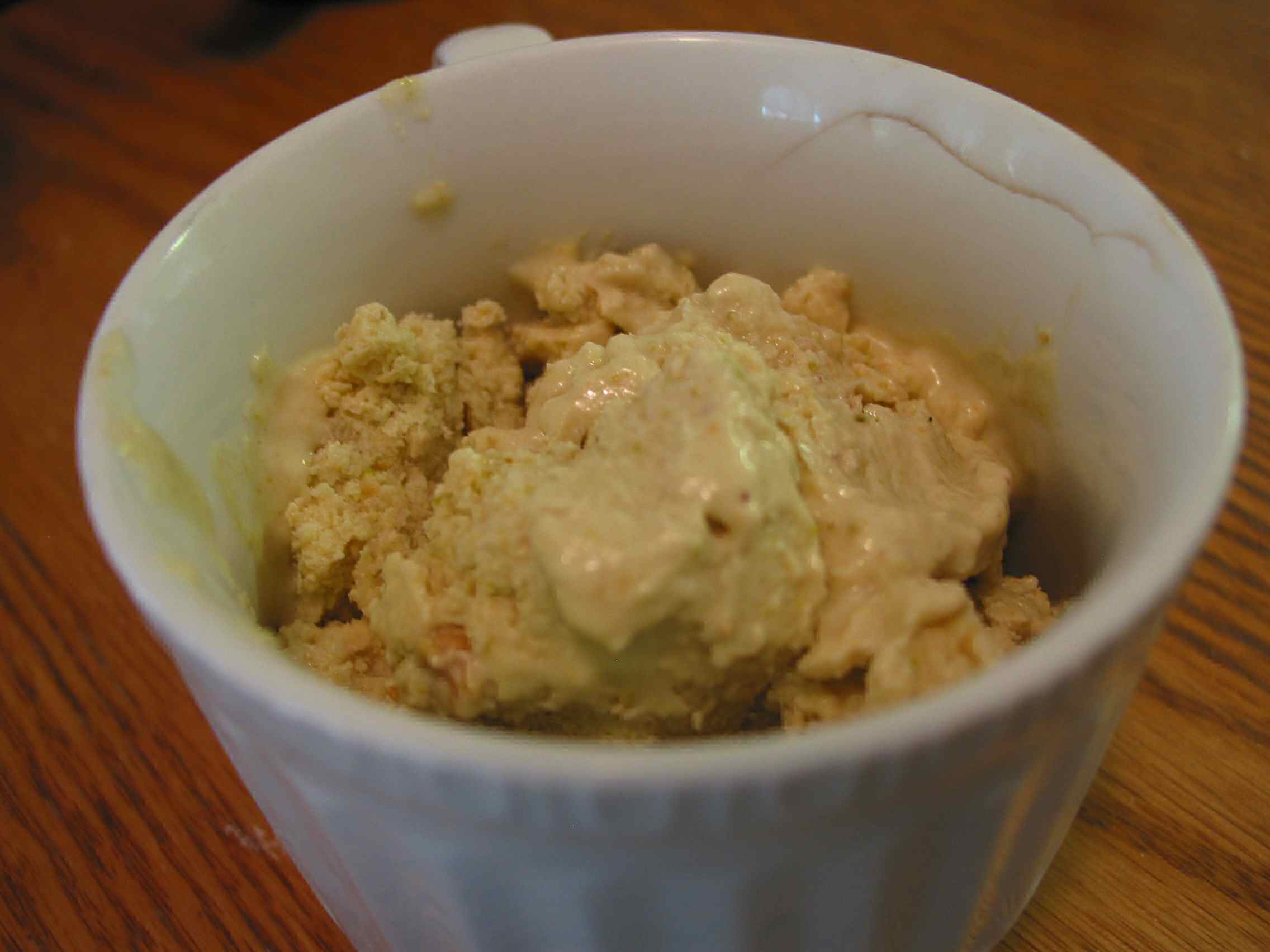
Homemade pistachio frozen yogurt, very low carb

It’s over 90 degrees most of the day in Pasadena, and I’ve gotten tired of looking at the limited selection of Dreyer’s (Edy’s east of the Rockies), Breyers, Haagen Daz, and Private Selection flavors with my daughter. It’s starting to get tedious, and they’ve dropped many of the classics for the cheapest possible quality candy-plus-ersatz-vanilla (note: their real vanillas are better). The forgotten classics were better-tasting, less dependent on goo and sweetened brown wax parading as chocolate or (if salted) peanut butter.

No supermarket ice cream brand in the non-superpremium range today offers rum raisin or pistachio worth considering anymore. It’s easy enough to doctor your own version with storebought vanilla ice cream and the aforementioned rum and raisins, but pistachio?

Pistachio used to be a standard ice cream flavor, didn’t it? Maybe I’m just getting old? Naah. Even in the ’70s when I was a kid, most of the “pistachio” ice cream around was already fake. I want the real thing, not the artificially green, mostly-vanilla-with-a-tinge-of-synthetic-almond kind.

And I want it low-fat for me and my husband and low-carb for my daughter (and us too, why not?) And I want it to taste delicious despite all that. Tall order? Actually, it’s easier than you’d think.

David Lebovitz has a Sicilian pistachio paste-based gelato in The Perfect Scoop, and he blogged about it a couple of years ago as well. He made it sound delicious, but also expensive and hard to find the ingredients for. Not that I’m against a trip to Sicily, except in July when it’s about as searing as LA (been there, done that, got the sunburn and the Fellini moments combined with heat exhaustion).

About the same time, a local gelateria owner in my area took much the same position on the utter superiority of Sicilian pistachios versus California ones for an interview in the LA Times. Which is lovely if you have a good source of Sicilian pistachios or pistachio paste at a decent price, but what if you don’t?

Most of the home-brew pistachio ice cream recipes I’ve seen in magazines, blogs and cookbooks call for adding significant amounts of heavy cream. Or else they involve large amounts of sugar. Or both. Yes, those recipes will give ice cream-like results, but they’re completely offtrack for what I need.

In my universe, good taste on a hot day shouldn’t mean losing your svelte, your cool or your wallet.

The nuts themselves are okay–pistachios, like most nuts and seeds, are very low carb and though high in calories from total fat, most of that is unsaturated. If I can keep the rest of the ingredients low fat and low carb and the stuff still tastes good, I’ll have it. Right?

So okay. I’ve been playing around with California pistachios and–not gelato, that requires making an egg-based custard and blending it with flavorings. Done it once or twice, and it worked, but it’s more work than I want to do most days. Or it used to be. Nowadays I’ve got the microwave moxie to make custard without so much work, but it’s still not what I want today. I want easy.

Frozen yogurt made with real yogurt is too tart to work with anything much but fruit unless you mix in some milk–and then it’s icier and freezes harder.

However, this summer I’ve been playing around with fat-free Greek yogurt as the base for a couple of different ices in small quantities. Greek yogurt varies a bit in nutritional stats from brand to brand, and it’s expensive, which is why I took so long to try it out. But the cheapest all-real (no gelatin) stuff–Trader Joe’s O% fat plain version–while still twice as expensive as the regular plain nonfat yogurt ($5 vs. $2.50 a quart), has considerably less carb, maybe only 7 grams of carb per cup as opposed to 17 for regular. And it has about twice the protein–22 grams per cup. It’s a lot thicker and less acidic, so I’m assuming they drained out a lot of the carb in the whey. And it makes really easy frozen yogurts that taste like something and aren’t overwhelmingly tart.

Just mix in your flavoring of choice (preferably not too watery) with some sugar, and you can still-freeze it within an hour or two. If you think the tang needs to be tamed further, a little milk mixed in works okay and it stays thick enough to freeze fairly gracefully.

The texture is never going to be like ice cream, not entirely. It still mixes up pretty hard and a little icy if you still-freeze it, but once you’ve got it thawed out to the point where you can dig out a serving, it tastes good and changes to a creamy texture as you eat it, something like khulfi. Higher-fat yogurt would break the iciness up a bit but would defeat my purpose of lowering the saturated fat to something I can handle.

And the heavy fats and sugars mask any delicate flavorings. Think Italian gelato (the real kind you get on the street in Florence, not the overpriced stuff you get in pints in the supermarket here) and you know that a lighter base allows you things like rose or ricotta or apricot or kiwi, or hazelnut, or four different highly refined grades of chocolate. If you want to taste anything delicate in your ice cream, you have to get the fats and sugars down enough not to overwhelm it.

Not that I’m entirely subtle. My favorite icier-textured frogurt for when it’s broiling out is mint–Greek yogurt, a couple of drops of mint extract, if that’s strong enough without tasting like postage stamps, and a tablespoon or so of sugar. Divvy it up into 2-4 paper cups or popsicle makers (small is okay for this), freeze. On a searingly hot day it’s pretty good, intensely flavored and refreshing, and its popsicle-style texture is fine with me.

For something like coffee frogurt, I really do want a creamier texture if I can get it. I finally figured I should just brew a little bit of triple-strength coffee so I can mix just a few spoonfuls into a cup of Greek yogurt, maybe with a few spoonfuls of milk, and still get strong enough flavor.

A spoonful or two of alcohol-based flavorings like rum, amaretto, even just vanilla extract can soften the hard-freeze effect, since the alcohol freezing point is lower than that for water.

Or you can add something protein or starch to the mix–egg custards and cornstarch are the usual route for gelati and standard commercial ice cream, but silken tofu and nonfat powdered dry milk also work to break up the ice crystals. Greek yogurt is providing most of the protein here and little water, and the carb is a lot less than for the powdered dry milk.

The last thing on my list, and it sounds either weird or completely obvious, is to add a fat–but I want something unsaturated. Oil? Yuck (though I have seen some olive oil ice creams flavored with basil or the like). But what about nut butters? Those, don’t laugh too hard, work pretty well and give the frozen yogurt a richness that feels like ice cream, only without big saturated fats or modifiers or xanthan gum or corn syrup solids or whatever. Plus they’re interesting flavors.

Halvah: I started with my trusty jar of tehina–sesame paste. It’s got almost all its fat in polyunsaturated form. A tablespoon in a cup of Greek yogurt, plus a tablespoon of sugar, stir, freeze, dig out a chunk–not so hard! And the flavor–kind of like frozen halvah. Very rich, though. Maybe I could get away with less tehina or more yogurt?

Chocolate halvah: I tried a chocolate version–also not bad–by adding two tablespoons of cocoa powder and an additional spoonful of sugar to the tehina/yogurt mix. Pretty good, but the tehina taste was definitely still there alongside the chocolate. Like chocolate marble halvah. You have to be a fan.

Peanut butter? Probably more Americans would like it than the tehina version. Go easy on the peanut butter; a good-tasting mix I once made with half a cup got way, way way too rich very quickly once it was frozen. Stick with a tablespoon or so per cup of yogurt. I’d use natural peanuts-only peanut butter, preferably the crunchy one, for the purest taste, limit the sugar and add a pinch of salt.

But really. I started out wanting pistachio, and that’s where I’m still going with this. Because I ended up with two, count ’em TWO, really good, really different variations on pistachio, and both of them were really easy, really low in saturated fat, and REALLY low-carb. And actively delicious, which is definitely the point.

California pistachios may not be the Sicilian ideal, but they taste pretty good for what they are.  TJ’s sells 8 oz of roasted unsalted ones for about 5 bucks. Not exactly cheap. Still, the shelling’s been done, and for a pint of finished frogurt, you only need an ounce of pistachios. Will that be enough to taste like something? Oh, yes. Continue reading

Coconut, minus the hype

dried coconut shreds

Palm and coconut oils have made a huge comeback in the last few years. Both are very high in saturated fats, which promote high blood cholesterol and heart disease, but the vegan community has embraced them as “natural” and they’re turning up in all kinds of baked goods and sweets these days at Whole Foods. Which also sells big mayo jars full of coconut butter. Looks like Crisco, scoops like Crisco, costs 10 times as much.

A lot of the newer vegan recipes and packaged foods are direct mimics of things that used to include lard, beef tallow and suet at the lower end of the classiness scale, or butter at the high end. My local Whole Foods’ pastry case features a lot of croissant and baklava variations these days, all now made with palm oil, as are many of the muffins. Starbucks’ “old-fashioned kettle” doughnuts feature palm oil in two places, both the dough and the icing.

Why are these fats getting so popular? Why all the wishful thinking that a plant source automatically makes them healthy to eat in quantity? Why are all the nutrition advice columnists in the major newspapers and health magazines suddenly “holistic coaches” who graduated college with psych majors and the like rather than board-licensed nutritionists and registered dieticians?

The truth of the matter is that your body doesn’t care so much whether a saturated fat came from lard, a coconut, or a chemical vat–regardless of the source, the fat molecules are shaped the same and your digestive and metabolic enzymes process them all the same way.

Palm and coconut oil? The hip vegan crowd, who consider themselves really indie, would be surprised to learn how thoroughly they’ve been manipulated by a very big industry. In the past 10 years, these oils have suddenly ramped up production wherever palm trees can be grown, mostly in Malaysia and Indonesia, where producers started by stripping the jungles to plant a single crop (though some of the main palm oil traders, like Lever–yes, the soap manufacturer–have made statements that they’re working to reverse some of the damage and buy only from those who “plant sustainably”). The other main centers of palm and coconut oil growers are Africa, India and Latin America.

Palm and coconut oils have taken off not because they’re vegan (outside of India, there just aren’t enough to support the industry boom) but because they’re such a cheap source of fat. Well, cheap everywhere but the Whole Foods shelves. They are indeed useful to the processed baked-goods industry for lending that heavy grease “satisfaction” factor to things that used to be made with butter, suet or lard. And they’re much less heavily regulated in the US by the agricultural inspectors because they don’t trigger all those livestock rules.

But should you be eating them? Buying jars of coco butter for your home cooking? Something tells me you’d be better off eating less of anything that requires cooking in heavy fats as opposed to regular polyunsaturated vegetable oil. And cutting down on all fats unless you’ve actually been diagnosed by an MD, not a holistic coach, as underweight.

Because even the unsaturated fats have a lot of calories. Rip Esselstyn’s “Fire Engine 2 Diet” specifically cut out all oils because the people he was training to eat better really needed to lose weight, and the bottom line is that the 120 calories in a tablespoon of ordinary unsaturated vegetable oil are still extras. There’s no real way around that. Not even if you’re vegan.

And wasn’t the point of nonstick pans supposed to be so you could cut down on cooking fats? (ok, it was really so the pans would be easier to wash, but why not take advantage while you’re at it?)

I’m not saying you shouldn’t ever use coconut itself in cooking–I’ve been a Mounds fan from way back, and please just don’t ask about those poufy huge coconut-sprinked, bright pink marshmallow things we used to clamor for as kids (“Snowballs”? I think it was a half-dome of marshmallow that sat on a cookie…almost as bad as Moon Pies.) These days I try to eat it sparingly, because it’s still fatty, and because most of my coconut exposure now takes place in the form of macaroons at Passover, when I’m already feeling like if I see another can or box of something packaged I’ll pass out.

But seriously–and more sophisticatedly–coconut itself is a worthwhile cooking ingredient in some savory dishes, and it has a subtle, penetrating flavor that means you don’t have to use a ton. You can also find good steam-defatted versions of shredded coconut that have about half the fat of regular, and look for partially decreamed canned coconut milk as well (I think Trader Joe’s sells it, maybe Whole Foods as well). Unfortunately, half the fat for coconut is still pretty fatty, but it’s an improvement.

Even a spoonful of unsweetened shreds can give a curry or aviyal (i.e., coconut-based “dry curry” class of dishes) a satisfying suggestion of richness without adding loads of fat. Maybe a gram or two per serving, and it can help even out jagged edges in the spicing.

To get the most flavor out of a small amount of coconut, I do one of two things. In the aviyal of cowpeas below, I toast a spoonful of dried shreds Continue reading

Lightening up homemade scones

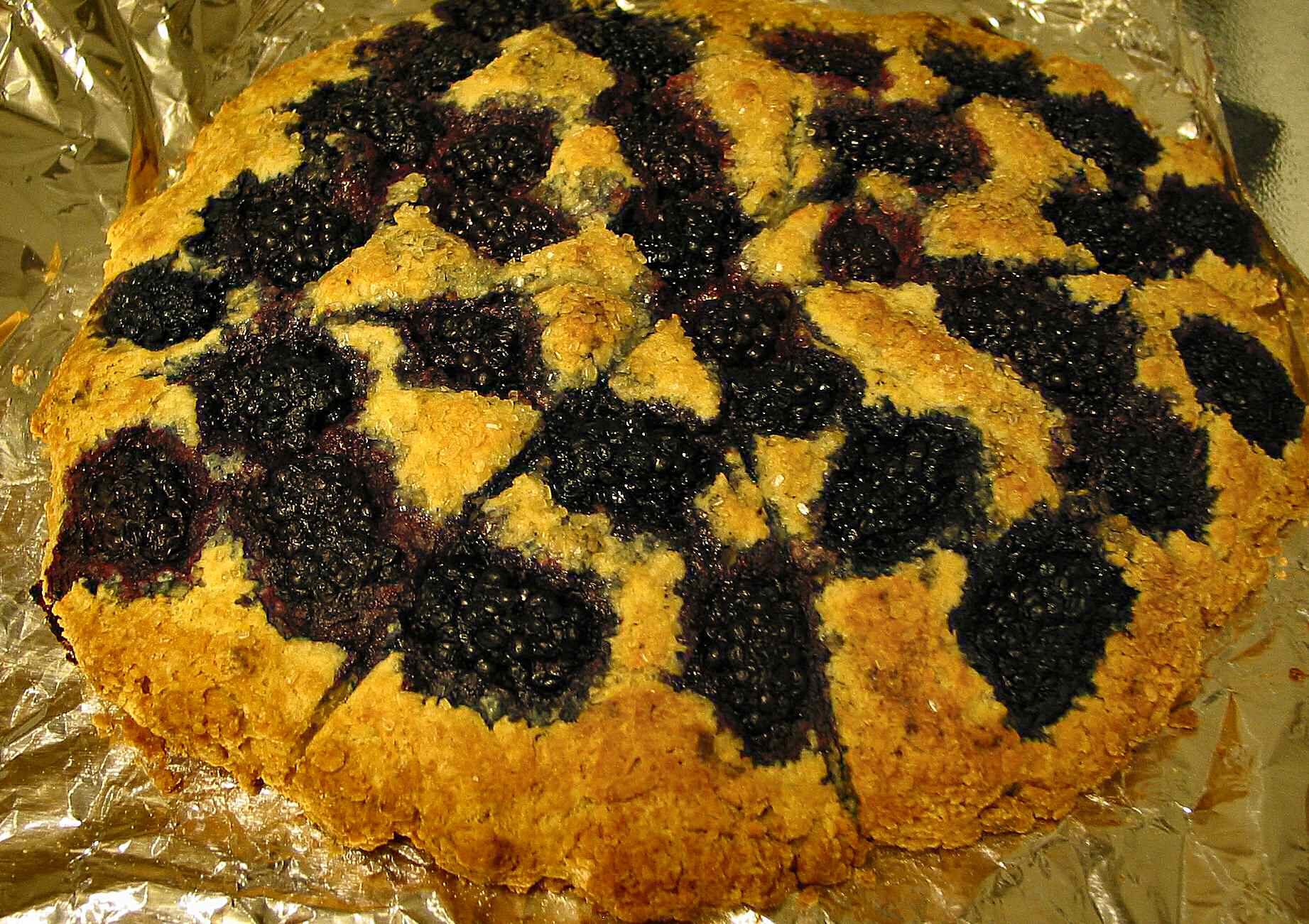
Blackberry scones for brunch

I’ve been wanting to post my favorite scone recipe for some time, but it seems to me that most food blogs start out with good intentions and end up maxing out on the desserts-and-starches end of the food spectrum.

The reason is pretty simple: if you’re a food blogger,  a baking recipe and a pretty picture (or any picture of an aggressively-frosted cupcake) will never put you wrong, even if the real result tastes kind of blah. I mean, cupcakes? Isn’t that what Duncan Hines is for? But if you do feature cupcakes, somebody’s sure to repost it or call it awesome, particularly if you figure out how to add bacon to it. Somehow people just don’t flock to posts about green beans in droves unless you’re redoing the Thanksgiving-straight-from-the-can classic, complete with canned fried onions.

There are way too many variations for every kind of baked good, none with a clear and permanent advantage, and people take them all literally (see under, my New Year’s apple pie insecurities).

So as I say, I’ve been reluctant to put up too many baking posts. Scones, though they’re not exactly the staff of life, are very easy to make and actually taste best when you make them from scratch–much better than buying them in a store and definitely not at your local Starbucks. The question I have is whether it’s a good idea to do it very often–I usually don’t, even on the weekend, but partly that’s because I live in southern California and heating the oven for more than five minutes in my little galley kitchen is often a Very Bad Idea. The other reason is that I keep remembering something Valerie Harper once said (maybe in the role of Rhoda Morgenstern; can’t remember): “I don’t know why I bother to eat this piece of chocolate cake. I should just apply it directly to my hips.”

Most quick breads (i.e., raised with baking soda or powder, or beaten egg whites, not yeast) do fine in a microwave as long as you don’t need them to brown. So lemon-poppyseed cake is okay, as is gingerbread. Scones, which to my mind require a deep and crunchy crust, need a regular oven to do well, but I make the sacrifice (90-degree weather makes it a genuine sacrifice) once in a while on Sunday mornings, because they taste terrific and they’re not exactly rocket science to make.

So if they’re that easy, should I really be posting about them–haven’t you already seen too many wide-eyed, “Look, Ma, I made SCONES!” kinds of posts?

Let’s face it. You can make great scones in a food processor from a very short list of ingredients for cheap, in about half an hour including baking time, and flavor them simply or exotically. Fruit or chocolate chips or chiles and herbs and cheese–all optional. I stick with berries and turbinado sugar, which makes the crust crunchy and glittery. Continue reading

Hunan Tofu, spare the salt (spoil the child)

tofu with broccoli

Last year my daughter kept hocking me that I never made enough meat. This year she’s going on twelve and decided, about a month before Passover, that she needed to be vegetarian because she has ambitions of becoming a veterinarian. Hard enough for anyone to deal with, but for a diabetic, it’s an added challenge, especially at Passover, which we got through with a lot of vegetables and a dispensation for tofu (though without soy sauce, which contains wheat) so she wouldn’t be stuck with only eggs and cheese and yogurt and nuts for protein. Next year, rice and beans are going back on the menu–I’m not stuck in Ashkenazi-think, and a lot of synagogues in the US are starting to reconsider the role of legumes, pulses and non-wheatlike grains at Passover. I’m all for it.

Still, we’re well past Passover now, and the issue today is tofu; see under: how to feed a vegetarian preteen some protein without overdosing her on sodium. One of our favorite Chinese restaurant dishes is tofu in black bean sauce, but no doubt about it, it’s loaded.

[Update Note, cue theme “Do the Math Yourself”: Check out the recent LA Times’ version of Hunan Tofu with Black Bean Sauce–looks wonderful, right? but the sodium stats at the bottom of the recipe are WAY off, even if Andrea Nguyen, the food writer, had been using low-sodium soy sauce. Perhaps the editors forgot to count the salt in the fermented black beans–which on its own is something like 850 mg per tablespoon, as far as I could find (it’s not listed in the USDA nutrient database). You really can’t rinse that kind of salt out, especially not if you’re using the rinse as a broth and adding it back into the dish. That plus 1/4 t. salt “or more” at 560 or so mg. and a couple of tablespoons of soy sauce–you’re looking at 750-1000 mg for each of 4 servings, or 1500-2000 each as “dinner for two”, or about an entire day’s worth of salt in a single dish–definitely not the 350 or so as stated in the article!]

Cooking at home is a lot cheaper in a number of ways (a 14-oz pack of firm tofu runs about $1.50 where we live), and we can figure out what to do about the sauce if we really want it. Invariably, the restaurant container is always swimming in sauce with a layer of oil on top, so I think just not doing that would be enough to improve the nutrition stats considerably.

Frying tofu at home won’t usually get you that crispy outside texture that you get in the Hunan tofu dishes from the restaurant–mostly, they’re shallow- or deep-frying the cubes or triangles in a lot more fat than you’d want to use at home for an ordinary dinner. A little less than that level of crispy is still okay by me. Getting any kind of brown on the outside would be a step up from the pale, flabby results I was used to achieving in the trusty nonstick pan.

So I started actually paying attention to the cookbooks I have on the shelf and to the techniques I invented for pan-browning things like salmon without salting the dickens out of them. I needed a (small amount of) sauce that tasted okay but wasn’t swamped with sodium. That means a little low-sodium soy sauce and a lot of ginger, garlic, maybe a bit of vinegar and sesame oil–and a surprise ingredient for browning and flavor depth: molasses.

Most syrups (agave included) run about 16 g. carb per tablespoon, a whisker more than a tablespoon of ordinary granulated sugar. Blackstrap molasses runs a bit less, at 11 g. per tablespoon. And it’s really thick, really strong-flavored, and really brownish-black. Also relatively inexpensive. Half a teaspoon will darken and thicken an ounce of sauce for frying tofu. It helps “stretch” the soy sauce–for looks as much as flavor and volume–without adding much sodium or carb to the dish. Even stranger (and better), molasses is a powerhouse source of potassium at 600 mg and iron at 20% of the RDA per tablespoon (not that we’re adding that much here, more like 1/6th tablespoon). The vinegar and sesame oil lend rich pungent flavor that doesn’t depend solely on the saltiness of the soy sauce, and ginger and garlic round out the combination.

So that’s the sauce. To get the tofu to brown in the frying pan, you have to get some of the extra water out of it first. There’s always the press-it-with-a-weighted-plate-on-top-for-30-minutes scheme, which always seems more of a pain than it’s worth. But I’m impatient.

There are two decent ways to press tofu other than the weighted plate setup. One requires thinking ahead (not my forte): slice the tofu and freeze the slices, then thaw them. The other–are you surprised yet?–is to slice and microwave the tofu on an open plate for a couple of minutes, say 4 minutes for a whole 14-oz. pad of firm tofu, or 2 minutes for half a pad. Then drain off the watery stuff that’s come out of the tofu (let it sit another few minutes and redrain), and pat the tofu dry.

To fry, heat a bit of olive or other vegetable oil in a nonstick pan. Brown some onion or scallion a few minutes. Make a frying sauce: 1-3 teaspoons of low-sodium soy sauce, depending on how much tofu you’re making, a minced clove of garlic, a teaspoon of fresh grated ginger, a few drops of sesame oil, a dash of vinegar and a pinch of brown sugar or better, a half-teaspoon of molasses. Hot pepper flakes or z’khug optional.

Pour the sauce into the hot pan and let bubble up a second or two. Then add the tofu cubes or triangles and toss a couple of times in the sauce. The sauce will be just enough to color the surfaces a little and get them started.  It’ll take another 5-10 minutes of stir-frying to get the tofu surfaces to brown nicely, but it does work. Serve atop microwaved broccoli and/or bok choy. Garnish at will with some chopped scallion, toasted almonds, fried mushrooms or slices of red bell pepper (or hot peppers and roasted peanuts for kung pao, if that’s your thing).

Sodium counts for this version:

If you figure the dish serves 3 people a decent meal-sized portion of protein, and the sodium is coming exclusively from the low-sodium soy sauce, a full tablespoon of soy sauce would be about 450-600 mg, so each serving is about 200 mg at the higher end. I don’t think I usually use quite that much for us, but even so it’s pretty reasonable. If you don’t mind doubling the sodium to about 400 mg per serving, you could make another dose of the frying sauce to drizzle the dish with at the last minute.