• Enter your email address to subscribe to this blog and receive notifications of new posts by email.

    Join 241 other subscribers
  • Noshing on

    raw blueberry pie with microwaveable filling and graham cracker crust

    This mostly-raw blueberry pie is a snap to make and very versatile--the filling microwaves in a few minutes, and you don't even have to bake the zippy gingered graham cracker crust--perfect for a hot Fourth of July and all summer long.

  • Recent Posts

  • Contents

  • Archives

  • Now Reading

  • See also my Book Reviews

  • Copyright 2008-2024Slow Food Fast. All writing and images on this blog unless otherwise attributed or set in quotes are the sole property of Slow Food Fast. Please contact DebbieN via the comments form for permissions before reprinting or reproducing any of the material on this blog.

  • ADS AND AFFILIATE LINKS

  • I may post affiliate links to books and movies that I personally review and recommend. Currently I favor Alibris and Vroman's, our terrific and venerable (now past the century mark!) independent bookstore in Pasadena. Or go to your local library--and make sure to support them with actual donations, not just overdue fines (ahem!), because your state probably has cut their budget and hours. Again.

  • In keeping with the disclaimer below, I DO NOT endorse, profit from, or recommend any medications, health treatments, commercial diet plans, supplements or any other such products.

  • DISCLAIMER

  • SlowFoodFast sometimes addresses general public health topics related to nutrition, heart disease, blood pressure, and diabetes. Because this is a blog with a personal point of view, my health and food politics entries often include my opinions on the trends I see, and I try to be as blatant as possible about that. None of these articles should be construed as specific medical advice for an individual case. I do try to keep to findings from well-vetted research sources and large, well-controlled studies, and I try not to sensationalize the science (though if they actually come up with a real cure for Type I diabetes in the next couple of years, I'm gonna be dancing in the streets with a hat that would put Carmen Miranda to shame. Consider yourself warned).

Chocolate Quickie: Unromantic but Reliable
It’s Valentine’s Day again–midweek, busy, too many items still on the list from last week to want a lot of fuss–or even be able to guarantee that my husband and I will both get home a reasonable time for dinner in a reasonable frame of mind to celebrate romance by cooking, or eating, something fancy. Last night I spied way too many people at the Trader Joe’s heaving large bars of chocolate and multiple bouquets of hothouse roses toward the cash registers. That’s okay–I’m not raining on anyone’s actual romance, but I have to admit I’m not feelin’ the official holiday symbols this week. Chocolate is good, don’t get me wrong. Flowers are pretty but require a vase and a pair of shears–usually right when I’m trying to cook dinner.

Last year we actually managed éclairs, and it was fun if a bit much–even though I managed to strip it down considerably with the microwave. Microwaveable ganache truffles are also easy, quick and fun if you’ve got the time to feed them to someone you love.

But with a kid who’s now waiting for college acceptances (and us parents anxiously figuring out both taxes and how to get around the outrageous Estimated Family Contribution)–well, we could all use a smallish midweek-style treat that doesn’t involve even that much effort to make–or work off afterward.

Lately I’ve been digging around in my cooking “blank books” from the last couple of decades. Part diary, part notes to self with or without illustrations in scratchy pen and occasional bragging, political satire, or outright swearing as the situation demands–when you’re writing cooking instructions for yourself, why not? I started these books long before the era of the blog, and hunting through them takes me back to what I was doing at the time.

Half the recipes I came up with are from before I figured out how to work a microwave, but I seem to have gone overboard as soon as I got enough of an introduction. One of the more unusual finds that worked really well a couple of years ago in a birthday dessert emergency (why do I tend to have these?) was a small but rich-tasting dessert halfway between cheesecake and flourless chocolate cake. The best parts:

  1. A limited and very simple ingredient list and
  2. You microwave it in 3 minutes. Seriously. Also,
  3. It’s small, and there are no leftovers. Sometimes that’s a plus.

This would probably be a decent rescue option if you had to make dessert with whatever’s in the cupboard and the fridge, and you’d left things till the last minute…or even a little later than that. As slapdash as this quickie is, it’s got big, big advantages over anything storebought–time, taste AND chocolate. Also, modest calorie and carb counts.

Not everyone has a grocery that carries labaneh, which is kind of a Middle Eastern cross between sour cream and yogurt cheese. Nowadays, though, a lot of mainstream supermarkets are carrying plain Greek yogurt, which also works pretty well, even nonfat. And not every doctor approves of cheesecake in any quantity, much less huge. Damn, as I’ve said before, my cholesterol-packin’ genes (also jeans, but that’s another matter). The completely nonfat version of this dessert works fine and tastes good too, now that I’ve retried it, and all the ingredients are real.

So–whomp the ingredients together in a bowl, nuke it about 3 minutes, cool it, stick it in the fridge. Serve it with raspberries, peaches, cherries, whatever goes with chocolate in your book. Or jam (raspberry, apricot or sour cherry would be great on this, and so would marmalade…).

Chocolate Quickie

Serves 3-4 in smallish wedges if you don’t care how it looks–otherwise (probably smarter) pour it into small single-serving ceramic cups before microwaving. If you double the ingredients, it’ll need another minute or so in the microwave. Definitely serve with fruit.

  • 4 T cocoa powder (20 g by weight; 8 g carb)
  • 4 T sugar (60 g, all of it carb)
  • 1 lg egg
  • 1/2 c. (112 g by weight) labaneh, preferably 1/2 the fat, or else fat-free or 2% plain Greek yogurt. (about 3-5 g carb for any of them; about 7 g saturated fat and 10 g total fat for the full-fat labaneh, much less for the yogurt)
  • 1/4 c. water (yes, really. It’s 60 grams or mL if you’re weighing it out)

Whisk everything together until smooth in a microwaveable ceramic dish (big soupbowl is fine), or else mix and then pour into small microwaveable coffee or flan cups for individual servings (more attractive and probably less prone to serving mishaps where it falls apart when you cut it and lift it out). Microwave uncovered on HIGH 3 minutes for the big bowl, maybe 2 minutes for the individual cups, checking progress and adding extra time in 20-second increments just as needed so you don’t overdo it. When it’s done it’ll be a little dry around the edges and just pulling away from the bowl or edges of the cups. Cool to room temperature, cover and chill until it’s time to serve. Cut in wedges with a sharp knife if you went with the single bowl version. A pie server would probably help it keep its shape long enough to dish up.

Variations–add some grated orange peel or marmalade to the mixture; add a spoonful of almond extract, vanilla, amaretto, or hazelnut liqueur; add espresso instead of water…?

Carb counts: about 17 g apiece for 4 servings, 23 g each for 3 servings, all of it in the form of sugars.

And one more…

Butternut squash salad with tehina

Butternut, kabocha, red kuri, Hubbard, turban, pumpkin (and acorn, and delicata, and all the rest)–if you’re microwaving a large red squash, you may as well have another easy recipe in your back pocket.

This is one from my gourmet cousin up north, something she served us as a Friday-after lunch a couple of Thanksgivings ago, and it’s both beautiful and surprising with almost no effort.

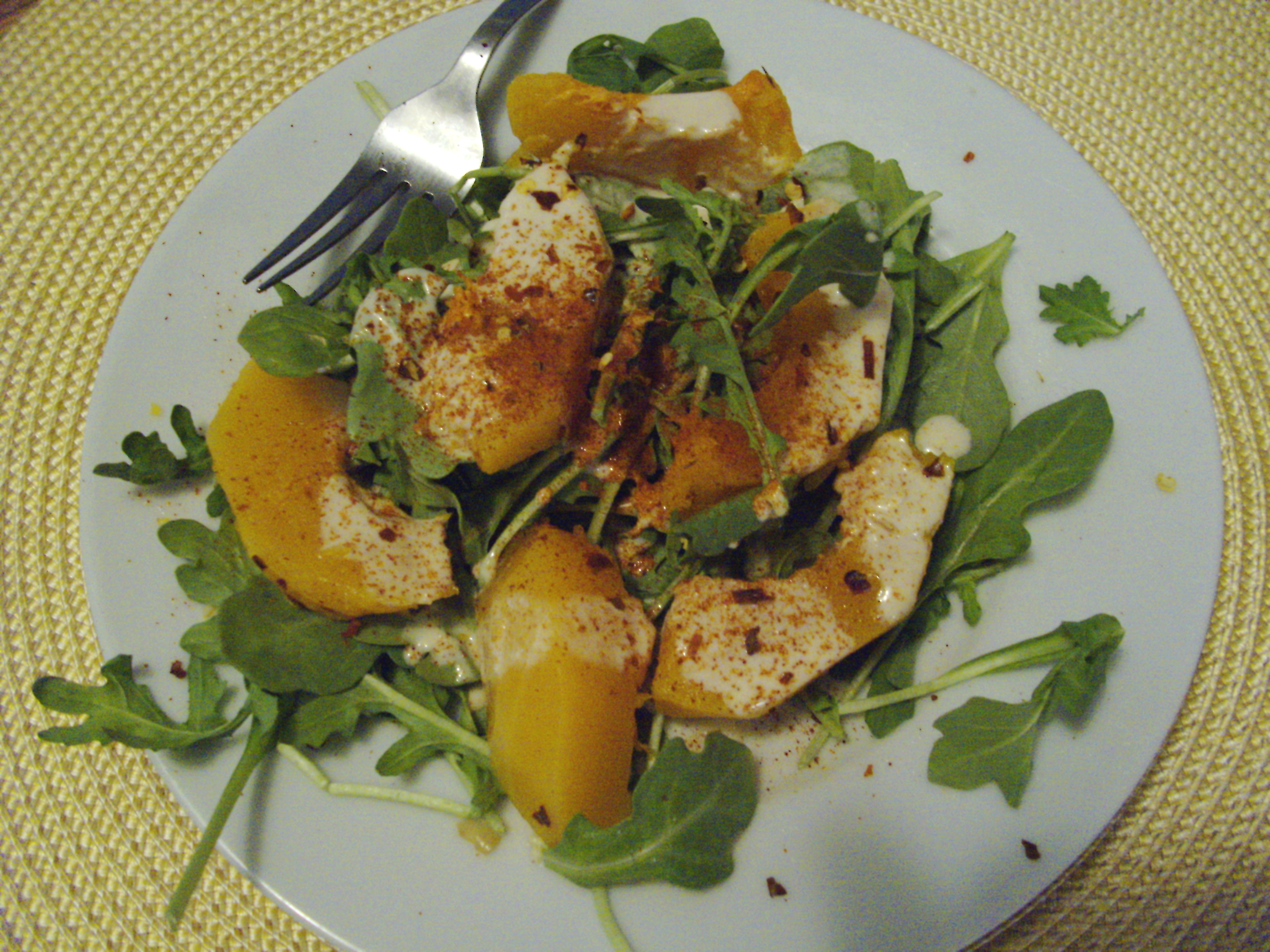
Red Squash Slices on Arugula with Tehina

I know, I know. I’ll never get that chichi cookbook deal giving it away that fast. You wanted suspense. Obviously.

But really. If you have a couple of big chunks of leftover roast or preferably microwaved butternut squash, peel and slice it up–cold or hot, either is fine. Put down a bed of arugula or other salad greens, fan out the slices of butternut, mix up a little tehina (sesame paste) with lemon juice, a small clove of garlic and an optional pinch of salt, add just enough water to get it pourable and drizzle it over the squash.

[Note: if you’re making tehina sauce yourself, put a large dollop of the sesame paste in the bowl first, then add the juice of a lemon and stir slowly with a fork, then the garlic and salt, then water by spoonfuls. If you try to add tehina paste to water, you get murky, milky thin stuff that never really emulsifies and you waste your expensive ingredients. I learned this the hard way in a kibbutz kitchen while the two crazy ladies I worked for cackled at me and smoked inches of ash over the food, so take my advice to heart. I’d never want to put you through that humiliation.]

If you want color and glamour, go for the Trader Joe’s or similar smoked paprika and sprinkle it lightly over the platter. Roasted sunflower seeds (shelled, obviously) are nice too. As are hot pepper flakes if you like heat. Sumac (the purplish red sour spice, not the irritating weed) is also pretty if you can get it where you are, but smoked paprika really hits the spot.

If you’re being impressive at short notice and you have an organic kabocha squash, scrub it well, cut off the cap carefully with a very sharp knife and dig out all the seeds, put the cap back on, then stick it on a microwaveable plate (Corelle is probably the best) or in a microwave-safe casserole dish, with either Saran wrap or a big microwaveable bowl as a cover. Drizzle a quarter-inch or so of water around it on the plate, hit it for 8 minutes and see if it’s cooked through (depends on the size of the squash). Give it another 3-4 minutes if it’s not quite there, until you can poke a sharp knife through it easily at a thick point. Let it sit 10-15 more to steam further and/or cool a bit. The kabocha is thin-skinned enough to slice through and eat the skin if you want, and it’s a pretty contrast between the dryish, nutty orange flesh and the thin green skin. Drain and bring the whole thing to slice at the table if you feel like it, and pass the tehina sauce.

Microwave Tricks: Black Beans

microwaved black beans

Cooking seasonally is a tricky thing–especially if your season currently includes hurricanes or extreme heat. Pasadena has finally cooled down to 80s/90s with a bit of cloud cover, but last week’s 105-degree afternoons were a serious challenge. It was so bad the only time to go out for a walk was about 5:30 in the morning. Hard to think school has been in session for a month, it’s already September, and Rosh Hashanah is a week and a half away. Running the oven is, to put it bluntly, not an option, and the stove top isn’t much better in my small and easily overheated galley kitchen.

Microwaving is a powerful way to cut the time and pain (and airconditioning bills) for bulk cooking of things like vegetables, rice, pasta…and dried beans, which are much cheaper and more versatile (and much lower in sodium) than canned. Make a bean stew or chili and you can zap a portion of it at will later in the week. Plus bean salads can be served cold–a plus for weeks like the ones we’ve had recently.

But for microwaving, you usually have to adjust whatever method is spelled out in a recipe to your oven, your containers, your food quantities. Microwave times are sensitive to all of those factors, plus how much water you have (water’s the main molecule microwave radiation acts on) and whether or not you’ve got a lid.

Most people don’t try to make changes based on their first-run results and most cookbooks never really explain how to make useful adjustments. Predictably, most microwave cookbooks end up in the Last Chance bin at your local Friends of the Library booksale.

It’s a shame, because once you’ve got your timing and so on down, you can repeat it with reliable results.

Over the years I’ve posted basic heat-to-simmer-and-let-sit-to-absorb microwave methods for cooking split peas, chickpeas, lentils and other bulk dried beans. Lentils and split peas always did work out well without needing to soak them first–they tend to be easier to cook quickly by standard stovetop boiling too. Chickpeas work okay if you presoak them or hot-soak in the microwave (heat briefly in water just to cover, let stand 15 minutes or so and let them swell up) before the main cooking, and adding a dash of baking soda to the soak water really helps. Same with gigantes (giant favas)–which I’ve now decided cook better with the skins left on, same as if you were boiling them, and they’re certainly a lot quicker and easier to peel afterward–also more fun.

But some beans just seem to toughen if you don’t presoak overnight or if you microwave them too long. Black beans and kidney beans have given me more trouble than they seem to be worth–and I’m a bit reluctant to post this because it’s fussier than I like to admit even after adjusting the method successfully. Microwaving isn’t supposed to take more time and fuss than straight boiling on a stove, or working with a pressure cooker, if you have and trust yourself with one.

But this is a good illustration of how to use a microwave as a workaround when you don’t, and it shows you how you might think about making adjustments based on what the food is doing or not doing.

I microwave because I want something relatively safe, that doesn’t heat up the kitchen, and that turns itself off when done because, let’s face it, I’d rather be reading or writing than waiting for a pot of water to boil or jumping up at the whistle to avert an explosion. And I want the beans properly cooked and tender in less total microwave time at the least and without having to boil them afterward on the stove. I’ve done that before and I’ll probably do again if it ever cools down enough, but I’d rather not have to. The prior microwaving steps still shorten the stovetop time to maybe half an hour, but really, I’d rather it were all microwave, no fuss (I can dream, can’t I?)

So after a rethink of my previous methods, I’ve made some changes to the way I cook black beans from scratch by microwave. It also works for things like brown rice, steelcut oats, and other tough, uncut, unpeeled whole grains like farro or pearl barley when you’ve forgotten to put them up for soaking overnight, and at least for the rice it’s quicker than the 45 minutes or so of my previous brown rice method–maybe 20-30 minutes for a pound or two of brown rice. For the beans, maybe an hour of time total, with sitting and rechecking. Maybe less if your beans are fresh enough and/or you remembered to soak them overnight first.

Cracking the method

It starts with the water. I had been covering a pound of dried beans (or brown rice) with more than an inch of water and heating it all, or else heating that much water by itself (more than a quart) and then tipping in the rinsed beans to soak for a bit. But since the water molecules are what the microwave heats up first for preference, the more water you have, the longer it takes for the Continue reading

Microwave Tricks: Quick-Pickled Peppers

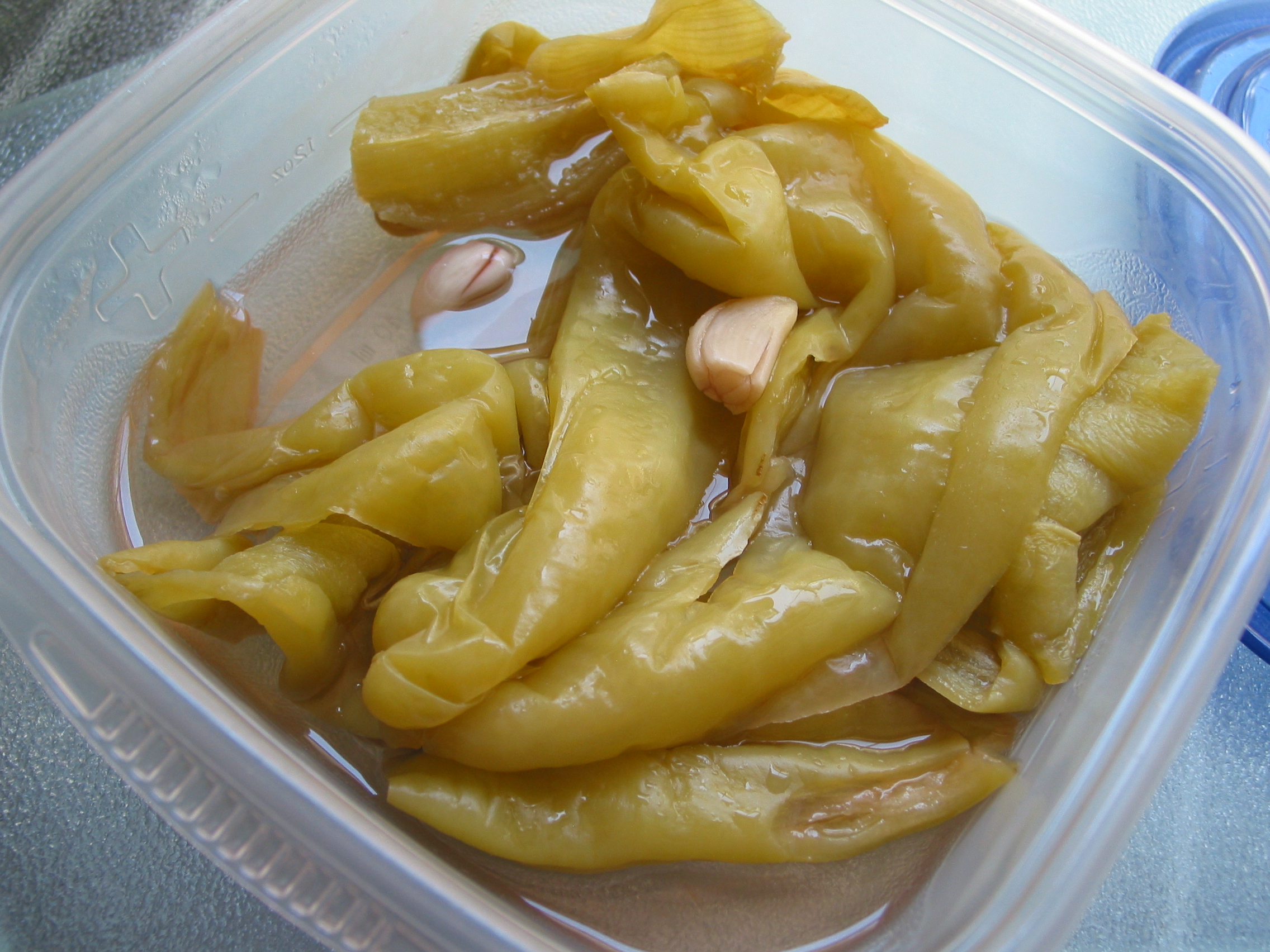
Microwave Hungarian pickled peppers

This is what happens when I get to the corner grocery or (more occasionally) the farmer’s market at the end of the day: I’ve already got a basket full of stuff, ripe, bursting with aromas it would take most supermarket produce days, weeks or forever to achieve. But there in the last-chance corner is a bag of very pale green, very contorted Hungarian peppers, about 10-15 of them for a last-chance dollar. They’re in good shape, maybe one or two has a couple of minor wrinkles, but that’s it. I can’t resist.

At first I thought I’d use them to stuff with corn kernels and feta and scallions, which I haven’t done for a while. But when I got them home, they were obviously too twisted to stuff, and very thin-walled at that. And unlike Anaheim or pasilla chiles, not really spicy enough to set off the corn. What then?

I’ve been feeling my nonexistent Italian and Greek roots lately, so I thought, pepperoncini? Well, why not? I did pickled green tomatoes last year, and it was incredibly easy (except for finding the green unripe tomatoes, which even my local Armenian corner store doesn’t provide often, and especially not at the height of the summer Fresno tomato frenzy).

But I didn’t want to wait two whole days for the peppers to ferment. And I didn’t want them quite as salty as actual pickles. So I decided to microwave-marinate them the way I make marinated artichoke hearts.

Yes, you can always just buy a jar of pepperoncini. My greengrocer definitely has them. But if you have the fresh peppers and they’re dirt cheap and you just want them right now, not necessarily every day for the next three months, microwaving them takes all of five minutes, and the result is surprisingly good.

It also brings out the full flavor of the peppers quickly–even a hint of spice, though they’re still not hot, and you can limit the salt to your own taste. Continue reading

Hot Air

The last two or three months of school seems to be getting more and more fraught every year–for parents, certainly. I’ve just woken up to the fact that I’ve been offline for something like three months now–March! yeesh! Not because I had nothing new to say about food, exactly, but because I had three or four competing ideas and no time to figure out pictures for the posts. And as everybody knows, if you didn’t take a picture of it, it practically didn’t happen. Just like all those tourists who used go to the Grand Canyon and (back in the day of actual film) had to wait for their pictures to be developed to see what it looked like…

And now that school’s out, it’s hot. 107 degrees twice this week in Pasadena, smoke in the air from the San Gabriel fire not too far away, and no desire to cook, walk during the day, or listen to anything resembling hot air.

Because the recent spate of presidential campaigning has become poised to take away almost any American’s appetite for a while.  Just read a newspaper online and look at the prominent photos and bombastic quotations and examples of rank cowardice.

I mean, yeah, I voted in the California primary two weeks ago, and I even researched all the local judges and assemblypeople for my district this time, hoping to make something count or at least not to commit any hideous mistakes.

Contrary to what you might think, reading the candidates’ own statements will actually give you a feel for what kind of people they are, whether they give a flying leap about their prospective constituents and whether they know how to tie their own shoes. Reading through about fifteen last-minute write-in candidate statements for various assembly-and-county-supervisor-type posts was pretty entertaining, actually–most of the hopefuls (you could guess which parties) stated their qualifications as “I believe in God.” Seriously. Sum total.

Nationalistic and bigoted fervor seem to be going around, though. To wit, “Brexit”, which actually won the vote today. Not that I don’t understand Britain’s–and everyone else’s–frustration with the EU administration, but the vote results and the resulting–utterly predictable–mess announced this morning are really disheartening.

Some are calling it a shot in the dark; to me it looks like a solid a shoot-yourself-in-the-foot-why-don’t-you move. It’ll take at least two years to execute, cost an immediate fortune in lost business and one-downmanship, and probably cost a lot more time, money and headache than previously suspected to resolve with the EU countries. Let’s face it; if Trump (king of the gold-tone hot air vent) thinks that it’s a great idea, you know you’ve gone wrong somewhere. Scotland, where his fabled floundering golf courses are located, went solidly for “remain,” by the way…

So is it any wonder I feel like taking a major break from my computer, my kitchen, and possibly your kitchen as well? If only to soothe your eyeballs and your rapidly developing ulcer, for which I apologize profoundly. Oy.

Now that that’s over, I guess I have no more excuses. What was I going to post all this time, anyway?

Harking back to early April, it looks like I made a couple of tries at something about microwaveable side dishes for Passover seders. Yes, it’s now too late to care where I hid the afikoman, but I maintain that the ability to microwave greens like asparagus or broccoli to perfection in a couple of minutes at the drop of a hat can save a meal–Passover or not–and some heat in the kitchen. If you’re vegetarian or leaning toward it, some of the not-chicken microwaveable soups can also be kind of handy and quick to nuke and store in those big snaplock containers in the fridge and free up your stove.

I didn’t go so far as to try any microwave matzah balls. No idea whether that would be a great idea or a terrible one, I was too not-chicken to try it. What can I say–be relieved. Be very relieved.

However, a crustless Israeli-style spinach and feta casserole, basically a quiche but more rustic in texture, was a hit both conventionally baked and browned for a Saturday congregation lunch during Passover and later for us at home via the quickie microwave method (minus the crust, so you don’t need the oven at all). It’s less glamorous-looking, more get-it-on-the-table-and-don’t-heat-up-the-house.

Israeli-style spinach, feta and egg casserole

Unfortunately for the spinach and feta thing, it turns out there are a gazillion of these posts all over the web, especially on low-carber fitness sites. Which takes away some of the charm of posting about it. But it’s still a good and very simple dish.

Israeli Spinach and Feta Crustless Quiche

Per casserole dish:

  • 6 eggs
  • 1 c. milk (skim is fine)
  • 1 lb. thawed and squeezed-out frozen spinach
  • 1 lg clove garlic, minced/mashed/grated
  • 2-3 chopped scallions
  • handful of chopped dill or 1-2 T dried
  • 6-8 oz. crumbled feta

Toss the spinach, herbs and feta lightly in the casserole dish so there are visible clumps of cheese (i.e., don’t blend it too fine), mix the eggs and milk together and pour them over. Optional–grate or sprinkle a pinch of nutmeg on top. Either bake about 35-45 minutes at 350F, which makes it all pretty, puffed and browned on top, or (as I see it, the better option for Pasadena weather), just nuke it covered in a microwaveable stoneware casserole for about 7-8 minutes until puffed and cooked through to keep your kitchen from sweltering.

…Are we sensing a theme here? I hope so–because yes, it’s actually been 107 degrees this week in Pasadena. I’m not that good at keeping my cool or not cooking at all (don’t ask about the sourdough I “rescued” by baking around midnight with all the doors and windows open when the temperature dropped below 90…) But I’m trying hard not to cook.

When it’s this hot, dinner becomes a pastiche of sort-of-niçoise salads with beans or canned tuna added, maybe some cold hard-boiled or medium-boiled eggs. I’m also not above making a dinner of wedges of leftover cauliflower omelet reheated (or not) in the microwave, and either tomato-cucumber salad or some sliced tomatoes with vinegar, olive oil, maybe basil flowers from the struggling plant outside.

box of winter salad

The big box of grab-and-go salad vegetables is still looking like a good strategy too–veg that doesn’t wilt in an instant is as valuable in summer as in winter. As is shredded Greek cabbage salad. Cold raw or microwave-blanched green beans, romano beans, cauliflower or broccoli with mustard dressing, Italian-type vinaigrette, or a yogurt-based dip is also a relief.

Here are a few other hot weather ideas dragged from the depths of my blank-book cookbooks, which I now realize I’ve been keeping more than half my life.

Cold marinated tofu

Tofu is actually pretty handy to have in hot weather–either nuked with vegetables instead of stir-frying if you can stand to eat it hot, or else sliced cold and marinated for ~ half an hour with jao tze dipping sauce ingredients poured over it. Continue reading

Emergency Éclairs 2.0, Even More Microwaved


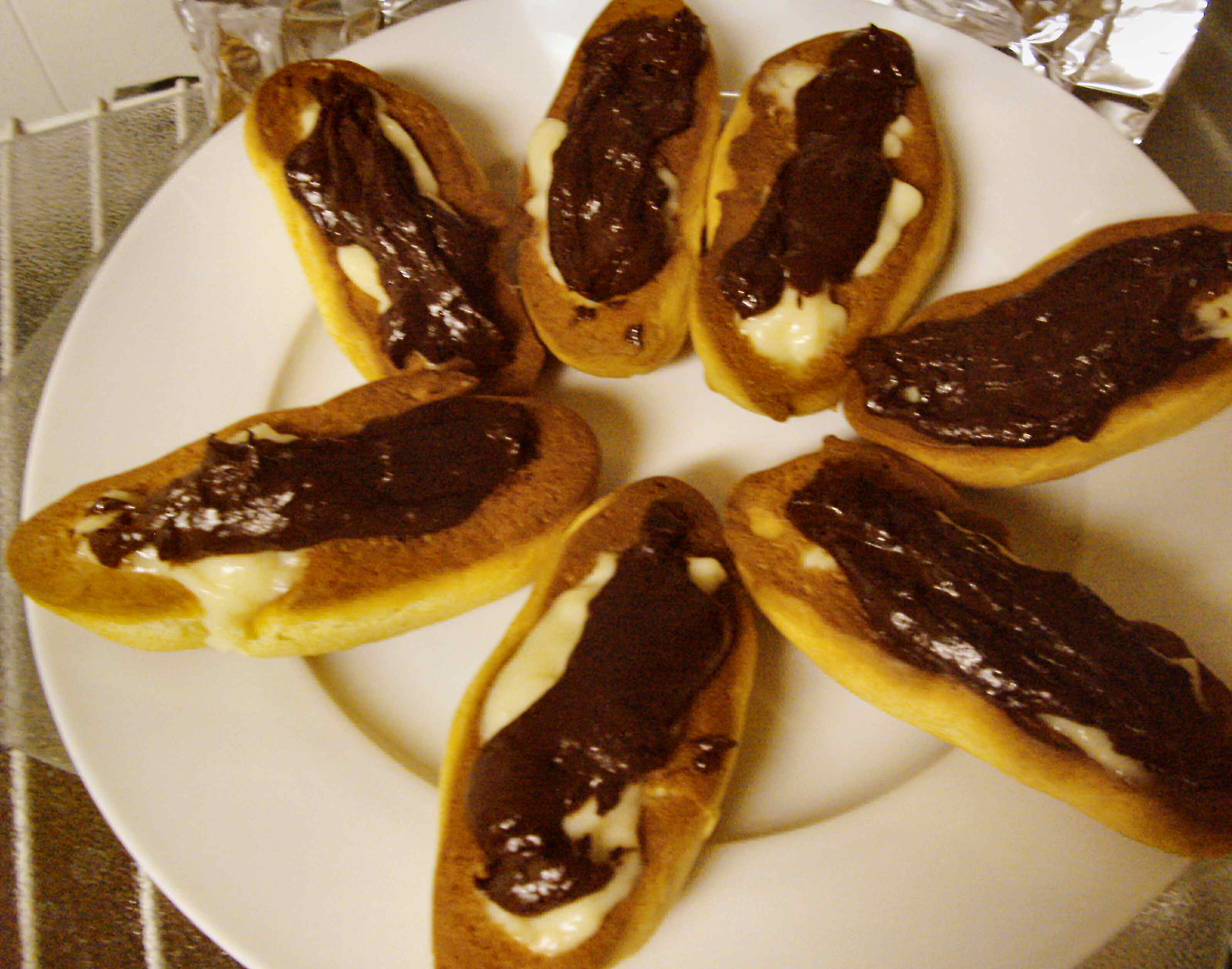
plate of eclairs

All the components of an éclair are at least partly microwaveable, flavorful and pretty forgiving. Even if you have to serve them upside down.

Here we go again, because it’s been Valentine’s Day this past weekend and I have pretty loose time standards for such things…I did actually make these before dinner on the 14th, so it counts. Not that you really need VDay as an excuse.

Éclairs are a lot simpler than they look in the pastry shops, and a lot cheaper than you’d think to make at home–in fact, cheaper than almost any American-style dessert in terms of calories, sugar, fat, salt… A surprisingly small amount of ordinary pantry staple ingredients goes a very long way and makes a bigger show than if you tried making brownies.

If you have a microwave, they can also be a lot quicker than most cookbook recipe specs, even though there are three separate parts to prepare and assemble–the filling, the shell, and the chocolate topping–rather than the usual American one-bowl dump-mix-and-bake scheme.

Éclairs don’t hit you over the head with sweet–they rely on the contrast of textures and flavors between the mostly unsweet pastry shell, the delicately sweet pastry cream, and the deep chocolate (or other flavor, but it has to be an actual flavor to be good, not the typical flavorless, oversweetened canned cake frosting) topping.

Éclairs have also become something of a canvas for artistic expression in Parisian bakeries; David Lebovitz has some great photos of ones with reproductions of paintings screened onto the tops, woodland scenes in colored icing and fondant and flavored marshmallows, fruit fantasias, and I don’t know what else, not to mention the fillings. They’re gorgeous to look at in the glass pastry cases but you couldn’t walk down the street, find a park bench, and just eat them with your fingers. You’d end up wearing them.

So the classic chocolate-topped, pastry cream-filled éclairs are still my favorite, partly because you can’t find them in most of the bakeries here.

Baking the dough is the one part you can’t really do in the microwave, more’s the pity (although you can do it in the toaster oven for a small batch). But otherwise, I can say it was worth it and–although I needed to step on a scale Monday morning to be certain–not that devastating dietwise…or even diabetes-wise. But, as with rugelach, you probably shouldn’t do this too often. Holidays and sharing are a pretty good idea. Leftovers are not. Limit the dietary badness.

Unromantic morning-after nutrition stat check: At the medium-small size I made, they weigh in at about 22 grams of carbohydrate, 160 calories, 6 grams of fat (mostly saturated, from the butter and chocolate plus egg yolks) and maybe 40-50 mg max of sodium apiece. Verdict: Not too shabby for a French dessert. Could be worse and often is. Stick to one apiece, plus some fruit, and eat it with a light supper that includes a green salad and you should be reasonably fine. Also svelte, happy, and able to sing «Non…je ne régrette rien…» the next morning. But please don’t. Not before coffee.

Even if you eat two at a time after supper because you’re not sure how long you can store the extras in the fridge so they don’t go all soggy the next day, it shouldn’t hit you like a ton of lead…well, not too much like a ton of lead. At least they weren’t full sized; they were pretty filling. Afterward, when we were lying in a daze on the couch recovering, my husband suggested just freezing any extras next time. He had a point.

About halving a recipe

I was in a hurry and couldn’t find the lower-saturated-fat recipe I’d used successfully for “Emergency éclairs 1.0” so I went with the recipes for choux paste shells and pastry cream in the “basics” back section of the white Silver Palate Cookbook. The dough and pastry cream worked fine in the microwave, as I think almost any standard recipes would.

Since there are only myself, my husband and our daughter here for dinner and eligible for éclairs (plus the cat, who is miffed that we didn’t count her), I cut both recipes in half–I repeat, limit the dietary badness…

The pastry cream was fine, but I hadn’t read all the instructions for the choux pastry, or I’d have known that the 3rd egg was for a completely unnecessary egg yolk glaze. When I halved the recipe I used an extra egg white as the “half egg,” and when the puffs puffed, they left nothing behind, no base, just a hollow, once I peeled them off the foil. The result was still fine for us but a little awkward for presentation–I had to sit them upside down like boats to fill them, and then cover the filling with the ganache. So definitely go back to the right proportions for the choux recipe (repeated below).

The ganache…is always very chocolate, very microwaveable, very forgiving of awkwardness and therefore perfection itself. It covers a lot of sins and makes you feel much better about them.

Mostly Microwaveable Éclairs

This is half-recipes all the way: it makes 6-7 half-size éclairs, 3″ rather than the standard 6″ monsters at the bakery. We each had two after supper and were completely stuffed.

Timing: If you’re doing the whole thing in one go, start by preheating the (regular) oven to 400 F, then make the pastry cream, which is really fast, and chill and stick it in the fridge, then do the choux paste, because as soon as you make that you need to dollop it out and bake it right away. If you use the microwave for the pastry cream, and you should, the choux will be ready to go just about when the oven beeps. Continue reading

Green Beans Get Serious

If you’ve gone to the supermarket the last couple of weeks, and seen huge haystacks of green beans on sale for under a dollar a pound, you might be wondering to yourself how much green bean casserole can any one family take? Pretty bad that Thanksgiving only has one sanctioned green bean recipe, and that no one can think of anything better to do with them over the holidays.

Not that I’m against plain and simple green beans, as long as they’re actually still green. Fresh, lightly steamed or microwaved or stir-fried, not boiled to death. Although frankly, I often prefer them raw and fresh as something to just wash and nosh, like carrot sticks or celery.

Even frozen green beans are fine if you treat them gently and cook them a bit less than you would fresh ones–the freezing and thawing break down all vegetables slightly, and you don’t want them to go to mush or turn brown.

Just not the dank, slimy brown horrors that emerged from a can every once in a while when I was a kid, and which my mother insisted, against all reason, had once been something living. Canned green beans are the zombies of the green bean world.

But with a bounty of cheap greens in winter, what to do with them is a pretty good question, and one that begs a three-minute solution, especially when most green vegetables are getting harder to come by. You want to stock up but you don’t want to be eating the same old, same old for a month.

My best solution for a quick green bean dish–other than the grab-and-go raw snack vegetable business above–is of course to wash and trim the tough ends from a bunch of green beans (I usually grab about a pound at a time). Stick them in a covered container or between two microwaveable stoneware or Corelle dinner plates with a drizzle of water (anything from a couple of tablespoons up to about a quarter-inch in depth) .

Three minutes on HIGH should cook a pound of rinsed and trimmed green beans to that crisp-tender ideal where they’re still green and just cooked but still have a bit of bite to them. Basically like blanched or steamed, but without the big stockpot of boiling water (which I hate to wait for and which seems a waste), the strainer, or the ice water bath (another wasted bowl).

And you can do it right before dinner as a last-minute thought, just enough for that meal so they stay green. Drain and serve them ASAP for best results. Don’t give ’em a chance to go brown.

If you want to keep them green for later, microwave them a little less, maybe 1.5-2.5 minutes per pound, just until they begin to turn jewel green, rinse them under a cold tap as soon as they’re done, drain and chill. Do not add anything acidic to them until just before you serve them so they don’t turn olive-brown.

Yes, it’s pretty plain–which is handy if you want it versatile. You can serve them hot with a mustard garlic vinaigrette or other salad-type dressing to dip into or drizzle over them. Or the richer (but not saturated-fat) sauces, tehina with lemon and garlic (and either water or plain yogurt), or Asian peanut sauce with chile, garlic and ginger are also good.

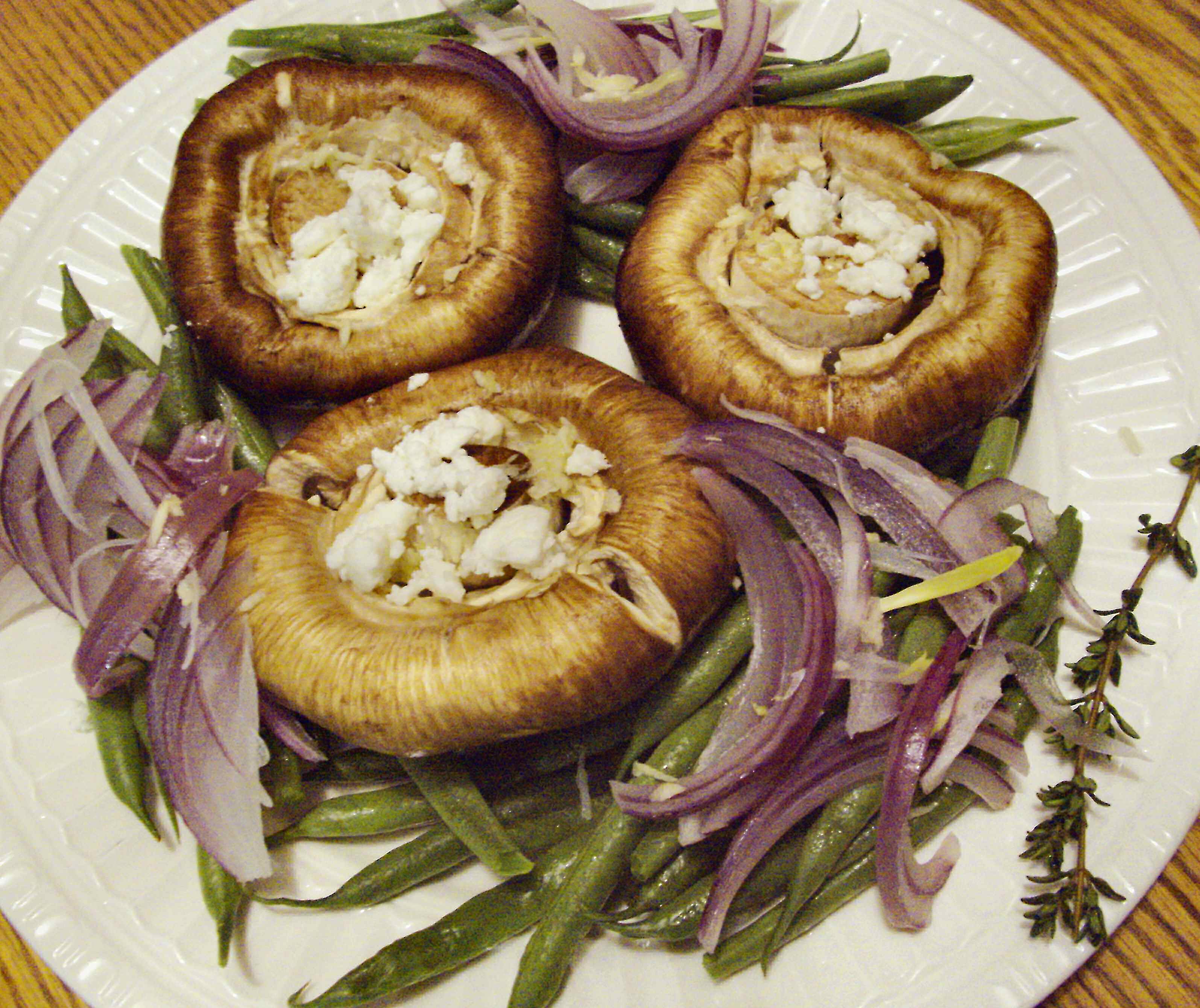
If you want something a little fancier-looking and vaguely French (we’re going for “day in Monet’s Garden,” not “tacky tourist café with haricots verts side dish that turns out to be nothing more than buttered overcooked green beans”) you can arrange the green beans in a covered stoneware platter or bowl, with thinly sliced onions and a bit of thyme and minced garlic strewn around to get a fairly nice-looking and savory microwave-to-table kind of dish that still only takes a few minutes to throw together and zap to perfection.

greenbeanswithstuffedcriminimushrooms

Slice some mushrooms over the green beans or nestle mushroom Continue reading

Microwave Tricks: Shakshouka

IMG_0458

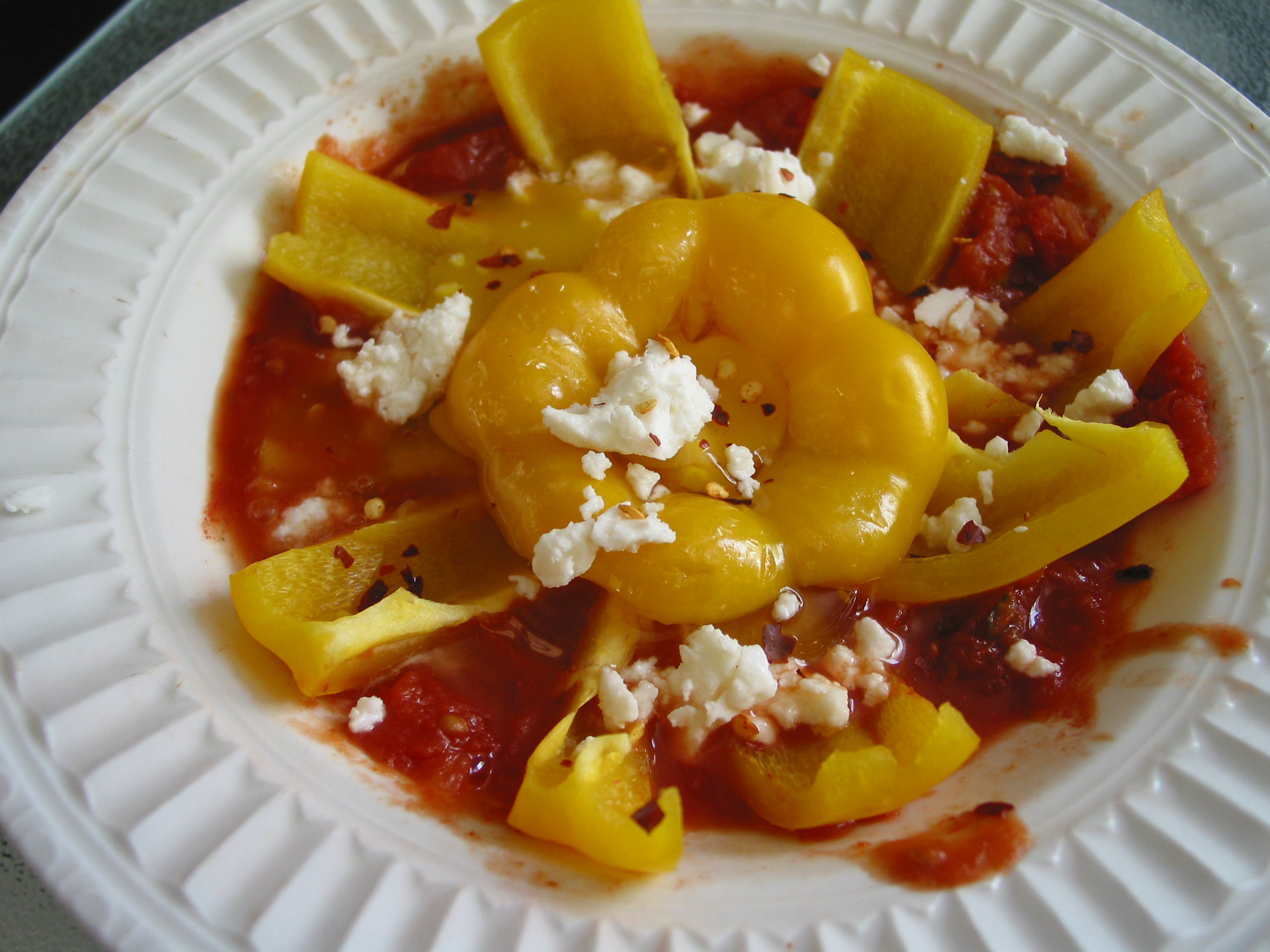
Marinara plus a pepper makes a good start.

Sometimes during Passover you just can’t take any more matzahnola. Or matzah with jam, or matzah brei. Or cake. Or macaroons. Anything for breakfast that doesn’t involve at least one vegetable (other than yourself, before coffee). Your tolerance for sweet stuff has been exhausted, and as for the leftover gefilte fish and hrein…no. We are not going there. No matter how much my husband insists it’s “perfectly good” (and I notice he hasn’t schlepped the rest of the jar with him to the office!)

Forget all that. There’s a pretty good cure for the Pesach blahs–you need some chile peppers and you need them now. Not in 20 minutes, no major cooking involved. You have a microwave, some cheap microwaveable soup bowls or the like, and you’re not afraid to use ’em for an increasingly popular Israeli brunch dish–shakshouka. Which is basically the Jewish version of huevos rancheros, only without beans or potatoes. Or lard.

Yotam Ottolenghi has made shakshouka popular and photogenic in at least one of his famous cookbooks, probably prettier than what I’ve got here. But it takes longer too, and I’m impatient.

To make shakshouka, you usually need a frying pan, olive oil, some tomatoes, peppers and onions, plus garlic, cumin, chile peppers, maybe a couple of oregano-or-thyme-and/or-cilantro-type herbs–sounds like the makings of salsa, no?–and some fresh eggs to crack into the resulting sauce. The sauce takes some 20-30 minutes to cook down, the eggs another 5-7 to cook more or less sunny-side-up in the middle of the sauce. That’s a lot of time for breakfast. I wanted a shortcut this morning.

Most jarred salsas are not kosher for Passover–it’s the distilled vinegar thing. That’s okay, because yesterday in a fit of domestic planning (uncharacteristic, I swear) I decided to make a batch of microwave marinara from some unsalted canned tomatoes. I don’t have a kosher-for-Passover food processor this year, though, so I decided, after trying to chop up some pretty tough Roma tomatoes (even with the skins off!) that I should just do as the Sicilians do and break them up with my hands as Tony Danza advises. A little chunkier than usual, but just fine. And actually ideal as a base for shakshouka–both its readiness for a mid-morning fridge scrounge and its rusticity made for a good start. A good dollop in a microwaveable soup bowl.

What else do you need? Maybe a bell or Anaheim-type pepper that needs to get used up. Cut it up (I got whimsical, you don’t have to potschky around with flower shapes). Add more onion if you feel like it; I didn’t. Stick it in the microwave for a minute or two to wilt the pepper and possible onion pieces.

IMG_0461

Then crack an egg or two into it, sprinkle on a bit of feta or panela or queso fresco as desired, maybe a pinch or so of chile pepper flakes or z’khug (I’d run out) and/or chopped cilantro as desired.

IMG_0463

Put another soup bowl on top as a lid, and microwave another minute or two until the eggs are cooked to your liking–check and add 30 seconds if you think it’s still got a raw spot somewhere, and/or leave the lid on for a few minutes and let it finish cooking in the residual heat of the sauce.

Obviously if you’re having people over for brunch, the standard frying pan method is better and quicker–more eggs and salsa means more time in the microwave, and no one wants to sit around as you microwave individual portions. But if it’s just you, or you and your partner, the microwave method works pretty well. Just add a little time (maybe another minute or so in 30-second increments) for four eggs as opposed to two.

IMG_0464

Hafla! (celebratory remark when there’s something good on the table and you didn’t have to wait an hour for it) Grab some matzah and a cup of hot coffee and b’te’avon (mangia bene/bon appétit/eat nice)!

Maximum Flavor in a Minimal Broth

minimal carrot onion soup

My kid had the flu just in time for President’s Day (and both Friday and Monday off from school). How does this happen in a place where it actually hit 90 degrees one day??? How annoying! But her classmates had been catching it right and left all through January and coming back to school still iffy. She and I had both gotten the flu shot a couple of months before, achy arms and all. The prevention rate this year isn’t all that good; only about 23%. And people have naturally been grumbling if or when they catch the flu anyway.

But I’m still pro-vaccine, and here’s why: The minute she woke up with fever, I called and got an appointment with her pediatrician for that morning, no being palmed off on the advice nurse (or the muzak they put you on while waiting half an hour). When you’ve got a diabetic kid with flu, you take a deep breath, channel your Brooklyn-raised mother and elbow your way through to get seen before the kid has a chance to develop nausea and vomiting, which makes it trickier to manage food, insulin and so on safely. I mean, we’ve done it, it’s doable, and we’ll probably have to do it again at some point, but it’s a total pain.

Luckily for me, the pediatrician is also from Brooklyn and doesn’t take offense. She and the nurses had been run off their feet, and yet she was glad we got our act together early enough for Tamiflu to do some good, because the poor kid just ahead of us at the clinic was wobbling and actually fainted just as he got into the exam room. Five days his family waited and he had serious fluid in his lungs. So I stopped feeling selfish and stupid for bringing my kid in when she was mostly okay except for a fever. And I hope the other kid’s better by now.

So I wanted to pass this on: the doctor told us the best-bet recommendation is still to get a flu shot. Why? Because even though you might still catch flu, the severe hospital-level cases this year with pneumonia and worse, at least in Southern California, are turning out to be almost all unvaccinated patients. That’s a result you might not have expected. You need that insider perspective to see there’s a more serious benefit hidden behind the obvious numbers. And the serious cases are pretty bad. So if you haven’t gotten a flu shot yet, go get one now.

And my kid did indeed get better by the time school started up again, and my husband and I managed not to catch the flu from her, which was good, because with a snarky bored teen home on a 4-day weekend, the last thing either of us needed was to catch it from her just when she was finally back at school.

But we needed soup in a big way. And with a sick kid in the house I had less time to go shopping. I imagine (because we had the fluke 90-degree day, I have to imagine it or else talk to my poor mom in Boston) that people caught in the big snows back east also have these problems of limited shopping mobility, patience and scant last-ditch vegetabalia in the house. What did we have left that was soup-worthy?

Well…there’s always the can of tomato paste for nearly instant cream-of-tomato, which my daughter likes when she’s sick. The real cream-of-tomato, made with actual tomatoes, is more voluptuous but takes 45 minutes on the stove and involves baking soda to tame the acidity before you add cream, plus the use of a stick blender which I aspire to but don’t yet own. Tomato paste doesn’t have much acidity to start with, so you could just skip the baking soda and heat with milk instead of water if you wanted to. We generally leave milk and cream out and add a dash of vinegar to restore some semblance of tomato flavor.

–  –  –

Tomato Soup in the Microwave (AKA, “bonus” recipe for what it’s worth)

  • 1/2 can tomato paste (no recipe EVER specifies a whole can, as far as I can tell…must be some kind of culinary superstition, much like “the Scottish play”…so just scoop the rest into a ziplock baggie, squeeze the air out, and throw it in the freezer for next time…)
  • 1-2 c. water (enough to bring it up to the thickness you like best for soup)
  • small splash of vinegar, any kind
  • small clove of garlic, minced, mashed or grated
  • pinch of cumin or thyme, optional
  • salt to taste after cooking
  • splash of milk or half-and-half, if you like it

In a microwaveable bowl, use a whisk or fork to mix the water gradually into the tomato paste until it reaches the thick-but-not-too-thick consistency you prefer for cream-of-tomato soup. Add the garlic, vinegar, and cumin or thyme, cover the bowl lightly and microwave 2-3 minutes or until heated through. If you want to add a little milk or half-and-half afterward, you probably could, just don’t add it and then heat or it’ll curdle from the vinegar (or leave the vinegar out to start with if you want it bland).

–  –  –

But down to business with the “not-chicken” vegetable broth. I’ve already gone about as far as I can go with bok choy and shiitake broth, up to and including hot-and-sour soup. Plus we didn’t actually have any bok choy left. Feh.

So the usual carrot-onion-celery not-chicken broth should have been next…but no celery either. Double feh. And no fresh dill–dry we had, but you know fresh makes a world of improvement. So it wasn’t looking all that good in the clear soup department this week. And I needed some for me, even though I only had a head cold and a bad temper and a sassy, feverish bored teen at home watching cartoons.

(BTW: if you luck out with a fresh bunch of dill that’s too big to use up quickly, wash the rest well, twist off the stem ends, stuff the dill into a ziplock sandwich bag with the air squeezed out and freeze it–it’ll stay good for a couple of months minimum, and you can just quickly crumble a frozen bit into whatever dish you want, then toss the bag back in the freezer. Or in Boston, just leave it out on the porch and rediscover it sometime in April.)

Normally I’d say onion and carrots alone aren’t enough for a soup; you have to have something else in there or when you add garlic it’ll just be about the garlic. Which is fine for me, of course, because my motto still seems to be, “If there’s no garlic, is it really food?”

True, the Italians have acqua pazza (“crazy water”), which is basically garlic broth. I think both Spain and France have similar offerings. But normal people might want something a little more complex or at least balanced.

My usual MO for vegetable soup and bok choy broth is just to microwave the base vegetables to wilt them and then bring them up with a bit of water, add garlic, herbs, and any other appropriate flavorings, and heat again. Pretty basic, and very quick–5 minutes, maybe 10 for a couple of quarts that will last me a week. But with such a limited vegetable base as onion and carrot, I was going to need something more.

So I scrounged again in the fridge. Carrots and a red onion…and a clove of garlic. A sprig of thyme–well. A little leftover white wine. Yes. OK.

It would all be kind of blah and pale, though, if I just dumped it in a bowl with some water and hit the nuke button. When you have so few main ingredients and they’re both boring when simply boiled or nuked, you have to strategize a little to get the best out of them quickly. Continue reading

Microwave Tricks: Rapid Red Cabbage

microwave sweet and sour braised red cabbage

When I was almost twelve, the year of All the President’s Men (go rent or borrow it from the library if you’ve never seen it), a classmate of mine came back from the weekend raving about a new restaurant his parents had taken him to.

Now, almost no one in my 7th grade math class, particularly not boys, either knew about or talked much about food above the pizza and burger level.

My friend’s family had spent the previous year in Italy–you could tell whenever he grumbled about real soccer with strategy vs. the weak substitute they were teaching us in PE that he was sorry they’d come back. Clearly it wasn’t the only thing he missed–this was the first “real” restaurant he’d been to in the US, and it was way out in the countryside.

The Bavarian Chef (which after 40 years is still open in Madison, VA, and now in Fredericksburg as well, I’m happy to see), had a menu like no other in the area: fondue, a magic word I’d never heard before and which my friend had trouble describing. One fondue with Emmenthal-type cheese for cubes of toasted bread, the other with a red sauce (tomato? redcurrant?) for spicy meatballs. Veal or maybe chicken Cordon Bleu (their current menu still has veal). The side dishes were distinctive as well, particularly the sweet and sour red cabbage…it was gourmet. European gourmet, the real kind, and possibly the first upscale restaurant in our part of Virginia.

In any case, my friend was enthusiastic enough about this place that (and I don’t remember this bit at all) I came home and said something to my parents, who were friends with his parents. The next thing you know, my folks schlepped me and my younger brother and sister out of town–half an hour’s drive and  into the next county–to try it out for my birthday. And my friend was right about all of it.

The cheese fondue was a completely new experience and a lot of fun. So was a glowing magenta side dish of sweet-and-sour red cabbage–it would have been fun for the color alone. Although that has not held true for me and beets, so maybe I shouldn’t say so. But luckily it, unlike beets, was  delicious. And so different from anything else I’d ever eaten that it impressed me even more than the chicken (or veal) with the ham and cheese in the middle, and I can’t remember anything at all about dessert.

Sweet and sour red cabbage, when you think about it, is completely contrary to American standard tastes, even those of 40 years ago when people still ate vegetables and cooked most dinners at home. If you had to describe it to someone at school–what would you even say? The ingredients–and the flavors–are pretty simple individually but surprising together: red cabbage, vinegar, sugar, cloves, salt, maybe black pepper. Maybe a bit of apple or onion in some versions. How could that go together? But it does, and I’ve loved it ever since.

And yet I never ever make it at home, because it takes up to 2 hours of simmering on the stovetop, depending on the recipe you have. The one time I made it, back in my 20s, when I was trying to recreate the experience, the whole apartment smelled really, really sulfurous. It reeked. Even though the cabbage did come out ok.

Too bad I didn’t even own a microwave until my mid-30s. But I’ve been rethinking it since last week, when I saw a picture of it in a Mario Batali cookbook from about 10 years ago. The combination of a German-style dish in an Italian cookbook reminded me of the whole prealgebra food debate and my friend’s unprecedented idea that good food was worth traveling for.

But you don’t have to travel far for this dish, and you certainly don’t have to spend 2-3 hours on it. There’s got to be a way, I decided (as usual). How hard could it be to microwave it?

Well,  it worked almost perfectly, at least as a test case: Continue reading