• Enter your email address to subscribe to this blog and receive notifications of new posts by email.

    Join 241 other subscribers
  • Noshing on

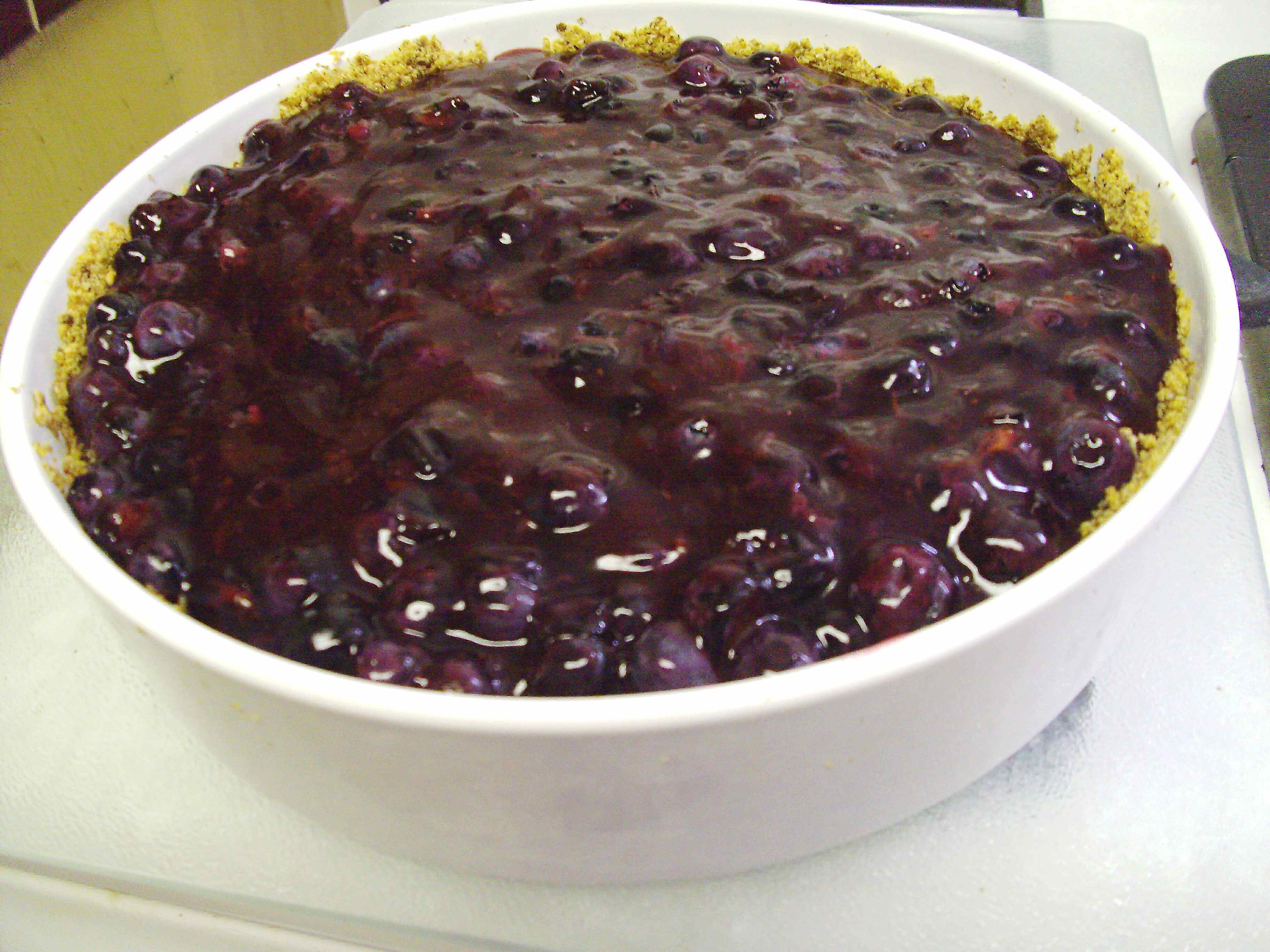
    raw blueberry pie with microwaveable filling and graham cracker crust

    This mostly-raw blueberry pie is a snap to make and very versatile--the filling microwaves in a few minutes, and you don't even have to bake the zippy gingered graham cracker crust--perfect for a hot Fourth of July and all summer long.

  • Recent Posts

  • Contents

  • Archives

  • Now Reading

  • See also my Book Reviews

  • Copyright 2008-2024Slow Food Fast. All writing and images on this blog unless otherwise attributed or set in quotes are the sole property of Slow Food Fast. Please contact DebbieN via the comments form for permissions before reprinting or reproducing any of the material on this blog.

  • ADS AND AFFILIATE LINKS

  • I may post affiliate links to books and movies that I personally review and recommend. Currently I favor Alibris and Vroman's, our terrific and venerable (now past the century mark!) independent bookstore in Pasadena. Or go to your local library--and make sure to support them with actual donations, not just overdue fines (ahem!), because your state probably has cut their budget and hours. Again.

  • In keeping with the disclaimer below, I DO NOT endorse, profit from, or recommend any medications, health treatments, commercial diet plans, supplements or any other such products.

  • DISCLAIMER

  • SlowFoodFast sometimes addresses general public health topics related to nutrition, heart disease, blood pressure, and diabetes. Because this is a blog with a personal point of view, my health and food politics entries often include my opinions on the trends I see, and I try to be as blatant as possible about that. None of these articles should be construed as specific medical advice for an individual case. I do try to keep to findings from well-vetted research sources and large, well-controlled studies, and I try not to sensationalize the science (though if they actually come up with a real cure for Type I diabetes in the next couple of years, I'm gonna be dancing in the streets with a hat that would put Carmen Miranda to shame. Consider yourself warned).

Microwave Wild Rice Pilaf

Thursday was kind of rushed–we started the morning late and kept being slow until it was nearly 2:30 and time to Zoom our family. But I managed to get a few Thanksgiving-type things going in the microwave for dinner before that and even managed to post about them at an almost-civilized length instead of going off on more tangents than anyone really wants to read even under current conditions. Artichokes–no big deal. Cranberry sauce, even less. Wild rice, though.

Wild rice, rinsed and ready to add water and microwave. Not very friendly-looking, is it?

Any grain with a tough husk takes a longish time to cook conventionally on a stovetop compared with something like white rice or rolled oats. And wild rice is tough enough that the Trader Joe’s package directions strongly recommend soaking the stuff in a bowl of water in the fridge overnight before attempting to boil it. A good suggestion that would help for microwaving too–a fine suggestion, if only we had started with things the day before. Not all that helpful when you need it the same day.

Microwaving works for brown rice, another long-cook whole grain, so it should (and in fact did) work for wild rice too. But it’s not quite the brief one-step kind of technique it is for white basmati rice. More a “nuke a few minutes to a simmer, let it sit 10 or so minutes to absorb hot liquid, stir, nuke a few more minutes and go away again, stir and check…..” kind of thing, similar to the way I cook beans, chickpeas and lentils, but with fewer rounds of cooking. I don’t know, it didn’t seem like a nuisance to me because I was doing two or three other things while it sat (one of those was sipping champagne while noshing with my husband on a few decorator cheeses and nuts and chatting with my in-laws and my daughter over Zoom). So I wasn’t in an overwhelming rush.

And it came out pretty nicely, so I’m posting it now. I would in fact do this again, because it came out pretty much as well as the original with a lot less work.

When I was younger and well before I had a child (who is now old enough to cook with her housemates, and did), I would make this pilaf in an electric wok with a lid, frying the onions and mushrooms first with the herbs, then adding the wild rice and some pearl barley and broth, bringing it to a boil and turning it down to simmer with a lid for however long, checking once in a while and stirring in the fruits and nuts and adding a little broth or water as needed. Similar idea to the microwaving, but on a stove or any heat element, you need to stay a lot more present. Microwaving lets you go away–it can stop itself and sit for a while without things drying out and scorching.

Continue reading

Crème de X: Purslane and basil dress up a lighter velouté

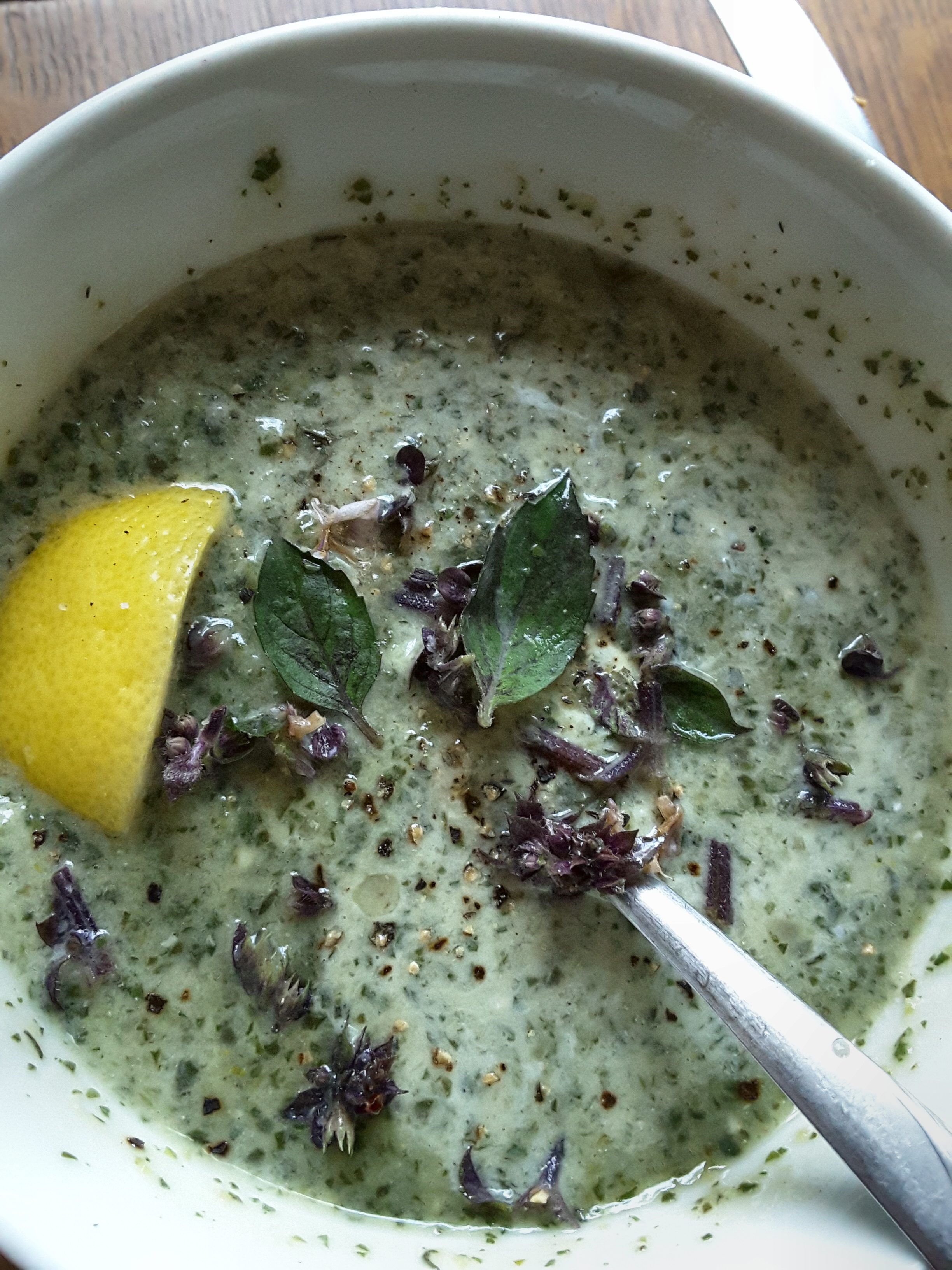
Purslane soup with purple basil garnish
Purslane plus purple basil flowers for that Crème-de-X factor

Sargent’s infamous ballroom portrait of Madame X is today’s inspiration for a soup that, like his subject, breaks a few stodgy rules and dares to produce an elegant but fresher, bolder, more nutritious–and certainly lighter–version of a classic French soup in a few minutes flat. It’s smooth but svelte. And it still keeps you in suspense.

So before we get to today’s featured mystery vegetable (herb? green? Let’s settle on green)–let’s talk about breaking the rules.

Most classic veloutés–vegetable-based cream soups–rely on thorough boiling-into-submission of the vegetables, generally mostly potatoes, to soften them for blending, which used to be done by hand through a mesh sieve back in Madame X’s and John Singer Sargent’s day. They also add a heavy dose of cream to mask any individual or strong flavors so nobody could possibly get upset that they can actually taste the vegetables.

All that cooking softens things but also breaks down most of the vitamins. Reliance on potatoes for bulk makes things starchier and blander as it crowds out the greens as the main ingredient. And I don’t have to tell you what I think about cream–you’re free to disagree but I take statins for a reason, and I’m an inveterate cheese freak. Also chocolate.

So I say save the high-ticket calories for something that packs a bigger punch tastewise even in small, expensive, memorable bites–goat cheese, bittersweet chocolate ganache. Not soup. Make it count.

Method counts too. The modernized French restaurant-approved cookbook methods for veloutés and blended soups in general are stupid, cumbersome and unsafe. There’s no good enough excuse anymore for telling inexperienced cooks–or any cooks–to boil up a vat of something and then try to pour it into a food processor or blender hot–very dangerous, and not the edge we’re seeking here. Scald marks are not chic. Nor is hot flying soup all over the kitchen walls.

In today’s world, you have a blender or food processor AND you probably have a microwave, no matter how many TV chefs may rail against it. You can do this smarter and safer and lighter and faster.

Common sense says blend your veg of choice first, then heat it. If it isn’t soft enough raw to blend smooth before cooking, steam it through first with minimal water and a lid in the microwave for a couple of minutes or, failing that, in a nonstick frying pan or stockpot with a drizzle of water, maybe a quarter-inch off the bottom of the container or pan, and a lid, also for a few minutes. Take it off the heat, pulse a few times in your blender or food processor without most of the liquid to get it started, then add cold liquid gradually as it blends further until it gets to the consistency you’re aiming for. You’re a lot less likely to generate big steam and pop the lid that way.

Then pour it into a microwaveable container with a lid to cook or reheat the soup in a few minutes without destroying every possible vitamin or losing all the color. You won’t scald yourself and you won’t be furious and frustrated and wishing you’d never heard of it before you even get to taste it (this does happen, you know, and cookbooks never mention it)… You’ll be fabulously unruffled (well…at least for this) and ready to dine when it’s ready to eat.

So, enough with the cooking hock-I-mean-hack. What’s with the purslane? What is purslane, anyway?

Fresh purslane in context

You’ve been wading patiently through my diatribe, and the suspense is killing you (but a nice distraction from worrying about the election totals, yeah?)

Purslane–slightly wilted but still worth cooking. I can sympathize.

Purslane, or verdolagas in Spanish, is a slightly tart fresh herb that tastes like a lemony version of watercress or spinach–sorrel? Texture- and looks-wise, it’s a cross between a fresh green herb like basil and a succulent like…like…well, like a jade plant (despite the fact that jade plants are not edible, I’m pretty sure). That is, the leaves are smallish but sort of fleshier than normal herbs. At least when they’re at their peak freshness. Most people who buy and eat purslane put it into a fresh salad and eat it raw. Some stirfry it or chop it and put it into spinach-type dishes. And it’s pretty nutritious–high in vitamins A and C, potassium and other minerals, surprisingly for a vegetable, highish in omega-3 fatty acids if you’re still into those. Grows pretty much throughout the world.

After a week in the fridge, though, it loses a little of its puff and starts to wilt a bit–is it going bad? can you still do something with it?

Continue reading

Why you shouldn’t buy precut veg

I know perfectly well that I’m preachy about buying bulk produce because it’s cheaper by far, the supposed “convenience” of precut amounts to less than a minute’s time difference in many cases, and the fiddly little precut plastic bags are a lot less fresh. But the current recall for a number of precut packaged veg products at Trader Joe’sand elsewhere reminded me of something my mother (who cooks reluctantly, very reluctantly) used to point out when I was a kid.

She would wash everything well under the tap and then (in a rare show of good lab technique) trim the cut ends off further because, as she pointed out, a lot of the produce is cut out in the field, where dirt and pesticides abound. People harvesting out in the field are not washing their hands or their knives every few minutes, nor are they in a position to wash the produce well before cutting it off the stalk or vine. It wouldn’t really improve things that much if they did.

The fancy precut veg producers are doing the washing and cutting up under less dusty conditions, but they’re actually creating more risk of contamination. Every time you cut into a vegetable, you’re exposing an inside surface. That’s usually fine when you’re cooking or serving it right afterward. But let it sit around, especially in a plastic bag, under dubious refrigeration, for several days, (how many more questionable conditions can I pile on here)–as the precut prepackaged veg does in the supermarket, and you’re pretty much begging for something to go wrong. The peel is there for a reason–it seals and filters out a lot of the bacteria and fungi that are always around in the soil, the air, the water, your hands.

Usually when fruit and vegetables are hand-harvested with a knife, it’s on an inedible stem or stalk, and if left in the open air, the cut will dry and more or less seal over–think how cauliflower and celery stumps look, or the dryish root ends of broccoli or cut asparagus. Not particularly appetizing, and generally that’s the bit you’d discard. The rest of the vegetable stays pretty fresh for several days–it’s essentially still alive (sometimes, as with bok choy, even still growing new shoots from the cut stump), so the plant’s own internal chemistry provides another natural hedge against outside bacteria.

But when it’s bagged and cut in small pieces, all the exposed surfaces provide a lot more opportunity for contamination and the plastic bag lets whatever moisture is lost collect on the outside of the pieces. Not good. So the less your vegetables and fruits are cut up before you buy them, the fewer chances to contaminate the inside parts of the vegetables.

Another reason to avoid processed and fast food

In the past five or ten years, obesity and diabetes researchers have started taking a closer look at environmental factors that have unexpectedly strong disruptive effects on our appetite, food consumption levels and metabolism, even at levels currently deemed safe by the Food and Drug Administration. The potential of artificial sweeteners to lower glucose tolerance in less than a week by shifting the balance of gut bacteria is only one unnerving example.

Environmental chemicals like fungicides, pesticides and plasticizers (BPA and the like) have long been of concern for cancer, endocrine disruption and infertility. Some extensive and carefully conducted studies now reveal that some of these chemicals can also increase fat cell development and storage as well as insulin resistance. Low levels of exposure directly increase the rate of obesity in rats, and  population studies, though not as extensive, show that exposure also tracks with obesity in humans.

These common chemicals are now being considered obesogens–chemicals that cause obesity or at least make people more prone to it. And these are effects that may end up being passed down.

In the rat studies, the effects lasted for several generations, and that also seems to tally with earlier findings on environmental endocrine disruptors and male infertility. Some of the tests that were conducted on rats in the obesogen study were too invasive to perform on human subjects, and a human generation is a lot longer than a rat generation–20+ years vs. 6 weeks–so it may be hard to trace inheritance in humans just yet.

Well–so what does it mean for us while we wait for the perfect definitive human study to come along?

To my mind, it means taking a harder look at how we choose the food we eat. We can’t remove all pesticide residues from the environment but we can probably eat fewer things wrapped pristinely in plastic and cut down our reliance on plastic utensils and disposable containers.

As I look around my kitchen, I realize just how often I reach for plastic sandwich bags–daily for lunches, but also for leftovers, herbs, halves of onions or lemons, cheese, vegetables. Stacking plastic storage containers keep soup, salad, rice or beans–or this week, an overload of stuffed shells, since I finally got my cook-once-eat-six-times-or-so batch cooking mojo figured out. And almost everything else in my fridge and on my shelves is in contact with plastic at one time or another.

Plastic wrappings pervade most of the supermarket offerings–overwraps on plastic-coated juice boxes, plastic see-through windows on cardboard pasta boxes, sacks of dried beans and rice, loaves of bread, plastic inner bags for boxed cereals and snacks, and plastic linings on the insides of tin cans. Also, of course, all those bottles of soda and energy drinks and vitamin waters and juices and milk. And yogurt. To say nothing of fast food, vending machine food, and so on.

Plastic is everywhere because it’s cheap, light, flexible, avoids breakage in shipping, and it helps you keep your food dry if you want it dry or moist if you want to keep it from drying out. You can keep everything separate and clean and airtight even when stored side by side. You can store it in the freezer and take some types of plastic containers right to the microwave. If you want to give up plastic, either for health reasons or environmental ones, you have to give up some of those advantages too.

Your next best bets are glass, which is heavy and breakable and no longer reliably tempered borosilicate, at least not in the US. Or perhaps stainless steel, at least for cold containers–maybe a stainless steel kit for lunches? I don’t know–if you don’t take strict care of it, or if it’s in contact with wet or acidic foods for long periods, it may rust. Storing salads or tomato-based items might be a problem. Ceramic bowls and containers–also heavy and breakable, and some of the food-approved glazes still leach measurable amounts of copper and other metals.

I do occasionally see someone from the homesteading and health food store generation, or else in Amish or Mennonite-style dress, loading up on bulk buy drygoods at Whole Foods with their own glass jars and cotton drawstring bags. And I always admire them for it, but I also think that’s an awful lot of stuff to trundle around to the store and get the clerks to okay. It is not easy to do and it’s obvious they’ve saved up for a monthly trip to stock up because you wouldn’t want to have to do it more than that often, especially when you have young children in tow, even very well behaved young children as they often do (another thing to admire them for; my daughter used to go and play hide-and-seek in the corner grocery when she was that young. At least she knew not to take anything).

But back to plastics and food storage. The obesogen phenomenon is intriguing but probably not the main source of the current obesity epidemic. Common sense says people might have slightly more propensity for developing fat cells but they’d still be small cells if people weren’t overfeeding them by eating more calories than they used to. That’s the major trend, by far. It’s still the food itself that matters most.

Processed and fast food still dominate as popular items of diet, and they’re very high-calorie-density compared with most nonstarchy bulk vegetables, which never seem to be recommended first on any popular weight loss and fitness show anymore (cough–Dr. Continue reading

Microwave Tricks: 10-Minute Tofu

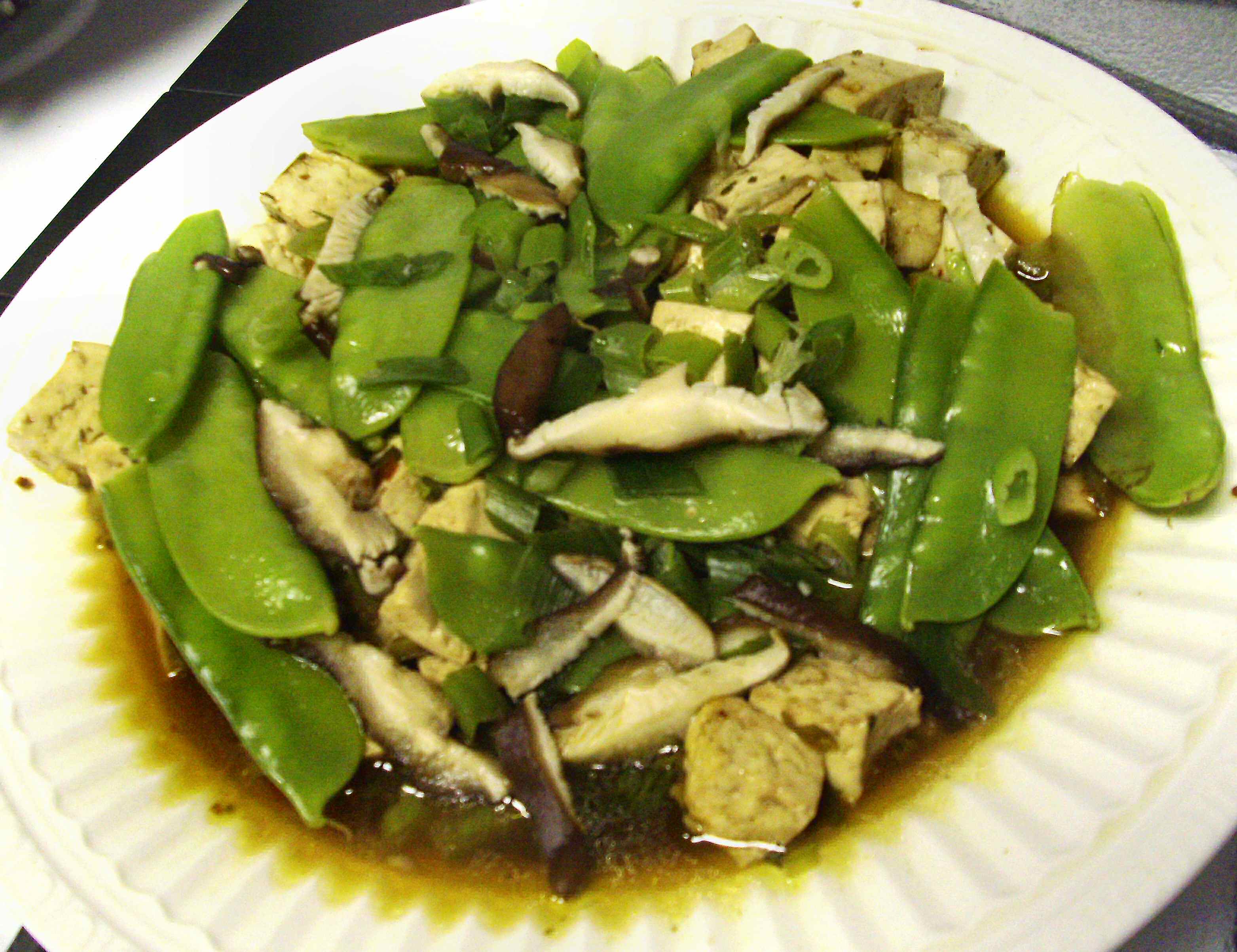
Microwaved platter of low-sodium tofu with snow peas

Microwaved tofu platter in minutes, minus the big oil and salt overload of takeout. I’ve used snow peas and shiitake mushrooms this time, but you could use any greens you like and mix them up–bok choy, broccoli, green beans. Frozen snow or sugar snap peas work too.

This is the recipe I meant to put in the last post about reducing sodium in Chinese food.

Tofu is, as everyone knows by now, extremely versatile. It’s vegetarian, it’s shapeable, it’s mild but satisfying in flavor, it comes in a variety of textures and thicknesses, and it’s quick to cook–fried, steamed, stuffed, crumbled–or to eat cold. It’s also low-fat, low-sodium, nearly carb-free, and relatively high in protein, with some iron and calcium too. And it’s very inexpensive–less than $2 for a 14-oz. pad of tofu at the supermarket, about three or four servings’ worth.

When it’s hideously hot out, as it was much of September here in Pasadena, you can marinate a sliced cold block of silken tofu by pouring a jao tze-style dipping sauce over it maybe half an hour, garnish with scallion shreds or crushed toasted nuts, and serve it as an appetizer. Or eat firm tofu plain and cold, if you like it. Or throw some tofu cubes into a salad with cabbage, lightly-steamed (or microwaved) fresh brussels sprouts, scallions and halved hard-boiled eggs, and drizzle peanut sauce over it.

Or you can decide there’s no way you’re going to stand over a stove with a frying pan, but you’d like a proper cooked dinner that resembles kung pao or ma po tofu with some greens, just not doused in heavy greasy oversalted sauce or requiring a run to your local takeout, and it would be nice if it were very quick. Very quick. Like five minutes tops. And that it didn’t involve the stove at all.

When my daughter decided she wanted to be vegetarian a couple of years ago, I discovered that you can “quick-press” tofu for Hunan tofu in about 4-5 minutes for a standard 14-19 oz. pad by cutting it up, standing the pieces on a microwaveable dinner plate, and microwaving, then draining off the liquid. Then it’s ready to stir-fry and it’ll brown decently. But I’ve done it so often in the past two years that my daughter’s kind of tired of it now (and has also gone back to eating fish and chicken once in a while). But we still like tofu. And with 100-degree days filling so much of September, there was just no way I was going to stand at the stove. So….

The entirely microwaveable tofu dish below is my daughter’s current preference, because the tofu cubes are softer, steamed in the microwave in a thin sauce rather than browned, and the scallions never scorch. And it’s not bad at all, and it takes, if not a literal 5 minutes, maybe about 10, start to finish.

This is more of a technique than a recipe, really, because you can use whatever cookable greens you have and like–fresh broccoli with the stalks, green beans, bok choy, etc. are pretty classic and generally not expensive per pound, but I’m not against using frozen unsalted (store brand; I’m cheap) sugar snap peas or green beans if the fresh ones are out of season. You’re microwaving; it’ll work out, and you won’t overcook the tofu. Continue reading