
• Enter your email address to subscribe to this blog and receive notifications of new posts by email.

    Join 241 other subscribers
  • Noshing on

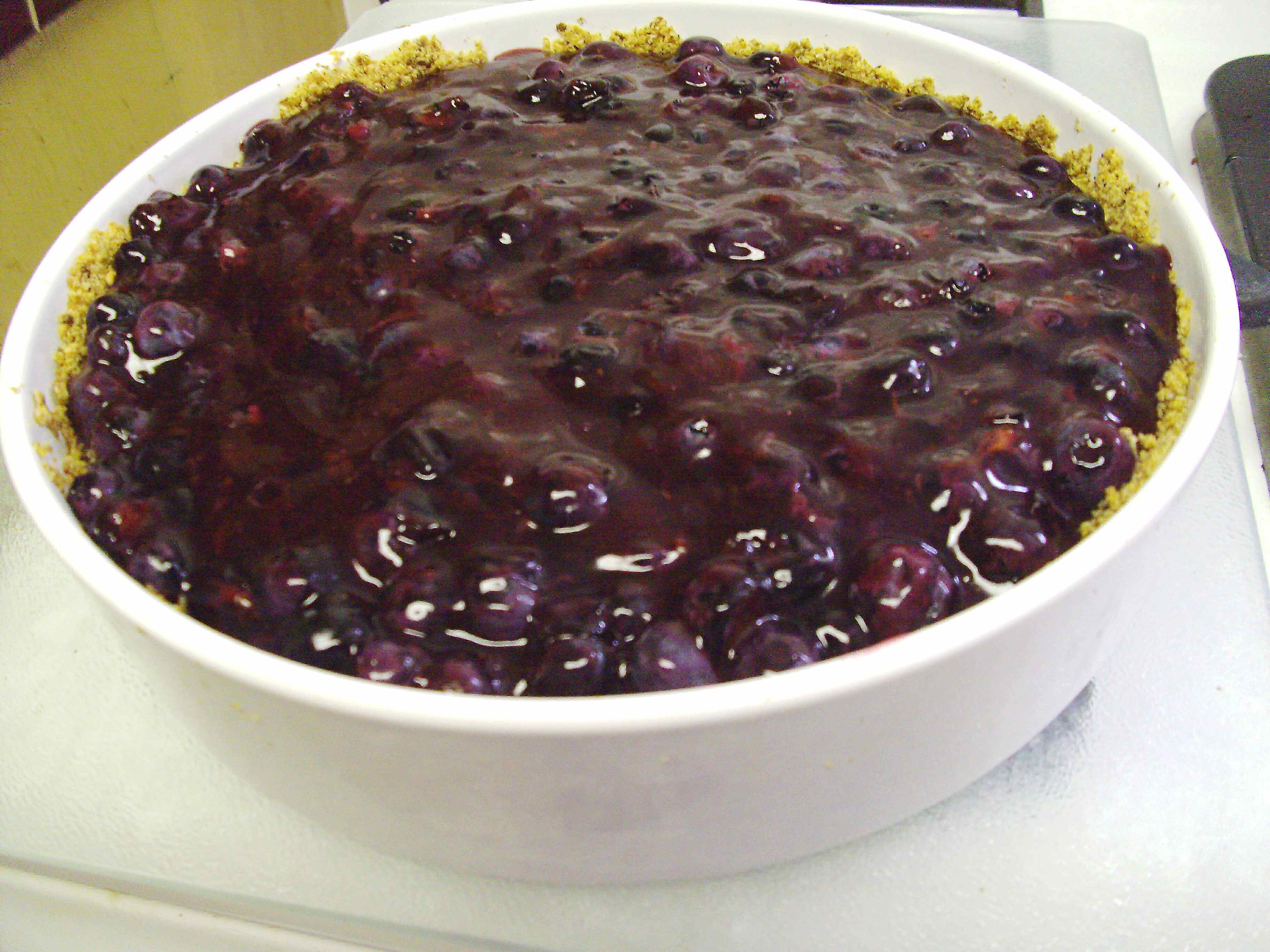
    raw blueberry pie with microwaveable filling and graham cracker crust

    This mostly-raw blueberry pie is a snap to make and very versatile--the filling microwaves in a few minutes, and you don't even have to bake the zippy gingered graham cracker crust--perfect for a hot Fourth of July and all summer long.

  • Recent Posts

  • Contents

  • Archives

  • Now Reading

  • See also my Book Reviews

  • Copyright 2008-2024Slow Food Fast. All writing and images on this blog unless otherwise attributed or set in quotes are the sole property of Slow Food Fast. Please contact DebbieN via the comments form for permissions before reprinting or reproducing any of the material on this blog.

  • ADS AND AFFILIATE LINKS

  • I may post affiliate links to books and movies that I personally review and recommend. Currently I favor Alibris and Vroman's, our terrific and venerable (now past the century mark!) independent bookstore in Pasadena. Or go to your local library--and make sure to support them with actual donations, not just overdue fines (ahem!), because your state probably has cut their budget and hours. Again.

  • In keeping with the disclaimer below, I DO NOT endorse, profit from, or recommend any medications, health treatments, commercial diet plans, supplements or any other such products.

  • DISCLAIMER

  • SlowFoodFast sometimes addresses general public health topics related to nutrition, heart disease, blood pressure, and diabetes. Because this is a blog with a personal point of view, my health and food politics entries often include my opinions on the trends I see, and I try to be as blatant as possible about that. None of these articles should be construed as specific medical advice for an individual case. I do try to keep to findings from well-vetted research sources and large, well-controlled studies, and I try not to sensationalize the science (though if they actually come up with a real cure for Type I diabetes in the next couple of years, I'm gonna be dancing in the streets with a hat that would put Carmen Miranda to shame. Consider yourself warned).

Bravo to LAUSD

Some actual good news on the school lunch front appeared in the LA Times  yesterday:

L.A. Unified removes flavored milk from menu

The Los Angeles public school district, one of the largest in the nation, had to vote its bigger contracts for things like milk early, so they made the announcement yesterday. They’ve also announced they’re going to drop breaded, fried wastes of space like chicken nuggets and offer more vegetarian options, more farm-to-school contracts for actual fresh produce, all the good things we’ve been waiting decades to see again.

This is all in deep contrast with the frosty reception Jamie Oliver’s “Food Revolution” show has received from actual LA schools in the past few months. And there’s a reason for it that you don’t have to dig too deep to get to. A lot of the fine upstanding revisions to the LAUSD school lunch menus and cafeteria revamps have not actually gone through for budget-crunch reasons. Some of the salad bars were never installed and implemented. As with many pieces of legislation, the intentions were good, or sounded good, but the money never showed up. Benefit: zero.

And a friend of ours who’s a school principal says the federal food subsidy program for poor students–there are an awful lot of them in his school, as in many of the LA area schools–is woefully underserving those kids. Some wouldn’t get a meal at all if they didn’t eat at school, and the food they get today is barely worth the name.

If the LAUSD can actually manage this year’s resolutions right, it’ll be a big step forward. The chocolate milk wars in the city board offices have been surprisingly intense–proponents of keeping the sugared chocolate and strawberry-flavored drinks argued that if they were pulled, most kids wouldn’t drink milk at all, 60 percent drink the flavored milks when available and that there’d be a big drop in milk consumption.

Proponents of going to plain (and Lactaid, and soy, to accommodate everyone, this is California after all) countered with the ugly fact that  the amount of sugar in the flavored milks puts them just about in the range of Coke, and argued that if fast food choices weren’t waved so constantly in the kids’ faces and the cafeterias offered real food instead, rather than alongside, the kids would eat more real food. And they’d get used to plain milk quickly enough.

I can attest to this phenomenon. We don’t keep fast food or junk food in the house, and I’ve been serving fresh vegetables and whole foods rather than prepared or processed things out of a box most of my adult life. I don’t get too many complaints, not only because my husband’s no cook, but because that’s what there is to eat and it’s the way we grew up eating at home.

Our daughter came along and started out with plain unsweetened yogurt, vegetables, bread and plain oatmeal or the lower-salt store brand versions of Cheerios. Also, for reasons that aren’t particularly clear even now, she had a thing for Indian food, spices and all. The maitre d’ at our favorite restaurant laughed when he saw this two-year-old kid tucking into a hot cauliflower dish and saag paneer. He remembered me coming in for a serious feast with my husband when I was very, very pregnant and hoping it would either induce labor or at least last me until I was in shape to come back. I’d never considered that she’d like to eat what I ate while pregnant–I’m still not sure it’s true, but I figure Indian families would have more experience with seeing how their kids develop a taste for vegetables and varied spices. Even now, she likes a wider variety of non-sweet flavors than her friends. I like to think it’s because she’s gotten to taste them, and because we like to experiment.

Part of the comparatively low-sugar diet for her was self defense–she was an up-like-the-rocket, down-like-the-stick kind of toddler if she ate many sweets at a time, even then. Years before, my sister’s older son had gotten stuck in a serious chocolate milk habit at that age, because my sister had given it first as a treat, then as a regular drink, then for comforting him or to appease temper tantrums, then to get him to do the things he should have been doing with or without milk. She had a hell of a time getting them both back out of the vicious cycle. I’m not as organized and can’t fool myself, so I took it as a warning.

My daughter got sweets occasionally, but mostly she was eating the kinds of foods we ate and now that she’s diabetic AND eleven at the same time (pity me!), I’m extremely grateful that she got the taste for nonsweet foods early in life. She only really wants junk foods if they’re right in front of her, or hungers out loud for what she knows are exaggeratedly high-carb items if her blood glucose is a bit high. When she’s in good shape, she goes for vegetables and fruits and cheese and Continue reading

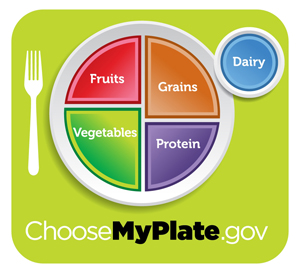
The new MyPlate icon–fantastic or plastic?

Everyone in the food press seems to be weighing in on the new replacement for the much-cursed USDA Food Pyramid in all (both?) its glorious confusion and obfuscation of real nutritional goals that might have (and should have) undermined the beef, corn, pork, corn, sugar, corn, and soy industries if they’d ever been presented honestly.

So where does that leave us? With ears of fresh corn that are more than 50 cents apiece in Los Angeles supermarkets, and the new…

USDA MyPlate logo

Already, the USDA’s MyPlate web site is in a certain amount of branding trouble (and of course, that’s what counts most in America): the Texas DMV had already bagged “MyPlates.com” for its vanity license plate division (highly unappetizing), and Livestrong.com already has its own well-established “MyPlate” food calculator and fan base. And those items come up first on Google searches. As in, the whole first page or more. The government site ranks way down the list and had to water down the impact of its original name choice with “choose” just to get a URL. Can it elbow out the competition just by bolding the “MyPlate” part?

What really counts are the food and nutrition opinion maker comments, though. And a lot of those are detracting in a nitpicking way that I think kind of misses the point.

The first thing they all have to say is that the plate looks dumbed down. Forgive me, but wasn’t the Food Pyramid’s unreadable and unusable design a large part of the problem? The MyPlate icon is simpler and more direct, and it names real food groups, not “Big Mac” or, on the haute side of things, any of Ferran Adrià’s foams. No wonder foodies and populists alike are wondering what it has to do with them.

A small sampling of the main arguments:

MyPlate: The Food Pyramid for dummies? (LA Times): Dr. Andrew Weil and others discuss what’s still wrong with the new icon. Weil says “fruits” could still include fruit juice, which is usually a useless sugar bomb in comparison with whole fruit, and he worries that the protein section, which comes with a guideline to eat 8 oz. of fish per week, might encourage unthinking people to increase their mercury intake since swordfish is on the guideline menu, as are some of the generally overfished popular species of fish. Weil’s not wrong about the fruit juice vs. actual fruit, but his hand-wringing about fish is really geared for well-off readers who can afford to eat much of it. All the fishes he names are Continue reading

AHA: Diet sodas and excess salt both linked to strokes

The latest from the American Heart Association and American Stroke Association’s joint International Conference on Stroke 2011, which is going on in Los Angeles this week from Wednesday through Friday.

Diet soda may raise odds of vascular events; salt linked to stroke risk.

Two large studies on a mixed-race/age/gender/other health status population have just shown that:

1. Drinking diet soda every day increases your risk of a heart attack or stroke in the next 9-10 years. In the study, diet soda regulars had a 48% higher rate than nondrinkers even after accounting for metabolic syndrome and existing or past heart disease.

2. For every 500 milligrams of sodium you eat per day over the AHA’s recommended 1500 max, you have a 16% higher risk of getting a stroke–no matter whether you have high blood pressure or normal blood pressure.

There was one other piece of really bad news announced:

The Centers for Disease Control’s analysts looked at hospitalizations for ischemic stroke (blocked arteries to the brain) between 1994 and 2007 and found that while strokes are decreasing in people over 65 (which is good), they’re INCREASING in children, teens and younger adults. Although older adults still have much higher overall risk of stroke than younger people, the trend toward higher stroke hospitalization rates for younger people is significant and needs to be explored further. Stroke hospitalizations increased by:

  • 31% among boys 5-14; 36% among girls 5-14
  • 51% in men 15-34, 17% in women 15-34
  • 47% in men 35-44, 36% in women 35-44

The CDC researchers didn’t have clear evidence of a cause for the rise in strokes among younger people, but said the rise in average body weight, blood pressure and diabetes, which are known risk factors for stroke, bore a closer look.

The fact that stroke hospitalization rates started rising in children over 5 (the researchers looked at younger children as well but didn’t find an increase under age 5) suggests to me that part of the trend may be due to a more processed diet with higher salt consumption as children head for school. All in all, it gives you the impression that we are the junk food generation, and it’s catching up with us as we speak.

Play with your food…

In a season of too many boring holiday cookies, this take on playing with your food, from artist/New York Times blogger Christoff Niemann, caught my eye…

Let It Dough! – NYTimes.com

No idea how they taste when baked, but I suspect that’s not really the point, and anyway, reading Niemann’s column is a calorie-free splurge on a rainy Monday. Printed out, it could make a tasty impromptu greeting card (or several) as well, as long as you give copyright credit and a link so your friends can find the whole article easily.

I can’t wait ’til he takes on gingerbread. Gehry or Gaudì?


Fastest Pie in Town

Pumpkin pie in the microwave

On the energy downswing from a departed sleepover guest, my daughter suddenly declared she wanted pumpkin pie, we had two cans of it and I’d said I would make it soon and I still hadn’t, why wasn’t I making it, it wasn’t fair, she hadn’t had any all year and it was past October so it was in season. This last argument was just for good measure, given the pumpkin was in a can, but still, give her points for it–it’s a new crop after all those shortages.

With ears ringing, I said, but it’s already 5:30. “So? I can help!” You’ve been there, I’m sure.

Pumpkin pie is a slow-food-slow kind of dish–not much way around it. Even with a premade crust and a can of “pumpkin pie mix” rather than just packed steamed pumpkin, the filling needs 45 minutes to an hour to bake. Then it needs another hour or more to cool enough to eat. And if you’ve got a tiny kitchen and your kid is helping, the elbows factor is bound to add some time and confusion.

Also, normally, with a diabetic kid, you don’t just think, “Hey! Let’s make pie for dessert!” Especially since the filling calls for 3/4 cup of sugar per pie.  But pumpkin pie, if it’s made from scratch and isn’t just a frozen ready-made version, is kind of reasonable on carbohydrates for a dessert–about 25 grams for 1/6 of an 8″ shallow pie, according to the ADA guidebook, or in our case, 35 grams for 1/8 of a standard 9.5″ deep-dish pie (calculated from the ingredients). And pumpkin may be a fruit and not a vegetable, but it’s still got a respectable serving of vitamin A and fiber. And I also like it, which helps.

Still, the time is a killer. But I had such a surprise success with spinach quiche in the microwave a while back that I started thinking. The standard filling for pumpkin pie is also based on a custard, more or less–a couple of eggs, a cup and a half of milk per deep dish pie. It’s half the eggs of a quiche, but it might well still work in a microwave. That part would take something like 5-7 minutes and leave enough time for the pie to cool while we got dinner together.

Actually, I’d wanted to try this for a while, and not with company in tow, just in case it flopped. The weather here was 97 degrees most of the week but dropped to the low 70s today and was promising an actual chill for evening. So doing the crust in the regular oven for 15 minutes or so wouldn’t actually make life miserable.

It was almost looking like a decent idea considering the fact that it was and still is totally nuts to make an entire pumpkin pie from scratch right before dinner (or at least everything from scratch short of hacking up a raw pumpkin and dealing with the seeds). So I decided to go for it, and I made my daughter deal with the filling while I made the crust and parbaked it. We just about managed not to step on each other or crowd into the same corner at the same time, but both parts went well. And then the real test came–time to nuke. Continue reading

Somewhat Scary Food

Today’s topic is particularly revolting, because it’s never too late to start considering what lies ahead at the end of this month I mean, tonight–and yes, we’re already late for the door. Yes, buying bags of generically sorta-chocolate Hershey’s and Mars brand mini candies is the accepted, sterile, utterly safe way to go on Halloween. But really, it’s not very interesting. Especially not for kids. And it’s gotten a lot more expensive in the last year, as far as I can tell.

(Though if you’re going that route–or your kid is going out trick-or-treating elsewhere–check out the Buzzle.com comprehensive candy carbs list if you need to know about that kind of thing in detail, or the little rule-of-thumb chart at the bottom of my Carb Counts page. If nothing else, it’ll keep you away from the communal candy dish at work.)

When I was a kid we went out trick-or-treating with the exhortation to touch nothing, TASTE NOTHING, until we got home and my mother could inspect it all for razor blades or dimes or other nasties that might unimaginably (except to my mom; dimes are not something most people will part with these days except for a venti with extra whipped cream and a cherry on top) be stuck in things like apples. It was an annual ritual of paranoia that lent that unnameable something–a hint of danger and excitement–to the otherwise blatantly fake costume horror. Because, of course, we were usually walked strategically to the homes of families our parents knew, just as they walked their kids to ours.

Then there was the time a friend invited me to her church’s haunted house–the activities mostly consisted of blindly sticking our hands in bowls of cold spaghetti or reaching out for something that turned out to be grapes with the skins peeled off. We were getting too old for it, really, and it was more icky than scary. But still. Somehow the innocent days of bobbing for apples and sticking your hand in cold spaghetti have gotten lost in the too-adult fear of sharing germs or getting pneumonia from having to plunge your head into a bowl of cold water.

Kids don’t get to help set up anything but the store-bought decorations anymore, and if they have any say in what treats to hand out, it’s through the universally accepted point-and-whine technique at the supermarket Halloween aisle. Reading the teeny-tiny fine print on the ingredient lists for all those mini candies, spooky and mysterious as the 4-syllable chemical names may be,  just doesn’t cut it for scariness or adventure. Nor do the huge blowup animatronic decorations–the creepy hand, the dancing skeleton, the vampire rising from the coffin to a boogie-woogie soundtrack like so many Halloween versions of the Singing Trout–is this Robert Pattinson’s future?

Most kids can’t even make their own toast these days. How are they supposed to cope with creating pickled porcupine quills or tarred hornet brittle?

Fortunately, a number of cookbooks (from before the sterilized-and-wrapped-for-your-protection era) are available from the ether or at your local library with answers to just these sorts of dilemmas. If you have a stove and a freezer and possibly a food processor or electric mixer, you stand a good chance of rescuing your young innocents from the debilitating descent into middle-aged indifference, incapacity and accountancy.

I refer here, first and foremost, to the slim but venomous contents of Roald Dahl’s culinary imagination (and that of his widow, Felicity Dahl, who unearthed these books and made sure they saw light of day). To be absolutely sure I’m doing it right, I’m starting with Volume II, Roald Dahl’s Even More Revolting Recipes (Penguin Putnam, 2001), because Volume I, Revolting Recipes, clearly wasn’t revolting enough. Only the best for my child!

What could such books possibly contain? Roald Dahl’s Even More Revolting Recipes is a fair mix of candies, sweet drinks, desserts and actual non-sweet food–this last is the real surprise. But no vegetables, unfortunately, other than a bit of decorative tomato and some oddly Martian-looking potatoes (I fervently hope they don’t sing).

In keeping with modern ideas about kids and cooking, a number of the recipes call for prefab products (the one for Tongue Rakers, a kind of onion-and-garlic-laced bread shaped like a pitchfork, calls for a “packet” of your favorite pizza dough mix rather than the basic flour-water-yeast-and-salt), and several involve the strategic use of food coloring (Hornets Stewed in Hot Tar, a black-dyed pumpkin- and other-seed brittle) or fluorescent paint Continue reading

Rising Expectations for Rosh Hashanah

Just a quick word to say L’Shanah Tova U’metuka! May you have a good and sweet New Year!

Here’s what my daughter and I baked the afternoon before the start of Rosh Hashanah. You can find the basic recipe here.

Crown challah for Rosh Hashanah

Crown challah for Rosh Hashanah

It’s the first time I’ve baked bread since my daughter became diabetic in February, but by now, six months along, we both feel like we have the approximate carb counts down well enough. I tend not to make my challah very sweet anyway, but this year I also left out the raisins, which are about a gram of carb each, to make things a little easier until we were sure we knew how to figure portions. It still came out pretty and tasted good.

Without raisins, we figure, a baked piece of challah is like most other bread, about 50% carb by weight in grams, and it seems to work. Using a simple ratio like this is a lot easier (when we’re home and have a scale handy, anyway) than worrying about exactly how many cups or grams of flour I put in the dough and calculating exact portion carbs–something I still tend to do for desserts and treat foods like berry scones since they’re so variable. Or as our endocrinologist said, “Everyone guesses wrong for birthday cake.” Next time, we’ll try it with raisins and see how it goes.

Challah birds

One thing we like to do with the extra dough–I make sure there is some–is to let my daughter make challah birds. Usually we shape these by making a small 6-inch rope of spare challah dough and tying it into an overhand knot. You can press a raisin into one of the ends for an eye, and the other end becomes the tail, which you can leave alone, stretch out a bit, or score with a knife tip for “feathers”. This year, my daughter went free-form so the rolls came out looking more like bollilos, but she liked them, which is the important thing.

Mine: A lot of people make spiral challahs for Rosh Hashanah with a single thick rope curled around in a turban shape. Tunisians and some other North African and Mizrahi Jews shape the top end into a hand shape. I like to braid my round challahs into a crown, though I admit they’re not always the most even at the joined end. They still seem to even out as they rise to the occasion.

Braided crown challah rising in the oven for Rosh Hashanah

Braided crown challah rising in the oven for Rosh Hashanah

Challah dough is so easy to put together (2 minutes by food processor, plus cleaning, or 5-7 minutes by hand and letting it rise right in the mixing bowl) that if you get the dough ready in the morning and have a couple of hours in the afternoon free for braiding (10-15 minutes unless you’re having too much fun), the second rise (40ish) and baking (another 40ish), it’s a lot of fun and less expensive than store-bought, and more individual too.

B’te’avon! (bon appétit!)

New Page Up: Carb Counts and Ratios

I’ve just uploaded a new page (see the top menu tabs) with a couple of tables of the most useful rules of thumb I’ve found for carb counting. Since my daughter became a Type I (insulin-dependent) diabetic back in February, we’ve both had to become pretty familiar with the amounts of carbohydrate in a given amount of different foods.

Although the American Dietetic Association’s “Choose Your Foods” carb count guide for diabetics is pretty helpful (and pretty inexpensive, about $3 per copy if you order from them direct on www.eatright.org), it’s written from the perspective of the eater, not the cook.

So (as the cook in the family) I’ve worked out the approximate ratios of carb grams per total weight of some common foods I serve routinely. Rice and beans are easy enough to remember. But when I want to know how much of a given potato my daughter can eat as one carb serving (15 g), it helps to be able to know that a regular potato is about 1/6th carbohydrate. Then all I have to do is weigh it on the food scale in grams and divide by 6.

The 2/3 carb ratio for moderately sweet baked goods like pie, scones, cookies and muffins is also pretty helpful if we’re home and can weigh a portion for my daughter. Sweets are one of the hardest things to guess right consistently by eye, even when you’ve made them yourself. If there’s a nutrition label, by all means go with it; if not, weighing a portion and figuring 2/3 has been a pretty good approximation so far.

Ice cream is its own thing–again, hard to figure. Dreyer’s 1/2-the-Fat is our standard home brand, and hovers around 15-18 grams per half-cup (small scoop). But Baskin Robbins 31 Flavors are all over the map–when you go in for a cone, you really need to ask them to look it up for whatever size scoop, then figure the cone separately. A junior scoop in a cake cone for pistachio almond turned out to be something like 25 grams, plus 4 grams for the cone. Almost double what a plain scoop would have been at home.

Over-the-top caramel-syrup-fudge-frosting types of confections are a little out of my league, closer to candy bars than cakes, and would probably be more like 80-90% carb by weight (or mass, if you’re being excessively metric about the properties of grams).  I haven’t listed them because they’re so laden it’s hard to think of serving them very often, but I do have a basic rule-of-thumb candy list at the bottom of the carb counts page (saving the best for last) and a link to a much better, more comprehensive one so kids don’t have to feel completely shut out at Halloween or Valentine’s Day. Or birthdays.

I also have a short (for me) bit of hard-won advice on how to strategize with a (school-aged) diabetic kid before they have to face candy-prone situations where their friends are free to eat right away and they aren’t. Good for braces-wearers too…actually maybe we should all take the hint.

In any case, I hope you find this new page helpful whether you’ve got diabetics in the family or you just want to know what you’re eating.

Let me know what you think!

Unappetizing: Nutrition “Awareness” on Top Chef

Perhaps it’s a futile attempt to understand how restaurant chefs think about food and nutrition, but lately I’ve been watching the very warped “Top Chef” episodes for the last couple of seasons–easy to do online. I can’t help wondering not only at the contestants, all of whom seem to display basic ignorance of what used to be called the “Four Food Groups,” but at some of the judges who fault them on nutritional challenges.

In this season there have been two, the School Lunch Challenge and–not that the judges even thought about it as a nutritional challenge, which they should have–the Baby Food Challenge. In both, the judges seemed at least as lacking in nutritional knowledge as the contestants, and in some aspects even worse.

The School Lunch Challenge brought out scathing comments on the show and on a number of blogs, particularly when the bottom-ranked chef, who went home for her gaffe, attempted to make a banana pudding palatable by adding sugar. Tom Colicchio made a big deal of her adding two pounds of sugar to the pudding–which was to feed 50 students.

And admittedly it’s not great for nutrition, but it was hardly the disaster he and the other judges made out. If anyone had bothered to whip out a calculator and known how to use it for pounds-to-kilos conversions, they’d have discovered that the two pounds of sugar amounts to 0.91 kilos. Or 909 grams, to be a little more precise (which we shouldn’t, the chef was eyeballing what she added). Divide by 50 and you get 18 grams per serving or about 4 teaspoons–not all that surprising an amount of sweetener in any prepared dessert. Add that to the starch already present as thickener and the sugars from the milk and bananas and you probably have 30-40 grams of carb or thereabouts per half cup of pudding.

It would be a lot for someone diabetic, like my daughter, but not disastrous as long as she knew how much carb was in it, and it certainly wouldn’t be disastrous for most school kids if the rest of the meal was balanced with low-fat protein and vegetables and not too much other starch.

But actually, most of the lunch entries were pretty starchy. The fact that they didn’t all have as much noticeable added sugar is almost immaterial–starches break down into sugars. You have to count them all.

What really stood out was the pathetic nature of the criterion “to include a vegetable.” One that was most-praised–a slab of caramelized (talking of sugar) sweet potato under a chocolate sorbet as a dessert–was mostly a starch, though in its favor it had vitamin A and fiber. Another team served celery (no vitamins and very low fiber, despite the stringiness) with a peanut-butter mousse (why, oh lord, not just peanut butter? chef-think at work?) piped out directly onto the celery, supposedly so kids would eat it. No one liked the mousse because it looked Continue reading

Veg-phobia II: Summer Edition

My daughter is at camp for two weeks, the longest she’s been away from home, learning to deal with meals and insulin on her own (with the camp nurse’s help). After six months of calculating and eight weeks of giving herself shots, I know she’s ready to do it, and the nurse is ready, and her counselors are ready. And I overprepared and brought more supplies than she’ll need (my daughter has nicknamed this “Mom-anoia”).

I brought everything and a little bit more–including carrots and celery sticks and low-fat cheese sticks, and a loaf of whole wheat bread for activity carbs. I felt like I was turning into my grandmother, who used to bring shopping bags full of real bagels and corn rye on the plane with her from New York whenever she and Grandpa visited us in small-town Virginia.

But really. The nurse laughed at first when I asked a couple of weeks ago if the camp kitchen had vegetables as an option for campers who needed a non-junk snack (I’d looked at the sample menus online and they looked a bit Boy-Ar-Dee to me), but then she admitted the camp doesn’t really serve a lot of vegetables and suggested I bring them for her to store in the infirmary fridge. They don’t have anything whole wheat either. I think she stopped laughing and started sounding rueful about a third of the way through her reply. “We have fruit,” she said half-heartedly, knowing immediately that it wouldn’t really do for a diabetic.

The food at camp is a smack in the face with the wet rag of reality: this is how the rest of the country eats today. And don’t get me wrong, it’s a great camp in every other respect, with a long track record all over the Americas and people of my generation who still feel immensely grateful to have gone as kids. We were very fortunate to get a scholarship for it.

So what’s gone wrong with the food? It’s like school cafeteria food in the ’70s, but without the kale or the stewed tomatoes, the half-hearted iceberg lettuce salads or the lima beans. Take all that away and you have spaghetti, turkey burgers, the occasional chicken or tuna fish, grilled cheese, pizza, some form of potatoes or corn, and fruit. Some protein, a surprising amount of fat, hidden and otherwise, highish salt and a lot of starches on top of starches. It’s also “all you can eat.” But what are you really getting that’s worth seconds? No fiber. No vitamins. Few minerals. Nothing green. Per the Sylvia cartoons, “We feature all-white meals.”

Vegetables? Salad if you’re lucky. Broccoli? Nearly unheard of. Tomatoes? only occasionally. Red cabbage, carrots, celery or any other noshing vegetable of worth? Um, not this summer.

And it is summer. Best time of year for greens. This is when it’s all happening at the farmers’ markets all over the country, and your local newspaper is probably exhorting you to get out there and try it. And did I mention this is California, prime place for vegetabalia all year round?

How did this happen? To a well-educated, professional and middle-class part of the population, no less? The nurse tried to explain to me, “This is what they’re used to at home. The kitchen figures the kids won’t eat them.”

Disheartening in the extreme. But she’s right about the way families tend to eat these days. We saw it firsthand when some dear friends of ours came to visit Continue reading