• Enter your email address to subscribe to this blog and receive notifications of new posts by email.

    Join 241 other subscribers
  • Noshing on

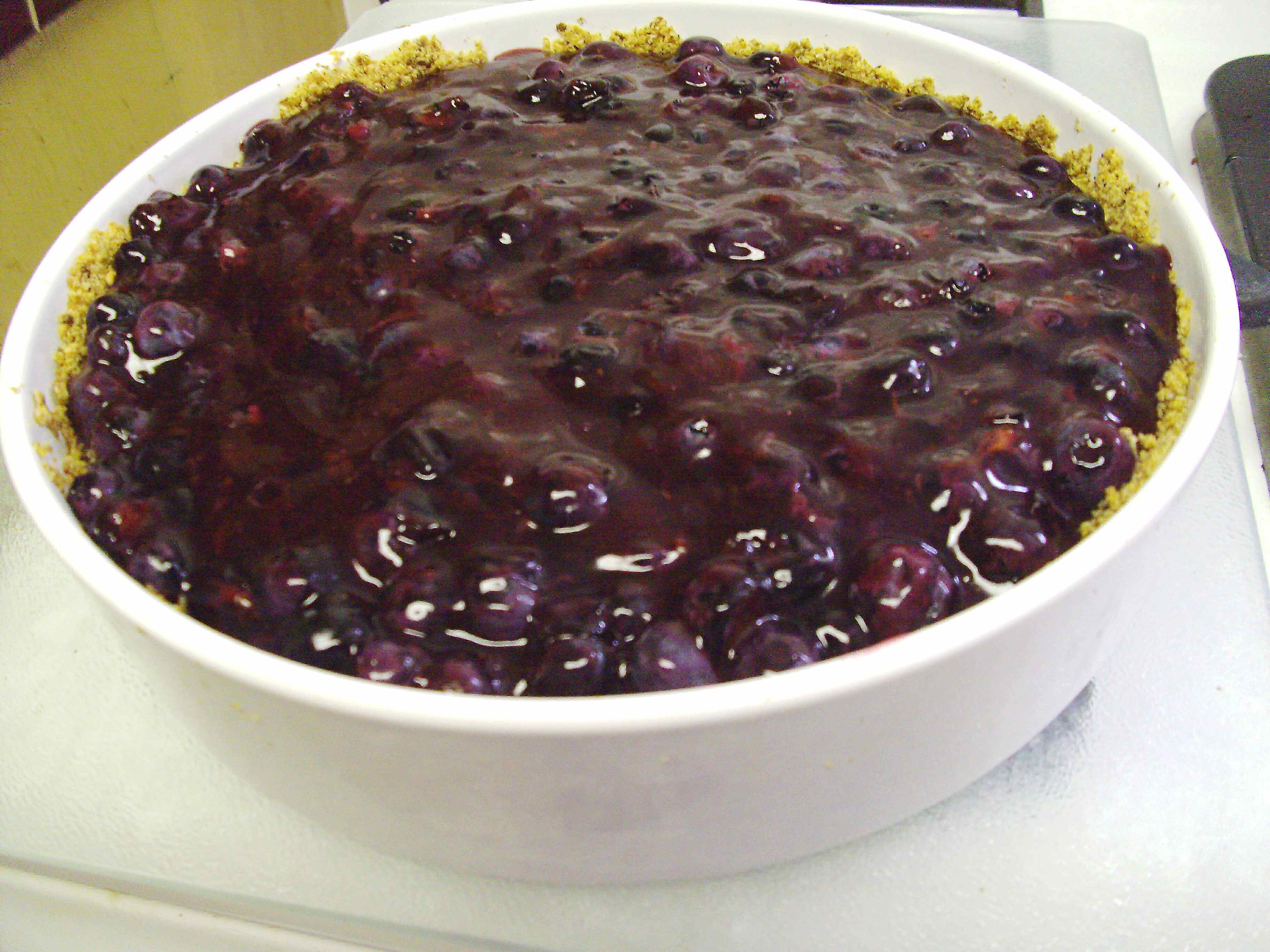
    raw blueberry pie with microwaveable filling and graham cracker crust

    This mostly-raw blueberry pie is a snap to make and very versatile--the filling microwaves in a few minutes, and you don't even have to bake the zippy gingered graham cracker crust--perfect for a hot Fourth of July and all summer long.

  • Recent Posts

  • Contents

  • Archives

  • Now Reading

  • See also my Book Reviews

  • Copyright 2008-2024Slow Food Fast. All writing and images on this blog unless otherwise attributed or set in quotes are the sole property of Slow Food Fast. Please contact DebbieN via the comments form for permissions before reprinting or reproducing any of the material on this blog.

  • ADS AND AFFILIATE LINKS

  • I may post affiliate links to books and movies that I personally review and recommend. Currently I favor Alibris and Vroman's, our terrific and venerable (now past the century mark!) independent bookstore in Pasadena. Or go to your local library--and make sure to support them with actual donations, not just overdue fines (ahem!), because your state probably has cut their budget and hours. Again.

  • In keeping with the disclaimer below, I DO NOT endorse, profit from, or recommend any medications, health treatments, commercial diet plans, supplements or any other such products.

  • DISCLAIMER

  • SlowFoodFast sometimes addresses general public health topics related to nutrition, heart disease, blood pressure, and diabetes. Because this is a blog with a personal point of view, my health and food politics entries often include my opinions on the trends I see, and I try to be as blatant as possible about that. None of these articles should be construed as specific medical advice for an individual case. I do try to keep to findings from well-vetted research sources and large, well-controlled studies, and I try not to sensationalize the science (though if they actually come up with a real cure for Type I diabetes in the next couple of years, I'm gonna be dancing in the streets with a hat that would put Carmen Miranda to shame. Consider yourself warned).

Fruitcake and the Jews

A week or so ago, just before the Chanukah madness, my husband brought home what he assumed were The Goods from the local Vons (Safeway chain affiliate on the west coast)–a classic fruitcake, green and red candied citron glowing evilly amid chunks of walnut and raisins and other less identifiable bits and topped with syrupy pecans and glacéed cherries. Tacky as hell, we know. We love fruitcake anyway.

Why do Jews like fruitcake more than Christians do? You know, the kind of indestructible fruitcake everyone jokes about passing off to some unsuspecting cousin after having received it 20 years earlier and having kept the tin in the closet all that time underneath some shoes. The kind the British refer to as “doorstop”. The kind all modern cake blogs decry when they present their own lighter, cakier, less fruity and less chewy version as “fruitcake you’ll actually like.” THAT fruitcake.

Well. Private Selection or not, the cake from Vons was…I don’t know if there are new legal restrictions on using rum or bourbon or other booze as a baking ingredient these days (or ice cream flavor; hard to find Rum Raisin anymore). Maybe it’s a California-does-rehab thing, or just a huge downgrading of quality, but it. Was. Awful.

No rum. No bourbon or other appropriate flavoring. Instead, the loaf was permeated with an aggressively soapy flavor/odor (we couldn’t even tell which), horridly artificial and perfumy like fruit-scented liquid hand soap. Or that overpowering Dove soap I always hated as a kid. You couldn’t even taste the raisins or walnuts, which by all accounts, including visual inspection, were present.

We were, perhaps for the first time ever, not tempted to eat any more, not even to try a tiny second taste the next day to see if it was really as bad as we thought the first time. Just passing the open packet on the table was enough to convince us the bar of Dove that must have fallen into the batter was still giving that loaf its younger-looking complexion. After several days of forlorn looks in its direction, we actually threw it out.

In any case, I’ve been looking for a trustworthy recipe for fruitcake ever since and not succeeding much. In a place where there is no fruitcake, strive thou to make taka a fruitcake. (Not exactly sure what the “taka” part means in Yiddish; the way my mother says it, it means something like “especially” or “such a”, but less polite and more ironic, as you might use it when pointing out how incredibly garish and over-the-top the neighbor’s Christmas lights are with the Continue reading

A Slow Food Fast Thanksgiving

Pumpkin pie in the microwave

I’m not sure how to take all the following good news–it’s been such a strained year that the sudden release of pressure is going to make me zip around the room, once the coffee kicks in.

1. My mother-in-law has threatened to favor the brand-new kosher butcher in her town this holiday season so that we can eat the turkey too this year (and maybe not fight about it). She promised not to smear said turkey with butter. We’ll cross our fingers. But at least we won’t have to cook. I’m keeping that firmly in mind.

2. As of this week, my daughter’s finally on an insulin pump and fairly thrilled about it, so she can navigate dinner AND dessert at my in-laws’ without breaking down and crying that she only gets two tablespoons of pie for a reasonable serving. We are still encouraging her to count carbs and not go hog-wild or she’ll be zipping around the room until midnight.

3. The school concert’s in less than two hours. Is that really enough time to do everything, or at least something? Naaaah. Well, maybe coffee and something other than the news.

4. We still have to schlep up Interstate 5 for about 6 hours tomorrow, starting “early” (i.e., an hour and a half after the time my husband announces this evening as the absolute latest), passing the Harris Ranch and its attendant aromas, which can be more than slightly offputting if you’re not an avid horticulturist. But at least when we get to my in-laws’ we don’t have to cook. As I said, I’m keeping that firmly in mind. I know I already said it, but it’s so important I figured it was worth saying twice.

Despite my firm resolve after last week’s marathon kiddush that I will strive Not To Cook (could I possibly be Peg Bracken’s unacknowledged lovechild? Unfortunately, no. However, my mother was a devotee of the Don’t Cook Too Much school of thought, and I’m starting to appreciate that. Really I am.)…where was I? Oh yeah…I will probably bring at least two lemons, some thyme and rosemary, a head of garlic and a couple of bags of fresh cranberries with us on the road. Call it flavor insurance. For whatever reason, my in-laws, who have developed what can only be called fanatical devotion to Italian food of every possible kind (having both grown up in white bread country), always run out of these basic essentials about halfway through, and my mother-in-law tends to tell my father-in-law to go back out and pick up extras just as the stores are closing…

The cranberries, I’m well aware, aren’t Italian. They’re for making 5-minute microwave cranberry sauce with about half the sugar of regular. My mother-in-law tends to try out her fancier cranberry chutneys and relishes every year, and every year they contain things like chardonnay–which is fine for the grownups but I’m no grownup. Her chutneys have more than 10 ingredients and sit stirring on the stovetop for at least 45 minutes. I don’t know how she does it–I’d go stir-crazy. I’m just not that good.

So anyway–I wish you all a great Thanksgiving at somebody else’s house, so you don’t have to cook or do the dishes. My idea of heaven.

But if you absolutely have to cook, here are a couple of posts for speeding up a few of the obligatory or not-so-obligatory Thanksgiving items–most can go in a microwave (I always, always think that’s worthwhile. Well, usually). A few of these are dairy, so use your discretion.

5-Minute Cranberry Sauce

Microwave Pumpkin Pie

Basic instructions for microwaving green beans, brussels sprouts and other vegetables

Creamed Spinach Variations

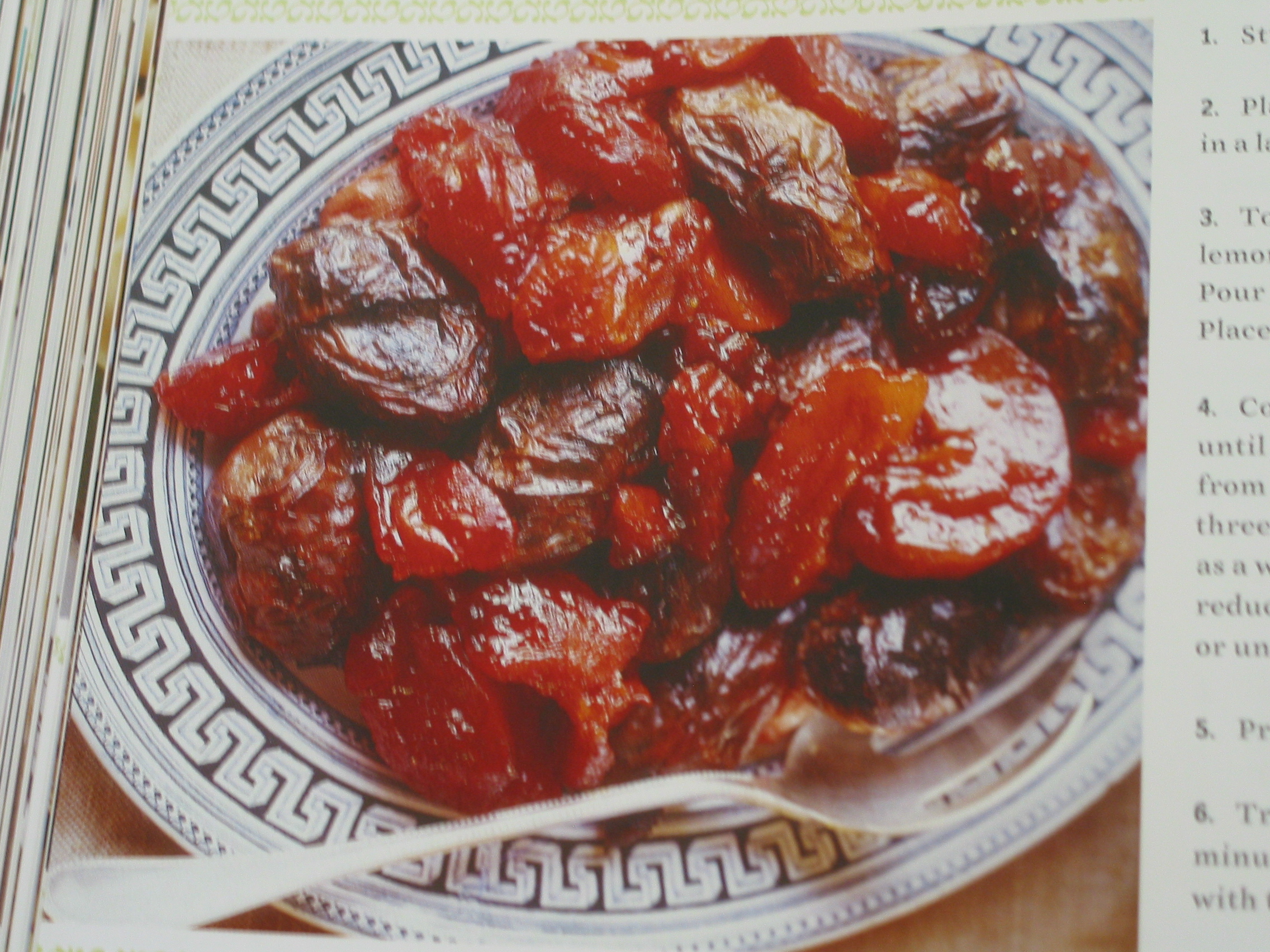
“Marbella”-style cooked vegetable relish with artichoke hearts, olives, tomatoes and prunes

Turkey Breast with Ta’am (flavor) –not microwaved, not a whole bird, but it is a lot quicker and tastes unusually good if you have a small crowd. DO keep it covered in the oven to prevent it drying out.

Some options for vegetarian centerpiece dishes… (ideas more than recipes)

Spice mixes because sometimes you want to liven up the party…

Syrian Jewish stuffed vegetables (baby eggplants and onions) with an incredible lentil filling (NOTE–this one is “not exactly quick”; well, maybe for the eggplants microwaving would be enough, but the onions still take some serious roasting even after microwave assistance.  However, it is delicious and impressive.)

Microwave gingerbread and microwave flan (and a recommendation for mead…)


Stuffed Eggplants with Quince, A Vegetarian Odyssey

Stuffed Eggplant with Quince and Stuffed Onion Rolls

I did it. It was 90+ degrees outside yesterday afternoon and felt a lot hotter inside when I started cranking the oven to try this dish right away rather than wait for the weekend, but I’m just no good with delayed gratification.

If I have the mini-eggplants and I have the quinces and I have the tamarind concentrate (homemade! two days ago! it’s practically crying out to be used already!) and I have the “hashu” filling for the vegetables sitting in the fridge smelling wonderful, then it just doesn’t matter that Rosh Hashanah dinner is in what, maybe 3 hours, and I still haven’t braided the challot, to say nothing of baked them. Obviously I’ve gotta try this extra-credit dish out RIGHT NOW.

Actually, I figured the house was going to be heating up anyway once I started baking the challot, so why not get it all over with at once?

There was a more serious reason to try it. Today in services I was still thinking about Dweck’s book and her recounting of her parents’ horror in 1947, when, about to return from a vacation in Europe, they learned the government back home had started massacring whole Jewish communities in reaction to the announcement that the UN had accepted Israel as a Jewish state.

The Syrian Jewish community fled wherever they could–just as my family did under the pogroms in the Ukraine back in the 1880s and 1920s. Dweck maintains that the reception the Syrian Jews got in the US from those of us who were already here was so aloof–they didn’t speak Yiddish, they didn’t look the same, they did a few things differently for kashrut and prayers–that her community kept to themselves ever after.

I can believe it, unfortunately–the period right after World War II and the Holocaust was one of paranoia and circling the wagons for American Ashkenazim.

Eastern and Western Jews had similar discomfort with each other in postwar Europe. Reading between the lines a little in Claudia Roden’s and Colette Rossant’s memoirs, the two, who had just lost everything, thought their new Ashkenazi neighbors were cold and inhospitable and indifferent to their exile; the Ashkenazi neighbors and relatives, meanwhile, thought the wealthy young Egyptian arrivals were horribly spoiled and indifferent to the European disaster they had just missed. Altogether, the Ashkenazi, Sephardi, and Mizrahi communities were in closer touch before World War I than they were after the 1940s.

I can only hope that now, 60 or 70 years on, we have more in common and more regard for each other, no matter where we came from. Israel’s great mix of cultures has been a good influence, even though it originated in hardship, and perhaps today we are in better shape to appreciate what we have in common than we have been for nearly a century.

When I look through Dweck’s family’s photos, I see so many people who look astonishingly like several members of my family–my dad and my sister especially. The dignified lady presiding at the seder table on the front cover is a shockingly exact adult version of a girl I knew from my synagogue’s youth group–it’s the sturdy mouth and chin and the set of the eyes, certainly, but also the irrepressibly thick and curly hair (the 1920s formal chignon has it all over my friend’s 1970s braids, which took her hours to corral her hair into). The formal photographs of families in the 1920s, all the daughters dressed beautifully but in the same fabric the mother is wearing, sailor suits on the boys, stern dignified expressions all–I’m pretty sure each of my grandmothers had at least one of those in her collection. The 1930s-era engagement portrait with pearls and bobbed hair–so modern! Pin it up next to the one of my dad’s parents, who married in 1939 and looked so incredibly naive and young then. The family gatherings at Pesach, grandma presiding over the white lace tablecloth and all the seated cousins glancing behind them at the camera from over their shoulders–there’s probably one or two with my mother as a toddler on someone’s lap in Brooklyn and another of her as a teen, whipping her glasses off and blinking myopically for the photo. It could be any of our families. It could have been us in Syria and Egypt and Turkey, it could have been them in the Ukraine or Germany or Poland. We none of us have entirely safe histories, and none of us are entirely separate.

In any case, Dweck’s book is important to me not only for capturing her community’s traditions, tastes and history but for reaching out to the rest of us and giving us a chance to share it, compare it with our own, and reconsider what it means to be part of the Jewish world now.

So–and this is not to trivialize but to explain, since we sometimes live and remember through food, especially at the holidays–it was a great time to try out a challenging dish (challenging for me, anyway) from her book and serve it last night to my family for Erev Rosh Hashanah. I cook from scratch, I cook a lot, but I’ve never really done  the legendary great-aunts-at-Pesach kind of slow cooking where everyone groans in pleasure and declares “nobody does it like this anymore” when they taste it. I’ve only once cooked a whole turkey, and I’ve rarely tried anything else that took more than an hour and a half to cook. It’s a transformative experience, one that teaches me a lot about my great-aunts and great-grandmothers, both in the shtetls with the wood-fueled pripitschoks and communal ovens, and here in America with modern kitchens and big lace-covered tables. Trying this long-cooked dish gave me the chance to experience both my family’s past celebrations and Dweck’s at the same time.

To my very great pleasure, her recipe worked the way it was supposed to on the first try and tasted like the effort was worth it, even though her instructions are pretty simple and brief. That’s a huge achievement.

So–if you’re ready for this, keep reading–otherwise, glance at the pictures and skip to the bottom…

The “Stuffed Eggplants with Quince” Experience

First of all, let me just say that I LOVE my local Armenian corner grocers for a lot of reasons, but the fact that they have all the ingredients for Dweck’s dishes (other than kosher meat, that is) is a big, big plus.

I would have tried microwaving–and I still will–instead of a 2-hour braise, but I wasn’t sure how it was supposed to taste, whether microwaving would cook the raw rice in the filling well enough, and how the sauce was supposed to interact with the stuffing and the eggplants. I knew from a previous hard-luck experience that quinces don’t do especially well (or even well at all) in the microwave and really need long stewing under conventional heat to get tender and turn bronzy pink and sweet. So all in all, I decided following the directions in Aromas of Aleppo might be the wiser course for a first try. Even though, from my usual 15-minutes-tops perspective on conventional-heat cooking, Poopa Dweck’s method is glacially, almost outrageously, slow.

Basically, you core the baby eggplants, stuff them with hashu (beef-and-rice filling, rice and tomatoes, or in my case lentils-and-rice), and layer them in a saucepan with quince slices. Then you dilute some tamarind concentrate and add a bit of sugar and salt, pour the sauce over the pan and heat for 10 minutes on the stove until the eggplants start to sweat, add water to come about 3/4 of the way up , simmer half an hour to reduce the liquid and cook the rice in the filling, then transfer to the oven to braise covered for about 40 minutes and then uncovered for another 30. It’s a lot like making brisket, actually.

Dweck gives two allspice-laden recipes for the filling, one for ground beef with rice, the other a rice-and-tomato filling that’s close to what I use for dolmas. I opted to follow the ground beef recipe but substitute an equal weight of cooked green lentils for the meat and add a little garlic. It would work, I was pretty sure, and in fact it turned out to be the best, most delicious part of this recipe–which, skipping to the punchline, was pretty terrific and worthwhile, even for the work Continue reading

The Birthday Project: New Year, New Food

I was born halfway between Rosh Hashanah and Yom Kippur, so on any given year, I could be stuck eating honeycake or none at all on my birthday. I think I’ve had maybe two actual birthday parties in my life. It’s a concept my daughter, born in June, doesn’t get.

But occasionally I luck out–and this year was one of the best. My husband asked what I wanted and I had a real answer–a cookbook I’ve been lusting after at the library and that costs only slightly more than my probable library fines if I don’t return it.

So this is it–feast your eyes, I’ll turn the pages:

Aromas of Aleppo by Poopa Dweck

And this is the project that sold me on it:

Stuffed Eggplant with Quince

Stuffed Eggplant with Quince

Poopa Dweck, a cousin by marriage to Claudia Roden, has edited the New York Syrian Jewish community’s version of a sisterhood cookbook (every synagogue in America’s sisterhood seems to have put out at least one of those) for something like 20 years, only people in her community actually used it frequently. My birthday gift is the 2007 culmination of Dweck’s experience, and it’s just a very beautiful cookbook to leaf through–visually but also for the possibility that when you try the dishes, they’re actually going to work.

It doesn’t take much reading for me to realize that despite the unfamiliarity of some of the flavors–allspice in meat stuffings, tamarind-based sauces–this is the best kind of traditional Jewish home cooking, the kind that has your favorite great-aunts outdoing each other for Pesach, Rosh Hashanah, and other big celebrations. So, somewhat exotic in flavoring but utterly familiar in spirit. (And actually, as I discovered in another Syrian Jewish cookbook, A Fistful of Lentils, by Jennifer Felicia Abadi, a few dishes, like stuffed cabbage with a sweet-and-sour sauce, and manti, a kind of ravioli, are pretty similar to Ashkenazi holishkes and kreplach.)

Like all Jewish great-aunt dishes for the holidays, this dish of stuffed eggplants and quinces comes with two required homework items: the beef and rice stuffing, and tamarind concentrate. The beef I’m not worried about–my first try on this is going to be vegetarian, because I’m not planning on heading out to the kosher butchers in the Valley. I can use a green lentil and rice filling that I already know will taste fine with those flavorings of allspice and cinnamon and onion. Maybe a hit of garlic too, and maybe a bit less salt than for the beef–as I discovered a few weeks ago, with the green lentil sausages, lentils don’t hide the salt flavor as much as beef might.

The other item, tamarind concentrate, turns out to be inexpensive but somewhat unlovely to make–though still something of an adventure. Especially for a blog called Slow Food Fast.

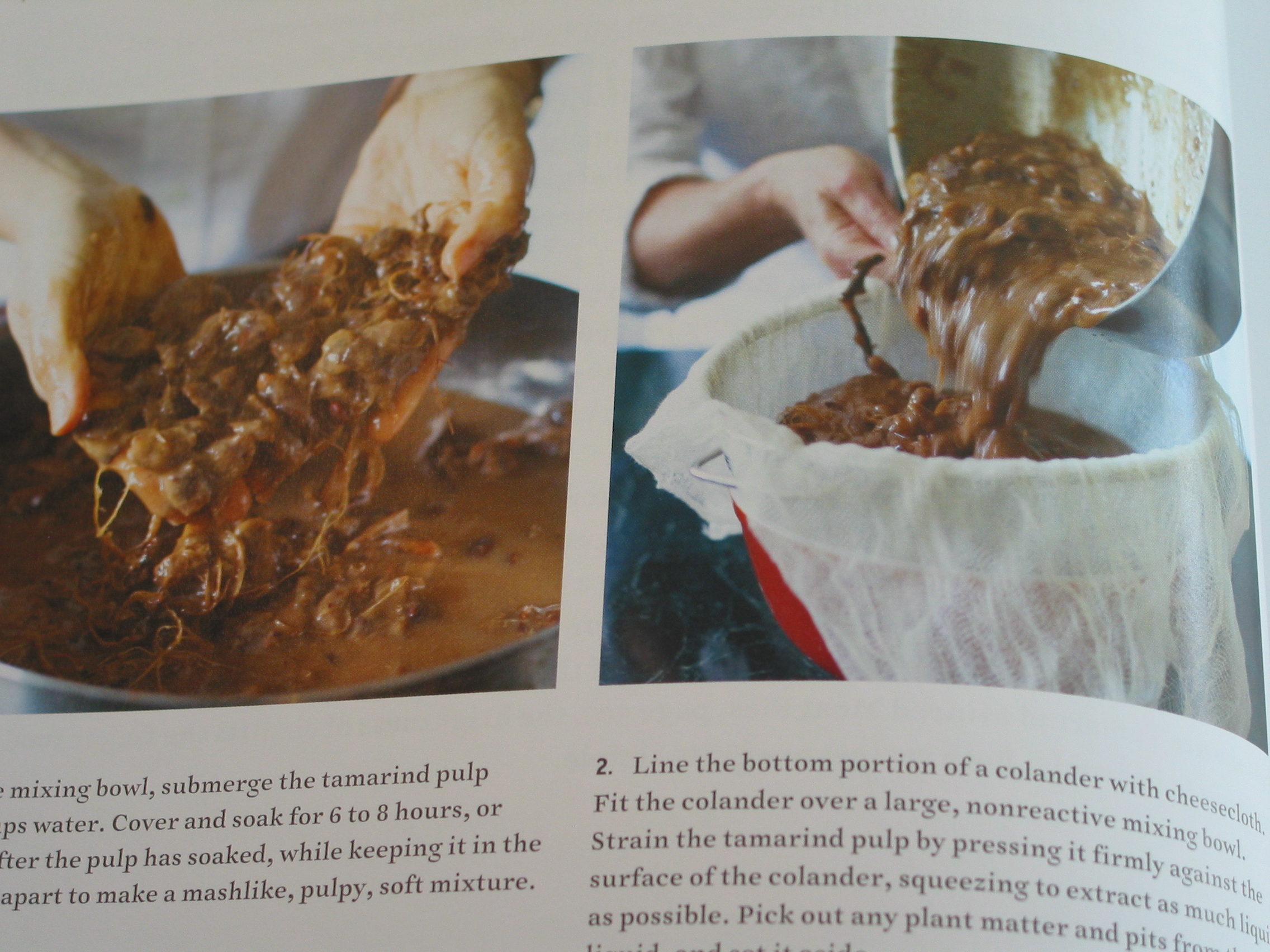
Here’s what’s on page 42 of Aromas of Aleppo for how to work the tamarind pulp into something that will give up its flavor to a sauce:

Poopa Dweck's Aromas of Aleppo--instructions for making tamarind concentrate

Working the tamarind pulp

Now, I’m not all that squeamish, but bleaaghhh. First ya gotta soak the stuff overnight, then ya gotta get in there and mish around–I dunno. I decided to speed it up where I could…

I thought about the little 1-lb. brick of pressed seedless tamarind pulp I’d bought from my Armenian greengrocers for this dish. It just seemed like a tougher version of dried prunes or apricots, which I usually soak up successfully enough in a few minutes by heating them with water in the microwave. Would it work here or would it ruin the flavor? I cut off a chunk, submerged it in water in a microwaveable bowl, and tried it.

Tamarind pulp rehydrated in the microwave

Five minutes of microwaving, covered, plus about 20 minutes sitting time–it was definitely done. And really, really incredibly tart, a surprise given tamarind’s distinctly plummy aroma. Success! But no wonder they call it “ouc” (pronounced OO-rgh, according to Dweck)–that was my immediate reaction when I tasted a tiny sip. It’s THAT sour. My second reaction was that I should probably say Shehekheyanu–the blessing for any new venture, especially for holidays and the first taste of a new fruit in the year.

I realized only afterward that I should have done the whole brick while I was at it–I was about to discover why Dweck calls for preparing three pounds of pulp at a time, not a couple of ounces.

Next step–squishing the pulp in the water to extract as much flavor as possible before filtering through cheesecloth and reextracting the pulp left behind in fresh water…no. Just no. I am not a cheesecloth girl–it never, never cuts neatly, even with Fiskars shears.

So, I was thinking, I have a microwave for a reason. I also decided I have a food processor for a reason, and this is definitely it. I stirred once with a fork first to make sure there really weren’t any pits in there, as advertised on the package front. Then I poured it all into the food processor, and gave it a whirl. That worked too. I seemed to be on a roll with the speed-it-up-immensely daydream.

Filtering the tamarind liquid

Filtration–I’ve used overlapping coffee filters in a colander whenever I make paneer in the microwave, and it worked pretty well here too–maybe better than Dweck’s photos, which show a cloudy filtrate coming through the cheesecloth. Mine was clear and amber–maybe too clear? Was it going to taste authentic without the silty stuff? I could only hope. It sure was sour, even dilute as it was. Continue reading

On the inevitable hot dog eating contests

I did something at my in-laws’ Fourth of July cookout that I haven’t done in years: I ate a hot dog. So did my husband. I think my daughter ate two and a half hot dogs (actually, I think she ate more and gave us a story, but her grandfather maintains that someone else may have gotten the extras in the pack). Given how crappy hot dogs generally are, you may be wondering why we did this: because my in-laws made the effort to buy kosher ones for us, and because Hebrew National hot dogs don’t have much in the way of carb, and my daughter is fairly crazy about them (because we don’t cook enough meat for her tastes at home).

What hot dogs, kosher or otherwise, do have–and this is why I have to put in a huge caveat–is sodium. And saturated fat. A regular H-N hot dog has about 490 mg sodium. A knockwurst (which we decided against; the flavor’s not really very different, it’s just bigger) has 810 mg. Plus more calories and saturated fat, though the regular’s no great bargain–as much fat as protein, easily.

I have to admit they taste a lot better grilled outdoors on an actual grill than they do indoors in a grease-laden cafeteria service pan, especially since you can dress them up significantly with sharp mustard, crusty French rolls instead of whitebread buns, and sauerkraut and browned onions instead of the usual insipid cafeteria ketchup. So I can go with the “once a year, enjoy, and just eat a little more carefully the rest of the week” argument.

However. Hot dog eating contests are just wrong. Sixty-two or however many hot dogs appear in the “ain’t it amazing?” recordbreaking stories section of your local newspaper the next morning? Enough hot dogs for 30 people or so? That’s not enjoyment, that’s not even tasting the food–tasting slows one down, and possibly triggers the dire appetite signal to retreat or suffer an immediate reversal of fortune after just a few hot dogs. Even for teenage contestants.

For the non-contestants among us (such as my daughter), I say, two hot dogs is probably the outer limit of sanity in one day–so just figure you’ll eat the other sixty another time. Two is about half your recommended daily max for sodium intake and about the max for saturated fat. And it’s not really delivering much in the way of protein. What’s true of bologna is just about as true for hot dogs–they’re made of meat, but they don’t add up nutritionally to actual meat (about 6 or 7 grams of protein per dog), and they sure have a lot of downsides without delivering the really distinctive flavors and variety of, say, gourmet specialty sausages.

There aren’t a lot of kosher specialty sausages made widely available in the US at this point. Actually, according to my father-in-law, there aren’t enough true (pork) and high-quality bratwurst distributors either anymore, and the owner of the one available to them, who happens to operate in my mother-in-law’s native state of Wisconsin, has openly supported political causes and candidates that are thoroughly repugnant to them.

I suspect that leaves a bad taste in everyone’s mouth on the Fourth of July.


French Food with Jewish Roots (and vice versa)

Joan Nathan's "Quiches, Kugels, and Couscous" (Alfred Knopf, 2010)About…a month ago, already? Two? Oy! I decided my next serious food post was going to be a review of Joan Nathan’s current bookQuiches, Kugels, and Couscous: My Search for Jewish Cooking in France (Alfred Knopf, 2010). And I’ve been looking through this book for much of that time, trying to figure out what to say first and what I’d want to cook from it that I haven’t tried before.

An initial read attracted me very much: Nathan, who worked as an aide to Teddy Kollek back in the 1970s, when he was still the gregarious and widely-admired–in fact the last widely admired and liked–mayor of Jerusalem, came back to the States as interested in people as in food, and has balanced the two focuses in most of her cookbooks ever since.

In this book, she starts out by visiting her French cousins and branches out to meet all sorts of people–deli owners, a gefilte fish maven, Holocaust survivors and one of the farm women who sheltered some of them during the war, the new wave of North African Jews from Morocco to Egypt who arrived in France after the mass expulsion from Arab countries in the 1950s;  the Provençal Jews who trace their ancestry back to pre-Inquisition Spain and Portugal, the Alsatian Jews whose dishes, despite coming from the heart of the original Ashkenazi community, are not as familiar as I would have expected.

Throughout the book she’s collected personal stories of all kinds, visiting home cooks, restaurant chefs, purveyors of spices and other specialty items that Jews initiated and led the European trade for–particularly chocolate and coffee. And she has dug up a few surprises as well.

Paul Bocuse, for example, is widely considered the grand old man of French haute cuisine, so much so that a major international competition is named for him. Nathan discovered that he keeps one stockroom Continue reading

Chickpea Crepes: Protein Inside-Out

Ever since Thanksgiving I’ve been thinking about the challenge of coming up with a proper vegetarian centerpiece for major celebrations–one with a single, unified dish cut up to share, something with protein, not just vegetables or grains, something with great complex flavor and no artificial ingredients.

This is apparently a tall order. For months now I’ve scoured vegetarian and vegan cookbooks in hopes of some serious suggestions and come up nearly blank. Perhaps it’s because most vegetarian cooking in America is based on southeast Asian vegetarian cuisines, which don’t emphasize centerpiece or “main” dishes as much as assortments of several smaller ones, none of which necessarily take the lead. Or because a lot of the nondairy, non-egg vegetarian cooking consists of beans, rice, tofu, seitan and vegetables–not a bad thing, but not usually pretty or convincing as a centerpiece and occasionally incomplete on protein or complex flavor (there’s an awful lot of salt or soy sauce in some of these cookbooks). The few centerpiece dishes with a meatloaf-style filling wrapped in puff pastry or phyllo or potatoes seem to include premade seitan (high in salt) and/or things like mushrooms or eggplant or spinach and nuts with a fair amount of starch for binder, which means you’re repeating starches between the filling and the wrapper and not providing much protein.

One solution might be to put the protein, or at least some of it, in the wrapper itself, so the filling can be flavorful vegetables and so on but not have to come up to the concentrated protein level of meat.

Chickpea flour crêpes are one such possibility, and they’re very easy to make. A bit stronger in flavor than ones made with wheat flour, they hold together well in the frying pan and come out thin, springy and wrappable without the need for eggs. They also take well to a Continue reading

Play with your food…

In a season of too many boring holiday cookies, this take on playing with your food, from artist/New York Times blogger Christoff Niemann, caught my eye…

Let It Dough! – NYTimes.com

No idea how they taste when baked, but I suspect that’s not really the point, and anyway, reading Niemann’s column is a calorie-free splurge on a rainy Monday. Printed out, it could make a tasty impromptu greeting card (or several) as well, as long as you give copyright credit and a link so your friends can find the whole article easily.

I can’t wait ’til he takes on gingerbread. Gehry or Gaudì?


Getting Mead-ieval

(plus 2 era-appropriate desserts to go with it)

Chaucer's Mead shelftalker label

Chaucer's Mead new 2010 label. Diehard homebrewers aren't as enthusiastic as Wine Enthusiast, but most of them seem young and clearly weren't expecting a dessert wine.

A couple of years ago my husband was rooting around our dwindling wine rack selection on a Halloween eve, right before the trick-or-treat crowd came by. It was actually starting to get genuinely chilly outside in the evenings…

“Hey, Deb–what is this stuff? Chaucer’s Mead?!” [squints at label] “Says you’re supposed to serve it fresh. How old is it?”

“I dunno. Last year? I forgot it was there.”

“Are you sure it’s still good?”

I started typing away to find out. “One of the Renaissance Faire bloggers says it’s really gross fresh and you’re supposed to let it age, but it looks like they mean the kind you make at home.”

Clearly neither of us was an expert.

Mead, of course, is a drink made by fermenting honey. I’d been vaguely aware of it ever since I was eight or nine years old and my dad handed me a copy of Howard Pyle’s The Merry Adventures of Robin Hood. (Quick, everybody, picture Errol Flynn or Kevin Costner, your preference, dressed up more or less as Kermit the Frog in a pointy hat and feather, leaping up onto a dead log with arms akimbo to shout “Ha-Ha-Ha-Ha!” at his fellows in a gratingly cheerful tone…)

I like reading about medieval and renaissance Europe, but I’ve never favored the Renaissance Faire approach–especially because you have to sew your own costume AND know all the names of the pieces AND how to lace them all together. A lot of participants get very snotty about each other’s authenticity. Which is fun, clearly, but I’d be the one they were getting snotty with. Also I’ve never wanted to be addressed as “wench” unless I had a huge frying pan handy to teach the knave who tried it some manners.

Also, after seeing my ex-brother-in-law’s home beer brewing setup (very successful, but then he’s English and knows his stout) I always thought that brewing mead at home would also involve big trash cans with burp valves (I mean, gas traps, though on reflection that’s actually no politer), attract a guaranteed parade of ants even in January (this being Pasadena), and that the stuff would come out cloudy and greenish and a little too authentically medieval for enjoyment.

So all in all, it wasn’t until I stumbled on a bottle at the Trader Joe’s while looking for a gift bottle of more conventional port that I ever considered tasting mead. It was enough of a novelty and the price was right–about $10. Then, of course, I put it in the wine rack and forgot about it for an entire year…which, it turns out, is the right thing to do.

Back at the kitchen counter my husband had finished squinting at the fine print, decided it probably wouldn’t kill or blind both of us at the same time, and was already opening the bottle to pour  a sip into each of two glasses. It looked and smelled like a white dessert wine–light, clear, not at all the cloudy, beerily fermenting syrup I’d been imagining. So we decided to risk it on the count of three.

Even though it looked fine, I’m not crazy about sweet dessert wines and my husband is, so I was still prepared to wince. But whatever I was expecting, it certainly wasn’t this.

It didn’t taste like honey at all–it tasted like all the flowers the honey had been made from. Somehow the brewing and aging had unlocked all the delicate nectary flavors that had been trapped inside the honey, and the flavor kept changing and shifting with every sip. A sherry glass was plenty–it was a bit rich, another surprise, because sherry hovers around 18% alcohol, and this mead was only 10%. But it was intense and fascinating.

Just then, of course, my husband spotted the little packet of spices, like a teabag, that had been hanging around the neck of the bottle and decided he really ought to mull some of the mead with them. In five minutes, the whole downstairs smelled of nutmeg. It was too cloying for me, but he liked it. (Chorus: because he’s a boy) See, though, you can get away with that for a $10 bottle, and your wife doesn’t have to get mad at you. And there was enough left to have a little unsullied mead over the next couple of days.

What to serve with it, though?  I want to keep the contrast between the mead and the food, which is going to have to be either an appetizer or a Continue reading

More things to fry in olive oil

Thanksgiving has barely ended and Hanukkah is already upon us–which means more food! This time with olive oil to commemorate the rededication of the Temple in Jerusalem after a war in which the Assyrian Greeks trashed and piggified it in hopes that we’d be so abashed we’d immediately convert and become a convenient tribute-paying way station for their marches around the edge of the Mediterranean to Carthage.

I know the official story credits Judah Maccabee, but really, it happened like this:

The Assyrian Greeks thought we’d be too frightened to complain when they marched through Israel, taking what they wanted and getting their muddy footprints everywhere. They hadn’t yet heard of chutzpah. They also hadn’t reckoned with a little-known secret force:  Jewish grandmothers. These bubbies could out-argue G-d. Weekly. And the lectures? …

“Carthage, schmarthage!” the grandma said. “Wipe your feet already, what are you, a Hannibal?”

Then she hefted a mighty frying pan at the intruders and that’s all she wrote.

So the real hero of this geschichte is clearly not Judah Maccabee, aka “The Hammer” — but Judith ha-Machvat, or “Judy with the Frying Pan Handy” — a woman who could really scare off the goniffs! And so in her memory, we fry up all kinds of goodies for Hanukkah and none of the calories stick to our hips at all. Really. It’s a miracle.

So…enough bubbe meises. Back to the present day.

Last night I made latkes without benefit of a food processor–after a slight kitchen drawer reorganization last spring, I forgot where I put the shredder disk. But for a smallish batch for the three of us–only two spuds and half an onion–it’s not so difficult to grate them by hand, as long as you use a fork to hold the stubs (of the potatoes, not your fingers, I hope) to avoid getting extra “proteins” in there…

The Obligatory Latkes (very basic, but tasty in a good way)–about 12 or so 2-3-inch latkes, enough for 3 people for supper, so scale up as needed

Carbs: 2 big potatoes weighed 480 g total on the food scale before peeling. An estimated 1/6th of the weight of nonsweet potatoes is carb–so about 80 g carb total for this recipe. A 4-latke serving would be about 20-25 g carb.

  • 2 big russet potatoes, scrubbed, peeled, shredded on large holes of grater/food processor blade
  • 1/2 medium onion, grated on fine holes into the same bowl OR chopped finely in the food processor BEFORE changing to the shredder blade and doing the potatoes on top of the onion
  • 2 eggs
  • spoonful of olive oil
  • 1-2 t. flour
  • pinch of salt
  • pinch of baking soda (which I completely forgot last night, so it’s optional)
  • olive or vegetable oil for frying

Grate the potatoes and onions by hand or food processor into a big bowl. The grated onions will help prevent discoloration in the potatoes. Take handfuls of the mixture and squeeze them nearly dry, and pour off most or all of the liquid that collected in the bottom of the bowl. Return the potatoes to the bowl, add the eggs, spoonful of olive oil, flour, salt and baking soda and stir until evenly mixed.

Heat several tablespoons of oil in a nonstick pan until shimmering and dollop soupspoonfuls of the latke mixture in, flattening them as they start to fry. Swirl the pan a little to get the oil touching each latke and maybe keep them from sticking to the pan. Wait until you see brown edges at the bottom of the latkes, then flip and fry the other side, swirling the oil a little or adding another spoonful in droplets where the pan seems to need it. You want these really brown and crisp on the outside, not pale yellow.

Drain on napkins or paper towels on a plate, and at the end, if no one’s snatched them as they cooked, you might want to reheat them all together in the pan or microwave them on the plate for half a minute on HIGH. Serve with applesauce and sour cream or labaneh or plain yogurt.

–  –  –  –  –

That’s the only recipe I’m giving here with set quantities–latkes are more like pancakes, everything below is like a stir-fry.

Non-Latke Options

Even with mechanical assistance in the form of a food processor, I’m a one-latke-night-per-year-is-enough kind of person. I want something other than potatoes if I’m going to be frying stuff in more than a spoonful or so of olive oil. Therefore I look for other maybe less starchy and more flavorful (one can always hope) things to fry:

Pre-nuked (microwaved) eggplant slices, fried in a couple of spoonfuls of olive oil after heating a little garlic and curry powder, maybe a dab of z’khug, for a few seconds first. Onion and red bell pepper are good in this mix too.

Marinated artichoke hearts, perhaps drained slightly and shaken in a plastic bag with a spoonful or so of flour or almond meal or chickpea flour and a little grated cheese and/or some oregano or thyme–no extra salt needed

Pre-nuked cauliflower, breaded as for the artichoke hearts

or–pre-nuked cauliflower, stirfried in a spoonful or so of olive oil with a dab of z’khug if you like things hot, with red bell peppers, onions, and another Continue reading