
• Enter your email address to subscribe to this blog and receive notifications of new posts by email.

    Join 241 other subscribers
  • Noshing on

    raw blueberry pie with microwaveable filling and graham cracker crust

    This mostly-raw blueberry pie is a snap to make and very versatile--the filling microwaves in a few minutes, and you don't even have to bake the zippy gingered graham cracker crust--perfect for a hot Fourth of July and all summer long.

  • Recent Posts

  • Contents

  • Archives

  • Now Reading

  • See also my Book Reviews

  • Copyright 2008-2024Slow Food Fast. All writing and images on this blog unless otherwise attributed or set in quotes are the sole property of Slow Food Fast. Please contact DebbieN via the comments form for permissions before reprinting or reproducing any of the material on this blog.

  • ADS AND AFFILIATE LINKS

  • I may post affiliate links to books and movies that I personally review and recommend. Currently I favor Alibris and Vroman's, our terrific and venerable (now past the century mark!) independent bookstore in Pasadena. Or go to your local library--and make sure to support them with actual donations, not just overdue fines (ahem!), because your state probably has cut their budget and hours. Again.

  • In keeping with the disclaimer below, I DO NOT endorse, profit from, or recommend any medications, health treatments, commercial diet plans, supplements or any other such products.

  • DISCLAIMER

  • SlowFoodFast sometimes addresses general public health topics related to nutrition, heart disease, blood pressure, and diabetes. Because this is a blog with a personal point of view, my health and food politics entries often include my opinions on the trends I see, and I try to be as blatant as possible about that. None of these articles should be construed as specific medical advice for an individual case. I do try to keep to findings from well-vetted research sources and large, well-controlled studies, and I try not to sensationalize the science (though if they actually come up with a real cure for Type I diabetes in the next couple of years, I'm gonna be dancing in the streets with a hat that would put Carmen Miranda to shame. Consider yourself warned).

A different take on pumpkin “spice”

It’s just past Halloween and soon to be Thanksgiving. The pumpkin bins at the Trader Joe’s will probably disappear next Tuesday morning, very convenient. The worst of it is, the only edible-grade pumpkins they sell are the little pie pumpkins. The gorgeous Cinderella’s carriage ones, a dusky pale orange-gray, are a staple of Mediterranean cooking from soups to couscous to filled fillo spirals and beyond. Even candied pumpkin as a spoon sweet. But the ones the supermarkets here sell are grown for looks only with questionable water, fertilizers and pesticides, and are presumably just for decorating your lawn and attracting rodents.

It would be so nice if they sold edible larger pumpkins like the Cinderella kind–organic ones? even in wedges, as they do in European and North African farmers’ markets. It’s a shame to see so much food potential wasted like that.

Meanwhile, Starbucks, Cinnabon and other mall favorites will no doubt be assaulting the national palate once again with an overload of nutmeg and cinnamon extracts–the gastronomic equivalent of “Rockin’ Around the Xmas Tree” and “Feliz Navidad” played endlessly over the PA system wherever you go shopping. Taste is no object.

So my grumbling has resulted in a couple of searches for pumpkin with spices that don’t threaten anyone’s latte. I’ve been cruising my ever-growing collection of Mediterranean and Near Eastern cookbooks in search of good vegetarian and vegetable dishes that I can speed up with the help of a microwave without losing flavor.

Just by starting with a microwaved butternut or other whole red squash, you can cut the roasting, peeling and chopping time and effort (and danger of self-inflicted wounds) way down. Some decent savory recipe ideas can be done with ordinary cans of plain packed pumpkin too.

Then my preference is to go savory rather than sweet. It’s more interesting, for one thing, and it’s more versatile too. Finally, I look to see if I can make some of the recipes I find faster, svelter–and preferably both.

I see little benefit to using heavy cream, full sticks of butter, and extra egg yolks for “richness,” which mostly means as bulking ingredients more than for actual flavor. My head, my heart, my doctor and my hips are all in accord with me on this one. Besides, I’m a cheese freak. In my world, you need to save up your limited saturated fat allowance for stilton or chevre or camembert–something with funk and flash and that lightningy je ne sais quoi.

My lineup of adaptations so far:

Kolokithopita

Like spanakopita triangles or fillo rolls but instead of spinach and feta, use cooked and fairly dry pumpkin (or in this case butternut squash) mashed with feta, oregano and/or thyme (or fresh za’atar if you can get it), hot pepper flakes, a little tehina sauce or some garlic and lemon.

Butternut squash fryup–just add a little feta and some hot pepper flakes

If you’re only making 4-8 rolls or triangles, you can stick them on a length of foil that fits your toaster oven. Use a sandwich baggie over your hand to dab very sparing amounts of olive or expeller-pressed grapeseed oil or other light vegetable oil on each individual fillo sheet before folding in thirds, putting the filling on and rolling or folding. Brush the tops very lightly with a little more oil, turn down your toaster oven settings to about 400F and bake for about 10 minutes. When the tops are golden brown, turn the pastries over very gently and bake the whitish bottoms a little longer.

Pumpkin Gorgonzola Flans with Toasted Walnuts
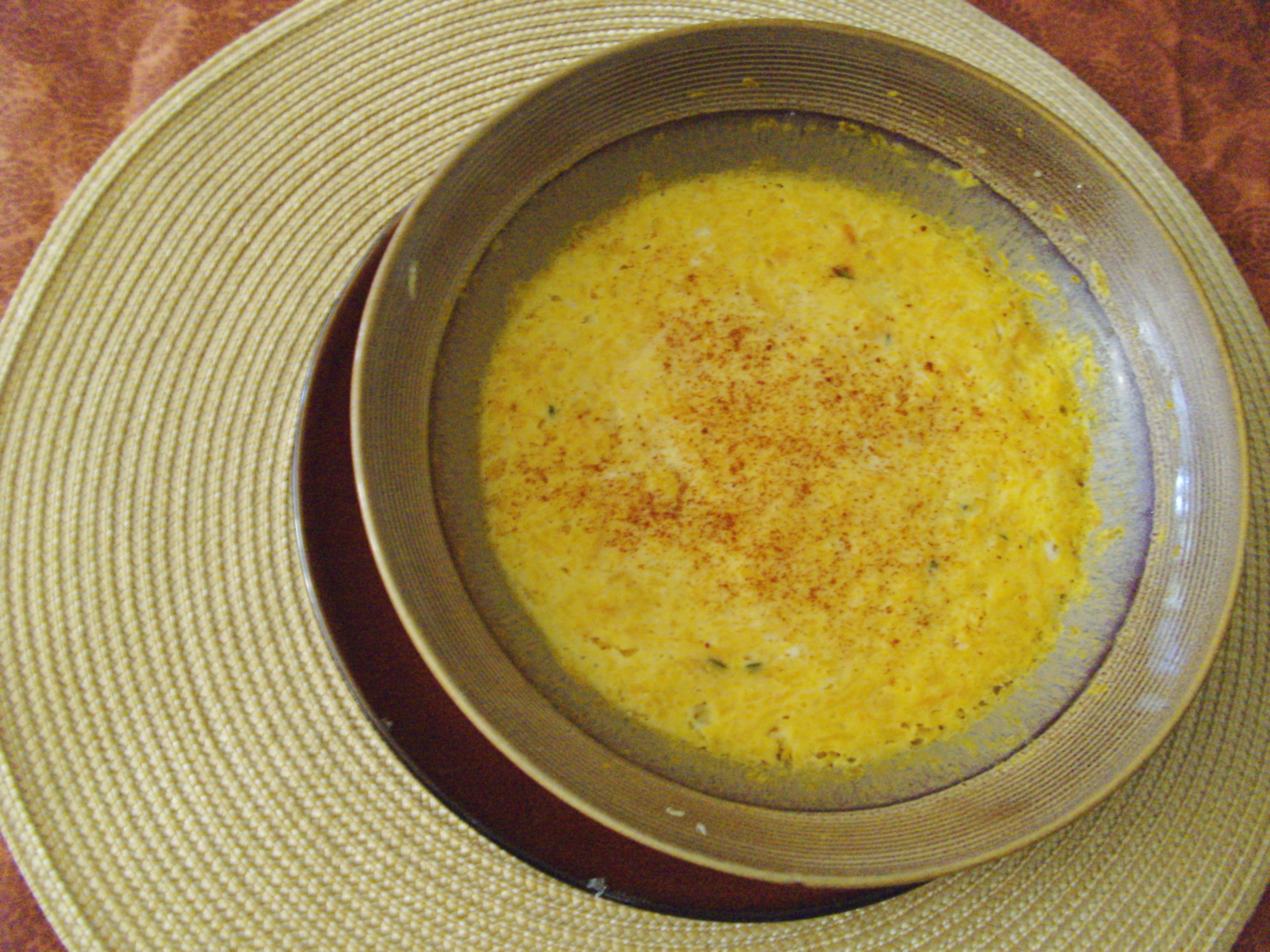
Butternut squash savory flan, slimmed down

adapted from Dorie Greenspan’s Around My French Table

This one has to be microwaveable–it’s a custard base, after all. It also, and I mean this, has to be svelte-able. Really. Greenspan uses 3 eggs plus 2 yolks and half a cup of heavy cream for only one 15-ounce can of packed pumpkin. That’s pretty obscenely rich, especially with 4 ounces or so of crumbled gorgonzola and some toasted walnuts sprinkled over the 6 individual ramekins before baking in a water bath in a conventional oven. And she suggests creme fraiche or sour cream as a garnish? Yikes.
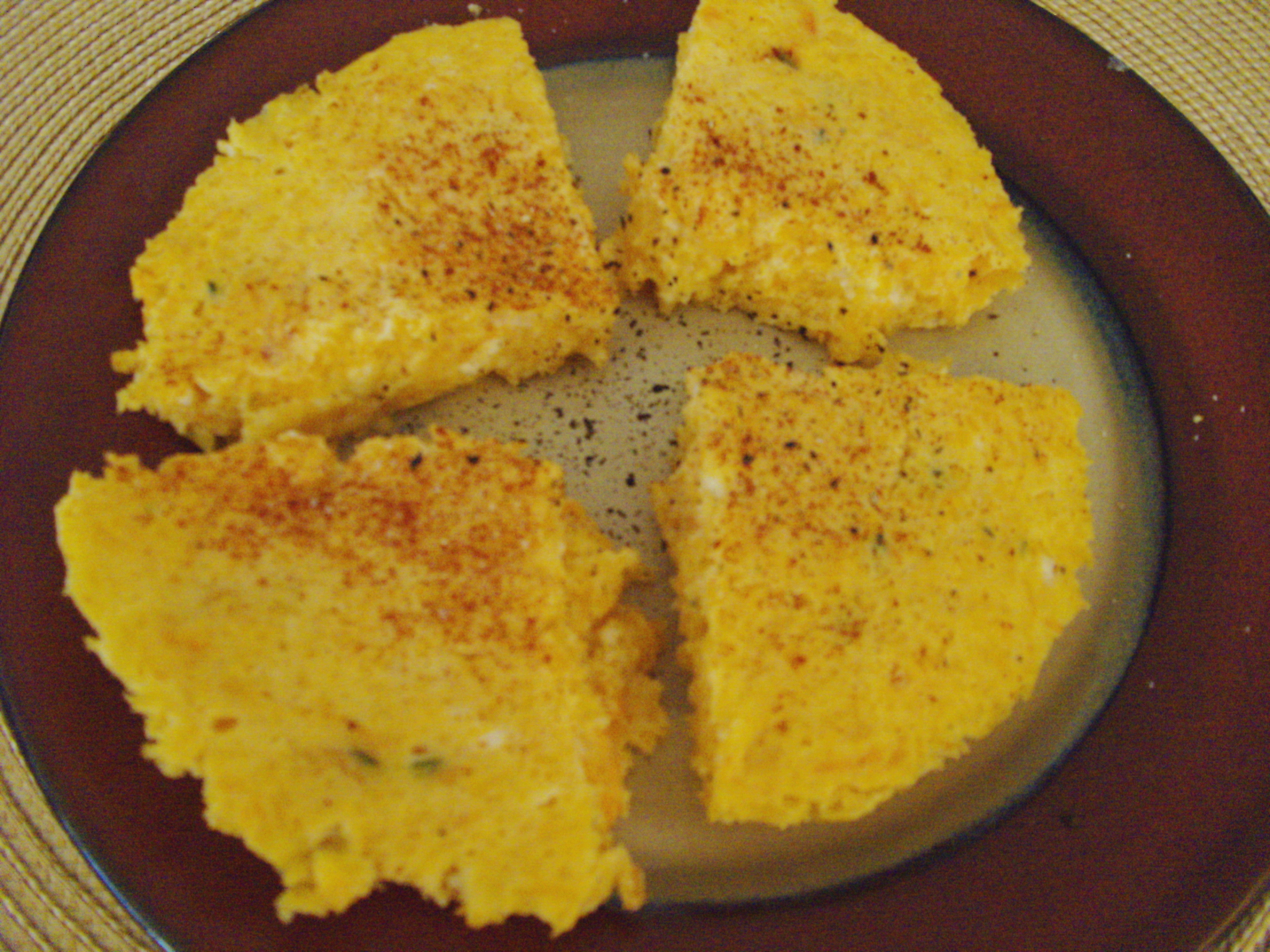
Flan in quarters

Microwave-safe ceramic ramekins are pretty inexpensive if you shop Ross for Less or Target.  I didn’t have gorgonzola or any kind of bleu on hand, so I winged it for concept with some feta.  I will say I’ve noticed that at least Stella gorgonzola melts into a runny sauce in a microwave–good if you want a smooth gorgonzola salad dressing, not so good for a recipe like this where you don’t want it to disappear into the flan. Maybe a more solid bleu like Stilton will melt and run but I’m hoping it stays together better.  Also, nuts in the microwave–maybe not a good idea, at least for big chunks. Even with the moisture from the flan taking the brunt of the energy, I kind of think you’re at risk of scorching them from the inside out, particularly if they’re on top of the flan. Better to roast them separately on a lowered heat in the toaster oven–200-250F for 5 minutes or so while the flan is going in the microwave, then sprinkle them on afterward as a garnish.

My half-recipe test came out pretty delicious on its own merits and I’m going to buy a small wedge of Stilton to try next. Because I mashed the butternut squash with a fork rather than using a purée, it’s a little rougher and less refined but the fresh taste is noticeable and lighter. Using plain nonfat yogurt in place of the heavy cream also made it obviously lighter and played up the tang that gorgonzola and bleu normally contribute. The acidic yogurt  may be counterintuitive if you’re thinking conventional cooking, but the small addition of flour plus the egg plus the starch and fiber in the squash prevent it from separating and curdling under heat.

Half-recipe pumpkin flan for lunch (serves 1-3 for lunch or an appetizer/side dish)

  • 6-7 oz/185 g chunk of cooked (microwaved, roasted, leftover) butternut or other red squash
  • 1 lg egg
  • 1/4 c or large heaping soupspoon of plain nonfat milk-and-cultures-only yogurt (not even Greek! just the cheap regular!)
  • small clove of garlic, mashed/minced/grated
  • pinch or stem worth of thyme
  • 1 t flour
  • 1 oz crumbled feta
  • sprinkle of smoked paprika, grind of black pepper to taste
  • toasted walnuts, optional

Mash everything up to the feta together in a microwaveable soup bowl, sprinkle on a little paprika and/or pepper, cover the bowl lightly with a lid or saucer, microwave 3 minutes on HIGH. Lift the lid carefully to check–it may still be liquidy in the center but cooked towards the outside rim. If the bowl’s very hot, let it sit covered another couple of minutes, jiggle again to see if the center’s cooked. If not, give it another 30 seconds and let sit again to cool down enough to handle. Cut into 3-4 pieces and serve–garnish as desired.

Last-Minute Sweets for Rosh Hashanah

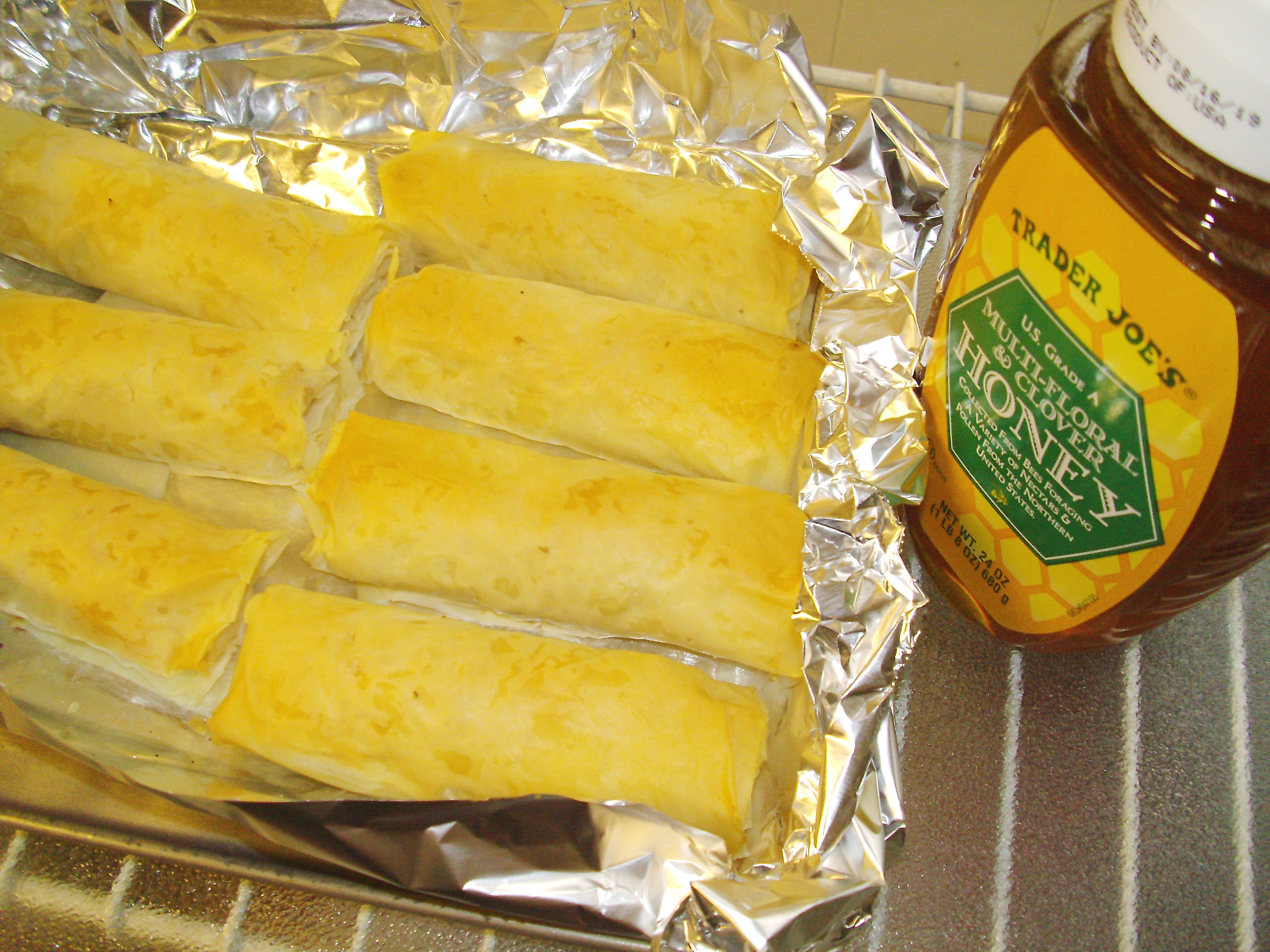
toaster oven baklava rolls with honey

A quick last-minute wish for peace and a sweet and prosperous New Year to everyone. I know it doesn’t look that likely, between the physical and political versions of “weather” in the news, but I try to remember that it begins with us in our own neighborhoods and that we can make a difference by our own actions. If you haven’t yet, please make an effort to donate aid–even a couple of bucks–to the victims of Hurricanes Harvey, Irma and Maria and to the victims of the earthquakes in Mexico. If you have neighbors and friends waiting to hear from loved ones caught in these disasters, do what you can to support them.

In the meantime, if you’re stuck for a last-minute dessert that works along the theme of “honey”–try baklava. I’m not actually kidding–if you have a toaster oven (for smaller amounts, 7-10 portions) and a microwave, and you have the makings of baklava (a roll of fillo, a bag of walnuts, some sugar and sweet spices and some butter or light-flavored vegetable oil), plus a bottle of honey, you’re in business. Of course, you could do apples instead of walnuts and make a strudel instead–also good and pretty easy. Peel and slice up or chop the apple (s), stick the pieces on a plate and microwave a minute or so to cook through and drain the juices before sprinkling on sugar, spices, and crushed nuts or breadcrumbs and/or raisins, and rolling up in fillo.

Toaster Oven Baklava Rolls

These are kind of like “ladies’ fingers” Moroccan fillo pastries, only with walnut filling rather than almond paste. Rolling individual fillo sheets is easy and a lot  quicker (and more fun, frankly) than layering several sheets flat and neat and then cutting pieces and baking and pouring a big jar of cold syrup over the hot pan. Plus the traditional syrup soak is a huge overload of sweet that’s admirable in its own odd way but very rich and hard to deal with–very sticky–right before you have to head off to synagogue. This is kind of a modular recipe–make just a few rolls if you feel like it, drizzle a bit of honey over the rolls at will.

  • roll of fillo dough , thawed (uses 1 sheet per roll; if you have extra left over, rewrap carefully and store in the fridge or freezer)
  • about 1 ounce walnuts per roll (I used about 6-7 ounces for 7 rolls)
  • 1 T sugar per 3-4 oz walnuts (I used 2T)
  • cinnamon or ground cardamom, about 1/2 t for 6-7 oz walnuts)
  • 1 t orange blossom water, optional, or orange or lemon juice or rind–you don’t want the mixture wet, this is for aromatic flavor
  • 2-3 T butter, melted, or vegetable oil, or a mixture, as needed
  • honey to drizzle over the top once baked, about 1/2-1 t per roll
  1. Slice the butter thin and melt in a ceramic or other microwaveable bowl, about 2 minutes.
  2. Put the walnuts in a plastic bag with some room and roll over them with a rolling pin or wine bottle to break them up fairly fine with a few 1/8th-1/4 inch bits, or if you feel like it, chop them in a food processor, not too fine. Add the sugar, spices and orange blossom water or juice to the bag and mix them into the nut meal.
  3. Unroll the fillo carefully onto a clean flat surface (lay down plastic wrap first as needed).
  4. Put a plastic sandwich baggie over your hand and dip it lightly into the melted butter. Dab on the top sheet of fillo.
  5. Fold the fillo sheet in thirds lengthwise. Grab a small handful of the nut mixture (2 T-ish), squeeze, and place at one end of the fillo strip. Tuck the side edges over it by 1/4-1/2 inch, then roll the end over and around the nut filling to enclose it. Dab a bit more butter on the rest of the strip and roll it up. Place on tin foil. Repeat with the rest of the fillo sheets until you run out of nut filling. If you run out of butter or oil, you can slice a bit more to melt quickly. You don’t need much per roll and the sandwich baggie should help spread it without absorbing any.
  6. When all the rolls are made, dab the last of the butter or oil on the tops, wait a minute to let it sink in a bit, and place the sheet in a toaster oven (or your regular oven preheated to 350F). For the toaster oven, set to bake on 350-400F, not “toast”, for about 8-10 minutes and keep an eye on it so nothing burns.
  7. Bake until the rolls are a deep golden brown and smelling baked. Remove from the oven, cool and squeeze on a drizzle of honey to taste–about half to one teaspoon per roll is enough for flavor without submerging it in syrup.

Baklava rolls browning in the toaster oven–don’t forget to set the temperature a little lower than for toasting so the tops don’t burn

L’Shanah Tova Tikatevu!

Finding heart

Right before the inauguration, a woman I didn’t know wished me a happy new year as we passed each other in the library. Something about the cautious way she said it made me wish it back to her with a wry twist we both acknowledged: neither of us felt we had much to look forward to in the coming administration, and both of us were worried for our families, our children, our community, ourselves. “We’ll keep on,” she said and I nodded. Both of us were a little grim.

And although it’s spring and Passover started Monday night, I am still a little grim and on standby. Every so often I feel a bit lighter in spite of the news, but to tell you the truth, I still often feel like hiding under a table. With a big tablecloth on it. In another, better, saner country. I kind of wonder if Iceland’s available. Are there Jews in Iceland? I hope so. Do they have enough matzah? I could lend them some…

But it’s spring. You can’t just hibernate for 4 years (or 2, hoping for a reversal in Congress in 2018 and a brain transplant for pretty much everyone in the White House, starting not with Trump–may not be possible–but perhaps Spicer? no, again, not possible–stick the oversized bunny suit back on him, make him hop around the WH lawn–would you be able to tell the difference?)

Ahem! As I was saying, you have to get back out there and see how your neighbors are faring and talk to them. If you’re not naturally extroverted and you work alone (double-ahem!), it’s even more important to take a breather and reconnect in the real world.

Despite my wariness about the immediate future of American government and my repeated incredulity at the daily headlines, there is reason for hope in this country. All kinds of people, business leaders and employee groups, religious leaders and congregations, public officials, judges, entertainers, and most of all, ordinary citizens have started speaking up and donating money and time to support the safety and rights of threatened and persecuted minority groups, whether their own or someone else’s. Citizen or not. Same religion or gender or race or not. California’s not the only place where this is happening. If it can happen in North Carolina, in Kansas, in Pennsylvania, in Texas–it can happen anywhere.

These surprising oases of sanity, civil contribution and decency give me heart that we can take steps in our own neighborhoods and states to protect the progress and community we’ve recovered since 2008.

But I do have to ask, is there really still room for a food blog like mine? Is this what I should be doing this year? Can I help anyone by talking about food and trying to seek pleasure in it when we’re all worried about bigger things? It’s taken me four five whole months to get to the point where I can say I think so.

A few weeks ago, still wondering, I went to Shabbat services for the first time in a while and tried hard to find heart and figure out what to do with it. And I did. I looked around at my neighbors and friends, I joined in the prayers and singing, sat with my husband, said kaddish for my brother and father and grandmother, whose yahrzeits all fall in the same week, got an aliyah, heard my daughter chanting the longest possible maftir in the book (usually we’re tawkin’ 3 verses at the end of the Torah reading, this time it was 20-plus). I found myself thinking both how proud I was of her, how beautifully she sang it, and how rusty my Hebrew reading had gotten through neglect these past months.

Being with my community and my family, seeking something not posted in the daily news headline deathspiral, put me in a more expansive frame of mind.

I decided not to let the current occupants of the White House and their make-America-hate-again tactics continue to ruin my or my neighbors’ life and drain all the color out of our days. I decided not to hide under the table–it was too much like duck-and-cover, and that’s only good for ducks, and only if it’s Wabbit Season.

We can be better and more powerful together than our current representatives in Washington think. Although I would personally like to thank MY congressional representatives, Judy Chu and Adam Schiff, as well as my senators Kamala Harris and Dianne Feinstein. Keep doing the right thing, and Chazak v’Amatz (strength and courage).

Living well and supporting each other is the best revenge.

(Chasing recalcitrant rightwing congressional reps down with pitchforks or at least cellphones at various town halls and telling them to do their jobs is starting to be tempting too, don’t get me wrong. Plus it’s aerobic.)

So anyway, back on track. Because Civility 101 demands community, and community includes good food. Even if it occasionally has to be served up with a pitchfork. And, as I mentioned somewhere up in the wilderness above, it’s Pesach. Time for a taste of freedom.

Passover Links

Passover Pareve, Eggless Chocolate Torte (Sacher Torte) with Dairy-free Ganache

Assorted Passover cakes (apple/almond, banana ginger) and breakfast schemes

Macaroons, mandelhorns and almendrados

Homemade Horseradish (but I’m not bitter)

Not gefilte–better fish options

Microwave shakshouka

Not-chicken soup

Israeli spinach-feta casserole

Rosh Hashanah DIY: Coming around again

Ashkenazi (eastern European) Jewish food goes through phases of trendiness in America, and it’s coming around again.

When I was about twelve, in the mid-1970s, The Jewish Catalog by Richard Siegel and Michael and Sharon Strassfeld sparked a renaissance of enthusiasm among younger and non-Orthodox Jews for everything from Israeli dance to Hebrew calligraphy to tying the knots correctly on the corners of a prayer shawl (the early 1970s was not just the “me decade,” it was also the era of macrame). Siegel and the Strassfelds took a DIY approach to creating a full Jewish life outside the shtetl. They made it hip, interesting and fun to observe Shabbat, understand the holidays, gather friends to plant trees, bless the sun and the new moon, cast bread on the waters, pen your own Hebrew inscriptions, and make–and of course blow–your own shofar. The book quickly became a top bar and bat mitzvah gift and influenced not only the way our synagogues practiced and our religious schools taught children but how young adults, affiliated or not, felt about being Jewish in public. Everything became more hands-on and more celebratory.

What would a Jewish DIY catalog be without food? The diagrams for how to braid challah in three, four or six strand loaves were unprecedented. So were the cartoons, which leavened everything but the homemade matzah. Cartoon matzah balls flirted at the edge of the bowl before diving in, one of them tipping his kreplach hat. A man up to his armpits in a garbage can full of grapes asks if this is really the way zaydeh (Grandpa) made his Shabbos wine, and another explains ruefully to his girlfriend that he thought more yeast would make the challah lighter, not more aggressive, as it overflows the bowl and oozes toward his foot.

The Catalog also introduced a lot of people to their first taste of Israeli and Sephardi food–felafel and hummus recipes were included alongside the chicken soup and cholent, even though they were admittedly limited to ingredients most people could find in a suburban supermarket in the mid-’70s.

All in all, The Jewish Catalog set a very high bar and is still something of a classic.

By the mid-1990s, though, bagels were mainstream American food and very different from the real, crackle-crusted deal. Rye bread was soft and bland and delis were dying. Meanwhile, Sephardi and Mizrahi food were becoming more familiar and more popular in the US and UK. Prepared hummus started appearing in supermarket refrigerated cases along with spinach-artichoke party dips. Hummus from scratch started requiring dried chickpeas, not canned.

In the past few years, delis have been making a comeback–though mostly not kosher ones–and so has traditional Ashkenazi baking, though mostly via cookbooks. Kosher and otherwise Jewish cookbooks of every culinary stripe have been churning out of the big publishing houses, and Jewish authors are prominent in vegetarian and vegan cooking as well. We’re in the midst of another DIY Jewish renaissance–though more foodie- than observance-oriented.

The Gefilte Manifesto is one of the newest and possibly best of the books from a new generation of Jewish food artisans and restaurateurs, and it manages to capture some of the spirit of The Jewish Catalog.

Authors Jeffrey Yoskowitz, a pickle maker and fermentation enthusiast, and Liz Alpern, a former aide to Joan Nathan, own and operate the Gefilteria, a millenial-style craft food business based on their gefilte fish and accompaniments. It currently combines a line of frozen gefilte fish loaves and jarred condiments with direct sales at farmer’s markets and pop-up catered events in several cities around the country.

This book is the product of that collaboration, and it’s remarkable this year not least because its authors actually respect the traditional Ashkenazi foodways they’re representing. There’s no braggadocio (eep! hints of 3 pounds of bologna on white bread! sorry!) and no slavishness toward food glam, or what the Los Angeles Jewish Journal likes to call “foodie-ism.” They keep the recipes kosher and avoid the temptation (such as it is) to add tired treyf tropes like bacon or shrimp (although they do have some kimchi-infused recipes). Instead, they refresh the classics by making them fresh, with real ingredients and good technique.

Gefilte fish becomes an elegant terrine with herbs or smoked whitefish (the authors’ limited-distribution frozen signature gefilte loaf,  featuring a whitefish base and a pink salmon top layer, is also pictured in a picnic shot but not given a recipe in the book). Horseradish gets a citrusy twist, and pickles range from classic half-sour dills to cardamom-spiked pickled grapes. Soups–mushroom barley, borscht for those who like it (I unfortunately never have, except for the color), chicken, blueberry, and an unusual one–zurek, an unusual Polish soup based on rye sour starter. Kreplach–Jewish ravioli–join pieroshki and include both meat and vegetarian fillings.

Yoskowitz and Alpern update cholent, brisket, chicken and tsimmes. They show you how to cure your own corned beef and pastrami, work out gribenes and knishes, and offer a selection of desserts both traditional–rugelach–and not so traditional, as in beet-chocolate ice cream.

DIY pantry items like homemade sour cream and farmer cheese, spicy mustard, wine vinegar and “everything” butter join fresh salads and breads and several varieties of pickled herring or trout. Drinks include beet kvass–there’s a general direction toward fermentation, one of Yoskowitz’s specialties–and flavored syrups for nostalgia sodas along the lines of Dr. Brown’s Cel-Ray and Cream sodas.

The book isn’t comprehensive but exploratory. Yoskowitz and Alpern trade cooking and tasting notes, childhood and family memories, and their experiences discovering and recreating Ashkenazi foods they didn’t necessarily grow up with. Along the way they adapt recipes and refer readers to a number of other Jewish cookbooks and authors whose ideas and food they’ve liked.

The results are attractive, modern, humorous and appetizing. Except perhaps for the shot of the two of them grating horseradish–and wearing safety goggles and kerchiefs soaked in vinegar or, as Alpern puts it, “classic protest gear.” Altogether, a Jewish Catalog-worthy production.

Yoskowitz and Alpern are touring the country this fall to promote The Gefilte Manifesto. Locally they’re staging a couple of tasting events across Los Angeles in early November and will appear at the San Diego Jewish Book Fair.


Emergency Éclairs 2.0, Even More Microwaved


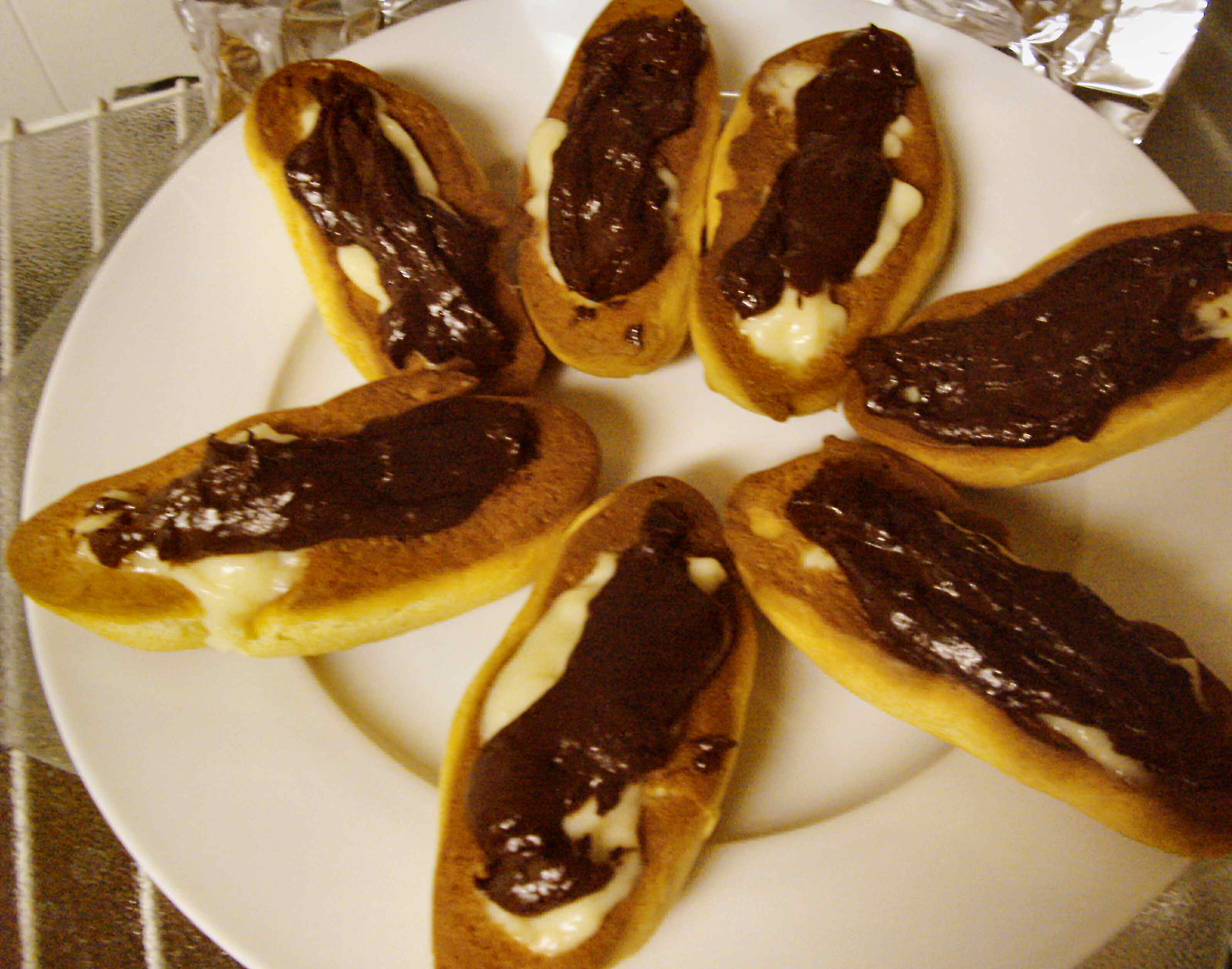
plate of eclairs

All the components of an éclair are at least partly microwaveable, flavorful and pretty forgiving. Even if you have to serve them upside down.

Here we go again, because it’s been Valentine’s Day this past weekend and I have pretty loose time standards for such things…I did actually make these before dinner on the 14th, so it counts. Not that you really need VDay as an excuse.

Éclairs are a lot simpler than they look in the pastry shops, and a lot cheaper than you’d think to make at home–in fact, cheaper than almost any American-style dessert in terms of calories, sugar, fat, salt… A surprisingly small amount of ordinary pantry staple ingredients goes a very long way and makes a bigger show than if you tried making brownies.

If you have a microwave, they can also be a lot quicker than most cookbook recipe specs, even though there are three separate parts to prepare and assemble–the filling, the shell, and the chocolate topping–rather than the usual American one-bowl dump-mix-and-bake scheme.

Éclairs don’t hit you over the head with sweet–they rely on the contrast of textures and flavors between the mostly unsweet pastry shell, the delicately sweet pastry cream, and the deep chocolate (or other flavor, but it has to be an actual flavor to be good, not the typical flavorless, oversweetened canned cake frosting) topping.

Éclairs have also become something of a canvas for artistic expression in Parisian bakeries; David Lebovitz has some great photos of ones with reproductions of paintings screened onto the tops, woodland scenes in colored icing and fondant and flavored marshmallows, fruit fantasias, and I don’t know what else, not to mention the fillings. They’re gorgeous to look at in the glass pastry cases but you couldn’t walk down the street, find a park bench, and just eat them with your fingers. You’d end up wearing them.

So the classic chocolate-topped, pastry cream-filled éclairs are still my favorite, partly because you can’t find them in most of the bakeries here.

Baking the dough is the one part you can’t really do in the microwave, more’s the pity (although you can do it in the toaster oven for a small batch). But otherwise, I can say it was worth it and–although I needed to step on a scale Monday morning to be certain–not that devastating dietwise…or even diabetes-wise. But, as with rugelach, you probably shouldn’t do this too often. Holidays and sharing are a pretty good idea. Leftovers are not. Limit the dietary badness.

Unromantic morning-after nutrition stat check: At the medium-small size I made, they weigh in at about 22 grams of carbohydrate, 160 calories, 6 grams of fat (mostly saturated, from the butter and chocolate plus egg yolks) and maybe 40-50 mg max of sodium apiece. Verdict: Not too shabby for a French dessert. Could be worse and often is. Stick to one apiece, plus some fruit, and eat it with a light supper that includes a green salad and you should be reasonably fine. Also svelte, happy, and able to sing «Non…je ne régrette rien…» the next morning. But please don’t. Not before coffee.

Even if you eat two at a time after supper because you’re not sure how long you can store the extras in the fridge so they don’t go all soggy the next day, it shouldn’t hit you like a ton of lead…well, not too much like a ton of lead. At least they weren’t full sized; they were pretty filling. Afterward, when we were lying in a daze on the couch recovering, my husband suggested just freezing any extras next time. He had a point.

About halving a recipe

I was in a hurry and couldn’t find the lower-saturated-fat recipe I’d used successfully for “Emergency éclairs 1.0” so I went with the recipes for choux paste shells and pastry cream in the “basics” back section of the white Silver Palate Cookbook. The dough and pastry cream worked fine in the microwave, as I think almost any standard recipes would.

Since there are only myself, my husband and our daughter here for dinner and eligible for éclairs (plus the cat, who is miffed that we didn’t count her), I cut both recipes in half–I repeat, limit the dietary badness…

The pastry cream was fine, but I hadn’t read all the instructions for the choux pastry, or I’d have known that the 3rd egg was for a completely unnecessary egg yolk glaze. When I halved the recipe I used an extra egg white as the “half egg,” and when the puffs puffed, they left nothing behind, no base, just a hollow, once I peeled them off the foil. The result was still fine for us but a little awkward for presentation–I had to sit them upside down like boats to fill them, and then cover the filling with the ganache. So definitely go back to the right proportions for the choux recipe (repeated below).

The ganache…is always very chocolate, very microwaveable, very forgiving of awkwardness and therefore perfection itself. It covers a lot of sins and makes you feel much better about them.

Mostly Microwaveable Éclairs

This is half-recipes all the way: it makes 6-7 half-size éclairs, 3″ rather than the standard 6″ monsters at the bakery. We each had two after supper and were completely stuffed.

Timing: If you’re doing the whole thing in one go, start by preheating the (regular) oven to 400 F, then make the pastry cream, which is really fast, and chill and stick it in the fridge, then do the choux paste, because as soon as you make that you need to dollop it out and bake it right away. If you use the microwave for the pastry cream, and you should, the choux will be ready to go just about when the oven beeps. Continue reading

How to fly with a pie

Happy Chanukah–tonight was the first night–and as per usual, a belated Happy Thanksgiving too. I hope everyone ate nice, had fun, enjoyed and helped do the dishes wherever you gathered.

Now that it’s over, I have a few more additions to the list of things I’ve learned–good or bad–about How To Travel With Food ™. Because my in-laws, who usually host Thanksgiving, are traveling in Africa (!!!–think elephants coming up to their cabin porch), my ex-brother-in-law invited all the rest of us to join him for the weekend instead. In Sonoma. At what turned out to be not a cabin with or without elephants, but a luxurious private residence he’d booked for the group as a vacation rental. And it was out and out marvelous. If a little weird and unsettling in its own way.

Sonoma-Kenwood.jpg

When we were still deciding how to reach Sonoma from Pasadena, we realized with dismay that it’s about 10 or 11 hours by car at the best of times, and Thanksgiving week is not the best of times. When we lived on the east coast, a trip like that would have us thinking airplane automatically, but out here we usually just suffer. My niece and her boyfriend drove up from San Luis Obispo, usually 4 hours north of us, and it took them 9 hours instead of 5 or 6. So I was really grateful to my husband for finding affordable plane tickets for an hour’s flight into Oakland. So far, so good, and it took a lot of the strain out.

But all those airline rules. And we were the ones bringing pumpkin pie. In carry-on. My ex-BIL offered to pick up a couple of big stalks of brussels sprouts for me up there (I don’t think we even had any more at down here by this time; Trader Joe’s was out of them by weeks) as well as a green cabbage for Greek cabbage salad. These are big heavy scary-looking items you just don’t want to schlep on a plane unless you’re auditioning for the live version of Shrek. As the shopping list got longer, I decided to just bake the pies at home, cool them, freeze them as far as possible, and take them in a stiff box with some ice packs stuffed in the corners and hope for the best.

Continue reading

Happy 4th!

rawblueberrypie-2pounder-med

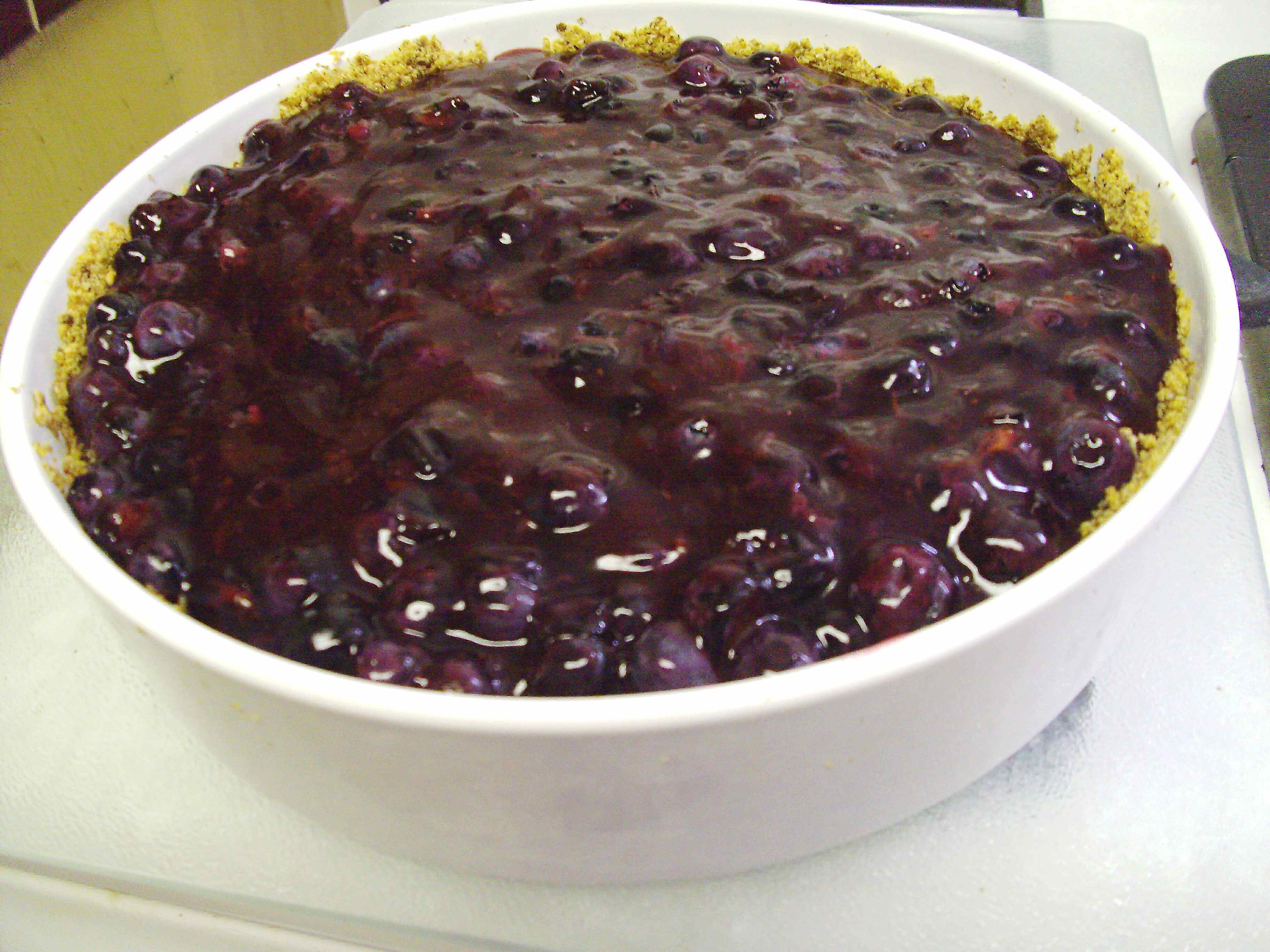
The raw blueberry pie right before we cut into it.

If you have to do a pie in the middle of summer, say, if you’re bringing something to a Fourth of July outing, this might be the kind you want. It only takes a few minutes to put together (other than picking over the blueberries to make sure you’re not leaving any stems in). And Trader Joe’s is selling two-pound containers of blueberries for a moderate price, about $6, at least in southern California. That’s enough for a pretty big pie. So I got two boxes for my daughter’s birthday party last week and discovered that just one box was about a third more than my old newspaper recipe called for. Well…we can always use a few blueberries around the house! And the pie ingredients are so simple it’s not hard to scale up a bit and still have it work out nicely. Very nicely, in fact.

The syrup you start the filling with can be boiled up in a minute or so in the microwave, so you don’t have to heat up your house or stand over a stove. Then you just stir in the starch slurry and some lime juice to thicken it, and start folding in the raw berries. When they’re all in, you pour it into the crust and let it cool until set.

And I’m not sure you actually have to run an oven for a graham cracker crust, although I did for about 10 minutes–I think it makes the sugars melt a bit with the butter, so the resulting caramel, if you can call it that, binds the crumbs together and then hardens slightly when it cools and the crust stays crisp a little longer. But maybe that’s just fantasy. If you want to keep the oven off, you’ve got my vote. If you want to buy a frozen graham cracker crust-lined pie tin (or two; with this amount of filling you could probably do 2 standard smaller pies), that’s your call too.

I don’t usually buy graham crackers at all, but for this I think it’s worth doing the crust at home–it takes maybe 2-3 minutes to grind up enough for a crust and press it into a pan, and it’s a little more versatile than the commercial versions. I can put in a bit less sugar and butter than the standard crust recipes do, skip the salt, throw in a little almond meal if I feel like it, and add a couple of pinches of cinnamon and ginger to spice things up. Leftover crackers are handy for making impromptu ice cream sandwiches, if you can keep your kids away from them until you’re ready to do that.

Here’s my scaled-up version for a two-pound box (909 g. approximately) of fresh blueberries. That’s about 300 grams more blueberries than the old 4-cup recipe I copied from my mother-in-law, so it needs somewhat more in the way of crust and sugar, but not actually that much more–go by taste and be conservative. This version is sweet but fresh, which is the joy of keeping most of the blueberries raw. It won’t make you feel like you’ve just eaten half a jar of jam. Continue reading

Persian Posh and Jewish Soul: Two Veg-Friendly Cookbooks for Spring

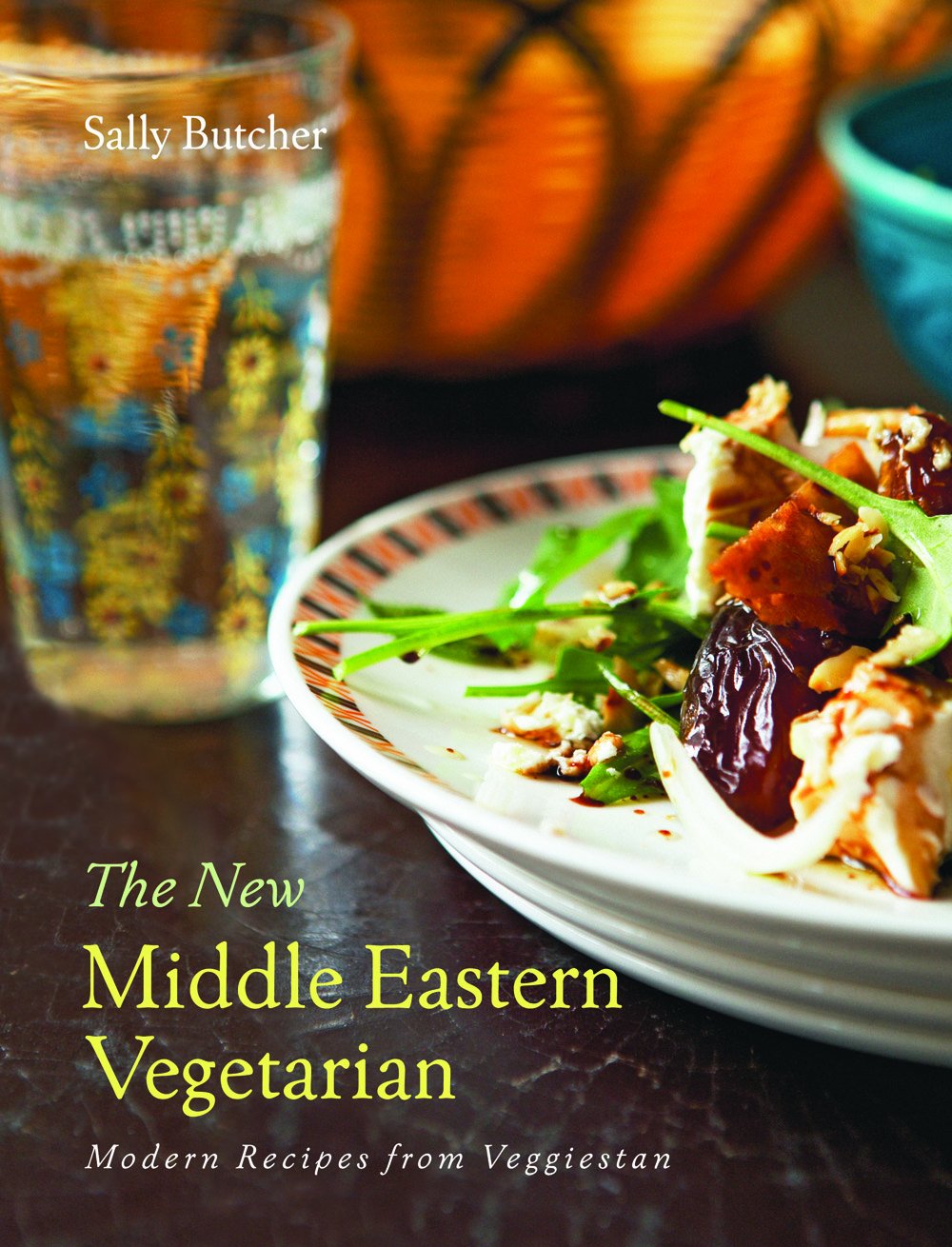
"The New Middle Eastern Vegetarian" (aka "Veggiestan" in the UK) by Sally Butcher, cover photo from amazon.co.uk "Jewish Soul Food: From Minsk to Marrakesh" by Janna Gur. Cover photo from amazon.com


Passover week didn’t exactly go the way I’d hoped, with loads of new vegetable dishes to play with and experiments in microwave gastronomy that would wow the most cynical reader…

After the optimistic start with the chocolate almond torte and the microwave shakshouka for one, I suddenly caught a bug–my husband caught it first, suffered a day or so, got better and then kindly passed it to me, and I ended up sick for the better part of the week. We all agree we got it from a kid he was sitting next to at seder. Now that our kid’s a teenager, we’re no longer used to it. Clearly we’ve gone soft.

So I was–shall we say–less than enthusiastic about cooking the last week or so, and ended up with lots of ideas that stayed in my head while I stayed in bed, attempting to keep up on tea, rice, poached eggs and applesauce. And feeling really embarrassed that every time I opened the fridge and saw all the beautiful vegetables I’d bought for the week, I peered at them suspiciously–how much trouble would they cause me? Was it really a crappy virus or was it maybe secretly food poisoning, even though everyone else was able to eat? Maybe tomorrow–and closed the fridge door again and groaned. It took a couple of extra days to start looking at vegetables with any enthusiasm at all.

This, I thought, is what most of the country thinks about fresh vegetables if a dolled-up superstar chef isn’t holding one on the cover of a glossy magazine (or even if he is). Maybe with a little less queasiness or dizziness than I experienced, but with that lurking suspicion that vegetables have dirt on them, that you have to wash them off and then cut them up and do something to them, that they’re not sterile and wrapped in plastic for your protection, and that it’s all too much bother. What a lousy, paranoid way to live.

So anyway, now that I’m better the vegetables are looking good again, and the (four or five) leftover matzah boxes have been relegated to a top shelf for sometime when I’m not sick of them and want to experiment a bit for next year.

Two bright and sun-filled new (or newish, anyway) cookbooks that make lavish and hearty use of vegetables were languishing on my desk for the entire week of Passover (and two weeks before that, when I was too busy to do more than look at them wistfully). Sally Butcher’s Veggiestan is a collection of pan-Middle Eastern vegetarian recipes that centers on her husband’s family Persian cuisine and their experience as the proprietors of a Persian specialty grocery in London. Jewish Soul Food: From Minsk to Marrakesh is Israeli food writer/editor Janna Gur’s second major English-language cookbook, and it focuses on Jewish “grandma” food from all the cultures Israel is home to.

Both books run something along the lines of Yotam Ottolenghi’s approach to food–appealing, vegetable-filled, exotic, and fun to cook and eat. But the food is generally simpler and homier, more traditional and with fewer trendy/haute touches or UK-specific ingredients like salsify or seabeans that you just can’t find most places in the US. Butcher and Gur each have a foot in both professional and home cooking, which may make the difference. The recipes here are not chefly so much as cookable. Eminently cookable, and they make me want to run right out and try so many things (especially if I can stuff any of the steps into the microwave) that I’m just going to have to get them both and give back my overdue library copies.

The authors share an approach to traditional and modern Middle Eastern food that is enthusiastic, knowledgeable, ecumenical and–I’m not sure how to say it exactly, but  neighborly comes close. Reading these books is like hanging out in the farmer’s market and the kitchen with a friend who knows how to make all the dishes your grandmother might have made but never showed you.

Veggiestan is the original 2011 UK title of Butcher’s mid-sized cookbook, now out in trade paperback,  but the publishers thought that title would be too controversial for the US (land of “freedom Continue reading

Microwave Tricks: Shakshouka

IMG_0458

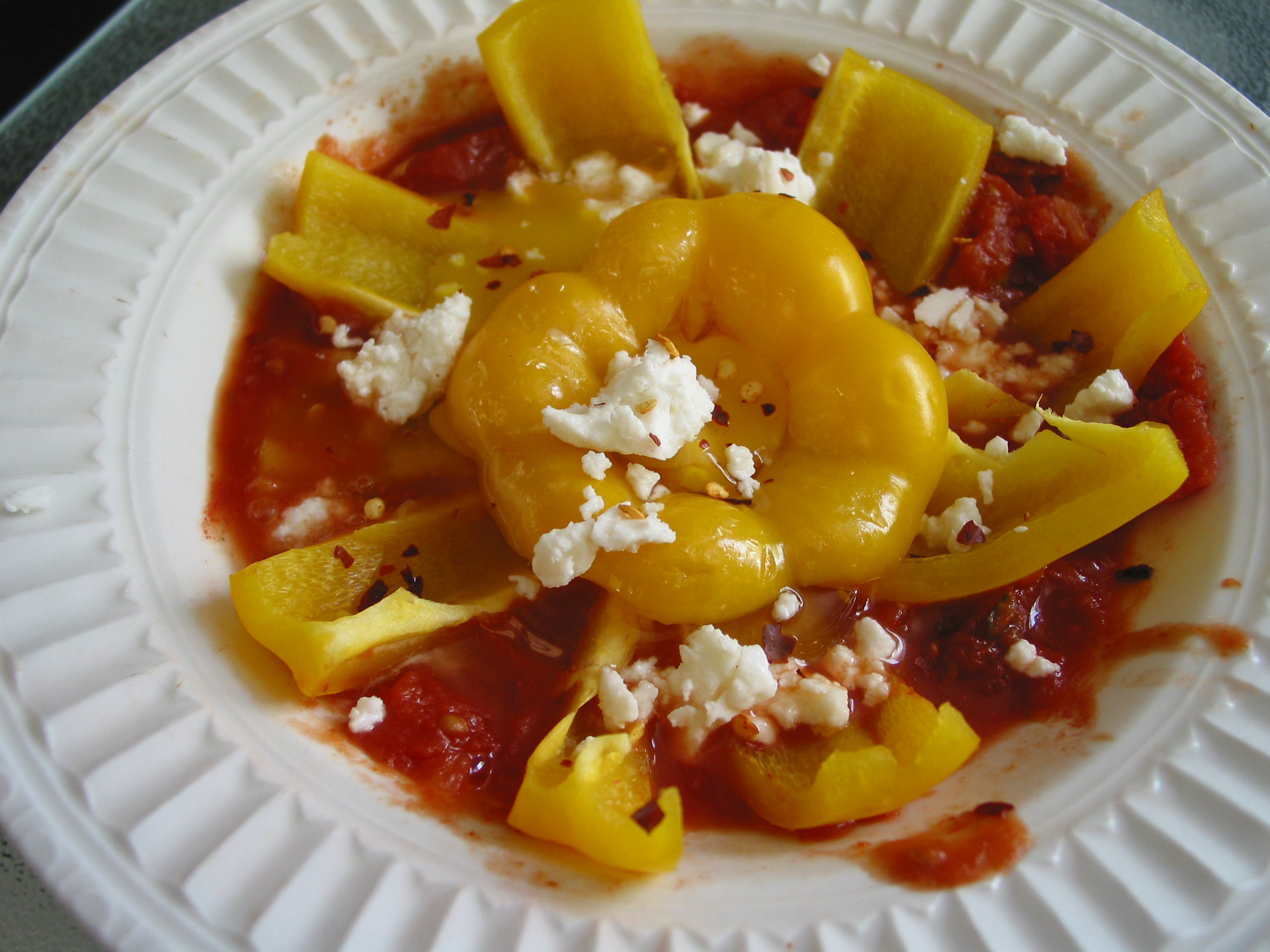
Marinara plus a pepper makes a good start.

Sometimes during Passover you just can’t take any more matzahnola. Or matzah with jam, or matzah brei. Or cake. Or macaroons. Anything for breakfast that doesn’t involve at least one vegetable (other than yourself, before coffee). Your tolerance for sweet stuff has been exhausted, and as for the leftover gefilte fish and hrein…no. We are not going there. No matter how much my husband insists it’s “perfectly good” (and I notice he hasn’t schlepped the rest of the jar with him to the office!)

Forget all that. There’s a pretty good cure for the Pesach blahs–you need some chile peppers and you need them now. Not in 20 minutes, no major cooking involved. You have a microwave, some cheap microwaveable soup bowls or the like, and you’re not afraid to use ’em for an increasingly popular Israeli brunch dish–shakshouka. Which is basically the Jewish version of huevos rancheros, only without beans or potatoes. Or lard.

Yotam Ottolenghi has made shakshouka popular and photogenic in at least one of his famous cookbooks, probably prettier than what I’ve got here. But it takes longer too, and I’m impatient.

To make shakshouka, you usually need a frying pan, olive oil, some tomatoes, peppers and onions, plus garlic, cumin, chile peppers, maybe a couple of oregano-or-thyme-and/or-cilantro-type herbs–sounds like the makings of salsa, no?–and some fresh eggs to crack into the resulting sauce. The sauce takes some 20-30 minutes to cook down, the eggs another 5-7 to cook more or less sunny-side-up in the middle of the sauce. That’s a lot of time for breakfast. I wanted a shortcut this morning.

Most jarred salsas are not kosher for Passover–it’s the distilled vinegar thing. That’s okay, because yesterday in a fit of domestic planning (uncharacteristic, I swear) I decided to make a batch of microwave marinara from some unsalted canned tomatoes. I don’t have a kosher-for-Passover food processor this year, though, so I decided, after trying to chop up some pretty tough Roma tomatoes (even with the skins off!) that I should just do as the Sicilians do and break them up with my hands as Tony Danza advises. A little chunkier than usual, but just fine. And actually ideal as a base for shakshouka–both its readiness for a mid-morning fridge scrounge and its rusticity made for a good start. A good dollop in a microwaveable soup bowl.

What else do you need? Maybe a bell or Anaheim-type pepper that needs to get used up. Cut it up (I got whimsical, you don’t have to potschky around with flower shapes). Add more onion if you feel like it; I didn’t. Stick it in the microwave for a minute or two to wilt the pepper and possible onion pieces.

IMG_0461

Then crack an egg or two into it, sprinkle on a bit of feta or panela or queso fresco as desired, maybe a pinch or so of chile pepper flakes or z’khug (I’d run out) and/or chopped cilantro as desired.

IMG_0463

Put another soup bowl on top as a lid, and microwave another minute or two until the eggs are cooked to your liking–check and add 30 seconds if you think it’s still got a raw spot somewhere, and/or leave the lid on for a few minutes and let it finish cooking in the residual heat of the sauce.

Obviously if you’re having people over for brunch, the standard frying pan method is better and quicker–more eggs and salsa means more time in the microwave, and no one wants to sit around as you microwave individual portions. But if it’s just you, or you and your partner, the microwave method works pretty well. Just add a little time (maybe another minute or so in 30-second increments) for four eggs as opposed to two.

IMG_0464

Hafla! (celebratory remark when there’s something good on the table and you didn’t have to wait an hour for it) Grab some matzah and a cup of hot coffee and b’te’avon (mangia bene/bon appétit/eat nice)!

Passover Dessert Challenge: No Eggs!

 Passover-eggless-chocolatealmondtorte-halfsheet

Bear with me, I’m still a little hyper (see below). Three days before the first Passover seder, and I’ve been asked to bring a non-fruit, non-macaroon dessert. With a few caveats.

This is the ultimate, I think: a fresh dessert, preferably deep chocolate, with no dairy (serving at a meat meal), no fake stuff (because I can’t stand it) and obviously for Passover, no chametz (forbidden grains like wheat, barley, oats, etc.) or kitniyot (legumes, corn, rice, peas and green beans, some seeds, nuts and spices, plus some vegetable oils derived from them, like sunflower…). Also, for reasons of the requesting family’s allergies, no pistachios, hazelnuts or cashews, or cinnamon.

Or, and here’s the kicker for Passover desserts–eggs. No eggs! And it’s got to be moist and fabulous, or at least obviously better than the standard choke cake box mix, and prettier than the all-real-but-undecorated apple-almond cake I served a couple of years ago. And it’s got to rise and still be kosher for Passover under Orthodox Union rules. Which I had to look up on line for some of the possibilities I had in mind.

It’s not dread in my heart, surprisingly, but a little tinge of excitement at another chance to mess around and come up with something decent.

I’ve done a few home desserts that weren’t bad and that didn’t contain most of the forbidden items. My first best hope is something as close as possible to my favorite, Sacher torte (because I’m unoriginal and because at least I’ll like it). I’ve been working on this for a while and I thought, I can get by without eggs as long as I have some other way to raise the cake and keep it from turning into a rubber brick.

And eggs aren’t the only way to raise a cake or make a cookie without violating the kosher-for-Passover rules. It turns out that some brands of baking soda, including Arm&Hammer and a number of smaller and store brands, are processed under sufficient supervision so there’s no contamination from cornstarch or grains or the like, and are now considered kosher for Passover under O-U rules–it’s worthwhile looking them up. So is all unflavored bottled soda water, even without a kosher certification mark. That one I remember from my student days, when somebody said you could pour seltzer into matzah ball mix to lighten it.

Another item that turns out to be okay is linseed–aka flax. So if you grind linseed and bring it up with water, you could do a kosher-for-Passover dessert without eggs for the kinds of things flaxmeal works for. Consult a vegan dessert book (aside: a lot of the authors are Jewish! Maybe not so surprising), use matzah cake meal and/or almond meal instead of standard flour, and you might be in like Flynn (or at least like Feldman).

Other key ingredients to check are K-leP (kasher lePesach; kosher for Passover)…

The chocolate, obviously. Elite makes so-so quality but certified pareve kosher for Passover bittersweet bars, and they can definitely be put to work. Hershey’s plain (not Special Dark) non-dutched cocoa powder is accepted by the O-U even with just its regular certification mark. Some cider vinegar is probably certified–but fresh lemon juice or orange juice might work too, in case I can’t find an O-U-labeled version. And unflavored raw almonds, walnuts, pecans and almond meal from Trader Joe’s are also all approved, at least this year. Also white cane sugar and non-iodized salt with a regular year-round O-U certification mark.

Other items:

Plain dried fruits as long as they’re not coated with vegetable oils or the like.

Plain fresh fruits other than raspberries and their kin, which are hard to inspect for tiny bugs among the drupelets (but which the O-U has a whole procedure for inspecting at home to make them okay–it boils down to washing and looking carefully. So much for the mystery…).

Spices are more of a pain–some, like caraway and fennel, are considered kitniyot, even though very similar ones in the same family, like anise, are acceptable. Not that I was going to put any of these in a chocolate cake, mind you, but I like to keep my options open for other, non-chocolate, possibilities. Ground spices need to be certified for Passover, and most of the supermarket store brands aren’t.

Finally there’s the taste/texture issue, the 11th commandment: Thou Shalt Serve No Choke Cake (not even before its time, and thank you so much Paul Masson).

You want something raised with seltzer or baking soda and no eggs, you’re taking your chances on a pretty dry item. Almond meal contributes oil and moisture without making things oily as long as you remember to cut down on oil ingredients to compensate. But depending on how light or springy you want your cake, you may need more matzah cake meal for structure, which really dries things out if you go too far with it. Weighing the matzah meal is better than measuring into a cup because it’s dryer–already baked–so it’s denser than regular flour. You need more liquids if you use matzah meal–hence the usual eggs. Without eggs, you want something that will retain moisture in the cake and still give a bit of structure. Apples or applesauce would be my best bet, substituted for whatever oil, margarine or butter your cake recipe calls for, just slightly lower volumes to avoid making the batter too wet.

Pumpkin I’ve also tried in my callow youth. While it’s fine and occasionally impressive for a non-chocolate dessert and for plenty of savory dishes, something about it suppresses the essence of chocolate. The one time I tried canned pumpkin for fat-free brownies, the texture came out near-perfect, but it mysteriously sucked all the chocolateness out of the air while the brownies were baking. And then there was a serious blank in the chocolate department when I tasted, even though the texture was good and I’d put in a lot of cocoa powder. Life is unfair. And on the other hand apples won’t let you down, and even a little applesauce works beautifully instead of oil both in chocolate box mixes and in from-scratch cakes. Should work for Passover versions too.

Lest you wonder whether it’s possible to do a decent pareve frosting suited to a Sacher Torte Occasion, which–no surprise here–is what I’m aiming for, I’ve just done a test run (Wednesday) on the whole cake recipe I had in mind, thinking I might have to adjust before Friday.

This cake is a cocoa-flavored version of the basic gingerbread (cake, not cookie) recipe from the Silver Palate cookbooks. I’ve used it for honeycake at Rosh Hashanah with good results—even in the microwave. I almost always substitute unsweetened applesauce or grated apples for any oil in standard cake recipes or box mixes.

Here I’m also increasing the baking soda a little to compensate for the lack of an egg and substituting almond meal for most or all of the flour (and not adding molasses or ginger, obviously). From the typical nutrition label, I estimate the almond meal is about fifty percent oil by weight, most of it polyunsaturated fats. You really don’t need any more fat in the cake. It’s not low-cal even so, but the advantage healthwise is that most of the oil is polyunsaturated and monounsaturated, plus the almonds have fiber and protein. Beats adding sticks of butter.

The Silver Palate gingerbread method is pretty classic: you mix the dry ingredients together. Stir in the egg and oil (in most recipes) or in this case just the apple or applesauce and extra baking soda. Then you pour on fresh hot coffee or boiling water and stir quickly to get things just mixed to a batter. A little vinegar or in this case, a squeeze of fresh lemon juice, stirred in at the last minute before pouring into a sheet pan and sticking it in the oven, helps the coffee activate the baking soda.

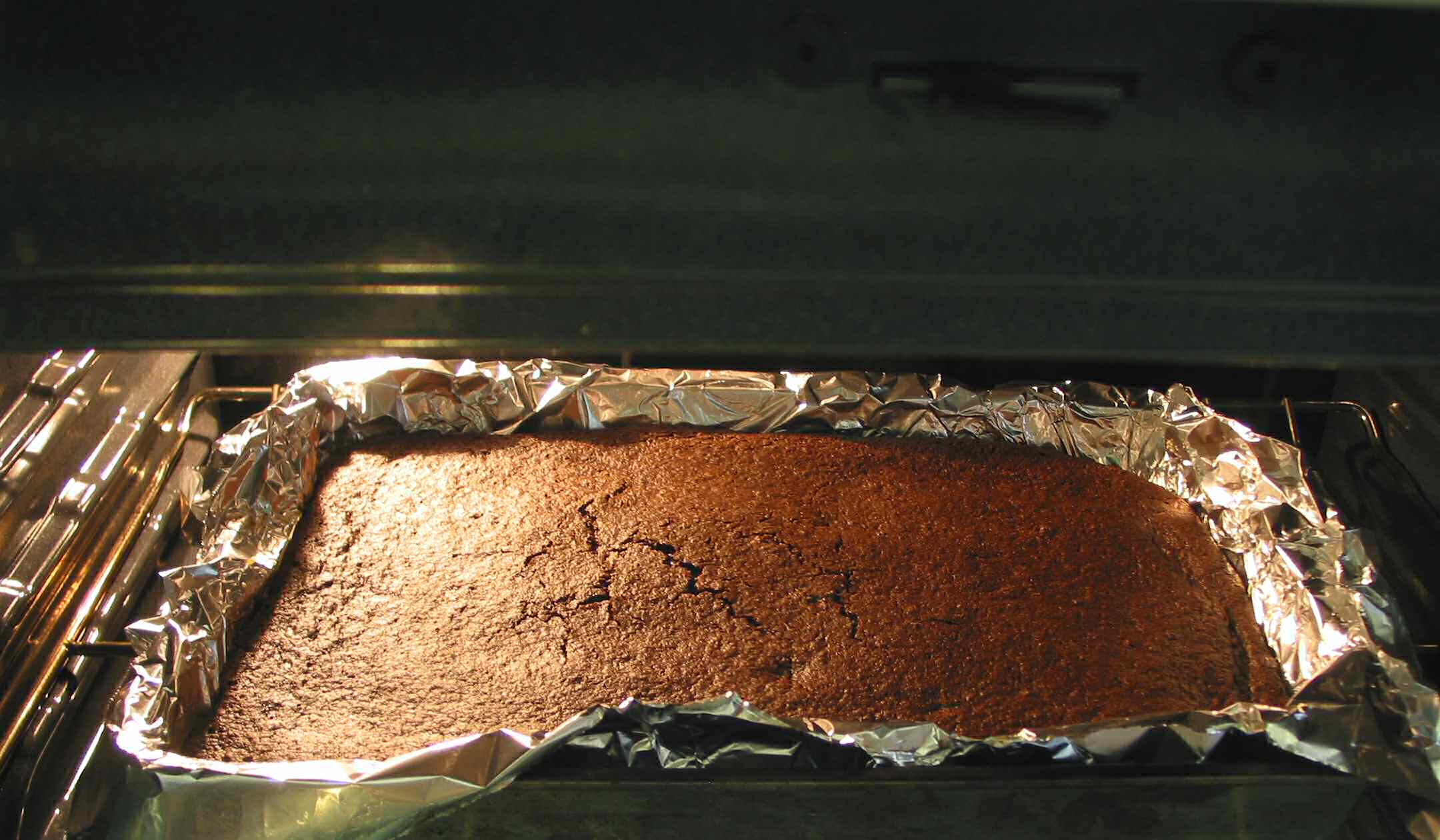
The pareve, egg-and-butter-free chocolate cake didn’t rise a ton, probably because I included exactly zero matzah cake meal, and just a tiny token bit of potato starch, probably not quite enough to keep the rise. The cocoa powder itself provides a little backbone as it cooks, but probably next time I’ll add either another two or three spoonfuls of potato starch or a single sheet of matzah, crumbled into the coffee grinder and turned into fine grind cake meal.

But even as it was, first time around, this cake came out like you wouldn’t believe. Excessively fudgy cake, insanely good, and the attempt at a completely nondairy ganache without nasty creamer or margarine-type additions went so well I’m going to have to patent it or something.

As I’m sure (and sorry) is apparent, due to the serious cocoa-and-hot-coffee content, plus the elation that it wasn’t a flop, I found myself on a caffeine high and completely unable to shut up about it while driving my kid home from school. She discovered I wasn’t wrong. We both recommend thin (half-inch) slices to avoid shock, caffeine highs, and that feeling afterward like you’ve just eaten Monty Python’s wafer-thin mint. You will be satisfied–a little goes a long way.

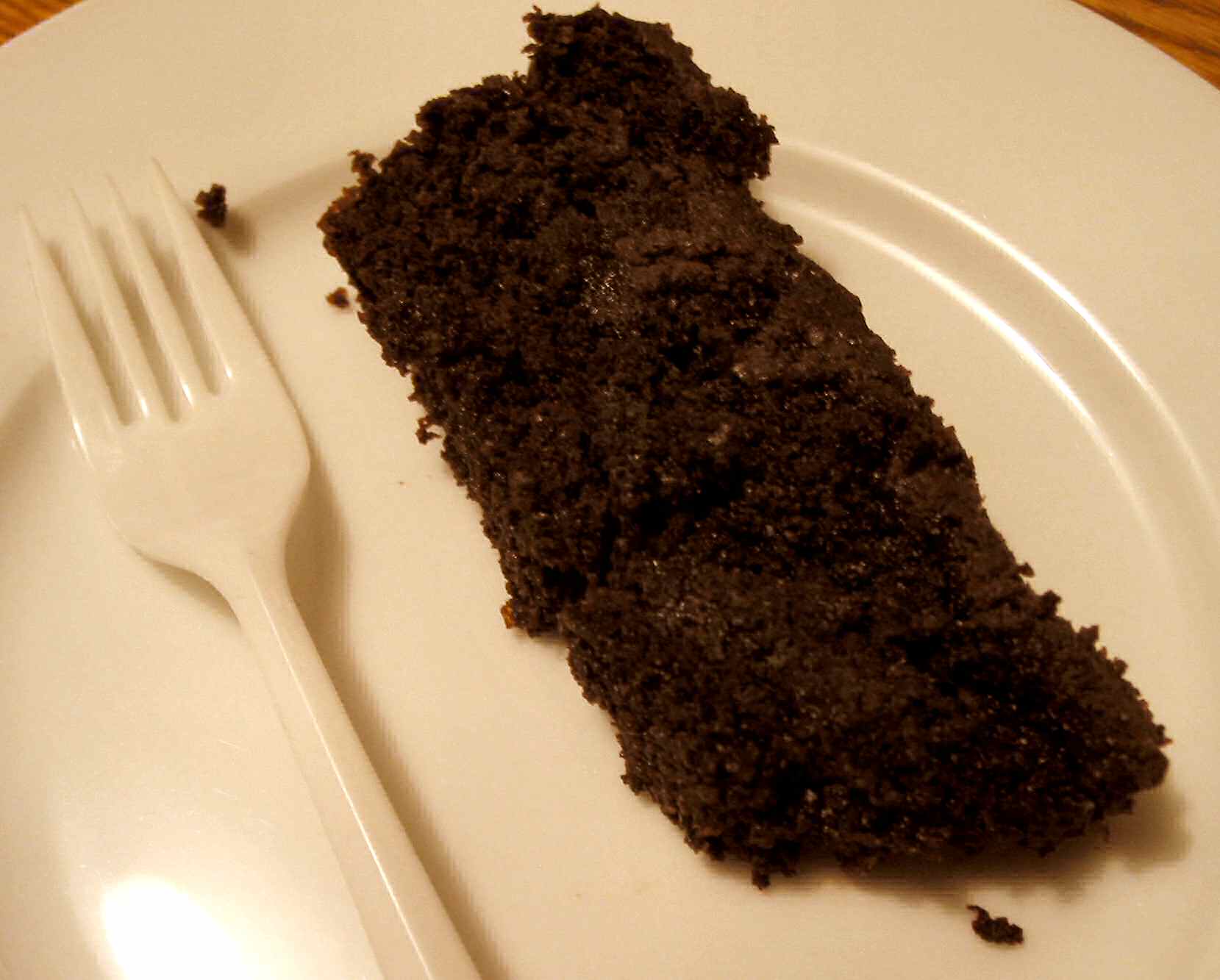
This half-inch slice is seriously enough for a serving. It's that rich.

This half-inch slice is seriously enough for a serving at the seder. It’s that rich.

Anyway, this is going to work and it is SIMPLE. And tastes fabulous. Fabulous, very definitely. If you like flourless chocolate cake and ganache, try this at home. Even though, as I say, it has no butter. No eggs. And no crap. And it’s not too slow (though the baking time kind of is; 40-45 minutes because it’s very moist and stays that way after it collapses back down and shows light cracking–see photo at top of post). Continue reading