

• Enter your email address to subscribe to this blog and receive notifications of new posts by email.

    Join 241 other subscribers
  • Noshing on

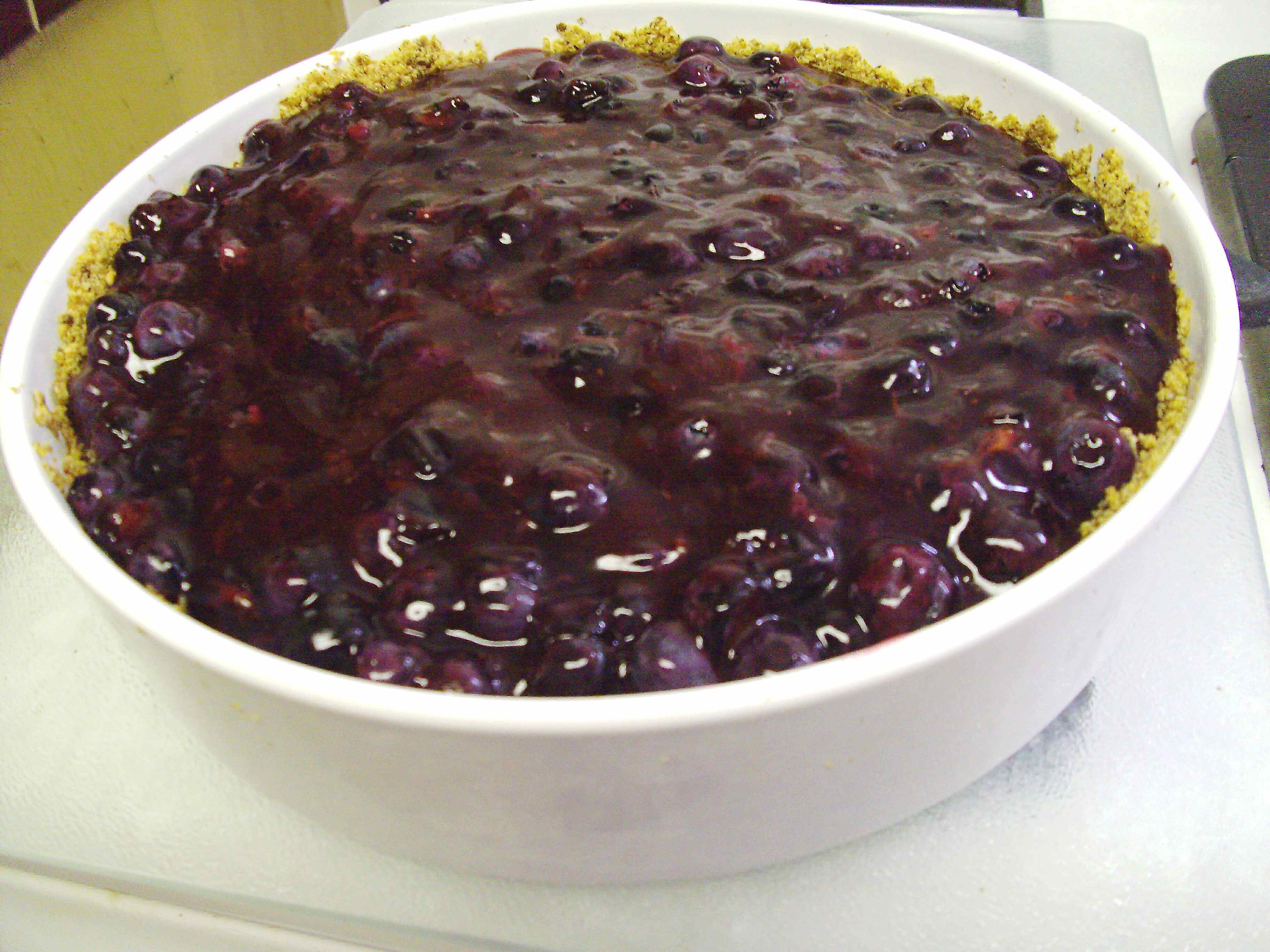
    raw blueberry pie with microwaveable filling and graham cracker crust

    This mostly-raw blueberry pie is a snap to make and very versatile--the filling microwaves in a few minutes, and you don't even have to bake the zippy gingered graham cracker crust--perfect for a hot Fourth of July and all summer long.

  • Recent Posts

  • Contents

  • Archives

  • Now Reading

  • See also my Book Reviews

  • Copyright 2008-2024Slow Food Fast. All writing and images on this blog unless otherwise attributed or set in quotes are the sole property of Slow Food Fast. Please contact DebbieN via the comments form for permissions before reprinting or reproducing any of the material on this blog.

  • ADS AND AFFILIATE LINKS

  • I may post affiliate links to books and movies that I personally review and recommend. Currently I favor Alibris and Vroman's, our terrific and venerable (now past the century mark!) independent bookstore in Pasadena. Or go to your local library--and make sure to support them with actual donations, not just overdue fines (ahem!), because your state probably has cut their budget and hours. Again.

  • In keeping with the disclaimer below, I DO NOT endorse, profit from, or recommend any medications, health treatments, commercial diet plans, supplements or any other such products.

  • DISCLAIMER

  • SlowFoodFast sometimes addresses general public health topics related to nutrition, heart disease, blood pressure, and diabetes. Because this is a blog with a personal point of view, my health and food politics entries often include my opinions on the trends I see, and I try to be as blatant as possible about that. None of these articles should be construed as specific medical advice for an individual case. I do try to keep to findings from well-vetted research sources and large, well-controlled studies, and I try not to sensationalize the science (though if they actually come up with a real cure for Type I diabetes in the next couple of years, I'm gonna be dancing in the streets with a hat that would put Carmen Miranda to shame. Consider yourself warned).

Political Pancakes, or, Why is Borders flogging so much lard?

Why Borders is not getting my business this week

Why Borders is not getting my business this week

I know–highly unappetizing. I don’t think even a full teaspoon of salt would help here. And I’m getting back to actual food as of today, I promise.

But I just had to “share” my inbox this morning before I get started. Borders has now closed its Pasadena store but keeps sending me these fabulous discounts in the pretty hope that I’ll schlep to Arcadia to check them out. What does it say when a huge business that’s trying to stay afloat after two decades of leading the field misses so blatantly in its one-to-one personalized marketing?

For that matter, what does it say (reading the tea leaves here) when Newt Gingrich looks like the most coherent and readable (and properly-dressed) selection? I mean, I was there–in 1995 I started working at NIH and promptly got caught in the federal furloughs when he lost his budget armtwisting attempt on Bill Clinton.

What does it say when the Gritch is allegedly trying to run for president and his soon-to-be-available tome is grouped with those of three other deeply discounted “authors” who have no actual public service background, just a penchant for loud titles and  army drag (of various centuries)? Where the hell did Laura Ingraham get that hat? No wonder she’s not keeping up with Patt Morrison. And I thought French food was a no-no for today’s discerning ultraconservative trougher?

I do also wonder at the significance of Ann Coulter’s latest effort being discounted just that six percent more than everyone else’s…maybe it’s the fact that she’s jumped (appropriately) on the vampire-empire bandwagon? Too bad there are no handsome devils on the cover (almost guaranteed there are none inside either). I’m sure they’d sell like hotcakes. Maybe she’s included an actual recipe for hotcakes (with blood sauce or fava beans or something)?–You never know.  Can she actually cook? Without fatback?

Given the deep and undoubtedly thorough marketing research Borders has done (by sending me of all people this fabulous selection of deals), I’m sure they’ve already figured out which way the wind is blowing. I can smell it from here.

In honor of this great selection, I’ve decided to pull out the stops and dig into the older of my cookbooks for an appropriate response.

Semi-Patriotic Pancakes–No Lard AND No Blood (well, at least no added salt)!

Makes about 16 3-4″ diameter pancakes, enough for 3-4 people

  • about 1 c. bread flour, whole wheat flour, matzah cake meal, buckwheat flour, or any mix of these as desired (to preserve our individual freedoms. Put that gun down, Jeb! We’re talking first amendment, not second!) Generally if you’re using buckwheat or whole wheat, it’s better to go half-and-half with regular flour so the pancakes aren’t too heavy or grainy
  • 2 large eggs, separated–I usually toss one of the yolks but keep both whites
  • dollop of plain milk-and-cultures-only yogurt (for that Mediterranean touch)
  • milk or buttermilk (depending how sour you are, and if you use buttermilk skip the yogurt)–about a cup, but might be more to make the batter consistency come out right
  • 1 T sugar (any color, even green if that’s all you’ve got and can stomach the results)
  • 1 capful vanilla extract AND/OR a shake or two of cinnamon (keep it small)
  • oil or butter –1 T for the batter, the rest for frying

Optional mix-ins: blueberries or raspberries (fresh are good, but if you have frozen ones leave them frozen to add when you fry the pancakes; otherwise make a sauce of defrosted ones to serve at the table instead), chopped peeled apples, pecans, chocolate chips, etc. etc. NO: liver, fava beans, or blood-anything!

1. In a large bowl mix the the flour, sugar, flavoring(s), egg yolks, the tablespoon of oil or butter, the dollop of yogurt if using,  and enough milk or buttermilk to make a thick but just-pourable batter. If you’ve got chopped apples, nuts or chocolate chips, you can mix them in now.

2. In a second bowl beat the egg whites to reasonably stiff peaks, then fold them gently into the batter to lighten it. Start frying as soon as you’ve got this done.

3. Fry 3-4″ dollops (about 2-3T each) of the batter in a large (preferably nonstick) frying pan over medium to medium-high heat. If you’re adding berries, add a few to each pancake as soon as you’ve spooned the batter into the pan, and let the pancake batter rise around and over the berries a bit before flipping to the other side.  You’ll know to start flipping the pancakes when you see the bottom edge start to look solid and a ring of small bubbles appears just above it–but I sometimes go a little longer to make sure because the leavening is egg whites-only, which makes a pretty delicate batter. You don’t want the pancakes to collapse completely.

4. “Stick a fork in ’em, they’re done.”–The late, great governor of Texas, Ann Richards, July 15, 1992, in an interview with David Letterman about the Republicans’ chances, and quoted on page 61 of my swiss-dot cookbook… Incidentally, she was wearing an outfit that puts any of Ann Coulter’s to shame–she had her very, very white hair up in a classic Texas beehive and she was wearing a hot pink miniskirt that she actually had the legs for. I miss her still.

AHA: Diet sodas and excess salt both linked to strokes

The latest from the American Heart Association and American Stroke Association’s joint International Conference on Stroke 2011, which is going on in Los Angeles this week from Wednesday through Friday.

Diet soda may raise odds of vascular events; salt linked to stroke risk.

Two large studies on a mixed-race/age/gender/other health status population have just shown that:

1. Drinking diet soda every day increases your risk of a heart attack or stroke in the next 9-10 years. In the study, diet soda regulars had a 48% higher rate than nondrinkers even after accounting for metabolic syndrome and existing or past heart disease.

2. For every 500 milligrams of sodium you eat per day over the AHA’s recommended 1500 max, you have a 16% higher risk of getting a stroke–no matter whether you have high blood pressure or normal blood pressure.

There was one other piece of really bad news announced:

The Centers for Disease Control’s analysts looked at hospitalizations for ischemic stroke (blocked arteries to the brain) between 1994 and 2007 and found that while strokes are decreasing in people over 65 (which is good), they’re INCREASING in children, teens and younger adults. Although older adults still have much higher overall risk of stroke than younger people, the trend toward higher stroke hospitalization rates for younger people is significant and needs to be explored further. Stroke hospitalizations increased by:

  • 31% among boys 5-14; 36% among girls 5-14
  • 51% in men 15-34, 17% in women 15-34
  • 47% in men 35-44, 36% in women 35-44

The CDC researchers didn’t have clear evidence of a cause for the rise in strokes among younger people, but said the rise in average body weight, blood pressure and diabetes, which are known risk factors for stroke, bore a closer look.

The fact that stroke hospitalization rates started rising in children over 5 (the researchers looked at younger children as well but didn’t find an increase under age 5) suggests to me that part of the trend may be due to a more processed diet with higher salt consumption as children head for school. All in all, it gives you the impression that we are the junk food generation, and it’s catching up with us as we speak.

Age, salt and the new USDA dietary guidelines

Last Monday the USDA released its latest version of the Dietary Guidelines for Americans (nominally dated “2010”). I was driving home and NPR carried USDA Secretary Tom Vilsack’s speech, in which he listed a few of the new highlights: eat less, eat less food with solid fats, eat less processed food, eat more vegetables and fruits, eat less sodium.

How much less sodium? About 2300 mg or 6 grams (1 teaspoon) of table salt per day, he said, is the recommended maximum for healthy adults, in line with the long-standing National High Blood Pressure Education Program’s guidelines, which are shared by the American Heart Association and many other professional medical groups.

There’s a second lower-sodium recommendation for anyone overweight, African-American, with heart or kidney disease or high blood pressure or diabetes, and anyone middle-aged or older. This year, as the more specifically heart-health-oriented professional organizations already recommend, the USDA guidelines set the lower maximum at 1500 mg per day, or about 3 grams of table salt.

And you’d think that was great, and I do, that the USDA guidelines have finally caught up with what the medical associations have been demanding based on the overwhelming weight of studies on dietary sodium intake as it affects blood pressure, cardiovascular disease including stroke, and kidney disease.

But there are two catches hidden in the midst of all this, and I’m not even sure Vilsack was aware of it. Smaller one first: Middle-aged? How old is middle-aged?

“Fifty-one and older,” Vilsack said. Whew, I thought. Four more years before I have to start thinking of myself as middle-aged. By the time I get there, I’m hoping the standard will have gotten fudged upward by at least another decade or so.

Because, you know, if you’re not 50 yet, 51 sounds reasonable–and comfortably remote for a lot of younger adults. Which I am, thank you very much. Don’t look at me like that.

So here’s Catch-51: When I was working at the National Heart, Lung and Blood Institute back in the mid-’90s, the general working recommendation for lowering sodium to 1500 mg/day was all the other high-risk groups Vilsack mentioned…and healthy adults 40 and up. Not 51 and up.

The choice of a cutpoint at age 40 for otherwise healthy people was based on the risk data from the first three National Health and Nutrition Education Surveys, which began collecting data across the nation starting in the 1970s. The latest version collected data around 2006 and its findings were just released last spring by the Centers for Disease Control. All the NHANES studies correlate  in-depth interviews about diet, exercise and lifestyle patterns, and cardiovascular history along with clinical health measurements (height and weight, blood pressure, cholesterol, urinary sodium excretion, blood iron, etc.) from thousands of ordinary Americans. Even early on, there appeared to be an independent higher risk and a greater need to lower sodium at 40 and older, all other health risk factors being equal.

But of course 40 seems too young to be middle-aged. And the USDA, which issues the Dietary Guidelines for Americans, tends to downplay certain elements of the risk statements so that no one, or at least not the agency’s chief constituents, gets upset. The no one in this case might easily be the Continue reading

Souper

I’m a hardcore used book glutton–you can often find me squinting at the Friends of the Library Last Chance shelves for the 25 cent specials, wondering whether some of the offerings are really worth a quarter or not, and if not (as is often the case), how come the same book (Dan Brown’s DaVinci Code and Angels & Demons both come to mind here, as do any pseudo-psychology guru selections and Betty Crocker spiralbound works from the 1970s) in slightly better condition is going for two bucks upstairs in the Friends’ main room. But I rarely come away entirely disappointed, because the used book shelves tend to contain quirky and entertaining gems you can no longer find in the thinning selection of bestsellers at your local Borders if it’s still open.

Last spring, I picked up just such a gem at my synagogue’s library used book sale and have been suitably impressed with my bookhound instincts ever since.

The Soup Peddler's Slow & Difficult Soups by David AnselThe Soup Peddler’s Slow & Difficult Soups by David Ansel (Ten Speed Press, 2005) has sat on my desk for about six months, aging gracefully under a shifting pile of papers, notes, my camera, my blank book cooking diaries, and other detritus, and every once in a while I unbury it again, read a bit at random, thumb through it, and resolve that I really MUST review it here.

Ansel’s book is the story of how he became the Soup Peddler, a Baltimore-born Jew cooking, peddling and, I guess, pedaling homemade soups of all kinds to subscribing customers all over a small town in Texas.

It’s a little hard to describe. The Soup Peddler’s Slow & Difficult Soups is something in the vein of MFK Fisher’s A Long Time Ago in France or Frances Mayes’ Under the Tuscan Sun, but it’s even more in the vein of Garrison Keillor’s Lake Woebegon Days, John Berendt’s Midnight in the Garden of Good and Evil (only without the murder or most of the voodoo, I think–I haven’t finished Soups yet), Woody Allen’s Radio Days and almost any of the local asides in Kinky Friedman (another slightly more famous/infamous Texas Jew)–pick one of his earlier mysteries, I don’t know, but let’s say the one where he and his sister (both adults) are arguing and each tells the other they “mourn the fact” that the other one’s being an idiot. Only with soup recipes and the sometimes risqué, sometimes heartbreaking tales Ansel’s Soupies recount in their email orders.

Since I’ve only been thumbing through it, not reading straight from beginning to end, I can only give you a taster here:

I hopped on Old Yellow [his bike], coasted down Mary Street straight across the creek. … I found the Follicle Fondler on his front porch stropping his scissors.

“Sir,” he said.

“Yes sir,” I said. “I’m here to take you up on your offer to discuss the gumbo.”

He inflated his great lungs and, setting down his scissors, exhaled through his flaring nostrils. “Let’s go inside,” he said. He cleared off the kitchen table  and rummaged in the corner, pulling out a roll of maps. He laid them out on the table.

“I hope you’re prepared to go all the way,” he said.

He drew up his lower lip. I raised my eyebrows hopefully. “Good,” he said. “Where are you going to smoke the ducks?”

“The Smoked Salmon Man has promised his smoker.”

“Does he have access to an ample supply of mesquite?”

“Yes, he…”

“WRONG!!!” he boomed. I steadied myself against the kitchen counter. “Always use hickory.”

“Yes, hickory, got it.”

“So,” he said, narrowing his eyes and softening his voice, “will you be using okra?”

I inhaled and paused, my eyes darting back and forth across the kitchen for a clue. “Yes,” I said confidently, smiling.

“Good,” he said…”We need to talk about the roux. What are your plans for the roux?”

“Well, that’s kind of what I came here to talk about. I…”

“Son, this is not a time for tomfoolery.”

“I wasn’t…I just…”

“If you’re not serious about this, we can just roll up these maps right now and that will be that.”

“No sir. I’m serious. I’m totally serious.”

“Like, totally?”

“Totally.”

“Okay. You’re going to make a dark-brown roux. You’re going to stir it without stopping till it’s done. You’re going to take it to the edge of burning. You’re going to sweat. Don’t sweat into the roux. You’re going to get burnt. Don’t cry into the roux. You’re going to wear your arm in a splint the following week. A normal pot of roux lasts about three beers. Let’s see, you’re making (inaudible) gallons (inaudible) carry the five,” he mumbled, counting on his thick fingers. “Your roux should take about thirty beers.”

excerpted from The Soup Peddler’s Slow & Difficult Soups by David Ansel (Ten Speed Press, 2005)

Ansel’s business is still local, but he’s expanded enough to have a staff do some of the onion chopping and bicycle delivery for him. If you’re in his part of Texas, look up The Soup Peddler World Headquarters, which contains more anecdotes as well as ordering information if you want to become a Soupie yourself. If not, look for this book. I entirely wish it were available at Borders, front and center of the cookbook section, but it isn’t.

Meanwhile, I’m off to try Ansel’s version of Shorbat Rumman (yellow split pea soup with mint, spinach, parsley, cilantro, scallions, lime juice and pomegranate syrup), of which he writes:

Neither slow nor difficult…Dazzle even your most Republican friends with this soup, and when they ask, “What’s that taste?” just say casually, “Oh, that’s pomegranate syrup. We like to keep some around the house just in case we’re having Iraqi food for dinner, don’t you?”

Local, organic and forgotten field hands

Darra Goldstein’s editorial in the Fall 2010 issue of Gastronomica calls out the schism between the “local, organic” righteousness of wineries and customers and the forgotten field workers they still exploit in the process. Worth a read, even though Goldstein doesn’t get quite far enough to suggest a solution or call for renewed political attention.

Gastronomica | Fall 2010 | Volume 10 Number 4.

Food for thought?

According to MediaFinder.com, 193 new magazines launched in the US during 2010, while 176 folded. Closures were down from 596 defunct magazines in 2009–most famously including Gourmet, whose November 2009 final issue with the huge stuffed glazed turkey is still sitting forlornly on our local library branch’s magazine stand a year later.

But from MediaFinder’s other trends, it seems the closure of this flagship food magazine has only spurred the launch of a (not literal, at least I hope not) thousand to take its place. While more B2B titles folded than launched, food magazines represent the most launches of any single category.

What does it mean? Are they just trying to fill the void, capture some of the market share that Gourmet commanded? Or do they really think there’s room for growth and that more and more people will pick up food magazines at the checkout counter and then subscribe for an ever more splintered and specialized set of food topics?

Are Americans really that obsessed with food, given that fewer cook regularly than even 10 years ago? Or are we using food as a relatively noncontroversial substitute topic for everything else of importance that scares us more? Like the fact that our banks got bailed out but they didn’t reinvest in America by creating more loans or more jobs (where’s the surprise)? That our biggest corporations are undercutting the political power of the citizenry and our Supreme Court is granting them effective status as citizens even though they don’t pay proportional taxes to support the welfare of the nation? Worse, that we’re still stuck wasting billions and billions on a moribund set of wars in Iraq and Afghanistan, and that our troops and national reserves have been turned into indentured servants unable to exit service when their agreed-upon term is over, and it’s been swept under a rug? And that we’re still “processing” and foot-dragging our way through the Guantanamo cases Bush’s administration left behind, with less and less plausibility for holding those prisoners without trial, and the “Patriot Act” is still in force–mostly for what? More abuses of citizen privacy have been committed under it than actual terrorist plots detected.

Maybe it’s time to get off our couches after all as we head into the new year.


Soupe à l’oignon gratinée (or not)

French onion soup without the gloppy gratin

Sometimes it pays to think out the recipes you read before you try them. For example…

I love and miss French onion soup from my pre-kosher days (that would be up to about age 19, long, long ago…) Can’t be helped, though–if you keep kosher, beef stock does not combine with Gruyère. And I’ve never actually tried making it at home before, because, if you go by a traditional, official kind of recipe like the one published in the LA Times below, it’s a 3-hour ordeal.

RECIPE: Soupe à l’oignon gratinée – Los Angeles Times.

Total time: 3 hours  Servings: 8  Note: Adapted from Comme Ca.

  • 8 large yellow onions, halved and sliced lengthwise into 1/4 -inch strips
  • 1/4 cup unsalted butter
  • Salt
  • 2 2/3 cups water, divided
  • 2/3 cup dry Sherry
  • 5 cups chicken broth (with as little sodium as possible)
  • 2 2/3 cups beef broth
  • 8 sprigs fresh thyme and one bay leaf, tied together
  • Fresh ground black pepper
  • 1 loaf French bread
  • 1 pound Gruyère, grated

Pretty onerous just on the ingredients (lot of salt in them thar vacuumpaks of stock), not to mention the bread. The Swiss cheese, oddly enough, is a lower-salt cheese than most, about 120-150 mg sodium per ounce as compared with, well, anything else at 180-210. It makes up for the lack of salt with a huge OD of saturated fat–and 2 ounces per person’s got to be a lot, really, just for melting on top of soup. It would be another matter if this were a legitimate fondue, or a sumptuous grilled cheese on really good toasted pain levain, and you were actually going to eat it all, but if I recall correctly, you aren’t.

Because I never had French onion soup at home, I never had to face the task of scrubbing baked-on cheese off the rims of the bowls afterward. Maybe 1/3 of what was sprinkled on ended up stuck like Swiss barnacles to the bowl, which seems like a waste, especially if you shell out for real Gruyère.  The rest turned into goop that sank to the bottom of the bowl and stretched up for yards on the spoon only to stick to the front of your teeth. Or blouse.

Plus at home there’s all the rooting around in the cabinets hoping your soup bowls are the kind that can survive the broiler and that your oven mitts (and guests) can Survive The Gruyère.

But the real cruncher here is time.

The LA Times instructions don’t even include the time it takes to sliver 8 very large onions, but you should, because it’s not trivial: 20-30 minutes, plus crying time. Heat the oven to 400 degrees (15-20 min, they also forgot this bit, but maybe while you’re crying over the onions). Stew onions with butter and 1/4 t salt in lidded casserole in the oven until the onions are softened and a light golden-brown, about 1.5 hrs, during which you’re supposed to stir every 15 minutes (!) Take the casserole out and cook further on the stove top until the onions are a deep golden-brown and just begin to stick to the bottom of the pot to form a crust (10 min? 15? 20? more?–from the experience below, I’d say at least 20, maybe even 30). Add half of the water and cook until the water has evaporated, about 8 minutes (so specific?). Add the sherry and keep stirring until it has evaporated, 3 to 5 minutes. Stir in the remaining water, broth and the thyme bundle, bring to simmer (5-10 min) and simmer 40 minutes (why 40? who knows?). Slice and toast the bread. Fill 8 oven-proof soup bowls, lay the toasts on top of the soup, sprinkle the grated Gruyère evenly over the tops and place the bowls under the broiler just until the cheese is bubbling and begins to brown in places (5 minutes?). Serve immediately.

TOTAL TIME: At least 3 hours, probably more like 3 1/2.

KLUTZ FACTOR: HIGH–lot of hot transfers of heavy casserole dish, finding and broiling ovenproof soup bowls, transferring to the table without spilling…not to mention serving “immediately”.

Then there’s…(you knew this was coming)

Nutrition per serving: 490 cal; 27 g protein; 36 g carb; 3 g fiber; 26 g fat (15 g sat); 78 mg. cholesterol; 808 mg. sodium.

Wow! Am I wrong in thinking that almost no soup should be this much of a labor of love, not to mention love handles? For this much time, fat and salt, I’d demand at LEAST grilled marinated lamb. Or a good runny camembert, a perfectly ripe pear, some excellent sourdough toast and a half-glass of something complex and interesting in the way of wine.

Maybe it’s as delicious as promised. But all those hours, all that stirring, not to mention all that fat and sodium and cholesterol, just for a bowl of onion soup and a slice of toast with melted cheese? Is it any wonder Lipton’s is popular?

Still…Can we do better with the onion soup itself? Maybe as in, vegetarian but still opulent, and furthermore without the heavy-duty time and calorie burden? Let’s try, anyway.

The first objections I have are eight huge onions and 8-10 cups of salted broth. Do I want to make anywhere near that much onion soup? Do I have that many takers in my house? Unfortunately not. One huge onion just for me, then. Maybe my husband and daughter, but only if it’s obviously fabulous. In which case, I won’t really want to share with them.

The main thing here is getting the flavor out of the onions–you want to caramelize them thoroughly and evenly without breaking down their aromaticity too badly. But I personally think baking them slowly in a big oven for an hour and a half just to start to do that is insane. Even if we’re talking about eight big onions.

My first attempt at shortening this recipe did not go badly, exactly, but it didn’t get me soupe à l’oignon either. Continue reading

Getting Mead-ieval

(plus 2 era-appropriate desserts to go with it)

Chaucer's Mead shelftalker label

Chaucer's Mead new 2010 label. Diehard homebrewers aren't as enthusiastic as Wine Enthusiast, but most of them seem young and clearly weren't expecting a dessert wine.

A couple of years ago my husband was rooting around our dwindling wine rack selection on a Halloween eve, right before the trick-or-treat crowd came by. It was actually starting to get genuinely chilly outside in the evenings…

“Hey, Deb–what is this stuff? Chaucer’s Mead?!” [squints at label] “Says you’re supposed to serve it fresh. How old is it?”

“I dunno. Last year? I forgot it was there.”

“Are you sure it’s still good?”

I started typing away to find out. “One of the Renaissance Faire bloggers says it’s really gross fresh and you’re supposed to let it age, but it looks like they mean the kind you make at home.”

Clearly neither of us was an expert.

Mead, of course, is a drink made by fermenting honey. I’d been vaguely aware of it ever since I was eight or nine years old and my dad handed me a copy of Howard Pyle’s The Merry Adventures of Robin Hood. (Quick, everybody, picture Errol Flynn or Kevin Costner, your preference, dressed up more or less as Kermit the Frog in a pointy hat and feather, leaping up onto a dead log with arms akimbo to shout “Ha-Ha-Ha-Ha!” at his fellows in a gratingly cheerful tone…)

I like reading about medieval and renaissance Europe, but I’ve never favored the Renaissance Faire approach–especially because you have to sew your own costume AND know all the names of the pieces AND how to lace them all together. A lot of participants get very snotty about each other’s authenticity. Which is fun, clearly, but I’d be the one they were getting snotty with. Also I’ve never wanted to be addressed as “wench” unless I had a huge frying pan handy to teach the knave who tried it some manners.

Also, after seeing my ex-brother-in-law’s home beer brewing setup (very successful, but then he’s English and knows his stout) I always thought that brewing mead at home would also involve big trash cans with burp valves (I mean, gas traps, though on reflection that’s actually no politer), attract a guaranteed parade of ants even in January (this being Pasadena), and that the stuff would come out cloudy and greenish and a little too authentically medieval for enjoyment.

So all in all, it wasn’t until I stumbled on a bottle at the Trader Joe’s while looking for a gift bottle of more conventional port that I ever considered tasting mead. It was enough of a novelty and the price was right–about $10. Then, of course, I put it in the wine rack and forgot about it for an entire year…which, it turns out, is the right thing to do.

Back at the kitchen counter my husband had finished squinting at the fine print, decided it probably wouldn’t kill or blind both of us at the same time, and was already opening the bottle to pour  a sip into each of two glasses. It looked and smelled like a white dessert wine–light, clear, not at all the cloudy, beerily fermenting syrup I’d been imagining. So we decided to risk it on the count of three.

Even though it looked fine, I’m not crazy about sweet dessert wines and my husband is, so I was still prepared to wince. But whatever I was expecting, it certainly wasn’t this.

It didn’t taste like honey at all–it tasted like all the flowers the honey had been made from. Somehow the brewing and aging had unlocked all the delicate nectary flavors that had been trapped inside the honey, and the flavor kept changing and shifting with every sip. A sherry glass was plenty–it was a bit rich, another surprise, because sherry hovers around 18% alcohol, and this mead was only 10%. But it was intense and fascinating.

Just then, of course, my husband spotted the little packet of spices, like a teabag, that had been hanging around the neck of the bottle and decided he really ought to mull some of the mead with them. In five minutes, the whole downstairs smelled of nutmeg. It was too cloying for me, but he liked it. (Chorus: because he’s a boy) See, though, you can get away with that for a $10 bottle, and your wife doesn’t have to get mad at you. And there was enough left to have a little unsullied mead over the next couple of days.

What to serve with it, though?  I want to keep the contrast between the mead and the food, which is going to have to be either an appetizer or a Continue reading

More things to fry in olive oil

Thanksgiving has barely ended and Hanukkah is already upon us–which means more food! This time with olive oil to commemorate the rededication of the Temple in Jerusalem after a war in which the Assyrian Greeks trashed and piggified it in hopes that we’d be so abashed we’d immediately convert and become a convenient tribute-paying way station for their marches around the edge of the Mediterranean to Carthage.

I know the official story credits Judah Maccabee, but really, it happened like this:

The Assyrian Greeks thought we’d be too frightened to complain when they marched through Israel, taking what they wanted and getting their muddy footprints everywhere. They hadn’t yet heard of chutzpah. They also hadn’t reckoned with a little-known secret force:  Jewish grandmothers. These bubbies could out-argue G-d. Weekly. And the lectures? …

“Carthage, schmarthage!” the grandma said. “Wipe your feet already, what are you, a Hannibal?”

Then she hefted a mighty frying pan at the intruders and that’s all she wrote.

So the real hero of this geschichte is clearly not Judah Maccabee, aka “The Hammer” — but Judith ha-Machvat, or “Judy with the Frying Pan Handy” — a woman who could really scare off the goniffs! And so in her memory, we fry up all kinds of goodies for Hanukkah and none of the calories stick to our hips at all. Really. It’s a miracle.

So…enough bubbe meises. Back to the present day.

Last night I made latkes without benefit of a food processor–after a slight kitchen drawer reorganization last spring, I forgot where I put the shredder disk. But for a smallish batch for the three of us–only two spuds and half an onion–it’s not so difficult to grate them by hand, as long as you use a fork to hold the stubs (of the potatoes, not your fingers, I hope) to avoid getting extra “proteins” in there…

The Obligatory Latkes (very basic, but tasty in a good way)–about 12 or so 2-3-inch latkes, enough for 3 people for supper, so scale up as needed

Carbs: 2 big potatoes weighed 480 g total on the food scale before peeling. An estimated 1/6th of the weight of nonsweet potatoes is carb–so about 80 g carb total for this recipe. A 4-latke serving would be about 20-25 g carb.

  • 2 big russet potatoes, scrubbed, peeled, shredded on large holes of grater/food processor blade
  • 1/2 medium onion, grated on fine holes into the same bowl OR chopped finely in the food processor BEFORE changing to the shredder blade and doing the potatoes on top of the onion
  • 2 eggs
  • spoonful of olive oil
  • 1-2 t. flour
  • pinch of salt
  • pinch of baking soda (which I completely forgot last night, so it’s optional)
  • olive or vegetable oil for frying

Grate the potatoes and onions by hand or food processor into a big bowl. The grated onions will help prevent discoloration in the potatoes. Take handfuls of the mixture and squeeze them nearly dry, and pour off most or all of the liquid that collected in the bottom of the bowl. Return the potatoes to the bowl, add the eggs, spoonful of olive oil, flour, salt and baking soda and stir until evenly mixed.

Heat several tablespoons of oil in a nonstick pan until shimmering and dollop soupspoonfuls of the latke mixture in, flattening them as they start to fry. Swirl the pan a little to get the oil touching each latke and maybe keep them from sticking to the pan. Wait until you see brown edges at the bottom of the latkes, then flip and fry the other side, swirling the oil a little or adding another spoonful in droplets where the pan seems to need it. You want these really brown and crisp on the outside, not pale yellow.

Drain on napkins or paper towels on a plate, and at the end, if no one’s snatched them as they cooked, you might want to reheat them all together in the pan or microwave them on the plate for half a minute on HIGH. Serve with applesauce and sour cream or labaneh or plain yogurt.

–  –  –  –  –

That’s the only recipe I’m giving here with set quantities–latkes are more like pancakes, everything below is like a stir-fry.

Non-Latke Options

Even with mechanical assistance in the form of a food processor, I’m a one-latke-night-per-year-is-enough kind of person. I want something other than potatoes if I’m going to be frying stuff in more than a spoonful or so of olive oil. Therefore I look for other maybe less starchy and more flavorful (one can always hope) things to fry:

Pre-nuked (microwaved) eggplant slices, fried in a couple of spoonfuls of olive oil after heating a little garlic and curry powder, maybe a dab of z’khug, for a few seconds first. Onion and red bell pepper are good in this mix too.

Marinated artichoke hearts, perhaps drained slightly and shaken in a plastic bag with a spoonful or so of flour or almond meal or chickpea flour and a little grated cheese and/or some oregano or thyme–no extra salt needed

Pre-nuked cauliflower, breaded as for the artichoke hearts

or–pre-nuked cauliflower, stirfried in a spoonful or so of olive oil with a dab of z’khug if you like things hot, with red bell peppers, onions, and another Continue reading

Couscous, its own fine self

Fine-grained couscous made directly from farina

When I’d just come back from a year in Israel after college, I read through Paula Wolfert’s Couscous and Other Good Food from Morocco several times. Her descriptions of the market stalls, the kitchens of the aristocrats, and the very down-to-earth cooks making tricky components like warka leaves for bistilla or rolling and sieving different sizes of couscous from farina and flour fascinated me. They filled in parts of the culture I hadn’t understood in the Moroccan Jewish community I’d just left.

Two of the dishes in the book, two only, have I actually made in all the time since. But if you get the right two, two is enough.

I first ate couscous in Ma’alot, up in the north of Israel in the western Galilee. On my first night in the volunteer program, my new roommates brought me to a tiny 4-table restaurant in the town center after a very miserable and cold trudge up to the top of the hill in a January downpour. The restaurant would have been a real hole-in-the-wall anywhere else, and even here it seemed to cater to the few single men who had neither hope nor prospect of a girlfriend, and whose mothers had finally nudged them out the door. Israel’s amenities–grocery stores and the like–are still often a grade or so down in appearance from what we’re used to in the US, and I’d been there half a year already, so I was used to ignoring it and discovering what was good. Still, even 25 years ago, most restaurants in the larger towns were not this dowdy. This was card tables and folding chairs. My heart sank. Where had I come to?

Not 5 minutes after we’d been seated, however, the lady who ran the kitchen fetched us out a huge platter mounded with couscous and chicken legs and vegetables, steaming hot and smelling incredible. The chicken was delicious (everybody sing; I’ve just been subjected to another showing of Sherlock Holmes’s Smarter Brother at our in-laws’ over Thanksgiving weekend) but the couscous itself was so light and fine it was like eating hot curried snowflakes. What was it? How do you do that? And in half a year of eating at Continue reading