
• Enter your email address to subscribe to this blog and receive notifications of new posts by email.

    Join 241 other subscribers
  • Noshing on

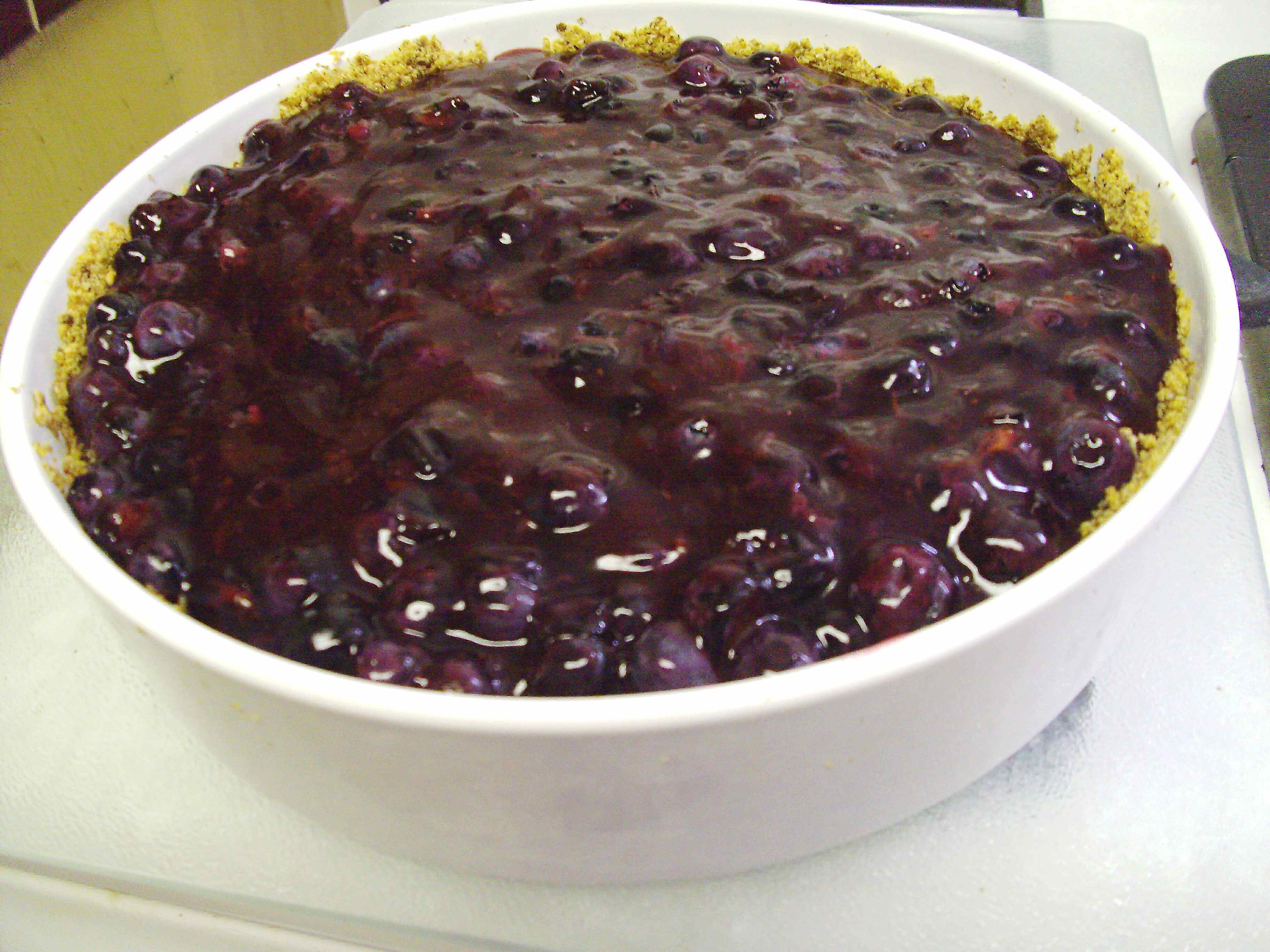
    raw blueberry pie with microwaveable filling and graham cracker crust

    This mostly-raw blueberry pie is a snap to make and very versatile--the filling microwaves in a few minutes, and you don't even have to bake the zippy gingered graham cracker crust--perfect for a hot Fourth of July and all summer long.

  • Recent Posts

  • Contents

  • Archives

  • Now Reading

  • See also my Book Reviews

  • Copyright 2008-2024Slow Food Fast. All writing and images on this blog unless otherwise attributed or set in quotes are the sole property of Slow Food Fast. Please contact DebbieN via the comments form for permissions before reprinting or reproducing any of the material on this blog.

  • ADS AND AFFILIATE LINKS

  • I may post affiliate links to books and movies that I personally review and recommend. Currently I favor Alibris and Vroman's, our terrific and venerable (now past the century mark!) independent bookstore in Pasadena. Or go to your local library--and make sure to support them with actual donations, not just overdue fines (ahem!), because your state probably has cut their budget and hours. Again.

  • In keeping with the disclaimer below, I DO NOT endorse, profit from, or recommend any medications, health treatments, commercial diet plans, supplements or any other such products.

  • DISCLAIMER

  • SlowFoodFast sometimes addresses general public health topics related to nutrition, heart disease, blood pressure, and diabetes. Because this is a blog with a personal point of view, my health and food politics entries often include my opinions on the trends I see, and I try to be as blatant as possible about that. None of these articles should be construed as specific medical advice for an individual case. I do try to keep to findings from well-vetted research sources and large, well-controlled studies, and I try not to sensationalize the science (though if they actually come up with a real cure for Type I diabetes in the next couple of years, I'm gonna be dancing in the streets with a hat that would put Carmen Miranda to shame. Consider yourself warned).

Homemade Halvah

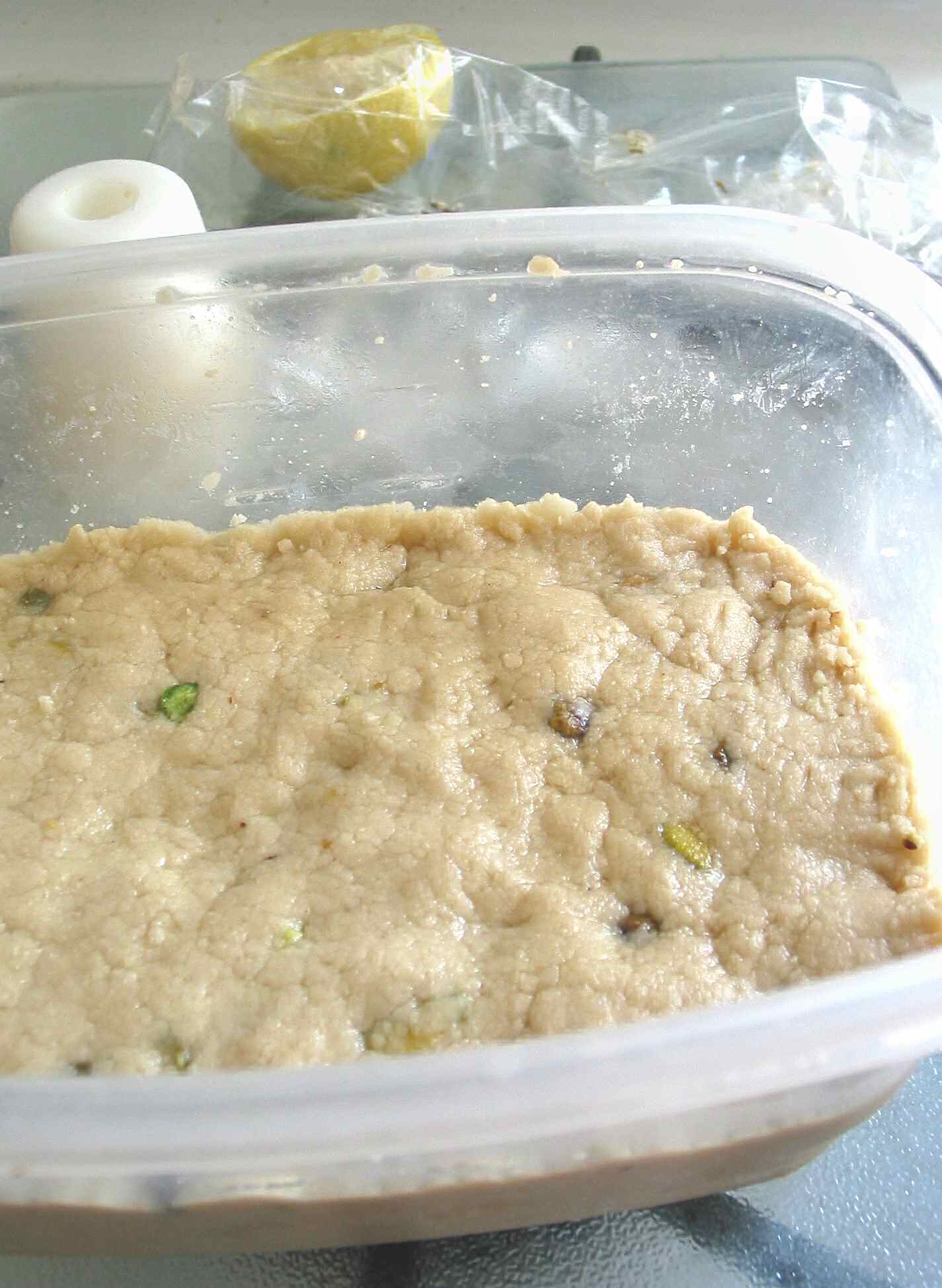
Sesame halvah with pistachios

A little trickier than it looks–this one is nearly right and tastes good, but it was stiffer and more crumbly than professional halvah once it cooled. Next time!

I first tasted halvah at the age of six while visiting my cousins, who lived in my town but had been to Israel the year before. One afternoon my aunt shaved off a very thin sliver from this mysterious loaf of sandy light-brown stuff and handed to me with the caution, “Only a little piece at a time. It’s very rich.” Which it was, but the feathery impossible texture melted on my tongue and I wanted more.  When I got home from the visit, my father laughed when I asked him what my aunt had meant by “rich”–and explained that it meant “heavy”. That made no sense either–the tiny sliver was light and delicate. Then he said that once when he was twelve he’d eaten an entire pound of halvah in a single sitting and been extremely sorry afterward, because it sat in his stomach like a lead brick for hours…

I mention these things not just because they’re true of eating halvah, but they’re a good indication of the balance you need to achieve if you ever try making it.

Last year at Rosh Hashanah I made stuffed eggplants and onions with tamarind sauce from Poopa Dweck’s Aromas of Aleppo. I’ve enjoyed them enough to make the onions repeatedly over the past year, and I’ve also enjoyed the idea of making a new food for the New Year. Dweck’s book happens to have a halvah recipe, and the pictures look right, and the recipe looks really simple.

Well…the ingredients are incredibly simple–tehina, sugar, water, lemon juice, flavorings like a little vanilla, clove and cinnamon, maybe some pistachios or sliced almonds to mix in. The steps–boil sugar with a bit of water until it reaches 240°F on a candy thermometer. I don’t have one but she adds, helpfully, that it’s until the syrup coats the back of a spoon and is at the soft ball stage–shades of childhood reading through the Joy of Cooking‘s mysterious and dangerous section on candy recipes. Ahem! Boil the syrup and pour it hot over the tehina in the food processor, add the flavorings and blend. Take out the mass of halvah and press it into a pan to cool, then cut into cubes or slices and store at room temperature for a week or the refrigerator for up to 6 months…not that it will last that long.

Simple, right? So simple. I can probably microwave the syrup in about 2 minutes instead of simmering it for 20 on the stove, at least if I stir every 20-30 seconds and keep checking it…with the food processor handy, it’s like a 10-minute recipe if that! Simple.

The trouble with making halvah at home, as I discovered last week, three times, is that it’s not so simple. The first time I tried a proportionate miniature test version, with half a cup of tehina and about 3/8 cup of sugar, all measured and calculated down to the gram. The syrup cooked in a minute in the microwave and things were going really well…except the mixture seized up hard and crumbly the instant I mixed the syrup and tehina with a fork. And it was a bit too sweet and bland. Did something go wrong with the proportions? Did it need more of the oily tehina to make it flexible?

The second time I made it, the syrup was a little looser and the mixture turned a flat oily dark putty color and never really solidified past a thick paste. Nearly the same exact proportions, better taste (less bland, less cloying, more sesame). But I had made a soft sesame version of peanut butter fudge. You could slice it in squares, but it would sag like soft caramel.

So clearly it’s not that simple. I went to the web, thinking, of course someone will know what I’m doing wrong. And maybe someone does, but he or she is clearly not on the web expounding on the finer points of making halvah.

Oh, there are dissertations on halvah, but most of them are talking about the wide variety of desserts around the world that go by the same name–kinds that are based on wheat flour, carrots, sunflower seeds, and other main ingredients to mix with the syrup and pat into a pan.

Most of the (relatively few) tehina-based recipes are identical to Dweck’s, a pound of tehina, two cups of sugar, 1/3 cup of water, a teaspoon of lemon juice, a pinch of clove and cinnamon, maybe a spoonful of vanilla.

But the pictures show (and sometimes the rueful comments do too) that it’s not the ingredients at fault when the texture’s off. It’s the technique, which is usually missing from the recipe.

The videos I found on YouTube specifically for making tehina-based halvah didn’t really help. Iraqi halvah workers boiling syrup in an old–well, it kind of looks like a very worn-out steel bowl set over a trash can fire in an abandoned stairwell, and they’re stirring away with a wooden paddle before pouring in the tehina, which turns into curds that they then paddle and knead until they’re happy with it, but you can’t really see what it is that makes the difference.

Then there’s the Syrian halvah factory demonstration posted by Middle Eastern chef and cookbook author Anissa Helou–much cleaner, with an official halvah-kneading machine that Willy Wonka might have been proud of, pummeling the tehina/syrup mixture with what looks like a mechanical boxing glove on a stick, until it looks like hummus that’s Continue reading

Baking with “Inside the Jewish Bakery”

A few weeks ago I reviewed Stanley Ginsberg and Norman Berg’s new book, “Inside the Jewish Bakery” for my local Jewish book festival committee by testing out the key recipe: bagels. Ginsberg and Berg give the inside scoop on what bakeries do and don’t do to make things work better than you usually can at home. Along the way–and the most interesting part for me–they give a huge helping of Jewish Bakery history. Not just nostalgia (“Weren’t those marble ryes worth wrestling over?”) but the fascinating cultural developments that gave rise to such things the Bagel Maker’s Union (local 338 [number corrected thanks to Stan Ginsberg]) in Brooklyn, and they’d break your legs if you tried to make nonunion bagels, at least through the 1960s.

Ginsberg’s the son of a baking family and Berg is a professional baker; between them they tell the story of Ashkenazi baking and the inside story of what it’s like to start work at 10 pm and head for home around 7 in the morning, all the while giving what turn out to be great technical baking notes.

And yet the recipes themselves are full of errors–and yes, this is the print edition we’re talking about, not an advance reader’s copy. The authors have a 6-page correction sheet (errata) up on the book’s web page, so if you’re going to get to it and try it out–and why not, if you’re ambitious about baking–check it out carefully against the recipe in the book, read everything over very carefully first, and then get to it in a way that won’t send you scurrying for specialty ingredients. NOTE: per Stan Ginsberg (see comments below) the 2nd edition’s recipes have been corrected so things should be easier.

If you can read between the lines and have some experience with bread under your belt, you’ll find the recipes do work (once corrected). My bagels came out very well, with that crunchy crust and dense, chewy bite all of us ex-New York types have missed for decades out here in California (actually, I’m posting this from Montreal, where the bagels are lighter and sweet? have to try, probably won’t love them).

I do have pictures to post (once I can get home and edit them down) of the bagels proofing slowly overnight in the fridge and one of the last remaining survivors–my daughter still had it in her bookbag when we came east this week. Ten days, obviously not still fresh, but not spoiled either. As tough as the dough it came from (which, again with the asides, is very tough compared with regular pizza or challah doughs, and you have to knead it by hand unless you have the dough hook of the century. If not, you’ll develop the right hook of the century.)

So here are my notes to the local Challah Club, which was interested in trying out some of the other recipes. Good luck and eat nice!

Notes for the Challah Club members up for a challenge:

1. Read all the instructions several times first and double-check the errata sheets. It’s 6 pages of corrections for the whole book and it’s up at the Inside the Jewish Bakery web site under a top menu link on the right (Errata). Hopefully we can get the second edition in soon.

The book web site also has lots of info, interviews, links to other related stuff.

Also check notes on special ingredients in the front for unfamiliar names–diastatic malt in the bagels and elsewhere is defined up front; it’s just malt. I think they get a little technical on flour grades–they’re tied in with an aggressively technical bakers web site/forum (NY Bakers, you don’t expect them to be laidback, do you? but most of it’s just futzing around with professional stuff). Chernushka seed is nigella seed–available here at the Armenian groceries. And then do whatever makes best common sense and doesn’t have a huge cash layout just for one loaf!

2. The recipes in this book are weighable on a food scale in grams, which is how I did the bagels (just this once, just to see if it needed me to be that nerdy). Some of the flours are technical grades beyond what you can easily get in the grocery store; you can mix flours to get the right consistency. For example, bread flour is 13% protein, but I added a teaspoon of vital wheat gluten to bring it up to the 14% protein specification for the bagels, and for something that really needed stretch, like rye, maybe, I would have added a little more. Don’t know that you really need to, but if you’re gonna be nerdy, a food scale and a calculator are handy tools.

3. If you go for the pastries, some have a mix of butter and shortening-plus-butter-flavoring. I’m not a shortening fan; I’m just not; I prefer butter or margarine. The laminated doughs add these things in stages, so read the errata pages and double-check the recipe instructions for how much fat to put into the pastry dough when. Gets confusing occasionally.

4. One thing that’s not in the corrections pages: watch the salt. You do not need as much as they throw in for the breads–not for flavor, not for texture. The bagels I made with only half the salt in the recipe because the original would have been 400-500 mg. of sodium per bagel, which is getting up into Campbell’s Tomato Soup territory (or half a South Beach Diet frozen microwaveable “lunch”). And they tasted fine without it and did most of the right things without me having to join the bagel-makers’ union.

Broccoli IS a conservative political bogeyman!

This exposé from yesterday’s New York Times goes into the longish history of how conservatives started waving broccoli stalks at any issue they don’t like…

Just as I suspected when Justice Antonin Scalia started spouting broccoli-tinged party-line nonsense this March, the Republicans really DID originally decide to blame broccoli based on George Herbert Walker Bush’s stated hatred of an innocent green. Yeesh! You can’t make this stuff up. And I was really, really trying to!

New York big-soda ban, long overdue

All the food behavioral experts on both coasts seem to be whining that New York City’s new ban on oversized sodas “won’t work”. Well, all the experts in New York and LA. Even Michelle Obama has backed off delicately from taking a position on it. Oy. People!

The Washington Post‘s columnists Ruth Marcus and Alexandra Petri have two different takes–one more serious but employing Yiddish to describe the psychology of the whole protest, the second, despite lack of Yiddish, funnier about people who insist on their right to drink a whole tubful of soda at a go. So I’m going to take the middle road–oh, screw it, I’m going to use Yiddish if I feel like it and still be hilarious despite my gravitas. Because it really is hilarious. If only it weren’t so sad.

Jon Stewart is quoted as kvetching that Mayor Bloomberg’s proposed ban is the only thing that can make him agree with conservatives. David Just, partner expert to Brian Wansink, says people “want” their big drinks and will surely just find a way to work around the restrictions.

Well, maybe a few will really want 20+ ounces of soda at a sitting badly enough to go back to the concession stands and wait in line three times to get 3 separate drinks of 8 ounces or so. Or juggle 3 small bottles back to wherever they’re drinking it all. But I’m betting most people won’t.

Why do people supposedly “want” such huge drinks in the first place? The oversized Big Gulp-style cups were a marketing ploy that started about 15-20 years ago at the burger franchises and the 7-Elevens. They were supposed to look like a huge bargain–for an extra however many cents, they’d double the amount of soda they gave you. What a deal! And the ploy worked–created a habit.

Most people don’t really need or even want that much soda, but as many of my coworkers–women especially–used to say, shrugging helplessly, “Well, I don’t really want this much, but this is the only size they sell.” And you really can’t split a 20-ounce with ice back at the office unless you have cups. Everyone will wonder whether you got tempted on the way back and started sipping from it. Eeeewww. You can’t save it in the fridge for later either because it goes flat pretty quickly.

The soda companies got the concessions for school cafeterias–why not brand the captive audience early–in exchange for money the schools have lost from their cities and states anytime those governments wanted to hand out tax relief to corporations–like soda bottling plants. A different version of “eat local”.

By now, people are so used to the soda bloat they’ve started to decide it’s their right to drink bigger than their stomachs–or bladders–can handle. And it is–you’re allowed to be stupid if you want to.  Only problem is, did the soda companies also offer to build more bathrooms to handle the outflow?

So I say Mayor Bloomberg, who’s in charge of the biggest city in America, is doing his city a huge favor by trying to get the soda industry’s claws back out of them. There’s no way the industry will scale back its sizes voluntarily, especially not if they can get experts like David Just to voice their incredible “the-consumer’s-the-one-who-wants-the-elephant-sized-drinks-we’re-just-providing-it-for-them” act.

When you get the big gulp-style Coke, how much of it are you really tasting? Maybe the first third of it? Maybe less. After that, are you drinking it while reading your computer screen? Driving? Watching tv or a movie? Would you really want someone to film–and then post on YouTube–footage of you slurping mindlessly throughout the day?

If you’re not paying attention to what you drink, is it worth drinking just because it’s there? Same for eating. And David Just and Brian Wansink–weren’t these the guys who did all that people-eat-30-percent-more-when-parked-in-front-of-a-tv-screen-than-at-the-table research? I do believe they were.

So getting back to a small Coke that you’ll actually pay enough attention to to taste? That might be worthwhile. Then you can think about what you’re tasting and decide if it’s good enough to keep drinking. Or whether, like me, you’d rather wait until next Passover, when Coke and other big soda manufacturers put out limited editions made with cane sugar instead of corn syrup.

I haven’t been a big soda drinker for years, and I usually don’t miss it at all. It was astoundingly easy to give up, and my teeth have thanked me ever since. On the rare occasion when I have a little at a party, my preferred soda is and always was definitely root beer or ginger ale, not cola, and usually I can only take about half a glass–it’s all way too sweet, even with ice. So I’m not the right person to sympathize with habitual soda drinkers–I just can’t get into it, and diet is gross.

But having tasted the sugar version of both Coke and Pepsi, I can say the difference it makes to both versions is amazing–much cleaner flavor, and a little is enough to be happy with it.

Meanwhile, a better idea would be to drink water instead of the big-3 flavors and save your shekels for small niche sodas with better, realer, more interesting flavors as an occasional treat.

Case in point: a summer soda tasting event in Los Angeles to raise money to reopen exhibitions from the shuttered Southwest Museum in Highland Park. The Southwest museum had wonderful Native American collections–kachinas, headdresses, Bakelite jewelry of the 1930s, photos, and much more. It was taken over by the Autry Museum a couple of years ago, but has remained dormant since then with a lot of its collections in storage and out of the public eye. I was fortunate enough to have taken my husband and daughter there about 10 years ago, before it closed.

Galco’s Soda Pop Stop, an independent soda market run by curator John Nese in Highland Park, is hosting the soda tasting–his second–with something like 500 different small brands, including plenty of nostalgia brands (though no NeHi Grape–don’t know if they’re still around) and imports.

According to a profile of Nese in The Quarterly Magazine, Galco’s motto is “Freedom of Choice”, with flavors like coffee, bananas, spruce, cucumber, mint julep, and many others–check out their huge soda list, which includes ingredients, prices and bottle sizes! Amazing. Maybe that’s the kind of freedom soda fans should be going for. Amazingly enough, most of these flavors don’t come in 20-ounce monstrosities, or even in plastic.

If you’re in Los Angeles on July 22, check it out–tickets are only $12 in advance, $15 the day of the event, and you can get them at Galco’s on York Blvd. or through the Friends of the Southwest Museum web site.

Eat the City, Read the Book

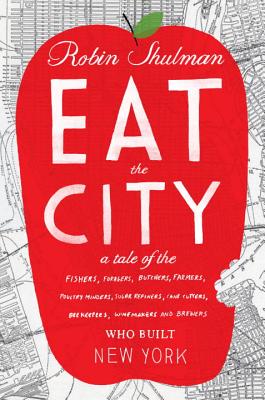
Robin Shulman's "Eat the City" bookcoverI’ve just received an advance copy of Robin Shulman‘s forthcoming book, Eat the City: A Tale of the Fishers, Foragers, Butchers, Farmers, Poultry Minders, Sugar Refiners, Cane Cutters, Beekeepers, Winemakers and Brewers Who Built New York.

[Or at least that’s the title on the cover art–the copyright info page version of the book title squeezes in even more food trades–what, or rather who, the heck are “hungers”? People who “curate” aged hanger steaks?]

Shulman, a well-known reporter who has worked for the New York Times, the Washington Post, the Los Angeles Times, Slate and other venues, has covered hard-news beats from city politics and urban blight to Middle East diplomacy. In Eat the City, Shulman explores the neighborhoods of New York, where she lives, and from hundreds of interviews, she harvests seven key stories to tell in depth: Honey, Vegetables, Meat, Sugar, Beer, Fish and Wine.

Each chapter, rich and multilayered, cuts across decades of urban history, whether development or decay, recounts conflicts and unexpected cooperation between would-be urban farmers and the neighborhood factories or city agencies they deal with, and uncovers the not-so-obvious ways these individual entrepreneurs bring a sense of connection and vitality to the city.

So we meet a man who after returning not entirely whole from a stint in Iraq, got enthusiastic about beekeeping when it was still illegal. In 2010, he rallied New York’s clandestine beekeepers to convince the city to rescind its ban on rooftop hives, and started training hundreds of apprentices. The retired numbers runner who farms vacant lots in Harlem–something he started as a cover for his gambling operations in the ’60s and turned into one of the first urban community garden projects–is still going strong in his 70s, but he’s seen several of his neighborhoods fall silent over the decades as buildings crumbled and the city neglected the people. The Manhattan ad exec risks her health and her freedom sneaking into taped-off areas to fish striped bass from the East River–she’s not sure it’s safe to eat, but she’s as hooked as her catch, and often announces her triumphs on Facebook. And somewhere toward the end of the book is the true and presumably unvarnished story of Manischewitz, the first big brand of kosher wine in America (and actually, probably anywhere, since before the 20th century most people made their own kosher wine at home).

Eat the City is due out in July, and all I can say is get out there and reserve yourself a copy, or clamor at the cash register of your local bookstore to order you one. Because this is the best book I’ve read in quite a while on the history and present fortunes of small independent food growers in one of America’s largest urban landscapes.

Like Michael Pollan’s books, it has depth and thoughtful analysis of the meaning of food in modern life. Unlike Pollan, Shulman isn’t advocating a lifestyle choice, she’s giving you a window on individuals as they elbow their way into a crowded city to make room for themselves.

Food is the medium here, but the impulse is universal, and the result is a better understanding of both food entrepreneurs and the meaning of city life itself. If you want to know what’s really happening beyond the wide-eyed grow-your-own-tomatoes-in-Brooklyn blogs, just pick a chapter and start digging in.

American Grown (Groan?)

I have mixed feelings about Michelle Obama’s forthcoming book, American Grown, which the Barnes & Noble web site describes as:

Now, in her first-ever book, American Grown, Mrs. Obama invites you inside the White House Kitchen Garden and shares its inspiring story, from the first planting to the latest harvest… Learn about her struggles and her joys as lettuce, corn, tomatoes, collards and kale, sweet potatoes and rhubarb flourished in the freshly tilled soil.  Get an unprecedented behind-the-scenes look at every season of the garden’s growth…  Try the unique recipes created by top White House chefs…  [read about a community] garden that devotes its entire harvest to those less fortunate, and other stories of communities that are transforming the lives and health of their citizens. With American Grown, Mrs. Obama tells the story of the White House Kitchen Garden, celebrates the bounty of our nation, and reminds us all of what we can grow together.

The book is due out –well, now, really, the end of May. But I’ll tell the truth here: I hate this description and I’m sorry she wrote the book just from the blurb. Really, this is the best they could do? It’s so colorless. It sounds like a bland, give-the-wife-a-project kind of capitulation written by the official White House handlers.

What I find most disheartening about the beige, friendly-sounding jacket blurb is the “About the Author” section, in which Obama is described as the First Lady of the United States and a mother of two daughters, and that in 2010 she started the Let’s Move program. These are all good things, and she’s done a lot with the program. But nowhere does it mention her career–now on hold for at least four years–as a lawyer, and a good one.

In terms of public relations, Obama has conducted her Let’s Move program more successfully than Hillary Clinton, who was also a skilled and high-power attorney, handled a much-embattled health care expansion plan in her eight years as First Lady. Clinton is thorny and opinionated and direct, and is only now learning to keep her moves as Secretary of State quiet rather than telegraphing all her punches–but she’s achieving a lot. Obama is a lot smoother and more immediately likeable–something the rightwingers got wrong from the start–and she’s full of common sense, people sense, and I keep hoping for big wins from her.

Obama’s charismatic and not easily ruffled, and she’s a fashion icon–you could see the newspapers focusing on that since it’s so much easier and picturable than a career full of sitdown negotiations with House Republicans and stacks of paper and emails. But both women have been in the awkward position of First Lady, competent people sidelined for significant numbers of years by their husbands’ presidencies, hemmed in by the public expectation that they’ll shrink themselves into June Cleaver-like roles.

The Lady Bountiful bit is homey, patriotic, old-fashioned and charming. But it’s also hideously condescending and weird as hell that in this day and age it’s seen as acceptable to shove a professional out of work and relegate her to homemaking, even if it’s on such a grand scale. Home gardening is what you do on your day off, when you’re out of work or retired. Even if you enjoy it and are great at it, which I’m not. The fact that I got no tomatoes until January this year says a few things. If we had to depend on what I can grow successfully, we’d starve.

So what I say is, if you’re gonna go First Lady, go big. For the press release, why not do it more like the blockbuster movie radio voiceovers?

[pulsing dark synth strains, standard gravelly yet unctuous baritone voiceover]

“IN A WORLD…where everything has stopped growing except the American waistline…comes a heroine for our times. Once a high-power attorney, now down on her luck and forced to smile at hostile crowds who want her husband to say something–anything–definite about the economy, Michelle Obama IS… The First Lady.

[patriotic/threatening military march starts to swell with a roll of the tympani]

With NOTHING MORE than a trowel, a packet of seeds, a groundskeeping staff of at least twenty, a fully-trained yet cooperative head chef and a large, green lawn, Michelle Obama is TAKING ON …. Corporate America. You’d better HOPE …

[tympani going crazy à la “2001: A Space Odyssey”]

…she WINS.”

See you at the movies!

Coconut, minus the hype

dried coconut shreds

Palm and coconut oils have made a huge comeback in the last few years. Both are very high in saturated fats, which promote high blood cholesterol and heart disease, but the vegan community has embraced them as “natural” and they’re turning up in all kinds of baked goods and sweets these days at Whole Foods. Which also sells big mayo jars full of coconut butter. Looks like Crisco, scoops like Crisco, costs 10 times as much.

A lot of the newer vegan recipes and packaged foods are direct mimics of things that used to include lard, beef tallow and suet at the lower end of the classiness scale, or butter at the high end. My local Whole Foods’ pastry case features a lot of croissant and baklava variations these days, all now made with palm oil, as are many of the muffins. Starbucks’ “old-fashioned kettle” doughnuts feature palm oil in two places, both the dough and the icing.

Why are these fats getting so popular? Why all the wishful thinking that a plant source automatically makes them healthy to eat in quantity? Why are all the nutrition advice columnists in the major newspapers and health magazines suddenly “holistic coaches” who graduated college with psych majors and the like rather than board-licensed nutritionists and registered dieticians?

The truth of the matter is that your body doesn’t care so much whether a saturated fat came from lard, a coconut, or a chemical vat–regardless of the source, the fat molecules are shaped the same and your digestive and metabolic enzymes process them all the same way.

Palm and coconut oil? The hip vegan crowd, who consider themselves really indie, would be surprised to learn how thoroughly they’ve been manipulated by a very big industry. In the past 10 years, these oils have suddenly ramped up production wherever palm trees can be grown, mostly in Malaysia and Indonesia, where producers started by stripping the jungles to plant a single crop (though some of the main palm oil traders, like Lever–yes, the soap manufacturer–have made statements that they’re working to reverse some of the damage and buy only from those who “plant sustainably”). The other main centers of palm and coconut oil growers are Africa, India and Latin America.

Palm and coconut oils have taken off not because they’re vegan (outside of India, there just aren’t enough to support the industry boom) but because they’re such a cheap source of fat. Well, cheap everywhere but the Whole Foods shelves. They are indeed useful to the processed baked-goods industry for lending that heavy grease “satisfaction” factor to things that used to be made with butter, suet or lard. And they’re much less heavily regulated in the US by the agricultural inspectors because they don’t trigger all those livestock rules.

But should you be eating them? Buying jars of coco butter for your home cooking? Something tells me you’d be better off eating less of anything that requires cooking in heavy fats as opposed to regular polyunsaturated vegetable oil. And cutting down on all fats unless you’ve actually been diagnosed by an MD, not a holistic coach, as underweight.

Because even the unsaturated fats have a lot of calories. Rip Esselstyn’s “Fire Engine 2 Diet” specifically cut out all oils because the people he was training to eat better really needed to lose weight, and the bottom line is that the 120 calories in a tablespoon of ordinary unsaturated vegetable oil are still extras. There’s no real way around that. Not even if you’re vegan.

And wasn’t the point of nonstick pans supposed to be so you could cut down on cooking fats? (ok, it was really so the pans would be easier to wash, but why not take advantage while you’re at it?)

I’m not saying you shouldn’t ever use coconut itself in cooking–I’ve been a Mounds fan from way back, and please just don’t ask about those poufy huge coconut-sprinked, bright pink marshmallow things we used to clamor for as kids (“Snowballs”? I think it was a half-dome of marshmallow that sat on a cookie…almost as bad as Moon Pies.) These days I try to eat it sparingly, because it’s still fatty, and because most of my coconut exposure now takes place in the form of macaroons at Passover, when I’m already feeling like if I see another can or box of something packaged I’ll pass out.

But seriously–and more sophisticatedly–coconut itself is a worthwhile cooking ingredient in some savory dishes, and it has a subtle, penetrating flavor that means you don’t have to use a ton. You can also find good steam-defatted versions of shredded coconut that have about half the fat of regular, and look for partially decreamed canned coconut milk as well (I think Trader Joe’s sells it, maybe Whole Foods as well). Unfortunately, half the fat for coconut is still pretty fatty, but it’s an improvement.

Even a spoonful of unsweetened shreds can give a curry or aviyal (i.e., coconut-based “dry curry” class of dishes) a satisfying suggestion of richness without adding loads of fat. Maybe a gram or two per serving, and it can help even out jagged edges in the spicing.

To get the most flavor out of a small amount of coconut, I do one of two things. In the aviyal of cowpeas below, I toast a spoonful of dried shreds Continue reading

Lightening up homemade scones

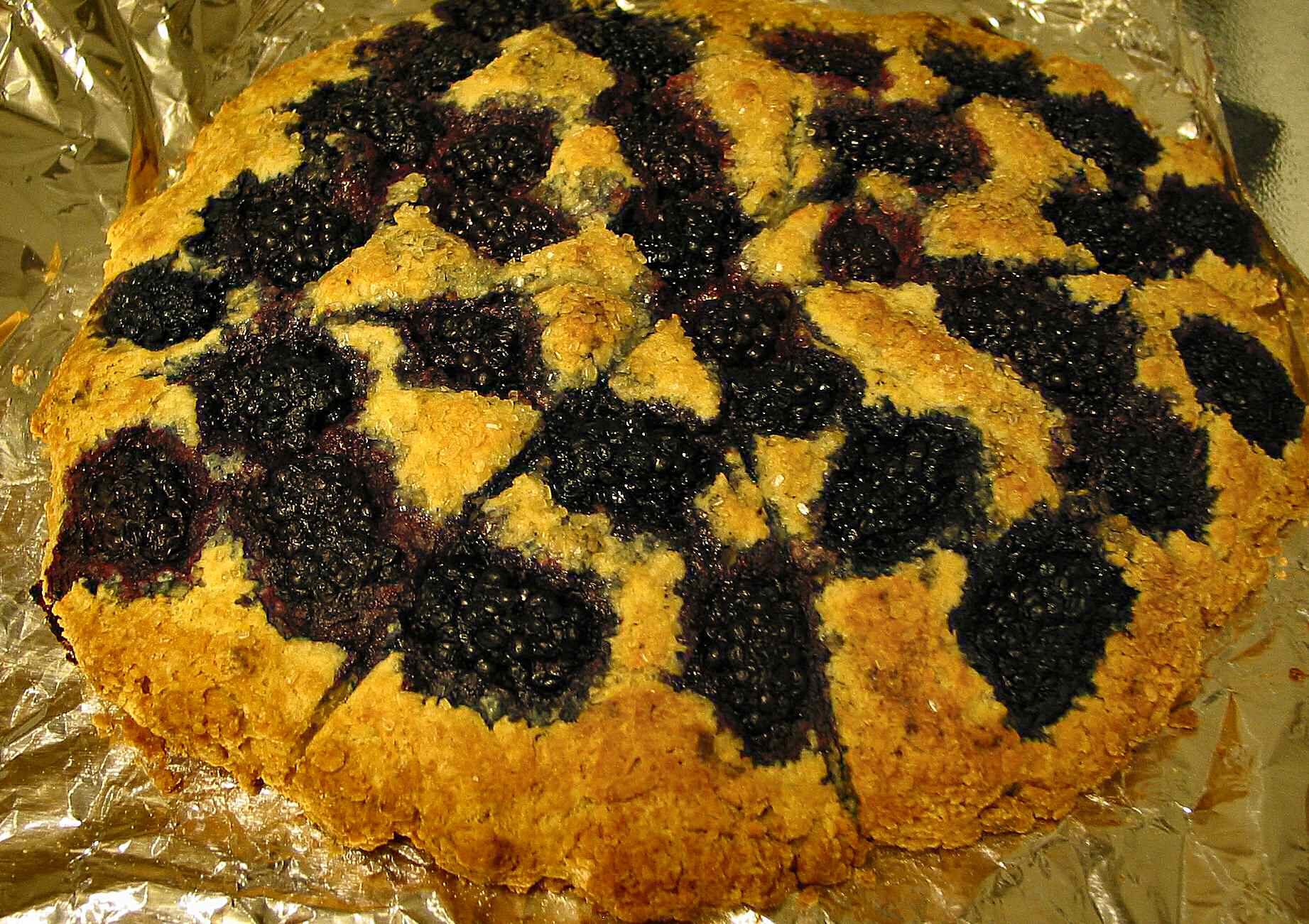
Blackberry scones for brunch

I’ve been wanting to post my favorite scone recipe for some time, but it seems to me that most food blogs start out with good intentions and end up maxing out on the desserts-and-starches end of the food spectrum.

The reason is pretty simple: if you’re a food blogger,  a baking recipe and a pretty picture (or any picture of an aggressively-frosted cupcake) will never put you wrong, even if the real result tastes kind of blah. I mean, cupcakes? Isn’t that what Duncan Hines is for? But if you do feature cupcakes, somebody’s sure to repost it or call it awesome, particularly if you figure out how to add bacon to it. Somehow people just don’t flock to posts about green beans in droves unless you’re redoing the Thanksgiving-straight-from-the-can classic, complete with canned fried onions.

There are way too many variations for every kind of baked good, none with a clear and permanent advantage, and people take them all literally (see under, my New Year’s apple pie insecurities).

So as I say, I’ve been reluctant to put up too many baking posts. Scones, though they’re not exactly the staff of life, are very easy to make and actually taste best when you make them from scratch–much better than buying them in a store and definitely not at your local Starbucks. The question I have is whether it’s a good idea to do it very often–I usually don’t, even on the weekend, but partly that’s because I live in southern California and heating the oven for more than five minutes in my little galley kitchen is often a Very Bad Idea. The other reason is that I keep remembering something Valerie Harper once said (maybe in the role of Rhoda Morgenstern; can’t remember): “I don’t know why I bother to eat this piece of chocolate cake. I should just apply it directly to my hips.”

Most quick breads (i.e., raised with baking soda or powder, or beaten egg whites, not yeast) do fine in a microwave as long as you don’t need them to brown. So lemon-poppyseed cake is okay, as is gingerbread. Scones, which to my mind require a deep and crunchy crust, need a regular oven to do well, but I make the sacrifice (90-degree weather makes it a genuine sacrifice) once in a while on Sunday mornings, because they taste terrific and they’re not exactly rocket science to make.

So if they’re that easy, should I really be posting about them–haven’t you already seen too many wide-eyed, “Look, Ma, I made SCONES!” kinds of posts?

Let’s face it. You can make great scones in a food processor from a very short list of ingredients for cheap, in about half an hour including baking time, and flavor them simply or exotically. Fruit or chocolate chips or chiles and herbs and cheese–all optional. I stick with berries and turbinado sugar, which makes the crust crunchy and glittery. Continue reading

Fruitcake and the Jews

A week or so ago, just before the Chanukah madness, my husband brought home what he assumed were The Goods from the local Vons (Safeway chain affiliate on the west coast)–a classic fruitcake, green and red candied citron glowing evilly amid chunks of walnut and raisins and other less identifiable bits and topped with syrupy pecans and glacéed cherries. Tacky as hell, we know. We love fruitcake anyway.

Why do Jews like fruitcake more than Christians do? You know, the kind of indestructible fruitcake everyone jokes about passing off to some unsuspecting cousin after having received it 20 years earlier and having kept the tin in the closet all that time underneath some shoes. The kind the British refer to as “doorstop”. The kind all modern cake blogs decry when they present their own lighter, cakier, less fruity and less chewy version as “fruitcake you’ll actually like.” THAT fruitcake.

Well. Private Selection or not, the cake from Vons was…I don’t know if there are new legal restrictions on using rum or bourbon or other booze as a baking ingredient these days (or ice cream flavor; hard to find Rum Raisin anymore). Maybe it’s a California-does-rehab thing, or just a huge downgrading of quality, but it. Was. Awful.

No rum. No bourbon or other appropriate flavoring. Instead, the loaf was permeated with an aggressively soapy flavor/odor (we couldn’t even tell which), horridly artificial and perfumy like fruit-scented liquid hand soap. Or that overpowering Dove soap I always hated as a kid. You couldn’t even taste the raisins or walnuts, which by all accounts, including visual inspection, were present.

We were, perhaps for the first time ever, not tempted to eat any more, not even to try a tiny second taste the next day to see if it was really as bad as we thought the first time. Just passing the open packet on the table was enough to convince us the bar of Dove that must have fallen into the batter was still giving that loaf its younger-looking complexion. After several days of forlorn looks in its direction, we actually threw it out.

In any case, I’ve been looking for a trustworthy recipe for fruitcake ever since and not succeeding much. In a place where there is no fruitcake, strive thou to make taka a fruitcake. (Not exactly sure what the “taka” part means in Yiddish; the way my mother says it, it means something like “especially” or “such a”, but less polite and more ironic, as you might use it when pointing out how incredibly garish and over-the-top the neighbor’s Christmas lights are with the Continue reading

Stuffed onions in a hurry

Stuffed onions ready for steaming in the microwave

With a microwave and a frying pan, you can make stuffed vegetables like Mehshi Basal quickly, and they taste even better than with long roasting. These are just rolled and ready for a few minutes of steaming in the microwave.

Just after Rosh Hashanah I posted my first-ever attempt at an elaborate Syrian Jewish dish of sweet-and-sour stuffed eggplants with quince, and because I had more stuffing than I needed, I went for seconds with Aromas of Aleppo on the spot and tried out the Mehshi Basal, or stuffed onions with tamarind sauce, which was actually even better. It was easier to put together and I was patting myself on the back when we tasted the results.

Still, given that I was using a lentil stuffing in place of ground beef, I was a little dismayed at how long the traditional braising and roasting took to cook the onions all the way through–an hour and a half at least, and that was after stuffing them. A second attempt in November, this time exclusively with stuffed onions for a congregation brunch, did no better on time, and I came away thinking that roasting was an extremely inefficient way to cook these–might even have toughened them inadvertently.

Why, you have to ask, should I make such a big deal about stuffed onions–they’re a party trick, after all, not standard cooking. But we discovered we really liked them, and they’re a pretty good kind of party trick. They were a surprise hit at the brunch. If I hadn’t snuck myself one while setting up in the kitchen, I’d have missed out altogether.

Actually, I think they fascinated everyone as much for the magic trick as for the flavor. People who’d never tasted them before kept coming up to me–and even my daughter–to ask, “How do you get the filling into the onions???”

If they hadn’t been so time-consuming I could have made double the amount and they’d still have disappeared. Or I could throw them together easily just for us on the odd weeknight as a treat–but one with some iron and fiber in it–instead of the standard pasta or rice.

So in the time since, I’ve finally rethought the process and come up with something that requires no oven time and cuts the actual cooking after stuffing them down to about 20 minutes or so–as long as you already have some cooked lentils (microwaved to perfection in about 10 minutes of cooking time and 30-4o minutes of standing time) and tamarind sauce (or “mock tamarind” sauce, a 5-minute microwave-assisted blend of prunes and/or apricots with water and some lemon juice, plus-or-minus tomato paste, applesauce and other flourishes you don’t really need for this) to hand.

I know, you probably don’t have these things sitting around. But this recipe might change your mind. Lentils are good stuff even on their own, and the stuffing here is a knockout.

Even genuine tamarind sauce isn’t so bad anymore, assuming you don’t or can’t just buy a prepared concentrate. I’ve sped the process up from an hour-plus to a few minutes just by nuking it, pulsing in a food processor, and this time, neither filtering it quite so aggressively as I did back in September NOR bothering to boil the stuff down to a sticky residue. It’s so much less painful, and I think it even tastes better, with more of the fruit character left in. See my notes at the end of the post for how to do it the quickie way (in modest jam-jar quantities, not quarts).

Anyway, back to the stuffed onions. I’m actually proud of myself for this one, and I’ve tried it three times in a row so I can vouch for it–the last time, I put my daughter to work stuffing the onion layers, and she did a great job.

For this method all you need are a microwave oven, a frying pan and a food processor. Instead of boiling the onions for 20 minutes to separate the layers, you microwave them in a drizzle of water for 5. Instead of braising the stuffed Continue reading