• Enter your email address to subscribe to this blog and receive notifications of new posts by email.

    Join 241 other subscribers
  • Noshing on

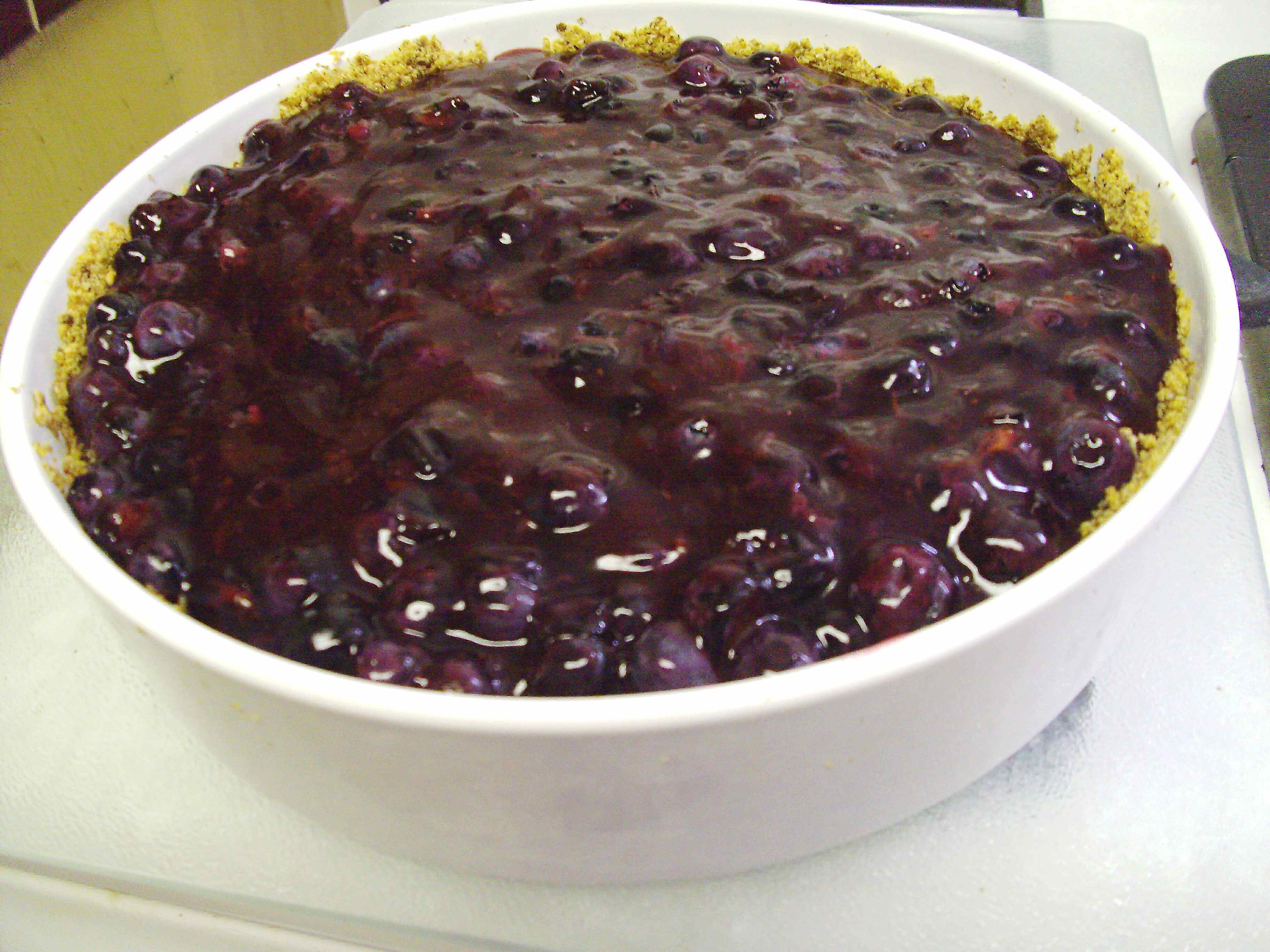
    raw blueberry pie with microwaveable filling and graham cracker crust

    This mostly-raw blueberry pie is a snap to make and very versatile--the filling microwaves in a few minutes, and you don't even have to bake the zippy gingered graham cracker crust--perfect for a hot Fourth of July and all summer long.

  • Recent Posts

  • Contents

  • Archives

  • Now Reading

  • See also my Book Reviews

  • Copyright 2008-2024Slow Food Fast. All writing and images on this blog unless otherwise attributed or set in quotes are the sole property of Slow Food Fast. Please contact DebbieN via the comments form for permissions before reprinting or reproducing any of the material on this blog.

  • ADS AND AFFILIATE LINKS

  • I may post affiliate links to books and movies that I personally review and recommend. Currently I favor Alibris and Vroman's, our terrific and venerable (now past the century mark!) independent bookstore in Pasadena. Or go to your local library--and make sure to support them with actual donations, not just overdue fines (ahem!), because your state probably has cut their budget and hours. Again.

  • In keeping with the disclaimer below, I DO NOT endorse, profit from, or recommend any medications, health treatments, commercial diet plans, supplements or any other such products.

  • DISCLAIMER

  • SlowFoodFast sometimes addresses general public health topics related to nutrition, heart disease, blood pressure, and diabetes. Because this is a blog with a personal point of view, my health and food politics entries often include my opinions on the trends I see, and I try to be as blatant as possible about that. None of these articles should be construed as specific medical advice for an individual case. I do try to keep to findings from well-vetted research sources and large, well-controlled studies, and I try not to sensationalize the science (though if they actually come up with a real cure for Type I diabetes in the next couple of years, I'm gonna be dancing in the streets with a hat that would put Carmen Miranda to shame. Consider yourself warned).

French reaction to food waste

Some things that rarely make it into US newspapers are considered more serious in Europe. Large-scale destruction of food, crops, livestock or arable land is one topic that really sets the French off, no matter what their political leanings. It’s an offense they’ve considered beyond the pale ever since Henry V invaded Normandy and Aquitaine in the 1400s. His officers and gentlemen destroyed crops and livestock wherever they went, siege or no, to the point that even their Burgundian allies wouldn’t forgive or forget.

Hence Le Figaro’s detailed account today of Moscow’s latest reaction to European and US sanctions for its invasion of Ukraine last year:

Le Figaro 8/6/15: Moscou détruit des tonnes d’aliments

The French newspaper reports that Russia’s agricultural agency has stopped merely confiscating and returning embargoed out-of-country produce to its country of origin and as of today is now destroying it outright within Russia, either at the borders with Belarus and Ukraine, or seizing it from store shelves. Tons of tomatoes, nectarines, peaches, and other produce, meats and cheeses from Poland and western European countries that have participated in sanctions against Russia are being crushed and dug under with farm equipment or else incinerated at a plant near St. Petersburg.

Given the likely hardship and isolation the Russian populace has experienced since Putin embarked on reseizing chunks of Ukrainian territory without admitting to it, you might think the best thing to do as a deterrent would be to seize the contraband and redistribute it evenly to the poorer citizens, and deny profits to the smuggler-importers. Grinding all that European-produced food under with tractors and the like may be a satisfying symbolic response for Putin, but it’s horribly wasteful and, as with the whole Ukraine project, not  a benefit to the citizens at large.

According to the article, the head of the Russian agriculture service admitted that destroying all that food doesn’t look good on TV. The country’s public media, including Tass, are portraying it pretty negatively.

He hinted that the contraband is suspect in quality as well as in political origin–some of the cargoes had been deceptively labeled as coming from Turkey or the like, but had really been produced in places like Ireland. From what I can gather, the reporter at Le Figaro wasn’t too impressed with that argument, and it’s possible that the head of the agriculture service wasn’t too happy about being ordered to destroy the food either but couldn’t say so.

And from the frequency of individual foodstuff mentions in the article, I’d say the waste of tons of peaches, nectarines, tomatoes and carrots and meat might be the greater part of the injury, but to the French, the destruction of all that fromage under tractor wheels was the final insult.

The only thing I can think is, it’s a damn good thing it’s still summer, because if the government did that in the winter, or close to winter, the public reaction might quickly become something other than merely unhappy.

Movie and a Pickle: “Deli Man”

About a week ago, my husband and I decided we were finally grown up enough to take ourselves out to a movie (and leave our slightly attitudinal teenager home to watch some sort of awful teen tv series without us). We’d heard from friends about a documentary called Deli Man that was showing at reasonable hours downtown, and it sounded not bad. We found parking at the bookstore next to the theater, ignored most of the threatening new signs about being towed if we didn’t shop the bookstore and get back out within 90 minutes (it was a Sunday evening, and the bookstore was closing early), and walked into a sparsely attended theater.

Which (the sparseness, I mean) was a shame for the theater and everybody who wasn’t there more than it was for us, because Deli Man is terrific.

You’ll laugh, you’ll cry, you’ll wonder what a Cordon Bleu-trained chef is doing in Houston kibbitzing with his customers in a strip mall deli while sweating the details behind the counter and agonizing over the memory of his grandfather’s idyllic but lost gravy recipe as he serves up gargantuan matzah balls, stuffed chops, and sandwiches you need to be a python to get your jaws around. Cue Jerry Stiller, Fyvush Finkel, Larry King and other New Yawk old-timers, the local Jewish community fans in Houston, and some of the best–and hopefully not last–deli men in the business.

See the trailer on YouTube.com


In between the semi-humorous profile of David “Ziggy” Gruber, third-generation deli man and one of the last under 50, plus (of course) all the kibbitzing from family and friends who wonder when and if he’s ever going to be marriage material, you get interviews with the old hands who themselves are sons and grandsons of the original great deli owners.

Sarge’s, 2nd Avenue Deli, Stage Deli, Carnegie Deli, Ben’s Best–most of the guys who are still in business and some who aren’t. They’re famous, they’re well-established, they dress nice…they’re still working backbreaking hours themselves and pushing their kids to get out and go to law school or into engineering because it’s such a hands-on business and training juniors with the right attitude is so difficult. And attitude is what counts.

David Sax (Save the Deli), Jane Ziegelman (97 Orchard) and Michael Wex (Born to Kvetch and Just Say Nu) trace the roots of the deli through the waves of Jewish immigration on the Lower East Side, the move to Jewish-style as opposed to kosher, and the decline in our times of a great old-neighborhood tradition as the old urban neighborhoods changed hands and Jews struck out for the suburbs.

You get a chillingly clear picture of why the number of Jewish delis has shrunk from thousands in New York alone after WWII to only about 150 nationwide today. At the same time you see why the deli guys hang in there–and so do their customers.

Jewish delis, kosher or not, are not the usual kind of American casual restaurant. They’re extremely personal and familial, as Jews still tend to be with each other. The old-style Jewish waiters would argue a lot; sometimes they’d tell you rather than ask what you were going to eat, and it became a classic shtick. But as Gruber pointed out on Alan Colmes’ Fox News Radio interview (and no, I can’t believe I’m providing a link to anything Fox either, but it was a good interview), the days of the cranky waiter are more or less gone.

And on the other hand, delis still deliver more for the money than the nouveau-hip places with $50 plates and $18 drinkies. The regular customers expect more–not necessarily more food (though that’s an impression you might get from the outsized portions), but for the deli owners and waiters to know them, talk with them, argue even–and remember exactly how they like their food.

We come from a culture that thrives on argument as a form of intimacy. If you’re not arguing (lightly, not nastily) with your wife, husband, kids, friends, shul members, and pretty much everyone else you care about…how can they be sure you’re really paying attention? It’s become a lost art, though–even Jews of my generation cringe when we hear our parents bellowing cheerfully up and down the stairs at each other. I had to train my genteelly brought up husband that there’s a huge difference between yelling out to him from the far end of the house and yelling at him, and I expected him to just yell back the answer and not get mad or insulted. He’s almost got it by now…

That kind of personal is what makes the give and take between kvetchy customers and ebullient owners work so well and it adds ta’am, flavor, to the whole experience of going to a deli. They know you, and they pay attention whether you’re a CEO or an average Joe.  You can’t get that in a chain restaurant; you don’t get it at a three-star haute palace.

Delis have also, at their best, been the kinds of places where seemingly hard-nosed owners were known to sustain their neighborhoods in hard times, sometimes secretly comping a free meal if a customer was out of work.

Deli Man is deliberately and intelligently personal even as it traces the history, the economics, the fans among the Broadway stars, and the paradoxical Americanness of the Jewish deli. There are plenty of old black-and-white vintage photos, a bittersweet tour of the Lower East Side and its remnants, and klezmer music from one of the modern greats. Far from becoming a Ken Burns wannabe, though, it’s funny, wry, well-paced, modern–and most of all, it gets to the heart of what makes a deli matter. From start to finish, this is a documentary that cuts the mustard. In fact, my only serious kvetch is this: too much pastrami, not enough corned beef.

Or pickles. So in honor of this movie I’m trying out a long-planned jar of pickled green tomatoes, something I remember with fondness and bemusement from my childhood. Whenever my grandparents would come down to Virginia to visit us, they’d schlep bags stuffed with good tough breads, real bagels, packets of corned beef and pastrami. Along with precariously packed containers–were they plastic tubs, or were they, as I remember, merely stapled glassine Continue reading

Purim: Poppyseed filling with a Persian-style twist

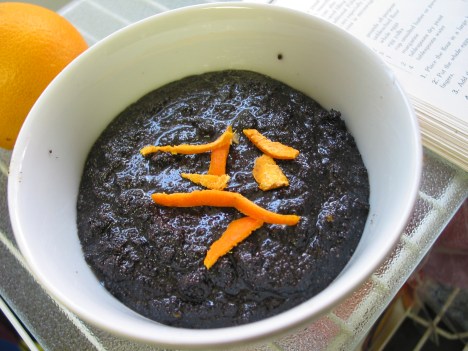
poppyseed filling with orange blossom water

Tonight is Purim, when we dress up in costume, make fun of dire villains and dull kings, cheer modest heroes and most of all praise a heroic woman, Esther, who risked everything to change the king’s addled mind and spare the Jews of the Persian empire.

In previous years, I’ve done the Hamantaschen thing–low carb, medium carb, all homemade, no pasty white horrors, praise of Joan Nathan’s basic recipe from her first cookbook…lots of non-Dayglo, non-candy fillings from figs, prunes, apricots, and so on…

Today I’m probably not going to get a chance to bake anything or even cook very much, because I decided to take a leaf out of Esther’s Megillah this year and read part of the fifth chapter, splitting it with my (much-wiser-than-Ahashverosh) husband. So about three days ago I decided I was going to go for it and learn the Purim cantillation (trope marks for chanting) system. Which takes more nerve than usual, because it’s tricky and somewhat deceptive, like the entire story. And it’s been almost two years, since my daughter’s bat mitzvah, since I’ve even chanted Torah. And, like I said, three days ago. Not brilliant.

Luckily there’s Youtube. And a number of synagogues post recordings by their hazzanim (cantors, male and female) for the cantillation marks and for the readings as a whole. Only there are so many versions for Purim! It’s a late holiday in our history, after a lot of us were living in the Persian empire, and the different melodies reflect our already dispersed community. One interesting version was by a Moroccan hazzan–his system actually had a couple of trope mark tunes that are nearly the same as ours for the regular weekly Torah and Haftarah readings. Maybe those are the oldest ones that everyone has more or less in common? Cool!

So–our daughter is chanting a few verses with her youth group for Chapter 7 tonight, and the director is bringing kosher Persian food from a restaurant on the West Side of LA, where the largest Iranian (and Iranian Jewish) community outside of Iran resides. I wish I were a kid tonight, for sure.

Still, in honor of the occasion and the roots, I did get around to making poppyseed filling for the hamantaschen I’ll make tomorrow.

I went to my local Armenian greengrocer yesterday morning for vegetables and picked up a new bag of poppyseeds, hoping they were fresh, really fresh enough to use. My previous latest bag in the freezer has puffed up suspiciously with air–suggests it’s no good and starting to release gases even though I didn’t open it before freezing, dammit.

I tasted the new poppyseeds raw–okay. But rancid sometimes only shows up when you toast them, so I poured a spoonful in a metal pan and swirled them around on the stove until the aroma came up. Then I test tasted those once they were cool enough. Still good, still lucky.

Poppyseed filling is quite an elaborate affair in my trusty 1984 spiralbound edition of Joan Nathan’s The Jewish Holiday Kitchen. Figs, apricot jam, brandy, egg whites? Oy. Ten or more ingredients. A production, and kind of expensive considering how many younger people don’t like poppyseed filling. Including my daughter, I’m sad to report (see below)…

But I do, which is the important thing, and my supermarket no longer carries those cans of Solo in the Jewish Foods section. So I decided it was fine to simplify. And while I was at it, to add a hidden Persian-style element or so for the occasion of Purim.

So this filling looks black…but holds the essence of early spring and orange blossom within it. And if anyone doubts that it’s completely effective in its ability to transform, at least temporarily, I should add that my daughter, who insisted she tells me every year she hates poppyseed filling with a hot hate, and that I never listen, took a tiny bite and looked surprised and pleased…at least for about five seconds, until the bitter toastiness of the poppyseeds came through like a bagel at rush hour, poor kid, and she pulled a Tom Hanks (from Big, the caviar scene). She even did the wiping-the-tongue-desperately-with-a-napkin bit. And no, I’m not sure I should be telling you this. Five seconds delay, though. From her, I’m gonna have to count that as a win. And it was pretty funny, another point to Purim.

Poppyseed Filling With a Persian Twist

  • 6 oz (172 g; it was the size of bag they sold) very fresh poppyseeds
  • 6 oz. sugar (again, 172 g, but anyway, the same amount as the poppyseeds)
  • 1/4 c (60 ml) water
  • juice of a lemon
  • orange part of the rind of an (organic, washed) orange or tangerine (in this case), grated or if that’s too much of a pain, shredded with a knife and ground in a coffee grinder or food processor with an additional spoonful or so of sugar
  • pinch each of ground cloves and cardamom (if you have it)
  • very tiny shake or grinding or pinch of nutmeg
  • up to another 1/2 c. water (see instructions and PS note at the bottom)
  • 1/2 t. vanilla
  • 1 t. orange blossom water (yes, this was my idea of the Persian twist, and it’s good, though probably it should have been rosewater for authenticity–I just wasn’t ready for that)

Taste-test the poppyseeds raw, then toast a spoonful in a dry steel saucepan on the stovetop until you start to smell their aroma. Cool and taste-test again before using to make sure there’s no funky, off, or rancid flavor to them.

ground poppyseeds

Then grind them a few pulses in a coffee grinder (in two batches) or in a food processor or blender.

In the steel saucepan, combine the sugar and water with a squeeze of lemon and let the sugar wet down all the way before turning on the burner to medium. Bring just to a slow simmer without stirring–the slurry should start to go clear as the sugar dissolves.
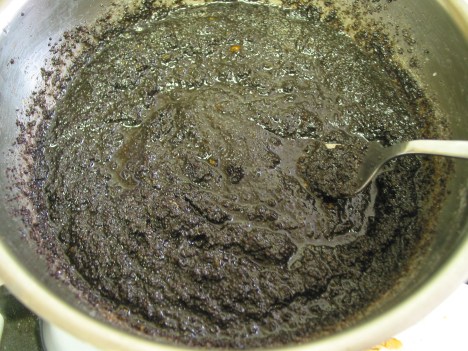
poppyseeds cooking in syrup

Add the ground poppyseeds and stir gently. It should be a thick dark-gray grainy mass. Keep the pot on a low heat so it bubbles gently but doesn’t spit for about 5 minutes, stirring occasionally but not hard or you might cause the syrup to seize. As it cooks add the lemon juice, spices, grated orange or tangerine rind and stir in, then [see the PS below] test-taste–if the seeds are still kind of hard, add 1/4 c. water, let simmer with a lid partway on for a few minutes, stir and do it again here until the seeds soften a bit and the raw-poppy edge is off. Add the vanilla and just before taking it off the heat, stir in the orange blossom water. Take a tiny bit and let it cool enough to taste and adjust any flavorings, then take off the heat and pour into a container to cool to room temperature. It will thicken further, especially after you put it in the fridge.

B’te’avon, bon appétit, and Chag HaPurim Same’ach!

PS…AKA, next-day “Do-over,” kind of. Because I wouldn’t want anyone to try this, be happy for a few minutes, and then kind of hate the result when they took a second taste. If it needs a fix, it needs a fix, and I felt this did…

The next day I took it out of the fridge for a taste test before deciding if I really wanted to bake…it was pretty grainy and the top was crusted sugar. I stirred it and realized the seeds were pretty hard still and kind of bitter–not rancid, just really raw-poppyseed. Very strong. I think I didn’t have enough liquid in the recipe compared with Joan Nathan’s, even without all the jams and things. She had “juice of an orange” in there somewhere next to the juice of a lemon, and I’d assumed it was mostly for flavor, but probably the extra liquid helped cook the poppyseeds too (hence, the “up to another 1/2 c. water” bit I’ve just added to the ingredients list).

Never one to look away from a challenge (oh yeah? I hear someone muttering sarcastically in the background)…I decided to reheat the filling in the microwave with some extra water and a lid for a minute or so and see if that would induce the poppy seeds to absorb some of the water and soften up a bit. I stirred in about 1/4 c. of water, which immediately went cloudy-white, kept stirring, and the filling thinned almost to pancake batter consistency. Put a lid on and heated 2-3 minutes in the microwave, let sit a few minutes to absorb. It was better as well as thicker, and a little of the poppyseed bitter edge was out as well. So I did it again with another 1/4 c. water, heated 2 minutes or so, let it sit again and it thickened back up but the seeds were definitely softer and a little more brown than black (although I admit it’s pretty hard to tell).

In any case, I’d do this the first time around while it’s still cooking on the stovetop. Add the extra water in bits after you’ve added the poppyseeds and spices, and before adding vanilla or orange blossom water (so you don’t evaporate them off). Expect to cook it down from about pancake batter looseness until it becomes very thick, a grainy paste. Then taste a little and feel to see if the seeds have softened and mellowed in flavor–add more water and cook longer or else do the microwave thing instead if you’re impatient, but I think it might only take maybe as much as 15-20 minutes on the stove rather than the 5 minutes I’d expected.

Safety: The only thing about heating syrups in the microwave (this is basically a syrup with seeds) is that they can get very, very hot. So 1. keep an eye on it while it’s heating and be ready to stop the microwave if it starts to boil over (this didn’t, either time, but you just don’t know) and 2. don’t use a plastic microwave container because the mixture could melt or scar plastics. Proper microwaveable ceramic or old-style borosilicate pyrex is ok if you still have some from 20 years ago or can find it in Europe and tote it home. (NOTE: “new Pyrex” that clanks and is made outside the US is made of soda lime glass and is not very heat-stable–see right sidebar warning).


Media misread on the new USDA dietary guidelines

The new USDA public nutrition guidelines are being updated again, as scheduled, and the Dietary Guidelines Advisory Committee’s version now says some egg yolks are okay and to limit carbs and sugar instead. A variety of media commentators have jumped all over that, even though it’s not very different from what the guidelines have been emphasizing for years. Now, if anything, I would have hoped that most of the commentaries in the newspapers of record would be critical of the industry influence on the USDA’s nutrition guidelines for the general public each time, but no.

The most prominent commentators, notably Nina Teicholz, whose op-ed in last Sunday’s New York Times really bothered me, are well-educated and should know how to “read a french fry” as it were. But instead of looking at the likely effect of loosened USDA dietary limitations on a public that has gone so seriously overboard on calorie-dense food, they’ve taken the opposite tack. Mostly to declare self-righteously that the new relaxation of standards really means all the previous recommendations to limit saturated fat and cholesterol were bunk and a waste of time based on “uncertain” and “weak” or even “junk” science.

Which is untrue. Epidemiologic research–large observation studies and surveys, like the NHANES diet and cardiovascular health survey series from the 1970s onward, and the big Framingham Heart Study of the 1950s onward, are not junk science. They do what clinical feeding trials can’t: they look for the contribution of individual dietary risk factors to chronic and complex-origin health conditions like heart disease and stroke across very large population groups. Both the processed food industry and people like Teicholz claim that clinical feeding trials are the only legitimate way to provide “proof” of cause and effect, but the cost of conducting them carefully long enough and with a big enough participant pool for meaningful results would bankrupt the nation halfway through.

Epidemiologic findings matter on the large public scale. Not every specific applies absolutely and equally to every single person, but that’s not what population-wide studies are for. The big studies, loose as they might seem compared with DNA fingerprinting and perfectly demonstrated cause-and-effect kinds of lab workups for individual cases, give best-bet recommendations for most people to reduce their risk.

Your genetics determine how well that works for you specifically, but most of us don’t have access to DNA testing on that level, and the “big six” lifestyle risk factors (high sat fat, high blood cholesterol and blood pressure, overweight, lack of exercise and smoking) are a lot easier to change and get some control over. After all, you can’t change your genetics much (and yes, my daughter is quite disgruntled that she can’t pick cooler parents. But tough. We couldn’t pick ours either).

So anyway, I know I’m unusually irritated with any news about USDA dietary guidelines–I used to work at NIH, and some of my colleagues had attempted to serve on the dietary guidelines committee and ended up completely frustrated at how “bought” the process became. The USDA has always had a conflict of interest when it comes to public health recommendations because its main mission is support of US agriculture, and public health always comes a distant second to big business. The committees have repeatedly subverted and weakened the scientific nutrition panelists’ best-finding recommendations by including food industry participants and weighting toward industry priorities in the consensus mix. There’s no great reason to expect the food industry isn’t still playing and winning the same game on the same committee this time around. [Update: the meat industry has just asked for an additional 75 day comment period].

But the main problem I see at this point is how poorly mainstream journalists and editors have handled the announced overhaul. None really seem to have dug into the comparison between current and previous issues of the guidelines, much less compared the USDA’s final takes with dietary guidelines from the DGAC, a combined group of more purely biomed/scientific research experts representing HHS (including NIH) and the FDA, or those of the major health advocacy organizations such as the American Heart Association.

And declaring that it’s now fine for anyone to eat all fats without limitation is nonsense and a misread. The USDA guidelines don’t say that–the DGAC draft guidelines certainly don’t say that. And if the USDA does attempt to drift in that direction for the final release, as some of the director’s announcements suggest, given the participation of Big Food and Big Agriculture hoping to sell the public more meat, eggs, and cheese, along with more profitable processed goods, would you necessarily believe them?

Is it really the fault of the scientists on the panels over the years, as Teicholz claims (“How did they get it so wrong?”), that the epidemiology findings they relied on for previous rounds of recommendations weren’t borne out by much smaller and less conclusive clinical studies?

Maybe the role of saturated fat is less apparent in a clinical study. I don’t doubt that. But as noted above, the statistical power of the comparatively short-term clinical trials for cardiovascular disease effects is bound to be a lot lower than in a long-term population-wide study, even if the controls are tighter. There are so many interfering factors–other dietary and lifestyle factors, and so many varieties of genetic risk factors within and among different population groups, genders, and age groups, that you need the big numbers and the large timescale to see effects above the noise. Meta-analysis of a lot of limited clinical studies with iffy results doesn’t make up for that. If anything, it compounds their individual uncertainties.

[And in fact it turns out that much of Teicholz’s assumption on that point is based on a very poorly conducted, much criticized meta-analysis of studies on saturated fat and cardiovascular disease published last spring. Most inclusive meta-analyses performed using standard stats analysis best practices actually show reductions of between 14 and 26% in CV events and deaths when subjects cut their saturated fat intake below 10% of calories and ate more vegetables instead of carbs, or else substituted polyunsaturated fats for them.]

Teicholz’s op-ed had carefully modulated but still overt indignation at the imperfect scientific basis behind previous recommendations to cut saturated fat and limit egg yolks and other high-cholesterol foods. What should be there and isn’t is the acknowledgement that when those recommendations were first announced to the public–by the AHA, the CDC and the USDA in the late 1960s, population trend studies over the next 10 years showed a stark drop in the rate of heart attacks–about a 30 percent drop. In other words, it worked. Big time.

And the broad peak of the population curve for a first heart attack shifted to the right by 10 years–that is, the average age for men went from about 50 to about 60, and for women from about 60 to 70. These were huge improvements in public health overall, and they were achieved partly because the public believed and paid attention, and partly because the nutrition and health experts hadn’t given up and abdicated responsibility in the face of industry pushback.

Clearly these results didn’t last; but is that the fault of the studies that identified saturated fat and cholesterol as things to reduce (note: not eliminate completely, just reduce)? The 1980s ushered in a long Republican-led era of unfettered, uncritical support of corporate priorities over public health, Reagan’s “ketchup is a vegetable” quip and the conversion of school lunches to chain restaurant concession contracts, a popular nose-thumbing at so-called “food police” health recommendations, the rise of high-fat-and-sugar-and-oversized-portion “comfort” and “indulgent” foods in restaurants and food magazines, and an entrenched anti-science bias in Congress that still haunts us today.

Not that much has changed from Reagan’s time in office–including the sad observable fact that most Americans for the past decade or so clearly aren’t paying serious attention to or even attempting to follow those modest earlier USDA recommendations, particularly the recommendations to eat more vegetables rather than more boxed, labeled namebrand processed foods, whether Big Macs or Ding Dongs or Froot Loops…

So few Americans today eat any vegetables at all compared with people of the same ages in the 1970s. As I’ve mentioned before, a shocking number of my friends, in their 40s and 50s already, do not cook at all. They have advanced degrees, if mostly in the humanities. They nervously repeat but don’t understand how to  read between the lines of whatever diet and health claims are in the news, and they’ve come to think cooking is too hard. They have a lot of takeout menus on their iPhones.

There is just one more factor to mention here: the profit motive. Teicholz, a former contributor to NPR, Gourmet and Men’s Health, wrote that op-ed in part to promote her new book, The Big Fat Surprise, which claims that diets high in meat, butter, Continue reading

An Appreciation of Lox

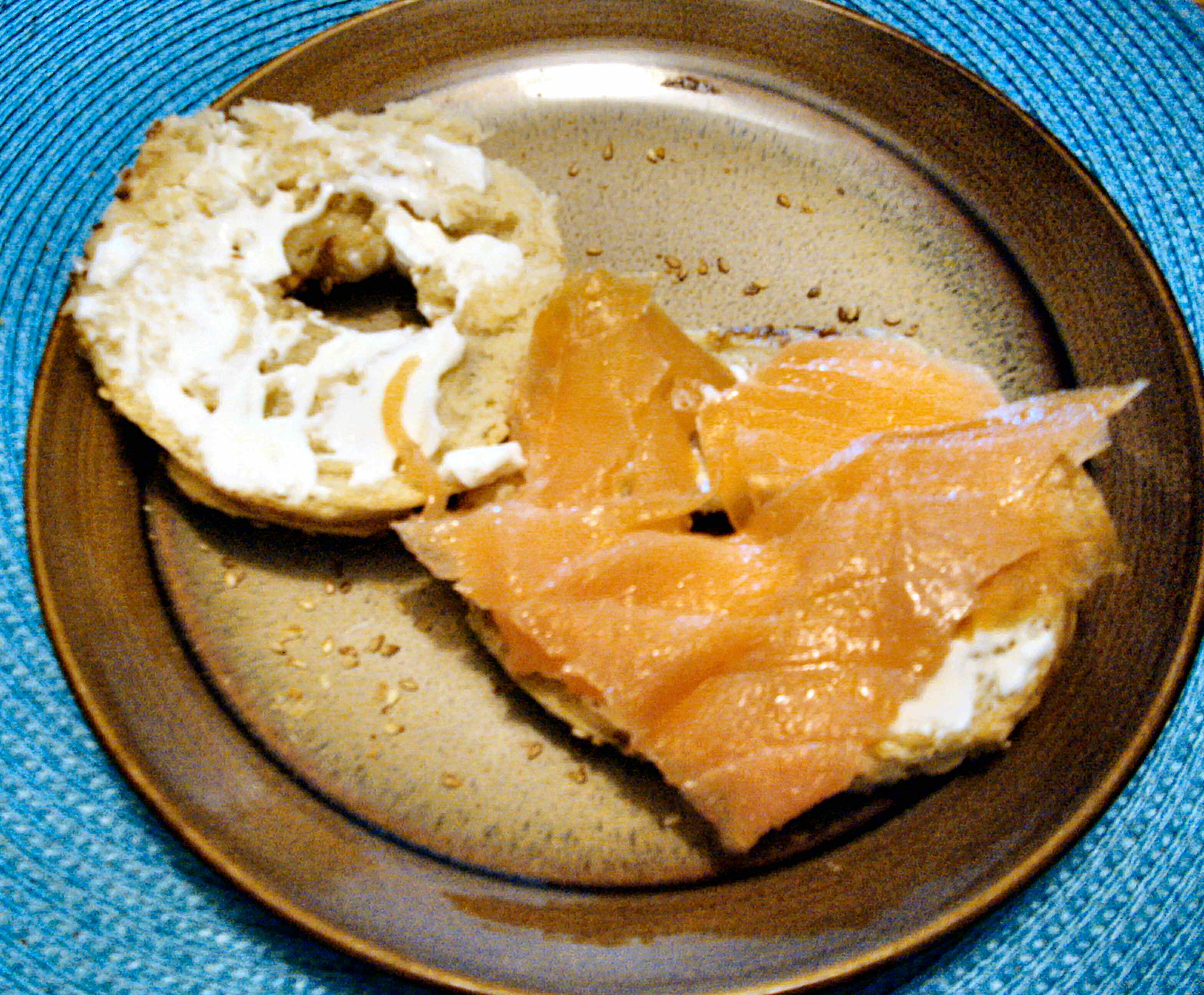
bagel with nova lox

Homemade bagel with nova from a local Los Angeles smoked fish company


For its annual Mother’s Day brunch, the Men’s Club at our synagogue always serves a surprisingly lavish spread with the woiks–lox, bagels, fruit salad, eggs and mimosas. Although I’m not a huge fan of big and slightly-kitschy gatherings featuring big and slightly-kitschy piano acts, I really deserved someone else making me a lox-and-eggs Sunday brunch right about then. But at the last minute I had to miss it in order to hock my kid about her last oversized ridiculous semester projects for 8th grade (due the next day, naturally). Better mothers complained to the principal, who just smiled nicely but did nothing useful. I just figured we’d get through it all so my daughter never had to be an 8th grader again. It worked–salutatorian, even–so, moving on but not required to give a speech: win/win.

But the lost lox! and the not having to cook or do dishes for Mother’s Day! Then I agreed to chaperone a school science camping trip the last week before graduation and  ended up with sand, grime, KP duty, outdoor showers, iffy Boy Scout Camp-style food, and not just one but 32 whole teenagers preoccupied with their hair and late to class.

So now that it’s all over I’m in serious need of payback.

My local Armenian greengrocer has locally-smoked nova lox (they have sable, too–I was tempted) and I had a bowl of dough in the fridge just sitting there waiting to be used up–so I made a few impromptu bagels the last Sunday morning of the school year, as soon as I’d gotten all the sand back out of everything and my kid was done with classes for the year. The bagels weren’t quite as dense as they ought to be because I used my standard pizza/pita/calzone dough instead of the genuine classic, but they did well enough because the dough was several days old, cold-proofed and straight from the fridge, and I boiled them before baking. And there was lox. Throw in a few once-over-medium eggs and some shmear and some fruit and hot coffee and you’ve got the ideal late-spring/early-summer breakfast, even if you have to make it yourself.

Now I know lox is a high-salt item–even the Nova. I anticipate it not for the salt, which I always think we could do with a little less of, but because it’s lox. A delicacy. Something to enjoy on the rare occasion when you get to celebrate. Something to treat with respect.

I’m not going to apologize for enjoying it, either. In the modern world of food publishing, people are forgetting how to do that. Even Jews. Maybe especially Jews, some of whom act as though our traditional deli and “appetizing” (bagels, cream cheese and smoked fish of all kinds) is suddenly something to shove under a rug or apologize for liking on the grounds that it’s not organic or locally sourced or Whole Foods or food-mag-trendy enough, and because it doesn’t include bacon or pancetta. Or kale.

The idea that enjoying lox simply because it’s lox isn’t cool enough anymore has gained a lot of traction in the past few years of foodieism. A couple of years ago, Martha Rose Shulman committed a serious travesty in the New York Times with “Lavash Pizza with Smoked Salmon” (she didn’t even call it lox). Toasted lavash is perfectly good for other things, but not for lox. Too fragile, and frankly too flavorless. I mean, why not rice cakes, as long as you’re being tasteless? But it wasn’t just the bread choice.

Somehow Shulman had abandoned the Joy of Lox. Shulman actually called her lox on lavash “a great way to work more salmon, rich in omega-3 fats, into your diet.” I have to ask, are most of us really having that much trouble “working in” more salmon? More to the point, does any lox fanatic really want to be thinking about fatty acids of any kind while eating it?

But at least she wasn’t agonizing over it as too Jewish. Mark Bittman pulled this inexplicable self-flagellation-in-print a few weeks ago in the New York Times, apologizing publicly for eating lox and bagels on a Sunday morning. In New York, yet. (Maybe it’s because he moved to Connecticut?) He’s kvetching about skipping his morning run, his usually-so-virtuous-but-betrayed-just-this-once-by-shameful-genetic-temptation stance on (gasp) farm-raised salmon, his devouring of shmear, which he says is too bland for the calories to like officially. He even had the nerve to blame his decision to eat it all on a sudden mental breakdown. And then he went further and called bagels and lox “comfort food.” As though it were in the same low-grade category as mac and cheese or mashed potatoes from a box.

Vey ist mir! I mean, come on. I’m pretty sure Woody Allen still eats lox without apologizing for it.

Bittman should be apologizing for being ashamed of enjoying lox (all the while glupping it). Along with apologizing for promoting pancetta and guanciale while professing a greener and more affordable diet. And for forgetting to add garlic to his recipes. That’s almost worse than deprecating lox.

More recently, Melissa Clark met with one of the scions of Russ & Daughters, which by now you’d think was the only serious lox and whitefish emporium left–it’s the subject of a documentary I just missed at the last LA Jewish film festival. The two laid out a spread for at least thirty or forty very lucky people, by my standards, but I think they were doing it mostly for a few family and friends–maybe 10-15 people–and posing it all on the table for the camera. It was beautiful but way too much. At least, though, she was both thrilled and nostalgic, the right way to be when faced with a complete beauty pageant of smoked fish.

Altogether, I could only think Shulman, Bittman and Clark all grew up in big cities with too much lox around. Because when I was a kid in the small-town South, we could only get lox twice a year when one or another set of grandparents came down from New York.

Other people’s grandparents bring toys. Ours brought pastrami, corned beef, half-sour kosher dills, pickled green tomatoes, real bagels, serious breads you just couldn’t get down South, and lox. All of them were special, not just to us but to our grandparents–real deli was part nostalgia, part roots, part pride, part simply great eats.

Pastrami and corned beef to go with the pickles and the tough, chewy pumpernickel and rye with the union label pasted on the end (you were supposed to fight for it)–these were the working people’s foods of their youth on the Lower East Side and the Bronx,  and they still loved them. And so did we.

My mother’s parents, born in the shtetls of Poland and Ukraine, came to America as children and, thank G-d [only instance of poverty being worthwhile], couldn’t afford to go back when their parents got homesick.

Fast forward to the ’70s: My Grandma Thel, short, plump but ladylike, coiffed, and wearing those pale oxford pumps I used to think of as librarian shoes, would step off the little regional plane in Charlottesville loaded down with huge grocery bags full of chewy, crackle-crusted bagels, Jewish kornbroyt or “corn bread” (a heavy European wholegrain sourdough; no actual cornmeal except what’s dusted on the baking sheets to keep the loaves from sticking), rye bread laced with bitter caraway seeds, sometimes a babka, and always, a huge half-wheel of her own light chocolate-flecked sponge cake (for which I’ve inherited the recipe but haven’t tried it yet–will post when I get it right). I hope the other passengers were smart enough to be jealous. The aromas alone should have clued them in. Grandpa Abe, of vishniak fame, was a lucky man.

On the drive home from the airport, Grandma Thel would tell me and my sister how she just managed to argue another customer at Andell’s or Goodman’s out of the last loaf of kornbroyt with seeds because she was bringing it down to her very special grandchildren so we would grow up knowing the real thing, and that the other lady Continue reading

Purim options

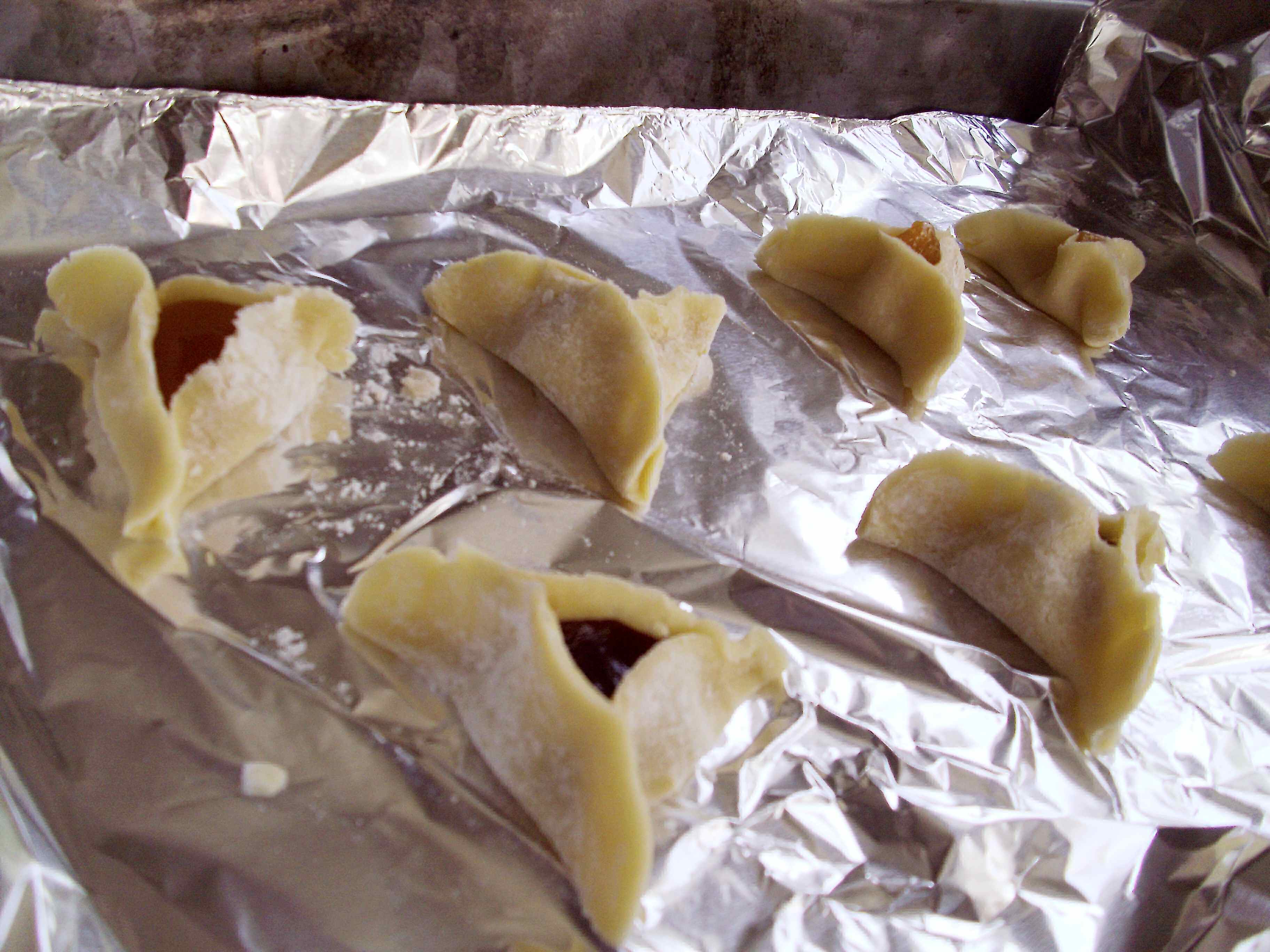
standard cookie-dough hamantaschen

Regular hamantaschen with prune lekvar

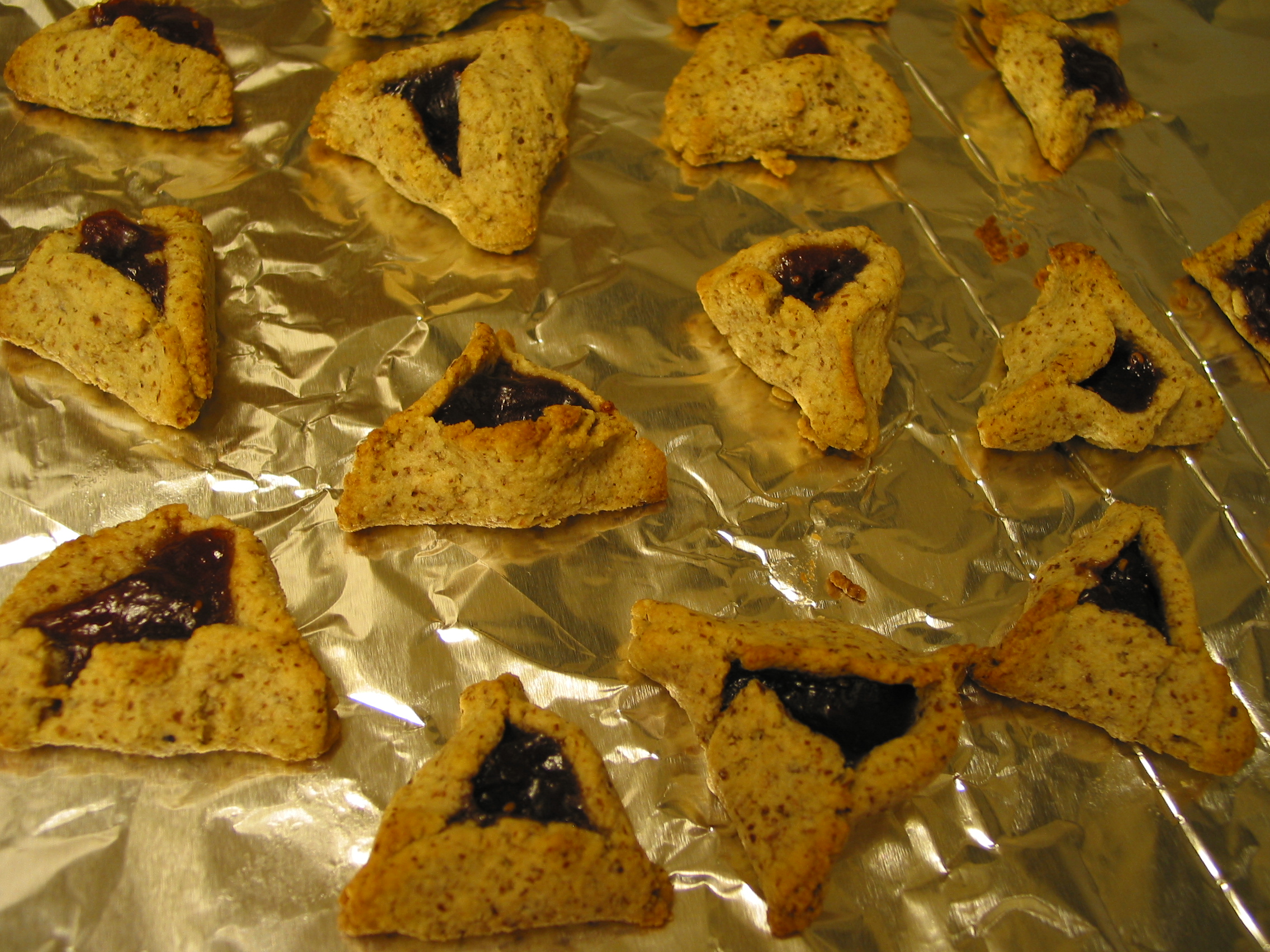
Almond meal-based low-carb hamantaschen

Almond meal-based low-carb hamantaschen

Purim is here tonight, a little late thanks to the “leap month” this year (drawbacks to a lunar holiday calendar) but none the worse for it–it’s over 80 degrees here, which means it’s almost time for Purim. Los Angeles is the only place I’ve ever been, including Israel, where people were slathering sunblock on their kids and gasping for water bottles at a Purim carnival well ahead of lining up for hamantaschen and games. It was 94 degrees that year. Fifteen years of this and I’m still not used to it.

Purim, of course, means manic baking, heat wave or no, because the adults’ reading of the Megillah (the Book of Esther) had…ummmm….last-minute planning and no one thought about hamantaschen as part of the refreshments until midweek. I think I’m the only one left in our  shul who still doesn’t care about having a fabulously original themed cocktail party for the adults afterward. Any kind of cocktail party is more drinking than I want to do, and I’m damned if I wanna dress up in full office battle array again after so many years sidestepping all the suits in my closet, just so I can fit in with the Mad Men theme. I’ve never even seen the show.

But I actually make hamantaschen at home once in a blue moon instead of schlepping over to the Valley to buy them from a kosher bakery.

So I did the stupid, crazy thing and volunteered. How many people? I asked–maybe 60. So I have SIX batches of dough sitting in my freezer relaxing. It took about half an hour, about 5 minutes apiece,  to do all the batches in the food processor, one after another and weighing out the ingredients so they’d be consistent. And yet…after all the excitement from two weeks ago, I’m just not all that geared up to roll it all out and bake it just this minute. Maybe when things cool down slightly–half an hour? Maybe?

Friday happens to have been Pi Day as well–and to my daughter, who was supposed to be my second-in-command for this delicate operation, and to her algebra teacher this morning, that meant Pie Day. They had about four different kinds of pie for all the math classes, and none of them had to calculate the areas or volumes of the wedges they sampled. My daughter, of course, was so elated that she ate two entire meals’ worth of carbohydrate in about fifteen minutes, and still came out with a pretty good blood glucose number an hour later–good on the calculated guesses, there–but at the cost of running through insulin that could have lasted her three or four more hours if she’d eaten an ordinary lunch. Teenagers! Mothers of teenagers!

Still, not to lose the spirit of things too much. It occurs to me that hamantaschen qualify as very small pies, only triangular. So we eventually started the process of inscribing a triangle inside a circle–240 times, if we can get through all the batches before showtime. Me, I’d settle for 3 or 4 batches and call it a week.

The raspberry jam filling–all that hard work for the first batch of rolling and filling–leaked all over the place. Too bad there isn’t still a vogue for vampire-everything; the first batch would have qualified! Too thin. You need a thick serious filling to stay in place during the baking.

So–time to nuke the prunes for lekvar and the figs for the heck of it (plus toast a small sampling of the poppyseeds in my freezer to see if they’re still okay to use for a filling, and to make sure I don’t pour in the bag of nigella seeds instead by mistake!). I rarely see these anymore, but I still believe in doing traditional fillings alongside the modern, newfangled apricot-jam-and-chocolate-chip ones. It’s true that if we keep skipping the prune filling, we might not turn into our own grandparents, and if we miss out on the poppy seed filling (known in Yiddish as mohn) we might pass the all-critical drug tests (à la Seinfeld) with no interferences, but then again we’d miss the ta’am, and what’s the joy of hamantaschen without a taste of the past?

Hamantaschen Recipes

Low-Carb Almond Meal-Based Hamantaschen

My version of Joan Nathan’s Hamantaschen, with four fillings: poppyseed, prune, apricot/chocolate, labaneh/cheesecake

Microwaveable dried fig and dried apricot fillings (originally for fillo pastries, but still good for this, and a lot less drippy than jam)

However–if you are feeling “Mad Men”, you might think of reconfiguring the hamantaschen motif for cocktail party fare instead. I was thinking about this Thursday but figured it would be too weird. Then I saw an article about it yesterday in one of the big three newspaper cooking sections–dammit! scooped again! In any case, if you’re feeling a little avantgarde, you could do a batch of savory hamantaschen if you feel like it. Use rugelach, bureka or olive oil tart dough instead of the standard sweet dough. Roll it out fairly thin, and fill with feta or bleu cheese mixed with labne or very thick sour cream, plus a little onion and some thyme, maybe a pecan or two. Or something with very cooked-down mushrooms and onions (so they don’t get soggy). Or pesto and cheese. Or spinach with cheese and nutmeg and lemon rind. Or tapenade. Etc.

Chickpeas of all sorts and descriptions

Since Esther supposedly refused meat and ate only chickpeas, chickpea recipes are also more or less relevant to Purim. Mine are not particularly traditional–look up Iranian Jewish recipes elsewhere on the web.

Chickpea crêpes  These can be savory or sweet, and they don’t require eggs or milk

The “other” moussaka–eggplant and chickpea stew

Hummus from scratch (aka how to nuke dried chickpeas)

Fast Hummus made with chickpea flour (microwaved)

There’s also the possible “nahit”–fry chickpeas in olive oil, drain and sprinkle with salt and pepper.

Or a cold chickpea salad with mint, scallion, garlic, olive oil and lemon juice or vinegar.

Or channa masala dal, something like the red lentil dal but with chickpeas (and not mashed)

Instant Pickles, Hold the Salt

Fast-marinated cucumbers, half-sour kosher dill style

One of the things that kept me motivated for blogging SlowFoodFast after the first fine careless rapture was my indignation at how popular over-the-top salting was becoming in popular food magazines, cookbooks, blogs and TV shows as chefs became celebrities, and how dangerous I knew it was for most people to eat that way regularly. A large part of my career a couple of decades ago was exploring the history of dietary sodium in cardiovascular research and writing about the DASH Diet.

What I’ve missed the past few years is just how many people, particularly younger ones, are starting to take up the challenge of cooking low-sodium and blog about their trials and successes. There’s a whole community out there, and they’re cooking pretty well. It is definitely possible, and generally easy once you get past the “how do I read a label and cook from scratch” aspect.

I just ran into Sodium Girl (aka Jessica Goldman Foung)’s blog-based cookbook, “Sodium Girl’s Limitless Low-Sodium Cookbook”. Diagnosed with lupus and kidney failure in her early 20s, she turned around her diet by dropping her sodium intake drastically to give her kidneys a rest in the hope they’d regenerate, and it worked. She’s been innovating with low- and near-to-no-sodium versions of favorite foods ever since, working with the National Kidney Foundation and other organizations. Her book, like her blog, is attractively photographed, full of cheerful writing and surprise takes on favorite foods.

One of the substitutions she makes that I have to approve of is a molasses-and-vinegar-based “faux soy sauce”. So I wasn’t the only one!

Another of her successful experiments is pickles. She goes for sugar-and-vinegar-style pickles, which makes sense, since they have no added salt in them, but I can’t help it–I have always cringed at sweet pickled anything. If it’s supposed to be a pickle, for my money, it’s gotta be a half-sour kosher dill and nothing but (or else an Indian lime or mango achaar pickle, or Moroccan preserved lemons, but that’s another story and still pretty high-salt at this writing. I’m working on it, but not yet holding out a lot of hope…)

Anyway, looking through Foung’s book reminded me of a simple, hearty and low-to-very low sodium version of my favorite pickles in the world. Continue reading

Say “Celà n’est sûre[-gelée-]ment pas le cas”

Following on reports this spring that Polish (and probably other-sourced) horsemeat made it through France and into British frozen supermarket lasagne, now we get word of even more devious (and frankly depressing) culinary misdeeds in today’s Washington Post online:

French restaurants acknowledge serving factory-frozen food

A surprising number of cafés are apparently serving up microwaved meals instead of cooking them in-house. Even the éclair, which doesn’t take a lot of time to cobble together, even for an amateur like me, is no longer safe. The profit margin is too high on these items, and the savings in cooking staff are phenomenal. In a down market, what else would you expect?

But it’s a big embarrassment for a country that’s traded primarily on its gastronomic leadership for decades since WWII. No, WWI. No, wait–probably since the Napoleonic era. Or before the Revolution. Cyrano de Bergerac does a soliloquy based on cream horns and other such items, if I recall.

Well, to tell you the truth, though, I’m not sure whether I’m shocked or relieved. Judging from what my family and I were able to eat in 2006 in Paris, I’d say that in a few cases (cafés within walking distance of museum exits, chosen in part for meltdown-avoidance) frozen might even be a step up from one or two of the overpriced restaurant meals we had (a horrid, horrid “salade niçoise” featuring canned green beans comes to mind). Those few meals were, and I can be generous when I have to, mediocre in a way that would be excusable in suburban America on travel but which were much less than okay given that it was Paris.

Mostly we ate food that wasn’t (comparatively, anyhow) too expensive (we skipped the meat dishes, since we keep kosher) and couldn’t be frozen well enough to fool customers who know how to cook. So omelets cooked where we could see them, felafel served with freshly chopped red cabbage, open-faced sandwiches, breads from a bakery that smelled like yeast and flour, not like plastic bags, and so on. The frozen items tended to be ice cream, which is supposed to be frozen. But that was a year or so before the big bank crashes, the collapse of the housing bubble in America and “too big to fail” and even the Madoff scandal. And even then things weren’t quite as glam, at the moderate end, as we’d been primed for.

And on the other other hand, what does it mean that so many French restaurants have resorted to this kind of tactic, microwaving (and charging for) tuna steaks with ratatouille accompaniment, as in the article? What, other than money of course, and the effects of a deep recession that’s hit France pretty hard this past year.

What it means, in part, is that (also according to the article) flash-freezing techniques are now at a point, at least in France, where they can keep the food acceptable in quality and that the suburban factories where these dishes are put together and frozen are doing a pretty fair job, fair enough to fool even moderately experienced diners (not just tourists). And that the “restaurants”–who knows if they’ll get to keep that title now that they’ve been exposed–have figured out how to be at least marginally competent at microwaving so they don’t just ruin the food.

Better if they were cooking fresh. Or, from the perspective of an avid microwaver, better if they were using their microwaves for something more sophisticated than defrost-and-warm. Better, since so many of the younger working French no longer cook for themselves very much, if the restaurants, cafés and bistros took their role as gastronomic role-model and rallying point a little more to heart. Certainly they shouldn’t be pretending to cook from scratch and charging commensurate prices.

But I wonder–is the food they’re serving significantly better in quality than America’s mass-produced frozen meals-for-one? It might just be, since it’s a more recently introduced phenomenon in France, and it’s been designed to pass muster as though it were cooked fresh. For such a fraud to be successful, the flash-frozen food cannot be like American tv dinners. It just can’t. It might be that many of these factory-produced dishes are still a lot less processed than the miseries perpetrated by Swanson, Kraft, Stouffer’s and so on over here. So maybe we need to take another look at their techniques and demand better quality in the frozen food section here, foods that don’t have aroma of oversalted wet cardboard clinging to them once thawed.

You must read this. Take an hour if you have to.

Today’s New York Times has an excerpt from investigative reporter Michael Moss’s forthcoming book on the processed food industry’s push to engineer addictive foods. It’s a long article, more than 12 pages, but well worth the read.

The Extraordinary Science of Addictive Junk Food – NYTimes.com.

Rugelach and the Chanukah Fairy

Doesn’t that sound like the perfect title for an equal-opportunity holiday-themed kiddie book? Too bad my daughter’s too old for it now, and so are my nephews. Plus no one under 30 knows how to pronounce rugelach anymore. The “ch” always makes for Adam Sandler jokes because it’s so obviously Hard to Pronounce and even more obviously Not English–you use your throat to talk? Gross joke alert! The young and self-conscious have even taken to respelling Chanukah Hanukkah, just to avoid getting laughed at by their friends. Or their parents.

You may be asking what on earth rugelach have to do with Chanukah–and I’m a little late discoursing about Chanukah this week, since it just ended. However, let me warn you, they’re entirely relevant to the holiday treats vs. self-control dilemma.

Rugelach rolls slashed, baked and ready to be cut apart

Forming long rolls, slashing them partway before baking and then slicing them after is a quicker and easier way to form rugelach, especially with a very soft, delicate and hard-to-handle dough. It also lets the dough bake into crisp layers without letting the jam leak out. These two rolls are half the batch.

Fresh cheese (cream cheese, farmer’s or pot cheese) and sour cream are symbolic of Chanukah just as much as frying latkes or sufganiyot (doughnuts) in olive oil. During the war with the Assyrian Greeks in ca. 165 BCE that led to the rededication of the Temple (the event that sparked Chanukah), a Jewish woman named Judith invited the Assyrian Greek general Holofernes into her tent for what he thought was dinner and a movie–and she served him rich cheesecake (sometimes the story says “cheese pancakes”–maybe blintzes? who knows) to make him thirsty and then offered him a lot of undiluted wine. After that, the tryptophan got to him as she’d hoped (they didn’t have turkey back then) and he fell asleep. She chopped off his head (possibly to save the Jews, probably to stop the snoring) and Famous Western Painters from Rubens to Klimt have been painting her portrait ever since.

Puts another spin on the supposed tameness of homestyle baking, don’t it? Also serves as a warning on the more-is-more approach to pigging out. But old-style rugelach are designed to prevent both tameness and pigging out.

Now rugelach–the real thing–are what Pop Tarts never aspired to be (see Jerry Seinfeld’s Pop Tart joke in development at the New York Times online). That is, rugelach are self-limiting (an anti-commercial value) not because there are only two in the package but because they are serious pastry and taste like it.

The real thing is rich and flavorful enough that a few bites, one or two rugelach, are plenty even though they’re small. And before you ask why, it’s the use of cream cheese in the dough; the  tang makes the flavor seem a lot richer with a little less fat than an all-butter pastry dough. And it makes the dietary badness self-limiting: you really know when you’ve had enough.

One or two–delightful, blissful, they don’t do it like this anymore, it’s really Old School, my grandmother used to make these, how do you get them so flaky? Three–these are delicious, these are so evil, you’ve got to try the chocolate apricot one, I’ve already had so many! Four–klunk, groan (head hits knees in queasy stupor). It never fails.

Despite the Americanization and factory production of rugelach (even Starbucks sells a tame untangy version of them occasionally, or they used to), rugelach are a Jewish bakery specialty with a very simple dough that gives unbelievably rich, flaky, almost strudel-like results if you do it right. And luckily for me, it’s easy to do right. But it’s still too dangerous to do often.

And yet I’ve found myself making several batches this “holiday season”–one for my daughter’s piano recital, using the classic (and palming off the leftovers on the hosts so I wouldn’t have them at home), one for an experimental “lite” version that almost, but not quite, worked. It had flake, it lacked character. Sort of like the bland Americanized versions. What can I tell you? The lack of tang can’t be made up with salt and sugar–the tang is really what does it, which is why I went back to the classic and won’t revisit it again until next year.

…Although a woman in my congregation says she has a recipe that uses cottage cheese instead of cream cheese and is really good, I am choosing not to believe her.

Note on the dietary badness factor: If you go with either of these doughs and the fillings as directed in the recipe (i.e., you don’t double the sugar or use very sugary jam), a single rugelach comes out with about 6 grams total fat and 6 grams carbohydrate, about 65 calories, and about 20 mg. sodium. The degree of saturated fat depends on which recipe you use.

Classic Rugelach Dough (makes 44-48)

The classic recipe for the dough is:

  • 2 sticks (8 oz., 1/2 lb.) unsalted butter
  • an 8 oz package cream cheese
  • 2 c. flour

So basically equal and large amounts of butter and cream cheese. Soften them both and beat them together (a food processor is fine). Put the blended fats in a big mixing bowl and fold in the flour very gently with a wooden spoon, a couple of forks or the like, and don’t mix too thoroughly,  just barely enough for everything to come together as a very soft crumbly dough you can press into a ball. Put the dough in a plastic bag and pat it into a disk, divide it into four parts with a knife, and chill in the fridge or freezer about an hour until it’s firm enough to roll out. Easy, right?

Some people decorate the basic recipe with extra salt or sugar or, G-d help us, vanilla (Gale Gand puts in all three, why I don’t know). But really, the basic is the best. It gives you a nonsweet, very savory base for a sweet filling, and it’s anything but boring. It does NOT need jazzing up any more than French or Danish puff pastry does. And it builds character to make a pastry that doesn’t bow to middle-American excess. We have plenty of our own excess, thank you very much.

But cream cheese AND butter. A pound of fats for only two cups of flour, and almost all of it’s saturated. Yikes.

So I got to thinking (it had to happen sometime last week). Could I make the dough a little less rich and still great? Subbing in a reduced-fat labaneh from Karoun Dairies for the cream cheese? Maybe–but there’d be some water in it. Might not flake right. Hmm. Try it anyway, report back. Continue reading