
• Enter your email address to subscribe to this blog and receive notifications of new posts by email.

    Join 241 other subscribers
  • Noshing on

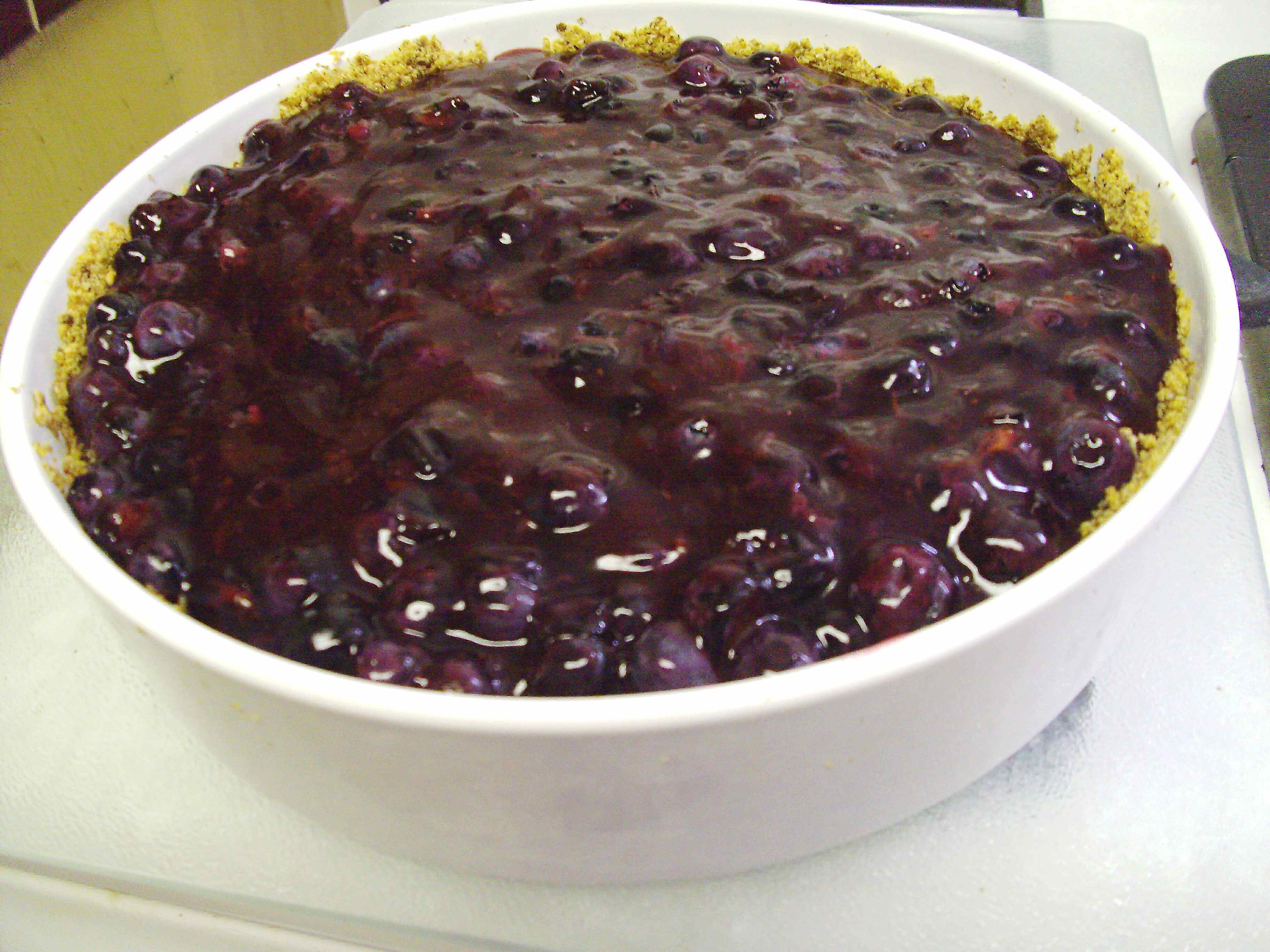
    raw blueberry pie with microwaveable filling and graham cracker crust

    This mostly-raw blueberry pie is a snap to make and very versatile--the filling microwaves in a few minutes, and you don't even have to bake the zippy gingered graham cracker crust--perfect for a hot Fourth of July and all summer long.

  • Recent Posts

  • Contents

  • Archives

  • Now Reading

  • See also my Book Reviews

  • Copyright 2008-2024Slow Food Fast. All writing and images on this blog unless otherwise attributed or set in quotes are the sole property of Slow Food Fast. Please contact DebbieN via the comments form for permissions before reprinting or reproducing any of the material on this blog.

  • ADS AND AFFILIATE LINKS

  • I may post affiliate links to books and movies that I personally review and recommend. Currently I favor Alibris and Vroman's, our terrific and venerable (now past the century mark!) independent bookstore in Pasadena. Or go to your local library--and make sure to support them with actual donations, not just overdue fines (ahem!), because your state probably has cut their budget and hours. Again.

  • In keeping with the disclaimer below, I DO NOT endorse, profit from, or recommend any medications, health treatments, commercial diet plans, supplements or any other such products.

  • DISCLAIMER

  • SlowFoodFast sometimes addresses general public health topics related to nutrition, heart disease, blood pressure, and diabetes. Because this is a blog with a personal point of view, my health and food politics entries often include my opinions on the trends I see, and I try to be as blatant as possible about that. None of these articles should be construed as specific medical advice for an individual case. I do try to keep to findings from well-vetted research sources and large, well-controlled studies, and I try not to sensationalize the science (though if they actually come up with a real cure for Type I diabetes in the next couple of years, I'm gonna be dancing in the streets with a hat that would put Carmen Miranda to shame. Consider yourself warned).

A Handful of Farina Breads

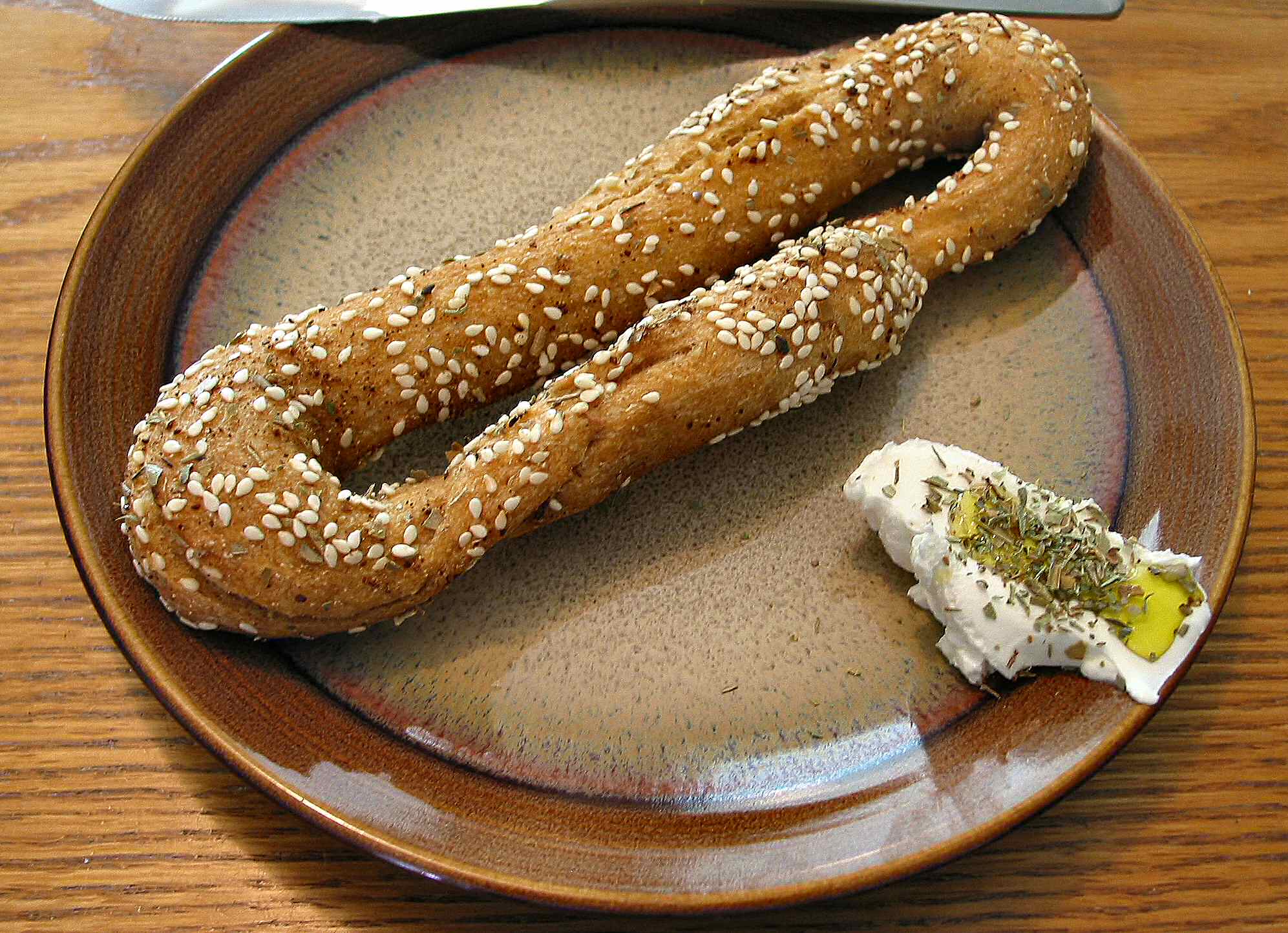
Simit bread or "beigele" with labaneh and herb spread

It’s been a couple or three weeks since my last post. I am currently in the desperate process of using up as much hametz, which is flour-yeast-bread-beans-lentils-rice-pasta-fillo-dough-oatmeal-etcetera, as possible before Passover. Right after Purim  I discovered I still had about 5 sacks of dried beans and lentils cleverly saved up and a sack of whole wheat flour and a 2-lb. bag each of bulgur AND farina! And a pound of wild rice. And a new bag of soy flour. Most of all which I couldn’t donate to the food shelter because it was either bulk or partly opened. Yeesh. What’s a girl to do?

Well…we’re certainly going to find out in the next couple of posts, aren’t we?…Even my suddenly-vegetarian daughter–yes, the very same one who kept bugging me about why I wasn’t cooking enough chicken for her last year–is wondering whether she has the stomach for more black bean burritos in the next two or three weeks (her conclusion: as long as there’s chipotle salsa around, what’s the problem?) My husband is looking at both of us cross-eyed.

Okay, then. Project #1 (well, after the pot of black beans, anyway; those were pretty standard and don’t call for a post): bread.

Long, long ago, in a kibbutz kitchen far, far away, I made some bread for my parents, who were coming to Israel for a visit during the year I was there. December in Israel–drizzly and cold some days, bright and cool others. You never know what you’re going to get.

But I’d missed my parents dearly for half a year. To celebrate seeing them I had in mind something like one of the blackish poppy-filled strudel I’d seen in a Romanian bakery in the middle of Haifa’s downtown “Hadar” shopping district amid the felafel stands and bookstalls. Only I wanted something not sweet, and with a better dough. A savory bread, like a bialy but with poppy seeds. So onion and maybe a little parsley or dill, now that I’d worked in the side kitchen for 5 months and knew the Hebrew names for both herbs.

I decided on a basic bread dough, flour-water-yeast-salt with a bit of oil. I rolled it out flat into a long rectangle and filled it with chopped, fried onions, parsley, dill, thyme and salt (it actually had too much salt, to my embarrassment, but my mother loved it anyway) and a couple of handfuls of poppy seeds. Then I rolled up the column of bread, twisted it around itself into a longish double rope, glazed it with egg yolk and baked it. It was pretty good and looked impressive. And it was really easy. My mother ate it all week sightseeing while my dad was at his conference.

Those days are gone, but a recent trip my husband took brought back the memory along with a couple of loaves of multigrain herb bread from a traditional German bakery he discovered in Tehachapi. The breads lasted an entire week at room temperature (of course, our humidity’s so low in Pasadena that this may be an exception) without seriously high salt in the dough, and every time we passed the dining room table, the aroma of dill and thyme and scallions and sourdough made us want to tear off a chunk to eat just as-is.

Two weeks ago was Purim, the feast of lots (as in drawing lots to determine someone’s fate, not lots as in lots-of-hametz-to-use-up). It’s the holiday from which we get the term “the whole Megillah”–the Megillah being the Scroll of Esther, a long Scheherezade-style story set in Persia and very long to read out loud in one sitting to a large congregation while they cheer the heroes and boo the villain (also Scheherezade-style, it’s the wicked vizier–am I giving anything away? It’s always the wicked vizier, except when it isn’t. And did I mention it’s kind of long? Okay, then).

So anyway, I decided to make some of this scrolled bread to give as Purim shalachmones–food baskets sent to friends, but didn’t get that far this year. Hamantaschen was about the limit of my ability, since it’s also get-your-kid-into-a-decent-school-for-next-year lottery time.

Usually these days the mishloach manot (same term, without the Yiddish accent) are candy bars, bagged snack foods, and maybe some raisins or an orange to round out the “3 different foods” custom. Occasionally you still see hamantaschen but the junk food factor has really taken over very sadly, I gotta say, even if it’s Israeli junk food. I mean, okay, felafel-flavored Bisli is fun once, but it’s really not much better than Cheetos, except that the wrapper is a good exercise for my daughter’s Hebrew reading skills (especially once she figured out which word meant “carbohydrates” on the nutrition label).

Nobody on the west coast even makes poppy seed hamantaschen anymore, to say nothing of prune lekvar filling, the two classics of my childhood. It’s a cultural deterioration I aim to remedy. Maybe next year–but for now, this weekend, with a container of poppy seeds still in the freezer, I’m thinking about making the bread, since it’s delicious, also involves poppy seeds and is unlike anyone else’s. And because I have flour and yeast to use up before Pesach, which is now right around the corner.

So I started pulling the flour off the shelf and realized I’d used up all the bread flour for hamantaschen but I still had a good 3-4 pounds of whole wheat, which wouldn’t make a good bread all by its lonesome. And on the other hand, I had both bulgur and farina–bulgur for tabbouleh or a wheat version of polenta, but farina–2 pounds of it. Well…it’s wheat and fairly fine. Maybe if I ground it up a bit further in the coffee grinder? I did, though the end result seemed less than convincing that I’d made any difference in it at all. Still pretty grainy. Dumped it into the food processor anyway along with an equal amount of whole wheat flour, some yeast, a little salt, and enough water for a fairly stiff but elastic ball of dough once it was processed.

The dough was pretty heavy to lift out and the farina absorbed a lot of water but it did seem to be developing some stretch, at least. I let it rise overnight in the fridge and started testing it out the next day. Continue reading

Tabbouleh vs. me

Exhausted. Yesterday I brought enough lunch food for 65 or so people at services because (get this) my husband signed us up to prepare the kiddush in celebration of our anniversary. Which is coming up in a couple of days. Ok. But I still have a tiny galley kitchen and all the drawers are still out in the garage awaiting some kind of decision on their fate–they have been that way since before we moved in, because they’re so chewed up I didn’t really want them back and haven’t decided what to replace them with yet.

And I think we (meaning I) did pretty well for costs by not doing the usual buy-salad-in-a-bag-for-thirty-bucks  and buy-a-big-commercial-sheet-cake and buy-a-vat-of-decorator-hummus.

But let me explain something I learned the hard way about making things from scratch. There’s a reason the boxes of commercial just-pour-boiling-water-on-it-and-wait tabbouleh are so tiny.

It’s not just all about profiteering–as you’d think I was going to say. Even I thought I was going to say that. But no.

At my local Armenian greengrocer’s I bought a 2.5 lb bag of #2 bulgur (the number denotes size of the cracked wheat grains) for $2.52 and a couple of bunches of parsley and lemons and a bunch of scallions and thought I was clearly way ahead of the Near East and Sadaf-purchasing folks. And yes, bulgur is microwaveable if you have a good-sized container. Just add water to cover by about an inch, put on a lid, and microwave 3-5 minutes, or enough to get the water to about boiling temperature, and let it stand about 15 minutes to absorb the boiling water. Then drain it and add lemon juice, olive oil, chopped parsley and scallion (and mint if you like it) and a bit of salt. More parsley than grain if you’re Lebanese and being authentic. Less green than grain if you’re doing what I grew up with.

What I didn’t take into account was exactly HOW MUCH tabbouleh one innocent-looking little pound of dry bulgur, or about 2 cups, actually makes.

Let’s just quietly admit it was considerably more than a salad bowl’s worth. So the expensive boxes you see in the Whole Foods, the little 4-6 oz. boxes, are probably just right for a family of less than 14.

I ended up freezing half of the grain in bags. I don’t think I’ll bother telling my in-laws before I bring it up for Thanksgiving. Wouldn’t want them to find themselves a pair of plane tickets just in the nick of time…


Green Lentil Sausages

A month or so ago I had been intrigued with a recipe on “Is This My Bureka?” (see sidebar for link) for Romanian mititei, a spicy cross between meatballs and sausages, and wondered whether I could make a vegetarian version with green lentils. Not because I can’t eat beef–I can if it’s kosher–but because I generally don’t like handling meat. (I don’t mind fish nearly as much; don’t ask about the logic, it’s just a preference.) All my meat dishes are still in storage, four months after the move. That’s not accidental–I hate switching over the dishes even more than I dislike handling meat.

So in any case, I tried it. Green lentils are on my list of easy-to-microwave, ultracheap nutritious staples. I cooked up about half a pound of dried lentils in water to substitute handily for a pound or pound and a half of ground beef. The mixture I made was heavy on garlic, pepper, and a variety of spices ground in the coffee mill. It was a lot lower on salt than BurekaBoy’s because I tasted it with a couple of pinches of salt–between 1/4 and 1/2 teaspoon–in the mix and that was more than plenty. Scared to think what a teaspoon and a half would have done. Maybe ground beef requires more, or maybe the lentils don’t absorb and hide the salt flavor as much.

The green lentil mixture was delicious even before cooking–with vegetarian sausage, burger or meatloaf recipes, unless you have raw eggs or uncooked flour in your mix, you can taste for seasonings pretty safely. If you do have eggs or raw flours in the mix or are making a sausage recipe with meat, poultry or fish, cook a spoonful first in the microwave and then do the taste test.

Unfortunately, though, the paste didn’t hang together as well as I’d hoped–cooking it didn’t help much. It was still delicious and spicy, but it just crumbled. And although I could live with it, I’ve been thinking about it ever since.

So my recent purchase of a bag of vital wheat gluten and my first foray into the mysterious world of seitan set me off. What if I added a little gluten to the lentil mix instead of the other way around? That way it would stick together and still be mostly lentils. The proteins would be balanced better by combining a pulse (lentils) with a grain (wheat). It would have loads of flavor without needing soy sauce or salty broth. It would be microwave-steamable, and probably fryable or grillable too. And I could still taste it safely before cooking to ensure there was the right amount of excessive garlic present.

And–half a cup of gluten wasn’t quite enough for the three or four cups of cooked lentils I used. Still kind of dry and crumbly when I made a few small patties and cooked it two ways (microwave and frying pan). I added a little more gluten to the rest of the uncooked mixture. Three-quarters of a cup of gluten per 3 or so cups of lentils was better–I could see the threads of gluten forming as I kneaded it together in the bowl.

The patties were still dryish and of course lentil gray-green, though this version hung together better when cooked. It still tasted good, very peppery and garlicky, with a hint of the allspice, fennel, coriander seed and other spices I’d put in. But because of the dryish texture I wasn’t sure I could recommend it fully–it was definitely a case of “Dance 10, Looks 3” at that point.

I cooked up the rest of the mix by microwave steaming, followed by a light pan fry in olive oil, and bagged them into the fridge. The next day, there they were–still a bit soft and crumbly, but hanging together better with a little more chewiness to them. Still not pretty but they tasted good. Waste not, want not, I thought. Pretty is for some other day. Continue reading

Microwave tricks: Seitan without Simmering

My sisters-in-law from Oakland were planning a visit to us this summer now that we actually have a house and can host them. It fell through, but the prospect got me thinking about vegan food and what we might serve them. They’re both good cooks, but they eat a lot of commercially-prepared vegan meat substitutes along with their own fresh vegetables and grains and baked goods.

I’m not great on packaged foods in general, and unfortunately, vegan proteins other than plain fresh tofu and dried beans look an awful lot like vegetarian versions of Oscar Meyer sliced bologna and turkey loaf to me. Not just the appearance, but the cost per serving (really high–something like 4-6 bucks for a chic little package that serves two, ostensibly) and the salt (also really high–600 mg and up per serving). And the ingredients lists are always long and kind of mysterious-sounding, either in a surprisingly chemical way or in a Japanese-ingredient-names-as-authenticity way. Not that I’m not working to figure out exactly what kombu and dulse and Job’s tears are. Two seaweeds and a resin? I think, anyway.

There’s also a lot of yeast extract in some of these processed vegan proteins–sounds like between that and the salt, what they really did was dump in Vegemite or Marmite. Bleagh (my husband’s sister is kind of an Anglophile, but that doesn’t excuse either version to me).

On the other hand, some of the vegan cookbooks out now have do-it-yourself recipes for seitan, and so do Ellen’s Kitchen and FatFree Vegan Kitchen.

Seitan is basically wheat gluten dough cooked in stock. If you do it yourself at home, it may take an hour to simmer but really isn’t very expensive compared with the commercially prepared versions. A 5-lb bag of flour at about $2-3 or a few ounces out of a 22-oz bag of vital wheat gluten (about $6-8, depending where you buy it, and worth it for getting 100% gluten out of the bag and not having to wash the starches out of the dough since it’s already done for you) produces something like a pound or two of seitan at a go. That’s enough for a larger meal, maybe even for that elusive home-made vegetarian centerpiece dish

Why is this worth doing if you don’t eat vegan and aren’t actually having vegan guests in the house after all? (and now that I’ve schlepped the last of the moving boxes out of the living room, I’m really wondering).

I think back to my favorite Chinese restaurant back east, the Hunan Manor in Columbia, MD. Every time we fly back east we try to make a stop there.

One of the things that makes the Hunan Manor great is their willingness to experiment and invent. They serve a wide variety of vegetarian versions of standard banquet dishes using “vegetarian chicken”–basically seitan cut and fried as for meat. These dishes complement their masterful use of tofu with textures from nearly silken to deep-fried to pressed and diced for the vegetarian jao tse, which I’ve always thought looked better and probably tasted better than the pork-based meatball filling our nonkosher friends would get (though they raved about them, and I’ll take their word for it).

The last time we came east, the restaurant had added several new dishes using a different form of seitan with very finely layered rolls that were cut in bite sized pieces, coated and fried–a pretty close simulation for the layered flesh of chicken. It was really delicious in their orange “chicken” with perfectly cooked bright green broccoli. It was unexpectedly unsalty as well, so I don’t know whether they made it in-house or had bought the prepared seitan in an unflavored form.

Either way, the dish was a great argument for using seitan creatively, and I don’t think my sisters-in-law, competent cooks though they are, have eaten any seitan dishes that good using anything from a little Gardein package.

So I decided I’d like to try my hand at seitan at home and see if I can’t come up with something flavorful, chewy, satisfying and nutritious, without having it scream salt. After all, once you’ve got the finished loaf or pieces, you’re Continue reading

Political Pancakes, or, Why is Borders flogging so much lard?

Why Borders is not getting my business this week

Why Borders is not getting my business this week

I know–highly unappetizing. I don’t think even a full teaspoon of salt would help here. And I’m getting back to actual food as of today, I promise.

But I just had to “share” my inbox this morning before I get started. Borders has now closed its Pasadena store but keeps sending me these fabulous discounts in the pretty hope that I’ll schlep to Arcadia to check them out. What does it say when a huge business that’s trying to stay afloat after two decades of leading the field misses so blatantly in its one-to-one personalized marketing?

For that matter, what does it say (reading the tea leaves here) when Newt Gingrich looks like the most coherent and readable (and properly-dressed) selection? I mean, I was there–in 1995 I started working at NIH and promptly got caught in the federal furloughs when he lost his budget armtwisting attempt on Bill Clinton.

What does it say when the Gritch is allegedly trying to run for president and his soon-to-be-available tome is grouped with those of three other deeply discounted “authors” who have no actual public service background, just a penchant for loud titles and  army drag (of various centuries)? Where the hell did Laura Ingraham get that hat? No wonder she’s not keeping up with Patt Morrison. And I thought French food was a no-no for today’s discerning ultraconservative trougher?

I do also wonder at the significance of Ann Coulter’s latest effort being discounted just that six percent more than everyone else’s…maybe it’s the fact that she’s jumped (appropriately) on the vampire-empire bandwagon? Too bad there are no handsome devils on the cover (almost guaranteed there are none inside either). I’m sure they’d sell like hotcakes. Maybe she’s included an actual recipe for hotcakes (with blood sauce or fava beans or something)?–You never know.  Can she actually cook? Without fatback?

Given the deep and undoubtedly thorough marketing research Borders has done (by sending me of all people this fabulous selection of deals), I’m sure they’ve already figured out which way the wind is blowing. I can smell it from here.

In honor of this great selection, I’ve decided to pull out the stops and dig into the older of my cookbooks for an appropriate response.

Semi-Patriotic Pancakes–No Lard AND No Blood (well, at least no added salt)!

Makes about 16 3-4″ diameter pancakes, enough for 3-4 people

  • about 1 c. bread flour, whole wheat flour, matzah cake meal, buckwheat flour, or any mix of these as desired (to preserve our individual freedoms. Put that gun down, Jeb! We’re talking first amendment, not second!) Generally if you’re using buckwheat or whole wheat, it’s better to go half-and-half with regular flour so the pancakes aren’t too heavy or grainy
  • 2 large eggs, separated–I usually toss one of the yolks but keep both whites
  • dollop of plain milk-and-cultures-only yogurt (for that Mediterranean touch)
  • milk or buttermilk (depending how sour you are, and if you use buttermilk skip the yogurt)–about a cup, but might be more to make the batter consistency come out right
  • 1 T sugar (any color, even green if that’s all you’ve got and can stomach the results)
  • 1 capful vanilla extract AND/OR a shake or two of cinnamon (keep it small)
  • oil or butter –1 T for the batter, the rest for frying

Optional mix-ins: blueberries or raspberries (fresh are good, but if you have frozen ones leave them frozen to add when you fry the pancakes; otherwise make a sauce of defrosted ones to serve at the table instead), chopped peeled apples, pecans, chocolate chips, etc. etc. NO: liver, fava beans, or blood-anything!

1. In a large bowl mix the the flour, sugar, flavoring(s), egg yolks, the tablespoon of oil or butter, the dollop of yogurt if using,  and enough milk or buttermilk to make a thick but just-pourable batter. If you’ve got chopped apples, nuts or chocolate chips, you can mix them in now.

2. In a second bowl beat the egg whites to reasonably stiff peaks, then fold them gently into the batter to lighten it. Start frying as soon as you’ve got this done.

3. Fry 3-4″ dollops (about 2-3T each) of the batter in a large (preferably nonstick) frying pan over medium to medium-high heat. If you’re adding berries, add a few to each pancake as soon as you’ve spooned the batter into the pan, and let the pancake batter rise around and over the berries a bit before flipping to the other side.  You’ll know to start flipping the pancakes when you see the bottom edge start to look solid and a ring of small bubbles appears just above it–but I sometimes go a little longer to make sure because the leavening is egg whites-only, which makes a pretty delicate batter. You don’t want the pancakes to collapse completely.

4. “Stick a fork in ’em, they’re done.”–The late, great governor of Texas, Ann Richards, July 15, 1992, in an interview with David Letterman about the Republicans’ chances, and quoted on page 61 of my swiss-dot cookbook… Incidentally, she was wearing an outfit that puts any of Ann Coulter’s to shame–she had her very, very white hair up in a classic Texas beehive and she was wearing a hot pink miniskirt that she actually had the legs for. I miss her still.

Chickpea Crepes: Protein Inside-Out

Ever since Thanksgiving I’ve been thinking about the challenge of coming up with a proper vegetarian centerpiece for major celebrations–one with a single, unified dish cut up to share, something with protein, not just vegetables or grains, something with great complex flavor and no artificial ingredients.

This is apparently a tall order. For months now I’ve scoured vegetarian and vegan cookbooks in hopes of some serious suggestions and come up nearly blank. Perhaps it’s because most vegetarian cooking in America is based on southeast Asian vegetarian cuisines, which don’t emphasize centerpiece or “main” dishes as much as assortments of several smaller ones, none of which necessarily take the lead. Or because a lot of the nondairy, non-egg vegetarian cooking consists of beans, rice, tofu, seitan and vegetables–not a bad thing, but not usually pretty or convincing as a centerpiece and occasionally incomplete on protein or complex flavor (there’s an awful lot of salt or soy sauce in some of these cookbooks). The few centerpiece dishes with a meatloaf-style filling wrapped in puff pastry or phyllo or potatoes seem to include premade seitan (high in salt) and/or things like mushrooms or eggplant or spinach and nuts with a fair amount of starch for binder, which means you’re repeating starches between the filling and the wrapper and not providing much protein.

One solution might be to put the protein, or at least some of it, in the wrapper itself, so the filling can be flavorful vegetables and so on but not have to come up to the concentrated protein level of meat.

Chickpea flour crêpes are one such possibility, and they’re very easy to make. A bit stronger in flavor than ones made with wheat flour, they hold together well in the frying pan and come out thin, springy and wrappable without the need for eggs. They also take well to a Continue reading

Superfoods and Magic Beans

“Top 10 (or 7, or 5, or whatever) Superfoods” lists seem to be popping up on the covers of all the in magazines this month. If I didn’t get a headache every time I tried it, I’d be rolling my eyes.

The classic bloated diet article with the even more classic bloated promise of magic beanhood is nothing new, I realize. But “superfoods”…

The premise of calling something a superfood is that if you eat this one special food, or at least shop your way down the list of 5, or 10, or whatever’s in the article, you’ll be so much healthier than someone who eats a regular food. Right?

Usually the items on these lists of so-called superfoods turn out to be expensive exotics like dried acai berries and pomegranate juice. Both of which just happen to have heavyhitter funding and marketing efforts behind branded packaged versions of them, and the companies that have started branding and marketing them have both recently come under FDA scrutiny for overinflated and unsubstantiated health claims.

Of course you don’t have to go branded to run into wide-eyed, breathless claims about supposed superfoods. More mundane choices like the sunflower seeds, green peas and garlic touted in this LA Times food section article are also now being highlighted as the new great green hope for America.

But not for the reasons that make the most sense–that these foods are relatively unprocessed vegetables, fruits, whole grains, nuts and seeds (occasionally someone remembers to add something from the beans and pulses category too). All of this vegetation has almost disappeared from the current mostly-processed, mostly restaurant diet of the American public. The general categories now touted as superfoods contain protein, fiber, vitamins and minerals. They’re wholesome and varied if you buy them fresh (or dried) and cook them yourself. Some of them are green (and they’re supposed to be!)

That’s in stark contrast to the now-standard and really dreary burger, ketchup, fries and soda that are all made out of the same three or four overused industrial ingredients (wheat, soy, corn and salt, with a little beef scrap or so thrown in for the burger, some leftover tomato paste for the ketchup, and much less potato than you’d think in the fries). I understand how something that’s actually recognizably plant-based would seem exotic and ultrahealthy in comparison. I do. Because frankly, you could take your soy-based green crayons and color a piece of all-natural bamboo-fiber cardboard and eat that and it would be healthier than the fast food special.

But does that mean vegetables, fruits, whole grains and nuts and seeds are suddenly superfoods?

What are superfoods supposed to be, exactly? Look at the captions for what’s so great about each featured food Continue reading

Microwave Tricks: Brown Rice Resolution

Resolution #15 from my last post was to figure out a decent “quick” method for cooking tougher grains like brown rice and pearl barley. These grains still have the skin on, which forms a barrier to quick absorption, so they take 45-50 minutes to cook on the stovetop, which is simply too much for me to babysit. Apparently I’m not alone on this–I see vacuum-packed packets of precooked brown rice at the Trader Joe’s (and similar bowls in the freezer both there and at Whole Foods).

To say the least, this is not the right way to go if you’re earnest about spending less on staples while going a little bit greener in the new year (think of all the freezer energy cost and coolant leaks, the cooking energy expended, the plastic packaging, etc.)

According to Nina Shen Rastogi of Slate.com, microwaving can be the greener cooking option as long as you don’t leave your microwave plugged in when you’re not using it–apparently the little digital clock display thingy takes up a surprising amount of energy (and do you really need a microwave to tell you the time? Hang a battery-operated clock in view of the kitchen and you’ve got it…)

So microwaving should be the way to go with brown rice, as it is for pasta (plain or whole-grain) and white rice. But unfortunately, microwaving brown rice, with its tough outer skin, really doesn’t work well at all if you just dump the raw rice into some water and try to nuke it straight up, the way you can with these quicker-soaking grains. Certainly not in 3-5 minutes of cooking time. Not without babysitting and worrying about boilover. Feh.

And it’s never a good idea to nuke something starchy more than a few minutes at a time, at least not without a lot of water in it–you could end up with plastic (think about what happens to bagels if you microwave them for more than 15-20 seconds).

But you know I don’t like to give up once I decide something should work. So–I thought about something I posted a couple of years ago on nuking oatmeal successfully and decided to try the presoak idea that had worked for steelcut oats. Only who wants to presoak rice overnight if they don’t have to? Steelcut oats–you know you’re going to make them for the next morning’s brunch (only do it on a weekend). Stick ’em in a bowl with water and a lid, let it sit overnight, nuke a few minutes in the morning and you’ve got it. It’s perfect.

Rice? I never know what I’m making for supper until about an hour before.

But a hot presoak worked pretty well to get things started, and it only took about 15 minutes (because I was impatient). The whole thing still took about an hour–well, maybe less in the strict sense, I wasn’t paying attention Continue reading

Couscous, its own fine self

Fine-grained couscous made directly from farina

When I’d just come back from a year in Israel after college, I read through Paula Wolfert’s Couscous and Other Good Food from Morocco several times. Her descriptions of the market stalls, the kitchens of the aristocrats, and the very down-to-earth cooks making tricky components like warka leaves for bistilla or rolling and sieving different sizes of couscous from farina and flour fascinated me. They filled in parts of the culture I hadn’t understood in the Moroccan Jewish community I’d just left.

Two of the dishes in the book, two only, have I actually made in all the time since. But if you get the right two, two is enough.

I first ate couscous in Ma’alot, up in the north of Israel in the western Galilee. On my first night in the volunteer program, my new roommates brought me to a tiny 4-table restaurant in the town center after a very miserable and cold trudge up to the top of the hill in a January downpour. The restaurant would have been a real hole-in-the-wall anywhere else, and even here it seemed to cater to the few single men who had neither hope nor prospect of a girlfriend, and whose mothers had finally nudged them out the door. Israel’s amenities–grocery stores and the like–are still often a grade or so down in appearance from what we’re used to in the US, and I’d been there half a year already, so I was used to ignoring it and discovering what was good. Still, even 25 years ago, most restaurants in the larger towns were not this dowdy. This was card tables and folding chairs. My heart sank. Where had I come to?

Not 5 minutes after we’d been seated, however, the lady who ran the kitchen fetched us out a huge platter mounded with couscous and chicken legs and vegetables, steaming hot and smelling incredible. The chicken was delicious (everybody sing; I’ve just been subjected to another showing of Sherlock Holmes’s Smarter Brother at our in-laws’ over Thanksgiving weekend) but the couscous itself was so light and fine it was like eating hot curried snowflakes. What was it? How do you do that? And in half a year of eating at Continue reading

Matzah Brei–blintzes?

Matzah Brei Blintzes

Thursday morning I broke down and decided to cook  breakfast for my daughter instead of leaving it at matzah, jam, yogurt and fruit. I’m not a big fan of matzah brei, a poor substitute for french toast in which the eggs never really seem to absorb very well and you’re left swallowing the hard corners of the matzah. Neither crisp nor soft, it always seems like a wrong turn to me.

On the other hand, I didn’t have any matzah meal in the house for pancakes (how much extra matzah product do you really need when you’re trying to eat less of it?) So I broke down and took a couple of sheets of the whole wheat matzah from the latest box and prepared to do battle.

I think I’ve mentioned once or twice that I hate waiting for water to boil. But a pyrex pie plate with half an inch of water in the bottom takes only 2 minutes to heat up fairly well in the microwave. And it has room for the matzah, which I broke up into halves. But whole wheat matzah doesn’t soak up all that well, even after several minutes in hot water. It’s the tougher bread of affliction. What now?

I fished out a dinner plate and covered the pie plate with it, stuck it all back in the microwave, and hit stun for another minute. To my surprise, it worked–really worked. The matzah didn’t fluff up or anything–but it was soft and pliable and even a bit elastic, something like just-cooked lasagne noodles. No hard corners. I drained off the hot water and poured on the egg-milk soak, which didn’t really soak in much even though the matzah was now soft. Sigh.

My daughter came around a corner, looked at me fishing one of these matzah halves out of the pie plate, and said, “I wish we could have blintzes” and I thought–well, these actually bend–could we? Why not?

Matzah brei blintz ready for frying

Matzah brei blintz, ready for frying

Continue reading