
• Enter your email address to subscribe to this blog and receive notifications of new posts by email.

    Join 241 other subscribers
  • Noshing on

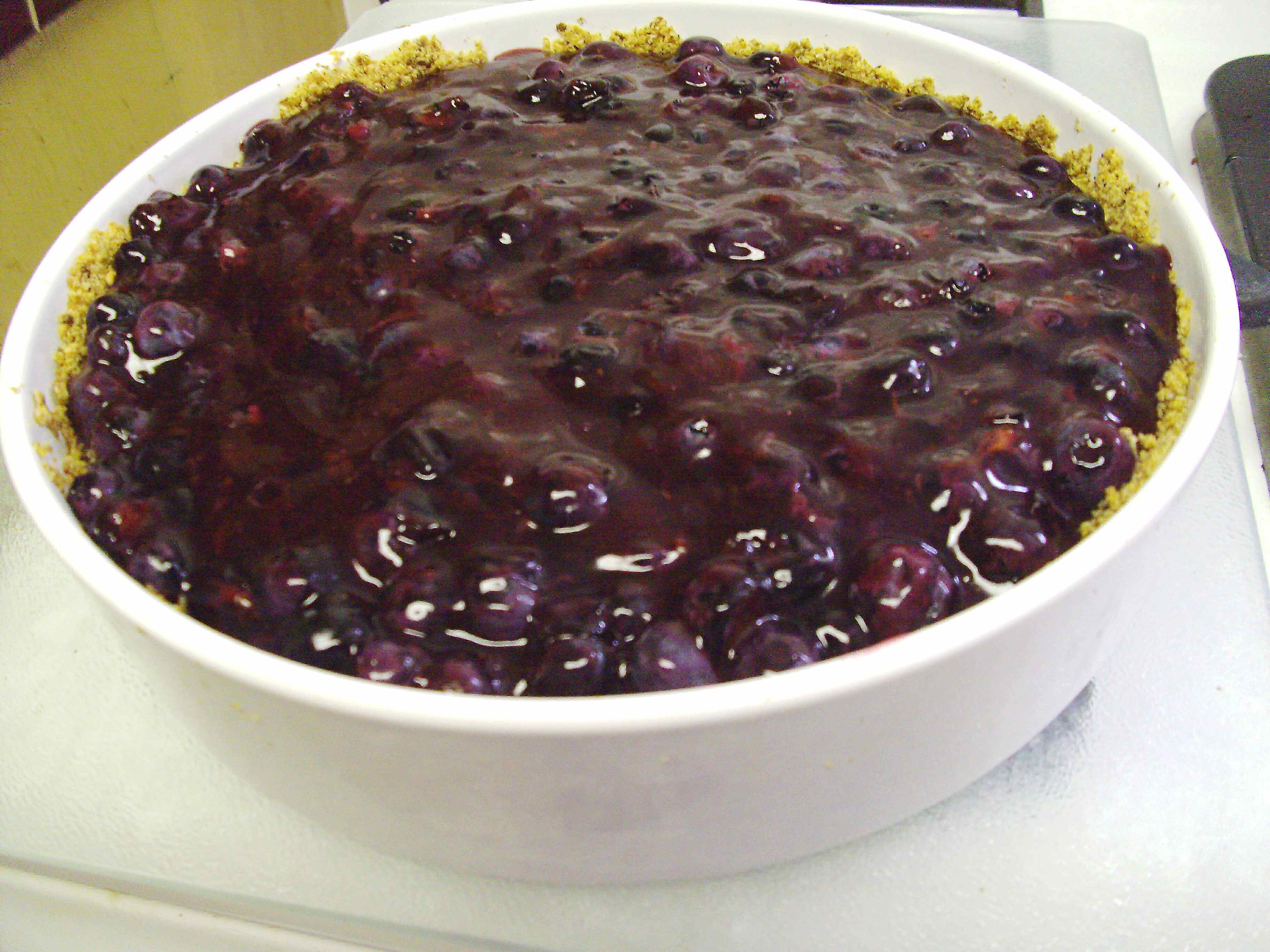
    raw blueberry pie with microwaveable filling and graham cracker crust

    This mostly-raw blueberry pie is a snap to make and very versatile--the filling microwaves in a few minutes, and you don't even have to bake the zippy gingered graham cracker crust--perfect for a hot Fourth of July and all summer long.

  • Recent Posts

  • Contents

  • Archives

  • Now Reading

  • See also my Book Reviews

  • Copyright 2008-2024Slow Food Fast. All writing and images on this blog unless otherwise attributed or set in quotes are the sole property of Slow Food Fast. Please contact DebbieN via the comments form for permissions before reprinting or reproducing any of the material on this blog.

  • ADS AND AFFILIATE LINKS

  • I may post affiliate links to books and movies that I personally review and recommend. Currently I favor Alibris and Vroman's, our terrific and venerable (now past the century mark!) independent bookstore in Pasadena. Or go to your local library--and make sure to support them with actual donations, not just overdue fines (ahem!), because your state probably has cut their budget and hours. Again.

  • In keeping with the disclaimer below, I DO NOT endorse, profit from, or recommend any medications, health treatments, commercial diet plans, supplements or any other such products.

  • DISCLAIMER

  • SlowFoodFast sometimes addresses general public health topics related to nutrition, heart disease, blood pressure, and diabetes. Because this is a blog with a personal point of view, my health and food politics entries often include my opinions on the trends I see, and I try to be as blatant as possible about that. None of these articles should be construed as specific medical advice for an individual case. I do try to keep to findings from well-vetted research sources and large, well-controlled studies, and I try not to sensationalize the science (though if they actually come up with a real cure for Type I diabetes in the next couple of years, I'm gonna be dancing in the streets with a hat that would put Carmen Miranda to shame. Consider yourself warned).

The new MyPlate icon–fantastic or plastic?

Everyone in the food press seems to be weighing in on the new replacement for the much-cursed USDA Food Pyramid in all (both?) its glorious confusion and obfuscation of real nutritional goals that might have (and should have) undermined the beef, corn, pork, corn, sugar, corn, and soy industries if they’d ever been presented honestly.

So where does that leave us? With ears of fresh corn that are more than 50 cents apiece in Los Angeles supermarkets, and the new…
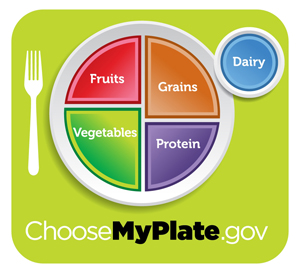
USDA MyPlate logo

Already, the USDA’s MyPlate web site is in a certain amount of branding trouble (and of course, that’s what counts most in America): the Texas DMV had already bagged “MyPlates.com” for its vanity license plate division (highly unappetizing), and Livestrong.com already has its own well-established “MyPlate” food calculator and fan base. And those items come up first on Google searches. As in, the whole first page or more. The government site ranks way down the list and had to water down the impact of its original name choice with “choose” just to get a URL. Can it elbow out the competition just by bolding the “MyPlate” part?

What really counts are the food and nutrition opinion maker comments, though. And a lot of those are detracting in a nitpicking way that I think kind of misses the point.

The first thing they all have to say is that the plate looks dumbed down. Forgive me, but wasn’t the Food Pyramid’s unreadable and unusable design a large part of the problem? The MyPlate icon is simpler and more direct, and it names real food groups, not “Big Mac” or, on the haute side of things, any of Ferran Adrià’s foams. No wonder foodies and populists alike are wondering what it has to do with them.

A small sampling of the main arguments:

MyPlate: The Food Pyramid for dummies? (LA Times): Dr. Andrew Weil and others discuss what’s still wrong with the new icon. Weil says “fruits” could still include fruit juice, which is usually a useless sugar bomb in comparison with whole fruit, and he worries that the protein section, which comes with a guideline to eat 8 oz. of fish per week, might encourage unthinking people to increase their mercury intake since swordfish is on the guideline menu, as are some of the generally overfished popular species of fish. Weil’s not wrong about the fruit juice vs. actual fruit, but his hand-wringing about fish is really geared for well-off readers who can afford to eat much of it. All the fishes he names are Continue reading

They don’t learn, do they?


The Washington Post reports this fabulous new piece of House Republican budget thinking:

Food safety advocates decry FDA cuts 

Didn’t we have a half-billion-egg recall just last summer? And peanut butter contamination? And the spinach, and the tomatoes? And, from the Chinese pharmaceutical and foodstuffs contingent, melamine in quite a number of items, including pet food and infant formula, to fake a high protein level?

Didn’t everybody in the House get up on their hind legs and demand more FDA field inspections, more accountability, more food safety? And now the House majority are cutting the FDA proposed budget from a modest raise proposed by the White House to less than the FDA received for this year’s operations?


Questionable sodium study, even more questionable comments

A new European study that purportedly shows low-sodium diets to be ineffective in preventing high blood pressure, and even more unlikely, that they increase the risk of death from heart attack or stroke, is being published in the May 4 issue of JAMA, and predictably it’s already excited a variety of comments in Gina Kolata’s current New York Times article from the CDC and from…Dr. Michael Alderman.

Predictably, because the CDC researchers think too few people were studied for too short a time with unreliable methods (24-hour urine collection to measure sodium intake indirectly, after the fact as it were.)

Alderman’s reaction was also predictable: he’s still insisting that only a nation-wide feeding study sort of clinical trial that follows its subjects until they die is sufficient to prove a true link between sodium intake and cardiovascular disease. Something so expensive and unwieldy it couldn’t be completed even if it were started, and we’d still be waiting around 30 years later wondering if salt had anything to do with heart attacks or strokes. Very convenient for the processed food industry, but pretty useless for public health. And also conveniently, Gina Kolata found more than one expert to say so.

What she didn’t find, but could have, is that a number of large-scale feeding studies have already been done and shown that eating a balanced lower-sodium diet helps reduce blood pressure and prevent blood pressure increases. DASH-Sodium is one of them. And no one had to wait until the study subjects died to figure it out.

A Closer look at Einstein Bros. Bagels

A few weeks ago I bought a challah from Einstein Bros. Bagels, which had taken over from the Noah’s in my town sometime last fall. Noah’s had supplied my daughter’s school on Fridays and their challah was pretty good for store-bought–this tasted the same. I hadn’t been in the store since the takeover so I didn’t really know what to expect, but other than the name change outside, it looked the same and had more or less the same offerings as ever.

I’m not sure what prompted me to go online and look for their nutrition information sheet, but I wanted an idea of what was in the challah, so I looked. I couldn’t find it on the Einstein Bros. site, but there was a pointer to the Noah’s web site–still up after the takeover, apparently, and that had the challah listed. What I found for the challah itself wasn’t incredibly shocking or anything, ingredients more or less kosher, not too bad on any of the nutritional factors. In fact, it’s probably one of the best bets at our former Noah’s, although you have to order a couple days ahead for Friday morning pickup.

On the other hand, the bagels and other menu items really stood out for sodium–most were over 500 mg per bagel, and some of the “gourmet” varieties of bagels were in the 700-900 range, even without lox. A few sandwiches soared as high as 3500 mg sodium (more than a day’s worth even for today’s average intake, and about two days’ worth according to the CDC and AHA guidelines)–just for a sandwich. Anything with chicken on it was astronomical as well–above 1600. Which sounded like Denny’s or Chili’s to me.

I started to wonder just who designed the food and how “designed” it was. Were we talking mostly bagel joint, or were we talking fast food with a highly engineered, set-in-stone formulation? If I wanted to contact them to ask about lowering the sodium in their dishes, was there a real person I could talk to?

The Einstein’s web site doesn’t have a lot on it other than Flash bells and whistles–the site is extremely corporate as far as information goes. The only thing I found that seemed worth noting here is the management team, and even that–maybe it was the Flash, or maybe there was some programming in the web site, but after three management biographies it failed to load any others. I had to shut my browser, clear my cache, and try again.

What I found surprised me (I’m kind of naïve, I know it). Even with all the evidence to the contrary–my sister once did a comprehensive marketing survey of west coast bagelries and concluded none of them had the real, crackle-crusted thing, it was all just ring-shaped white bread–I still harbor a faint hope that if it’s a bagel shop, it must be Jewish. Especially since the founder of Noah’s is, and Einstein Bros.–well, what would you conclude? But you would be wrong. Continue reading

AHA: Diet sodas and excess salt both linked to strokes

The latest from the American Heart Association and American Stroke Association’s joint International Conference on Stroke 2011, which is going on in Los Angeles this week from Wednesday through Friday.

Diet soda may raise odds of vascular events; salt linked to stroke risk.

Two large studies on a mixed-race/age/gender/other health status population have just shown that:

1. Drinking diet soda every day increases your risk of a heart attack or stroke in the next 9-10 years. In the study, diet soda regulars had a 48% higher rate than nondrinkers even after accounting for metabolic syndrome and existing or past heart disease.

2. For every 500 milligrams of sodium you eat per day over the AHA’s recommended 1500 max, you have a 16% higher risk of getting a stroke–no matter whether you have high blood pressure or normal blood pressure.

There was one other piece of really bad news announced:

The Centers for Disease Control’s analysts looked at hospitalizations for ischemic stroke (blocked arteries to the brain) between 1994 and 2007 and found that while strokes are decreasing in people over 65 (which is good), they’re INCREASING in children, teens and younger adults. Although older adults still have much higher overall risk of stroke than younger people, the trend toward higher stroke hospitalization rates for younger people is significant and needs to be explored further. Stroke hospitalizations increased by:

  • 31% among boys 5-14; 36% among girls 5-14
  • 51% in men 15-34, 17% in women 15-34
  • 47% in men 35-44, 36% in women 35-44

The CDC researchers didn’t have clear evidence of a cause for the rise in strokes among younger people, but said the rise in average body weight, blood pressure and diabetes, which are known risk factors for stroke, bore a closer look.

The fact that stroke hospitalization rates started rising in children over 5 (the researchers looked at younger children as well but didn’t find an increase under age 5) suggests to me that part of the trend may be due to a more processed diet with higher salt consumption as children head for school. All in all, it gives you the impression that we are the junk food generation, and it’s catching up with us as we speak.

Age, salt and the new USDA dietary guidelines

Last Monday the USDA released its latest version of the Dietary Guidelines for Americans (nominally dated “2010”). I was driving home and NPR carried USDA Secretary Tom Vilsack’s speech, in which he listed a few of the new highlights: eat less, eat less food with solid fats, eat less processed food, eat more vegetables and fruits, eat less sodium.

How much less sodium? About 2300 mg or 6 grams (1 teaspoon) of table salt per day, he said, is the recommended maximum for healthy adults, in line with the long-standing National High Blood Pressure Education Program’s guidelines, which are shared by the American Heart Association and many other professional medical groups.

There’s a second lower-sodium recommendation for anyone overweight, African-American, with heart or kidney disease or high blood pressure or diabetes, and anyone middle-aged or older. This year, as the more specifically heart-health-oriented professional organizations already recommend, the USDA guidelines set the lower maximum at 1500 mg per day, or about 3 grams of table salt.

And you’d think that was great, and I do, that the USDA guidelines have finally caught up with what the medical associations have been demanding based on the overwhelming weight of studies on dietary sodium intake as it affects blood pressure, cardiovascular disease including stroke, and kidney disease.

But there are two catches hidden in the midst of all this, and I’m not even sure Vilsack was aware of it. Smaller one first: Middle-aged? How old is middle-aged?

“Fifty-one and older,” Vilsack said. Whew, I thought. Four more years before I have to start thinking of myself as middle-aged. By the time I get there, I’m hoping the standard will have gotten fudged upward by at least another decade or so.

Because, you know, if you’re not 50 yet, 51 sounds reasonable–and comfortably remote for a lot of younger adults. Which I am, thank you very much. Don’t look at me like that.

So here’s Catch-51: When I was working at the National Heart, Lung and Blood Institute back in the mid-’90s, the general working recommendation for lowering sodium to 1500 mg/day was all the other high-risk groups Vilsack mentioned…and healthy adults 40 and up. Not 51 and up.

The choice of a cutpoint at age 40 for otherwise healthy people was based on the risk data from the first three National Health and Nutrition Education Surveys, which began collecting data across the nation starting in the 1970s. The latest version collected data around 2006 and its findings were just released last spring by the Centers for Disease Control. All the NHANES studies correlate  in-depth interviews about diet, exercise and lifestyle patterns, and cardiovascular history along with clinical health measurements (height and weight, blood pressure, cholesterol, urinary sodium excretion, blood iron, etc.) from thousands of ordinary Americans. Even early on, there appeared to be an independent higher risk and a greater need to lower sodium at 40 and older, all other health risk factors being equal.

But of course 40 seems too young to be middle-aged. And the USDA, which issues the Dietary Guidelines for Americans, tends to downplay certain elements of the risk statements so that no one, or at least not the agency’s chief constituents, gets upset. The no one in this case might easily be the Continue reading

The Minimalist Makes His Exit – NYTimes.com

You’ve probably already seen this–Mark Bittman is stepping out of his role as The Minimalist at the New York Times.

The Minimalist Makes His Exit

I don’t agree with some of his recipes. Desserts with more butter than they really require to be good, expensive Italian hazerai (Yiddish for “that greasy pig stuff”) in a lot of the food, and too much reliance on salt as a flavoring, though he’s nowhere near restaurant-standard. To my mind, these could use a remake. I also don’t think Bittman always walks the walk when it comes to touting nonmeat meals and affordable, commonsense ingredients.

But you can’t fault his enthusiasm and you definitely can’t fault his sense of fun on video. I don’t really think he’ll be able to parlay his next NY Times gig, on food politics and the like, into personal parodies of Blue Man Group, The Thin Man’s Return (He Couldn’t Resist the Spaghetti), or Legend of the [you-name-it Kung Fu] Master.

But I could always be wrong. In the meantime, he’s given us more loose-jointed “101 variations” kinds of roundups for summer salads, Thanksgiving side dishes, etc. than almost anyone else and has written two gigantic tomes on How to Cook Everything –even though I’m not sure I’d really want to cook everything. I mean, everything? Too many dishes to wash. Makes me tired just thinking about it.

Superfoods and Magic Beans

“Top 10 (or 7, or 5, or whatever) Superfoods” lists seem to be popping up on the covers of all the in magazines this month. If I didn’t get a headache every time I tried it, I’d be rolling my eyes.

The classic bloated diet article with the even more classic bloated promise of magic beanhood is nothing new, I realize. But “superfoods”…

The premise of calling something a superfood is that if you eat this one special food, or at least shop your way down the list of 5, or 10, or whatever’s in the article, you’ll be so much healthier than someone who eats a regular food. Right?

Usually the items on these lists of so-called superfoods turn out to be expensive exotics like dried acai berries and pomegranate juice. Both of which just happen to have heavyhitter funding and marketing efforts behind branded packaged versions of them, and the companies that have started branding and marketing them have both recently come under FDA scrutiny for overinflated and unsubstantiated health claims.

Of course you don’t have to go branded to run into wide-eyed, breathless claims about supposed superfoods. More mundane choices like the sunflower seeds, green peas and garlic touted in this LA Times food section article are also now being highlighted as the new great green hope for America.

But not for the reasons that make the most sense–that these foods are relatively unprocessed vegetables, fruits, whole grains, nuts and seeds (occasionally someone remembers to add something from the beans and pulses category too). All of this vegetation has almost disappeared from the current mostly-processed, mostly restaurant diet of the American public. The general categories now touted as superfoods contain protein, fiber, vitamins and minerals. They’re wholesome and varied if you buy them fresh (or dried) and cook them yourself. Some of them are green (and they’re supposed to be!)

That’s in stark contrast to the now-standard and really dreary burger, ketchup, fries and soda that are all made out of the same three or four overused industrial ingredients (wheat, soy, corn and salt, with a little beef scrap or so thrown in for the burger, some leftover tomato paste for the ketchup, and much less potato than you’d think in the fries). I understand how something that’s actually recognizably plant-based would seem exotic and ultrahealthy in comparison. I do. Because frankly, you could take your soy-based green crayons and color a piece of all-natural bamboo-fiber cardboard and eat that and it would be healthier than the fast food special.

But does that mean vegetables, fruits, whole grains and nuts and seeds are suddenly superfoods?

What are superfoods supposed to be, exactly? Look at the captions for what’s so great about each featured food Continue reading

Local, organic and forgotten field hands

Darra Goldstein’s editorial in the Fall 2010 issue of Gastronomica calls out the schism between the “local, organic” righteousness of wineries and customers and the forgotten field workers they still exploit in the process. Worth a read, even though Goldstein doesn’t get quite far enough to suggest a solution or call for renewed political attention.

Gastronomica | Fall 2010 | Volume 10 Number 4.

Cooking (and other important) Resolutions

(Of course)–I couldn’t leave 2010 on such a bitter note as the one in my last post, even though I think bitterness is a good, energizing, creative thing. Or as the great Eric Burdon once–or actually, quite any number of times–told an interviewer about his ordeal with getting paid for House of the Rising Sun, “I’m not bi’eh. I’m bi’ehsweet.” I have a thing for Burdon’s early stuff–voice like a hammer, great blues timing, pure nerve with a sense of humor, and clearly, a good appetite.

So I wish you all a Happy New Year, good eating, good cooking, good reading and good company, and thank everyone who’s visited and especially those who have taken the time to subscribe to Slow Food Fast. For myself, I’ve come up with about 11 new resolutions for 2011 (but as usual for me, it may will definitely run longer, since I’m terrible about following directions, even my own, whether cooking or resolving):

1. Learn the Dirty Dozen a little better and plan the weekly budget (see #3) to include buying these vegetables and fruits organic only. (I’ve got celery, potatoes, pears and strawberries down so far, but I know there’s gotta be at least 8 more, right?) Find places to buy them cheaper than Whole Foods.

1a. Learn to garden? Umm. Learn to schnorr backyard fruit from friends? More likely, ain’t it? Ok, ok, make more friends, schnorr backyard fruit and veg. And rosemary, which some people grow as a hedge here in Pasadena. Envy, envy, envy–turn it to a good purpose and offer to take some of the excess off their hands.

1b. Exercise basic civility towards other people’s food choices–your eat local is my eat kosher is his eat organic is her eat affordably. Everyone’s got different priorities, and you don’t know who is eating a particular way because they feel like it and who really needs to so they don’t end up in the hospital. Food shouldn’t be too huge a source of personal arguments. I mean, really, people, save some energy for the real issue–dark or milk chocolate?

2. Get the weekly food budget back down under $100 a week (holidays take it outta me). Make a list and (I cannot believe I’m saying this) check it twice. With a calculator. Include toilet paper and napkins and so on.

3. Use all the vegetables I buy sometime in the same week I buy them. This goes triple for any herbs. No brown broccoli (not usually a big problem in my house, actually) or rubbery carrots (didn’t mean to confess that). And NO cilantro or fresh dill left until it turns slimy while I dither over what to use it in… when in doubt, make soup (see #4), or with herbs, wash and freeze in baggies.

4. Make one big batch of soup each week (see #3 if necessary for motivation) and eat it.

5. Make one pound of beans each week and eat it in fabulously creative ways, or at least edible ones. Eat them as a substitute for, not addition to, fish or meat at least one dinner per week.

6. I’m stumped. Maybe I should make each of the previous resolutions count twice? Naaah. Put on some blues and think again.

The real #6: Eat vegetables at breakfast, Israeli-style.

7. Wash fewer dishes–make my kid do them! (oh, yeah, I’m rollin’ now!)

8. Reduce my dependence on oil–starting by using cocoa powder instead of a full-cocoa-butter chocolate fix…damn those holiday gift boxes. Hate See’s, hate it with a passion (unfortunately, not really)…

9. In the same vein–cut down to half-caf this week, decaf in two or three weeks. Start today. Too much hoppin’ around after midnight (or maybe just too much listening to Eric Burdon on YouTube–wait. Is there such a thing as too much, at least of his early stuff?).

10. Shop my neighborhood greengrocer’s first instead of the big box market. Buy and try a small amount of one new Silk Road ingredient each month (red pepper paste? knoug resin? green almonds? sea buckthorn nectar?)

11. Get a few new implements as long as they have a real multifarious use and a small kitchen footprint: stick blender? I hear it calling my name. Pasta machine? not so much–the box instructions say not to immerse in water. How are you supposed to wash it then? (see #7)

12. Make bread at home again.

13. Revamp a classic every so often, preferably with the intelligent use of a microwave to help speed things up where it will actually help. Like choux paste (at least for heating the liquid ingredients before adding the flour and eggs–that’s actually been done before, and not by me) or pretty-good fake-smoked whitefish salad (which is mine, see the end of this post). Continue reading