
• Enter your email address to subscribe to this blog and receive notifications of new posts by email.

    Join 241 other subscribers
  • Noshing on

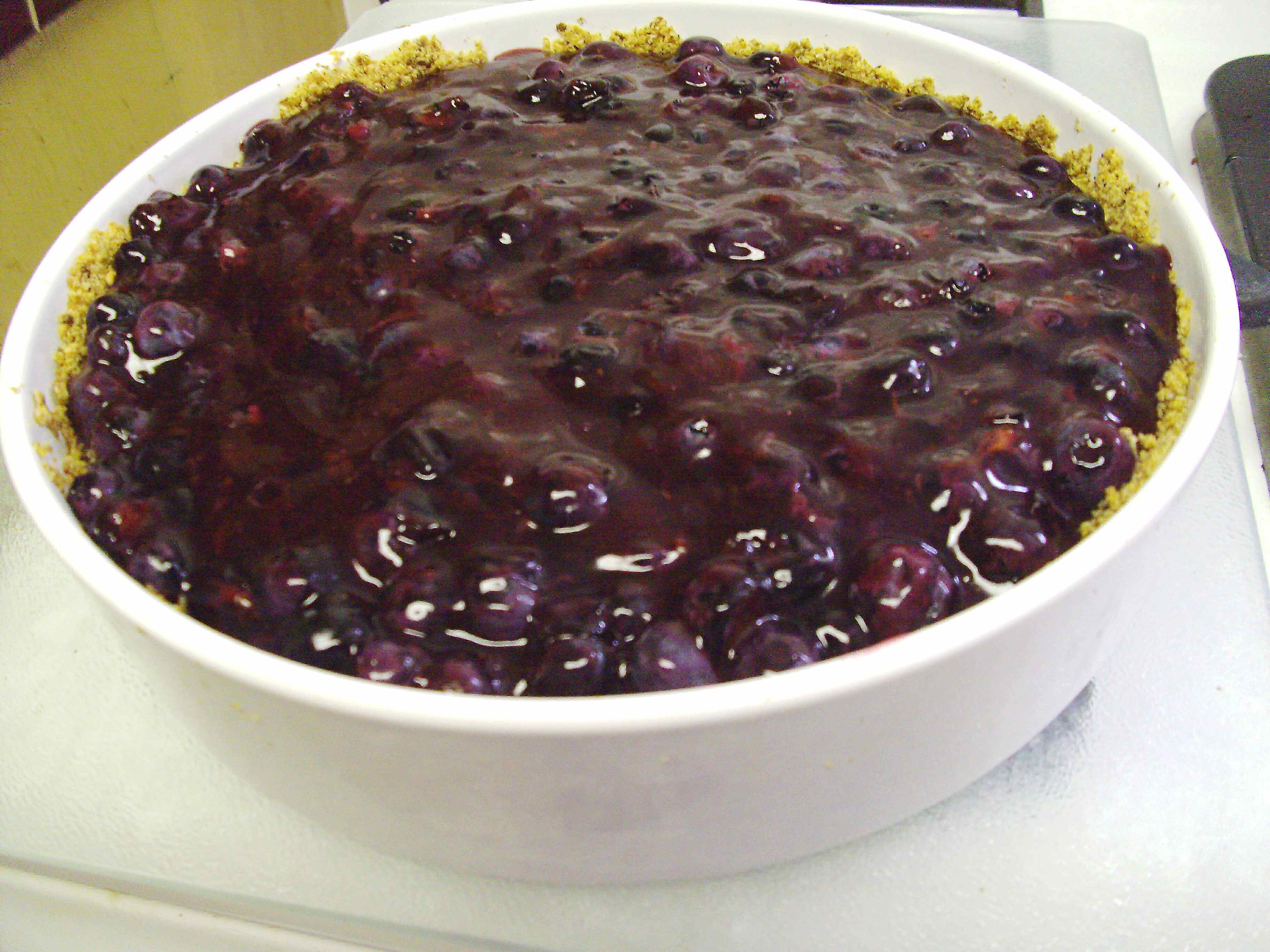
    raw blueberry pie with microwaveable filling and graham cracker crust

    This mostly-raw blueberry pie is a snap to make and very versatile--the filling microwaves in a few minutes, and you don't even have to bake the zippy gingered graham cracker crust--perfect for a hot Fourth of July and all summer long.

  • Recent Posts

  • Contents

  • Archives

  • Now Reading

  • See also my Book Reviews

  • Copyright 2008-2024Slow Food Fast. All writing and images on this blog unless otherwise attributed or set in quotes are the sole property of Slow Food Fast. Please contact DebbieN via the comments form for permissions before reprinting or reproducing any of the material on this blog.

  • ADS AND AFFILIATE LINKS

  • I may post affiliate links to books and movies that I personally review and recommend. Currently I favor Alibris and Vroman's, our terrific and venerable (now past the century mark!) independent bookstore in Pasadena. Or go to your local library--and make sure to support them with actual donations, not just overdue fines (ahem!), because your state probably has cut their budget and hours. Again.

  • In keeping with the disclaimer below, I DO NOT endorse, profit from, or recommend any medications, health treatments, commercial diet plans, supplements or any other such products.

  • DISCLAIMER

  • SlowFoodFast sometimes addresses general public health topics related to nutrition, heart disease, blood pressure, and diabetes. Because this is a blog with a personal point of view, my health and food politics entries often include my opinions on the trends I see, and I try to be as blatant as possible about that. None of these articles should be construed as specific medical advice for an individual case. I do try to keep to findings from well-vetted research sources and large, well-controlled studies, and I try not to sensationalize the science (though if they actually come up with a real cure for Type I diabetes in the next couple of years, I'm gonna be dancing in the streets with a hat that would put Carmen Miranda to shame. Consider yourself warned).

Lightening up homemade scones

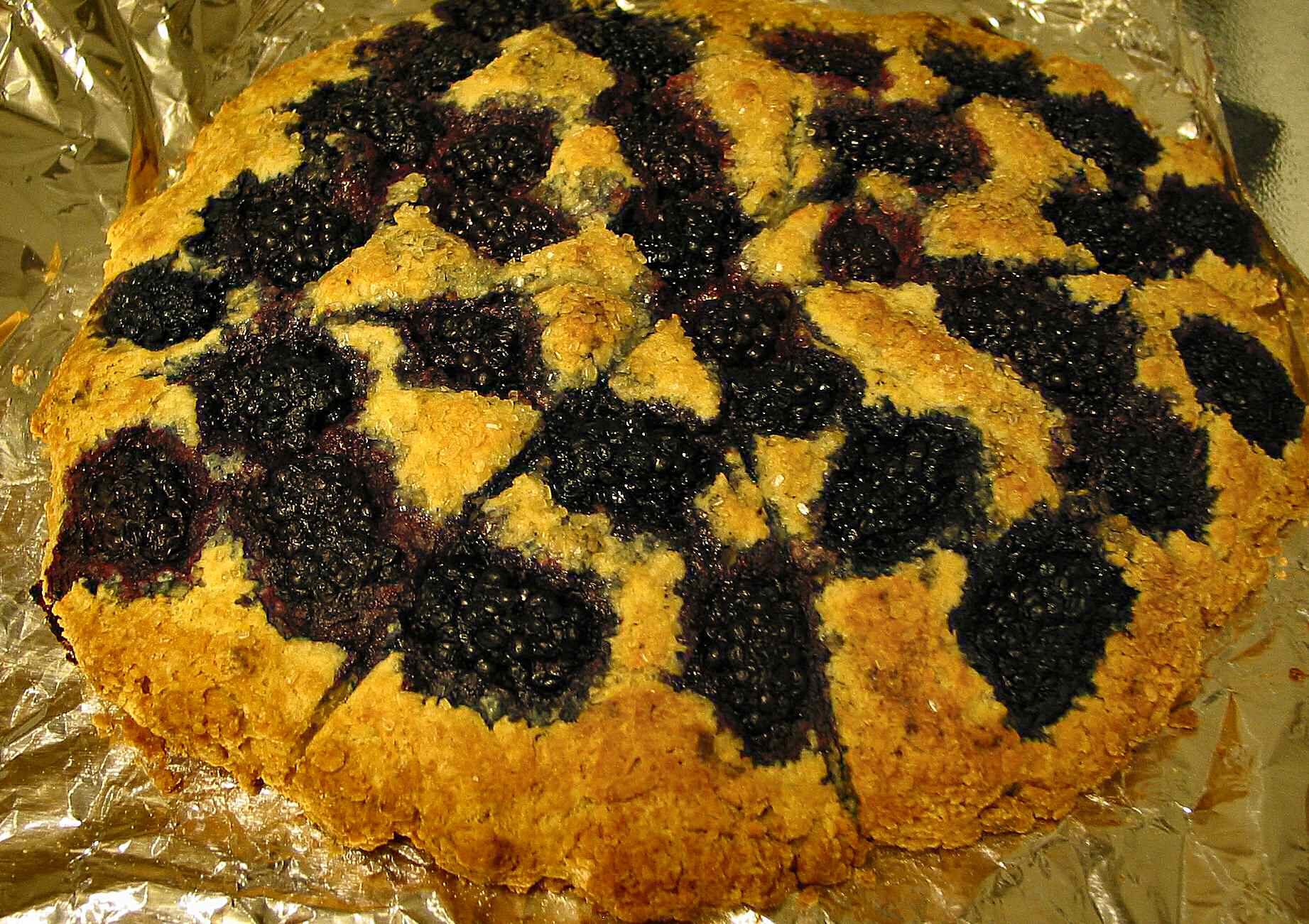
Blackberry scones for brunch

I’ve been wanting to post my favorite scone recipe for some time, but it seems to me that most food blogs start out with good intentions and end up maxing out on the desserts-and-starches end of the food spectrum.

The reason is pretty simple: if you’re a food blogger,  a baking recipe and a pretty picture (or any picture of an aggressively-frosted cupcake) will never put you wrong, even if the real result tastes kind of blah. I mean, cupcakes? Isn’t that what Duncan Hines is for? But if you do feature cupcakes, somebody’s sure to repost it or call it awesome, particularly if you figure out how to add bacon to it. Somehow people just don’t flock to posts about green beans in droves unless you’re redoing the Thanksgiving-straight-from-the-can classic, complete with canned fried onions.

There are way too many variations for every kind of baked good, none with a clear and permanent advantage, and people take them all literally (see under, my New Year’s apple pie insecurities).

So as I say, I’ve been reluctant to put up too many baking posts. Scones, though they’re not exactly the staff of life, are very easy to make and actually taste best when you make them from scratch–much better than buying them in a store and definitely not at your local Starbucks. The question I have is whether it’s a good idea to do it very often–I usually don’t, even on the weekend, but partly that’s because I live in southern California and heating the oven for more than five minutes in my little galley kitchen is often a Very Bad Idea. The other reason is that I keep remembering something Valerie Harper once said (maybe in the role of Rhoda Morgenstern; can’t remember): “I don’t know why I bother to eat this piece of chocolate cake. I should just apply it directly to my hips.”

Most quick breads (i.e., raised with baking soda or powder, or beaten egg whites, not yeast) do fine in a microwave as long as you don’t need them to brown. So lemon-poppyseed cake is okay, as is gingerbread. Scones, which to my mind require a deep and crunchy crust, need a regular oven to do well, but I make the sacrifice (90-degree weather makes it a genuine sacrifice) once in a while on Sunday mornings, because they taste terrific and they’re not exactly rocket science to make.

So if they’re that easy, should I really be posting about them–haven’t you already seen too many wide-eyed, “Look, Ma, I made SCONES!” kinds of posts?

Let’s face it. You can make great scones in a food processor from a very short list of ingredients for cheap, in about half an hour including baking time, and flavor them simply or exotically. Fruit or chocolate chips or chiles and herbs and cheese–all optional. I stick with berries and turbinado sugar, which makes the crust crunchy and glittery. Continue reading

Paula Deen and the diet that bites you back

This week’s “revelation” that Paula Deen, “the Butter Queen” is now a Type II diabetic was a surprise to nearly nobody. Deen, who revealed a harrowing backstory in her memoir of a bootstrapped career in catering, has enjoyed a surprising rise to fame on television. Two weeks ago, following in Emeril Lagasse’s footsteps, she appeared as Grand Marshal for the Rose Parade right here in Pasadena.

Of course, her otherwise ordinary “Southern Cooking” has been exaggerated out of all recognition with extra excess butter and sugar and mayonnaise, and so for years now cads like Anthony Bourdain have called her a scourge on the culinary scene (well, actually, he called her a lot worse than that, but he’s Anthony Bourdain. I’m paraphrasing politely, even though I kind of agree, at least foodwise).

With the revelation that she’s Type II, which everyone knows and fears due to their own increasing girth, Deen is bound to be the butt of predictable jokes this week and next, or until the next big Kardashian “revelation” that newspaper readers apparently care deeply about, or at least they do according to the reality TV networks footing the ad bills. (Even the New York Times has wasted column inches on this kind of drivel this year. Journalistic standards are dropping all over the place, I tell ya.)

But tell the truth, y’all: she ain’t the only one responsible. Not by a long shot. Read any “major” chef’s cookbooks and magazine offerings, other than perhaps those of Nobu, who deals mainly in raw seafood unadorned by carbs or noticeable layers of fat, and you’ll quickly realize that MOST of them exaggerate the salt, sugar and fat content of their dishes well beyond reason. Very few of them deal out plain vegetables on the plate. Very few deal out meats or fish without big sauces.

The other big, big feature stories on food in the New York Times this week:

1. Mark Bittman doing a quasi-deep bankruptcy commentary on Hostess that manages to recount his entire childhood consumption of Twinkies and co. in loving, fine-grained detail. He still attempts to sound self-righteous about it by the end because the ingredients include “ultra-processed flour”.

2. David Tanis of Chez Panisse, waxing lyrical about French lentils (du Puy or Die) as a salad with vinaigrette, hard-boiled eggs (so far, so good), some lettuce and….big fatty slabs of pork belly on top. Five or six of them per plate.

3. “The Miracle of Bo Ssam”–which turns out to be David Chang of Momofuku’s recipe for pork shoulder slathered in salt and brown sugar–twice–and cooked down for six hours in the oven. Caramelized barbecue. In fact, “crack” barbecue, to match Momofuku Milk Bar’s world-famous (to bloggers, anyway) “crack” pie made with most of the same ingredients.

Now people. With all of that going on, with Thomas Keller still boiling his vegetables in brine and poaching his lobster bits in butter, with the Culinary Institute of America instructing its naive young students to salt, salt some more, and salt yet again to achieve that perfect degree of salting in each dish (Coronaries ‘R’ Us), and with Congress sucking its collective thumb about local schools’ move this year to exclude french fries and pizza from the “vegetable” categories in their cafeterias—–

Does anyone really think that Paula Deen is NOT a woman of her time?

She’s nowhere near the worst–she’s just not as fashionable as all the tatted-up young bucks who get picked for Top Chef. She’s also not dishy, like Nigella Lawson, whose cookbooks, which started out about 10-15 years ago emphasizing lighter fare like Vietnamese salads with chiles, have also drifted drastically in the direction of high-calorie “indulgence” foods–some of them utter unmitigated goo-fests (avocado, mayo, roquefort? peanut butter, corn syrup, marshmallow fluff, chocolate bars? puff-pastry chicken pot pies-for-one?). Lawson makes the national news, at least in the UK, when she comes back out in public looking svelte again after puffing up too far past the point where male reviewers are still drooling. Will her next book of recipes slim down commensurately?

Unlike the more fashionable TV chefs on her network, Paula Deen is middle-aged and looks it. She’s fat, she’s gray though beautifully coiffed, she’s politely made up and decently dressed–no orange signature clogs–and she smiles. Maybe a little dippily, but if you didn’t know who she was, Continue reading

Fruitcake and the Jews

A week or so ago, just before the Chanukah madness, my husband brought home what he assumed were The Goods from the local Vons (Safeway chain affiliate on the west coast)–a classic fruitcake, green and red candied citron glowing evilly amid chunks of walnut and raisins and other less identifiable bits and topped with syrupy pecans and glacéed cherries. Tacky as hell, we know. We love fruitcake anyway.

Why do Jews like fruitcake more than Christians do? You know, the kind of indestructible fruitcake everyone jokes about passing off to some unsuspecting cousin after having received it 20 years earlier and having kept the tin in the closet all that time underneath some shoes. The kind the British refer to as “doorstop”. The kind all modern cake blogs decry when they present their own lighter, cakier, less fruity and less chewy version as “fruitcake you’ll actually like.” THAT fruitcake.

Well. Private Selection or not, the cake from Vons was…I don’t know if there are new legal restrictions on using rum or bourbon or other booze as a baking ingredient these days (or ice cream flavor; hard to find Rum Raisin anymore). Maybe it’s a California-does-rehab thing, or just a huge downgrading of quality, but it. Was. Awful.

No rum. No bourbon or other appropriate flavoring. Instead, the loaf was permeated with an aggressively soapy flavor/odor (we couldn’t even tell which), horridly artificial and perfumy like fruit-scented liquid hand soap. Or that overpowering Dove soap I always hated as a kid. You couldn’t even taste the raisins or walnuts, which by all accounts, including visual inspection, were present.

We were, perhaps for the first time ever, not tempted to eat any more, not even to try a tiny second taste the next day to see if it was really as bad as we thought the first time. Just passing the open packet on the table was enough to convince us the bar of Dove that must have fallen into the batter was still giving that loaf its younger-looking complexion. After several days of forlorn looks in its direction, we actually threw it out.

In any case, I’ve been looking for a trustworthy recipe for fruitcake ever since and not succeeding much. In a place where there is no fruitcake, strive thou to make taka a fruitcake. (Not exactly sure what the “taka” part means in Yiddish; the way my mother says it, it means something like “especially” or “such a”, but less polite and more ironic, as you might use it when pointing out how incredibly garish and over-the-top the neighbor’s Christmas lights are with the Continue reading

Stolen!

Toucan-beaked finjanim (coffee pots) from the Ethnographic and Folklore Museum in Akko, Israel

Brass finjanim (coffee pots) and tin plates from the pioneer days in Israel. Exhibition at the Ethnographic and Folklore Museum, Akko, Israel

Can’t decide whether I’m more heartbroken or flattered–maybe just surprised?

The Wall Street Journal 

a) has a food section (who knew?)

b) which is currently featuring a 4-part series of recipes by Yotam Ottolenghi.  (I’m actually in favor, and hoping for his book Plenty for my birthday–my husband  floated the suggestion a few weeks ago and I was really flabbergasted that he’d even heard of Ottolenghi. Must have been listening to  something on NPR.) Why is Ottolenghi favoring the WSJ, though, of all food column venues?

c) Said series is calling itself “Slow Food Fast” — the goniffs; can I charge them for it? wouldn’t you? — but it probably shouldn’t.

I’m not just saying that for my own sake (though that’s a big part of it, don’t get me wrong. I’m–the heck with neutrality–too annoyed to be giving a link to this).

Ottolenghi’s recipes aren’t really either slow-slow (stews, beans from scratch, etc.) or incredibly fast (microwave)–a lot are lightly fried or grilled, with a sharp mix of flavors, a lot of herbs, middle Eastern sauces and a tossed salad of some kind on the side. Soft-boiled eggs in a salad, corn latkes with a salad, pan-grilled mackerel on a pita with pistachio pesto and Greek yogurt (bet he’d rather have labaneh but can’t find it in New York or London)–etc.

Which makes them good eating, Israeli and Arab style. But not really slow food done fast.

Most Israeli cooking that’s still Israeli (and not nouveau-Italian, complete with oversized bowls of pasta and seven different cappuccino/macchiato/etc. kinds of coffee drinks) falls into three categories.

The old-fashioned stuff is long-cooked roasts or stews for meats and poultry, maybe stuffed vegetables or an eggplant or spinach casserole or couscous or pilaf. Traditional Romanian, Hungarian, and Moroccan restaurants and some home chefs (usually older women) serve these sorts of long-cooked dishes, but there’s no real shortcut for them.

Israeli street food (not western, engineered “fast food” like McD’s) mostly appears at lunch counters and road stops that specialize, but again the ingredients are real. Felafel, shawarma (even though they’re mostly using a mixture of turkey and beef instead of lamb these days), lahmajoun (ground-meat pizzas). Or else burekas, trays and trays of puff-like flake pastry layered with cheese or eggplant or potato or mushroom filling, and you stop in for lunch and have a huge slab of one with maybe a bit of salad on the side and some tea. All of these take some preparation–the fast part is you walking up to the counter and getting takeout.

In between these extremes are cafés that serve individually-cooked dishes–more informal than casseroles and stews, less casual and more varied than street food. Grilled or fried vegetables (peppers, onions, eggplants, tomatoes, zucchini, pumpkin? potatoes?–more eggplant) and beans, grilled fish or chicken, hummus and baba ghanouj, assortments of cooked salads,with a fresh salad and dishes of olives, turnip and eggplant pickles. A lot of olive oil and garlic and lemon and cumin, yogurt, vegetables, and water-flour-yeast-salt kinds of flatbreads. Street food stand sauces like tehina, salat turqui, harissa, and hilbe (sour yellow fenugreek sauce, kind of mustardy) are still part of it, but so are vinaigrettes and more complex flavorings, and a lot of fresh herbs make an appearance.

This is Ottolenghi’s kind of cooking, and I love it, but it’s neither slow food nor slow food done faster. It’s rustic, village-style food, even though he’s dressed up his version for London diners. At its best you feel like you could walk into the restaurant and fit in fine whether dressed for a theater evening or still dusty from hiking with a water bottle still hanging off your backpack. As though if you walked to the back you wouldn’t be that surprised to see the chefs squatting down over a little pine fire in the courtyard, grilling the food Bedouin-style,  on the back of a broad, battered skillet or skewered on a long thin stick.

They’re not really doing that in Tel Aviv or Haifa, of course, but desert camp cooking is still a key part of the local food lore. People still grill things like chicken hearts and livers outside on little pine fires in their courtyards at home with great pride. Or char eggplants and peppers directly on the gas stove–sort of smelly but undeniably authentic. They point out  za’atar, hyssop and other forageable herbs on wilderness hikes; they know how to make a quick camper’s flatbread of flour and water and a few sprigs of foraged maluakh (a salty plant found in the Negev) over the back of a frying pan. And they know how to brew botz — Turkish coffee–with a flourish.

It’s a part of Israeli life I fervently hope won’t disappear with all the new software companies and car dealerships and cappuccino joints that have popped up over the last couple of decades.

As for the use of my blog’s name, I’m thinking I should take the attitude Monty Python did one time when Margaret Thatcher made free with their Dead Parrot Sketch in a political speech for the Eastbourne by-elections: they announced that given the results of the elections, they thought it not only served her right, but that she had suffered adequately and publicly from her folly that they could save themselves the barristers’ fees for a lawsuit.

Me? I’m waiting til Tuesday. Somewhere else in the WSJ online was an editorial actually praising John Boehner’s plan for the debt ceiling. Feh.

Acai, African mangoes, and the ‘tiny belly’ con

The Washington Post:  ‘tiny belly’ online ad part of scheme, government says

Acai berry distributors have been under scrutiny from the FTC since the spring, but the “tiny belly” and “1 weird old tip” ads that flood the margins of your online newspaper are part of an elaborate scheme to sell you fake diets based on acai, African mangoes, hCG (placenta extract), and other snake oil.

According to the FTC, though, the true objective may be something else–the “free samples” require you to register your credit card.

Google and the other main ad server claim they’re weeding out bad ads, but this one is so prominent on so many sites you just have to wonder what kind of cut they’re getting from it. Because the same damn wiggling abdomen cartoon is everywhere, used over and over, it should be a snap to eliminate.

File this under: unappetizing.

The new MyPlate icon–fantastic or plastic?

Everyone in the food press seems to be weighing in on the new replacement for the much-cursed USDA Food Pyramid in all (both?) its glorious confusion and obfuscation of real nutritional goals that might have (and should have) undermined the beef, corn, pork, corn, sugar, corn, and soy industries if they’d ever been presented honestly.

So where does that leave us? With ears of fresh corn that are more than 50 cents apiece in Los Angeles supermarkets, and the new…

USDA MyPlate logo

Already, the USDA’s MyPlate web site is in a certain amount of branding trouble (and of course, that’s what counts most in America): the Texas DMV had already bagged “MyPlates.com” for its vanity license plate division (highly unappetizing), and Livestrong.com already has its own well-established “MyPlate” food calculator and fan base. And those items come up first on Google searches. As in, the whole first page or more. The government site ranks way down the list and had to water down the impact of its original name choice with “choose” just to get a URL. Can it elbow out the competition just by bolding the “MyPlate” part?

What really counts are the food and nutrition opinion maker comments, though. And a lot of those are detracting in a nitpicking way that I think kind of misses the point.

The first thing they all have to say is that the plate looks dumbed down. Forgive me, but wasn’t the Food Pyramid’s unreadable and unusable design a large part of the problem? The MyPlate icon is simpler and more direct, and it names real food groups, not “Big Mac” or, on the haute side of things, any of Ferran Adrià’s foams. No wonder foodies and populists alike are wondering what it has to do with them.

A small sampling of the main arguments:

MyPlate: The Food Pyramid for dummies? (LA Times): Dr. Andrew Weil and others discuss what’s still wrong with the new icon. Weil says “fruits” could still include fruit juice, which is usually a useless sugar bomb in comparison with whole fruit, and he worries that the protein section, which comes with a guideline to eat 8 oz. of fish per week, might encourage unthinking people to increase their mercury intake since swordfish is on the guideline menu, as are some of the generally overfished popular species of fish. Weil’s not wrong about the fruit juice vs. actual fruit, but his hand-wringing about fish is really geared for well-off readers who can afford to eat much of it. All the fishes he names are Continue reading

All Those Magazine Microwave Tips

I’m STILL working on a review of Joan Nathan’s Quiches, Kugels, and Couscous: My Search for Jewish Cooking in France. Reason–so far the stories are more engaging and attention-getting than the food itself. So deciding what I think about the food takes a reread and some comparative checking.

For now, I’ll note very briefly that Nathan actually recommends microwaving in several recipes. This is a big step forward in the top-tier cookbook world, even though Nathan’s few mentions are still pretty brief and simple uses for the microwave. They’re still commonsense, so I give her credit for not eschewing them.

But it brings up a sore point for me. A lot of food writers are starting to incorporate microwave tips in their publishing repertoires, but some of them don’t really know how to use a microwave for much or else they don’t do the important legwork and test out their suggestions under varying conditions so that readers won’t get burned.

Case in point: Melissa Clark in a recent article for Real Simple, 14 Who-Knew? Uses for Your Microwave. Clark’s article is an unfortunate object lesson on the need for caution, maybe even a bit of actual research and critical thinking on the bounty of quickie microwave tips the food and homemaker magazines love to dish up.

The “uses” in Clark’s list include sterilizing sponges and plastic cutting boards, juicing lemons, toasting nuts and coconut, heating up beauty products like gel masks and leg wax…

Not only are most of these nonfood uses unoriginal–did she just scour the ‘Net or did she try them out?–but some of them are actively dangerous, to say nothing of unappetizing. Some gel mask manufacturers even put a warning in their instructions not to microwave the mask by itself but rather in a bowl of water–you could end up overheating it and scalding your face. One reader commented that she’d tried the sponge-sterilizing trick and ended up with a houseful of black smoke and a ruined microwave. Very expensive and maybe even harmful, even without the risk of a house fire. Sponges and plastics give off volatiles when heated–do you want to breathe them? do you want to have them coating the inside of your microwave and then washing off into your food the next time you heat up a cup of coffee?

And do you really want to eat ANYTHING from your microwave after something like dirty sponges or a plastic cutting board has been heated up in it? To me it would be like eating off a table where someone’s just left their dirty socks.

SOOOO–Here are a few general (hard-earned, experience-based) notes on not abusing your microwave by following such tips unthinkingly. Because there will always be more articles like Clark’s than the kind I’d hoped for.

1. Don’t microwave nonfood items to clean them (or really, for any other nonfood reason…) At all. Your microwave is not a dishwasher, washing machine, or autoclave (and I have very unpleasant memories of the bio department autoclave and its smell when I was still a lab tech–wouldn’t exactly call it clean even if it did lyse the bacterial cell cultures…) The chemistry of microwaving is different from straight-up heating in an oven and may do something unpredictable or harmful if there’s no water present to absorb the energy, or occasionally even if there is. Think BPAs in plastic–there are loads of Continue reading

Superfoods and Magic Beans

“Top 10 (or 7, or 5, or whatever) Superfoods” lists seem to be popping up on the covers of all the in magazines this month. If I didn’t get a headache every time I tried it, I’d be rolling my eyes.

The classic bloated diet article with the even more classic bloated promise of magic beanhood is nothing new, I realize. But “superfoods”…

The premise of calling something a superfood is that if you eat this one special food, or at least shop your way down the list of 5, or 10, or whatever’s in the article, you’ll be so much healthier than someone who eats a regular food. Right?

Usually the items on these lists of so-called superfoods turn out to be expensive exotics like dried acai berries and pomegranate juice. Both of which just happen to have heavyhitter funding and marketing efforts behind branded packaged versions of them, and the companies that have started branding and marketing them have both recently come under FDA scrutiny for overinflated and unsubstantiated health claims.

Of course you don’t have to go branded to run into wide-eyed, breathless claims about supposed superfoods. More mundane choices like the sunflower seeds, green peas and garlic touted in this LA Times food section article are also now being highlighted as the new great green hope for America.

But not for the reasons that make the most sense–that these foods are relatively unprocessed vegetables, fruits, whole grains, nuts and seeds (occasionally someone remembers to add something from the beans and pulses category too). All of this vegetation has almost disappeared from the current mostly-processed, mostly restaurant diet of the American public. The general categories now touted as superfoods contain protein, fiber, vitamins and minerals. They’re wholesome and varied if you buy them fresh (or dried) and cook them yourself. Some of them are green (and they’re supposed to be!)

That’s in stark contrast to the now-standard and really dreary burger, ketchup, fries and soda that are all made out of the same three or four overused industrial ingredients (wheat, soy, corn and salt, with a little beef scrap or so thrown in for the burger, some leftover tomato paste for the ketchup, and much less potato than you’d think in the fries). I understand how something that’s actually recognizably plant-based would seem exotic and ultrahealthy in comparison. I do. Because frankly, you could take your soy-based green crayons and color a piece of all-natural bamboo-fiber cardboard and eat that and it would be healthier than the fast food special.

But does that mean vegetables, fruits, whole grains and nuts and seeds are suddenly superfoods?

What are superfoods supposed to be, exactly? Look at the captions for what’s so great about each featured food Continue reading

Local, organic and forgotten field hands

Darra Goldstein’s editorial in the Fall 2010 issue of Gastronomica calls out the schism between the “local, organic” righteousness of wineries and customers and the forgotten field workers they still exploit in the process. Worth a read, even though Goldstein doesn’t get quite far enough to suggest a solution or call for renewed political attention.

Gastronomica | Fall 2010 | Volume 10 Number 4.