
• Enter your email address to subscribe to this blog and receive notifications of new posts by email.

    Join 241 other subscribers
  • Noshing on

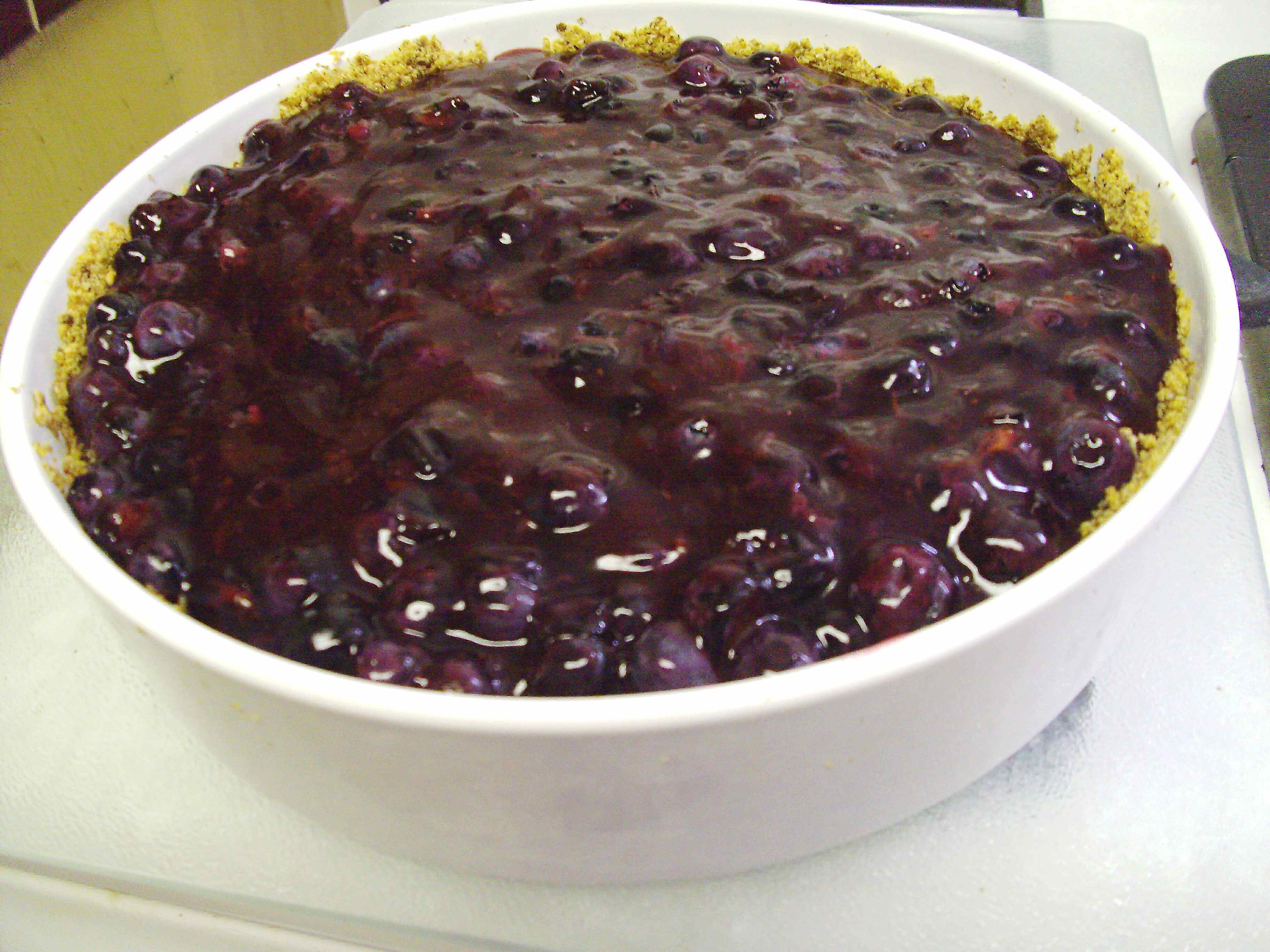
    raw blueberry pie with microwaveable filling and graham cracker crust

    This mostly-raw blueberry pie is a snap to make and very versatile--the filling microwaves in a few minutes, and you don't even have to bake the zippy gingered graham cracker crust--perfect for a hot Fourth of July and all summer long.

  • Recent Posts

  • Contents

  • Archives

  • Now Reading

  • See also my Book Reviews

  • Copyright 2008-2024Slow Food Fast. All writing and images on this blog unless otherwise attributed or set in quotes are the sole property of Slow Food Fast. Please contact DebbieN via the comments form for permissions before reprinting or reproducing any of the material on this blog.

  • ADS AND AFFILIATE LINKS

  • I may post affiliate links to books and movies that I personally review and recommend. Currently I favor Alibris and Vroman's, our terrific and venerable (now past the century mark!) independent bookstore in Pasadena. Or go to your local library--and make sure to support them with actual donations, not just overdue fines (ahem!), because your state probably has cut their budget and hours. Again.

  • In keeping with the disclaimer below, I DO NOT endorse, profit from, or recommend any medications, health treatments, commercial diet plans, supplements or any other such products.

  • DISCLAIMER

  • SlowFoodFast sometimes addresses general public health topics related to nutrition, heart disease, blood pressure, and diabetes. Because this is a blog with a personal point of view, my health and food politics entries often include my opinions on the trends I see, and I try to be as blatant as possible about that. None of these articles should be construed as specific medical advice for an individual case. I do try to keep to findings from well-vetted research sources and large, well-controlled studies, and I try not to sensationalize the science (though if they actually come up with a real cure for Type I diabetes in the next couple of years, I'm gonna be dancing in the streets with a hat that would put Carmen Miranda to shame. Consider yourself warned).

Bravo to LAUSD

Some actual good news on the school lunch front appeared in the LA Times  yesterday:

L.A. Unified removes flavored milk from menu

The Los Angeles public school district, one of the largest in the nation, had to vote its bigger contracts for things like milk early, so they made the announcement yesterday. They’ve also announced they’re going to drop breaded, fried wastes of space like chicken nuggets and offer more vegetarian options, more farm-to-school contracts for actual fresh produce, all the good things we’ve been waiting decades to see again.

This is all in deep contrast with the frosty reception Jamie Oliver’s “Food Revolution” show has received from actual LA schools in the past few months. And there’s a reason for it that you don’t have to dig too deep to get to. A lot of the fine upstanding revisions to the LAUSD school lunch menus and cafeteria revamps have not actually gone through for budget-crunch reasons. Some of the salad bars were never installed and implemented. As with many pieces of legislation, the intentions were good, or sounded good, but the money never showed up. Benefit: zero.

And a friend of ours who’s a school principal says the federal food subsidy program for poor students–there are an awful lot of them in his school, as in many of the LA area schools–is woefully underserving those kids. Some wouldn’t get a meal at all if they didn’t eat at school, and the food they get today is barely worth the name.

If the LAUSD can actually manage this year’s resolutions right, it’ll be a big step forward. The chocolate milk wars in the city board offices have been surprisingly intense–proponents of keeping the sugared chocolate and strawberry-flavored drinks argued that if they were pulled, most kids wouldn’t drink milk at all, 60 percent drink the flavored milks when available and that there’d be a big drop in milk consumption.

Proponents of going to plain (and Lactaid, and soy, to accommodate everyone, this is California after all) countered with the ugly fact that  the amount of sugar in the flavored milks puts them just about in the range of Coke, and argued that if fast food choices weren’t waved so constantly in the kids’ faces and the cafeterias offered real food instead, rather than alongside, the kids would eat more real food. And they’d get used to plain milk quickly enough.

I can attest to this phenomenon. We don’t keep fast food or junk food in the house, and I’ve been serving fresh vegetables and whole foods rather than prepared or processed things out of a box most of my adult life. I don’t get too many complaints, not only because my husband’s no cook, but because that’s what there is to eat and it’s the way we grew up eating at home.

Our daughter came along and started out with plain unsweetened yogurt, vegetables, bread and plain oatmeal or the lower-salt store brand versions of Cheerios. Also, for reasons that aren’t particularly clear even now, she had a thing for Indian food, spices and all. The maitre d’ at our favorite restaurant laughed when he saw this two-year-old kid tucking into a hot cauliflower dish and saag paneer. He remembered me coming in for a serious feast with my husband when I was very, very pregnant and hoping it would either induce labor or at least last me until I was in shape to come back. I’d never considered that she’d like to eat what I ate while pregnant–I’m still not sure it’s true, but I figure Indian families would have more experience with seeing how their kids develop a taste for vegetables and varied spices. Even now, she likes a wider variety of non-sweet flavors than her friends. I like to think it’s because she’s gotten to taste them, and because we like to experiment.

Part of the comparatively low-sugar diet for her was self defense–she was an up-like-the-rocket, down-like-the-stick kind of toddler if she ate many sweets at a time, even then. Years before, my sister’s older son had gotten stuck in a serious chocolate milk habit at that age, because my sister had given it first as a treat, then as a regular drink, then for comforting him or to appease temper tantrums, then to get him to do the things he should have been doing with or without milk. She had a hell of a time getting them both back out of the vicious cycle. I’m not as organized and can’t fool myself, so I took it as a warning.

My daughter got sweets occasionally, but mostly she was eating the kinds of foods we ate and now that she’s diabetic AND eleven at the same time (pity me!), I’m extremely grateful that she got the taste for nonsweet foods early in life. She only really wants junk foods if they’re right in front of her, or hungers out loud for what she knows are exaggeratedly high-carb items if her blood glucose is a bit high. When she’s in good shape, she goes for vegetables and fruits and cheese and Continue reading

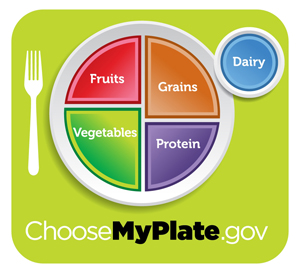
The new MyPlate icon–fantastic or plastic?

Everyone in the food press seems to be weighing in on the new replacement for the much-cursed USDA Food Pyramid in all (both?) its glorious confusion and obfuscation of real nutritional goals that might have (and should have) undermined the beef, corn, pork, corn, sugar, corn, and soy industries if they’d ever been presented honestly.

So where does that leave us? With ears of fresh corn that are more than 50 cents apiece in Los Angeles supermarkets, and the new…

USDA MyPlate logo

Already, the USDA’s MyPlate web site is in a certain amount of branding trouble (and of course, that’s what counts most in America): the Texas DMV had already bagged “MyPlates.com” for its vanity license plate division (highly unappetizing), and Livestrong.com already has its own well-established “MyPlate” food calculator and fan base. And those items come up first on Google searches. As in, the whole first page or more. The government site ranks way down the list and had to water down the impact of its original name choice with “choose” just to get a URL. Can it elbow out the competition just by bolding the “MyPlate” part?

What really counts are the food and nutrition opinion maker comments, though. And a lot of those are detracting in a nitpicking way that I think kind of misses the point.

The first thing they all have to say is that the plate looks dumbed down. Forgive me, but wasn’t the Food Pyramid’s unreadable and unusable design a large part of the problem? The MyPlate icon is simpler and more direct, and it names real food groups, not “Big Mac” or, on the haute side of things, any of Ferran Adrià’s foams. No wonder foodies and populists alike are wondering what it has to do with them.

A small sampling of the main arguments:

MyPlate: The Food Pyramid for dummies? (LA Times): Dr. Andrew Weil and others discuss what’s still wrong with the new icon. Weil says “fruits” could still include fruit juice, which is usually a useless sugar bomb in comparison with whole fruit, and he worries that the protein section, which comes with a guideline to eat 8 oz. of fish per week, might encourage unthinking people to increase their mercury intake since swordfish is on the guideline menu, as are some of the generally overfished popular species of fish. Weil’s not wrong about the fruit juice vs. actual fruit, but his hand-wringing about fish is really geared for well-off readers who can afford to eat much of it. All the fishes he names are Continue reading

AHA: Diet sodas and excess salt both linked to strokes

The latest from the American Heart Association and American Stroke Association’s joint International Conference on Stroke 2011, which is going on in Los Angeles this week from Wednesday through Friday.

Diet soda may raise odds of vascular events; salt linked to stroke risk.

Two large studies on a mixed-race/age/gender/other health status population have just shown that:

1. Drinking diet soda every day increases your risk of a heart attack or stroke in the next 9-10 years. In the study, diet soda regulars had a 48% higher rate than nondrinkers even after accounting for metabolic syndrome and existing or past heart disease.

2. For every 500 milligrams of sodium you eat per day over the AHA’s recommended 1500 max, you have a 16% higher risk of getting a stroke–no matter whether you have high blood pressure or normal blood pressure.

There was one other piece of really bad news announced:

The Centers for Disease Control’s analysts looked at hospitalizations for ischemic stroke (blocked arteries to the brain) between 1994 and 2007 and found that while strokes are decreasing in people over 65 (which is good), they’re INCREASING in children, teens and younger adults. Although older adults still have much higher overall risk of stroke than younger people, the trend toward higher stroke hospitalization rates for younger people is significant and needs to be explored further. Stroke hospitalizations increased by:

  • 31% among boys 5-14; 36% among girls 5-14
  • 51% in men 15-34, 17% in women 15-34
  • 47% in men 35-44, 36% in women 35-44

The CDC researchers didn’t have clear evidence of a cause for the rise in strokes among younger people, but said the rise in average body weight, blood pressure and diabetes, which are known risk factors for stroke, bore a closer look.

The fact that stroke hospitalization rates started rising in children over 5 (the researchers looked at younger children as well but didn’t find an increase under age 5) suggests to me that part of the trend may be due to a more processed diet with higher salt consumption as children head for school. All in all, it gives you the impression that we are the junk food generation, and it’s catching up with us as we speak.

Age, salt and the new USDA dietary guidelines

Last Monday the USDA released its latest version of the Dietary Guidelines for Americans (nominally dated “2010”). I was driving home and NPR carried USDA Secretary Tom Vilsack’s speech, in which he listed a few of the new highlights: eat less, eat less food with solid fats, eat less processed food, eat more vegetables and fruits, eat less sodium.

How much less sodium? About 2300 mg or 6 grams (1 teaspoon) of table salt per day, he said, is the recommended maximum for healthy adults, in line with the long-standing National High Blood Pressure Education Program’s guidelines, which are shared by the American Heart Association and many other professional medical groups.

There’s a second lower-sodium recommendation for anyone overweight, African-American, with heart or kidney disease or high blood pressure or diabetes, and anyone middle-aged or older. This year, as the more specifically heart-health-oriented professional organizations already recommend, the USDA guidelines set the lower maximum at 1500 mg per day, or about 3 grams of table salt.

And you’d think that was great, and I do, that the USDA guidelines have finally caught up with what the medical associations have been demanding based on the overwhelming weight of studies on dietary sodium intake as it affects blood pressure, cardiovascular disease including stroke, and kidney disease.

But there are two catches hidden in the midst of all this, and I’m not even sure Vilsack was aware of it. Smaller one first: Middle-aged? How old is middle-aged?

“Fifty-one and older,” Vilsack said. Whew, I thought. Four more years before I have to start thinking of myself as middle-aged. By the time I get there, I’m hoping the standard will have gotten fudged upward by at least another decade or so.

Because, you know, if you’re not 50 yet, 51 sounds reasonable–and comfortably remote for a lot of younger adults. Which I am, thank you very much. Don’t look at me like that.

So here’s Catch-51: When I was working at the National Heart, Lung and Blood Institute back in the mid-’90s, the general working recommendation for lowering sodium to 1500 mg/day was all the other high-risk groups Vilsack mentioned…and healthy adults 40 and up. Not 51 and up.

The choice of a cutpoint at age 40 for otherwise healthy people was based on the risk data from the first three National Health and Nutrition Education Surveys, which began collecting data across the nation starting in the 1970s. The latest version collected data around 2006 and its findings were just released last spring by the Centers for Disease Control. All the NHANES studies correlate  in-depth interviews about diet, exercise and lifestyle patterns, and cardiovascular history along with clinical health measurements (height and weight, blood pressure, cholesterol, urinary sodium excretion, blood iron, etc.) from thousands of ordinary Americans. Even early on, there appeared to be an independent higher risk and a greater need to lower sodium at 40 and older, all other health risk factors being equal.

But of course 40 seems too young to be middle-aged. And the USDA, which issues the Dietary Guidelines for Americans, tends to downplay certain elements of the risk statements so that no one, or at least not the agency’s chief constituents, gets upset. The no one in this case might easily be the Continue reading

Cranberry Sauce Without the Fuss

Cranberry sauce in the microwaveI love homemade cranberry sauce, and not just at Thanksgiving. It makes a pretty good jam for breakfast and (should the need arise) a pretty good tisane for a congested sore throat if you heat a dollop in a mug of water and sip it hot, berries and all. Despite the fact that it’s tart, which you’d think would make your throat hurt more, the cranberries actually contain something soothing that will give you at least temporary relief when you’re in the throes of Los Angelitis and the Tylenol hasn’t kicked in yet (you can trust my expertise on this one, unfortunately). But hopefully you won’t need it for anything medicinal this winter and can just enjoy fresh-made cranberry sauce for its own sake.

A lot of people are convinced that just opening a can is the easiest and least scary way to go. They must have read the package directions and decided it was too much work to make the syrup first (very intimidating-sounding) or that adding the berries and letting them pop was likely to spatter the stove until it looks like a magenta Dalmatian.

But really, you can just microwave cranberry sauce and it works fine. Throw all the ingredients (berries, sugar, water) into a 3-cup pyrex bowl, slap a lid on partway, and nuke it for 5 minutes. That’s it. No preboiling. Don’t even bother mixing it. In five minutes, you’ve got standard fresh-made cranberry sauce in a bowl that can go straight to the fridge once it’s cool. And no saucepan or stove top to wash before your guests arrive.

You can dress it up with some orange peel or juice, or a pinch of clove and cinnamon. You could add a chopped, peeled granny smith apple or a well-scrubbed chopped organic seedless orange with the peel to the berries for cooking, or else stir in a spoonful of Cointreau or Triple Sec after the jam cools, and you’d have something a little more sophisticated, but the basic recipe is worth having as a first run.

And most helpfully, if you’re looking for something less sugared, you can cut the typical cup of sugar per 12-oz bag of cranberries in half and it’ll still gel decently. Or you can do it with no sugar at all, let all the berries pop and thicken up just in water, and sweeten it with your preferred artifice after it’s cooled. It won’t be completely carb-free per tablespoon or so even with no added sugar, but it’ll be pretty low.

Approximate carb counts (total and per tablespoon, counting 1 T as ~1/16th c.):

Cranberry-only version without apple or orange

  • With 1 cup of sugar: 242 g carb per 2.5-3 c. cranberry sauce  or 5-6 g/T.
  • With 1/2 c. sugar: 142 g carb/recipe or ~3 g/T.
  • Artificially sweetened only: 42 g carb/recipe or ~1 g/T.

Cranberry sauce with apple or orange

With a good-sized apple or orange chopped in, figure 25 extra grams of carb per recipe or 0.5 gram extra carb per tablespoon.

Any way you go with it, though, homemade cranberry sauce has a good deal less carb per spoonful than other kinds of commercial jams, and probably a good deal less than the stuff in a can. It’s a lot better tasting too.

Microwave Cranberry Sauce

  • 12-oz package fresh cranberries, washed well
  • 1 c. water
  • 1 c. sugar (standard Thanksgiving back-of-package recipe), 1/2 c. sugar (my version this week, which was plenty sweet enough for me), OR no sugar during cooking but artificial sweetener added afterward to taste

optional additions: chopped peeled apple, finely chopped whole scrubbed organic orange, pinch or so of powdered cloves and/or cinnamon, a little grated orange or lemon peel, or a spoonful of orange liqueur or brandy

Put the cranberries, sugar if using, water, and apple or orange if using in a 3-cup pyrex bowl, cover loosely with a microwaveable lid so steam can escape but it won’t spatter, and microwave on HIGH 5 minutes. (If you’ve added an apple or orange, you might need an extra minute to account for the extra fruit.) Keep an eye on it toward the end, but it probably won’t boil over.

The mixture should already be thickening to a sauce/jam consistency (it’ll thicken more as it cools), and most of the berries should be popped. Stir well and microwave a minute or so more with a vented lid if you want it thicker. Let cool to room temperature and, if using artificial sweetener, sweeten to taste. Other flavorings–you could add grated lemon or orange peel (sparingly) or clove or cinnamon before cooking, but save any alcohol-based flavorings for after the jam has cooked so they don’t just evaporate in the microwave.

Fastest Pie in Town

Pumpkin pie in the microwave

On the energy downswing from a departed sleepover guest, my daughter suddenly declared she wanted pumpkin pie, we had two cans of it and I’d said I would make it soon and I still hadn’t, why wasn’t I making it, it wasn’t fair, she hadn’t had any all year and it was past October so it was in season. This last argument was just for good measure, given the pumpkin was in a can, but still, give her points for it–it’s a new crop after all those shortages.

With ears ringing, I said, but it’s already 5:30. “So? I can help!” You’ve been there, I’m sure.

Pumpkin pie is a slow-food-slow kind of dish–not much way around it. Even with a premade crust and a can of “pumpkin pie mix” rather than just packed steamed pumpkin, the filling needs 45 minutes to an hour to bake. Then it needs another hour or more to cool enough to eat. And if you’ve got a tiny kitchen and your kid is helping, the elbows factor is bound to add some time and confusion.

Also, normally, with a diabetic kid, you don’t just think, “Hey! Let’s make pie for dessert!” Especially since the filling calls for 3/4 cup of sugar per pie.  But pumpkin pie, if it’s made from scratch and isn’t just a frozen ready-made version, is kind of reasonable on carbohydrates for a dessert–about 25 grams for 1/6 of an 8″ shallow pie, according to the ADA guidebook, or in our case, 35 grams for 1/8 of a standard 9.5″ deep-dish pie (calculated from the ingredients). And pumpkin may be a fruit and not a vegetable, but it’s still got a respectable serving of vitamin A and fiber. And I also like it, which helps.

Still, the time is a killer. But I had such a surprise success with spinach quiche in the microwave a while back that I started thinking. The standard filling for pumpkin pie is also based on a custard, more or less–a couple of eggs, a cup and a half of milk per deep dish pie. It’s half the eggs of a quiche, but it might well still work in a microwave. That part would take something like 5-7 minutes and leave enough time for the pie to cool while we got dinner together.

Actually, I’d wanted to try this for a while, and not with company in tow, just in case it flopped. The weather here was 97 degrees most of the week but dropped to the low 70s today and was promising an actual chill for evening. So doing the crust in the regular oven for 15 minutes or so wouldn’t actually make life miserable.

It was almost looking like a decent idea considering the fact that it was and still is totally nuts to make an entire pumpkin pie from scratch right before dinner (or at least everything from scratch short of hacking up a raw pumpkin and dealing with the seeds). So I decided to go for it, and I made my daughter deal with the filling while I made the crust and parbaked it. We just about managed not to step on each other or crowd into the same corner at the same time, but both parts went well. And then the real test came–time to nuke. Continue reading

Rising Expectations for Rosh Hashanah

Just a quick word to say L’Shanah Tova U’metuka! May you have a good and sweet New Year!

Here’s what my daughter and I baked the afternoon before the start of Rosh Hashanah. You can find the basic recipe here.

Crown challah for Rosh Hashanah

Crown challah for Rosh Hashanah

It’s the first time I’ve baked bread since my daughter became diabetic in February, but by now, six months along, we both feel like we have the approximate carb counts down well enough. I tend not to make my challah very sweet anyway, but this year I also left out the raisins, which are about a gram of carb each, to make things a little easier until we were sure we knew how to figure portions. It still came out pretty and tasted good.

Without raisins, we figure, a baked piece of challah is like most other bread, about 50% carb by weight in grams, and it seems to work. Using a simple ratio like this is a lot easier (when we’re home and have a scale handy, anyway) than worrying about exactly how many cups or grams of flour I put in the dough and calculating exact portion carbs–something I still tend to do for desserts and treat foods like berry scones since they’re so variable. Or as our endocrinologist said, “Everyone guesses wrong for birthday cake.” Next time, we’ll try it with raisins and see how it goes.

Challah birds

One thing we like to do with the extra dough–I make sure there is some–is to let my daughter make challah birds. Usually we shape these by making a small 6-inch rope of spare challah dough and tying it into an overhand knot. You can press a raisin into one of the ends for an eye, and the other end becomes the tail, which you can leave alone, stretch out a bit, or score with a knife tip for “feathers”. This year, my daughter went free-form so the rolls came out looking more like bollilos, but she liked them, which is the important thing.

Mine: A lot of people make spiral challahs for Rosh Hashanah with a single thick rope curled around in a turban shape. Tunisians and some other North African and Mizrahi Jews shape the top end into a hand shape. I like to braid my round challahs into a crown, though I admit they’re not always the most even at the joined end. They still seem to even out as they rise to the occasion.

Braided crown challah rising in the oven for Rosh Hashanah

Braided crown challah rising in the oven for Rosh Hashanah

Challah dough is so easy to put together (2 minutes by food processor, plus cleaning, or 5-7 minutes by hand and letting it rise right in the mixing bowl) that if you get the dough ready in the morning and have a couple of hours in the afternoon free for braiding (10-15 minutes unless you’re having too much fun), the second rise (40ish) and baking (another 40ish), it’s a lot of fun and less expensive than store-bought, and more individual too.

B’te’avon! (bon appétit!)

Lightening Up Apple and Almond Cake

Since Nigella Lawson’s Feast came out a few years ago, her “Damp Apple and Almond Cake” has been praised by food bloggers, morning tv show hosts, and just about everyone else who’s tried making it.

Most of her dessert recipes are not for the health-conscious. In the past 10 years, most of her food has become if anything a lot heavier and gooeyer and richer, migrating from Thai and Vietnamese summer salads with sharp clean flavors to avocado AND bleu cheese AND sour cream WITH taco chips, or chocolate bar AND non-natural peanut butter AND whipping cream AND caramel as an ice cream sauce. Or chicken pot pie WITH a lot of bacon in it and no vegetables AND a store-bought puff pastry top (a whole sheet goes for a mere two servings). I can’t think how far she’ll take things next.

But the  “Damp Apple and Almond Cake”–despite the less appetizing connotation of “damp” in American speech (I think “moist” would probably be the equivalent word over here, or at least I hope so. It would at least conjure up fewer images of seeping rot under the stairwell)……….. okay, where was I with all the parentheses? Oh yeah.

What people have to say about this recipe is that it works as written, and it’s really good. No mean thing these days.

So okay. I have almond meal, I have apples, I have a fresh lemon, and I have some decent vanilla for a change (the Kroger stuff I bought for my daughter’s birthday cake back in mid-summer was shamefully weak). And I have eggs. That’s basically what you need to make this cake.

But it’s blazingly, disgustingly hot, 100+ Fahrenheit, yet again in Pasadena. And–AND–I look at the original recipe (serves 10-12) and realize that while the almond meal is a good move–much, much lower carb than flour–the recipe requires 8 eggs. Eight. E-I-G-H-T. Which puts it in the European spongecake class of baking. My grandmother made a similar thing, only with flour and chocolate chips, and probably 12 eggs, for a huge wheel of a cake.

And the directions call for simmering the apples down to a thick applesauce, then cooling and blending in the food processor with a huge, heavy amount of almond meal and a fairly high amount of sugar and all the eggs, and it’s a “dense” cake. No wonder.

Three and a quarter cups of almond meal. Dense. And almond meal tends to require a little less sugar than flour-based cakes to register sweetness–maybe that could be cut down too?

Those eggs–do you need all the yolks? Do you need all eight eggs for that matter? And while you’re at it, why not take advantage of what eggs do best, since it’s a European-style cake with no other leavening. Separate them and whip the whites to fold into the batter.

So here was what I came up with on a hot September pre-Rosh Hashanah afternoon.

Lightened-Up Apple Almond Cake

  • 3 fairly big Granny Smith apples, peeled and sliced or chopped (~23-25g carb each or ~75)
  • 2 c. almond meal (see Trader Joe’s for a decent-priced 1-lb bag at about $4) (20 g carb/cup or 40)
  • 2 T. flour or matzah cake meal (~10 g carb)
  • 1 c. sugar (200 g carb)
  • 3 yolks
  • 4 egg whites
  • 1 t. vanilla
  • juice of a lemon
  • 1-2 oz. orange juice (optional) (~3-5 g carb)
  • grated rind of half a lemon
  • grating of nutmeg
  1. Put the apple slices or chunks on a microwaveable dinner plate and microwave on HIGH 3 minutes.
  2. Blend the almond meal and sugar in a food processor until very fine (whiz several seconds, good enough)
  3. Add the yolks, apples, flour or matzah meal, lemon juice and rind, vanilla, orange juice and nutmeg and blend well.
  4. Whip the egg whites separately in another bowl large enough to pour in the batter from the food processor. When the whites are stiff (can be done easily enough by hand in only a minute or so with a big balloon whisk, just tip up the bowl and hold it at a slight angle in your other hand, or else use your method of choice), start pouring the batter into them a little at a time and folding with the whisk. I know this is backward from the usual method but it works out ok and saves a third bowl…
  5. Pour into a deep-sided microwaveable casserole or a deep dish pyrex pie plate (chancy, may spill over a bit).
  6. Set a microwaveable soupbowl upside down in the middle of the microwave turntable. Center the casserole or pie plate on top, and microwave uncovered 7 minutes on 70% (for an 1150ishW oven). Stop if it seems to be overflowing and wait a minute before continuing. When it stops rising and settles back in the plate, you might cover with a dinner plate and microwave another minute or so on HIGH until you’re convinced it’s cooked all the way down to the bottom.

Cool and slice–the total carb count is about 325 for the recipe, so 1/16th should be about 20 grams, 1/10th, if you can eat that much, is 33 grams, etc. It’s light, soft, substantial and rich-tasting, and 1/16th slice was pretty good tonight for all the testers at my table. And it only took 4 eggs and a cup and a quarter less almond meal. And about half the sugar of Nigella’s recipe but all the apples.

Lightened-up microwave version of Nigella Lawson's "Damp Apple and Almond Cake"

Not a looker in the microwaved version here, which doesn't brown the top, and I didn't decorate with slivered almonds or lemon slices, but the flavor's so intense and tangy that the 1/16th wedges here were perfect for a quick light dessert.

Verdict—Really, really good, and when I do it again maybe I’ll have cool enough weather to try out the oven so it’ll brown as well (about 25 minutes). I would probably go for a deep-sided casserole or even a soufflé dish. Then I could top it with slivered almonds as in Lawson’s version, and perhaps capture a little more of the rise from the egg whites without it collapsing down afterward.

In a regular oven it’s best to oil the pan and dust it with a little almond meal, but I didn’t have to for the microwave–probably for the same reasons it doesn’t brown on top, it also doesn’t cause a lot of sticking on the bottom.

Another change I might make next time would be to add just a couple of drops of almond extract–not enough to overpower the lemon and apples, just enough to play up the almond meal. This time around when I reached for the little bottle I discovered it was bone dry–hence the nutmeg, which actually worked out quite well.

But all in all, and despite the fact that it LOOKS like a typical Passover choke cake, it really isn’t. It’s very moist and even this way the flavor was wonderful and satisfying. So b’te’avon (bon appétit in Hebrew) and kudos to Nigella Lawson, and maybe this will encourage you (and her) to lighten up a little.

New Page Up: Carb Counts and Ratios

I’ve just uploaded a new page (see the top menu tabs) with a couple of tables of the most useful rules of thumb I’ve found for carb counting. Since my daughter became a Type I (insulin-dependent) diabetic back in February, we’ve both had to become pretty familiar with the amounts of carbohydrate in a given amount of different foods.

Although the American Dietetic Association’s “Choose Your Foods” carb count guide for diabetics is pretty helpful (and pretty inexpensive, about $3 per copy if you order from them direct on www.eatright.org), it’s written from the perspective of the eater, not the cook.

So (as the cook in the family) I’ve worked out the approximate ratios of carb grams per total weight of some common foods I serve routinely. Rice and beans are easy enough to remember. But when I want to know how much of a given potato my daughter can eat as one carb serving (15 g), it helps to be able to know that a regular potato is about 1/6th carbohydrate. Then all I have to do is weigh it on the food scale in grams and divide by 6.

The 2/3 carb ratio for moderately sweet baked goods like pie, scones, cookies and muffins is also pretty helpful if we’re home and can weigh a portion for my daughter. Sweets are one of the hardest things to guess right consistently by eye, even when you’ve made them yourself. If there’s a nutrition label, by all means go with it; if not, weighing a portion and figuring 2/3 has been a pretty good approximation so far.

Ice cream is its own thing–again, hard to figure. Dreyer’s 1/2-the-Fat is our standard home brand, and hovers around 15-18 grams per half-cup (small scoop). But Baskin Robbins 31 Flavors are all over the map–when you go in for a cone, you really need to ask them to look it up for whatever size scoop, then figure the cone separately. A junior scoop in a cake cone for pistachio almond turned out to be something like 25 grams, plus 4 grams for the cone. Almost double what a plain scoop would have been at home.

Over-the-top caramel-syrup-fudge-frosting types of confections are a little out of my league, closer to candy bars than cakes, and would probably be more like 80-90% carb by weight (or mass, if you’re being excessively metric about the properties of grams).  I haven’t listed them because they’re so laden it’s hard to think of serving them very often, but I do have a basic rule-of-thumb candy list at the bottom of the carb counts page (saving the best for last) and a link to a much better, more comprehensive one so kids don’t have to feel completely shut out at Halloween or Valentine’s Day. Or birthdays.

I also have a short (for me) bit of hard-won advice on how to strategize with a (school-aged) diabetic kid before they have to face candy-prone situations where their friends are free to eat right away and they aren’t. Good for braces-wearers too…actually maybe we should all take the hint.

In any case, I hope you find this new page helpful whether you’ve got diabetics in the family or you just want to know what you’re eating.

Let me know what you think!