• Enter your email address to subscribe to this blog and receive notifications of new posts by email.

    Join 241 other subscribers
  • Noshing on

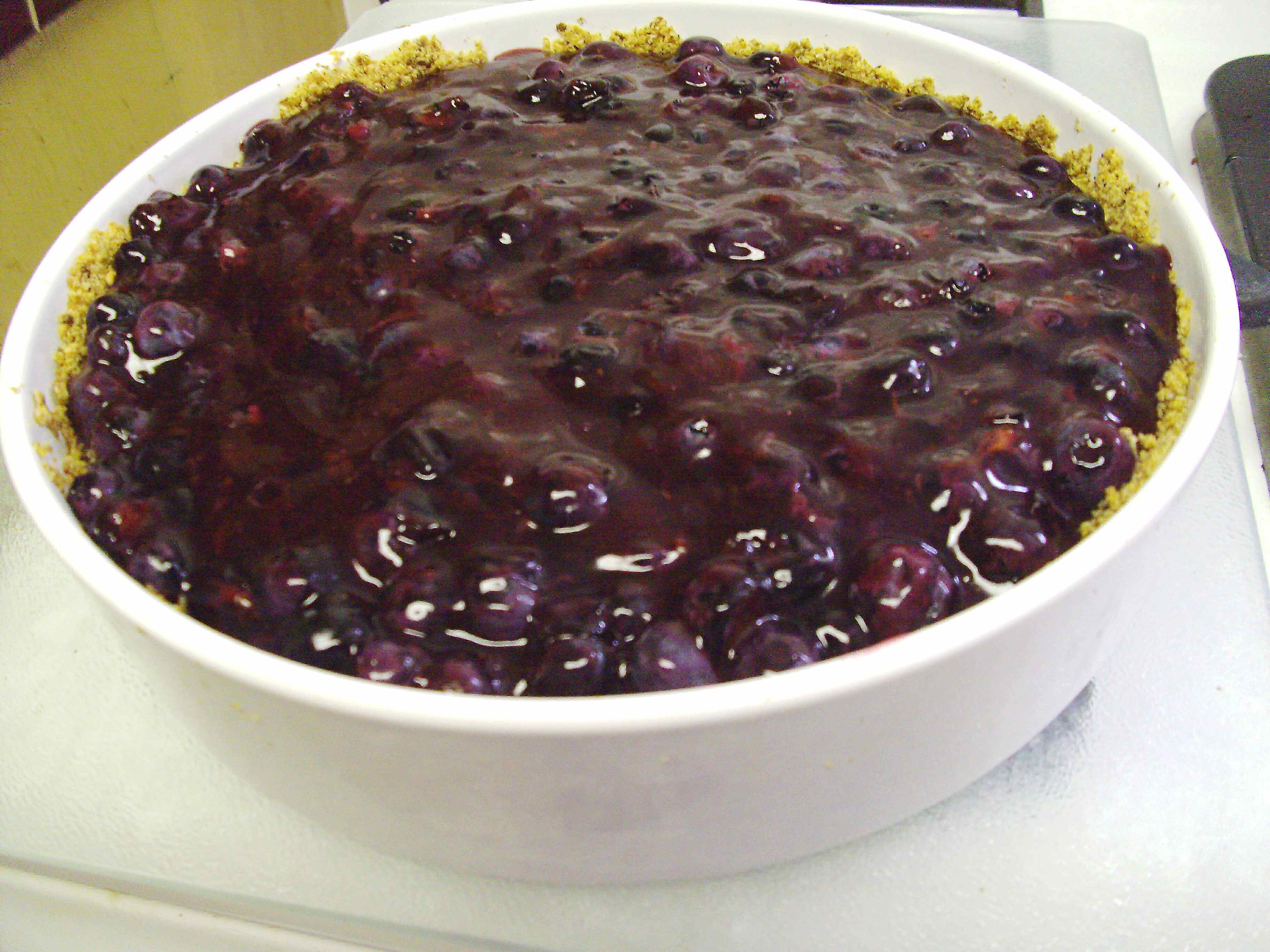
    raw blueberry pie with microwaveable filling and graham cracker crust

    This mostly-raw blueberry pie is a snap to make and very versatile--the filling microwaves in a few minutes, and you don't even have to bake the zippy gingered graham cracker crust--perfect for a hot Fourth of July and all summer long.

  • Recent Posts

  • Contents

  • Archives

  • Now Reading

  • See also my Book Reviews

  • Copyright 2008-2024Slow Food Fast. All writing and images on this blog unless otherwise attributed or set in quotes are the sole property of Slow Food Fast. Please contact DebbieN via the comments form for permissions before reprinting or reproducing any of the material on this blog.

  • ADS AND AFFILIATE LINKS

  • I may post affiliate links to books and movies that I personally review and recommend. Currently I favor Alibris and Vroman's, our terrific and venerable (now past the century mark!) independent bookstore in Pasadena. Or go to your local library--and make sure to support them with actual donations, not just overdue fines (ahem!), because your state probably has cut their budget and hours. Again.

  • In keeping with the disclaimer below, I DO NOT endorse, profit from, or recommend any medications, health treatments, commercial diet plans, supplements or any other such products.

  • DISCLAIMER

  • SlowFoodFast sometimes addresses general public health topics related to nutrition, heart disease, blood pressure, and diabetes. Because this is a blog with a personal point of view, my health and food politics entries often include my opinions on the trends I see, and I try to be as blatant as possible about that. None of these articles should be construed as specific medical advice for an individual case. I do try to keep to findings from well-vetted research sources and large, well-controlled studies, and I try not to sensationalize the science (though if they actually come up with a real cure for Type I diabetes in the next couple of years, I'm gonna be dancing in the streets with a hat that would put Carmen Miranda to shame. Consider yourself warned).

Halloween Candy Carb Guide

Halloween is coming…if you have a diabetic kid, as I do, it’s more difficult than Valentine’s Day to deal with the ups and downs. This year my daughter is in college and making her own decisions, but we’ve been strategizing since her first Halloween with T1D (Type 1 diabetes, the kind that requires insulin round the clock) about how to handle the (several pounds of) candy haul safely without spoiling all the fun.

She will tell you I spoiled it by throwing out one or more pounds (out of 3, more than we even handed out) behind her back a couple of years later, and she still feels ripped off. I will tell you that she eked out at least 2 of her 3 pounds of junk for over a month of getting to eat a piece or two every day with a meal, so what’s she complaining about?

Now of course she prefers actual chocolate, high-percentage, with some actual chocolate flavor instead of light-brown oversweetened waxy mush. But the appeal of trick-or-treating lasted a long time and is probably still going strong.

The point being, people with Type 1 diabetes still like candy and can in fact eat some of it with insulin to cover it, just “in moderation” as the Juvenile Diabetes Research Foundation puts it. In moderation meaning a little at any one time, preferably not on its own but with an actual meal that contains protein and vegetables and fiber to help de-spike it (for Halloween, I suppose I should say, “defang it”). And always with known and limited carb counts and the right amount of insulin to cover it.

Regular candy bars come with nutrition labels and carb counts, and you usually only buy one at a time, but Halloween throws everything off. The little minis and fun-sized and so on? And artificial sweeteners aren’t really the answer, especially not for kids, because there are some emerging health issues. If your kid (or you) have a candy haul with no labels, how do you carb count?

There are three ways to deal and you’ll want them all.

Start with the eyeball method

This is good for when you’re still on the street or at a party, or whenever you don’t have better measurement methods or official info handy…

If it’s a chocolate, the square minis (less than an inch on a side) are about 5 grams of carb apiece, and so are the small wrapped hard candies (“boiled sweets” in the UK) like Brach’s or Kraft peppermints and butterscotch, regular-sized thin 1″ plain lollipops and so on.

The slightly bigger 1 1/2″ long by 1/2″-5/8″ rectangles of standard chocolates are about 8-11 grams apiece.

The JDRF’s annual official guide to Halloween candy carbs

Once you get your haul home, or if you have a smartphone on you, use the official carb counts for any common candies with brand names. The  JDRF Halloween Candy Carb Guide is a PDF list you can print out and stick on the fridge or keep handy on your smartphone. They update it every year to keep it current.

When in doubt, weigh it out

Your best bet for any candy without a label–gummy worms, home-made or unwrapped chocolates, candy-bowl candy, etc.–is to weigh it on a scale that shows grams. Almost anything but sesame halvah (which you’re unlikely to pick up trick-or-treating) will be more than 85% carb by weight. (Halvah is about 50% by weight because it’s half sesame paste, half sugar syrup, but really. It’s kind of the exception.) Regular fudge is similar in texture but in terms of carb, it’s right up there around 90% like most commercial candies.

Most mass-market chocolate candy (i.e., Mars and Hershey, not the high-percentage bars) is 85-95% carb by weight, so if you weigh it in grams, multiply by 0.9 and you’ve got a pretty good estimate at least in reasonable single portions (1-2 pieces of candy, half an ounce or so). Hard candies like peppermints or butterscotch, Jolly Rancher, Lifesavers, etc. are basically 100% carb, so whatever they weigh in grams is the number of grams of carb. Jelly beans and gummy worms are in-between but figure 90-100% carb by weight.

Those percentages are a bit finicky and not everyone needs to know the carb to within a gram or so. If you don’t have a head for math or a calculator handy, just weigh it and figure it’s all carb, keep the portions limited to half an ounce (15-20 grams of candy) and and you won’t be off by more than 1-2 grams of carb.

For more tips on helping a young kid deal with diabetes and candy at Halloween, and more on general carb counting by weight for regular foods, check out the Carb Counts page (or just click the tab at the top of the blog).

Take two on pears

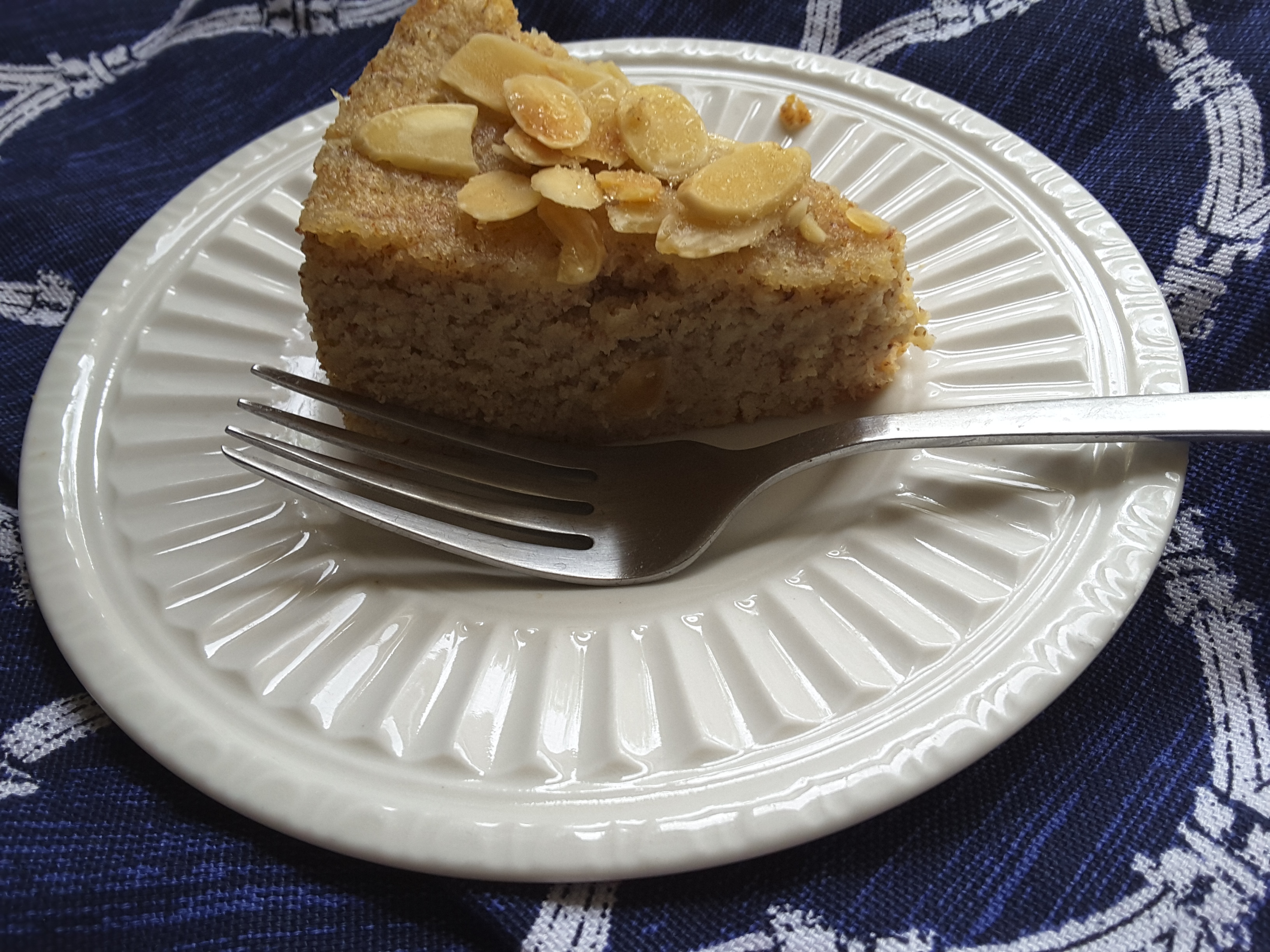
pear almond torte

When pears are good, at the peak of ripeness and aromaticity, they’re very very good, and biting into one will see the juice roll down your chin. When they’re not at their peak, or even when they’re frankly over the hill, you can still use them to advantage.

Slightly underripe pears slice thin and stay crisp in salads or on a cheese platter, something like jicama or underripe watermelon. They’re just barely sweet, not unctuous enough to upset the balance with a sharp vinaigrette or an aged cheese.

Ripe pears can substitute well in a variety of desserts for either apples (when still firm) or bananas (when very ripe, or even overripe and getting mushy).

And they lend a note of European sophistication to many desserts (and salads, and even main dishes) thanks to a dry aromatic twist to their sweetness–not exactly bitterness, more like something that plays well with the bitter notes of almonds, hazelnuts, bittersweet chocolate and dry red wine. These are flavors that don’t mesh as well with most apples due to their more overt sweetness and higher acidity, and probably not so well with bananas either due to the novocaine factor. (Although I’ve never actually tried to pair bananas with cabernet, I can just imagine it. Not promising.)

So even if you’re not a big fan of raw pears, the occasional bargain bag may be worth considering for desserts. If you can get them organic at a decent price, do, because pears are on the “dirty dozen” list for absorbing pesticides. Trader Joe’s sells bags of 6-8 small to medium (3.5-4 oz.) organic pears for about $3 at this writing. But what if, as happens occasionally, the child who insisted she wanted them instead of apples yet again has eaten two, and the rest have sat neglected in the fridge for long enough to turn?

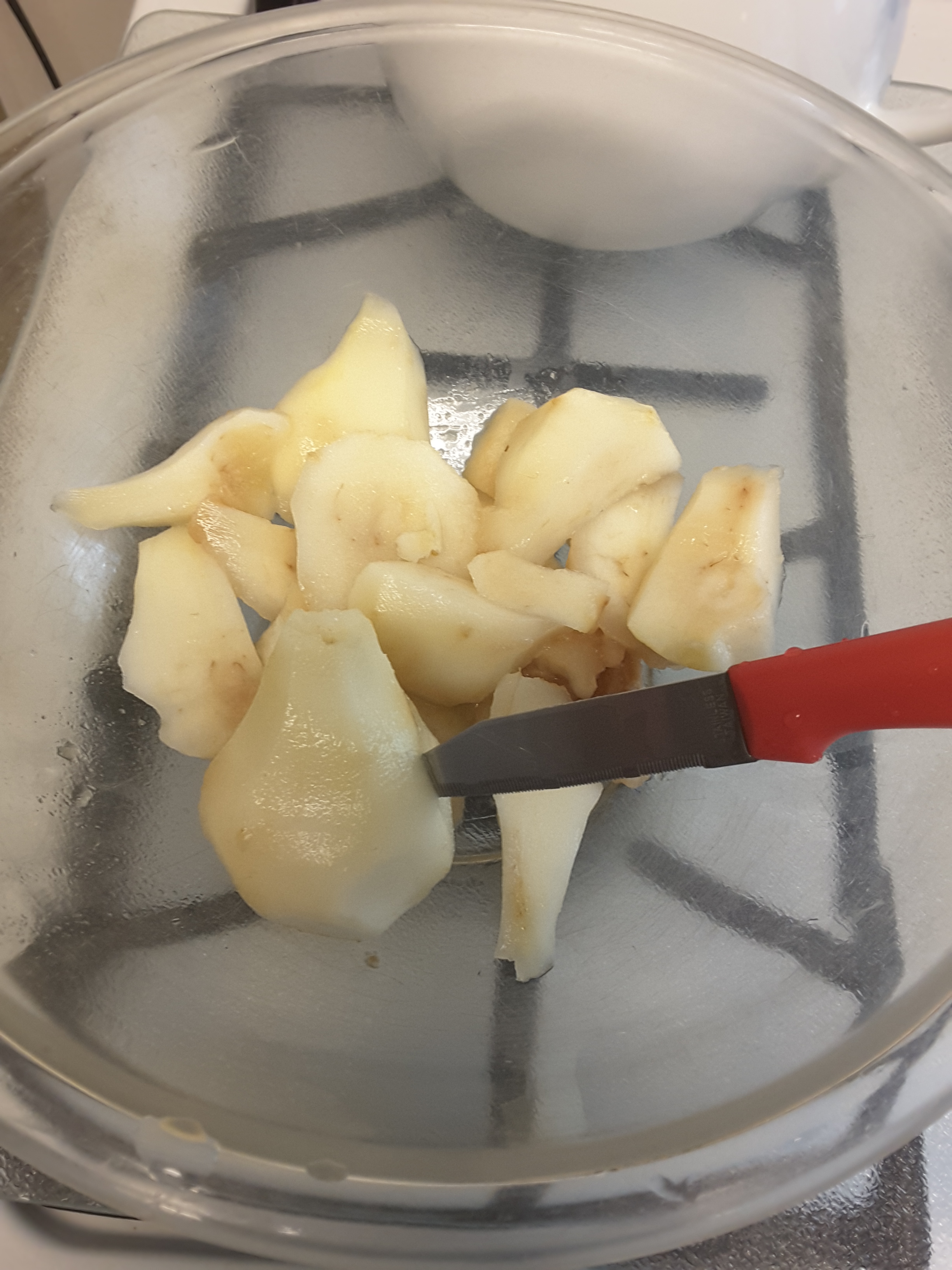
Overripe pears don’t look very nice on the outside and may have gone bland and/or brown, but they’ve still got what it takes if you peel them and cut away actual bad spots. If they’re only a little overripe and still flavorful, use them for a sorbet or microwave them for a minute or so to turn them “micro-poached.” If they’re really soft and going brown, peel and core them, remove all the brown bits and then mash or blend them as you would ripe bananas to give body and moisture to a cake or torte.

Here are two easy microwaveable desserts that use ripe to overripe pears and are Passover-worthy but can work anytime.

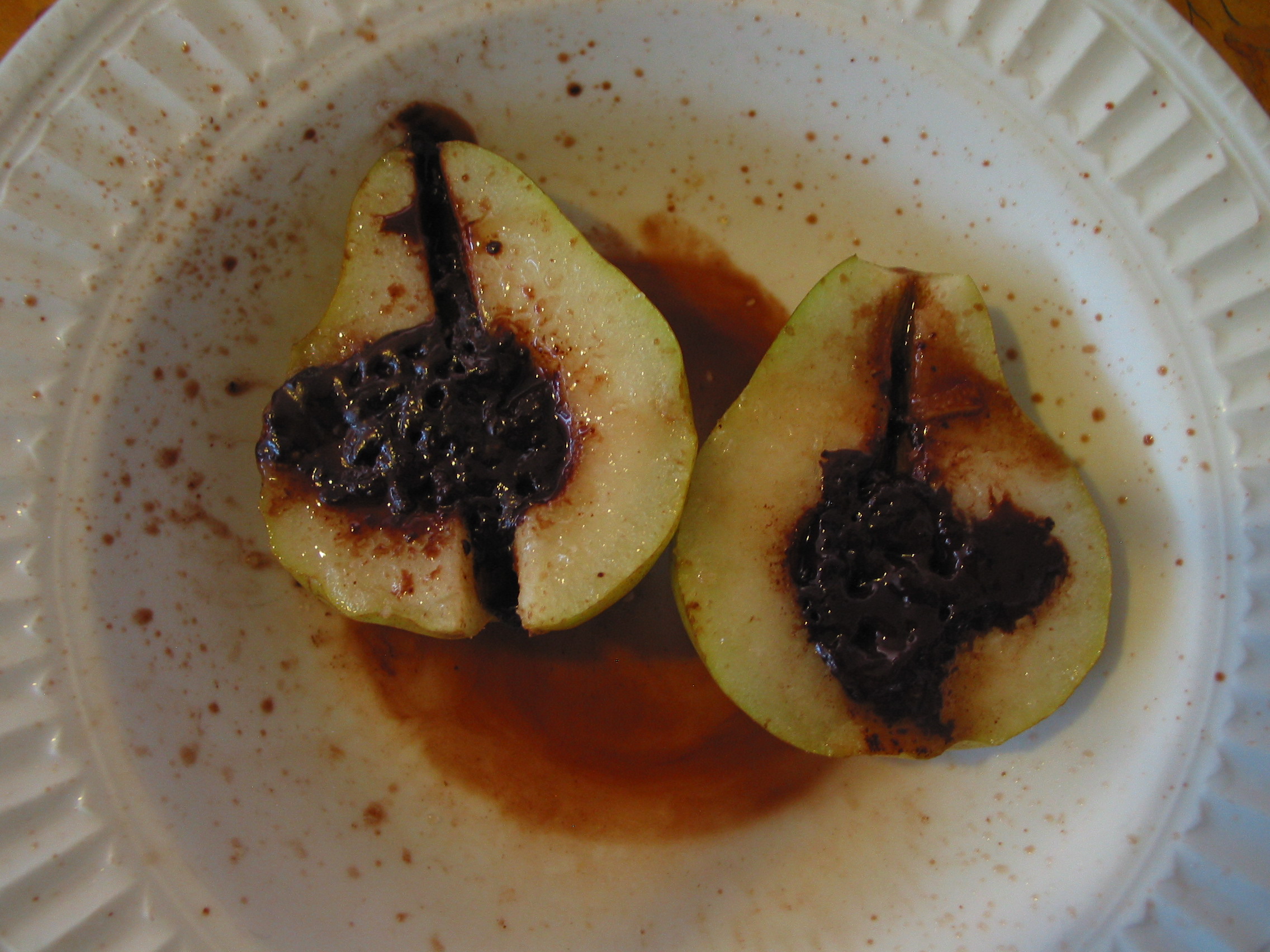
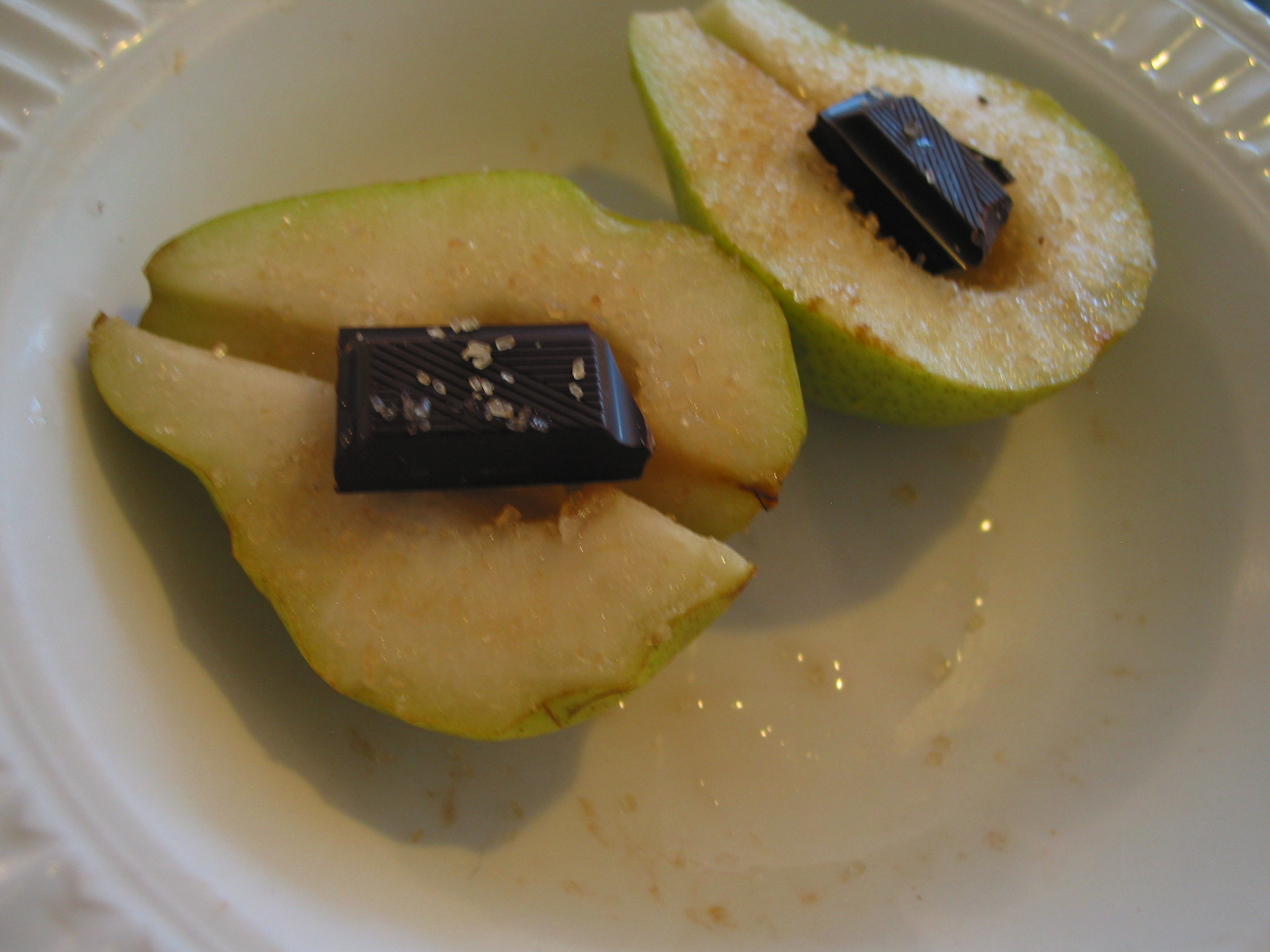
microwaved pear with chocolate

Micro-Poached Pears with Chocolate

This one’s very fast and impromptu–make just one pear or a few at a time and add a little time just as needed.

It can be hard to find chocolate that’s labeled kosher for Passover. Depending on your level of observance, consult the Orthodox Union’s Passover Guide, which changes year to year but  lists brands with kosher certification or acceptability even without a mark. If you eat kitniyot (beans, legumes, corn and peas, some spices, seeds and nuts) you can probably eat most chocolate that contains soy lecithin and vanilla. If not, look for the specially marked Elite chocolate bars that are kosher certified for Passover–for the Orthodox Union in the US, it’s the regular OU symbol (a capital U in a circle) but with a capital P superscript at the right. Other kosher certification at the Orthodox level is most likely to be the Hebrew letter kaf and/or a paragraph of Hebrew text naming the certifying rabbinical authority and location, sometimes with a circular seal containing the text (usually this is if it’s an Israeli product). There may be other certified or acceptable chocolates made with vanilla beans rather than extract (or without vanilla at all) and without lecithin–some of the high-end organic brands, for example.

  • Ripe to very ripe pears
  • Dark chocolate, your preference for cocoa percentage, brand, etc.
  • optional: turbinado or regular granulated sugar, cinnamon, powdered ginger etc. for sprinkling (check the OU site if you need to; regular granulated sugar is certified as-is but brown sugars aren’t always, and ground spices need to be certified for Passover)

Wash the pears, split in half and trim out the seed core and stem threads.

Lay the halves face up on a dish or plate that can go in the microwave. Place a square of chocolate on each half about where the core was.

Microwave 1-2 minutes per pear, just until the chocolate starts to melt and bubble and the pears are tender. Sprinkle with turbinado or other sugar and spices as desired before or after microwaving.

Eat with a knife and fork–add blackberries or a dollop of yogurt on the side if you want. Let it cool a little before digging in–I’m never that good and the roof of my mouth sometimes suffers for it.

Making the best of bad pears

The second recipe is yesterday’s riff on the Banana Ginger Almond Torte (from the I can haz cake?! Passover breakfast menu scheme…) crossed with my lightened-up version of Nigella Lawson’s “Damp Apple Almond Cake.”

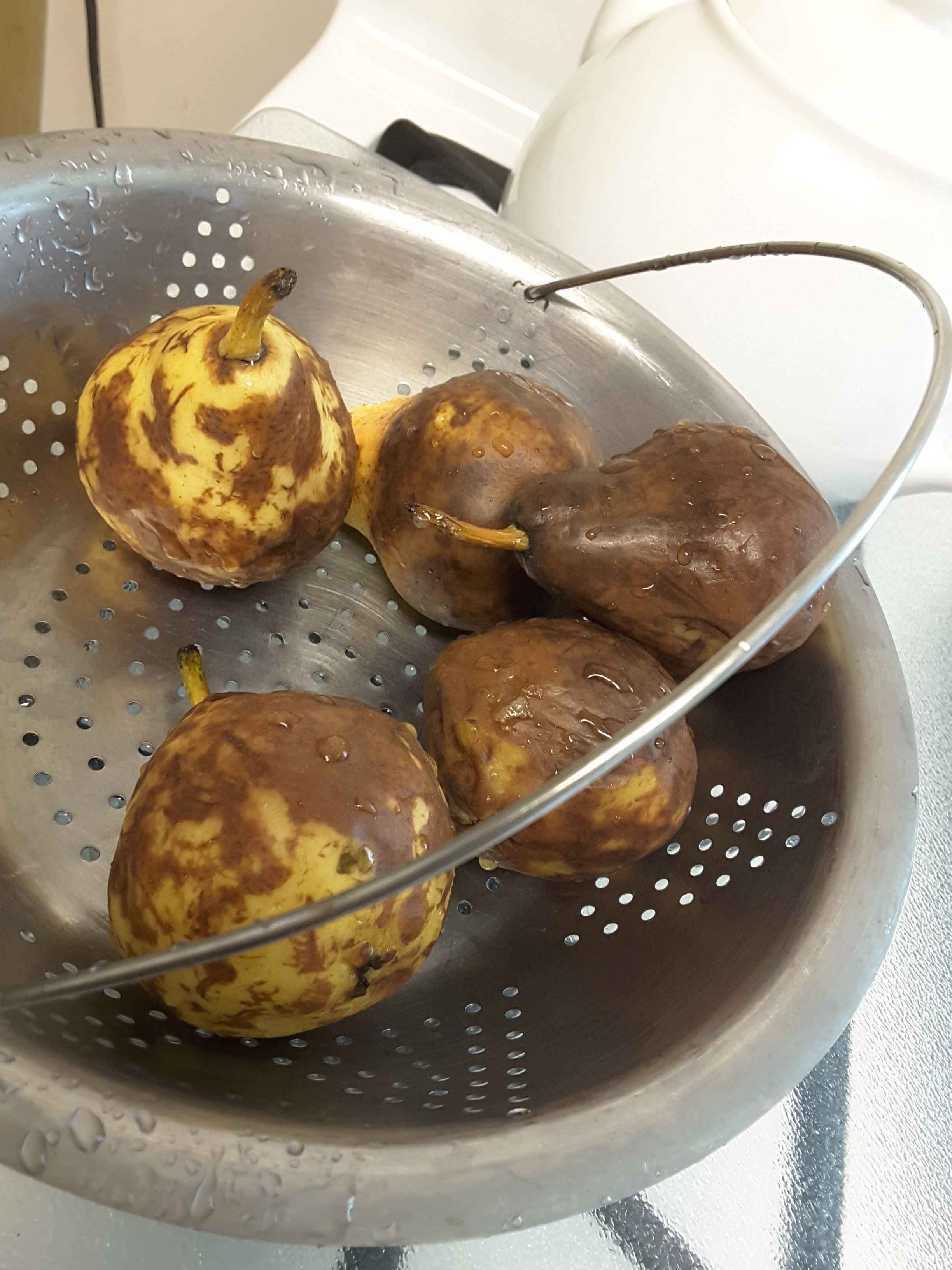
five overripe pearstrimmed pears

Only, obviously, I had 5 small way-overripe pears to deal with. Brownish to quite brown on the outsides. But good enough inside to yield about 1 to 1 1/2 cups of pear once they were trimmed. And the result was seriously delicious.

pear almond torte slice

Continue reading

Diabetes meets ethnic foodways in new ADA series

Just in at my library are two new cookbooks from the American Diabetes Association. Indian Cuisine Diabetes Cookbook by May Abraham Fridel (©2017, ADA, Inc.)  and The Italian Diabetes Cookbook by Amy Riolo (©2016, ADA, Inc.)  are written by two food authorities in their respective home cuisines. The books are bright, they’re attractive, the food looks decent and authentic.

But what makes them “diabetes cookbooks”? What have they changed–or not–about the recipes and what was the ADA’s role other than simply publishing them? Above all, how helpful are they to an average diabetes or prediabetes patient?

Both books start out with an explanation of their food traditions and what’s generally healthy about them. Both include a variety of food categories for different meals, from appetizers or chaats to mostly-protein “main” dishes to mixed casserole-type dishes to salads, breads, soups, cooked vegetables, fruits, baked sweets and drinks. The Indian cookbook also includes some useful spice mixes and tips on how to handle them, and the Italian one includes some traditional menu choices and tips on choosing wine.

The recipes are generally very DASH Diet-able with an emphasis on a variety of vegetables, beans, whole grains, low-fat dairy, whole fruits and nuts, along with smaller portions of meat and cheese and less added sugar for desserts.

On a closer read, the adaptations to recipes mainly look like sane portion sizing for starches and sweets, reducing or substituting poly- and monounsaturated fats for some of the saturated fats, cutting down excess sugars in sweets and desserts, adding fruit and vegetables, and substituting almond flour and dried fruits for standard flour and sweeteners. The recipes are adjusted just enough to be low in sodium and saturated fat, reasonable on calories, total carbohydrates and added sugars. The portion sizes listed are smaller than what you’d get at an American restaurant or see on a magazine cover these days but they’re close to the amounts people traditionally serve.

So the nutrition stats are a general improvement compared with most current cookbook-style recipes for equivalent dishes, and it looks like the nutrition guides at the bottom of each recipe are relatively accurate given the ingredients. So far so good. If this was the ADA’s doing, I’m all for it.  But it seems obvious to me that it would be better to trust the ADA reviewers’ understanding of diabetes nutrition than either cookbook author’s.

I was surprised to find that the ADA let each of the authors go her own way on the introductions, and that the health explanations tend to be vague and cultural rather than practical. In the Indian cookbook, Fridel describes ayurvedic dietary principles rather than talking about nutrients. Riolo also veers off into a discussion of which appetizer traditionally goes with which first course and how to choose Italian wines in a way that doesn’t really have anything to do with target carb counts or  exchanges for a meal either.

You can discount or admire these things as you please, but you can’t really learn a lot from them diabetes-wise. They’re not really directed toward helping patients put together balanced, carb-controlled meals from the nutrition stats given with the recipes.

Moreover, the ADA’s particular nutrition stats system lists “carbohydrate exchanges” separately from “starch,” “fruit” “vegetable” and “dairy” exchanges, even though most of the ingredients that fall into those categories contain significant carbohydrates. All of them have to be counted for diabetes management.

It’s not clear why their system differs so much in this regard from the Academy of Nutrition and Dietetics’ standard “Choose Your Foods” exchanges system for carb count approximations. It works okay for figuring out standard servings definitions for the major food groups if you’re following the DASH Diet or USDA/HHS MyPlate plans, but it’s not really in keeping with the way endocrinologists and certified diabetes educators train Type I diabetes patients. It makes carb counting and carb planning for meals more complicated than it has to be. That can’t be a good thing.

Also, simply giving the nutrition and exchanges stats for each recipe as it shows up in the book is not the same as teaching a new patient how to carb count or set up a balanced plate. Most of the dishes are mixtures of carb-containing and noncarb-containing ingredients–casseroles, soups with beans, meat and vegetables, biryanis, meatballs containing breadcrumbs, and so on. Those are some of the most difficult foods to estimate carbs for by eye, and it’s not visually obvious–or discussed in any detail–what the authors and their nutrition consultants at the ADA did to adjust these specific recipes.  In this regard the ADA books are no worse than most “diabetes diet” cookbooks and magazine recipe collections, but they’re also not much clearer.

Beginners really would do better to start with the carb and noncarb foods separated on the plate, at least until they get a feel for what to count and how much food to serve.

What both of these books–and any others in the ADA series–could use is a short, clear explanation for how to work through the nutrition stats they give in each recipe and how to plan a nutritionally balanced meal around that dish to reach a target total amount of carbohydrate. A two-page standard ADA primer with a basic diabetes meal plan diagram, some suggested per-meal carb counts or carb exchanges, a balanced-nutrition plate à la ChooseMyPlate.gov,  examples of where to look in the recipes for serving sizes and how to create a full meal from them, how to add things up for a meal’s total carb, etc., would help a lot. It might also be helpful to point out how to rework the meal plan if someone wants more than the standard serving amount or takes second helpings.

All in all, these two cookbooks aren’t terrible as cookbooks, but they’re not nearly as helpful as they could be as diabetes guides.

BMI criticized again…by psychologists?

The International Journal of Obesity has just released a short article by Janet Tomiyama (UCLA) and Jeffrey Hunger (UC-Santa Barbara) et al–a team of psychologists. They analyzed NHANES data from 2005-2012 for about 75,000 individuals, and concluded that BMI status doesn’t correlate well with six concrete markers of cardiovascular and metabolic health–blood pressure, blood triglycerides and cholesterol, blood glucose, insulin resistance, and C-reactive protein. Extrapolating a bit from the NHANES study participant numbers, they conclude that millions of Americans–54 million–have been misclassified as unhealthy due solely to their BMI numbers.

According to their analysis, 47% of the overweight people in the study had healthy status (0-1 of 6 markers) other than their weight. About 30% of obese and even 16% of morbidly obese people had healthy status according to their protocol, whereas about 30% of those in the healthy BMI range had more than one actual cardiovascular or metabolic disease marker that would be ignored if only BMI is considered.

Is this really the death-knell for public concern over weight? Should it be?

Here’s how the UCLA press release puts it (with my emphases in italics):

But a new study led by UCLA psychologists has found that using BMI to gauge health incorrectly labels more than 54 million Americans as “unhealthy,” even though they are not.  […]

“Many people see obesity as a death sentence,” said A. Janet Tomiyama, an assistant professor of psychology in the UCLA College and the study’s lead author. “But the data show there are tens of millions of people who are overweight and obese and are perfectly healthy.”

Incorrectly labels? Perfectly healthy?

The definition for “healthy” used in this study is 0 to 1 known risk factor for CVD and diabetes. But clinically, one risk factor is often enough to be of acute concern, especially if it’s untreated high blood pressure or blood glucose. Those generally need treatment sooner rather than later.

Furthermore, the study as posted on Hunger’s web page excludes obesity and overweight a priori from that count of risk factors for CVD and diabetes. I don’t know the absolute latest research consensus, other than what was in the Dietary Guidelines for Americans Advisory Committee’s report last February, but my general understanding is that weight does show some statistically independent influence on CVD at least. That picture may be changing as we learn more about its interactions with other risk factors, but if it’s still valid, weight should have been counted as one of the existing “known risk factors” along with the other markers and that would have skewed Tomiyama and Hunger’s analysis considerably.

Even without those considerations, the different weight groups classified by BMI cutpoints do in fact show a significant increase in health risk from one category to the next. Turn Hunger and Tomiyama’s percentages around and you see that 70% of people in the 18.5-24.9 healthy BMI range have 0-1 risk marker other than weight; 53% in the 24.9-29.9 overweight range have more than 1 marker, 70% in the 30-35 range have more than 1 marker, and 84% in the 35 and over BMI range have more than one marker other than weight.

Plot those crude percentages and you’ll see a very sharp rise in risk incidence between the healthy and overweight categories, a reversal of fortune from “most people healthy” to “more than half at risk,” with further solidification of “most people at risk” as you venture further into obese and morbidly obese. There’s really no debating that trend, even given the narrow way this team has defined “healthy.” To say nothing of “perfectly healthy.”

Researchers in biomedicine (i.e., physical as opposed to psychological medicine) have recently reexamined whether the current BMI cutpoints defining healthy, overweight, obese and morbidly obese are in the right places to describe most people’s 10-year risk of overt CVD events (heart attacks and stroke), diabetes, or all-causes mortality, or whether BMI is just a continuous gradient of increased risk without definable cutpoints. At last count, the conclusion was that the current statistical best-fit cutpoints are pretty much correct, even though the data for individuals have a pretty big spread (and that each BMI step or number still has incrementally higher risk than the one below).

The upshot: BMI categories are still a pretty good marker of the overall health status of Americans when you’re talking about trends. Crude, yes. Exceptions for athletes with much more muscle than fat, yes. But the numbers are still strongly in favor of using BMI as a general warning flag to check for more specific cardiovascular and metabolic disease markers in individuals.

It’s very odd to see a paper like this coming from a team of behavioral psychologists, which Tomiyama and Hunger are. They’re at least nominally outside their field here, doing a statistical analysis on physical health data, and the paper’s methodology and definitions (along with some of their position statements in the American Journal of Public Health and elsewhere) show a specific agenda toward deconsecrating BMI and downplaying overweight and Continue reading

Lackluster “Secrets” from the Eating Lab

I’ve just read Dr. Traci Mann’s popular book, Secrets from the Eating Lab, which came out in April (and is hence a “new book” at my library at the moment…). I had some real hopes for this book on dieting, obesity, and the psychology of eating. Mann has some fame in behavioral psychology, and her lab at the University of Minnesota is influential. Plus she just wrote an op-ed that Oprah Winfrey’s investment in WeightWatchers is a smart business move because diet failure, which leads to repeat customers, is a built-in and stated profit strategy for the company. Mann points out it’s the same logic that runs casinos. Big revelation? probably not, but still a good point and illustrative of the circular logic in popular American diet culture.

So about Secrets from the Eating Lab. The tone of the book is personable and it’s a quick read–a couple of hours will cover it. But…it’s not really a very good book and it makes Mann look a little like the huge parade of airheaded “pundits” who show up on Fox News and Good Morning America and Dr. Oz to talk about emotional eating right before presenting a plate of “healthy treats” that turn out to be brownies.

OK, it wasn’t quite that brainless. I even liked a lot of what Mann had to say about how to live an integrated life and not obsess over weight. But the book is a very good example of why someone who’s reasonably expert in one facet of diet research may not be the right person to interpret other areas for the public.

The behavioral studies are interesting and entertaining. Although the findings are not altogether news anymore, the lab setups she and her team used to demonstrate them are fun to read about. A sample of the psych experiment findings, which are the strongest part of Mann’s book:

  • The eating style of your companions is likely to influence you pretty strongly when you eat as a group. Her lab tested this in an entertaining series of experiments.
  • “Determination and willpower” is more wishful thinking than a successful diet strategy for a lot of people, and structuring your environment is more effective.
  • Keeping a bowl of treats even more than arm’s length away from you reduces your likelihood of grazing, and if you actually have to get up and walk to get more, you probably won’t.
  • People eat more when distracted with screentime or eating while driving or whatever than when focusing on their food.
  • Smaller plates lead to greater satisfaction with less food.
  • Offering vegetables at the school cafeteria before serving the rest of lunch, and without competition from french fries, gains a much higher rate of takers than when there are other foods available.
  • Announcing foods as “healthy” is a turn-off.
  • Most intriguingly, “comfort food” is no more effective than any other food, or even no food, for recovery after an emotional shock.

All of these findings mesh with common sense, and few of her recommendations are implemented as regularly as one would like in daily life at school or work. But the behavioral studies from her lab are only a small part of the book, one or two chapters in the middle. Where Mann runs into trouble is nearly everywhere else. Put bluntly, she’s way out of her depth in the larger world of academic obesity research, and neither she nor most of her readers or even, crucially, her book editor seem to know it.

The main themes of Secrets from the Eating Lab are 1. that diets don’t work, 2. obesity is not the deadly killer everyone assumes it is, and 3. therefore you should stop obsessing and be healthy in other ways, for example by exercising to relieve stress.

These claims are stated as blanket facts rather than opinions she wants to explore, even when she bolsters them with studies. Outside of her own lab’s experimental framework she makes fundamental and glaring misstatements and assumptions of fact that can easily be disproven. The result is not markedly better than what you might expect from a high school debate team’s background prep for the season topics, “Do Diets Work?” and “Does Obesity Kill?”

In the “diets don’t work” chapter, Mann scours the literature for a largeish number of diet studies in which subjects attempted to lose weight, then winnows the 300 or so studies down to about 26 that meet her criteria of a randomized controlled study with reasonable participant recruitment and retention. Although some studies demonstrated short-term weight loss or differential success between two test diets over the course of weeks, months or a year, longer followup revealed no net loss and a large degree of regained weight among participants, and most of the studies had a lot of dropouts before completion. Moreover, most were less than carefully conducted and relied on self-reported weight and diet recall from the subjects rather than weigh-ins and so on.

Well, fair enough. But she doesn’t look at more recent and stringent work, as a nutrition researcher would be expected to. And she doesn’t really explore what the behavioral environments of the experiments might have contributed–something she might have been able to lend better insight into. Continue reading

Frittata on the Rebound

Dr. Lustig’s “Teaching Breakfast” clinical teaching program for families with obese or diabetic children posed a question for me that I didn’t get a chance to test out until this morning. If something with balanced protein and vegetables–say, an omelet–is a better choice than most breakfast cereal, or poptarts, or doughnuts, or whatever most kids are eating before they go to school, how do you get that to be affordable and quick to prepare on a schoolday?

The easiest way to do eggs for several people at a time without overdoing the cholesterol is probably to do a big omelet or scramble and take out some of the yolks. But you might not have time  to do it at the optimal time for the gourmet–that is, right before you’re going to eat it. Not if you’re heading your kid(s) out the door with the daily litany to grab socks, shoes, homework and lunches and not to worry about what color lipstick (or hairstyle, or comic book, depending on age and taste) because you’re going to be late and come on, already.

We didn’t have this problem in my childhood; you either got out to the bus stop on time by yourself or you walked to school in disgrace, because my mother was not going to make our breakfast or lunch (for which we were immensely grateful), or do any big rescues for “emergencies” based on footdragging. And staying home was not an option we wanted to explore. My sister and I could count on the other one telling on us, not to mention the prospect of running into Mom if she came home early or picked up a phone call from the school attendance clerk. Motivation is everything…

But grownups have these dilemmas too. Who wants to be messing about with a frying pan and washing up when you’re trying to get to work? So many of my daughter’s teachers last year could be spotted out in the parking lot of the school right before the first bell, standing by their cars and bolting down an egg mcmuffin-type thing from a fast food drive-through (drive-thru? hate that commercial spelling) with a cup of coffee in the other hand. Quick, seemingly nutritious, but actually horribly high-salt-and-fat-and-calorie-for-what-it-is, and quite expensive too. Not a good daily habit. If you can do eggs and coffee from scratch at home, you’re bound to do them better and a lot cheaper. You could probably save up for a new tablet or pair of theater tickets within weeks, and you might even lose a bit of weight.

So eggs. A frittata has a lot more vegetation in it than a classic French-style omelet, and it’s more sturdy–look at the very solid, nearly stiff Spanish potato-filled version; always served at room temperature in cubes or wedge slices, almost as some kind of potato kugel.

Well, okay, you don’t want a potato frittata if you’re trying to get the nutrition up to snuff without tons of calories or grams of carb. You want some lighter but substantial vegetables so you don’t end up feeling like you swallowed a lead balloon for the rest of the day.

But the good news is that you don’t have to cook and serve it right on the spot. You can do it ahead and stick it in the fridge. If you do it the night before, you can cut it into wedges and microwave one on a plate for 15-30 seconds and you’re ready to go. Or, of course, you can serve it cold–kind of like the classic cold pizza for breakfast, only  better balanced. And most frittatas go well with salsa.

I am not a fan of the kind of isn’t-it-rustic-Italian-or-Provençal glossy magazine frittata instructions that call for frying first and then running under a broiler or what have you. That takes time and heats up the house ( bad in Los Angeles) and probably calls for expensive stovetop-to-oven-friendly cookware, which is usually not [sorry, forgot the “not” when I first posted this] nonstick. A lot of excess fuss for an effect you can perfectly well achieve in an ordinary nonstick frying pan in a couple of minutes on the stovetop, which is how most people who make frittatas at home “authentically” in tiny Italian or Provençal kitchens actually make them. Unless you’re doing a fancy brunch service for 20 diners at a time, in which case it might actually be quicker to do a baked eggs thing in a big casserole and skip the frying. But then I’d hope you were getting paid through the nose for that. Little chance of collecting caterer’s fees at home.

As for the vegetables, cauliflower and zucchini are both very good low-carb, low-calorie stand-ins for potato, and they’re pretty inexpensive and easy to prepare, especially if you have a microwave so you can parcook them on a plate for a minute or so before adding them to the frying pan. That gives you a chance to soften them through quickly and at the same time drain off some of the liquid–they’ll fry faster and won’t make the frittata soggy.

Cauliflower has more fiber, vitamin C and calcium than zucchini, and it’s a bit firmer as well. Zucchini is milder and easier for kids (or adults) who aren’t yet used to eating a variety of vegetables. A frittata like this is also the ideal way to use up that scary-big overgrown zucchini your enthusiastic gardening neighbor gifted you with. Or that someone anonymous parked on your doorstep in the middle of the night.

…It is getting to be the season for that sort of reverse larceny, now that I think about it. Someday I feel it would be right to invent a spring-loaded, siren-enhanced trap for stealth zucchini donors. Something involving on-the-spot forced acceptance of a large cafeteria-style green or orange jello mold with canned fruit cocktail floating in it, faded-pink “cherries” and all, as the price of escape…  Or maybe I’ve just been watching too much “Big Bang Theory” with my daughter this weekend and have started to channel my inner Sheldon. And really, I don’t mind stealth zucchini nearly as much as gifted Meyer lemons.

Okay. Back to the frittata–after all, if you already know how to make a basic omelet, this post is mostly just for entertainment, a mere vehicle for shocking photos of various vegetables that have been foisted off on us by well-meaning friends. It’s enough to make you feel like Wallace & Grommit in “The Curse of the Were-Rabbit”:

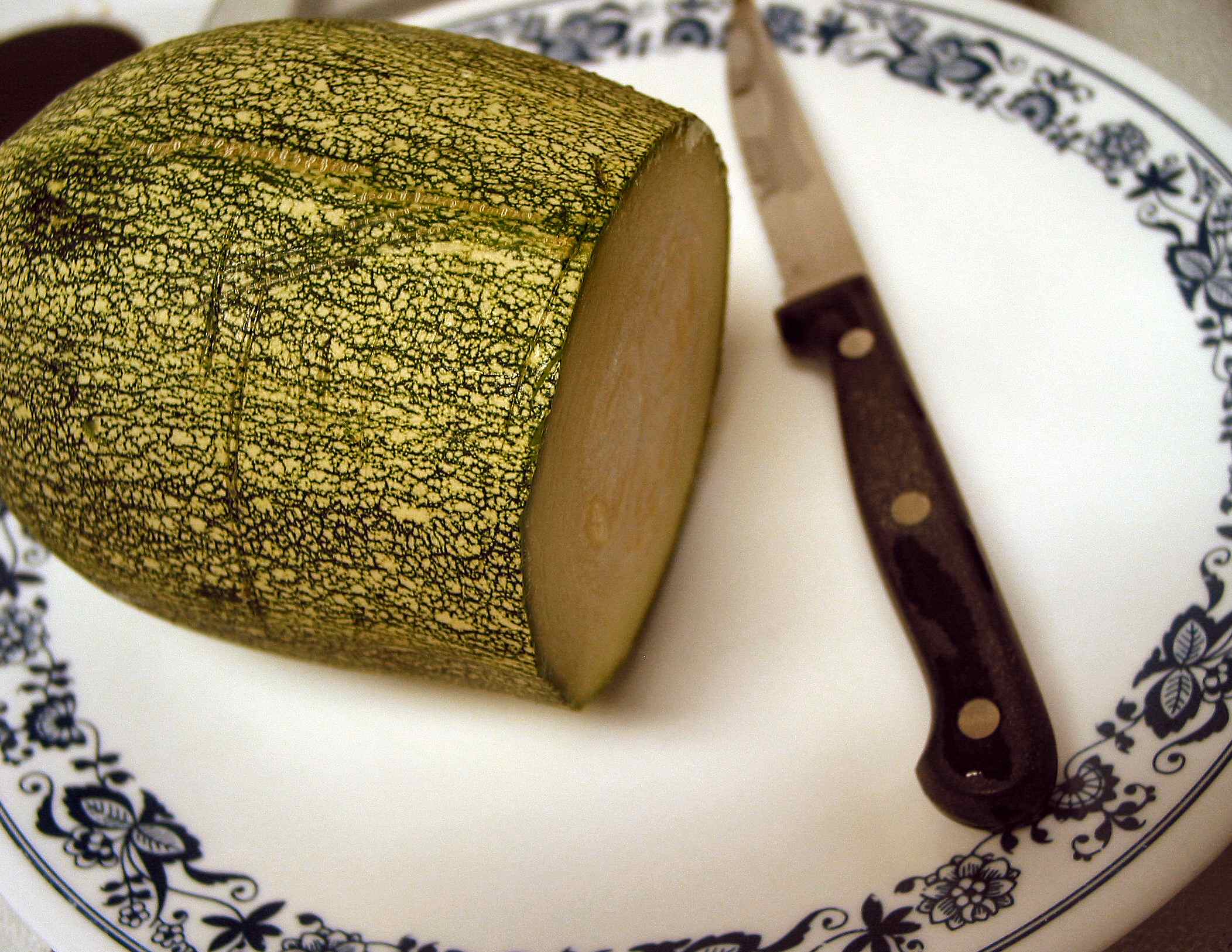
Monster zucchini half

Monster zucchini. This is a dinner plate and steak knife we’re talking about here. And only half the zucchini. The other half of which I’m sure is still stalking the neighborhood in the wee hours of the night.

IMG_8903

Breaking down a zucchini (well, how would YOU go about it? I didn’t have a wooden stake or silver bullet or anything) for a monster omelet.

Continue reading

Chain-restaurant excess strikes again

The Center for Science in the Public Interest has found itself swamped for choice in its 2015 Xtreme Eating “awards” list.

What’s the highest calorie chain-restaurant meal in America? (LA Times online, 6/3/15)

The entries are frightening–typically 1-2 days’ worth of calories, 3 days’ worth of saturated fat and sodium, huge oversized amounts of food. One steakhouse platter with so much hamburger meat–not even steak–seven burgers, each piece topped with cheese or at least cheez–it’s like eating several Double Whoppers at once. Ice cream float-type concoctions with no actual pie but pie crust pieces crumbled on them. They start at 32 ounces. Which is clearly the new 20 ounces if you actually read through the horrible meal descriptions, because another chain’s sweet tea is only offered in a 32 oz size as well. That’s a quart. For one person. There’s a 900-calorie margarita in there somewhere at 24 ounces.

I’m sure Michael Jacobson, CSPI’s president, never dreamed there’d be something fully twice as bad on any restaurant menu as fettucine Alfredo, which he termed “a heart attack on a plate” only what, 20 or so years ago?

What the hell is going on here?  The chains may be cutting down slightly on artificial colors and trans-fats and GMO ingredients, but they’re serving meals with an entire day’s worth of calories embedded in the endless parade of glop that is routinely slathered on otherwise reasonable-sounding main ingredients like chicken breast (note: a top offender for hidden sodium in the “healthy” chain offerings, especially on salads). “Special” sauces, breadings, cheese, frying oil, stuffings, dips, and less-announced coatings (the problem with the chicken) that add surprising amounts of sweet, salt and/or fat. Chipotle isn’t on CSPI’s wall of shame over this, but it’s just as true of them as of any of the others–their meals typically run 500-800 calories for a burrito without chips, guacamole or salsa (not to mention sour cream and added cheese), and the same number of milligrams of sodium.

The meal insults listed on CSPI’s site consist of huge portions that could more normally serve four people, not one. Dishes are never less than 3″ high and cover every square millimeter of the plate. Burgers are multiplied–if one or two are okay, six or seven must be even better. Vegetables have disappeared, of course.

Accessories double or triple the calorie, fat and sodium counts of the full “meal”: caesar salad, fries, biscuits, half-gallon drinks, whole quarts of ice-cream-related desserts. Why is this gargantuan approach even appealing?

They didn’t list Baskin-Robbins 31 Flavors, but maybe they should have–a couple of years ago I took my daughter there for a post-diabetes-diagnosis ice cream cone so we could do something normal for summer, albeit with a shot of insulin (it was a new experience) and we got the entire brochure of offerings when we asked for the nutrition info. The single cone, no lightweight for any of the flavors at about 250-300 calories (double or triple what it would be for Dreyer’s/Edy’s half-the-fat, our standby) and 25-30 grams of carb (also double the D/E per serving), turned out to be a best bet. Some of the sundaes were getting to the 20 oz. range, with over 1500 calories and two days’ worth of carb and fat. The soft serves were actually the worst nutritionally, much higher in calories, carb and fat than they look for the volume you get–and especially given how plain the flavors always are.

Overall, the picture of chain food is not lookin’ good. It’s a nightmare of shameful, pointless stuntlike excess, the stuff parodied in Wall-E and Idiocracy among other movies from the past decade. Only as one of the CSPI judges remarked, it’s become the new normal, and much faster than the screenwriters imagined. Maybe we should all look at the before pictures of the participants on The Biggest Loser, as shown in all the accompanying guidebooks (see your local Friends of the Library bookstore) and ask ourselves if we really want to do that. Because that’s a lot of work.

Media misread on the new USDA dietary guidelines

The new USDA public nutrition guidelines are being updated again, as scheduled, and the Dietary Guidelines Advisory Committee’s version now says some egg yolks are okay and to limit carbs and sugar instead. A variety of media commentators have jumped all over that, even though it’s not very different from what the guidelines have been emphasizing for years. Now, if anything, I would have hoped that most of the commentaries in the newspapers of record would be critical of the industry influence on the USDA’s nutrition guidelines for the general public each time, but no.

The most prominent commentators, notably Nina Teicholz, whose op-ed in last Sunday’s New York Times really bothered me, are well-educated and should know how to “read a french fry” as it were. But instead of looking at the likely effect of loosened USDA dietary limitations on a public that has gone so seriously overboard on calorie-dense food, they’ve taken the opposite tack. Mostly to declare self-righteously that the new relaxation of standards really means all the previous recommendations to limit saturated fat and cholesterol were bunk and a waste of time based on “uncertain” and “weak” or even “junk” science.

Which is untrue. Epidemiologic research–large observation studies and surveys, like the NHANES diet and cardiovascular health survey series from the 1970s onward, and the big Framingham Heart Study of the 1950s onward, are not junk science. They do what clinical feeding trials can’t: they look for the contribution of individual dietary risk factors to chronic and complex-origin health conditions like heart disease and stroke across very large population groups. Both the processed food industry and people like Teicholz claim that clinical feeding trials are the only legitimate way to provide “proof” of cause and effect, but the cost of conducting them carefully long enough and with a big enough participant pool for meaningful results would bankrupt the nation halfway through.

Epidemiologic findings matter on the large public scale. Not every specific applies absolutely and equally to every single person, but that’s not what population-wide studies are for. The big studies, loose as they might seem compared with DNA fingerprinting and perfectly demonstrated cause-and-effect kinds of lab workups for individual cases, give best-bet recommendations for most people to reduce their risk.

Your genetics determine how well that works for you specifically, but most of us don’t have access to DNA testing on that level, and the “big six” lifestyle risk factors (high sat fat, high blood cholesterol and blood pressure, overweight, lack of exercise and smoking) are a lot easier to change and get some control over. After all, you can’t change your genetics much (and yes, my daughter is quite disgruntled that she can’t pick cooler parents. But tough. We couldn’t pick ours either).

So anyway, I know I’m unusually irritated with any news about USDA dietary guidelines–I used to work at NIH, and some of my colleagues had attempted to serve on the dietary guidelines committee and ended up completely frustrated at how “bought” the process became. The USDA has always had a conflict of interest when it comes to public health recommendations because its main mission is support of US agriculture, and public health always comes a distant second to big business. The committees have repeatedly subverted and weakened the scientific nutrition panelists’ best-finding recommendations by including food industry participants and weighting toward industry priorities in the consensus mix. There’s no great reason to expect the food industry isn’t still playing and winning the same game on the same committee this time around. [Update: the meat industry has just asked for an additional 75 day comment period].

But the main problem I see at this point is how poorly mainstream journalists and editors have handled the announced overhaul. None really seem to have dug into the comparison between current and previous issues of the guidelines, much less compared the USDA’s final takes with dietary guidelines from the DGAC, a combined group of more purely biomed/scientific research experts representing HHS (including NIH) and the FDA, or those of the major health advocacy organizations such as the American Heart Association.

And declaring that it’s now fine for anyone to eat all fats without limitation is nonsense and a misread. The USDA guidelines don’t say that–the DGAC draft guidelines certainly don’t say that. And if the USDA does attempt to drift in that direction for the final release, as some of the director’s announcements suggest, given the participation of Big Food and Big Agriculture hoping to sell the public more meat, eggs, and cheese, along with more profitable processed goods, would you necessarily believe them?

Is it really the fault of the scientists on the panels over the years, as Teicholz claims (“How did they get it so wrong?”), that the epidemiology findings they relied on for previous rounds of recommendations weren’t borne out by much smaller and less conclusive clinical studies?

Maybe the role of saturated fat is less apparent in a clinical study. I don’t doubt that. But as noted above, the statistical power of the comparatively short-term clinical trials for cardiovascular disease effects is bound to be a lot lower than in a long-term population-wide study, even if the controls are tighter. There are so many interfering factors–other dietary and lifestyle factors, and so many varieties of genetic risk factors within and among different population groups, genders, and age groups, that you need the big numbers and the large timescale to see effects above the noise. Meta-analysis of a lot of limited clinical studies with iffy results doesn’t make up for that. If anything, it compounds their individual uncertainties.

[And in fact it turns out that much of Teicholz’s assumption on that point is based on a very poorly conducted, much criticized meta-analysis of studies on saturated fat and cardiovascular disease published last spring. Most inclusive meta-analyses performed using standard stats analysis best practices actually show reductions of between 14 and 26% in CV events and deaths when subjects cut their saturated fat intake below 10% of calories and ate more vegetables instead of carbs, or else substituted polyunsaturated fats for them.]

Teicholz’s op-ed had carefully modulated but still overt indignation at the imperfect scientific basis behind previous recommendations to cut saturated fat and limit egg yolks and other high-cholesterol foods. What should be there and isn’t is the acknowledgement that when those recommendations were first announced to the public–by the AHA, the CDC and the USDA in the late 1960s, population trend studies over the next 10 years showed a stark drop in the rate of heart attacks–about a 30 percent drop. In other words, it worked. Big time.

And the broad peak of the population curve for a first heart attack shifted to the right by 10 years–that is, the average age for men went from about 50 to about 60, and for women from about 60 to 70. These were huge improvements in public health overall, and they were achieved partly because the public believed and paid attention, and partly because the nutrition and health experts hadn’t given up and abdicated responsibility in the face of industry pushback.

Clearly these results didn’t last; but is that the fault of the studies that identified saturated fat and cholesterol as things to reduce (note: not eliminate completely, just reduce)? The 1980s ushered in a long Republican-led era of unfettered, uncritical support of corporate priorities over public health, Reagan’s “ketchup is a vegetable” quip and the conversion of school lunches to chain restaurant concession contracts, a popular nose-thumbing at so-called “food police” health recommendations, the rise of high-fat-and-sugar-and-oversized-portion “comfort” and “indulgent” foods in restaurants and food magazines, and an entrenched anti-science bias in Congress that still haunts us today.

Not that much has changed from Reagan’s time in office–including the sad observable fact that most Americans for the past decade or so clearly aren’t paying serious attention to or even attempting to follow those modest earlier USDA recommendations, particularly the recommendations to eat more vegetables rather than more boxed, labeled namebrand processed foods, whether Big Macs or Ding Dongs or Froot Loops…

So few Americans today eat any vegetables at all compared with people of the same ages in the 1970s. As I’ve mentioned before, a shocking number of my friends, in their 40s and 50s already, do not cook at all. They have advanced degrees, if mostly in the humanities. They nervously repeat but don’t understand how to  read between the lines of whatever diet and health claims are in the news, and they’ve come to think cooking is too hard. They have a lot of takeout menus on their iPhones.

There is just one more factor to mention here: the profit motive. Teicholz, a former contributor to NPR, Gourmet and Men’s Health, wrote that op-ed in part to promote her new book, The Big Fat Surprise, which claims that diets high in meat, butter, Continue reading

Artificial sweeteners causing glucose intolerance

A new study on artificial sweeteners published in Nature goes a long way toward explaining one of the most puzzling findings about sweetened drinks in recent years: that regular consumption of even diet sodas is associated with an increased incidence of obesity and Type II diabetes. Surely, if the sweeteners have no calories and negligible carbohydrate, this shouldn’t be happening? Surely people should be losing weight? But the national statistics have shown that it is, and they’re not.

According to a news summary in The Scientist (Sugar Substitutes, Gut Bacteria, and Glucose Intolerance), researchers at the Weizmann Institute of Science in Rehovot, Israel, demonstrated that repeatedly consuming zero-calorie sweeteners like saccharin, sucralose and aspartame (e.g., Sweet ‘N’ Low, Splenda, and NutraSweet) increases a person’s glucose intolerance by causing changes to his or her gut bacteria.

The researchers did extensive testing on mice first–fed them artificially sweetened water for several weeks and compared glucose tolerance and gut flora with those of control groups that received either glucose solution or plain water. The experimental mice had much higher rates of glucose intolerance than either of the control groups, including the one that was fed glucose solution.

They also had very different gut bacteria composition, which the researchers thought might be causing the changes in glucose tolerance. Wiping out the gut bacteria of control mice with antibiotics and then repopulating with the gut bacteria from sweetener-fed mice caused glucose intolerance in the normally fed mice.

The researchers repeated their experiments on healthy human subjects, and they got the same dramatic results. The timeframe for measurable changes in glucose tolerance was within as little as six days for one of the tests.

Admittedly, the researchers were dosing their subjects with sweetener concentrations at the highest levels currently deemed safe by the FDA. So if you only consume these sweeteners occasionally and in small quantity–say, chewing sugarless gum once in a while–you might not be causing a drastic change in your gut bacteria or glucose tolerance.

But so many people in the US consume diet sodas and artificially sweetened teas and so on in large quantity on a daily basis that it’s possible they’re coming close to the levels used in these experiments. If you consume even half the maximum defined “safe” daily level, you might well be impairing your glucose tolerance significantly. But there may not be a safe level. There’s no saying what level–if any–of sweetener per day is low enough not to change gut bacteria and raise glucose intolerance–it may be a matter of dose or it may be a matter of how long and how regularly people consume these sweeteners.

Glucose tolerance is a measure of your body’s ability to supply insulin quickly and at the right level whenever you eat or drink something with starches or sugars. Part of the gut’s function is to release glucose into the bloodstream, but Continue reading

The Devil’s Food is in the Details

Melissa Clark has published an over-the-top cake recipe for the New York Times this week with two frostings and a demo video in her usual breezy style. The devil’s food cake, one of my favorite kinds, is pretty enough, and it looks like a fun idea, but… two homemade buttercream-type frostings? What kind of cake recipe is she using, and how does it compare with my usual (dare I say it) Duncan Hines?

I checked out the recipe itself and did a quick back-of-the-envelope calculation on the basic nutrition stats–carbs, fat, sodium, calories–then stared at it for a minute and wondered if I could possibly have been right.

Because the total I was coming up with was scary:  more than 1000 calories per serving for 10 servings. Half a day’s calories crammed into one piece of chocolate cake. It was about twice what I would have estimated looking at the photo. I mean it LOOKS pretty standard, if a little tall, on that cake stand. But 1000-plus calories per slice? Are you kidding? Had to be wrong.

So I went to the recipe nutrition calculator at myfitnesspal.com and tried it again. And it confirmed again that the recipe is indeed over-the-top, and over 1000 calories per tenth of the cake. What’s gone wrong here?

Here’s Clark’s recipe in the New York Times online for reference:

Devil’s Food Cake With Black Pepper Buttercream

and here’s what I saved off the nutrition calculator for everything–the cake plus both frostings:

Nutrition stats for Melissa Clark's 2-frosting devil's food cake for 10

Nutrition stats for Melissa Clark’s 2-frosting devil’s food cake for 10 people Calculated using myfitnesspal.com, 5/5/2014. Click the image to enlarge as needed, the numbers are still pretty scary.

My crude estimates, based on experience from having to calculate carbs in baked goods for a diabetic kid, were very close to the online calculator totals, within about 2o calories per serving and within 2-5% for each of the other stats.

And although it’s good to know my arithmetic and skepticism skills haven’t gotten rusty in the past month or so of trying hard not to bake, I think the nutrition chart above really tells you what’s going on in the world of popular recipe publishing today, particularly for American baking.

So let’s hit it over the head once more, because it’s still ridiculous: The first thing to think is, geeeeeeezzzzzz, over 1000 calories per serving.

How does Clark keep so thin? Did she actually eat a whole piece of this thing, or just pose for the photographer?

A 1/10th wedge of cake is a pretty big slice to begin with, and this cake is six layers tall–three full pans, cut crosswise in halves–for a standard-diameter round cake. In the accompanying demo video, Clark explains that the extra layers give you more room for frosting. “And isn’t that the best part?” she quips.

Well–I guess if you really like buttercream. She’s got both a vanilla-and-black-pepper buttercream AND a whipped chocolate ganache frosting. Does devil’s food cake really need so much dressing up to be good?

But here’s the added cost per serving: 111 grams of carb (about 2 meals’ worth), 86 grams of which are sugar. That’s 21 teaspoons of sugar per slice. A full day’s worth. 71 grams of mostly-saturated fat. Three full days’ worth.

Pro chefs excuse themselves for this kind of thing by calling their food “indulgent” or “decadent”. But this isn’t just excess, it’s mindless excess that doesn’t really add to the flavor or quality of the kind of dessert it’s supposed to be.

If you look at just the frosting ingredients, we’re talking 4 sticks of butter and 2 1/2 cups of sugar. The cake itself contains another stick-plus of butter and almost another two cups of sugar. So 5 sticks of butter and 4 1/2 cups of sugar total, or about half a stick of butter and half a cup of sugar per person, if you serve 1/10th cake as suggested. That puts it way into Paula Deen territory. Maybe even beyond Paula Deen.

I have to ask: Can’t we do a little better and still be decadent? Do we really need all that excess goo for it to be an okay cake?

It’s not that the frostings or even the cake are terrible-tasting or artificial or bland–she uses a whole real vanilla bean in the buttercream.  But it’s an awful lot of fat and sugar piled up with cake included merely as the excuse for the frosting.

That kind of tells you that the cake itself isn’t so hot. I’d rather have a smaller piece of a really good, really chocolate cake with more intense flavor per bite and no actual need to rely on frosting for interest. Something like Alice Medrich‘s revamped, lower fat Reine de Saba-style cakes (“Fallen Chocolate Soufflé Cake” and “Bittersweet Deception,” neither of which contain any butter) from Bittersweet, which she’s just reissued as Seriously Bittersweet. Or even David Lebovitz’s chocolate-butter-sugar-eggs flourless chocolate cake, which he’s dubbed “Chocolate Idiot Cake.”

If the cake’s just there as a frosting vehicle, why not be honest? I’d rather skip the cake and make dessert some intense ganache truffles to eat in smaller quantity with strong coffee. And even then I’d cut back on the fat and sugar so I could concentrate on the flavor.

If you are going to try and make some version of Melissa Clark’s cake, you really need to cut it down to size. In my two public performances exploring Continue reading