
• Enter your email address to subscribe to this blog and receive notifications of new posts by email.

    Join 241 other subscribers
  • Noshing on

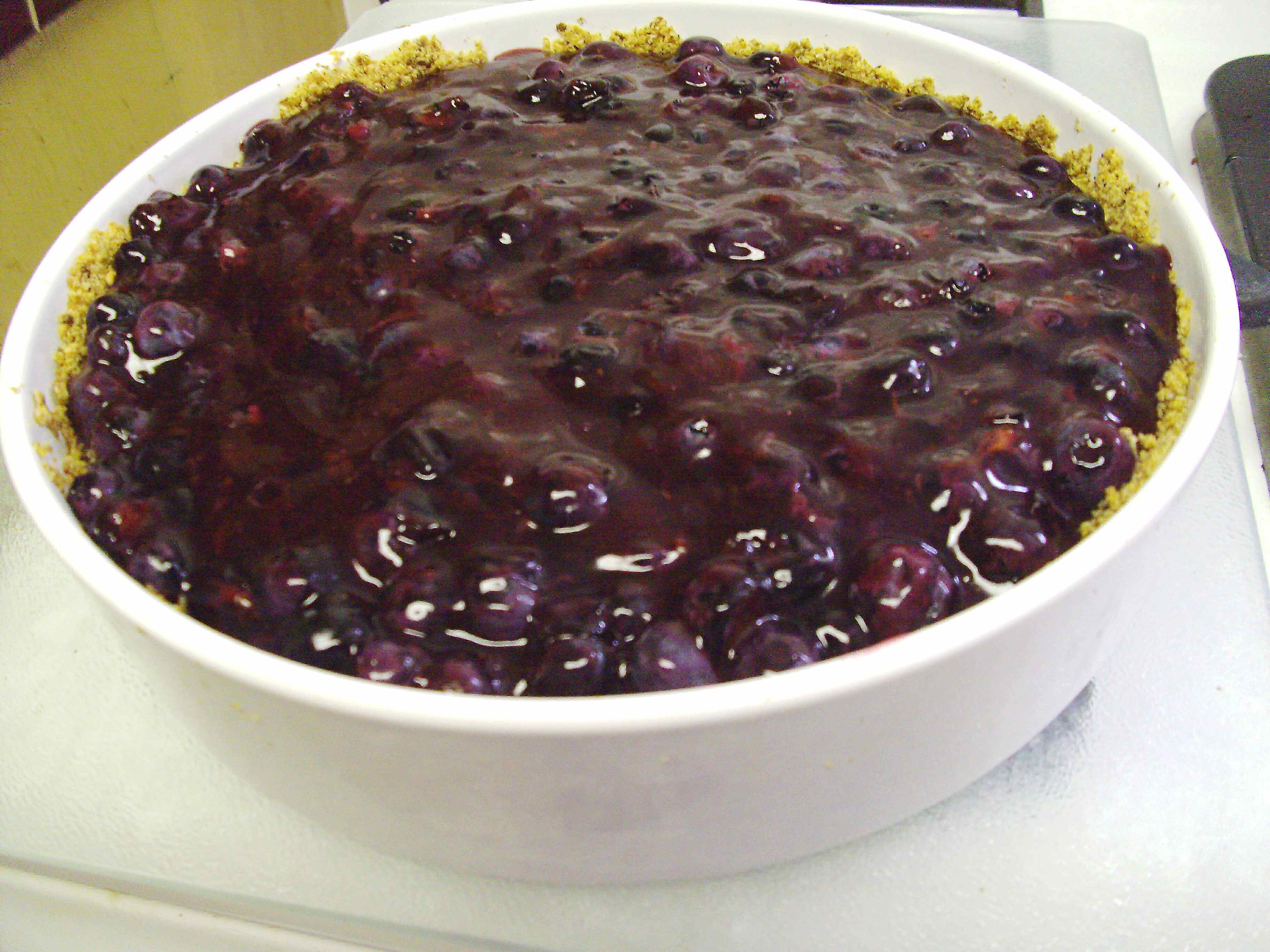
    raw blueberry pie with microwaveable filling and graham cracker crust

    This mostly-raw blueberry pie is a snap to make and very versatile--the filling microwaves in a few minutes, and you don't even have to bake the zippy gingered graham cracker crust--perfect for a hot Fourth of July and all summer long.

  • Recent Posts

  • Contents

  • Archives

  • Now Reading

  • See also my Book Reviews

  • Copyright 2008-2024Slow Food Fast. All writing and images on this blog unless otherwise attributed or set in quotes are the sole property of Slow Food Fast. Please contact DebbieN via the comments form for permissions before reprinting or reproducing any of the material on this blog.

  • ADS AND AFFILIATE LINKS

  • I may post affiliate links to books and movies that I personally review and recommend. Currently I favor Alibris and Vroman's, our terrific and venerable (now past the century mark!) independent bookstore in Pasadena. Or go to your local library--and make sure to support them with actual donations, not just overdue fines (ahem!), because your state probably has cut their budget and hours. Again.

  • In keeping with the disclaimer below, I DO NOT endorse, profit from, or recommend any medications, health treatments, commercial diet plans, supplements or any other such products.

  • DISCLAIMER

  • SlowFoodFast sometimes addresses general public health topics related to nutrition, heart disease, blood pressure, and diabetes. Because this is a blog with a personal point of view, my health and food politics entries often include my opinions on the trends I see, and I try to be as blatant as possible about that. None of these articles should be construed as specific medical advice for an individual case. I do try to keep to findings from well-vetted research sources and large, well-controlled studies, and I try not to sensationalize the science (though if they actually come up with a real cure for Type I diabetes in the next couple of years, I'm gonna be dancing in the streets with a hat that would put Carmen Miranda to shame. Consider yourself warned).

Misunderstanding Salt Research: Bon Appetit’s Shameful “Health Wise” Column

I started this blog last spring more or less just to test out blogging lightheartedly about food. However, I have just read Bon Appetit‘s appalling “Health Wise” column from the May issue, “The Saline Solution” by John Hastings.

I do actually love to cook and eat well, and that’s my main purpose for this blog, but seeing this kind of blithely irresponsible “health” advice on salt makes my blood boil (not appetizing). Worse, it starts dragging me back to my work roots and up on my soapbox (also not appetizing, though kind of fun), because I trained as a biochemist and worked for several years as a science journalist. I worked for the National Heart, Lung, and Blood Institute at NIH at the time some of the bigger studies Hastings refers to were first being published. It was my job to know about them and write about them in plain (and preferably short) English for Congress and the public. To do it I talked to national experts, interviewed the leaders of the National High Blood Pressure Education Program, and combed through a century’s worth of research on salt and high blood pressure.

But you don’t have to be a scientist to find this stuff out. Descriptions of the studies AND their updates AND the reasoning behind the basic public health guidelines calling for Americans to watch their salt AND how to do it without eating a restricted diet of cardboard and baby cereal are all easily available from the NHLBI web site or the American Heart Association.

Hastings, a former editor of Prevention and health column contributor to O, the Oprah Magazine, is someone you’d expect to be reasonably accurate in reporting health research findings. But here he gets the science on salt and high blood pressure just about as backwards and upside down as he possibly can.

Worse yet, he does it in a strangely breezy, cheerleading tone that’s really hard to believe.

Hastings’ argument goes something like this:

…here’s a little secret: salt isn’t a problem. If that sounds crazy, it’s because the public health message about salt causing high blood pressure has been very, very effective, and it’s backed by reams of scientific research…Upon this, nearly everyone agrees. The controversy arises when you ask experts about the connection between salt intake and high blood pressure…All of this is fantastic news for those of us who are already cooking with high-quality meats and farmers’-market produce…

Did you follow all that? Probably you felt like you did for the few seconds you were reading it, but look again and you start to pick out the self-contradictions–“If it sounds crazy” that salt isn’t a problem, “it’s because the public health message that salt causes high blood pressure… is backed by reams of scientific research.”

Well, yes it is. The way Hastings phrases it, you’re supposed to think that was a bad thing, that health research in general and carefully designed tests of the effects of diet on cardiovascular health in particular are part of some kind of unnamed conspiracy against the public’s right to eat every bit of salt it can get.  Personally, I’d rather that broad public health messages were backed by reams of scientific research rather than by some diet guru or brand-name chef’s nutritional fantasy that will help sell his next book or tv program, or–more realistically–by corporate marketing and pressure campaigns from big pharma and big agro. Of course, it’s less profitable if people simply eat less salt–and less processed food–and never develop hypertension in the first place than if they eat salt like it’s going out of style and call it gourmet, and then have to make up for their diet by taking hypertension pills…hmm. Food, Inc., anyone?

“Upon this nearly everyone agrees”, but somehow there’s still a great controversy over it? Really? No. Not really.

The vast majority of salt researchers look at the bulk of the study results and conclude–repeatedly, for decades now–that salt is, in fact, a direct and modifiable risk factor for hypertension (high blood pressure). Which is both a disease in its own right and a leading risk factor for heart disease, stroke, and chronic kidney disease. Combine that with the fact that the average current salt intake is about twice what the consensus guidelines recommend and that more than half the adult population in the U.S. is crossing the line into overweight and obesity–and…well, yes.

Salt IS actually a health problem for most people. Gee.

The Bon Appetit article is a jumble of self-contradictions and serious misinterpretations of the findings from two older salt research studies, one of which has since been revised,  plus a cherry-picking recent review that comes to a different conclusion about salt than most of the other reviews of the same data on diet and health. That one comes from the lab of Mickey Alderman, an otherwise eminent researcher who just happens to be a long-time, much-trumpeted advisor and consultant for the Salt Institute.

Hastings  doesn’t indicate that he interviewed the man or even recognized his name on the journal article, but he should have. Anytime somebody in the media wants to come up with the magical–and really, really popular–conclusion that lots of salt, any day, any time, anywhere, please add more, is perfectly harmless and even good for you, they go to Mickey Alderman because they can paint him as a lone hero against the Food Police (the typical name they give the National Institutes of Health and the American Heart Association in such cases). Because what Alderman will say–with precision, but with disregard for the bigger public health picture–is that high salt intake isn’t directly proven to cause death from cardiovascular disease.

And it isn’t. It can’t be proven directly in a well-controlled diet study large enough to reach statistical significance, because that would require thousands of participants to follow a carefully prepared diet throughout their entire lifetimes, with no deviations for dates, wedding receptions, pizza parties, etc., and it would take 50-75 years to collect the majority of the data. You’d literally have to wait until most of the participants died before you could make a public health recommendation about salt. And the cost of doing that study “right” would run into the billions. It would bankrupt the federal science budget. And maybe a few other budgets as well.

That’s why the NHLBI and the AHA have sponsored studies that look at signs of developing cardiovascular illness–heart attacks, stroke, phlebitis, high blood pressure, kidney disease–rather than death. When you look at these ailments, you find that dietary salt actually matters quite a bit–contrary to what Hastings thought he understood from the studies he mentions.

Continue reading

Soba sodium revised

I just actually checked the package labels at Whole Foods–soba noodles from Eden brand run something like 470 mg sodium per serving–about twice what I’d estimated. Udon noodles were something like 650 mg per serving. Why? Why? That’s worse than a can of Campbell’s soup! Whole wheat pastas it is.

Red Lentil Dal

Ideally, I should have been posting this sometime in the winter, but I like it all year round–except for Passover week. Which is the real reason I’m posting it now: I bought a 2.5 lb. bag of red lentils from my corner grocery (Armenian, in this case) a month or so ago and have only used half. And Passover’s coming in a week.

Dal or rasam–depending on your Indian restaurant of choice–is a tangy thick soup of red lentils and tomatoes, with a variety of spices and either tamarind (traditional) or lemon juice (my personal preference). A lot of restaurant-style and westernized Indian recipes call for fairly shocking amounts of salt in savory dishes. This recipe doesn’t include salt at all or ghee (clarified butter) and doesn’t really need it. Like a lot of home-cooked soups and stews, it gets better overnight as the spices meld with the vegetables. Put in a good amount of garlic, lemon, cilantro and savory spices and see how it is–you can always add salt to your own dish at the table, but by day 2 it should be pretty good on its own.

I’ve given approximate amounts for the spices because you might add more lentils or have older or fresher spices–whole spices are usually more potent, especially if you grind them up just before you cook with them. You need to taste for yourself and adjust–this is easier if you’ve eaten dal before, obviously. Standard curry powder has a lot of spices in it but this tastes better if you add some extra coriander and cumin, and a sprinkling of something sweeter–cardamom plus cinnamon or 5-spice powder or garam masala.

Unlike most beans, lentils don’t need presoaking. Red lentils in particular are usually already split and cook up pretty well within about half an hour. I cook this dish in a big deep-sided teflon frying pan, but it gets a bit awkward to dish out–use what works best for you.  A regular soup pot is fine too.

Red Lentil Dal — Makes about 2 quarts

Spices:

  • 1/2 med yellow onion, chopped
  • 1″ chunk fresh ginger, grated, if you have it–don’t sub in anything if you don’t
  • 1 large T unsalted curry powder (Indo-European or other decent brand)
  • 1-2 t ground coriander or 1 t coriander seeds, crushed
  • 1/2 t cumin either ground or seeds
  • A good pinch of cardamom seeds crushed, or a teaspoonful of whole pods tossed in after the tomatoes (below) to stew with the lentils and then plucked out by the diners…
  • pinch cinnamon or 1/2 t garam masala or Chinese 5-spice powder
  • 1/2 t black mustard seeds if you have it
  • pinch nigella (“black caraway” or “kalonji” or “black onion seed”) if you have it–a little goes a fairly long way, because the flavor develops overnight in the fridge, so a pinch is enough
  • Hot stuff–add according to your own taste or leave it out: 1/2 t crushed hot pepper flakes, a bit of cayenne pepper, or 1/2-inch dab of z’khug (hot pepper/garlic/cilantro paste)

Tomatoes and lentils with liquids

  • 3-4 roma tomatoes (canned is fine) or 1-2  medium salad tomatoes, chopped or broken up
  • 1-2 fat clove(s) garlic grated–you might add one, then more later once the lentils are mostly cooked
  • ~2 c. red lentils, washed well and picked over. If you pour water over them to soak a bit while frying the spices, expect them to stick together–break them up with a fork to add to the pan.
  • Enough water to cover the lentils
  • juice of 1-2 lemons (add one first, stir and let cook and taste, then add more lemon as needed)

Adjustments and garnishes

  • additional garlic, coriander, curry powder, hot peppers or lemon juice to taste
  • fistful cilantro sprigs chopped

To a large teflon frying pan or soup pot, add the ingredients in stages:

  1. First, fry the spices in the oil with the onion and ginger, stirring for a minute just until they’re starting to smell fragrant, but don’t let them burn.
  2. Add the tomatoes and garlic, then the lentils, and water to cover. Add the lemon juice. Let the pan simmer uncovered, stirring occasionally, until the lentils have turned from red-orange to yellow and fluffy.
  3. Add more water as necessary and when it seems cooked, taste it and adjust for any additional spices, garlic, or lemon juice to  taste. I tend to add a bit more lemon and coriander as things go, and sometimes more garlic if it seems to need it.
  4. Stir in or sprinkle on the chopped cilantro leaves and serve with rice as a thick curry or in a bowl as a soup–a little chopped raw onion and tamarind chutney are also pretty good with this. Have hot pita bread or naan at the ready and maybe another sliced-up lemon.

Pan-Fried Green Bananas

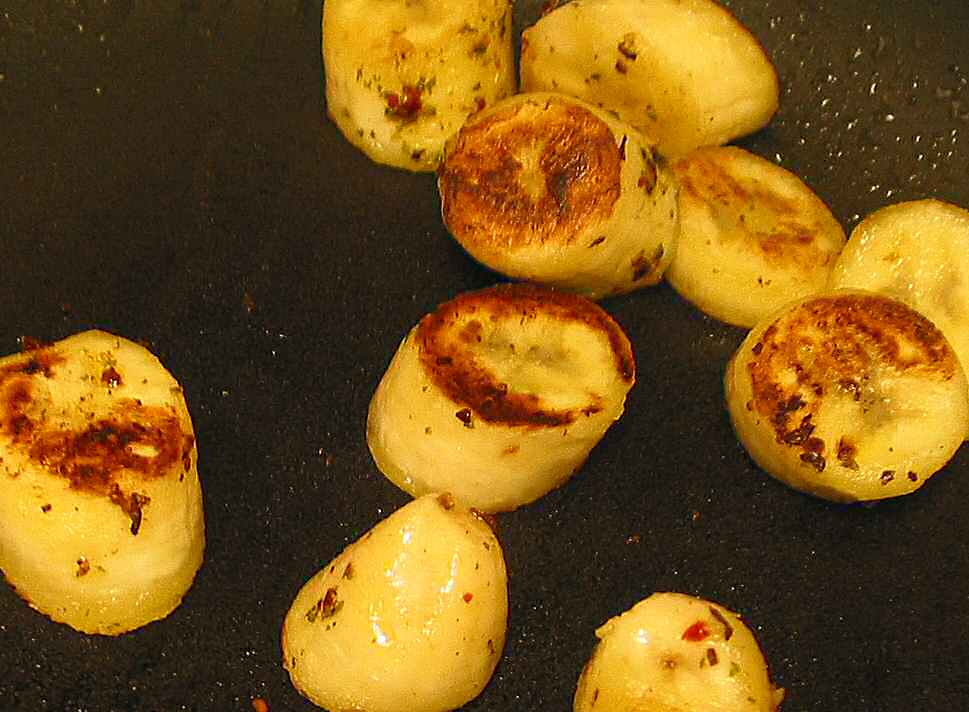
Fried Green Bananas on SlowFoodFast

Green bananas frying in olive oil with hot pepper, cilantro and garlic

Even though we buy bananas every week and consider them a staple–for kid temper tantrum management as much as for grownup temper tantrum management–after a few days we often have brown speckled bananas sitting on top of the microwave in a state where no one will touch them. No matter how green they start out. I think it must be that I buy too many to start with, assuming that of course we’ll reach for them automatically as soon as they turn yellow.

So I started considering my options. I could buy fewer and run out of them. I could eat them speckled and funkily too sweet. Hmm. Or I could start at the beginning and find something nonsweet to do with them while they’re still green and fresh.

A friend of ours makes Bananas Foster as his signature dessert dish, frying and flaming bananas in cognac. They turn out gooey and sweet and rich, basically like cooked sweetened bananas, and I’m never sure the effort and the singed eyebrows are really worth it. So frying wasn’t the first thing I thought of. But I microwaved a piece of green banana for a minute to see whether it would hold up when cooked and it did. It also had an intriguing flavor–like cooked potato with a light   tartness about it, but none of the novocaine overripeness or mushiness I’d feared.

I was thinking about some of the Indonesian curries with basil–perhaps underripe bananas would be a good stirfry ingredient for those? Well, perhaps they still will be, but in the meantime, I felt lazy and decided on something simpler, quicker, and with fewer ingredients. It turned out much better than I’d expected.

Pan-Fried Green Bananas

  • Large green (underripe) bananas
  • dab or more of z’khug (chile/garlic/cilantro paste)
  • olive oil

Peel the bananas–you may need a knife if they’re really green. Be careful peeling them, because the green peel contains a drippy sap that will stain clothes badly like some tough kind of glue, and I still haven’t found a way to get it out of my favorite pants. In any case, cut the bananas in bite-sized chunks or larger pieces, as you prefer. Heat a spoonful or so of olive oil with a little z’khug in a nonstick frying pan and then pan-fry the banana pieces a few minutes until the outsides turn brown and crispy, like good french fries. A dab of pesto or a little curry powder and minced garlic and ginger and/or scallion in the frying oil would probably also work in place of the z’khug.

Hot Tomato: Microwave Marinara

Microwave Marinara on SlowFoodFastGreat tomato sauce was the backbone of a great Greek-owned, Italian food student diner in my hometown. You know, the kind with the red vinyl-covered banquets with the brass rivets that have seen better days. The formica tables in faux wood grain. And the waitresses who never bother to hand you a menu because they already know what you want. You want The Sauce.

The sauce was so good you didn’t care if the ravioli was bland. You didn’t care if the eggplant in the parmigiana was limp or crushed or gummy with too much breading. No. The sauce was the thing. You could smell it from way down the block, and it was as good the last time I ate it as the first. In all, that was probably several hundred dinners through the end of college and into my working life. If you were a student on a $25 a week food budget, you’d put 5 bucks aside for Saturday night dinner at that diner because you knew once you ate something with The Sauce, you’d never go hungry again.

I don’t pretend my marinara is as good as theirs. For one thing, my family doesn’t like fennel nearly as much as I do, so I have to leave it out of the main batch. For another, mine has no salt and takes five minutes. By most gourmet estimates and all traditional ones, both facts should mean it’s awful. But it ain’t.

My sauce is pretty d**n good, as it happens. And a lot less bland than all those souped-up sauces by the jar with the 450-700 mg sodium per serving. And it takes five minutes. And it gets better the next day. And it’s one of the simplest recipes I can think of.

Microwave Marinara

  • 1 28-oz or 2 x 15-oz cans no-salt plum tomatoes in their own juice (e.g., Trader Joe’s, Whole Foods, sometimes Ralph’s/Kroger/etc.)
  • 1 t. no-salt tomato paste if none was included in the canned tomatoes
  • 1/4 med. yellow or red onion
  • 1 FAT clove garlic, about 1″x3/4″, mashed or grated
  • Couple of shakes of red wine vinegar, maybe 1-2 t.
  • Sprig or two of fresh thyme or 1/2 t. dried-but-not-dead
  • couple of basil leaves if you have them
  • Pinch or two of fennel seed if you have it and like it

Blend everything in a food processor (or you could grate or chop everything by hand if you insist, and you’ll feel and look so much more whole wheat). Microwave in a 2.5 cup pyrex bowl with a loose cover on HIGH (1150 W oven) for 5 min. The sauce will have thickened slightly at the top and edges. Use some, then cool and refrigerate the rest in a covered microwaveable container. Reheat for 1-2 minutes on HIGH the next time. Serve on everything. Everywhere. With abandon.

Frugal Shopping List–Vegetables

Everyone has their own idea of what should be on a frugal grocery list. Mostly, whatever’s on it should be nutritious, inexpensive, AND something you’re actually going to eat within the week, so it doesn’t go to waste. The other obvious rule is that it should add up to enough food for a week’s worth of meals without busting the budget.

Fresh fruits and vegetables seem to be the hardest thing for most people to buy cheaply, but they do the most for your diet and your tastebuds if you treat them right. I live in the Los Angeles area and when I first moved here, I suffered horrible sticker shock–not just because rents were 50% higher than back east, but because fresh produce hovered at or above the $2/lb mark–just about double what I paid in Maryland. $2/lb for tomatoes? In California? Sad and inexplicable, but true.

It took me a while to realize supermarkets are the least good deal on fruits and vegetables here. The long-running supermarket checkers’ strike forced me to break out and change the way I shop. Farmers’ markets are fun, but they can be chi-chi expensive too. The best bet for me is at my local mom-and-pop Armenian corner grocery a few blocks away, or else the Latino market with the huge vegetable section in the next town over. Those stores buy their wholesale produce in smaller quantities and closer to ripe than the supermarkets do, so they pay less and sell it for less with quicker turnover. Sometimes the produce is either smaller or less beautiful and shiny than what you see in the big chains, but often there are great ingredients you can’t even find in the supermarkets. Sometimes the owners bring in vegetables from their own gardens. And when they overstock, they slash prices like crazy.

My best deals so far:

  • an entire flat of yellow tomatoes on the vine (about 50)–3 bucks.
  • Butternut squash, 9 cents/lb. Yes, I thought it was a typo too. I ate it for a month.
  • Navel oranges, 10 lb/$1.00 (in winter, when the orange harvest comes in)
  • Lemons and limes, 10-20/$1.00. I bought a bunch and froze most of them.

But regular fruit and vegetable shopping can yield good deals too. Continue reading

High-speed soup–tomato vegetable

This is something I came up with about 10 years ago. It’s disgustingly easy to make, dirt cheap, vibrant in flavor, filling, entirely real, salt-free, and completely microwaveable. Also diet-smart: eating this every day for lunch, along with a veggie burger or a half-cup of beans for protein, helped me lose 20 pounds in a couple of months. And I’m not naturally good at that.

This vegetable soup has no salt, but it has lots of flavor and lots of vegetables–not a coincidence. The flavor of the vegetables melds with the dill and pepper and garlic, and there’s no salt to drown it out. So instead of being insipid, it, like many homemade soups, gets better the next day. And it takes maybe 15 minutes from start to finish for about 2 quarts of soup, fully cooked.

The trick to getting the most flavor from the vegetables without salt? Wilt the “aromatics” (onion, celery, and carrots) together first, with a little olive oil and nothing else for a few minutes, and then add the liquids and herbs. The order really makes a difference: your aromatics will release a lot more flavor this way than if you added them raw to the liquid ingredients and cooked it all together from the start (see, sometimes the French are right). The small amount of olive oil also helps draw out and trap the flavors (some flavors are fat-soluble) without adding a lot of calories.

High-speed Tomato Vegetable Soup

  • 3 big carrots, peeled and chopped bite-size
  • 3 stalks celery in bite-size pieces
  • 1 big onion, diced
  • drizzle (1-2 T) olive oil
  • 1 28-oz can or 2 15-oz cans salt-free tomatoes in their own juice (e.g., Trader Joe’s or Whole Foods)
  • 1 big clove garlic, grated or minced
  • 2-3 T fresh chopped dill or 1 T dried dill
  • 12 or so whole black peppercorns

1. In 2.5 qt pyrex bowl (or the like), mix onions, carrots, and celery. Drizzle olive oil over and stir lightly to mix. Put the lid over (I use a Corelle dinner plate, how chic) and microwave 5 min. on HIGH.
2. Pour the tomatoes and juice over the wilted vegetables, and break up the tomatoes to bite-size pieces as best possible. Add water to within an inch of the top, stir.
3. Add garlic, dill, and peppercorns, cover and microwave 5 min. to heat through.
4. Serve immediately or refrigerate overnight to meld and sweeten the flavors.

Impatience is its own reward

I learned to cook at the ripe old age of eleven. My mother had gone back to school, I had a younger sister and brother, and I had a problem. Mom said to make spaghetti–so far, so good–but when I got to the kitchen, I discovered there was no tomato sauce in the house. Luckily, there was a little can of tomato paste, and a cabinet full of dried spices that included the essential garlic powder and oregano, plus a bunch of herbs (they came as a set) that my mother owned but never actually touched. And, as I’ve mentioned, there were two guinea pigs available. Good enough.

I learned to cook again when I hit college and started helping a friend with Friday night dinners at the Hillel House. That’s also where I learned how to keep kosher.

I learned a third time when I moved in upstairs as a resident after my sophomore year–I was working a strenuous lab job on a tight budget–no more than $25 a week for anything–and I walked everywhere. My housemates introduced me to two basic spaghetti sauces–one red, one white–and the rest of the time I ate omelettes because eggs were a dollar a carton. I shudder now to think I got through a carton a week, and didn’t ditch any of the yolks. At the time I reasoned that I wasn’t eating meat–couldn’t get kosher meat easily, and it was beyond my budget. I did lose 20 pounds without realizing it. And I started baking my own bread–challah for Friday nights; pita the rest of the week. No real recipes; I went by feel.

The next time I learned to cook was after college, on a year’s study in Israel. In the kitchens of Kibbutz Ma’agan Michael, everything had to be done in a rush because we were feeding 1000 people a day. But they knew their way around an eggplant or seventy (we used the bread machines to slice them all). Up in Ma’alot, I worked in a clinic with everyone from the surrounding towns–Jewish, Muslim, Christian, and Druse–in one of the few truly friendly workplaces in the country, and I spent afternoons tutoring and being fed in people’s homes or else learning to haggle for vegetables in the Thursday open air market. There I learned how to brew tea with mint (in summer) or sheba (petit absinthe) in winter, how to cook with real garlic, how to use a “wonderpot” on top of a gas ring, and how to eat z’khug (chile-garlic-cilantro paste) with just about everything.

When I returned to the U.S., I had to learn to cook all over again. I started keeping a “blank book” (remember those?) for recipes, and I learned, over the course of twenty years, how to cook real food, better food, from scratch, but faster than the cookbooks called for. When my grandmother had a major stroke, I was still in my mid-20s and realized I probably couldn’t get away with an all-eggs-and-cheese diet. Eventually I went to work up at NIH, and discovered that cutting back on saturated fat, cholesterol, salt, and calories really does help cut the national risk of heart attacks and strokes.

After talking with a nutrition expert there, I learned that our tastebuds can adjust to almost any level of sodium and consider it “normal” within just two weeks. Dangerous if you develop a tolerance for high salt and consider it normal even at really exaggerated levels–as many people do. The good news is that we can retrain our palates downward just as quickly, so I tried a completely salt-free, unprocessed food diet for two weeks–with surprising rewards. Without salt to swamp the taste receptors, the natural flavors of vegetables and fruits seem particularly brilliant and clean.

And then I had a kid. And I had to learn to cook all over again–this time, using a microwave oven, because I didn’t want to leave my kid unsupervised while I stood trapped at the stove. I wanted something that would shut itself off when done. But by now I had gotten used to real ingredients and fresh foods, and I had to come up with microwave methods for them. So I did. This blog is the result.