• Enter your email address to subscribe to this blog and receive notifications of new posts by email.

    Join 241 other subscribers
  • Noshing on

    raw blueberry pie with microwaveable filling and graham cracker crust

    This mostly-raw blueberry pie is a snap to make and very versatile--the filling microwaves in a few minutes, and you don't even have to bake the zippy gingered graham cracker crust--perfect for a hot Fourth of July and all summer long.

  • Recent Posts

  • Contents

  • Archives

  • Now Reading

  • See also my Book Reviews

  • Copyright 2008-2024Slow Food Fast. All writing and images on this blog unless otherwise attributed or set in quotes are the sole property of Slow Food Fast. Please contact DebbieN via the comments form for permissions before reprinting or reproducing any of the material on this blog.

  • ADS AND AFFILIATE LINKS

  • I may post affiliate links to books and movies that I personally review and recommend. Currently I favor Alibris and Vroman's, our terrific and venerable (now past the century mark!) independent bookstore in Pasadena. Or go to your local library--and make sure to support them with actual donations, not just overdue fines (ahem!), because your state probably has cut their budget and hours. Again.

  • In keeping with the disclaimer below, I DO NOT endorse, profit from, or recommend any medications, health treatments, commercial diet plans, supplements or any other such products.

  • DISCLAIMER

  • SlowFoodFast sometimes addresses general public health topics related to nutrition, heart disease, blood pressure, and diabetes. Because this is a blog with a personal point of view, my health and food politics entries often include my opinions on the trends I see, and I try to be as blatant as possible about that. None of these articles should be construed as specific medical advice for an individual case. I do try to keep to findings from well-vetted research sources and large, well-controlled studies, and I try not to sensationalize the science (though if they actually come up with a real cure for Type I diabetes in the next couple of years, I'm gonna be dancing in the streets with a hat that would put Carmen Miranda to shame. Consider yourself warned).

Frittata on the Rebound

Dr. Lustig’s “Teaching Breakfast” clinical teaching program for families with obese or diabetic children posed a question for me that I didn’t get a chance to test out until this morning. If something with balanced protein and vegetables–say, an omelet–is a better choice than most breakfast cereal, or poptarts, or doughnuts, or whatever most kids are eating before they go to school, how do you get that to be affordable and quick to prepare on a schoolday?

The easiest way to do eggs for several people at a time without overdoing the cholesterol is probably to do a big omelet or scramble and take out some of the yolks. But you might not have time  to do it at the optimal time for the gourmet–that is, right before you’re going to eat it. Not if you’re heading your kid(s) out the door with the daily litany to grab socks, shoes, homework and lunches and not to worry about what color lipstick (or hairstyle, or comic book, depending on age and taste) because you’re going to be late and come on, already.

We didn’t have this problem in my childhood; you either got out to the bus stop on time by yourself or you walked to school in disgrace, because my mother was not going to make our breakfast or lunch (for which we were immensely grateful), or do any big rescues for “emergencies” based on footdragging. And staying home was not an option we wanted to explore. My sister and I could count on the other one telling on us, not to mention the prospect of running into Mom if she came home early or picked up a phone call from the school attendance clerk. Motivation is everything…

But grownups have these dilemmas too. Who wants to be messing about with a frying pan and washing up when you’re trying to get to work? So many of my daughter’s teachers last year could be spotted out in the parking lot of the school right before the first bell, standing by their cars and bolting down an egg mcmuffin-type thing from a fast food drive-through (drive-thru? hate that commercial spelling) with a cup of coffee in the other hand. Quick, seemingly nutritious, but actually horribly high-salt-and-fat-and-calorie-for-what-it-is, and quite expensive too. Not a good daily habit. If you can do eggs and coffee from scratch at home, you’re bound to do them better and a lot cheaper. You could probably save up for a new tablet or pair of theater tickets within weeks, and you might even lose a bit of weight.

So eggs. A frittata has a lot more vegetation in it than a classic French-style omelet, and it’s more sturdy–look at the very solid, nearly stiff Spanish potato-filled version; always served at room temperature in cubes or wedge slices, almost as some kind of potato kugel.

Well, okay, you don’t want a potato frittata if you’re trying to get the nutrition up to snuff without tons of calories or grams of carb. You want some lighter but substantial vegetables so you don’t end up feeling like you swallowed a lead balloon for the rest of the day.

But the good news is that you don’t have to cook and serve it right on the spot. You can do it ahead and stick it in the fridge. If you do it the night before, you can cut it into wedges and microwave one on a plate for 15-30 seconds and you’re ready to go. Or, of course, you can serve it cold–kind of like the classic cold pizza for breakfast, only  better balanced. And most frittatas go well with salsa.

I am not a fan of the kind of isn’t-it-rustic-Italian-or-Provençal glossy magazine frittata instructions that call for frying first and then running under a broiler or what have you. That takes time and heats up the house ( bad in Los Angeles) and probably calls for expensive stovetop-to-oven-friendly cookware, which is usually not [sorry, forgot the “not” when I first posted this] nonstick. A lot of excess fuss for an effect you can perfectly well achieve in an ordinary nonstick frying pan in a couple of minutes on the stovetop, which is how most people who make frittatas at home “authentically” in tiny Italian or Provençal kitchens actually make them. Unless you’re doing a fancy brunch service for 20 diners at a time, in which case it might actually be quicker to do a baked eggs thing in a big casserole and skip the frying. But then I’d hope you were getting paid through the nose for that. Little chance of collecting caterer’s fees at home.

As for the vegetables, cauliflower and zucchini are both very good low-carb, low-calorie stand-ins for potato, and they’re pretty inexpensive and easy to prepare, especially if you have a microwave so you can parcook them on a plate for a minute or so before adding them to the frying pan. That gives you a chance to soften them through quickly and at the same time drain off some of the liquid–they’ll fry faster and won’t make the frittata soggy.

Cauliflower has more fiber, vitamin C and calcium than zucchini, and it’s a bit firmer as well. Zucchini is milder and easier for kids (or adults) who aren’t yet used to eating a variety of vegetables. A frittata like this is also the ideal way to use up that scary-big overgrown zucchini your enthusiastic gardening neighbor gifted you with. Or that someone anonymous parked on your doorstep in the middle of the night.

…It is getting to be the season for that sort of reverse larceny, now that I think about it. Someday I feel it would be right to invent a spring-loaded, siren-enhanced trap for stealth zucchini donors. Something involving on-the-spot forced acceptance of a large cafeteria-style green or orange jello mold with canned fruit cocktail floating in it, faded-pink “cherries” and all, as the price of escape…  Or maybe I’ve just been watching too much “Big Bang Theory” with my daughter this weekend and have started to channel my inner Sheldon. And really, I don’t mind stealth zucchini nearly as much as gifted Meyer lemons.

Okay. Back to the frittata–after all, if you already know how to make a basic omelet, this post is mostly just for entertainment, a mere vehicle for shocking photos of various vegetables that have been foisted off on us by well-meaning friends. It’s enough to make you feel like Wallace & Grommit in “The Curse of the Were-Rabbit”:
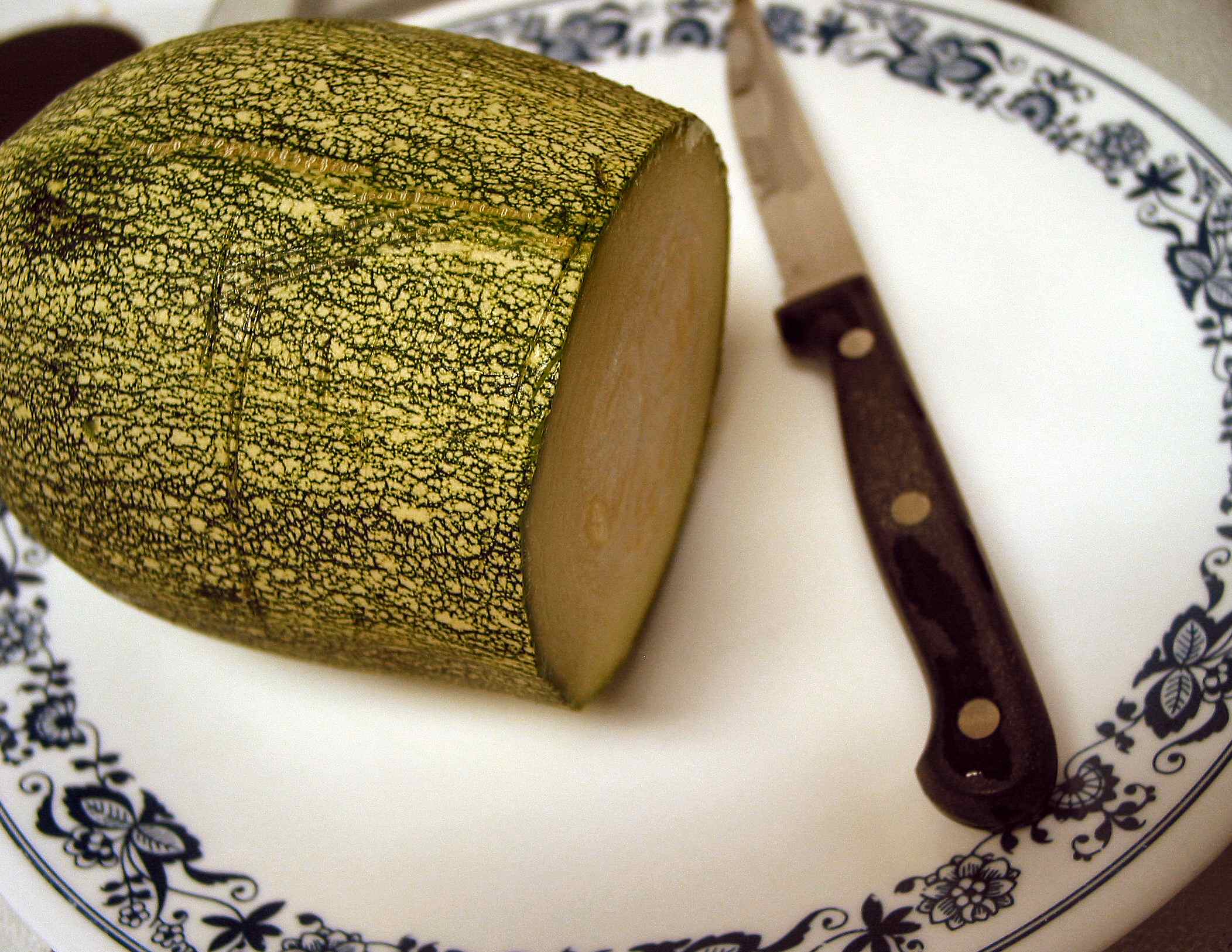
Monster zucchini half

Monster zucchini. This is a dinner plate and steak knife we’re talking about here. And only half the zucchini. The other half of which I’m sure is still stalking the neighborhood in the wee hours of the night.

IMG_8903

Breaking down a zucchini (well, how would YOU go about it? I didn’t have a wooden stake or silver bullet or anything) for a monster omelet.

Continue reading

Happy 4th!

rawblueberrypie-2pounder-med

The raw blueberry pie right before we cut into it.

If you have to do a pie in the middle of summer, say, if you’re bringing something to a Fourth of July outing, this might be the kind you want. It only takes a few minutes to put together (other than picking over the blueberries to make sure you’re not leaving any stems in). And Trader Joe’s is selling two-pound containers of blueberries for a moderate price, about $6, at least in southern California. That’s enough for a pretty big pie. So I got two boxes for my daughter’s birthday party last week and discovered that just one box was about a third more than my old newspaper recipe called for. Well…we can always use a few blueberries around the house! And the pie ingredients are so simple it’s not hard to scale up a bit and still have it work out nicely. Very nicely, in fact.

The syrup you start the filling with can be boiled up in a minute or so in the microwave, so you don’t have to heat up your house or stand over a stove. Then you just stir in the starch slurry and some lime juice to thicken it, and start folding in the raw berries. When they’re all in, you pour it into the crust and let it cool until set.

And I’m not sure you actually have to run an oven for a graham cracker crust, although I did for about 10 minutes–I think it makes the sugars melt a bit with the butter, so the resulting caramel, if you can call it that, binds the crumbs together and then hardens slightly when it cools and the crust stays crisp a little longer. But maybe that’s just fantasy. If you want to keep the oven off, you’ve got my vote. If you want to buy a frozen graham cracker crust-lined pie tin (or two; with this amount of filling you could probably do 2 standard smaller pies), that’s your call too.

I don’t usually buy graham crackers at all, but for this I think it’s worth doing the crust at home–it takes maybe 2-3 minutes to grind up enough for a crust and press it into a pan, and it’s a little more versatile than the commercial versions. I can put in a bit less sugar and butter than the standard crust recipes do, skip the salt, throw in a little almond meal if I feel like it, and add a couple of pinches of cinnamon and ginger to spice things up. Leftover crackers are handy for making impromptu ice cream sandwiches, if you can keep your kids away from them until you’re ready to do that.

Here’s my scaled-up version for a two-pound box (909 g. approximately) of fresh blueberries. That’s about 300 grams more blueberries than the old 4-cup recipe I copied from my mother-in-law, so it needs somewhat more in the way of crust and sugar, but not actually that much more–go by taste and be conservative. This version is sweet but fresh, which is the joy of keeping most of the blueberries raw. It won’t make you feel like you’ve just eaten half a jar of jam. Continue reading

This always happens right before vacation…

Finally, finally, we are going to the East Coast. We’ve had to put off seeing my mom and my sister (and assorted boys) twice since December due to incessant snow, none of which hit Los Angeles in the slightest. So as soon as school lets out, we’re packing for an ungodly wake-up call the next morning and getting out of SoCal for a bit more than a week. The cat gets a hotel/spa vacation without all the schlepping around between Bahston and New Yawk. We get the do-we-have-enough-clean-undies-to-make-it version.

So good, already. But as in many of my tangled big-event preparation schemes, I have a slight problem with the fridge:

Stuffed fridge right before traveling

The problem, part I…Note the tomatoes: 10+, excessively ripe, and the invisible 6 or so red peppers behind them. Not to mention the huge bag with 7-8 bunches of fresh herbs…

fridgedoor

Part II, the door…Note the huge bag of nectarines, lower left, the chiles just behind the mushrooms and two bags of apricots at right, just because…

AAAgh…just a little insane. Suffice it to say, it’s been an enthusiastic week or so vegetable-shopping-wise because the Fresno tomatoes are back in my local greengrocer’s, along with a lot of other produce, and I’ve gone overboard on a number of items, not least of which are lemon basil, mint, dill and tarragon (which I haven’t even decided if I like). The market beckons, the low prices for herbs and vegetables even more so, and the sun’s finally come out again after a month of gray days. And I’m a purple thumb as a gardener, so the greengrocer’s wares beckon even more strongly. How could I not want it all? But a little thought for the calendar might not have gone amiss.

So I’m in trouble again. We leave in 4 days. There are a maximum of three humans in the house (depends how we’re behaving at any given moment). Nobody but me really gets into gazpacho the way they should–though they will go with salads (the coarse-cut version of gazpacho). And it’s a sorry day when you have to threaten people with apricots and nectarines three meals a day. We should be reveling in the produce section, not roiling in it. If we were staying here, this would be an ideal scenario for the next week and a half, Continue reading

Parsley Doesn’t Count

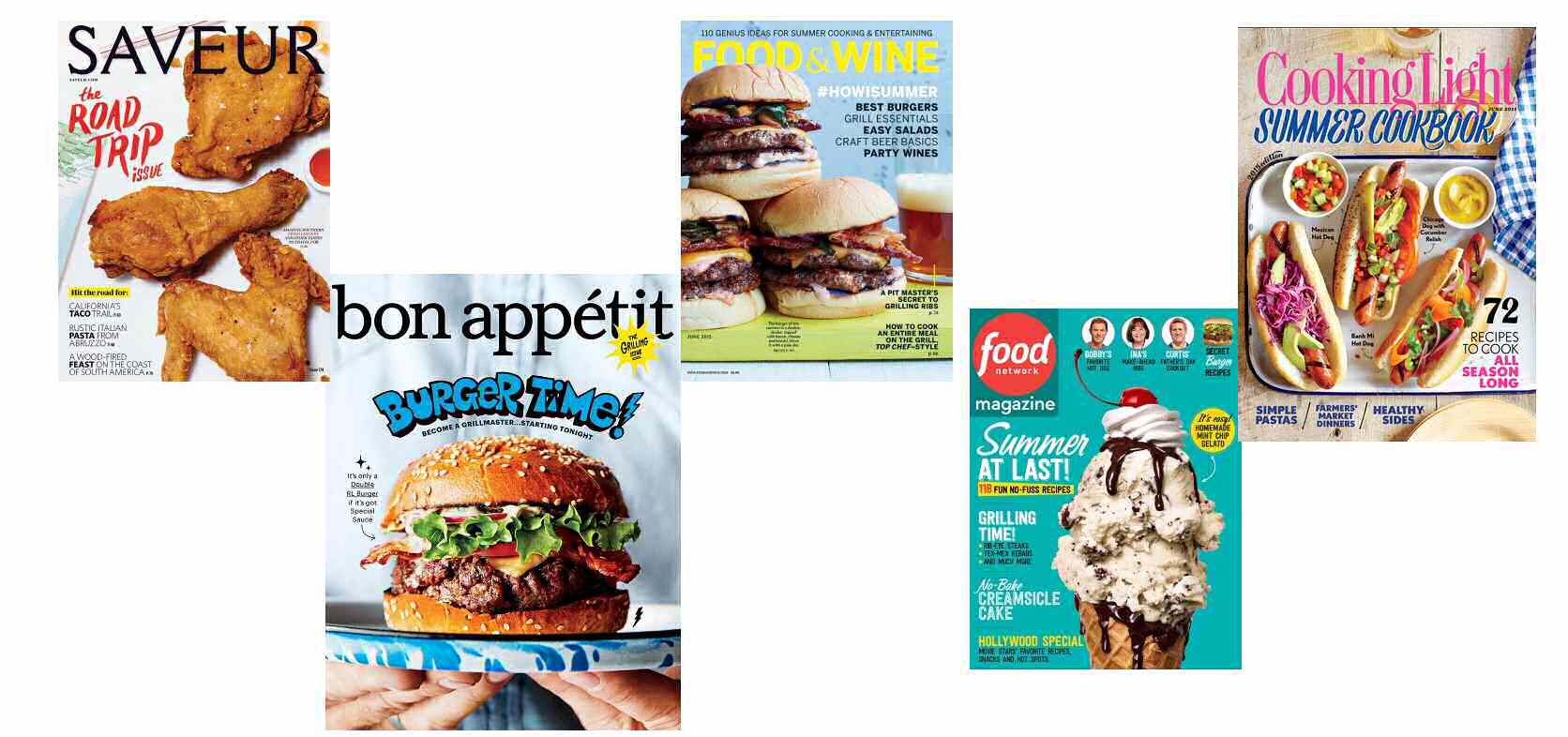
It’s nearly June, the big northeast snowfest that lasted into April is pretty much over, and all the May and June issues of the big food magazines are showing…almost no fresh vegetables on the covers. Or inside. Oh, you do see some green–but it’s garnish. Flat-leaf parsley, a little cilantro, a sprig of basil maybe, chopped or torn over the cover dish to make it pretty. But very few actual vegetables–take a little walk with me down the newsstand for a sec.

magcovers

All magazine cover thumbnails shown have been lifted shamelessly–they’re not mine, they’re the property of their respective publishers–and pasted together here solely for parody value and critical review of the food literature.

Saveur? Fried chicken. Seriously. Cooking Light? Hotdog special–one with a slice of pickle and tomato, another with avocado, to represent Vietnamese and Mexican, respectively.  Whoo-don’t you feel like a world traveler now. Food and Wine? Burgers by Bobby Flay. Bon Appétit? Another burger. Food Network? They don’t even pretend. Ice cream cone. With whipped cream and a cherry on top. On a cone.

The women’s mags are leaning toward desserts: Martha Stewart–cake. Southern Living, Allrecipes–pie. Better Homes & Gardens and BHG Diabetic Living both feature watermelon and ice cream or sorbet assortments. All of it very pink.

Eating Well cover Vegetarian Times cover

But even EatingWell and Vegetarian Times aren’t doing all that much vegetabalia on their green-looking covers. EW has a vegetable serving platter with a nice looking bunch of raw green beans and tomatoes at the bottom, but more than half of the platter is canned  beans or dip. Not that I’m against those, but they really aren’t fresh veg.  VT has a grilled veg and quinoa salad platter that looks wholesome enough, but if you zoom in for a closer look you realize it’s not mostly veg either. If you took a quarter of it for yourself, you’d only get 3 or 4 thin slices of pepper and zucchini on your plate along with the grain. Most of the green you see in the picture is a token sprinkling of arugula and basil sprigs strewn over the top–a strategy that’s being used and abused in the less veg-forward pubs to make steak or pork loin or mac ‘n’ cheese look like they have something fresh and healthy about them.

Lucky Peach and Cook’s Illustrated both go for graphics rather than photos. LP has a cartoony poster graphic of garden lushness for “The Plant Issue”–do they really have vegetabalia inside? Cook’s Illustrated has a pastel of radishes.

It’s as though they all decided to try to look summery without  including actual bulk greens–the signature of summer (well, other than watermelon). I’ve complained about this before, I know, but back then I was talking about friends who don’t cook much and are somewhat veg-phobic, not about upscale food media. For years the food glam world has been touting local sourcing, farmers’ markets, heirloom this and that, Provençal and Spanish and Italian and Middle Eastern cuisines, which are full of vegetables one way and another. But they really are no longer practicing what they preach. They’ve shrunk their focus down to the meager American fast food paradigm while pretending otherwise. And charging you between 4 and 10 dollars an issue.

But vegetables are so easy to ruin, you say. The green ones turn brownish olive if you hold them too long after cooking. If you’re going to hang around a whole hour waiting for the photographer to get the right shot, you’re going to have to cook a couple of batches in a row. Strewing a couple of sprigs of cilantro or parsley over something is so much easier!

The other reason we’re not seeing vegetables on the magazine covers: editorial production lag. Monthly magazines typically take anything from 2-6 months to produce from start to finish, so they work ahead. The May and June issues probably went to press two months ago, when it had barely stopped snowing in the northeast (per my mother and sister). Summer vegetables are not bountiful in March and April under those conditions–at least not in New York and Boston. But the editors could have put together something decent and thematic for the covers if they wanted to–I’m pretty sure I could have sent them a likely looking CARE package from my local greengrocer’s if they’d only asked and were willing to foot the overnight shipping.

A weekly haul from my greengrocer's comes in under $30 even with coffee, spices and special items.

Eat your heart out, foodie magazines! Time to gloat. A typical weekly haul from my greengrocer comes in at under $30 even with a pound of coffee or tehina or yogurt (not shown, obviously), bagged spices, dried beans, and  specials on fruit or nuts. When the tomatoes are better I stagger out the door with 5-10 lbs. at a time, but on the other hand the snow peas were a serious bargain this time around.

There are plenty of good vegetables around. Fresno tomatoes are back in my Armenian grocery (for which, oh! be joyful), we have green and romano beans, we have lettuces and purslane and bunches of fresh basil and dill and mint and za’atar (and yes, parsley, Continue reading

Microwave Tricks: Shakshouka

IMG_0458

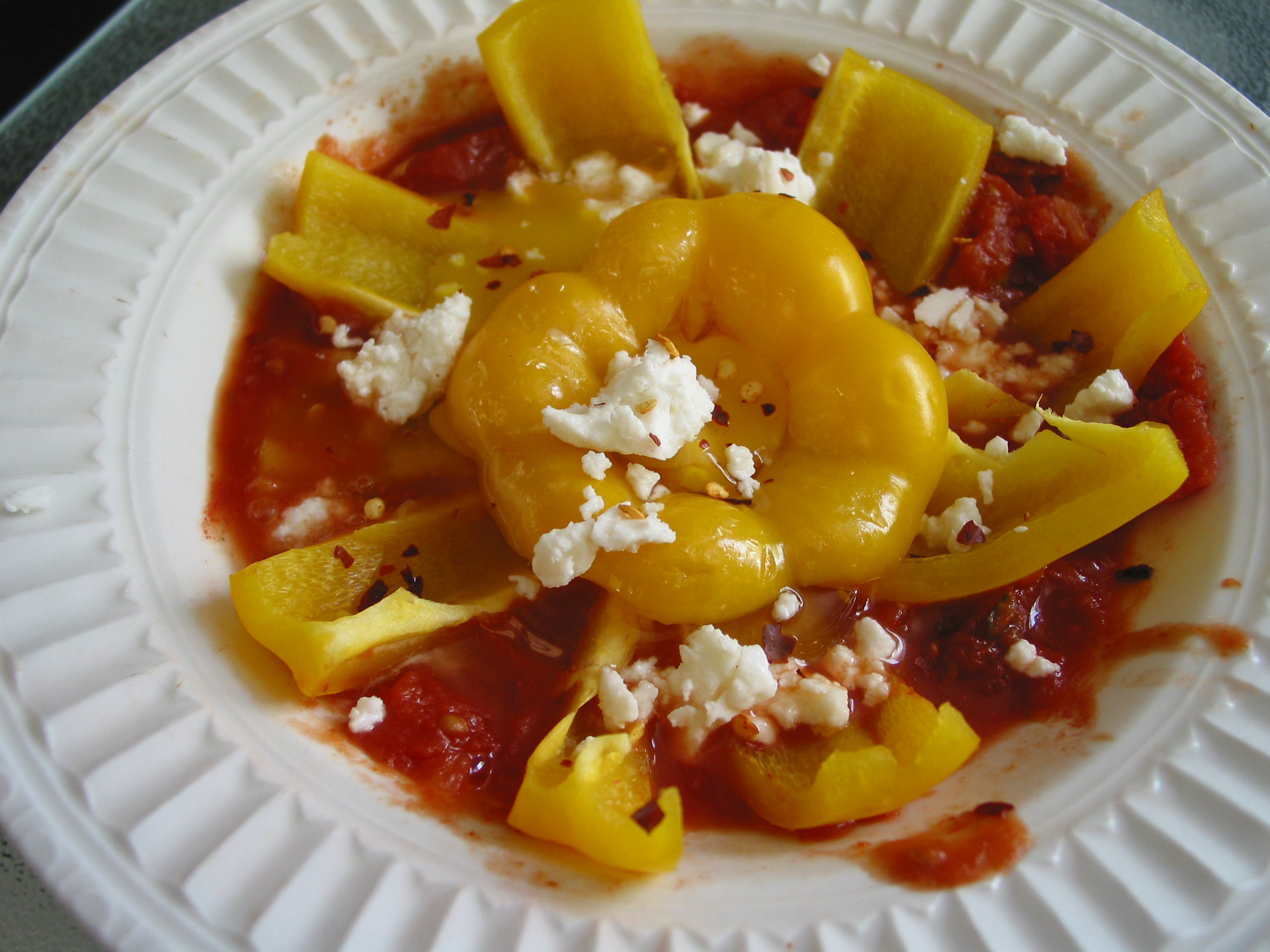
Marinara plus a pepper makes a good start.

Sometimes during Passover you just can’t take any more matzahnola. Or matzah with jam, or matzah brei. Or cake. Or macaroons. Anything for breakfast that doesn’t involve at least one vegetable (other than yourself, before coffee). Your tolerance for sweet stuff has been exhausted, and as for the leftover gefilte fish and hrein…no. We are not going there. No matter how much my husband insists it’s “perfectly good” (and I notice he hasn’t schlepped the rest of the jar with him to the office!)

Forget all that. There’s a pretty good cure for the Pesach blahs–you need some chile peppers and you need them now. Not in 20 minutes, no major cooking involved. You have a microwave, some cheap microwaveable soup bowls or the like, and you’re not afraid to use ’em for an increasingly popular Israeli brunch dish–shakshouka. Which is basically the Jewish version of huevos rancheros, only without beans or potatoes. Or lard.

Yotam Ottolenghi has made shakshouka popular and photogenic in at least one of his famous cookbooks, probably prettier than what I’ve got here. But it takes longer too, and I’m impatient.

To make shakshouka, you usually need a frying pan, olive oil, some tomatoes, peppers and onions, plus garlic, cumin, chile peppers, maybe a couple of oregano-or-thyme-and/or-cilantro-type herbs–sounds like the makings of salsa, no?–and some fresh eggs to crack into the resulting sauce. The sauce takes some 20-30 minutes to cook down, the eggs another 5-7 to cook more or less sunny-side-up in the middle of the sauce. That’s a lot of time for breakfast. I wanted a shortcut this morning.

Most jarred salsas are not kosher for Passover–it’s the distilled vinegar thing. That’s okay, because yesterday in a fit of domestic planning (uncharacteristic, I swear) I decided to make a batch of microwave marinara from some unsalted canned tomatoes. I don’t have a kosher-for-Passover food processor this year, though, so I decided, after trying to chop up some pretty tough Roma tomatoes (even with the skins off!) that I should just do as the Sicilians do and break them up with my hands as Tony Danza advises. A little chunkier than usual, but just fine. And actually ideal as a base for shakshouka–both its readiness for a mid-morning fridge scrounge and its rusticity made for a good start. A good dollop in a microwaveable soup bowl.

What else do you need? Maybe a bell or Anaheim-type pepper that needs to get used up. Cut it up (I got whimsical, you don’t have to potschky around with flower shapes). Add more onion if you feel like it; I didn’t. Stick it in the microwave for a minute or two to wilt the pepper and possible onion pieces.

IMG_0461

Then crack an egg or two into it, sprinkle on a bit of feta or panela or queso fresco as desired, maybe a pinch or so of chile pepper flakes or z’khug (I’d run out) and/or chopped cilantro as desired.

IMG_0463

Put another soup bowl on top as a lid, and microwave another minute or two until the eggs are cooked to your liking–check and add 30 seconds if you think it’s still got a raw spot somewhere, and/or leave the lid on for a few minutes and let it finish cooking in the residual heat of the sauce.

Obviously if you’re having people over for brunch, the standard frying pan method is better and quicker–more eggs and salsa means more time in the microwave, and no one wants to sit around as you microwave individual portions. But if it’s just you, or you and your partner, the microwave method works pretty well. Just add a little time (maybe another minute or so in 30-second increments) for four eggs as opposed to two.

IMG_0464

Hafla! (celebratory remark when there’s something good on the table and you didn’t have to wait an hour for it) Grab some matzah and a cup of hot coffee and b’te’avon (mangia bene/bon appétit/eat nice)!

Passover Dessert Challenge: No Eggs!

 Passover-eggless-chocolatealmondtorte-halfsheet

Bear with me, I’m still a little hyper (see below). Three days before the first Passover seder, and I’ve been asked to bring a non-fruit, non-macaroon dessert. With a few caveats.

This is the ultimate, I think: a fresh dessert, preferably deep chocolate, with no dairy (serving at a meat meal), no fake stuff (because I can’t stand it) and obviously for Passover, no chametz (forbidden grains like wheat, barley, oats, etc.) or kitniyot (legumes, corn, rice, peas and green beans, some seeds, nuts and spices, plus some vegetable oils derived from them, like sunflower…). Also, for reasons of the requesting family’s allergies, no pistachios, hazelnuts or cashews, or cinnamon.

Or, and here’s the kicker for Passover desserts–eggs. No eggs! And it’s got to be moist and fabulous, or at least obviously better than the standard choke cake box mix, and prettier than the all-real-but-undecorated apple-almond cake I served a couple of years ago. And it’s got to rise and still be kosher for Passover under Orthodox Union rules. Which I had to look up on line for some of the possibilities I had in mind.

It’s not dread in my heart, surprisingly, but a little tinge of excitement at another chance to mess around and come up with something decent.

I’ve done a few home desserts that weren’t bad and that didn’t contain most of the forbidden items. My first best hope is something as close as possible to my favorite, Sacher torte (because I’m unoriginal and because at least I’ll like it). I’ve been working on this for a while and I thought, I can get by without eggs as long as I have some other way to raise the cake and keep it from turning into a rubber brick.

And eggs aren’t the only way to raise a cake or make a cookie without violating the kosher-for-Passover rules. It turns out that some brands of baking soda, including Arm&Hammer and a number of smaller and store brands, are processed under sufficient supervision so there’s no contamination from cornstarch or grains or the like, and are now considered kosher for Passover under O-U rules–it’s worthwhile looking them up. So is all unflavored bottled soda water, even without a kosher certification mark. That one I remember from my student days, when somebody said you could pour seltzer into matzah ball mix to lighten it.

Another item that turns out to be okay is linseed–aka flax. So if you grind linseed and bring it up with water, you could do a kosher-for-Passover dessert without eggs for the kinds of things flaxmeal works for. Consult a vegan dessert book (aside: a lot of the authors are Jewish! Maybe not so surprising), use matzah cake meal and/or almond meal instead of standard flour, and you might be in like Flynn (or at least like Feldman).

Other key ingredients to check are K-leP (kasher lePesach; kosher for Passover)…

The chocolate, obviously. Elite makes so-so quality but certified pareve kosher for Passover bittersweet bars, and they can definitely be put to work. Hershey’s plain (not Special Dark) non-dutched cocoa powder is accepted by the O-U even with just its regular certification mark. Some cider vinegar is probably certified–but fresh lemon juice or orange juice might work too, in case I can’t find an O-U-labeled version. And unflavored raw almonds, walnuts, pecans and almond meal from Trader Joe’s are also all approved, at least this year. Also white cane sugar and non-iodized salt with a regular year-round O-U certification mark.

Other items:

Plain dried fruits as long as they’re not coated with vegetable oils or the like.

Plain fresh fruits other than raspberries and their kin, which are hard to inspect for tiny bugs among the drupelets (but which the O-U has a whole procedure for inspecting at home to make them okay–it boils down to washing and looking carefully. So much for the mystery…).

Spices are more of a pain–some, like caraway and fennel, are considered kitniyot, even though very similar ones in the same family, like anise, are acceptable. Not that I was going to put any of these in a chocolate cake, mind you, but I like to keep my options open for other, non-chocolate, possibilities. Ground spices need to be certified for Passover, and most of the supermarket store brands aren’t.

Finally there’s the taste/texture issue, the 11th commandment: Thou Shalt Serve No Choke Cake (not even before its time, and thank you so much Paul Masson).

You want something raised with seltzer or baking soda and no eggs, you’re taking your chances on a pretty dry item. Almond meal contributes oil and moisture without making things oily as long as you remember to cut down on oil ingredients to compensate. But depending on how light or springy you want your cake, you may need more matzah cake meal for structure, which really dries things out if you go too far with it. Weighing the matzah meal is better than measuring into a cup because it’s dryer–already baked–so it’s denser than regular flour. You need more liquids if you use matzah meal–hence the usual eggs. Without eggs, you want something that will retain moisture in the cake and still give a bit of structure. Apples or applesauce would be my best bet, substituted for whatever oil, margarine or butter your cake recipe calls for, just slightly lower volumes to avoid making the batter too wet.

Pumpkin I’ve also tried in my callow youth. While it’s fine and occasionally impressive for a non-chocolate dessert and for plenty of savory dishes, something about it suppresses the essence of chocolate. The one time I tried canned pumpkin for fat-free brownies, the texture came out near-perfect, but it mysteriously sucked all the chocolateness out of the air while the brownies were baking. And then there was a serious blank in the chocolate department when I tasted, even though the texture was good and I’d put in a lot of cocoa powder. Life is unfair. And on the other hand apples won’t let you down, and even a little applesauce works beautifully instead of oil both in chocolate box mixes and in from-scratch cakes. Should work for Passover versions too.

Lest you wonder whether it’s possible to do a decent pareve frosting suited to a Sacher Torte Occasion, which–no surprise here–is what I’m aiming for, I’ve just done a test run (Wednesday) on the whole cake recipe I had in mind, thinking I might have to adjust before Friday.

This cake is a cocoa-flavored version of the basic gingerbread (cake, not cookie) recipe from the Silver Palate cookbooks. I’ve used it for honeycake at Rosh Hashanah with good results—even in the microwave. I almost always substitute unsweetened applesauce or grated apples for any oil in standard cake recipes or box mixes.

Here I’m also increasing the baking soda a little to compensate for the lack of an egg and substituting almond meal for most or all of the flour (and not adding molasses or ginger, obviously). From the typical nutrition label, I estimate the almond meal is about fifty percent oil by weight, most of it polyunsaturated fats. You really don’t need any more fat in the cake. It’s not low-cal even so, but the advantage healthwise is that most of the oil is polyunsaturated and monounsaturated, plus the almonds have fiber and protein. Beats adding sticks of butter.

The Silver Palate gingerbread method is pretty classic: you mix the dry ingredients together. Stir in the egg and oil (in most recipes) or in this case just the apple or applesauce and extra baking soda. Then you pour on fresh hot coffee or boiling water and stir quickly to get things just mixed to a batter. A little vinegar or in this case, a squeeze of fresh lemon juice, stirred in at the last minute before pouring into a sheet pan and sticking it in the oven, helps the coffee activate the baking soda.

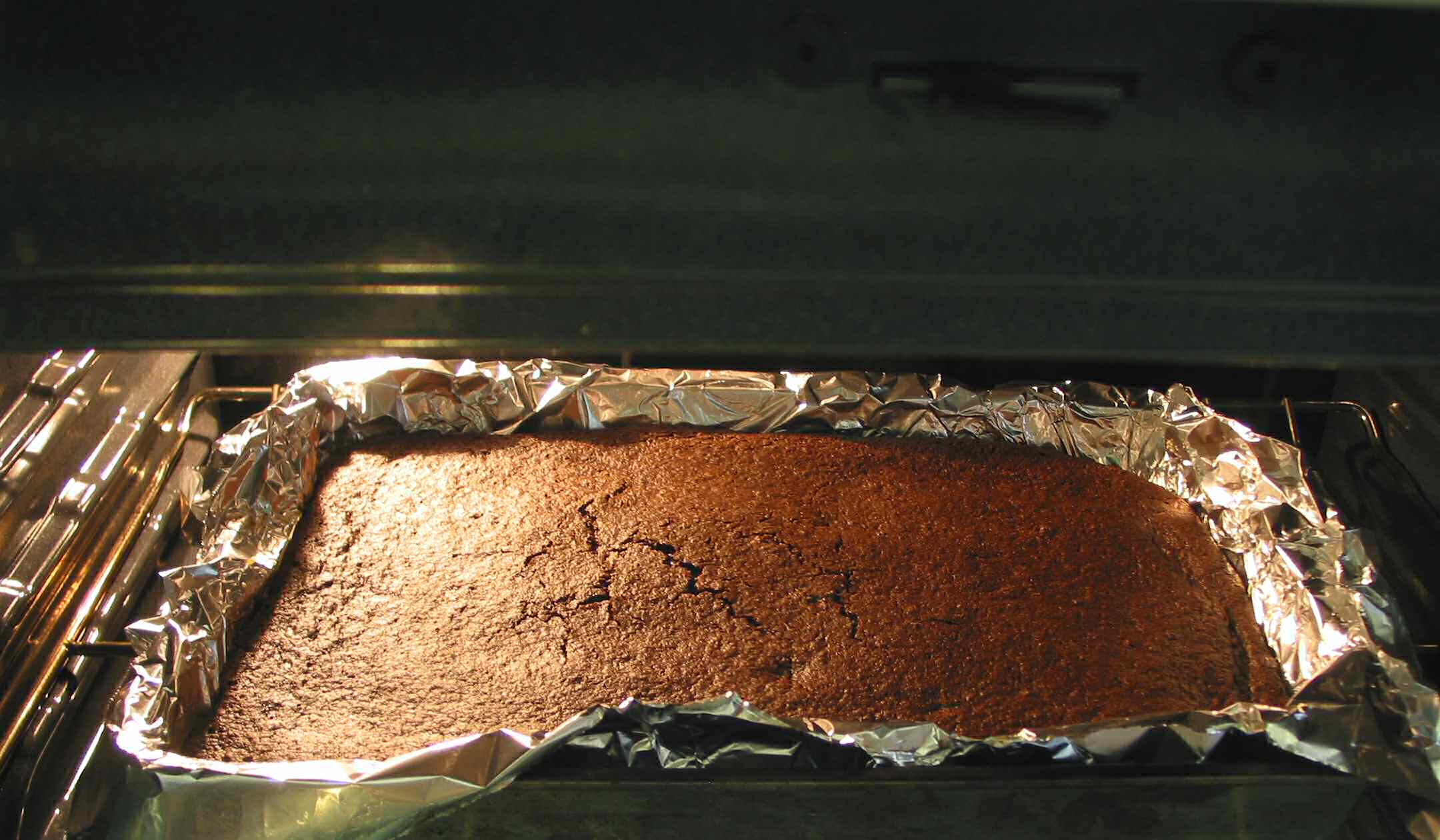
The pareve, egg-and-butter-free chocolate cake didn’t rise a ton, probably because I included exactly zero matzah cake meal, and just a tiny token bit of potato starch, probably not quite enough to keep the rise. The cocoa powder itself provides a little backbone as it cooks, but probably next time I’ll add either another two or three spoonfuls of potato starch or a single sheet of matzah, crumbled into the coffee grinder and turned into fine grind cake meal.

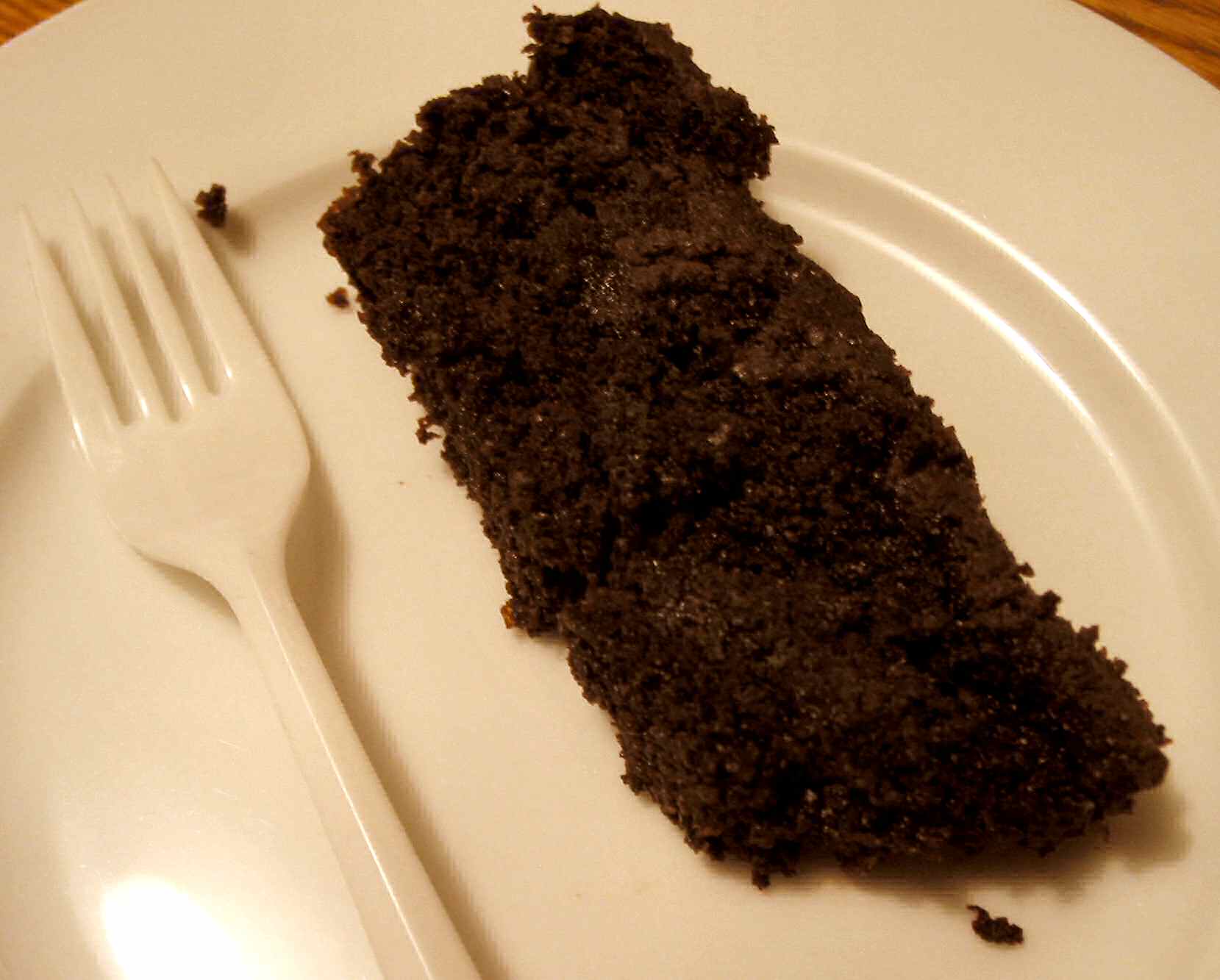
But even as it was, first time around, this cake came out like you wouldn’t believe. Excessively fudgy cake, insanely good, and the attempt at a completely nondairy ganache without nasty creamer or margarine-type additions went so well I’m going to have to patent it or something.

As I’m sure (and sorry) is apparent, due to the serious cocoa-and-hot-coffee content, plus the elation that it wasn’t a flop, I found myself on a caffeine high and completely unable to shut up about it while driving my kid home from school. She discovered I wasn’t wrong. We both recommend thin (half-inch) slices to avoid shock, caffeine highs, and that feeling afterward like you’ve just eaten Monty Python’s wafer-thin mint. You will be satisfied–a little goes a long way.

This half-inch slice is seriously enough for a serving. It's that rich.

This half-inch slice is seriously enough for a serving at the seder. It’s that rich.

Anyway, this is going to work and it is SIMPLE. And tastes fabulous. Fabulous, very definitely. If you like flourless chocolate cake and ganache, try this at home. Even though, as I say, it has no butter. No eggs. And no crap. And it’s not too slow (though the baking time kind of is; 40-45 minutes because it’s very moist and stays that way after it collapses back down and shows light cracking–see photo at top of post). Continue reading

Movie and a Pickle: “Deli Man”

About a week ago, my husband and I decided we were finally grown up enough to take ourselves out to a movie (and leave our slightly attitudinal teenager home to watch some sort of awful teen tv series without us). We’d heard from friends about a documentary called Deli Man that was showing at reasonable hours downtown, and it sounded not bad. We found parking at the bookstore next to the theater, ignored most of the threatening new signs about being towed if we didn’t shop the bookstore and get back out within 90 minutes (it was a Sunday evening, and the bookstore was closing early), and walked into a sparsely attended theater.

Which (the sparseness, I mean) was a shame for the theater and everybody who wasn’t there more than it was for us, because Deli Man is terrific.

You’ll laugh, you’ll cry, you’ll wonder what a Cordon Bleu-trained chef is doing in Houston kibbitzing with his customers in a strip mall deli while sweating the details behind the counter and agonizing over the memory of his grandfather’s idyllic but lost gravy recipe as he serves up gargantuan matzah balls, stuffed chops, and sandwiches you need to be a python to get your jaws around. Cue Jerry Stiller, Fyvush Finkel, Larry King and other New Yawk old-timers, the local Jewish community fans in Houston, and some of the best–and hopefully not last–deli men in the business.

See the trailer on YouTube.com


In between the semi-humorous profile of David “Ziggy” Gruber, third-generation deli man and one of the last under 50, plus (of course) all the kibbitzing from family and friends who wonder when and if he’s ever going to be marriage material, you get interviews with the old hands who themselves are sons and grandsons of the original great deli owners.

Sarge’s, 2nd Avenue Deli, Stage Deli, Carnegie Deli, Ben’s Best–most of the guys who are still in business and some who aren’t. They’re famous, they’re well-established, they dress nice…they’re still working backbreaking hours themselves and pushing their kids to get out and go to law school or into engineering because it’s such a hands-on business and training juniors with the right attitude is so difficult. And attitude is what counts.

David Sax (Save the Deli), Jane Ziegelman (97 Orchard) and Michael Wex (Born to Kvetch and Just Say Nu) trace the roots of the deli through the waves of Jewish immigration on the Lower East Side, the move to Jewish-style as opposed to kosher, and the decline in our times of a great old-neighborhood tradition as the old urban neighborhoods changed hands and Jews struck out for the suburbs.

You get a chillingly clear picture of why the number of Jewish delis has shrunk from thousands in New York alone after WWII to only about 150 nationwide today. At the same time you see why the deli guys hang in there–and so do their customers.

Jewish delis, kosher or not, are not the usual kind of American casual restaurant. They’re extremely personal and familial, as Jews still tend to be with each other. The old-style Jewish waiters would argue a lot; sometimes they’d tell you rather than ask what you were going to eat, and it became a classic shtick. But as Gruber pointed out on Alan Colmes’ Fox News Radio interview (and no, I can’t believe I’m providing a link to anything Fox either, but it was a good interview), the days of the cranky waiter are more or less gone.

And on the other hand, delis still deliver more for the money than the nouveau-hip places with $50 plates and $18 drinkies. The regular customers expect more–not necessarily more food (though that’s an impression you might get from the outsized portions), but for the deli owners and waiters to know them, talk with them, argue even–and remember exactly how they like their food.

We come from a culture that thrives on argument as a form of intimacy. If you’re not arguing (lightly, not nastily) with your wife, husband, kids, friends, shul members, and pretty much everyone else you care about…how can they be sure you’re really paying attention? It’s become a lost art, though–even Jews of my generation cringe when we hear our parents bellowing cheerfully up and down the stairs at each other. I had to train my genteelly brought up husband that there’s a huge difference between yelling out to him from the far end of the house and yelling at him, and I expected him to just yell back the answer and not get mad or insulted. He’s almost got it by now…

That kind of personal is what makes the give and take between kvetchy customers and ebullient owners work so well and it adds ta’am, flavor, to the whole experience of going to a deli. They know you, and they pay attention whether you’re a CEO or an average Joe.  You can’t get that in a chain restaurant; you don’t get it at a three-star haute palace.

Delis have also, at their best, been the kinds of places where seemingly hard-nosed owners were known to sustain their neighborhoods in hard times, sometimes secretly comping a free meal if a customer was out of work.

Deli Man is deliberately and intelligently personal even as it traces the history, the economics, the fans among the Broadway stars, and the paradoxical Americanness of the Jewish deli. There are plenty of old black-and-white vintage photos, a bittersweet tour of the Lower East Side and its remnants, and klezmer music from one of the modern greats. Far from becoming a Ken Burns wannabe, though, it’s funny, wry, well-paced, modern–and most of all, it gets to the heart of what makes a deli matter. From start to finish, this is a documentary that cuts the mustard. In fact, my only serious kvetch is this: too much pastrami, not enough corned beef.

Or pickles. So in honor of this movie I’m trying out a long-planned jar of pickled green tomatoes, something I remember with fondness and bemusement from my childhood. Whenever my grandparents would come down to Virginia to visit us, they’d schlep bags stuffed with good tough breads, real bagels, packets of corned beef and pastrami. Along with precariously packed containers–were they plastic tubs, or were they, as I remember, merely stapled glassine Continue reading

Chickpea Crêpes, Masala Dosa style

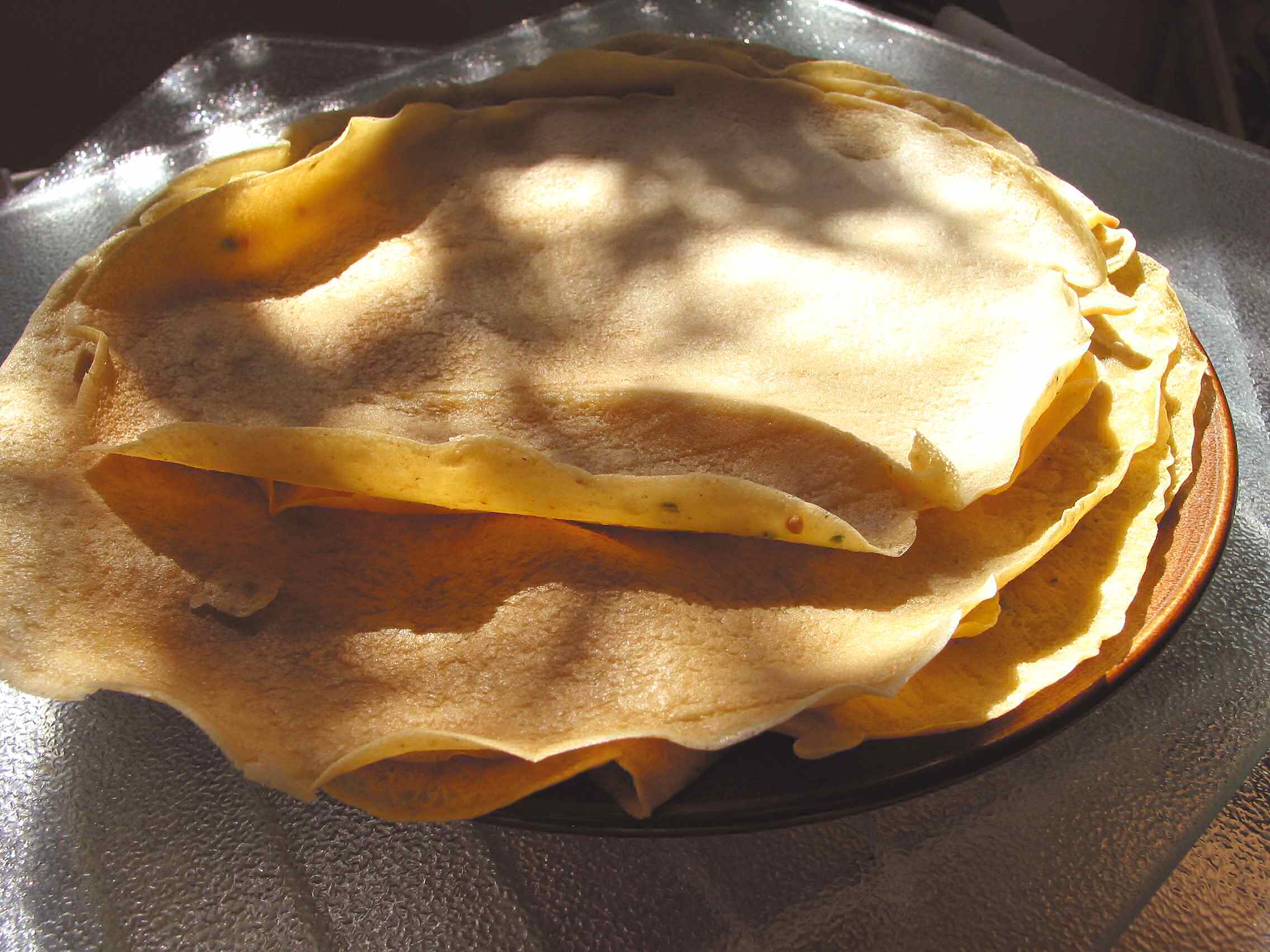
instant dosas with chickpea flour, ground rice and yogurt

Project 1 of Panic Week: “instant” dosas made with chickpea flour, rice and yogurt. The heavy dose of mustard seed and black pepper is surprisingly good.

Planning the cooking for Passover usually means thinking about the week itself, buying matzah and gefilte fish and horseradish and so on. But for me, it also means using up the open bags of flour, beans, rice and pasta, plus whatever yogurt, cheese and milk I have left, and yet not overdosing on starches. And I’ve just gotten the taxes done, so it’s time to look in the fridge and panic.

We’ve got just over a week to go before Passover, and there’s still a lot of chametz in the house…a pack of fillo (luckily only one), a pound each of dried chickpeas and red lentils, a bag of mung beans I don’t really know how to use, some rice, a bowl of dough…wonton wrappers. Chickpea flour! Rye flour! Why did I leave it all this long [breaks down and bangs head against wall for a second]?

I don’t usually want to cook or serve that much starch in a single week, but at least most of it is legumes with some fiber and protein. So I’ve been thinking about foods–both chametz and not-chametz–that don’t have to be devastating dietwise or empty your wallet or take forever and a half to cook.

Because even with snow on the ground all over the east coast, where my mom and my sister and most of my old friends are still shoveling it out of their driveways this late in March, Pesach is coming. And then maybe an actual spring with shorts weather? We can only hope! Time to lighten up in anticipation.

This week I’ve decided to post the chametz countdown (aka, “Panic Week”), and the next week or so, a couple of attempts at a Pesach week with mostly fresh, simple foods and a lot more vegetables, and without the usual total matzah-on-eggs-on-more-starch-and-potatoes-and-choke-cake-and-too-many-canned-macaroons kind of meal plan…can it be done? I think so. As long as I don’t let my husband do the shopping. Can it be done in a microwave? I’m counting on it.

Anyway–back to the Panic Week Project. First up, the chickpea flour and rice…as a batter for on-the-spot masala dosas. Continue reading

Purim: Poppyseed filling with a Persian-style twist

poppyseed filling with orange blossom water

Tonight is Purim, when we dress up in costume, make fun of dire villains and dull kings, cheer modest heroes and most of all praise a heroic woman, Esther, who risked everything to change the king’s addled mind and spare the Jews of the Persian empire.

In previous years, I’ve done the Hamantaschen thing–low carb, medium carb, all homemade, no pasty white horrors, praise of Joan Nathan’s basic recipe from her first cookbook…lots of non-Dayglo, non-candy fillings from figs, prunes, apricots, and so on…

Today I’m probably not going to get a chance to bake anything or even cook very much, because I decided to take a leaf out of Esther’s Megillah this year and read part of the fifth chapter, splitting it with my (much-wiser-than-Ahashverosh) husband. So about three days ago I decided I was going to go for it and learn the Purim cantillation (trope marks for chanting) system. Which takes more nerve than usual, because it’s tricky and somewhat deceptive, like the entire story. And it’s been almost two years, since my daughter’s bat mitzvah, since I’ve even chanted Torah. And, like I said, three days ago. Not brilliant.

Luckily there’s Youtube. And a number of synagogues post recordings by their hazzanim (cantors, male and female) for the cantillation marks and for the readings as a whole. Only there are so many versions for Purim! It’s a late holiday in our history, after a lot of us were living in the Persian empire, and the different melodies reflect our already dispersed community. One interesting version was by a Moroccan hazzan–his system actually had a couple of trope mark tunes that are nearly the same as ours for the regular weekly Torah and Haftarah readings. Maybe those are the oldest ones that everyone has more or less in common? Cool!

So–our daughter is chanting a few verses with her youth group for Chapter 7 tonight, and the director is bringing kosher Persian food from a restaurant on the West Side of LA, where the largest Iranian (and Iranian Jewish) community outside of Iran resides. I wish I were a kid tonight, for sure.

Still, in honor of the occasion and the roots, I did get around to making poppyseed filling for the hamantaschen I’ll make tomorrow.

I went to my local Armenian greengrocer yesterday morning for vegetables and picked up a new bag of poppyseeds, hoping they were fresh, really fresh enough to use. My previous latest bag in the freezer has puffed up suspiciously with air–suggests it’s no good and starting to release gases even though I didn’t open it before freezing, dammit.

I tasted the new poppyseeds raw–okay. But rancid sometimes only shows up when you toast them, so I poured a spoonful in a metal pan and swirled them around on the stove until the aroma came up. Then I test tasted those once they were cool enough. Still good, still lucky.

Poppyseed filling is quite an elaborate affair in my trusty 1984 spiralbound edition of Joan Nathan’s The Jewish Holiday Kitchen. Figs, apricot jam, brandy, egg whites? Oy. Ten or more ingredients. A production, and kind of expensive considering how many younger people don’t like poppyseed filling. Including my daughter, I’m sad to report (see below)…

But I do, which is the important thing, and my supermarket no longer carries those cans of Solo in the Jewish Foods section. So I decided it was fine to simplify. And while I was at it, to add a hidden Persian-style element or so for the occasion of Purim.

So this filling looks black…but holds the essence of early spring and orange blossom within it. And if anyone doubts that it’s completely effective in its ability to transform, at least temporarily, I should add that my daughter, who insisted she tells me every year she hates poppyseed filling with a hot hate, and that I never listen, took a tiny bite and looked surprised and pleased…at least for about five seconds, until the bitter toastiness of the poppyseeds came through like a bagel at rush hour, poor kid, and she pulled a Tom Hanks (from Big, the caviar scene). She even did the wiping-the-tongue-desperately-with-a-napkin bit. And no, I’m not sure I should be telling you this. Five seconds delay, though. From her, I’m gonna have to count that as a win. And it was pretty funny, another point to Purim.

Poppyseed Filling With a Persian Twist

  • 6 oz (172 g; it was the size of bag they sold) very fresh poppyseeds
  • 6 oz. sugar (again, 172 g, but anyway, the same amount as the poppyseeds)
  • 1/4 c (60 ml) water
  • juice of a lemon
  • orange part of the rind of an (organic, washed) orange or tangerine (in this case), grated or if that’s too much of a pain, shredded with a knife and ground in a coffee grinder or food processor with an additional spoonful or so of sugar
  • pinch each of ground cloves and cardamom (if you have it)
  • very tiny shake or grinding or pinch of nutmeg
  • up to another 1/2 c. water (see instructions and PS note at the bottom)
  • 1/2 t. vanilla
  • 1 t. orange blossom water (yes, this was my idea of the Persian twist, and it’s good, though probably it should have been rosewater for authenticity–I just wasn’t ready for that)

Taste-test the poppyseeds raw, then toast a spoonful in a dry steel saucepan on the stovetop until you start to smell their aroma. Cool and taste-test again before using to make sure there’s no funky, off, or rancid flavor to them.

ground poppyseeds

Then grind them a few pulses in a coffee grinder (in two batches) or in a food processor or blender.

In the steel saucepan, combine the sugar and water with a squeeze of lemon and let the sugar wet down all the way before turning on the burner to medium. Bring just to a slow simmer without stirring–the slurry should start to go clear as the sugar dissolves.

poppyseeds cooking in syrup

Add the ground poppyseeds and stir gently. It should be a thick dark-gray grainy mass. Keep the pot on a low heat so it bubbles gently but doesn’t spit for about 5 minutes, stirring occasionally but not hard or you might cause the syrup to seize. As it cooks add the lemon juice, spices, grated orange or tangerine rind and stir in, then [see the PS below] test-taste–if the seeds are still kind of hard, add 1/4 c. water, let simmer with a lid partway on for a few minutes, stir and do it again here until the seeds soften a bit and the raw-poppy edge is off. Add the vanilla and just before taking it off the heat, stir in the orange blossom water. Take a tiny bit and let it cool enough to taste and adjust any flavorings, then take off the heat and pour into a container to cool to room temperature. It will thicken further, especially after you put it in the fridge.

B’te’avon, bon appétit, and Chag HaPurim Same’ach!

PS…AKA, next-day “Do-over,” kind of. Because I wouldn’t want anyone to try this, be happy for a few minutes, and then kind of hate the result when they took a second taste. If it needs a fix, it needs a fix, and I felt this did…

The next day I took it out of the fridge for a taste test before deciding if I really wanted to bake…it was pretty grainy and the top was crusted sugar. I stirred it and realized the seeds were pretty hard still and kind of bitter–not rancid, just really raw-poppyseed. Very strong. I think I didn’t have enough liquid in the recipe compared with Joan Nathan’s, even without all the jams and things. She had “juice of an orange” in there somewhere next to the juice of a lemon, and I’d assumed it was mostly for flavor, but probably the extra liquid helped cook the poppyseeds too (hence, the “up to another 1/2 c. water” bit I’ve just added to the ingredients list).

Never one to look away from a challenge (oh yeah? I hear someone muttering sarcastically in the background)…I decided to reheat the filling in the microwave with some extra water and a lid for a minute or so and see if that would induce the poppy seeds to absorb some of the water and soften up a bit. I stirred in about 1/4 c. of water, which immediately went cloudy-white, kept stirring, and the filling thinned almost to pancake batter consistency. Put a lid on and heated 2-3 minutes in the microwave, let sit a few minutes to absorb. It was better as well as thicker, and a little of the poppyseed bitter edge was out as well. So I did it again with another 1/4 c. water, heated 2 minutes or so, let it sit again and it thickened back up but the seeds were definitely softer and a little more brown than black (although I admit it’s pretty hard to tell).

In any case, I’d do this the first time around while it’s still cooking on the stovetop. Add the extra water in bits after you’ve added the poppyseeds and spices, and before adding vanilla or orange blossom water (so you don’t evaporate them off). Expect to cook it down from about pancake batter looseness until it becomes very thick, a grainy paste. Then taste a little and feel to see if the seeds have softened and mellowed in flavor–add more water and cook longer or else do the microwave thing instead if you’re impatient, but I think it might only take maybe as much as 15-20 minutes on the stove rather than the 5 minutes I’d expected.

Safety: The only thing about heating syrups in the microwave (this is basically a syrup with seeds) is that they can get very, very hot. So 1. keep an eye on it while it’s heating and be ready to stop the microwave if it starts to boil over (this didn’t, either time, but you just don’t know) and 2. don’t use a plastic microwave container because the mixture could melt or scar plastics. Proper microwaveable ceramic or old-style borosilicate pyrex is ok if you still have some from 20 years ago or can find it in Europe and tote it home. (NOTE: “new Pyrex” that clanks and is made outside the US is made of soda lime glass and is not very heat-stable–see right sidebar warning).


Microwave Tricks: Rapid Red Cabbage

microwave sweet and sour braised red cabbage

When I was almost twelve, the year of All the President’s Men (go rent or borrow it from the library if you’ve never seen it), a classmate of mine came back from the weekend raving about a new restaurant his parents had taken him to.

Now, almost no one in my 7th grade math class, particularly not boys, either knew about or talked much about food above the pizza and burger level.

My friend’s family had spent the previous year in Italy–you could tell whenever he grumbled about real soccer with strategy vs. the weak substitute they were teaching us in PE that he was sorry they’d come back. Clearly it wasn’t the only thing he missed–this was the first “real” restaurant he’d been to in the US, and it was way out in the countryside.

The Bavarian Chef (which after 40 years is still open in Madison, VA, and now in Fredericksburg as well, I’m happy to see), had a menu like no other in the area: fondue, a magic word I’d never heard before and which my friend had trouble describing. One fondue with Emmenthal-type cheese for cubes of toasted bread, the other with a red sauce (tomato? redcurrant?) for spicy meatballs. Veal or maybe chicken Cordon Bleu (their current menu still has veal). The side dishes were distinctive as well, particularly the sweet and sour red cabbage…it was gourmet. European gourmet, the real kind, and possibly the first upscale restaurant in our part of Virginia.

In any case, my friend was enthusiastic enough about this place that (and I don’t remember this bit at all) I came home and said something to my parents, who were friends with his parents. The next thing you know, my folks schlepped me and my younger brother and sister out of town–half an hour’s drive and  into the next county–to try it out for my birthday. And my friend was right about all of it.

The cheese fondue was a completely new experience and a lot of fun. So was a glowing magenta side dish of sweet-and-sour red cabbage–it would have been fun for the color alone. Although that has not held true for me and beets, so maybe I shouldn’t say so. But luckily it, unlike beets, was  delicious. And so different from anything else I’d ever eaten that it impressed me even more than the chicken (or veal) with the ham and cheese in the middle, and I can’t remember anything at all about dessert.

Sweet and sour red cabbage, when you think about it, is completely contrary to American standard tastes, even those of 40 years ago when people still ate vegetables and cooked most dinners at home. If you had to describe it to someone at school–what would you even say? The ingredients–and the flavors–are pretty simple individually but surprising together: red cabbage, vinegar, sugar, cloves, salt, maybe black pepper. Maybe a bit of apple or onion in some versions. How could that go together? But it does, and I’ve loved it ever since.

And yet I never ever make it at home, because it takes up to 2 hours of simmering on the stovetop, depending on the recipe you have. The one time I made it, back in my 20s, when I was trying to recreate the experience, the whole apartment smelled really, really sulfurous. It reeked. Even though the cabbage did come out ok.

Too bad I didn’t even own a microwave until my mid-30s. But I’ve been rethinking it since last week, when I saw a picture of it in a Mario Batali cookbook from about 10 years ago. The combination of a German-style dish in an Italian cookbook reminded me of the whole prealgebra food debate and my friend’s unprecedented idea that good food was worth traveling for.

But you don’t have to travel far for this dish, and you certainly don’t have to spend 2-3 hours on it. There’s got to be a way, I decided (as usual). How hard could it be to microwave it?

Well,  it worked almost perfectly, at least as a test case: Continue reading