
• Enter your email address to subscribe to this blog and receive notifications of new posts by email.

    Join 241 other subscribers
  • Noshing on

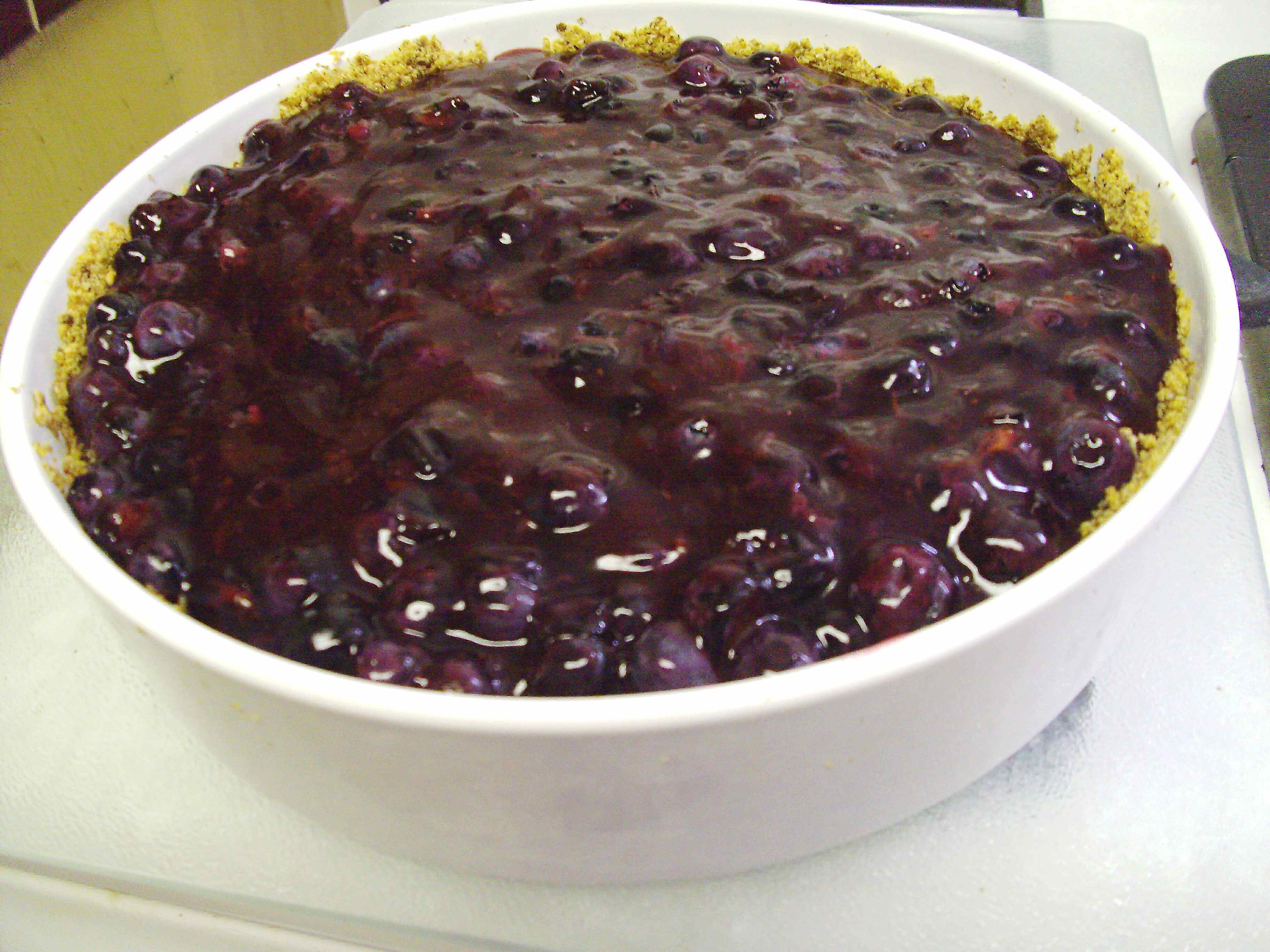
    raw blueberry pie with microwaveable filling and graham cracker crust

    This mostly-raw blueberry pie is a snap to make and very versatile--the filling microwaves in a few minutes, and you don't even have to bake the zippy gingered graham cracker crust--perfect for a hot Fourth of July and all summer long.

  • Recent Posts

  • Contents

  • Archives

  • Now Reading

  • See also my Book Reviews

  • Copyright 2008-2024Slow Food Fast. All writing and images on this blog unless otherwise attributed or set in quotes are the sole property of Slow Food Fast. Please contact DebbieN via the comments form for permissions before reprinting or reproducing any of the material on this blog.

  • ADS AND AFFILIATE LINKS

  • I may post affiliate links to books and movies that I personally review and recommend. Currently I favor Alibris and Vroman's, our terrific and venerable (now past the century mark!) independent bookstore in Pasadena. Or go to your local library--and make sure to support them with actual donations, not just overdue fines (ahem!), because your state probably has cut their budget and hours. Again.

  • In keeping with the disclaimer below, I DO NOT endorse, profit from, or recommend any medications, health treatments, commercial diet plans, supplements or any other such products.

  • DISCLAIMER

  • SlowFoodFast sometimes addresses general public health topics related to nutrition, heart disease, blood pressure, and diabetes. Because this is a blog with a personal point of view, my health and food politics entries often include my opinions on the trends I see, and I try to be as blatant as possible about that. None of these articles should be construed as specific medical advice for an individual case. I do try to keep to findings from well-vetted research sources and large, well-controlled studies, and I try not to sensationalize the science (though if they actually come up with a real cure for Type I diabetes in the next couple of years, I'm gonna be dancing in the streets with a hat that would put Carmen Miranda to shame. Consider yourself warned).

High-Speed Split Pea Soup

Split Pea Soup in the Microwave on SlowFoodFast

Microwave split pea soup, atop my current "blank book" cookbook (Sunflowers, by Vincent Van Gogh)

It’s November and even in Southern California, we’re starting to feel the season (there’s pretty much only one) change. It’s still sunny out, and sometimes near 100 degrees at midday, but by three or four in the afternoon, the temperature suddenly dips down into the 60s and people start complaining about it because they left their sweaters at home or in the car. And their hair is getting messed up. So even though you wouldn’t think it was necessary out here, split pea soup is on the menu.

There are two kinds of pea soup worth eating. Fresh (or fresh-frozen) peas make a sweet, delicate, beautifully green soup if you blend them with some water or milk and a little chive or onion or shallot and dill. Fresh pea soup also takes only five minutes to make, which is perfect for LA’s average springtime patience level. But that’s for spring–when the temperature suddenly hits an insistent 95 in mid-March and people start reaching for their waterbottles and sunglasses again. And declaring loudly, “Ah, it’s finally Spring!” when in reality we’ve had 80-degree days in December and January.

Split pea soup, the starchy thick heart of winter comfort eating, is another beast altogether. Most people either open a can of indifferent and hideously salty soup with mysterious lumps that claim to be carrot or–well, carrot, it’s the politest guess. Or else, if they actually cook, suffer a two-and-a-half-hour boiling-with-hamhocks-all-throughout-the-house kind of ordeal. Not that it doesn’t smell wonderful during that time, but with gas prices the way they are, and the sun still beckoning at midday, no one in their right mind wants to bother.

Doing it the old-fashioned way, it takes the full 2.5-3 hours for the peas to fall apart and make soup. And when you go to bed at night your pillow smells like split pea with hamhock…you really have to be dedicated to put up with that. Microwaving might just be the best solution. Mine is minus the hamhock, because this is a kosher-to-vegetarian kind of blog, but you can add a precooked piece of hamhock to yours if you’re serious about it–precooked for safety, because this soup may be too fast for a meat bone to cook all the way through the way it would if you boiled it to death on the stovetop.

High-Speed Microwave Split Pea Soup

  • 1/2 lb (half a 1-lb bag…) dried split peas (or a whole pound, see note #2)
  • water or low-sodium vegetable or chicken broth, about 2 qts.
  • 1/4 yellow onion
  • 1 fat clove of garlic, mashed, grated or minced
  • 1-3 t. curry powder, to taste
  • 1/2-1 t. each ground coriander and cumin
  • 1/4 t. ground caraway, optional
  • juice of 1 lemon
  • pinch or two of salt, to taste–don’t overdo it
  1. Rinse the split peas well in a colander, then scrape them into a 2.5 qt pyrex bowl, cover with water or broth (I prefer water, but your mileage may vary) by two inches at least, and cover the bowl with a lid or microwaveable plate.
  2. Nuke for 7 minutes on high and let it sit covered, not cooking, for maybe half an hour in the microwave. The peas will swell and take up most of the water.
  3. Scoop the peas into a food processor–leave the liquid behind in the bowl for now or you’ll get a lot of hot backsplash and the peas won’t puree well. Grind the softened peas down with the onion, garlic, lemon juice, and spices.
  4. As the peas grind down to a thickening mass, pour a little of the cooking liquid into the bowl in a slow stream.
  5. Once you have the consistency thick but pourable, add a little more water, put everything back into the bowl, stir well, and taste for salt. Don’t add more than a little–if it’s still not salty enough at the end, people can add their own at the table. Nuke the soup covered for 3 or 4 more minutes to reheat and cook the onion. The soup will probably thicken considerably, and you may have to stir in more water before serving.

Notes:

1. The flavor of lemon tends to weaken on reheating, so if you serve this soup throughout the week, reheat and then add a fresh squeeze of lemon.

2. You can make a whole pound at a time just about as easily–you may want to add another couple of minutes to the cooking times before blending if the peas aren’t done enough at the times listed above, but they may well be.

Pan-Fried Green Bananas

Fried Green Bananas on SlowFoodFast

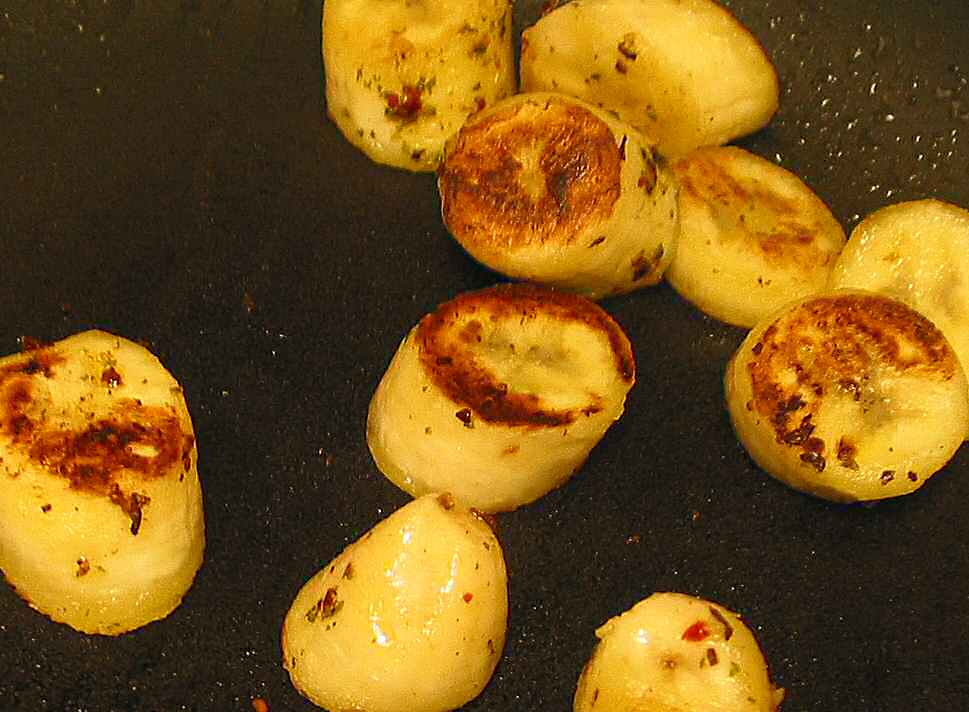
Green bananas frying in olive oil with hot pepper, cilantro and garlic

Even though we buy bananas every week and consider them a staple–for kid temper tantrum management as much as for grownup temper tantrum management–after a few days we often have brown speckled bananas sitting on top of the microwave in a state where no one will touch them. No matter how green they start out. I think it must be that I buy too many to start with, assuming that of course we’ll reach for them automatically as soon as they turn yellow.

So I started considering my options. I could buy fewer and run out of them. I could eat them speckled and funkily too sweet. Hmm. Or I could start at the beginning and find something nonsweet to do with them while they’re still green and fresh.

A friend of ours makes Bananas Foster as his signature dessert dish, frying and flaming bananas in cognac. They turn out gooey and sweet and rich, basically like cooked sweetened bananas, and I’m never sure the effort and the singed eyebrows are really worth it. So frying wasn’t the first thing I thought of. But I microwaved a piece of green banana for a minute to see whether it would hold up when cooked and it did. It also had an intriguing flavor–like cooked potato with a light   tartness about it, but none of the novocaine overripeness or mushiness I’d feared.

I was thinking about some of the Indonesian curries with basil–perhaps underripe bananas would be a good stirfry ingredient for those? Well, perhaps they still will be, but in the meantime, I felt lazy and decided on something simpler, quicker, and with fewer ingredients. It turned out much better than I’d expected.

Pan-Fried Green Bananas

  • Large green (underripe) bananas
  • dab or more of z’khug (chile/garlic/cilantro paste)
  • olive oil

Peel the bananas–you may need a knife if they’re really green. Be careful peeling them, because the green peel contains a drippy sap that will stain clothes badly like some tough kind of glue, and I still haven’t found a way to get it out of my favorite pants. In any case, cut the bananas in bite-sized chunks or larger pieces, as you prefer. Heat a spoonful or so of olive oil with a little z’khug in a nonstick frying pan and then pan-fry the banana pieces a few minutes until the outsides turn brown and crispy, like good french fries. A dab of pesto or a little curry powder and minced garlic and ginger and/or scallion in the frying oil would probably also work in place of the z’khug.

Hot Tomato: Microwave Marinara

Microwave Marinara on SlowFoodFastGreat tomato sauce was the backbone of a great Greek-owned, Italian food student diner in my hometown. You know, the kind with the red vinyl-covered banquets with the brass rivets that have seen better days. The formica tables in faux wood grain. And the waitresses who never bother to hand you a menu because they already know what you want. You want The Sauce.

The sauce was so good you didn’t care if the ravioli was bland. You didn’t care if the eggplant in the parmigiana was limp or crushed or gummy with too much breading. No. The sauce was the thing. You could smell it from way down the block, and it was as good the last time I ate it as the first. In all, that was probably several hundred dinners through the end of college and into my working life. If you were a student on a $25 a week food budget, you’d put 5 bucks aside for Saturday night dinner at that diner because you knew once you ate something with The Sauce, you’d never go hungry again.

I don’t pretend my marinara is as good as theirs. For one thing, my family doesn’t like fennel nearly as much as I do, so I have to leave it out of the main batch. For another, mine has no salt and takes five minutes. By most gourmet estimates and all traditional ones, both facts should mean it’s awful. But it ain’t.

My sauce is pretty d**n good, as it happens. And a lot less bland than all those souped-up sauces by the jar with the 450-700 mg sodium per serving. And it takes five minutes. And it gets better the next day. And it’s one of the simplest recipes I can think of.

Microwave Marinara

  • 1 28-oz or 2 x 15-oz cans no-salt plum tomatoes in their own juice (e.g., Trader Joe’s, Whole Foods, sometimes Ralph’s/Kroger/etc.)
  • 1 t. no-salt tomato paste if none was included in the canned tomatoes
  • 1/4 med. yellow or red onion
  • 1 FAT clove garlic, about 1″x3/4″, mashed or grated
  • Couple of shakes of red wine vinegar, maybe 1-2 t.
  • Sprig or two of fresh thyme or 1/2 t. dried-but-not-dead
  • couple of basil leaves if you have them
  • Pinch or two of fennel seed if you have it and like it

Blend everything in a food processor (or you could grate or chop everything by hand if you insist, and you’ll feel and look so much more whole wheat). Microwave in a 2.5 cup pyrex bowl with a loose cover on HIGH (1150 W oven) for 5 min. The sauce will have thickened slightly at the top and edges. Use some, then cool and refrigerate the rest in a covered microwaveable container. Reheat for 1-2 minutes on HIGH the next time. Serve on everything. Everywhere. With abandon.

Frugal Shopping List–Vegetables

Everyone has their own idea of what should be on a frugal grocery list. Mostly, whatever’s on it should be nutritious, inexpensive, AND something you’re actually going to eat within the week, so it doesn’t go to waste. The other obvious rule is that it should add up to enough food for a week’s worth of meals without busting the budget.

Fresh fruits and vegetables seem to be the hardest thing for most people to buy cheaply, but they do the most for your diet and your tastebuds if you treat them right. I live in the Los Angeles area and when I first moved here, I suffered horrible sticker shock–not just because rents were 50% higher than back east, but because fresh produce hovered at or above the $2/lb mark–just about double what I paid in Maryland. $2/lb for tomatoes? In California? Sad and inexplicable, but true.

It took me a while to realize supermarkets are the least good deal on fruits and vegetables here. The long-running supermarket checkers’ strike forced me to break out and change the way I shop. Farmers’ markets are fun, but they can be chi-chi expensive too. The best bet for me is at my local mom-and-pop Armenian corner grocery a few blocks away, or else the Latino market with the huge vegetable section in the next town over. Those stores buy their wholesale produce in smaller quantities and closer to ripe than the supermarkets do, so they pay less and sell it for less with quicker turnover. Sometimes the produce is either smaller or less beautiful and shiny than what you see in the big chains, but often there are great ingredients you can’t even find in the supermarkets. Sometimes the owners bring in vegetables from their own gardens. And when they overstock, they slash prices like crazy.

My best deals so far:

  • an entire flat of yellow tomatoes on the vine (about 50)–3 bucks.
  • Butternut squash, 9 cents/lb. Yes, I thought it was a typo too. I ate it for a month.
  • Navel oranges, 10 lb/$1.00 (in winter, when the orange harvest comes in)
  • Lemons and limes, 10-20/$1.00. I bought a bunch and froze most of them.

But regular fruit and vegetable shopping can yield good deals too. Continue reading

The Tzatziki Variations

One of my favorite easy dips is tzatziki–a combination of yogurt, chopped or grated cucumbers, garlic, onion, and dill, maybe a little mint, some lemon juice…all blended together in whatever proportion tastes good to you–. Good with felafel, good with grilled fish, good with cold beans or cooked potatoes, good on a chopped salad, good with grilled vegetable salads, good with bread dipped into it, good (if a bit strong on garlic in my version) just as it is, by itself. Good scrambled into eggs, as well. Why not?

The other night I was trying to figure out what to do with a bunch of cilantro and thought about the pungent, fresh green cilantro-and-mint chutney my local Indian restaurant serves with its tandoori salmon kebabs. That too is one of my favorites.

I have no idea how they really make it; I can only tell you that this yogurt-based improvisation tastes pretty close to me. The preparation was completely parallel to tzatziki, or at least the way I would make tzatziki. The key here is to get the cilantro and mint ground down as finely as possible–to a soft green silt if you can manage it. That means processing it by itself, then throwing larger, harder ingredients (onion and zucchini) into the processor in several passes to grind down fully, and only then adding the lime juice and yogurt. The combination of savory herbs, tartness, and garlic make this a very satisfying (and if you add a fairly large clove of garlic, breath-defying) dip without any added salt.

  • 1/2 bunch cilantro leaves, washed, picked over, and lightly chopped
  • juice of 1 lime
  • 1 clove garlic, peeled and grated
  • 1/2-1 zucchini, washed, with the peel on if it’s organic.
  • 1/4 or a bit less–maybe 1/8–medium onion
  • sprig of mint if you have it
  • 1 c plain nonfat just-milk-and-cultures yogurt

Chop the cilantro and mint a little, then put in a food processor bowl with the onion. Process until the onion pieces are too small to grind the cilantro down any further. Add the zucchini in large chunks and the lime juice, and process until it’s a paste. Add the yogurt and the grated or mashed garlic and process again until it all comes together as a pale green sauce. Serve it with Indian dishes–dal, saag paneer, kormas, etc.–grilled fish, grilled vegetables, bread, fresh vegetable platters, etc.

Or make a sandwich with it: Good foccaccia, ciabatta, or other relatively flat Italian bread without too many holes, or a similar Armenian “finger bread,” sliced in half flatwise (I know, that’s not a real word; I mean “laterally”) and toasted, then the cut sides slathered in the cilantro sauce, with arugula and mozzarella or provolone and maybe tomato etc.

High-speed soup–tomato vegetable

This is something I came up with about 10 years ago. It’s disgustingly easy to make, dirt cheap, vibrant in flavor, filling, entirely real, salt-free, and completely microwaveable. Also diet-smart: eating this every day for lunch, along with a veggie burger or a half-cup of beans for protein, helped me lose 20 pounds in a couple of months. And I’m not naturally good at that.

This vegetable soup has no salt, but it has lots of flavor and lots of vegetables–not a coincidence. The flavor of the vegetables melds with the dill and pepper and garlic, and there’s no salt to drown it out. So instead of being insipid, it, like many homemade soups, gets better the next day. And it takes maybe 15 minutes from start to finish for about 2 quarts of soup, fully cooked.

The trick to getting the most flavor from the vegetables without salt? Wilt the “aromatics” (onion, celery, and carrots) together first, with a little olive oil and nothing else for a few minutes, and then add the liquids and herbs. The order really makes a difference: your aromatics will release a lot more flavor this way than if you added them raw to the liquid ingredients and cooked it all together from the start (see, sometimes the French are right). The small amount of olive oil also helps draw out and trap the flavors (some flavors are fat-soluble) without adding a lot of calories.

High-speed Tomato Vegetable Soup

  • 3 big carrots, peeled and chopped bite-size
  • 3 stalks celery in bite-size pieces
  • 1 big onion, diced
  • drizzle (1-2 T) olive oil
  • 1 28-oz can or 2 15-oz cans salt-free tomatoes in their own juice (e.g., Trader Joe’s or Whole Foods)
  • 1 big clove garlic, grated or minced
  • 2-3 T fresh chopped dill or 1 T dried dill
  • 12 or so whole black peppercorns

1. In 2.5 qt pyrex bowl (or the like), mix onions, carrots, and celery. Drizzle olive oil over and stir lightly to mix. Put the lid over (I use a Corelle dinner plate, how chic) and microwave 5 min. on HIGH.
2. Pour the tomatoes and juice over the wilted vegetables, and break up the tomatoes to bite-size pieces as best possible. Add water to within an inch of the top, stir.
3. Add garlic, dill, and peppercorns, cover and microwave 5 min. to heat through.
4. Serve immediately or refrigerate overnight to meld and sweeten the flavors.

100 Greatest Dishes?

Bon Appetit has revamped its web site, the part separate from epicurious.com, which it shares with Gourmet magazine. One of BA‘s current features is its “Top 100 Dishes”. Of course, I scrolled through the list–who wouldn’t–but with increasing bemusement. Grilled Cheese? Main Dish Salads? Mac ‘n Cheese? Fruit Pies? These are the kinds of things featured on Top 100.

Ice cream, ok, I’m with them. Ice cream, even mediocre ice cream, really is one of the world’s greatest food achievements, a blend of simple, common ingredients engineered under what, up to the 20th century, was an improbable circumstance (freezing temperatures for food in a summer warm enough to enjoy them). There’s also a hint of the four medieval elements (earth-rock salt; air-whipped in; fire-all the hard work cranking, set against all the heat taken out of the liquid mixture; water-ice). And all with a hard-to-guess and sublime outcome. Even in vanilla. So–not a terribly original thought, but a philosophically and gastronomically accurate one, to call ice cream one of the Top 100 Dishes. Pretty much anywhere.

But many of the other dishes or categories are really mundane, even when they’re dressed up to mid-level restaurant and glam foodmag style, as both the grilled cheese sandwich (gouda, ham, gourmet European-style bread) and the mac and cheese (gruyere, English cheddar, AND brie, about 5 cups total, for only 1 lb pasta, broiled with bread crumb crust) are. The grilled cheese sandwich named “top 100” isn’t even the “ultimate grilled cheese sandwich,” (with fresh asiago or mozzarella and roasted peppers) listed further along the page in the related recipe links. Both Top 100 dishes are way too rich for their category, and they both seem like expensive versions of classics that still manage to be kind of bland.

Contrast that with something like the sandwich David Lebovitz described from one of his trips to London. Continue reading

Impatience is its own reward

I learned to cook at the ripe old age of eleven. My mother had gone back to school, I had a younger sister and brother, and I had a problem. Mom said to make spaghetti–so far, so good–but when I got to the kitchen, I discovered there was no tomato sauce in the house. Luckily, there was a little can of tomato paste, and a cabinet full of dried spices that included the essential garlic powder and oregano, plus a bunch of herbs (they came as a set) that my mother owned but never actually touched. And, as I’ve mentioned, there were two guinea pigs available. Good enough.

I learned to cook again when I hit college and started helping a friend with Friday night dinners at the Hillel House. That’s also where I learned how to keep kosher.

I learned a third time when I moved in upstairs as a resident after my sophomore year–I was working a strenuous lab job on a tight budget–no more than $25 a week for anything–and I walked everywhere. My housemates introduced me to two basic spaghetti sauces–one red, one white–and the rest of the time I ate omelettes because eggs were a dollar a carton. I shudder now to think I got through a carton a week, and didn’t ditch any of the yolks. At the time I reasoned that I wasn’t eating meat–couldn’t get kosher meat easily, and it was beyond my budget. I did lose 20 pounds without realizing it. And I started baking my own bread–challah for Friday nights; pita the rest of the week. No real recipes; I went by feel.

The next time I learned to cook was after college, on a year’s study in Israel. In the kitchens of Kibbutz Ma’agan Michael, everything had to be done in a rush because we were feeding 1000 people a day. But they knew their way around an eggplant or seventy (we used the bread machines to slice them all). Up in Ma’alot, I worked in a clinic with everyone from the surrounding towns–Jewish, Muslim, Christian, and Druse–in one of the few truly friendly workplaces in the country, and I spent afternoons tutoring and being fed in people’s homes or else learning to haggle for vegetables in the Thursday open air market. There I learned how to brew tea with mint (in summer) or sheba (petit absinthe) in winter, how to cook with real garlic, how to use a “wonderpot” on top of a gas ring, and how to eat z’khug (chile-garlic-cilantro paste) with just about everything.

When I returned to the U.S., I had to learn to cook all over again. I started keeping a “blank book” (remember those?) for recipes, and I learned, over the course of twenty years, how to cook real food, better food, from scratch, but faster than the cookbooks called for. When my grandmother had a major stroke, I was still in my mid-20s and realized I probably couldn’t get away with an all-eggs-and-cheese diet. Eventually I went to work up at NIH, and discovered that cutting back on saturated fat, cholesterol, salt, and calories really does help cut the national risk of heart attacks and strokes.

After talking with a nutrition expert there, I learned that our tastebuds can adjust to almost any level of sodium and consider it “normal” within just two weeks. Dangerous if you develop a tolerance for high salt and consider it normal even at really exaggerated levels–as many people do. The good news is that we can retrain our palates downward just as quickly, so I tried a completely salt-free, unprocessed food diet for two weeks–with surprising rewards. Without salt to swamp the taste receptors, the natural flavors of vegetables and fruits seem particularly brilliant and clean.

And then I had a kid. And I had to learn to cook all over again–this time, using a microwave oven, because I didn’t want to leave my kid unsupervised while I stood trapped at the stove. I wanted something that would shut itself off when done. But by now I had gotten used to real ingredients and fresh foods, and I had to come up with microwave methods for them. So I did. This blog is the result.