• Enter your email address to subscribe to this blog and receive notifications of new posts by email.

    Join 241 other subscribers
  • Noshing on

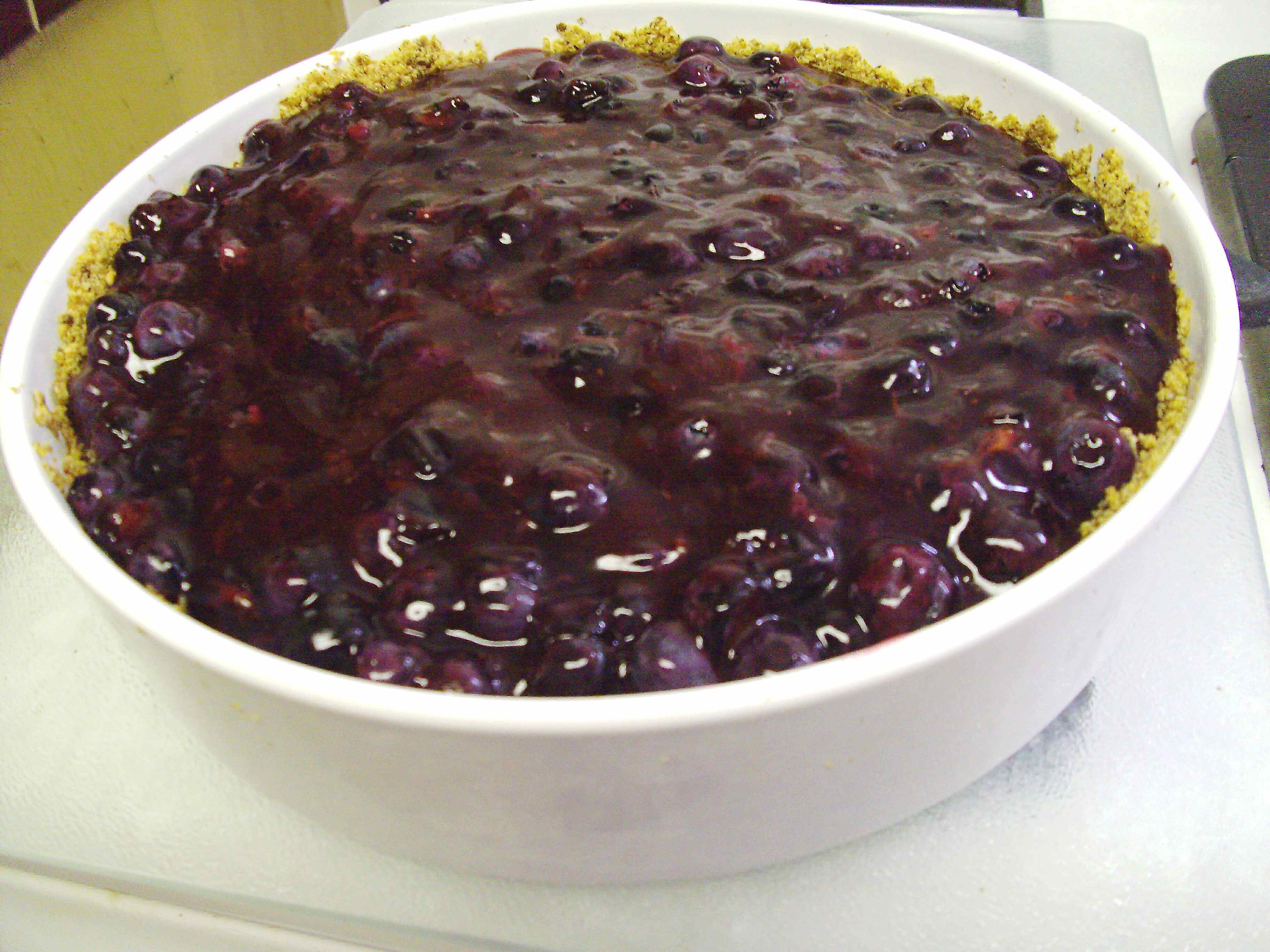
    raw blueberry pie with microwaveable filling and graham cracker crust

    This mostly-raw blueberry pie is a snap to make and very versatile--the filling microwaves in a few minutes, and you don't even have to bake the zippy gingered graham cracker crust--perfect for a hot Fourth of July and all summer long.

  • Recent Posts

  • Contents

  • Archives

  • Now Reading

  • See also my Book Reviews

  • Copyright 2008-2024Slow Food Fast. All writing and images on this blog unless otherwise attributed or set in quotes are the sole property of Slow Food Fast. Please contact DebbieN via the comments form for permissions before reprinting or reproducing any of the material on this blog.

  • ADS AND AFFILIATE LINKS

  • I may post affiliate links to books and movies that I personally review and recommend. Currently I favor Alibris and Vroman's, our terrific and venerable (now past the century mark!) independent bookstore in Pasadena. Or go to your local library--and make sure to support them with actual donations, not just overdue fines (ahem!), because your state probably has cut their budget and hours. Again.

  • In keeping with the disclaimer below, I DO NOT endorse, profit from, or recommend any medications, health treatments, commercial diet plans, supplements or any other such products.

  • DISCLAIMER

  • SlowFoodFast sometimes addresses general public health topics related to nutrition, heart disease, blood pressure, and diabetes. Because this is a blog with a personal point of view, my health and food politics entries often include my opinions on the trends I see, and I try to be as blatant as possible about that. None of these articles should be construed as specific medical advice for an individual case. I do try to keep to findings from well-vetted research sources and large, well-controlled studies, and I try not to sensationalize the science (though if they actually come up with a real cure for Type I diabetes in the next couple of years, I'm gonna be dancing in the streets with a hat that would put Carmen Miranda to shame. Consider yourself warned).

Green Lentil Sausages

A month or so ago I had been intrigued with a recipe on “Is This My Bureka?” (see sidebar for link) for Romanian mititei, a spicy cross between meatballs and sausages, and wondered whether I could make a vegetarian version with green lentils. Not because I can’t eat beef–I can if it’s kosher–but because I generally don’t like handling meat. (I don’t mind fish nearly as much; don’t ask about the logic, it’s just a preference.) All my meat dishes are still in storage, four months after the move. That’s not accidental–I hate switching over the dishes even more than I dislike handling meat.

So in any case, I tried it. Green lentils are on my list of easy-to-microwave, ultracheap nutritious staples. I cooked up about half a pound of dried lentils in water to substitute handily for a pound or pound and a half of ground beef. The mixture I made was heavy on garlic, pepper, and a variety of spices ground in the coffee mill. It was a lot lower on salt than BurekaBoy’s because I tasted it with a couple of pinches of salt–between 1/4 and 1/2 teaspoon–in the mix and that was more than plenty. Scared to think what a teaspoon and a half would have done. Maybe ground beef requires more, or maybe the lentils don’t absorb and hide the salt flavor as much.

The green lentil mixture was delicious even before cooking–with vegetarian sausage, burger or meatloaf recipes, unless you have raw eggs or uncooked flour in your mix, you can taste for seasonings pretty safely. If you do have eggs or raw flours in the mix or are making a sausage recipe with meat, poultry or fish, cook a spoonful first in the microwave and then do the taste test.

Unfortunately, though, the paste didn’t hang together as well as I’d hoped–cooking it didn’t help much. It was still delicious and spicy, but it just crumbled. And although I could live with it, I’ve been thinking about it ever since.

So my recent purchase of a bag of vital wheat gluten and my first foray into the mysterious world of seitan set me off. What if I added a little gluten to the lentil mix instead of the other way around? That way it would stick together and still be mostly lentils. The proteins would be balanced better by combining a pulse (lentils) with a grain (wheat). It would have loads of flavor without needing soy sauce or salty broth. It would be microwave-steamable, and probably fryable or grillable too. And I could still taste it safely before cooking to ensure there was the right amount of excessive garlic present.

And–half a cup of gluten wasn’t quite enough for the three or four cups of cooked lentils I used. Still kind of dry and crumbly when I made a few small patties and cooked it two ways (microwave and frying pan). I added a little more gluten to the rest of the uncooked mixture. Three-quarters of a cup of gluten per 3 or so cups of lentils was better–I could see the threads of gluten forming as I kneaded it together in the bowl.

The patties were still dryish and of course lentil gray-green, though this version hung together better when cooked. It still tasted good, very peppery and garlicky, with a hint of the allspice, fennel, coriander seed and other spices I’d put in. But because of the dryish texture I wasn’t sure I could recommend it fully–it was definitely a case of “Dance 10, Looks 3” at that point.

I cooked up the rest of the mix by microwave steaming, followed by a light pan fry in olive oil, and bagged them into the fridge. The next day, there they were–still a bit soft and crumbly, but hanging together better with a little more chewiness to them. Still not pretty but they tasted good. Waste not, want not, I thought. Pretty is for some other day. Continue reading

Ice cream, enhanced

Sometimes your kid sees a new flavor of Dreyer’s ice cream at the store and decides she has to try it because “It’s Black Raspberry, Mom!” and it’s on sale. But mostly because it’s a trendy light purple (“Orchid or thistle?” I asked, calling on my distant memories of the Binney & Smith guide to the universe.  “Lavender” she retorted. I caved to her superior fashion sense.) It was made with real raspberries–that’s a plus, I suppose. And it came in a “half-the-fat” version, and it was enough on sale that I could get a safety flavor as well.

It’s been over 100 degrees here in Pasadena this week, so ice cream is practically a medical supply.

When we got it home though, it tasted sweet and kind of dull. The fruit flavor was there but not particularly strong, and the overall effect–particularly the smell, for some reason–reminded me suddenly of those horrible “berry-flavored” motion sickness lozenges my mother used to foist on us just before long car trips. Bonamine? I’m still shuddering forty years later.

My daughter, blissfully free of Bonamine-induced associations, still thought it had merit, though, so we kept the lavender-tinted ice cream and I wondered whether anyone else would eat it without having to be threatened. What was wrong with it and could it possibly be fixed?

I’ve been potschkying around with store bought ice cream pretty much ever since I was old enough to buy it for myself–adding extra cocoa powder and some mint or almond extract to chocolate, leftover coffee and cinnamon to vanilla, and on and on. Not many people do this, or do this enough, I’ve discovered. You have to wonder why not, because most non-super premium ice cream in America is a little, or a lot, bland.

In fact, the only flavor I never messed with was Ben & Jerry’s Coffee Heath Bar Crunch, which was perfect and sublime and needed no help ever, other than a spoon. My husband and I were such devotees that when we had a chance to spend a late-summer week in Vermont and New Hampshire one year (way back when, in our 20s), we made sure to stop in at the factory in Stowe for a tour. CHBC was such a supreme flavor that I only gave it up when Ben and Jerry both retired and a new CEO took over. Somehow, the next pint I bought tasted a little off–weak on coffee flavor or something, hmmm…I looked at the ingredients and sure enough, they’d changed the formula and flavorings. It had also been monoglycerided down, even though the fat count was still in the stratosphere. I’m sure my ice cream snobbery saved me from a decade of extra arterial damage, but I’ve been sullen and resentful ever since (or at least that’s the explanation this week).

So anyway–back to the prosaic purple ice cream. It needed something–tartness–to liven it up, and probably would have been better as a frozen yogurt. Come to think of it, would yogurt work? Naah. Messy. Plus refreezing time. Lemon? Maybe, maybe not–it might end up seeming too sweet. Then I found a lime in the fridge–from who knows how many weeks ago; it had already lost its green, but it was still fine inside. Sometimes where lemon’s pure acidity underscores the sweetness and makes it more apparent, lime’s aromatic edge undercuts it and makes the flavor seem fresher. Works for ginger ale, works for blueberry jam…

A squeeze, a stir–from lavender to…raspberry pink (what else?) and I have to say, a BIG improvement in flavor. Much more like actual black raspberry. That’s all it took? Why couldn’t they have done that at the ice cream factory? But they didn’t.

I have another reason for punching up my storebought ice creams, and it’s not just boredom or fidgetiness (though those are obviously tops).

A long-ago-and-far-away gelato-eating expedition in Florence (it didn’t start out that way, but it’s the fulltime occupation in the summer–even more of a medical necessity when you’re wandering outside all day as a tourist) taught me the difference between Italian and American standards for ice creams: Americans expect big portions and don’t really pay attention to the flavor. Bland and sweet is acceptable. Italians are happy enough with small 1/3 cup portions as long as the flavors are wild and adventurous and vivid. If you can taste it well with one of those tiny gelato spoons, a gram at a time, it’ll last you.

Makes you wonder whether the lack of flavor punch in American ice cream (and maybe our other food as well) is the reason we typically eat biggish portions at a sitting, or seek out seconds. If it doesn’t taste like much, you eat it without paying attention, and end up not feeling like you’ve really eaten it. Interesting and vivid flavor seems like a good idea for health and portion control as well as pleasure–if you’re going to have ice cream, after all, you may as well taste it. Otherwise you could just suck on ice cubes.

So–a few suggestions for upping the flavor of store bought ice creams.

Go for plain flavors as your base

Try to find ones that are relatively low in carb and fat for a half-cup serving. Low here means about 15 grams of carb per half-cup, and maybe 2-3 grams of saturated fat.

Not only don’t the dressed-up flavors with loads of mix-ins need (or take well to) further tinkering at home, they’re not always as high in quality. Dreyer’s (Edy’s on the east coast), seems to try to keep the nutrition stats consistent across the line–ice creams with lots of mix-ins and/or caramel-type ribbon swirl are a bit higher in carb, up to maybe 22 grams per serving.

To keep things consistently low, though, the components or the ice cream itself have to compensate–so Reese’s Cup-style peanut butter and chocolate chip swirl has iffy peanut butter and iffier quality chocolate chips (well, so do the real Reese’s ™–don’t know whether authenticity is such a good thing in this case), plus the ice cream’s a bit icy, maybe even a little stale-tasting on occasion. You’d get more intense flavor from vanilla bean ice cream with a few squares of good dark chocolate chopped in and some peanuts or a bit of peanuts-only peanut butter.

Make flavors you can’t buy

Sometimes these are ones you grew up with, like Rum Raisin–I think only Haagen Daz still makes this. People got kind of prissy about feeding ice cream with rum flavoring in it to kids, I guess. Or raisins got too expensive.  So did pistachios, except in super premium ice creams.

No one makes ginger, or lemon-ginger, even though I’m pretty sure those were two of Bon Appétit‘s and Gourmet‘s big summer standbys for at least a decade (and I know because I once bought a decade’s worth of each magazine from my friends-of-the-library auxiliary at about a dime an issue. The seasons change, the same 10 recipes repeat…)

And no one makes Sabra (chocolate orange), or fig, or liquorice, or marzipan, or rose. Or pear. Or chocolate hazelnut with sour cherries.  Or even just plain bittersweet chocolate. There are home recipes for all of Continue reading

Really? No, not really.

Reason for dismay at the top level restaurants:

(LA Times Food Section) “Three top chefs create more healthful versions of favorite dishes”

They cut down a little on the calories–as in, substituted olive oil for butter, or ricotta for mascarpone, or even ground chicken for ground pork. But only one of them cut down significantly on the sodium–and even then it was 1000 mg for the dish, down from about 1400 mg. Give Daniel Mattern credit where it’s due, but it’s still a lot. Josiah Citrin’s dish, which started out about 650 mg, not horrible for restaurant food, actually went up in the modified version.

In Susan Feniger’s case (and she was far from succeeding or even trying hard on the sodium reduction), the sodium count was more than a day’s worth in one dish–from 2100 mg or more to 1800-plus. Choke. She did skip marinating the ground chicken, but the “mabo” sauce, which she didn’t change at all, contains three different kinds of soy sauce AND fermented black beans. Because you really need a sauce that salty in fine food?

Couldn’t she have done a different sauce, more savory or spicy but less salted? That’s the first thing I would have targeted. I probably would have used my low-sodium prune-based Asian barbecue sauce instead of the black bean sauce–it’s different, but good, and it’s similar enough in texture and flavor density to substitute well.

In fact, none of the chefs tried to go radically different–they were all too fixated on whether diners could tell the difference between the originals and the modified dishes. Well, if they’d changed anything worth changing, I’m sure the diners would have been able to taste the difference. The real question is, would it have been a good dish and would they have liked it? I think the chefs could certainly have gone after bigger, more ambitious changes and made the dishes satisfying–perhaps even better–without choking the diners on salt.

The bad part of the article came at the end. All three chefs just gave an arrogant little shrug when the results were revealed at the end of the test (showing that they hadn’t done all that well). They all said grandly that it doesn’t really matter, because as Josiah Citrin put it, their customers come “to be blown away” by the food.

And so, just like the fast food kings, they put the blame on the diners for not demanding better, saner nutritional standards. Beats workin’.

Microwave tricks: Seitan without Simmering

My sisters-in-law from Oakland were planning a visit to us this summer now that we actually have a house and can host them. It fell through, but the prospect got me thinking about vegan food and what we might serve them. They’re both good cooks, but they eat a lot of commercially-prepared vegan meat substitutes along with their own fresh vegetables and grains and baked goods.

I’m not great on packaged foods in general, and unfortunately, vegan proteins other than plain fresh tofu and dried beans look an awful lot like vegetarian versions of Oscar Meyer sliced bologna and turkey loaf to me. Not just the appearance, but the cost per serving (really high–something like 4-6 bucks for a chic little package that serves two, ostensibly) and the salt (also really high–600 mg and up per serving). And the ingredients lists are always long and kind of mysterious-sounding, either in a surprisingly chemical way or in a Japanese-ingredient-names-as-authenticity way. Not that I’m not working to figure out exactly what kombu and dulse and Job’s tears are. Two seaweeds and a resin? I think, anyway.

There’s also a lot of yeast extract in some of these processed vegan proteins–sounds like between that and the salt, what they really did was dump in Vegemite or Marmite. Bleagh (my husband’s sister is kind of an Anglophile, but that doesn’t excuse either version to me).

On the other hand, some of the vegan cookbooks out now have do-it-yourself recipes for seitan, and so do Ellen’s Kitchen and FatFree Vegan Kitchen.

Seitan is basically wheat gluten dough cooked in stock. If you do it yourself at home, it may take an hour to simmer but really isn’t very expensive compared with the commercially prepared versions. A 5-lb bag of flour at about $2-3 or a few ounces out of a 22-oz bag of vital wheat gluten (about $6-8, depending where you buy it, and worth it for getting 100% gluten out of the bag and not having to wash the starches out of the dough since it’s already done for you) produces something like a pound or two of seitan at a go. That’s enough for a larger meal, maybe even for that elusive home-made vegetarian centerpiece dish

Why is this worth doing if you don’t eat vegan and aren’t actually having vegan guests in the house after all? (and now that I’ve schlepped the last of the moving boxes out of the living room, I’m really wondering).

I think back to my favorite Chinese restaurant back east, the Hunan Manor in Columbia, MD. Every time we fly back east we try to make a stop there.

One of the things that makes the Hunan Manor great is their willingness to experiment and invent. They serve a wide variety of vegetarian versions of standard banquet dishes using “vegetarian chicken”–basically seitan cut and fried as for meat. These dishes complement their masterful use of tofu with textures from nearly silken to deep-fried to pressed and diced for the vegetarian jao tse, which I’ve always thought looked better and probably tasted better than the pork-based meatball filling our nonkosher friends would get (though they raved about them, and I’ll take their word for it).

The last time we came east, the restaurant had added several new dishes using a different form of seitan with very finely layered rolls that were cut in bite sized pieces, coated and fried–a pretty close simulation for the layered flesh of chicken. It was really delicious in their orange “chicken” with perfectly cooked bright green broccoli. It was unexpectedly unsalty as well, so I don’t know whether they made it in-house or had bought the prepared seitan in an unflavored form.

Either way, the dish was a great argument for using seitan creatively, and I don’t think my sisters-in-law, competent cooks though they are, have eaten any seitan dishes that good using anything from a little Gardein package.

So I decided I’d like to try my hand at seitan at home and see if I can’t come up with something flavorful, chewy, satisfying and nutritious, without having it scream salt. After all, once you’ve got the finished loaf or pieces, you’re Continue reading

Pyrex and Anchor Hocking now both unsafe for cooking

I’m not sure how I happened upon Consumer Reports’ disturbing feature from January on exploding glassware cooking accidents in both Pyrex and Anchor Hocking tempered glassware. Since a lot of my microwave directions call for Pyrex bowls, I thought I’d better post about it asap.

Here’s the link explicitly:

http://www.consumerreports.org/cro/magazine-archive/2011/january/home-garden/glass-cookware/glass-cookware/index.htm

Because I’ve used my current Pyrex bowls and bakeware for more than 10 years, I’ve been looking recently to replace and/or add to my collection. But every time I’ve looked for it in the past year or so, I’ve hesitated–the stuff on sale is a blueish color. Or it’s a little thinner than I remember. Or it doesn’t feel or even sound right when I pick it up. And the cardboard overwrap has a lot of new warnings about when and how you can or can’t use it that are different than the old classic Pyrex. It’s confusing–can I use it the way I’m used to or not?

So even though the casseroles and pie plates are bright and shiny and new and usually on sale at my local supermarket and the Target, I’ve passed them up, thinking, “I’ll do it next time.”

According to the Consumer Reports piece, it’s a damn good thing I did. Read the article. Now. Please. Before you put any of this generation of Pyrex in an oven or microwave. Before you give a set to some newlywed as a kitchen gift.

And don’t buy this stuff. If you did, don’t use it for any kind of heating up, conventional oven or microwave (I know, so what good is it if you can’t heat stuff up in it? Wasn’t that the whole point?)

Apparently both companies are claiming that the explosions–which have caused burns and lacerations when the victims took a hot casserole out of the oven or microwave and set it down–are the result of misuse, or perhaps the glassware had gotten dinged or scratched and therefore the flaws had weakened it, and that it was a rare phenomenon. The article authors estimated a fairly high number of incidents in the past few years based on hospitalization records and other outside evidence.

Consumer Reports debunked the companies’ blame-the-victims ploy by testing both brands of glass cookware at various temperatures and setting the pans down on a variety of typical kitchen surfaces.

The results were not pretty–Pyrex had a slight temperature range advantage over Anchor Hocking, but a fairly high percentage of both broke or exploded if they weren’t used exactly within the laundry list of restrictions on the cardboard overwrap that came with the new bakeware.

Altogether, conducting the tests and videorecording them took more guts than I would have without lexan armor and a full face shield.

But, as I’ve said, I’ve been using my mixing bowls and pie plates for years without problems. What’s going on?

The article authors did track down a probable explanation for all this breakage in what’s supposed to be very durable glassware. Both brands have recently switched to a cheaper formulation for their glass. Pyrex–note, no longer made by Corning–at least used to be borosilicate glass but now uses soda lime glass, as does Anchor Hocking’s tempered glass. Borosilicate is the standard for laboratory grade glassware; it’s stronger and somewhat more expensive to produce–probably the mineral shortages of the past few years have made it more so.

Technically, you can temper soda lime glass, but even when tempered it’s not as strong as the old classic tempered borosilicate. It also seems to be less uniform–and the little unevennesses in the material create local instabilities that can cause cracks and even explosions when subjected to rapid or uneven heating and cooling. It only takes a split second in some cases.

Borosilicate is almost certainly what my old Pyrex standbys are made of, and I’m standing by them. I just wish I could have bought more at the time, or that someone else made them now. I wish Pyrex’s current manufacturers in particular had not ruined their product by changing glass to reduce costs, and that their managers weren’t scrambling to deny it.

For now, I’d say please DON’T use the newer Pyrex or tempered glass bakeware items for microwaving. They’re just not the same anymore. Use microwave-safe ceramic instead.

Microwave Tricks: Stripped-Down Chiles Rellenos

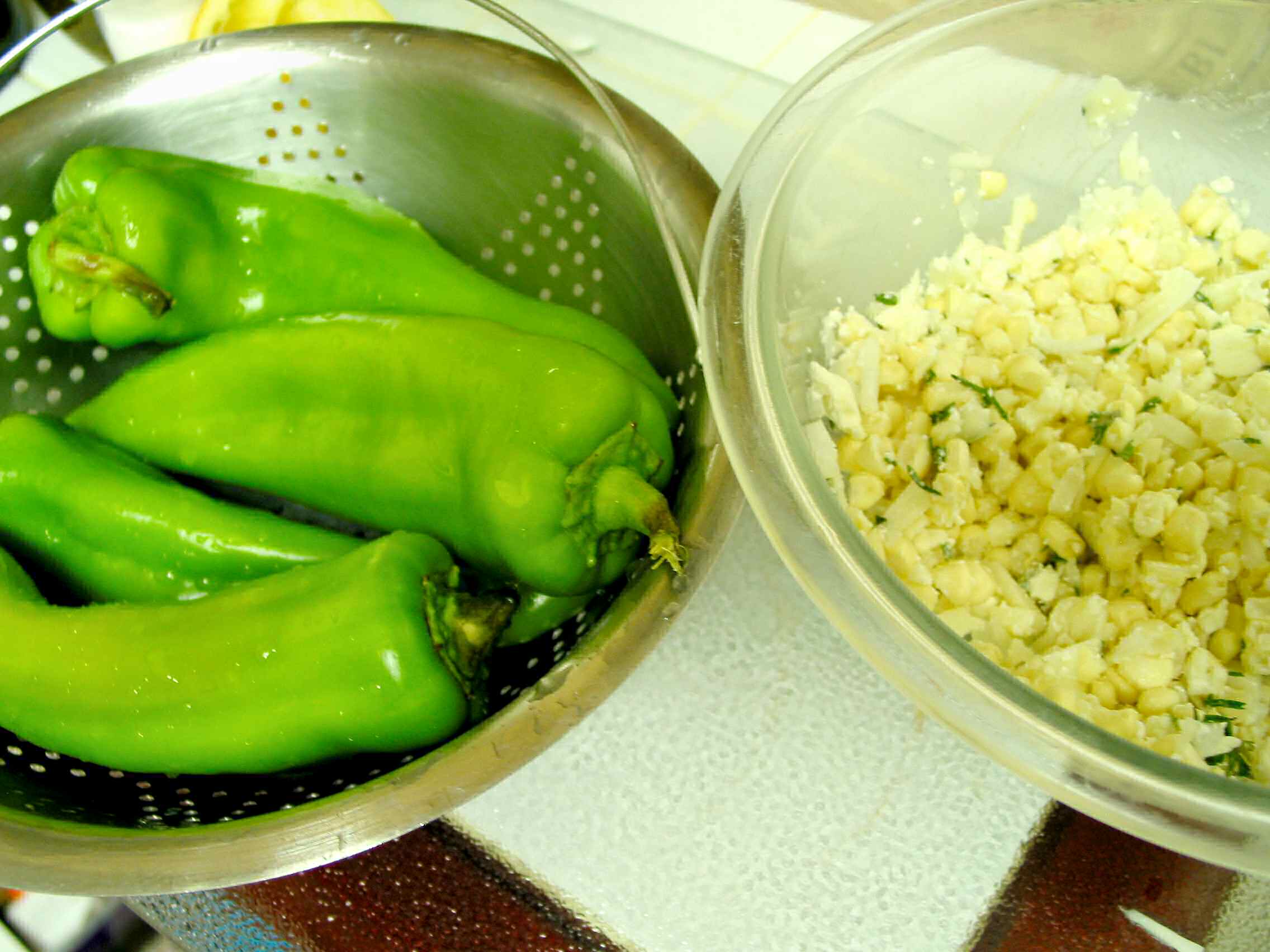
Anaheim chiles with corn and feta for stuffingI know, Diana Kennedy (The Cuisines of Mexico, 1971, and onward) probably wouldn’t do it this way–or maybe she would, at home, for herself? Naaah. She’s still pretty particular. Eighty-seven years old, and doesn’t seem to have slowed down noticeably in her quest to rescue the disappearing dishes of Mexico. Her latest, Oaxaca al Gusto (2010)  is a huge coffee table cookbook, beautiful and unfortunately for me, so full of rare Mexico-only ingredients, not to mention pork and lard, that I don’t know if there’s much I can really cook from it. I’m scouring it now for possibilities, but in the meantime…

Friday afternoon was vegetable-shopping day again, because we go through good tomatoes like a pack of sharks after a swimmer’s leg, and unfortunately our own backyard gardening adventure is turning out to be more like the $50 tomato kind of thing. To make up for packing our daughter out with my husband on his errands all afternoon instead of on mine (because I desperately needed some time off for bad behavior), I decided to do a little better than the usual dinner. Of course, they had a decent time, and so did I. Gotta do that more often.

So while they were gone I stopped at my greengrocer and bought a ton of ripe tomatoes that actually have flavor at 99 cents a pound (we have one left), a couple of eggplants for 65 cents apiece, some tart green plums, and these Anaheim chiles, which were beautiful and at $1.19 a pound, cheaper than the bell peppers this time. If you’re not completely clued into eating with the seasons, sometimes the pricetag gives a gentle hint of how the growers are thinking about any given vegetable that week.

Normally I wouldn’t buy Anaheim chiles–they’re pretty mild, but still hotter than bell peppers, which we usually eat raw, and the chiles are really better cooked. But when I saw them, all I could think about was stuffing them with feta for a quick pick-me-up side dish to go with mahi mahi and rice.

Some stuffed chiles are authentically made with Anaheims, I was encouraged to find (thumbing through one of my two, count ’em, two copies of Kennedy’s first book). But the ones that make good-looking cookbook photos are made with pasilla or poblano chiles–darker green, plumper to hold more stuffing, and with thinner walls. Also a little hotter, and often soaked up from their dried form. Baked in tomato broth or else stuffed with meat picadillo, coated in egg, baked, and dressed with a walnut/sour cream sauce (chiles en nogado) with pomegranate seeds sprinkled on top–a Moroccan-origin dish, maybe, with that egg cloak and the pomegranate seeds?

The other thing Kennedy specifies is to char, bag-steam and peel the peppers before using them, which makes the egg cling a lot better and probably makes them a bit more digestible. Very classic, but let’s face it, with all this stuff, including the sauces: I’m not that good, and I’m kind of impatient. What I really wanted for supper was quick stuffed peppers, gooey on the inside but not so messy outside– so as to avoid wearing it. (A girl’s gotta know her limitations. Maybe next time, if I can find an oilcloth bib my size?)

I’m not so interested in long baking in tomato broth or soaking fresh walnuts in milk for the moment–maybe sometime when I want to get the whole dish together, because I’m sure it’s delicious, especially if someone else is making it and heating up their own kitchen in July. But right now, time is ticking, it’s nearly supper, and Beauty and the Beast are about to show up in the driveway (my husband is beautiful for taking on the Beast, even if he grumbles while doing it.)

So I’m definitely not about to char and peel the peppers–what a pain, plus to me it makes them kind of slimy and slithery and not what I want to eat. Unlike Tom Colicchio, who consistently makes a fuss about it on Top Chef, I don’t mind the fact that pepper skins have a little bitter alkaloid edge to them. It’s part of what makes them peppers, and it helps them keep their crunch.

And, of course, I’ve had the experience of walking into someone’s house when they’d just been charring peppers on the gas burner, and it smelled an awful lot like dope. Not lovely, and not at all like them.

So anyway, these are not proper chiles rellenos by any normal standard. They just taste good, they’re not slimy, and they don’t take more than 15 minutes tops. My kind of dish.

In addition to the usual feta and mozzarella, I still had a few half ears of leftover corn on the cob from my daughter’s birthday party last weekend. They were still good, but there weren’t enough to share out for supper, unless–well, corn and peppers also go together (usually as a soup, but why not here too?)

Aside: That was surprisingly one of the easiest celebration dinners I have ever put together in my life — pan-grilled salmon fillets, tomato/basil salad, raw vegetables with bleu cheese dip, and microwaved corn on the cob. I was going to make a cheesecake but decided at the last to buy a Trader Joe’s frozen one for expedience and served it with strawberries and blueberries. It was surprisingly good, inexpensive, and quite moderate on carbs and calories for commercial cheesecake. Of course, because my daughter’s friends are all about 11-13 years old, at least one couldn’t eat the corn due to braces but didn’t know how to shuck the kernels off with a knife, one immediately declared she wasn’t into vegetables (I was mellow enough to shrug and say it was fine), and one couldn’t hack cheesecake so I scrounged her up an impromptu dessert of chocolate bar and cinnamon grahams because we had literally nothing else in the house dessertwise. Oy. And they all stayed up till 4 am, but at least they were quiet and sneaky about it. My goals for a good sleepover.

So anyway, I had made 6 or 7 ears of corn, broken in halves, and steamed them in the microwave in a big pyrex bowl for about 8 minutes. The leftovers were fine reheated during the week with a drizzle of water on a plate in the microwave for 30 seconds or so. But I still had a couple and decided to use the kernels for the chile stuffing, and they were delicious.

Stuffed Anaheim Chiles with Cheese (specific amounts given for 3 chiles, because that’s what I made for us Friday and again on Sunday with new corn, so this actually works out, but you can and should scale up, obviously, and I wish I had made enough to serve them a second time without starting all over.)

  • Anaheim chiles, 1 or 2 per person
  • corn kernels (1 ear or about 1 c. kernels made enough for 3 chiles, generously stuffed)
  • feta cheese, crumbled (1-2 oz)
  • low-fat mozzarella, chopped fine (1 oz/stick)
  • finely chopped onion (1/4 med yellow onion)
  • garlic clove(s), grated/minced/mashed (1 med clove)
  • za’atar (wild thyme), thyme, oregano or sage, chopped or crumbled in if dry (to taste; I used 1 t. or so chopped fresh za’atar–do what looks and tastes right for your quantities)

Wash the chiles, cut off the cap and remove the seed core as best possible without splitting the flesh (rinse with water to get out the seeds way down inside). It’s not really a disaster if the pepper splits–just wrap it around the stuffing and press it together, more or less, but it looks prettier and handles better if you keep the pepper whole.

Microwave the peppers on an open plate 3-4 minutes to start them cooking. Mix all the other ingredients together well with your hands–it’ll be pretty moist and crumbly, but you want the garlic and onion well distributed. Cool the chiles just enough to handle. Stuff the chiles with the mixture by hand, pressing it in with your thumbs as you go to make sure  some filling reaches the tip end. Microwave again on HIGH on an open plate 3-4 minutes for 3 chiles, arranged with the tips  toward the middle of the plate and the wide stem end toward the outside, or maybe 5-6 minutes for 6, or until the peppers are getting tender and the cheese has melted.

Don’t forget to wash your hands well with soap after handling the chiles–I find that even though the Anaheims are mild-tasting, my fingers still get a little of the classic burning sensation as an aftereffect when I handle them.

Stolen!

Toucan-beaked finjanim (coffee pots) from the Ethnographic and Folklore Museum in Akko, Israel

Brass finjanim (coffee pots) and tin plates from the pioneer days in Israel. Exhibition at the Ethnographic and Folklore Museum, Akko, Israel

Can’t decide whether I’m more heartbroken or flattered–maybe just surprised?

The Wall Street Journal 

a) has a food section (who knew?)

b) which is currently featuring a 4-part series of recipes by Yotam Ottolenghi.  (I’m actually in favor, and hoping for his book Plenty for my birthday–my husband  floated the suggestion a few weeks ago and I was really flabbergasted that he’d even heard of Ottolenghi. Must have been listening to  something on NPR.) Why is Ottolenghi favoring the WSJ, though, of all food column venues?

c) Said series is calling itself “Slow Food Fast” — the goniffs; can I charge them for it? wouldn’t you? — but it probably shouldn’t.

I’m not just saying that for my own sake (though that’s a big part of it, don’t get me wrong. I’m–the heck with neutrality–too annoyed to be giving a link to this).

Ottolenghi’s recipes aren’t really either slow-slow (stews, beans from scratch, etc.) or incredibly fast (microwave)–a lot are lightly fried or grilled, with a sharp mix of flavors, a lot of herbs, middle Eastern sauces and a tossed salad of some kind on the side. Soft-boiled eggs in a salad, corn latkes with a salad, pan-grilled mackerel on a pita with pistachio pesto and Greek yogurt (bet he’d rather have labaneh but can’t find it in New York or London)–etc.

Which makes them good eating, Israeli and Arab style. But not really slow food done fast.

Most Israeli cooking that’s still Israeli (and not nouveau-Italian, complete with oversized bowls of pasta and seven different cappuccino/macchiato/etc. kinds of coffee drinks) falls into three categories.

The old-fashioned stuff is long-cooked roasts or stews for meats and poultry, maybe stuffed vegetables or an eggplant or spinach casserole or couscous or pilaf. Traditional Romanian, Hungarian, and Moroccan restaurants and some home chefs (usually older women) serve these sorts of long-cooked dishes, but there’s no real shortcut for them.

Israeli street food (not western, engineered “fast food” like McD’s) mostly appears at lunch counters and road stops that specialize, but again the ingredients are real. Felafel, shawarma (even though they’re mostly using a mixture of turkey and beef instead of lamb these days), lahmajoun (ground-meat pizzas). Or else burekas, trays and trays of puff-like flake pastry layered with cheese or eggplant or potato or mushroom filling, and you stop in for lunch and have a huge slab of one with maybe a bit of salad on the side and some tea. All of these take some preparation–the fast part is you walking up to the counter and getting takeout.

In between these extremes are cafés that serve individually-cooked dishes–more informal than casseroles and stews, less casual and more varied than street food. Grilled or fried vegetables (peppers, onions, eggplants, tomatoes, zucchini, pumpkin? potatoes?–more eggplant) and beans, grilled fish or chicken, hummus and baba ghanouj, assortments of cooked salads,with a fresh salad and dishes of olives, turnip and eggplant pickles. A lot of olive oil and garlic and lemon and cumin, yogurt, vegetables, and water-flour-yeast-salt kinds of flatbreads. Street food stand sauces like tehina, salat turqui, harissa, and hilbe (sour yellow fenugreek sauce, kind of mustardy) are still part of it, but so are vinaigrettes and more complex flavorings, and a lot of fresh herbs make an appearance.

This is Ottolenghi’s kind of cooking, and I love it, but it’s neither slow food nor slow food done faster. It’s rustic, village-style food, even though he’s dressed up his version for London diners. At its best you feel like you could walk into the restaurant and fit in fine whether dressed for a theater evening or still dusty from hiking with a water bottle still hanging off your backpack. As though if you walked to the back you wouldn’t be that surprised to see the chefs squatting down over a little pine fire in the courtyard, grilling the food Bedouin-style,  on the back of a broad, battered skillet or skewered on a long thin stick.

They’re not really doing that in Tel Aviv or Haifa, of course, but desert camp cooking is still a key part of the local food lore. People still grill things like chicken hearts and livers outside on little pine fires in their courtyards at home with great pride. Or char eggplants and peppers directly on the gas stove–sort of smelly but undeniably authentic. They point out  za’atar, hyssop and other forageable herbs on wilderness hikes; they know how to make a quick camper’s flatbread of flour and water and a few sprigs of foraged maluakh (a salty plant found in the Negev) over the back of a frying pan. And they know how to brew botz — Turkish coffee–with a flourish.

It’s a part of Israeli life I fervently hope won’t disappear with all the new software companies and car dealerships and cappuccino joints that have popped up over the last couple of decades.

As for the use of my blog’s name, I’m thinking I should take the attitude Monty Python did one time when Margaret Thatcher made free with their Dead Parrot Sketch in a political speech for the Eastbourne by-elections: they announced that given the results of the elections, they thought it not only served her right, but that she had suffered adequately and publicly from her folly that they could save themselves the barristers’ fees for a lawsuit.

Me? I’m waiting til Tuesday. Somewhere else in the WSJ online was an editorial actually praising John Boehner’s plan for the debt ceiling. Feh.

Cannoli that won’t bust the carb count

Cannoli paste my way

This is a story about frugality–of the serendipitous sort.

The other week my daughter was with me at the supermarket (sometimes a mistake, sometimes an inspiration), and asked if we could get a packet of sugar cones to go with a drum of Dreyer’s ice cream. This was a trade-off for forfeiting Baskin-Robbins, whose ice cream is consistently higher in fat and carb than Dreyer’s or Breyer’s.

(Shakespearean aside #1) The B-R nutrition brochure is worth a pretty serious look for calories, fat, carbs, the total picture. You can definitely eat a days’ worth of calories–upward of 1500–in a single sitting if you order one of the fancier items. Skip the soft serve and stick to the single cone, for sure.

Not that we never stop in for a cone, but we never knew what the sugar cones were worth carbwise so Abby was limited to a paper cup or a cake cone. And of course for the price of two modest single cones at B-R, you could buy a 1.5 qt. carton at the store and scoop about 10 servings out of it yourself.

In the supermarket, the box with the sugar cones says 10 grams for Keebler and 11 grams for the Ralph’s (Kroger-affiliated) store brand, which is on sale, and about 50 calories per cone. The sugar cones have surprisingly simple ingredient lists for a processed food–wheat, brown sugar, vegetable oil, oat fiber (Ralph’s version) and a bit of salt (though not much–20 mg/cone) and maybe a little caramel coloring and malt flavoring.

But of course the ice cream tends to run out a bit sooner than the cones. And then what? Here’s where the “frugality” comes into it again (okay, I’m sort of rolling my eyes too, but still.)

I had about half a quart of ricotta left over from manicotti (same idea as for the microwaved stuffed shells, only using a plastic baggie with a corner torn out to pipe the spinach and cheese filling into both sides of the parcooked pasta tubes–worked pretty well actually). And ricotta, even on sale, is kind of expensive if you just let half of it sit in the fridge until it goes bad because there isn’t quite enough for another batch of pasta and you don’t know what else to do with it.

So anyway, the availability of leftover ricotta (I’m too cheap to do it with a brand new carton) plus the leftover cones added up in my head the other night to “Hey! Impromptu cannoli! Right now! And I don’t even have to go back to the store!”

I should probably explain.

The first cannoli I ever had were also the best. The parents of one of my sister’s high school friends ran a tiny Italian deli and specialty shop way out near the airport of our town, and what can I say–it was worth the schlep. In addition to imported pastas and olives and pickled peppers and salami and so on, you could buy a tub of their own fresh cannoli paste and a box of carefully packed pastry tubes so you could assemble the cannoli yourself at home and not risk sogginess or breakage on the way.

The D’Elicios’ cannoli paste contained ricotta, of course, sugar, and something else that I finally pinned down as lemon (and possibly orange) rind. And it was heaven on a spoon. So good I asked my mom to bring a box of their cannoli instead of a birthday cake to my college dorm  for my 18th birthday.

How was I to know that would be the last of the really great cannoli for decades? Continue reading

Microwave Tricks: Roast Eggplant Salad

Roast Eggplant, Onion and Pepper Salad

Ready for the microwave


This is what I made this afternoon for a potluck (before I realized the hostess meant for us to bring our own suppers to her pool party). Yes it’s easy–barring the onion crying session…I’ve included the recipe way back about 2 years ago in the first eggplant post I ever did, but it’s worth a recap:

Microwaved Roast Eggplant Salad

Slice one or two large firm eggplants into rounds, sit them in a pyrex dish, stuff slivers of bell pepper and onion between them, pour a little olive oil over the whole thing, and nuke 10-12 minutes on high. Then if that doesn’t look roasted (it won’t, but sometimes I just transfer everything to a plastic bag once it’s cool, mash a clove of garlic and toss it in, and stick it in the fridge overnight to marinate), preheat the oven to 350 F. Chop a fat clove or two of garlic and mix with another few tablespoons of oil, rub the mixture onto the eggplant, and put the pan in the hot oven for half an hour. Let it cool and serve it on sandwiches, with hummus or cheese, as an antipasto, etc.

Big Food mobilizes against child marketing guidelines

This Washington Post article isn’t the absolute clearest–looks like it was written as a last-minute rush piece, actually, but it’s worth getting to the end.

The basic idea is that in 2009 Congress demanded the CDC, FDA, USDA and FTC come up with a coherent set of voluntary nutrition guidelines for what the food industry can market directly to kids.

I’m not a big fan of voluntary nutrition or safety compliance guidelines for the food industry–mostly because industry players generally feel free to ignore or toy with them and then claim some kind of advertising advantage they haven’t earned. Voluntary guidelines also come with all kinds of soft landings and easy outs, and the proposed guidelines here are no great exception.

But in any case, now the four agencies have done it, and the food and restaurant industry is doing the predictable–throwing big lobbying bucks into a disinformation campaign-slash-tantrum.

How big? The campaign manager won’t say, but the preliminary guidelines report that US food industry marketing to kids 2-17 years old is currently something over $1 billion in three key categories (breakfast foods, restaurant chain food, and snacks).

So it probably won’t surprise you that companies like General Mills, Kellogg, and Pepsico have teamed up with ad-carrying media partners like Viacom (read: Nickelodeon) and Time Warner to try and quash the voluntary industry guidelines. Figure on the campaign to be spending in the mid-millions or more. They’d rather “salt and burn” instead of “cut the salt and learn.” And what a waste.

What will probably surprise you is just who this coalition–calling itself the “Sensible Food Policy Coalition”–?!!–hired to handle the campaign: Anita Dunn, a former Obama communications director whose husband, Robert Bauer, is  still White House counsel. Not a really lovely mashup, there.

Why she’s taking on the food industry campaign so they can keep protecting their ability to market garbage to the young and vulnerable is one question. Why the FDA and FTC, which have the power to decide what nutritional and medical claims, among other criteria, are valid and can be used in advertisements to adults, let alone kids and teens, are bothering with a voluntary measure instead of doing a proposed regulation to limit such marketing to youth is another.

In both cases, the answer is almost certainly money. The food and media industries have it, the federal agencies don’t.

[As it turns out, the FDA and FTC don’t have power to restrict Big Fo0d’s marketing to the under-17 crowd after all. They lost that specific ability in 1981–start of the Reagan administration… Reagan’s “ketchup is a vegetable” declaration was the beginning for drastically lowered nutritional standards and branded fast food concession contracts for public school lunches.]

So the right question under these circumstances is, where do you want to put YOUR money? How about this, if the federal agencies can’t get a decent result and the lobbies are buying off everyone else:

Boycott the Boxes. Hit ’em where it hurts.

Box 1–TV: If you have kids, limit their access to TV, and teach them to turn off the sound during the ads. Do it yourself. Treat the ads like the silly nuisance they are from the minute your kids are old enough to watch. Tell your kids the truth: most of the products advertised on kids’ shows are too shoddy–and overpriced–to market to grownups. The companies make them bright and loud and cheesy because they think kids can be fooled easier (your kids should be beautifully insulted at that if they’re about six or seven years old).  Go with PBS and videos you approve rather than commercial TV as much as you can.

Box 2–Packaged stuff parading as food: Skip almost everything that comes in a cardboard box or a plastic overwrap, or in a can. You can do this. You’ll save an awful lot of money by buying store brands only and cutting out the most pernicious items–sugared and high-salt packaged breakfast cereals, bags of starchy snack extras, and sodas, at least on an everyday basis. Save sodas and chips for parties, not for school lunch or part of dinner.

You’d do even better to go with fresh vegetables and whole fruits for most snacks and make a good habit for relatively cheap. They taste pretty good, don’t take long to fix, last at least a week in the fridge, and your kids won’t get sick overeating them.

There’s a reason the Pringle’s slogan is the very smug  “Betcha can’t eat just one.” No one says that about carrots or broccoli, or even about apples. Ever eaten too many of those in one sitting? Didn’t think so. Vegetables and whole fruits keep you satisfied longer, don’t hyperstimulate your appetite for snacks, and they don’t put on pounds that take a long time to work back off. They don’t promote cavities, either. Even nonsweet junk foods do–all that processed starchy stuff sticks to your molars like glue.