
• Enter your email address to subscribe to this blog and receive notifications of new posts by email.

    Join 241 other subscribers
  • Noshing on

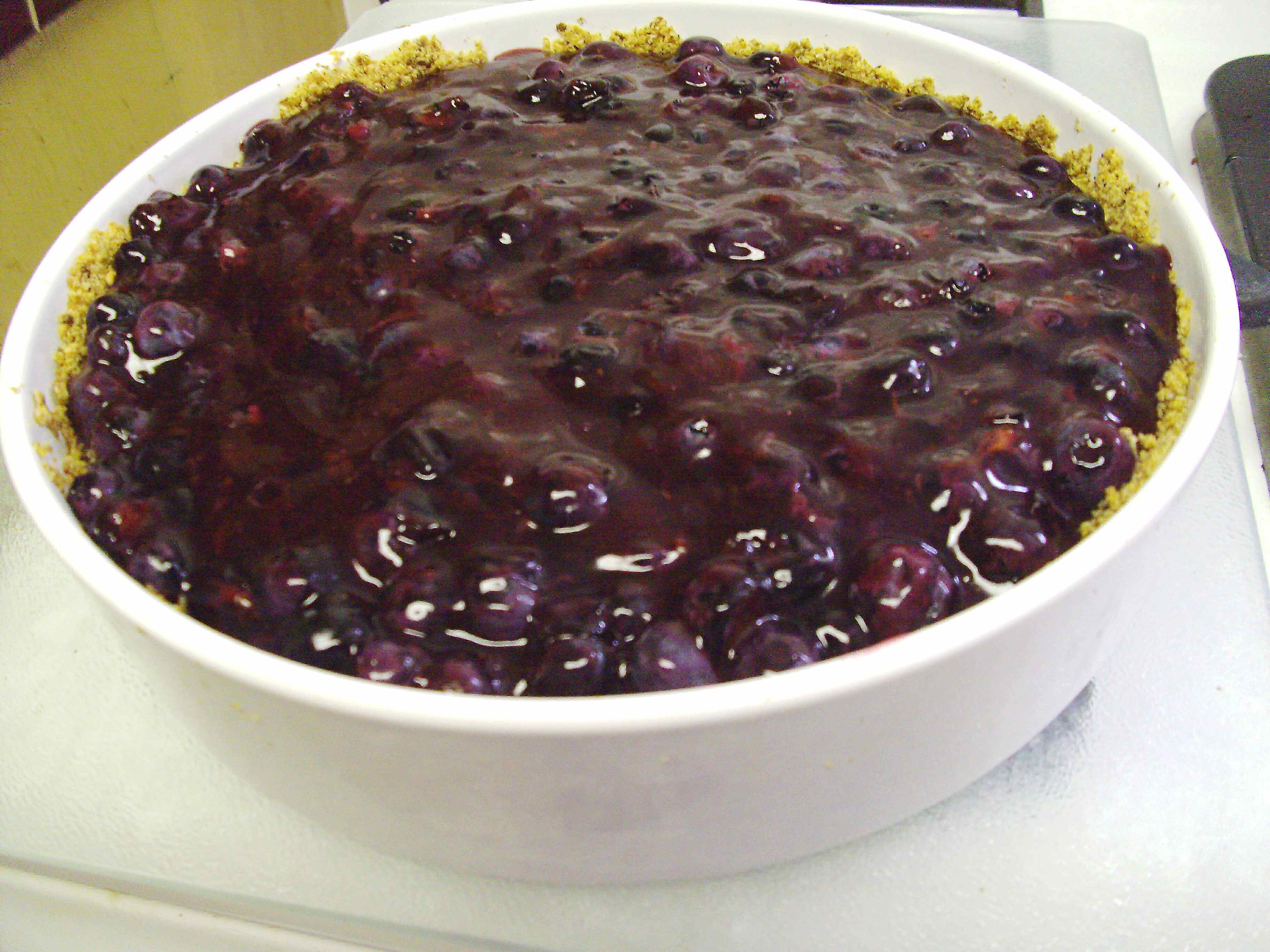
    raw blueberry pie with microwaveable filling and graham cracker crust

    This mostly-raw blueberry pie is a snap to make and very versatile--the filling microwaves in a few minutes, and you don't even have to bake the zippy gingered graham cracker crust--perfect for a hot Fourth of July and all summer long.

  • Recent Posts

  • Contents

  • Archives

  • Now Reading

  • See also my Book Reviews

  • Copyright 2008-2024Slow Food Fast. All writing and images on this blog unless otherwise attributed or set in quotes are the sole property of Slow Food Fast. Please contact DebbieN via the comments form for permissions before reprinting or reproducing any of the material on this blog.

  • ADS AND AFFILIATE LINKS

  • I may post affiliate links to books and movies that I personally review and recommend. Currently I favor Alibris and Vroman's, our terrific and venerable (now past the century mark!) independent bookstore in Pasadena. Or go to your local library--and make sure to support them with actual donations, not just overdue fines (ahem!), because your state probably has cut their budget and hours. Again.

  • In keeping with the disclaimer below, I DO NOT endorse, profit from, or recommend any medications, health treatments, commercial diet plans, supplements or any other such products.

  • DISCLAIMER

  • SlowFoodFast sometimes addresses general public health topics related to nutrition, heart disease, blood pressure, and diabetes. Because this is a blog with a personal point of view, my health and food politics entries often include my opinions on the trends I see, and I try to be as blatant as possible about that. None of these articles should be construed as specific medical advice for an individual case. I do try to keep to findings from well-vetted research sources and large, well-controlled studies, and I try not to sensationalize the science (though if they actually come up with a real cure for Type I diabetes in the next couple of years, I'm gonna be dancing in the streets with a hat that would put Carmen Miranda to shame. Consider yourself warned).

A Slow Food Fast Thanksgiving

Pumpkin pie in the microwave

I’m not sure how to take all the following good news–it’s been such a strained year that the sudden release of pressure is going to make me zip around the room, once the coffee kicks in.

1. My mother-in-law has threatened to favor the brand-new kosher butcher in her town this holiday season so that we can eat the turkey too this year (and maybe not fight about it). She promised not to smear said turkey with butter. We’ll cross our fingers. But at least we won’t have to cook. I’m keeping that firmly in mind.

2. As of this week, my daughter’s finally on an insulin pump and fairly thrilled about it, so she can navigate dinner AND dessert at my in-laws’ without breaking down and crying that she only gets two tablespoons of pie for a reasonable serving. We are still encouraging her to count carbs and not go hog-wild or she’ll be zipping around the room until midnight.

3. The school concert’s in less than two hours. Is that really enough time to do everything, or at least something? Naaaah. Well, maybe coffee and something other than the news.

4. We still have to schlep up Interstate 5 for about 6 hours tomorrow, starting “early” (i.e., an hour and a half after the time my husband announces this evening as the absolute latest), passing the Harris Ranch and its attendant aromas, which can be more than slightly offputting if you’re not an avid horticulturist. But at least when we get to my in-laws’ we don’t have to cook. As I said, I’m keeping that firmly in mind. I know I already said it, but it’s so important I figured it was worth saying twice.

Despite my firm resolve after last week’s marathon kiddush that I will strive Not To Cook (could I possibly be Peg Bracken’s unacknowledged lovechild? Unfortunately, no. However, my mother was a devotee of the Don’t Cook Too Much school of thought, and I’m starting to appreciate that. Really I am.)…where was I? Oh yeah…I will probably bring at least two lemons, some thyme and rosemary, a head of garlic and a couple of bags of fresh cranberries with us on the road. Call it flavor insurance. For whatever reason, my in-laws, who have developed what can only be called fanatical devotion to Italian food of every possible kind (having both grown up in white bread country), always run out of these basic essentials about halfway through, and my mother-in-law tends to tell my father-in-law to go back out and pick up extras just as the stores are closing…

The cranberries, I’m well aware, aren’t Italian. They’re for making 5-minute microwave cranberry sauce with about half the sugar of regular. My mother-in-law tends to try out her fancier cranberry chutneys and relishes every year, and every year they contain things like chardonnay–which is fine for the grownups but I’m no grownup. Her chutneys have more than 10 ingredients and sit stirring on the stovetop for at least 45 minutes. I don’t know how she does it–I’d go stir-crazy. I’m just not that good.

So anyway–I wish you all a great Thanksgiving at somebody else’s house, so you don’t have to cook or do the dishes. My idea of heaven.

But if you absolutely have to cook, here are a couple of posts for speeding up a few of the obligatory or not-so-obligatory Thanksgiving items–most can go in a microwave (I always, always think that’s worthwhile. Well, usually). A few of these are dairy, so use your discretion.

5-Minute Cranberry Sauce

Microwave Pumpkin Pie

Basic instructions for microwaving green beans, brussels sprouts and other vegetables

Creamed Spinach Variations

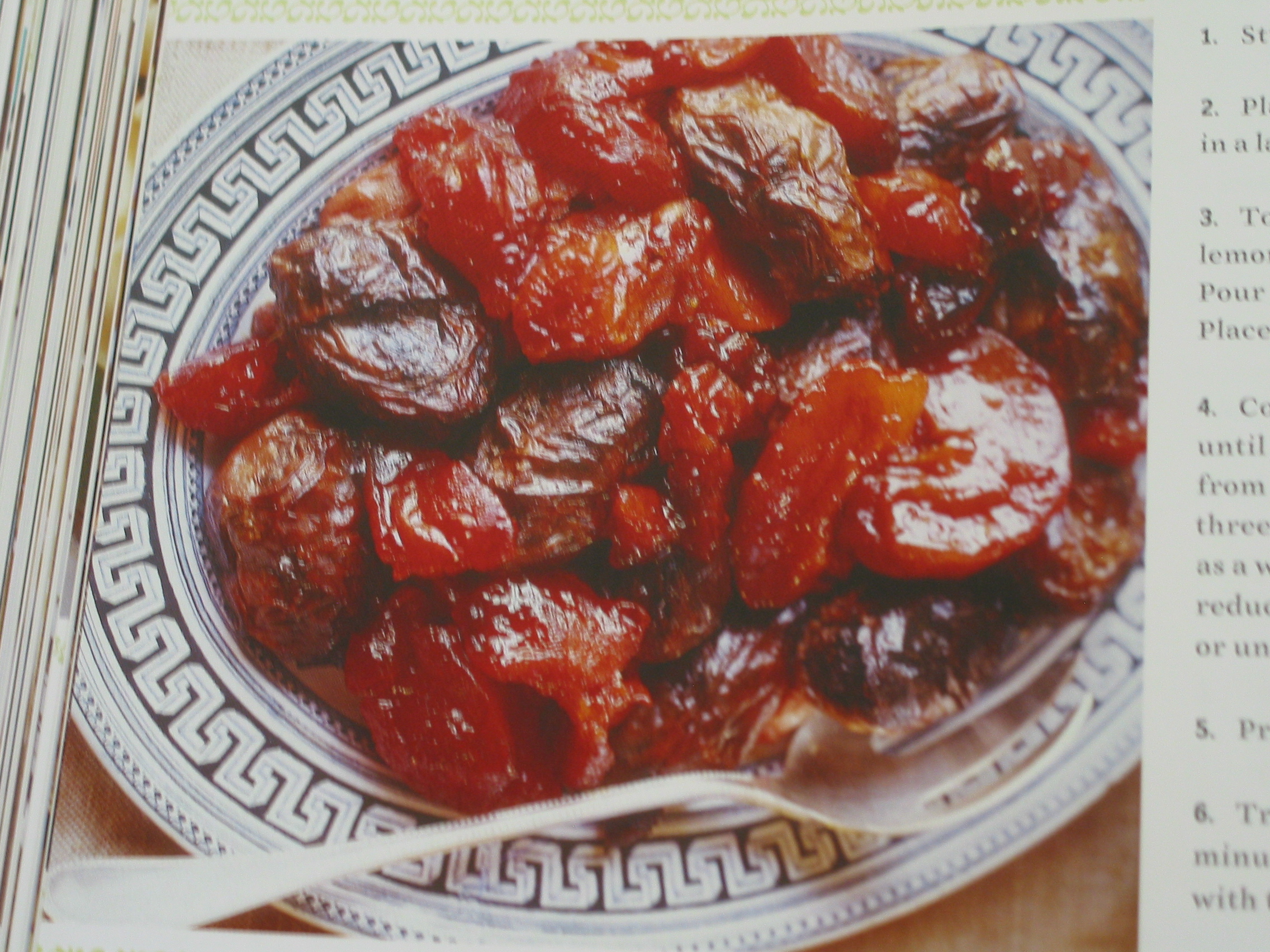
“Marbella”-style cooked vegetable relish with artichoke hearts, olives, tomatoes and prunes

Turkey Breast with Ta’am (flavor) –not microwaved, not a whole bird, but it is a lot quicker and tastes unusually good if you have a small crowd. DO keep it covered in the oven to prevent it drying out.

Some options for vegetarian centerpiece dishes… (ideas more than recipes)

Spice mixes because sometimes you want to liven up the party…

Syrian Jewish stuffed vegetables (baby eggplants and onions) with an incredible lentil filling (NOTE–this one is “not exactly quick”; well, maybe for the eggplants microwaving would be enough, but the onions still take some serious roasting even after microwave assistance.  However, it is delicious and impressive.)

Microwave gingerbread and microwave flan (and a recommendation for mead…)


DIY Pasta–no chic gadgets needed


handmade pasta, cut for ravioli

A few months ago I was surprised to read an interview with the British actress Emma Thompson–not about her acting, or producing, or screenwriting, or whatever, but about her having acquired a pasta machine so that she and her family could have fresh pasta at home.

What surprised me is that she called it a revelation, or revolutionary, can’t remember which. I think it came up in relation to a short dramatic interpretation of a poem called “Song of the Lunch” that she and Alan Rickman did for the BBC last year. It’s about 20 minutes long, posted on YouTube in sections but in its entirety, and it’s actually not bad, though not as funny about foodieism as “The Trip”. The main thing about it is that it takes place in an Italian restaurant in London. Hence the pasta issue.

Over the course of a misspent youth (which I’m still in, thank you very much) I have tried a number of times to make sheet pasta myself, with varying degrees of success.

  • Buckwheat noodles–grainy and dry. Try this soba recipe instead.
  • Jao tse dough made with flour, salt, and boiling water–a little thick but it worked well enough to boast about
  • Ravioli dough made with half egg, half water (this was a few weeks ago)–grainy, sticky, hard to roll evenly to the right thickness.
  • Yesterday’s classic pasta dough from Marcella Hazan, just flour and eggs–just right. In fact, the only right recipe there is, I’m now convinced.

So of course this post isn’t really revolutionary–I’m about 20 years behind the “Wow, you can make pasta at home” trend. And I refuse to call it “a revelation”, as fresh food that includes actual garlic always seems to be for the British. It’s just that it finally worked, came out pretty well, and wasn’t as hard or as time-consuming as I thought. Take it as read.

I should back up and say I never actually managed to pick up either a proper cranking pasta machine, even though you can sometimes find one at Ross for Less at under $20, or a proper long dowel-style rolling pin, which Hazan deems necessary for hand-rolling. This still worked very well.

Why no pasta crank for the crank? Why no artisan rolling pin? I’m not good about kitchen implements that are hard to store, particularly now that the drawers are out in the garage and the counter space is severely limited. I use an empty wine bottle, the tall hunch-shouldered kind with a long straight barrel and short neck. It stands up in a corner when not in use and doesn’t take up space. I also don’t roll any dough directly, but between two sheets of plastic wrap with a little flour or–my great new discovery, especially for this pasta dough–parchment paper. Works incredibly well, better than the plastic wrap, because it doesn’t wrinkle and stick.

In any case, the one kitchen gadget (other than the microwave, the toaster oven, or the coffee maker) that I’m always willing to give counter space to is my food processor (also not fancy–a $30 Hamilton Beach with a big work bowl, not a $200 Cuisinart).

Because although I’ve watched my share of “Make Your Own Pasta” cooking demos over the years where Mary Ann Esposito or the guest du jour on Julia Child cracks eggs into a well in a bowl of flour and “incorporates them” gradually, I know perfectly well from hard experience that kneading by hand is going to precede rolling out by hand, and that the food processor will make at least one of these ordeals a lot faster and less of a pain. It will also give me a better product. Pasta needs a lot of kneading–8-10 minutes!–to develop the gluten and get it to a smooth uniform texture that will hold when you roll and stretch it very thin.  I’m not that good or that patient. Or at least I wasn’t yesterday.

The rolling is the big thing–you have to get that dough thin enough to the point where you just begin to see through it. You don’t want it breaking, but it really Continue reading

Tabbouleh vs. me

Exhausted. Yesterday I brought enough lunch food for 65 or so people at services because (get this) my husband signed us up to prepare the kiddush in celebration of our anniversary. Which is coming up in a couple of days. Ok. But I still have a tiny galley kitchen and all the drawers are still out in the garage awaiting some kind of decision on their fate–they have been that way since before we moved in, because they’re so chewed up I didn’t really want them back and haven’t decided what to replace them with yet.

And I think we (meaning I) did pretty well for costs by not doing the usual buy-salad-in-a-bag-for-thirty-bucks  and buy-a-big-commercial-sheet-cake and buy-a-vat-of-decorator-hummus.

But let me explain something I learned the hard way about making things from scratch. There’s a reason the boxes of commercial just-pour-boiling-water-on-it-and-wait tabbouleh are so tiny.

It’s not just all about profiteering–as you’d think I was going to say. Even I thought I was going to say that. But no.

At my local Armenian greengrocer’s I bought a 2.5 lb bag of #2 bulgur (the number denotes size of the cracked wheat grains) for $2.52 and a couple of bunches of parsley and lemons and a bunch of scallions and thought I was clearly way ahead of the Near East and Sadaf-purchasing folks. And yes, bulgur is microwaveable if you have a good-sized container. Just add water to cover by about an inch, put on a lid, and microwave 3-5 minutes, or enough to get the water to about boiling temperature, and let it stand about 15 minutes to absorb the boiling water. Then drain it and add lemon juice, olive oil, chopped parsley and scallion (and mint if you like it) and a bit of salt. More parsley than grain if you’re Lebanese and being authentic. Less green than grain if you’re doing what I grew up with.

What I didn’t take into account was exactly HOW MUCH tabbouleh one innocent-looking little pound of dry bulgur, or about 2 cups, actually makes.

Let’s just quietly admit it was considerably more than a salad bowl’s worth. So the expensive boxes you see in the Whole Foods, the little 4-6 oz. boxes, are probably just right for a family of less than 14.

I ended up freezing half of the grain in bags. I don’t think I’ll bother telling my in-laws before I bring it up for Thanksgiving. Wouldn’t want them to find themselves a pair of plane tickets just in the nick of time…


Microwave Tricks: Getting more chocolate power from cocoa

Chocolate pot from the movie "Chocolat"

The infamous chocolate cauldron, image © Miramax

In the movie Chocolat, the riverboat captain tells the chocolatier that his favorite of all her confections is none other than the prosaic cauldron of hot chocolate she keeps on the hob to thaw out her customers. When she pours out a cup, it’s so thick it’s like hot molten chocolate bars. Hard to imagine how anyone could swallow more than a spoonful of it in reality, but you immediately believe it’s superior to the thin, miserly stuff that’s been passed off as hot chocolate in your childhood. And you’re right.

And on the other hand, how could anyone in their right mind want to down a cup of melted chocolate bars? Too rich, and for me, much too fatty. And with much too much cleanup–the last image that stuck in my mind from Chocolat was actually not the hot chocolate Juliette Binoche handed Johnny Depp and Judi Dench but the thickly encrusted cauldron that had been cooking chocolate all day long. Scary, and what a waste of chocolate for one scene!

So I don’t go for that myself, or at least not on such a grand scale. Though if you want that kind of recipe–go to David Lebovitz’s blog and look for Parisian (or worse yet, with even more chocolate, Belgian) hot chocolate. He’s got two kinds of Mexican hot chocolate drinks too.

Cocoa powder, the ordinary day-to-day stuff of American hot chocolate mixes, seems so much less potent and chocolaty than all the fancy recherché chocolate bars with the cocoa solids percentages, the exotic Latin American or African source names, the single-source, fair-trade, wine-label-styled descriptions. Cocoa powder is so prosaic (unless it’s Scharffen-Berger or Valrhona or another premium brand). How could it possibly be good enough for a high-class, French-style cup of hot chocolate?

Granted, cocoa powder–dutched, natural, either way–it’s pure cocoa solids. But it doesn’t really give you the full chocolate experience if you just mix it into things. Something’s missing.

Most professional chefs and chocolatiers will probably tell you it’s the cocoa butter that’s missing. And they’re not entirely wrong–fat does carry flavor and keeps the more volatile, delicate aromas in the chocolate from evaporating off too quickly or breaking down under heat.

But if that were the entire reason, cocoa powder, stripped of all its fat and stored in warehouses and supermarket shelves for months at a time, would be flavorless and dead by the time you got it home from the store, and we know that’s not the case.

When you make brownies or chocolate cake with cocoa powder, there comes a point in the baking when you suddenly smell the chocolate wherever you are in the house at that moment. Before you even realize you’re smelling it, before any Continue reading

Artificial sweeteners–false promise for lower carb counts?

Last Saturday night my family visited a couple from our congregation and had dinner in their sukkah. When we broached the question of what there would be for dinner so my daughter could get an idea of how much insulin to take, the husband announced that he too was diabetic–Type II, for several years. What followed was a bit of a culture clash.

I’m sure he meant to be encouraging as he declared that through a combination of self-discipline and exercise and not eating more than a very limited number of carbs per day (and they really were about half of what our daughter is supposed to eat) that his A1C tests were down in the normal range and he only had to test his blood sugar twice a week. Which of course is fine and nearly ideal for a Type II diabetic if it actually works.

I’m not entirely sure how my daughter took all of this, but he went on to dismiss another Type I diabetic we know as “paranoid and overdoing it” because she tests 6 or 7 times a day, which he assumed was unnecessary since he didn’t need to do that.

He had the shining confidence of someone for whom not much had ever gone awry and, having no idea how lucky he was, assumed it was down to his own skill rather than the fact that he had a working pancreas, wasn’t growing anymore, and wasn’t a girl. All big factors for blood glucose control. Clearly he’d never had a bad low with shakes from an overdose or hormonal surge, or a really sharp unexpected high from a shot that just didn’t get where it was supposed to go.

I was more tactful than I’ve ever been in my life when I pointed these things out. You wouldn’t have recognized me, I swear!

Oddest of all was his insistence that the real secret was his use of artificial sweetener, which let him enjoy all kinds of great desserts. I was puzzled–baked apples sprinkled with xylitol? Surely the apples themselves were pretty carby–as well as pretty sweet on their own. The carb difference between using artificial sweetener, a tablespoon–or even two–of table sugar for the pan, or just leaving the apples to bake without sweetener, would be pretty minimal per serving.

And indeed our host only took two wedges for himself.

The other dessert–and it did taste decent–was chocolate ice cream sweetened with xylitol. Given that the ice cream in question was a plain flavor from my usual brand, I was able to compare it with the ordinary version for carb with reasonable confidence.

It was plenty sweet–maybe sweeter than normal, for that matter. But for carbs?

There was no difference. 17 grams per 1/2 cup serving, xylitol or no.

Which brings up a sobering question: why use artificial sweeteners if they don’t lower the carb count significantly? Continue reading

When life hands you sour cherries, pit them!

Sour cherries after microwaving

Vishniak–I’m probably spelling it wrong–is sour cherries turned into a compote, a syrup, a soda (as in, Frank’s Cherry Vishniak from Philadelphia), or a cherry brandy.

How do I know, you ask. Ah–(and with the “Ah” I’m pulling a Dad and giving you the flavor of a particularly smug conversation he had explaining it all to me when I was 15 and had never heard of vishniak either). Because my mother’s father, as it turns out, had made a particularly fine cherry vishniak by accident, about 20 years before this story begins.

My Grandpa Abe came to the States in 1923 as a child from a harsh place whose main compensations were family, music, tea, Bessarabian grapes, and the cherry harvest. His family had survived the pogroms in the Ukraine, his father had survived being drafted into (probably the Tsar’s) army during the Bolshevik Revolution and decided that was enough already, and the family arrived on the last boat allowed to bring Jews into Ellis Island that year–sometime in August.

The family started out dirt-poor, with no English, stripped of everything by the old Russian and new Soviet border guards. And yet Grandpa ended up a doctor, head of internal medicine, energetic and cheerful, unusually beloved by the nurses in the ICU, and an avid world traveler in his later years (my grandmother was a little less thrilled, but a good sport and better at languages than he was).

Some time in the late 1950s, out on Long Island, a friend gave him a gift of sour cherries, which he quickly put up with sugar and vodka in a sterilized glass Mott’s prune juice jug (why, oh why did all four of my grandparents keep prune juice in the house? I never figured it out. They weren’t even out of their 50s when I was little, and I’m almost 50 now myself.)

But in any case Grandpa put the vishniak jug in a dark, quiet corner of the garage to mature for a couple of months and promptly forgot about it.

He and Grandma moved into a New York City apartment sometime in the mid-1960s, and then in the late 1970s, when I was 15, he retired and they moved back out to Long Island. My family came up to help them sort things out–and that’s where my dad started rooting around among the boxes in the garage and found a dust-caked jug with a faded Mott’s label and some dark reddish liquid and cloudy, lumpy slush at the bottom.

“Abe!” he said, horrified. “What are you doing keeping this old jar? And what the hell’s that stuff at the bottom?”

My dad had just spent at least an hour finding similarly dubious-looking treasures of neatly folded foil, rubber bands, wax paper, and other saved-up sundries that my ever-careful grandparents had paid good money to have moved back out of the New York apartment. Was this yet another such item meant to ward off the next Great Depression, or was Grandpa collecting surgical specimens for posterity?

My grandpa took one look at the cloudy jar and beamed–it had all come back. In true shtetl fashion, he uttered the magic word–“Ah!”–and with no further explanation, bustled around in the kitchen to find a couple of sherry glasses that weren’t too dusty. Dad wasn’t looking too thrilled.

In even truer shtetl fashion, Grandpa returned and promptly challenged my dad to a game of chess to celebrate. We kids were left baffled, but not for long–as the game was set out, we each got a tiny sip, and it was incredible.

It turned out that forgetting the cherry vishniak for 20 years or so was the best thing Grandpa could have done to it. When Grandpa opened the jar the vishniak aroma alone was so developed, so rich, that Dad just stopped kibbitzing in his tracks for a minute and inhaled reverently. The liqueur was a clear bright red–astonishing after 20 years–and at the bottom were all the brandied cherries. When it was time for us to leave, Grandpa filled us a little Paul Masson carafe (remember those?) with vishniak to take home.

Now, I don’t have the head for anything more than half an inch of wine–and that’s actually something I inherited from my dad more than my mom–but my local Armenian grocery was selling fresh sour cherries this summer and I managed to snag a box. What to do with them? I washed and stemmed them, then stuck them in the fridge until I figured it out.

This was not really a great move. They sat for at least 3 weeks in there–it’s a miracle more of them didn’t go moldy, but I lost quite a few when I finally opened the container today. The price you pay for dithering. I sorted them, washed the good ones really well and pitted them with a sharp little paring knife. But what now?

I have a bottle of vodka from years ago–still unopened, maybe I’ll use it next summer and put up some vishniak. But there aren’t enough cherries this time around. So I decided to try making a quick preserve the way I do with cranberries.

The raw cherries aren’t really that sour–they’re more bitter with a faint sweetness, like the wild unofficial and unrecognized variety that used to grow at the edges of the woods in the backyard when I was a kid in Virginia. But I decided to try them anyway.

I had a smallish bowlful–maybe a cup, cup and a half, of pitted cherries–and put a couple of tablespoons of sugar on them. Lemon–no lemons in the house. Citric acid “sour salt” I had in a shaker–you can get Rokeach brand in the Jewish section of your supermarket’s International Foods aisle, next to the Telma bouillon cubes and the unsold jars of Manischewitz gefilte fish from last Passover. But a little goes a long way–one modest shake was plenty.

Then–you won’t be entirely surprised at this, but I covered the bowl with a saucer and nuked it for 3 minutes on HIGH. It didn’t gel–I think you need a lot more sugar to make it gel without adding pectin–but it did make some liquid, and the smell–I’d taken all the pits out carefully before microwaving, but there was still a distinctly almondy smell when I moved the lid a little. Powerful stuff.

A tiny taste–heady and bursting with cherries. With more sugar, more cherries, and a bottle of vodka to add it to, in 20 years it might be worth talking about. But in my house it’s not gonna last that long.

I’ve learned my lesson–if you’ve got something rare like fresh sour cherries at a good price, get with it and use them right away. You can freeze them after you pit them, or you can cook them–or put them up with sugar and vodka, though I don’t think Mott’s is still issuing its juices in glass jugs, more’s the pity. The main thing is to act swiftly, and if anyone gives you trouble, threaten them to a game of chess.

Stuffed Eggplants with Quince, A Vegetarian Odyssey

Stuffed Eggplant with Quince and Stuffed Onion Rolls

I did it. It was 90+ degrees outside yesterday afternoon and felt a lot hotter inside when I started cranking the oven to try this dish right away rather than wait for the weekend, but I’m just no good with delayed gratification.

If I have the mini-eggplants and I have the quinces and I have the tamarind concentrate (homemade! two days ago! it’s practically crying out to be used already!) and I have the “hashu” filling for the vegetables sitting in the fridge smelling wonderful, then it just doesn’t matter that Rosh Hashanah dinner is in what, maybe 3 hours, and I still haven’t braided the challot, to say nothing of baked them. Obviously I’ve gotta try this extra-credit dish out RIGHT NOW.

Actually, I figured the house was going to be heating up anyway once I started baking the challot, so why not get it all over with at once?

There was a more serious reason to try it. Today in services I was still thinking about Dweck’s book and her recounting of her parents’ horror in 1947, when, about to return from a vacation in Europe, they learned the government back home had started massacring whole Jewish communities in reaction to the announcement that the UN had accepted Israel as a Jewish state.

The Syrian Jewish community fled wherever they could–just as my family did under the pogroms in the Ukraine back in the 1880s and 1920s. Dweck maintains that the reception the Syrian Jews got in the US from those of us who were already here was so aloof–they didn’t speak Yiddish, they didn’t look the same, they did a few things differently for kashrut and prayers–that her community kept to themselves ever after.

I can believe it, unfortunately–the period right after World War II and the Holocaust was one of paranoia and circling the wagons for American Ashkenazim.

Eastern and Western Jews had similar discomfort with each other in postwar Europe. Reading between the lines a little in Claudia Roden’s and Colette Rossant’s memoirs, the two, who had just lost everything, thought their new Ashkenazi neighbors were cold and inhospitable and indifferent to their exile; the Ashkenazi neighbors and relatives, meanwhile, thought the wealthy young Egyptian arrivals were horribly spoiled and indifferent to the European disaster they had just missed. Altogether, the Ashkenazi, Sephardi, and Mizrahi communities were in closer touch before World War I than they were after the 1940s.

I can only hope that now, 60 or 70 years on, we have more in common and more regard for each other, no matter where we came from. Israel’s great mix of cultures has been a good influence, even though it originated in hardship, and perhaps today we are in better shape to appreciate what we have in common than we have been for nearly a century.

When I look through Dweck’s family’s photos, I see so many people who look astonishingly like several members of my family–my dad and my sister especially. The dignified lady presiding at the seder table on the front cover is a shockingly exact adult version of a girl I knew from my synagogue’s youth group–it’s the sturdy mouth and chin and the set of the eyes, certainly, but also the irrepressibly thick and curly hair (the 1920s formal chignon has it all over my friend’s 1970s braids, which took her hours to corral her hair into). The formal photographs of families in the 1920s, all the daughters dressed beautifully but in the same fabric the mother is wearing, sailor suits on the boys, stern dignified expressions all–I’m pretty sure each of my grandmothers had at least one of those in her collection. The 1930s-era engagement portrait with pearls and bobbed hair–so modern! Pin it up next to the one of my dad’s parents, who married in 1939 and looked so incredibly naive and young then. The family gatherings at Pesach, grandma presiding over the white lace tablecloth and all the seated cousins glancing behind them at the camera from over their shoulders–there’s probably one or two with my mother as a toddler on someone’s lap in Brooklyn and another of her as a teen, whipping her glasses off and blinking myopically for the photo. It could be any of our families. It could have been us in Syria and Egypt and Turkey, it could have been them in the Ukraine or Germany or Poland. We none of us have entirely safe histories, and none of us are entirely separate.

In any case, Dweck’s book is important to me not only for capturing her community’s traditions, tastes and history but for reaching out to the rest of us and giving us a chance to share it, compare it with our own, and reconsider what it means to be part of the Jewish world now.

So–and this is not to trivialize but to explain, since we sometimes live and remember through food, especially at the holidays–it was a great time to try out a challenging dish (challenging for me, anyway) from her book and serve it last night to my family for Erev Rosh Hashanah. I cook from scratch, I cook a lot, but I’ve never really done  the legendary great-aunts-at-Pesach kind of slow cooking where everyone groans in pleasure and declares “nobody does it like this anymore” when they taste it. I’ve only once cooked a whole turkey, and I’ve rarely tried anything else that took more than an hour and a half to cook. It’s a transformative experience, one that teaches me a lot about my great-aunts and great-grandmothers, both in the shtetls with the wood-fueled pripitschoks and communal ovens, and here in America with modern kitchens and big lace-covered tables. Trying this long-cooked dish gave me the chance to experience both my family’s past celebrations and Dweck’s at the same time.

To my very great pleasure, her recipe worked the way it was supposed to on the first try and tasted like the effort was worth it, even though her instructions are pretty simple and brief. That’s a huge achievement.

So–if you’re ready for this, keep reading–otherwise, glance at the pictures and skip to the bottom…

The “Stuffed Eggplants with Quince” Experience

First of all, let me just say that I LOVE my local Armenian corner grocers for a lot of reasons, but the fact that they have all the ingredients for Dweck’s dishes (other than kosher meat, that is) is a big, big plus.

I would have tried microwaving–and I still will–instead of a 2-hour braise, but I wasn’t sure how it was supposed to taste, whether microwaving would cook the raw rice in the filling well enough, and how the sauce was supposed to interact with the stuffing and the eggplants. I knew from a previous hard-luck experience that quinces don’t do especially well (or even well at all) in the microwave and really need long stewing under conventional heat to get tender and turn bronzy pink and sweet. So all in all, I decided following the directions in Aromas of Aleppo might be the wiser course for a first try. Even though, from my usual 15-minutes-tops perspective on conventional-heat cooking, Poopa Dweck’s method is glacially, almost outrageously, slow.

Basically, you core the baby eggplants, stuff them with hashu (beef-and-rice filling, rice and tomatoes, or in my case lentils-and-rice), and layer them in a saucepan with quince slices. Then you dilute some tamarind concentrate and add a bit of sugar and salt, pour the sauce over the pan and heat for 10 minutes on the stove until the eggplants start to sweat, add water to come about 3/4 of the way up , simmer half an hour to reduce the liquid and cook the rice in the filling, then transfer to the oven to braise covered for about 40 minutes and then uncovered for another 30. It’s a lot like making brisket, actually.

Dweck gives two allspice-laden recipes for the filling, one for ground beef with rice, the other a rice-and-tomato filling that’s close to what I use for dolmas. I opted to follow the ground beef recipe but substitute an equal weight of cooked green lentils for the meat and add a little garlic. It would work, I was pretty sure, and in fact it turned out to be the best, most delicious part of this recipe–which, skipping to the punchline, was pretty terrific and worthwhile, even for the work Continue reading

The Birthday Project: New Year, New Food

I was born halfway between Rosh Hashanah and Yom Kippur, so on any given year, I could be stuck eating honeycake or none at all on my birthday. I think I’ve had maybe two actual birthday parties in my life. It’s a concept my daughter, born in June, doesn’t get.

But occasionally I luck out–and this year was one of the best. My husband asked what I wanted and I had a real answer–a cookbook I’ve been lusting after at the library and that costs only slightly more than my probable library fines if I don’t return it.

So this is it–feast your eyes, I’ll turn the pages:

Aromas of Aleppo by Poopa Dweck

And this is the project that sold me on it:

Stuffed Eggplant with Quince

Stuffed Eggplant with Quince

Poopa Dweck, a cousin by marriage to Claudia Roden, has edited the New York Syrian Jewish community’s version of a sisterhood cookbook (every synagogue in America’s sisterhood seems to have put out at least one of those) for something like 20 years, only people in her community actually used it frequently. My birthday gift is the 2007 culmination of Dweck’s experience, and it’s just a very beautiful cookbook to leaf through–visually but also for the possibility that when you try the dishes, they’re actually going to work.

It doesn’t take much reading for me to realize that despite the unfamiliarity of some of the flavors–allspice in meat stuffings, tamarind-based sauces–this is the best kind of traditional Jewish home cooking, the kind that has your favorite great-aunts outdoing each other for Pesach, Rosh Hashanah, and other big celebrations. So, somewhat exotic in flavoring but utterly familiar in spirit. (And actually, as I discovered in another Syrian Jewish cookbook, A Fistful of Lentils, by Jennifer Felicia Abadi, a few dishes, like stuffed cabbage with a sweet-and-sour sauce, and manti, a kind of ravioli, are pretty similar to Ashkenazi holishkes and kreplach.)

Like all Jewish great-aunt dishes for the holidays, this dish of stuffed eggplants and quinces comes with two required homework items: the beef and rice stuffing, and tamarind concentrate. The beef I’m not worried about–my first try on this is going to be vegetarian, because I’m not planning on heading out to the kosher butchers in the Valley. I can use a green lentil and rice filling that I already know will taste fine with those flavorings of allspice and cinnamon and onion. Maybe a hit of garlic too, and maybe a bit less salt than for the beef–as I discovered a few weeks ago, with the green lentil sausages, lentils don’t hide the salt flavor as much as beef might.

The other item, tamarind concentrate, turns out to be inexpensive but somewhat unlovely to make–though still something of an adventure. Especially for a blog called Slow Food Fast.

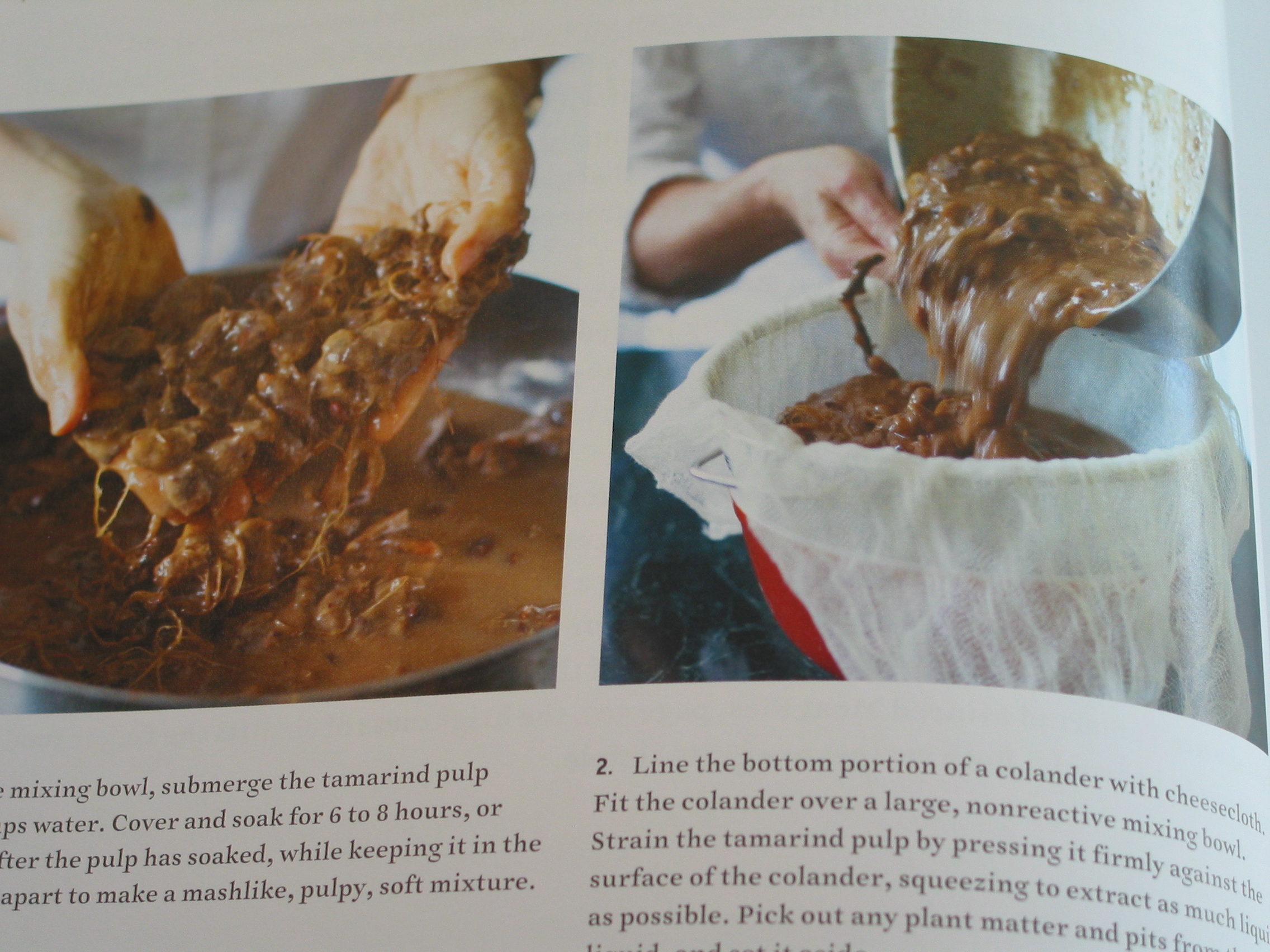
Here’s what’s on page 42 of Aromas of Aleppo for how to work the tamarind pulp into something that will give up its flavor to a sauce:

Poopa Dweck's Aromas of Aleppo--instructions for making tamarind concentrate

Working the tamarind pulp

Now, I’m not all that squeamish, but bleaaghhh. First ya gotta soak the stuff overnight, then ya gotta get in there and mish around–I dunno. I decided to speed it up where I could…

I thought about the little 1-lb. brick of pressed seedless tamarind pulp I’d bought from my Armenian greengrocers for this dish. It just seemed like a tougher version of dried prunes or apricots, which I usually soak up successfully enough in a few minutes by heating them with water in the microwave. Would it work here or would it ruin the flavor? I cut off a chunk, submerged it in water in a microwaveable bowl, and tried it.

Tamarind pulp rehydrated in the microwave

Five minutes of microwaving, covered, plus about 20 minutes sitting time–it was definitely done. And really, really incredibly tart, a surprise given tamarind’s distinctly plummy aroma. Success! But no wonder they call it “ouc” (pronounced OO-rgh, according to Dweck)–that was my immediate reaction when I tasted a tiny sip. It’s THAT sour. My second reaction was that I should probably say Shehekheyanu–the blessing for any new venture, especially for holidays and the first taste of a new fruit in the year.

I realized only afterward that I should have done the whole brick while I was at it–I was about to discover why Dweck calls for preparing three pounds of pulp at a time, not a couple of ounces.

Next step–squishing the pulp in the water to extract as much flavor as possible before filtering through cheesecloth and reextracting the pulp left behind in fresh water…no. Just no. I am not a cheesecloth girl–it never, never cuts neatly, even with Fiskars shears.

So, I was thinking, I have a microwave for a reason. I also decided I have a food processor for a reason, and this is definitely it. I stirred once with a fork first to make sure there really weren’t any pits in there, as advertised on the package front. Then I poured it all into the food processor, and gave it a whirl. That worked too. I seemed to be on a roll with the speed-it-up-immensely daydream.

Filtering the tamarind liquid

Filtration–I’ve used overlapping coffee filters in a colander whenever I make paneer in the microwave, and it worked pretty well here too–maybe better than Dweck’s photos, which show a cloudy filtrate coming through the cheesecloth. Mine was clear and amber–maybe too clear? Was it going to taste authentic without the silty stuff? I could only hope. It sure was sour, even dilute as it was. Continue reading

Weighing in on kitchen scales

Digital kitchen scale

Farhad Manjoo, better known for his columns on computer and phone technology, has now tackled kitchen tech for the New York Times in his  ode to the electronic kitchen scale.

And while I applaud the general idea that it’s a valuable tool–after all, we use ours daily–I’m both stunned and unsurprised at the same time at the limited perspective he shows [chorus, because he’s a boy]. For Manjoo, as for the food bloggers he quotes (J. Kenji Lopez-Alt of Serious Eats, Deb Perelman of Smitten Kitchen), using a kitchen scale is about cooking more precisely and with fewer measuring cups, spoons, bowls, etc. Which is fair enough, I suppose, if you’re really worried about whether you already cook well, or if you have ambitions for exactitude.

But why do most Americans who actually have a kitchen scale get one in the first place? The fact that our kitchen scale came with a “The Biggest Loser” sticker on it might give you a solid clue.

We got our scale because our daughter developed Type I diabetes at age nine. Although we started out with half- and third-cup measures for simple foods like beans or plain pasta, we really needed to be able to calculate how much carbohydrate was in more complex or variable-density foods like breads and baked goods so we could give her the right amount of insulin for them.

Our school office manager said she’d gotten one on doctor’s orders after suffering a stroke in her early 40s, and she swore by it to help her cut back significantly on carbs and get her portions right.

Health concerns, not haute cuisine, are the most urgent reason to learn to use a kitchen scale. Not that better-tasting food isn’t important, but learning how to eat more moderately by measuring and knowing what’s in a serving would help at least two-thirds of Americans back themselves down off the high-BMI, pre-diabetic ledge. Especially since an international diabetes conference just reported something like 350 million people worldwide now have diabetes, double the number from 20 years ago.

Digital scales seem to do the most good, for us at least, in preparing homemade pastries or complex dishes (such as quiches or filled pastas). Our other best use is weighing out complex high-carb foods like pastries and candies that we’ve bought elsewhere, since they can be so variable in density or sugar content.

Unfortunately, weighing out treats is usually a big eye-opener for us as well as our daughter. That blackberry pie my husband lugged home from a specialty bakery run is worth a meal and a half of carbs if you do the picture-perfect wedge. We’ve started to cut our pieces a little thinner not just so our daughter doesn’t feel shortchanged but so we don’t get slapped when we step on the big scales the next morning.

Along the way the scale has helped us learn carb fractions for different foods and figure portions for them so it’s easier to estimate when we eat out.

It’s not so tempting to eat a whole doughnut for Sunday breakfast from the surprisingly good and inexpensive bakery three blocks away when you discover that even the relatively modest sugar twist (a real doughnut utterly unlike Starbucks’) represents 60 grams of carb, worth a whole meal without even accounting for a glass of milk, and the jelly doughnut is something like double that. And once you’ve eaten it, you won’t really feel full. Dangerous goods. Better to split the doughnuts and eat something more substantive with them.

Bonus points for my daughter’s practical algebra skills here: she’s figured out how to calculate carb fractions based on the nutrition labels for her own custom blend of low-carb, high-fiber cereal and ultra-carby granola on regular mornings, and she’s pretty fast by now. The extra flourish on the calculator may make me roll my eyes (and yes, at a certain point I’m always thinking, “Just pour it, already!”) but she’s having fun showing off. Even though she’s done the measurements and calculations often enough to be able to eyeball the amounts in a cup if she wanted to.

Because of course, it can be taken too far…

After all, you can’t lug a kitchen scale to school with you in your backpack every day. Most diabetics of longer experience count by eyeballing and estimating when they eat out rather than agonizing over every gram. You can get a little too involved and dependent on the precision a scale offers and forget how to trust–and train–your innate abilities.

Which brings me back to Farhad Manjoo’s column. There’s nothing actively wrong with the way he’s using his scale, I suppose–except for his exuberance about pouring flour straight from the bag into the mixing bowl, then pouring sugar straight on top of that. If you overpour, you should be taking some back out, but then what? Discard the excess sugar now that it’s contaminated with flour? Ignore the contamination and scoop it back into the sugar sack? Take it from a former lab rat, you’d have done better in the waste-not sense as well as the food safety sense to weigh each separately into a paper cup or onto a plate and then pour it in the bowl.

But that’s for things that really benefit from weighing. Manjoo’s using the scale to figure the exact portion of coffee beans to use each day. One of his interviewees is using the scale to weigh out the exact amount of sugar for his iced tea. These things would do fine by eyeballing–or just using a spoon like a normal person.

Do you really need a kitchen scale to figure out how much grated cheese you want in your mac and cheese? Wouldn’t grating it until it looks and tastes good to you work at least as well?

These guys have lost their trust in their ability to eyeball or cook by feel as they check and recheck their precision on the digital scale. Couple that with the cachet of doing as the French do (that is, when they bother to weigh ingredients instead of cooking by instinct, which they’re inordinately proud of) and you have a new American tech obsession parading itself as competence chic.

It’s like checking your e-mail every 20 minutes. Or bringing your new iPhone to the dinner table and looking up instant info on the Web every time your wife brings up a topic to which neither of you knows the answer. (AHEM!!!) Not that I’ve ever met (or acknowledged meeting) any certain husbands who got that obsessive over their apps. Trust me, it does NOT make them more competent or enjoyable conversationalists…even if they do occasionally bring home some serious pie.

Food that’s fit to print–but is it fit to eat?

It’s the next “brilliant” thing. In the wake of Grant Achatz, Ferran Adrià et al, the now common your-photo-in-icing cake decorations made using an inkjet printer and soy-based and other edible inks have given way to 3D printable food–or at least that’s what the researchers at Cornell are calling it.

Hydrocolloid Printing: A Novel Platform for Customized Food Production (PDF)

Hydrocolloids are suspensions of fine particulates in liquids–in common terms, gels. Also pastes, like cake frosting or masa. Basically uniform goos. The Solid Freeform Fabrication (SFF) unit squirts the stuff through a computer-programmable injector needle onto a platform based on the design you feed in, and it goes in layers so you get an engineered form. Cool, right? Food, any shape you want, and they contend it can be any flavor too.

But it has to be made of goo. And it can’t clog the needle. And it’s not all that new–the Italians have been extruding pasta shapes for over a century. French pastry chefs did all the heavy lifting with choux paste and fondant flowers even longer ago. And in modern times Wilton makes all those fancy-looking metal tips for pastry bags that they sell in the craft chain stores and that will likely be tried out once and then sit forever in the back of your kitchen drawer.

But pastas, pastries and frostings are all about goo as a starting material. These guys are talking about fish.

Most of all, it isn’t all that appetizing, particularly when you see that they’re trying to sell you on a machine that can make what they’d like you to think of as a tomato with a goo composed of 1% gelatin, 8% xanthan gum and some tomato flavoring. Haven’t we had enough of synthetic tomatoes? Isn’t that what the heirloom movement is all about?

Apparently not. Here are the last couple of paragraphs of the paper I linked to above. See what you think.

It should be noted, however, that even if subtle differences are perceptible, it is not necessary in all cases to perfectly reproduce the original food; there is still great value in simulating the original food.

Regardless of whether a hydrocolloid approach is taken to food-SFF, or some other molecular gastronomic platform is employed, the potential future applications of food-SFF remain the same. From culinary professionals to laypeople, individuals from all walks of life will be drastically affected by food-SFF. Artistic boundaries will be pushed in fine dining and industrial producers will explore mass-customization. Laypeople will have housework time reduced and benefit from direct culinary skill injections. Web 2.0 will tackle the next great frontier as people from all over the world experience food in new ways, while forming social bonds and mass-collaborating.

Now that major barriers have been broken, such as high printer cost and proprietary restrictions, the stage is finally set for tremendous growth of food-SFF. Few things are more central to humanity than food, and therefore [it] should come as no surprise when food-SFF gains prominence as one of the 21st century’s important domestic technologies.

excerpted from:

Hydrocolloid Printing: A Novel Platform for Customized Food Production
Daniel L. Cohen, Jeffrey I. Lipton, Meredith Cutler, Deborah Coulter, Anthony Vesco, Hod Lipson

http://creativemachines.cornell.edu/sites/default/files/SFF09_Cohen1_0.pdf, accessed 9/12/11

Now tell me, is this future palatable to you? Or do you somehow, almost inconceivably, not relish the thought of a xanthan gum conglomerate taking over the world’s food supply and driving us fresh-food conspiracists underground? Dan Brown, where are you?