• Enter your email address to subscribe to this blog and receive notifications of new posts by email.

    Join 241 other subscribers
  • Noshing on

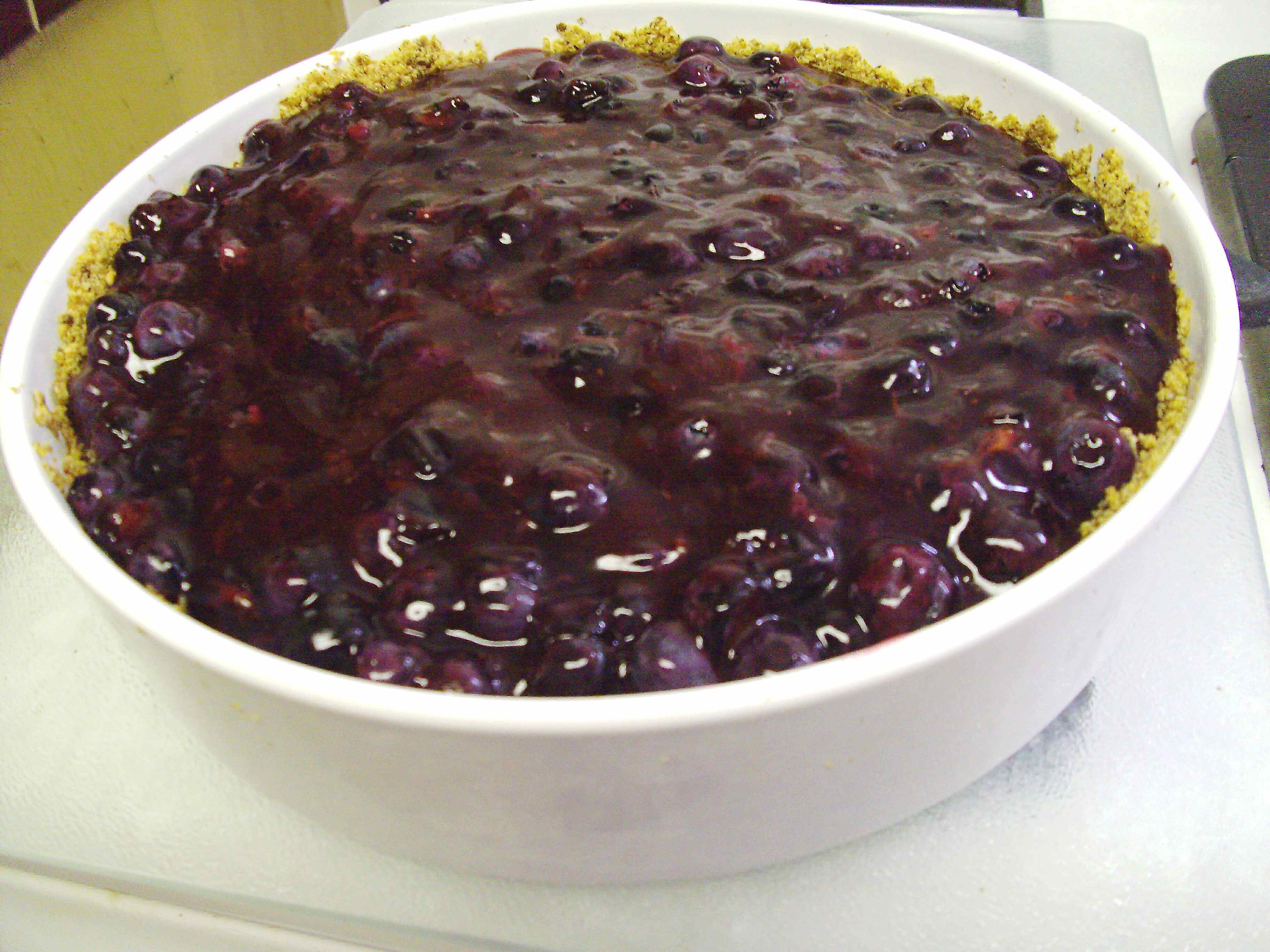
    raw blueberry pie with microwaveable filling and graham cracker crust

    This mostly-raw blueberry pie is a snap to make and very versatile--the filling microwaves in a few minutes, and you don't even have to bake the zippy gingered graham cracker crust--perfect for a hot Fourth of July and all summer long.

  • Recent Posts

  • Contents

  • Archives

  • Now Reading

  • See also my Book Reviews

  • Copyright 2008-2024Slow Food Fast. All writing and images on this blog unless otherwise attributed or set in quotes are the sole property of Slow Food Fast. Please contact DebbieN via the comments form for permissions before reprinting or reproducing any of the material on this blog.

  • ADS AND AFFILIATE LINKS

  • I may post affiliate links to books and movies that I personally review and recommend. Currently I favor Alibris and Vroman's, our terrific and venerable (now past the century mark!) independent bookstore in Pasadena. Or go to your local library--and make sure to support them with actual donations, not just overdue fines (ahem!), because your state probably has cut their budget and hours. Again.

  • In keeping with the disclaimer below, I DO NOT endorse, profit from, or recommend any medications, health treatments, commercial diet plans, supplements or any other such products.

  • DISCLAIMER

  • SlowFoodFast sometimes addresses general public health topics related to nutrition, heart disease, blood pressure, and diabetes. Because this is a blog with a personal point of view, my health and food politics entries often include my opinions on the trends I see, and I try to be as blatant as possible about that. None of these articles should be construed as specific medical advice for an individual case. I do try to keep to findings from well-vetted research sources and large, well-controlled studies, and I try not to sensationalize the science (though if they actually come up with a real cure for Type I diabetes in the next couple of years, I'm gonna be dancing in the streets with a hat that would put Carmen Miranda to shame. Consider yourself warned).

Irish Soda Bread, Lighter on the Soda

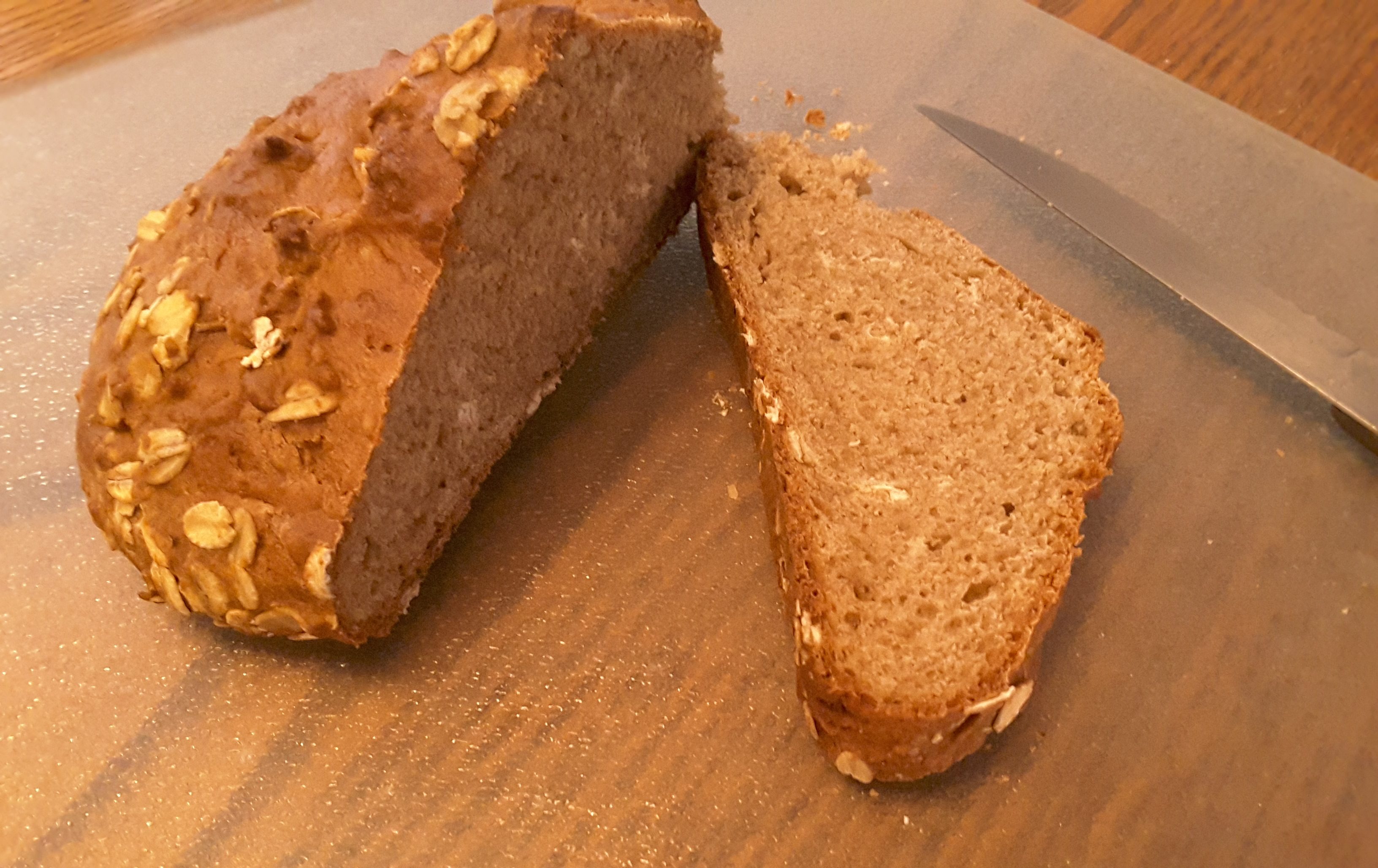
Irish soda bread with slice

Irish soda bread has a reputation—it’s quick and easy and yet rustic, but can be a bit rough on your stomach and supposedly goes heavy and rocklike within a day. Most people blame the whole wheat or the lack of yeast. I blame the soda.

This kind of quick bread was probably intended to be baked alongside the supper roast or casserole and eaten up at that meal—the loaves aren’t huge and there would probably be no leftovers to speak of. Time is of the essence when you’re making dinner for a hungry working family, and typical recipes I find call for a large tablespoon or more of baking soda for only two or three cups of flour. Then they cover the metallic/salt/soap flavor of the bicarbonate with extra spoonfuls of salt. The result is a high-sodium loaf that’s bound to irritate your stomach lining somewhat, even while fresh, and then will almost certainly end up pretty dry and hard, like the stereotypical box-mix Passover cakes, if you let it sit out at all.

I’m actually not sure whether the baking soda levels in today’s recipes are the same as or more exaggerated than classic ones. But considering some of the vintage recipes for similar quick breads, muffins, scones etc., from the 1930s or so, I suspect that the cheapness and novelty of baking soda and baking powder, which could replace eggs as well as yeast, made some of the recipe developers of the day more enthusiastic than they needed to be. Except, of course, if they were developing recipes for Arm&Hammer, Calumet or other brands…

Does it really need all that chemical leavening just to rise? As with tea breads, scones, and quick-mix oil- or applesauce-based cake layers, I find you can get away with a lot less than most recipes call for.  Half a teaspoon of baking soda is enough for two cups (8 oz. or 240 g by weight) of flour and the rise is just fine as long as you don’t wait around before sticking the mixed dough in the oven, and you have included an acidic ingredient like yogurt, buttermilk or vinegar to activate it. Then you don’t have to compensate the taste with excess salt either. The acidic ingredients and any dairy will tenderize the crumb as well.

In any case, these problems are easy to solve without doing your head in or spending a lot of cash on specific ingredients, because the beauty of Irish soda bread is its great adaptability to what you have on hand.

This is the adaptation I made a few times in March and April of 2020, when yeast was suddenly, inexplicably, sold out in the grocery stores, eggs were scarce and flour was being snatched off the shelves too.

Continue reading

Last-minute Thanksgiving 2021

Good reasonably fast bread makes for a better cheese plate–so I tell myself…

I’m always, always late to the table, I know it. Yes, it is sort of too late to do much more than give you the link to my Slow Food Fast Thanksgiving guide from a few years ago plus the few new ones from last year, and recommend “Thanksgiving” in the search box if you’re stuck for microwaveable but good ideas.

Last year was the first on-our-own-but-Zooming-it Thanksgiving and this is our second, and Chanukah starts Sunday evening. Maybe I’ll have something exciting and original by then.

Despite all that, I do have a few things I’ve been meaning to share but haven’t had time to post. The past few months seem to have sped up on me because my daughter’s aiming to graduate early this year, and because I’ve been helping host the still mostly-online Jewish Book Festival for our region and that means interviewing authors–some really eminent ones–for our local Federation magazine and moderating online for two of the events. So my “skill set,” both technical and staging, has had to rev up in a big way…

But Thanksgiving…I am doing most or at least some of the same menu I put together for “just us” last year–artichokes in the microwave, wild rice pilaf, salmon, broccoli, salad, pumpkin pie, cranberry sauce, and maybe some mushroom caps. All of it is good and almost all, everything but the salad, is microwaveable at least for part of it, and there will be good leftovers for lunch this weekend. So–not much new.

The things I did last year that I didn’t manage to post include a relatively quick whole wheat olive-rosemary faux-sourdough bread, which came out really well and I’m doing again, and the cheese plate à deux that manages to be interesting without breaking the bank…

These things may not come in time for today, depending where you are and how impatient or well-stocked, but they could come in handy in the next few weeks.

Whole wheat rapid faux sourdough with mix-ins

I usually keep a bowl of dough in the fridge for things like pita and calzone and it lasts me about a week. I’ve done proper sourdough rye and kornbroyt with medium success, and a yogurt-based 3-hour “faux” sourdough that wasn’t too bad, but lately I’ve decided that I can get a decent mildly sourdough flavor simpler and nondairy by just stirring a capful of apple cider vinegar into the flour as I’m making a regular yeast dough.

For this whole wheat bread, I’m doing a smaller ball of dough than my usual salad bowl worth–I want it quicker and it’s really just for this, so. I took a chunk of the regular dough since I had some in the fridge, maybe a heaping tablespoon or so, softened and pulled it apart with a fork in half a cup of warm water, sprinkled on about a cup each of whole wheat and regular bread/AP flour, less than half a teaspoon of salt, and a small capful of cider vinegar, and started stirring. I heated up another half a coffee mug of water a few seconds in the microwave, just to “finger-warm,” and added just enough to the bowl to get it to make a reasonable dough, kneaded it until smooth, drizzled on olive oil, covered the bowl and set it in a colander over a stockpot filled with hot tap water–and put a lid over it to shut out light. Hopefully it’s rising as we speak.

Olive rosemary bread in progress, as of Thanksgiving 2020–from the outcome, I’d say at least double the olives and throw in some chopped walnuts as well to get a more generous, nicer-looking distribution.

You can go a couple of different ways with mix-ins. Last year I chopped some Greek olives and minced a sprig or two of rosemary from the bush in the backyard, and when the dough was risen, I rolled it out into a rectangle and sprinkled everything on, rolled it up, let it rise again covered for 40 minutes or so while I heated the oven to 420F, and then threw a mugful of water into the oven and baked the bread for about an hour–it was a bigger loaf than I’m doing today, so I expect this one to take less time.

This year I’ll probably do the same but throw in a few chopped walnuts and maybe hot-soaked raisins as well. You could do raisins instead of olives if you prefer, nuts or no nuts, or just rosemary and thyme or sage if you want an herb bread.

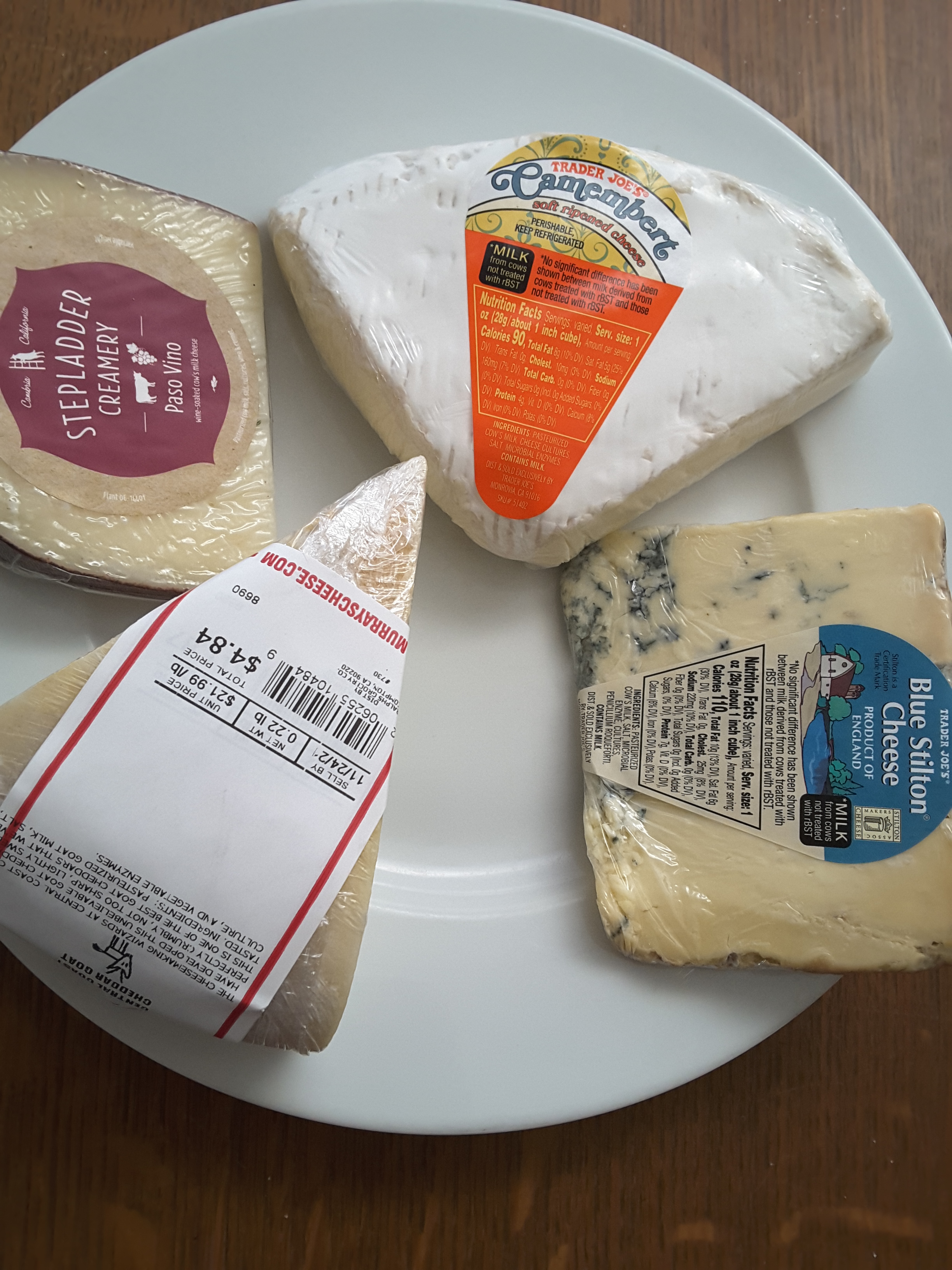
Cheese plate with slight microwave assist (because, of course…)

The Ralph’s/Kroger in my neighborhood put in a fancy cheese counter two years ago, trying to rival Whole Foods and more or less doing a decent job of it. The Ralph’s cheeses are all stocked by Murray’s, which is headquartered in (I think?) the Hudson Valley in New York.

Now, that of course doesn’t sound incredibly affordable and the regular prices aren’t terrible but they’re still $10-25 a pound, which is a lot. However, the cheese counter always has a few “under $5” baskets out to attract those of us who don’t have champagne budgets or big parties to stock but are still sort of cheese freakish.

$20 cheese plate! Notes: 1. The Stepladder Creamery wedge, at $7, is the most expensive one here and full price; it’s still relatively inexpensive, wonderful and flavorful even in slivers, and produced by the dairy where my niece is a goat herd manager up near San Simeon. The other wedges are all over 5 ounces–the Ralph’s/Kroger/Murray’s Cheeses goat cheddar with vegetarian rennet at the lower left, contrary to what the upside down label says, is actually over 9 ounces, not the “0.22 lb” (3.5 oz) on the label. The full prices for the other two from Trader Joe’s: 3.60 for 5 ounces of stilton; 4.66 for 8 ounces of camembert, both vegetarian rennet.

And sometimes they’re actually big wedges, 6-8 ounces, that are nearing their sell-by date, or maybe they’re just not moving, so they discount and you can get a major bargain on things like Humboldt Fog or Cambozola, a stilton, or an aged goatsmilk cheddar or asiago-style cheese like Ewephoria. (Of course, occasionally you can find seriously discounted Limburger going for 75 cents a tightly-wrapped chunk, because they really, really want you to take it off their hands).

Continue reading

Three-Hour Sourdough

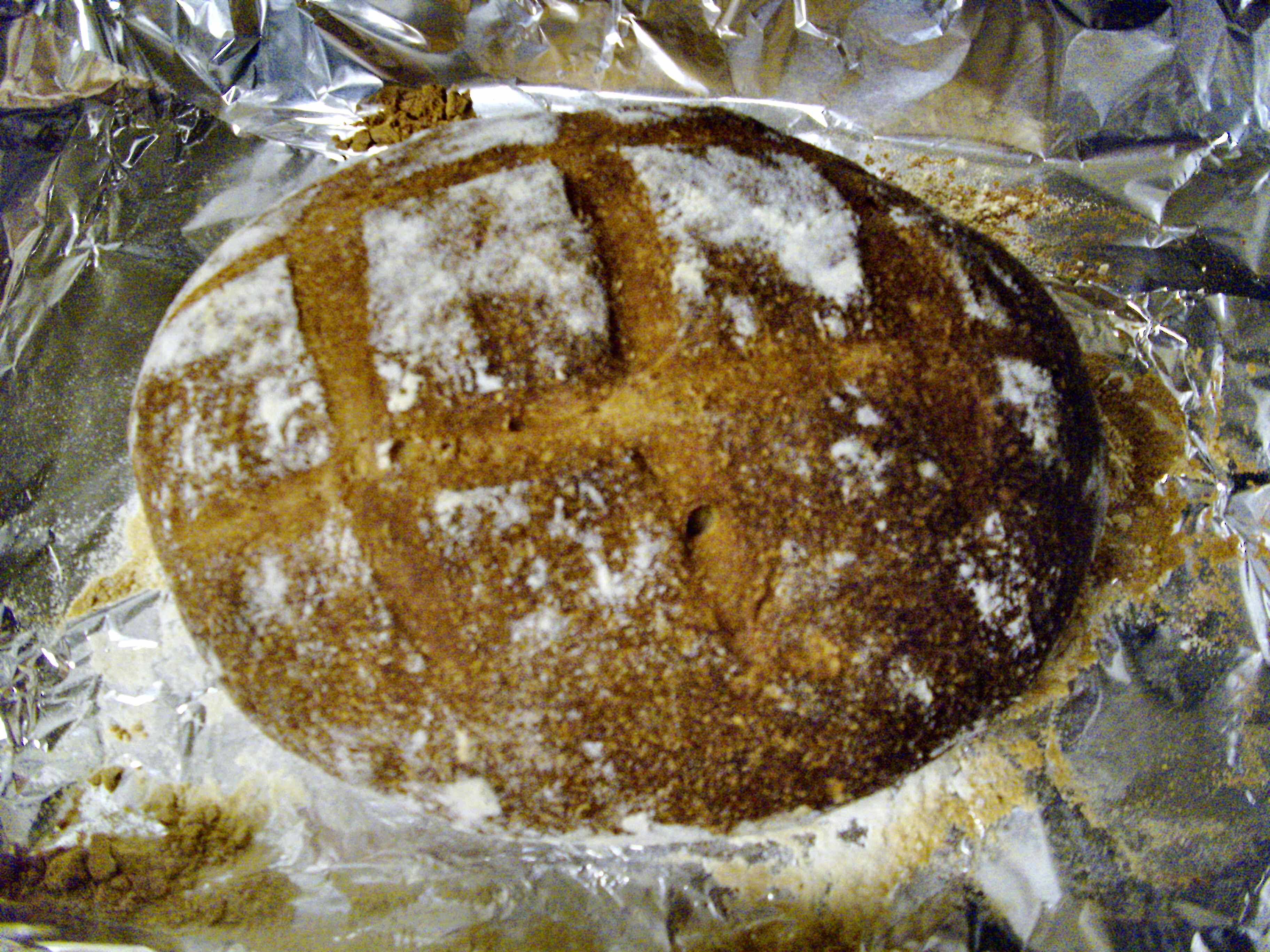
Three Hour Sourdough

I love sourdough–eating it, anyway. Baking? That’s enough of a challenge that I’m elated when it turns out relatively edible. Because even with my standards, which are a bit loose, there are times when the outcome is decidedly not up to expectations. I have trouble getting the dough risen well enough and into the oven before the acid chews up all the gluten. In other words, it tends to overproof and then flop. Few of my loaves–I can face it–have ended up risen enough to consider serving other people, and most of them are a bit coarse inside–partly because I want rye or whole wheat rather than just white bread.

The other challenge is the perennial one for sourdough cultures–it takes several days to build a decent-tasting and stable mix of flour, water, wild yeast and lactobacillus culture with no undesirable bugs or off-flavors and odors. And in the meantime most instructions tell you to take a small bit of the mixture, feed it fresh water and flour, and toss the majority. Wasteful–both of ingredients and time.

So for the past year or so I’ve wondered whether I couldn’t somehow just get a running start past all that by using commercial yeast (a big no-no according to sourdough experts) with some commercial lactobacillus culture–yogurt, maybe?–and flat-out cheating. As in, faux dough. Well, more precisely, perfectly real dough, with a real-enough sourdough taste and texture, only about 4 2/3 days faster. At least. Without just caving and paying 6 bucks at Whole Foods for a small decorator loaf.

Yesterday I wondered it strongly enough to hunt around online and see if the yogurt idea had occurred to anyone else–and it had.

Ladyandpups.com is the food blog of a sometimes cranky, sometimes poetic, impressively prolific and creative baker named Mandy Lee. She has a “fraudulent easy sourdough” recipe that uses more than a cup of plain yogurt with a small amount of yeast and 3.5 cups of bread flour–no added water, apparently–and some salt for a firm dough that rises either 18 hours at room temperature (1/4 t active dry yeast) or 6 hours (3/4 t. yeast) and comes out tasting right and looking beautiful and crackle-crusted via the Jim Lahey no-knead-but-preheat-the-dutch-oven method.

And that’s all to the good.

But I’m even more impatient than that, and most of my sourdough faux pas have to do with letting the dough sit too long before baking. Even a 6-hour rise seems like too much. I also wanted a whole-wheat sourdough (so half whole wheat, half bread flour), which means it’s already comparatively gluten-challenged. So I wanted a really short, sharp rise that would get the dough puffed up and bakeable before the acid got to the gluten too badly. With luck, the yeast would win out just enough to outpace the acid buildup and resulting hopeless flop, but still allow enough to develop a good tang, which is the whole point of sourdough in the first place.

That meant changing things a bit:

1. Less yogurt, only about half what Lee calls for–half would still have plenty of lactobacillus culture to reproduce, but wouldn’t contribute as much acid right up front.

2. Some water to dilute the initial acidity further to delay the inevitable gluten-chewing effect. More water also gets the dough smoother and the gluten developing more quickly even when there’s no acid-producing bacteria to worry about. That’s an added benefit since I was going whole-wheat.

3. Not too much yeast either. Normally, adding more yeast means getting a faster rise. But even 1/4 t. is about what I usually go with for a slower-rising dough with 5-6 cups of flour, and that only takes 3-4 hours to more than double in my kitchen, at least with a hot rise. I didn’t want so much extra yeast at the start that it outcompeted and inhibited the lactobacilli from the yogurt altogether, because no sour culture equals no sour flavor. Continue reading

In search of good rye bread

I’ve been attempting rye bread and kornbroyt (Jewish sourdough whole wheat bread) on and off since about last Chanukah–almost a whole year! You would think this was unnecessary, since I live close enough to North Hollywood/Valley Village, the eastern hub of LA for Jewish bakeries and delis (the older western hub is “the Fairfax” neighborhood and the Pico/Robertson area). The rye bread you can get at these places isn’t terrible; my synagogue orders it regularly along with 6-braid challahs for big events, and it’s okay. It just isn’t much better than Arnold’s or Sara Lee, the lightweight commercial supermarket versions I grew up with in the south when we couldn’t get the real thing from New York more than once or twice a year.

Last spring I bought the big crusty half-boule loaves of wholewheat sourdough from Trader Joe’s to sub in for kornbroyt at a big synagogue brunch and they were wonderful–and also not screamingly high in sodium as most hard-crust sourdoughs are (Whole Foods, most bakeries, certainly La Brea and friends). Certainly less per serving than the French loaves and ciabattas and other items on the gourmet bread stand at TJs. The Pain Mich’ demi-boule was a very good deal all the way around, and I’ve bought it weekly for years.

But shortly afterward, TJs switched bakers and the new ones produced something that only looked similar. The crust was flabby and the crumb was like the stuffing of old office chairs–crumbly and weak, lacking flavor, not springy and full of moxie like the real thing. What could have happened to my favorite shortcut to the good life? They still haven’t fixed the problem. Which is probably at least partly due to an inferior use of sour culture. Or CUL-choo-ah as my mom says (Brooklyn accent hard to miss).

So I was going to have to figure it out for myself if I didn’t want to remain a deprived child.

For the past 30-40 years, according to Stan Ginsberg and Norm Berg in their book Inside the Jewish Bakery, the flavor and texture of commercial rye bread  have really been watered down as companies went national and American-style with it. It became paler and lighter in texture, with less rye flour and more additives–oils, conditioners, salt. And they used commercial dry yeast instead of sourdough culture, which takes too long and for a long time wasn’t generally considered reliable or controlled enough a process for mass production–probably not for FDA and local health inspectors either. So most commercial rye bread lacks the true rye sour starter flavor, and is no longer really chewy or dark. Or crusty. Which is how I want mine.

All of those lost characteristics from my childhood memories of real New York rye bread and kornbroyt, made by local union bakers and brought down to Virginia once or twice a year by my grandparents, have now regained popularity in the US foodie arena. Well, not rye bread as such, but “old world” artisan wholegrain sourdough breads that seek to copy Poilâne’s legendarily crusty round loaf. Enthusiasts bring up a lot of sinister-sounding bakers’ terms: levain, cloak, slash, hydration percentage, etc. And they’ve come respectably close. But they’re still lacking the sign of authenticity: the union label pasted on the endpiece!

One major American bakery to achieve similar cult status to Poilâne is Tartine. Complete with three lengthy baking manuals so far on how to build a sour, incorporate all kinds of grains and let the sour culture digest them for the right number of days until they’re ready to set up as loaves.

The books are filled with gorgeous, crusty loaves that cost a fortune at gourmet bakeries if you can find them at all in your town. But it’s like looking through the bakery window, hungry, with your nose pressed up against the glass. Most people don’t have the singlemindedness to follow all the steps at home more than once, much less for more than one or two varieties of more-expensive, Whole-Foods-only, alternate grain breads.

The books are also filled with testimony as to just how many years it took each baker on the team to fulfill his or her apprenticeship and perfect the technique.

Years, though. That’s a lot of time to get yourself a decent home-baked loaf of rye bread that tastes like it could stand up to corned beef. Which makes me wonder whether a mere cookbook can really teach it.

So why bother (except for the perverse curiosity that drives me to mad-scientist-like experiments that probably won’t win the Nobel this year, or any year)? Because once in a while you want good rye bread even if you live on the West Coast.

Looking at the pictures and even reading the instructions can’t give you the exact right sour or air temp or humidity or other conditions that make Tartine’s bread award-winning. Your yeast may vary. You may not have the same sensitivity in your hands or know exactly how moist or elastic or heavy or whatever the dough needs to feel like at each stage. You have to be willing to experiment and fail a couple of times and pay attention to how it looks, feels, smells, and be willing to fiddle around and adjust the next time.

That’s okay. Perfection is not a Jewish ideal, so much, and rye bread is not so hard to improve with practice. Our great-(great-etc.) grandmothers were making rye bread pretty often in the shtetls with whatever starters they had and could keep going throughout some pretty challenging winters. And every spring they’d have to get rid of their sour cultures right before Passover and start over from scratch as soon as it was over. In Russian-Polish spring weather. (My grandfather always said you knew it was spring when the first oxcart got stuck in the mud. It meant the ground had finally thawed.)

So you could probably figure that the women in the shtetls weren’t always overjoyed to have to throw away their sour cultures every spring, and the first loaves of bread in the shtetls after Passover ended might not have been a lot of good for a week or so extra. Or they could have turned out like my first one, especially if it took an extra week for the miller to supply new rye and wheat flour.

To tell you the truth: getting a rye sour started is no big deal–I seem to have done it on the first try, even while taking the onion shortcut (see the bottom of the post) and being much too casual with the flour and water proportions in Ginsberg and Berg’s rye bread instructions from Inside the Jewish Bakery. It’s just that getting the sour ready for baking takes a while–like 3 to 5 days. And then it gets more refined and hopefully consistent as you feed it sequentially over time. Professional bakers guard their established sours like gold.

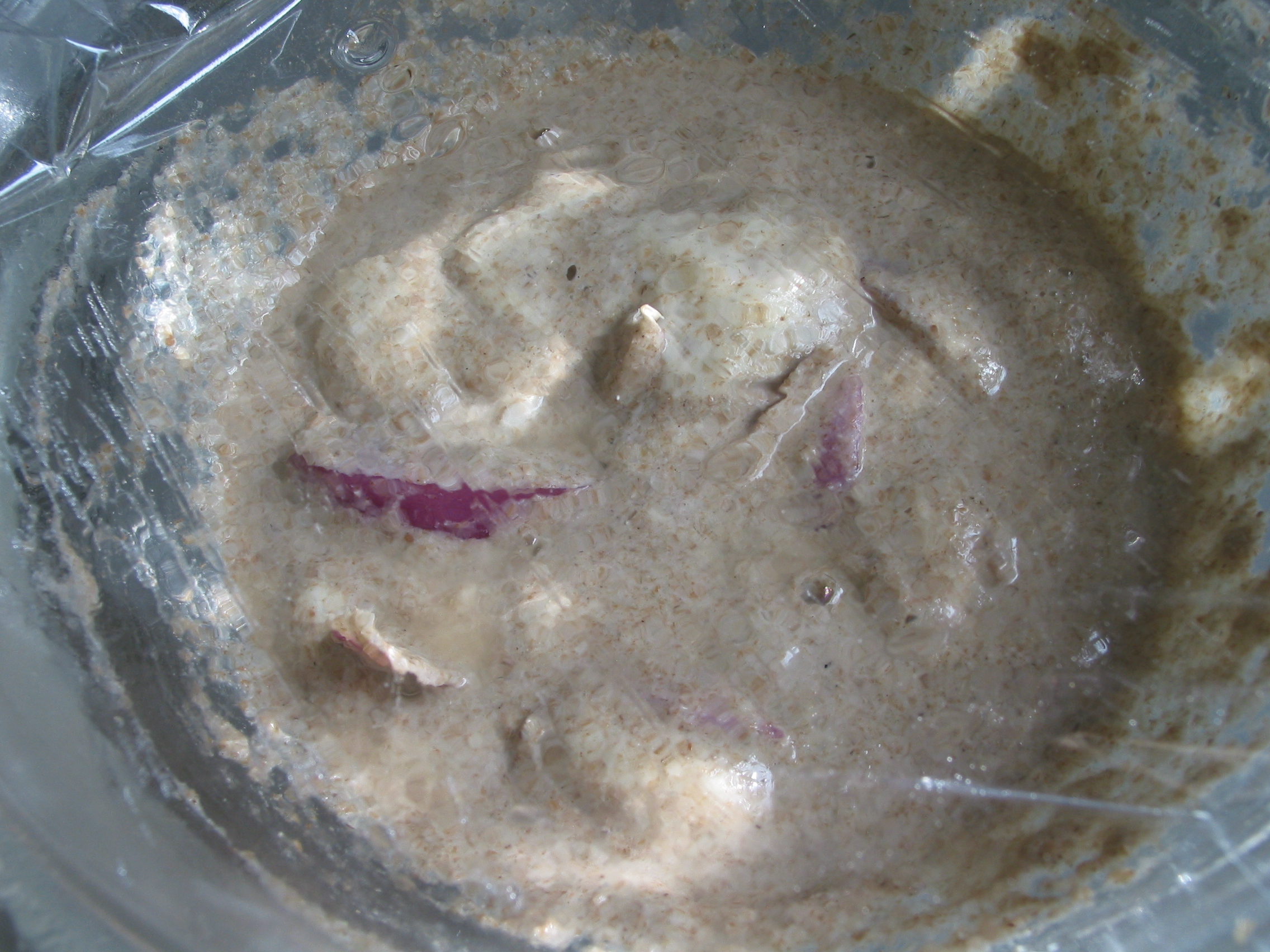
Rye sour getting started with raw onion

Rye sour getting started with raw onion

What went wrong on my first try, right before New Year’s, was that I didn’t put in quite enough wheat flour for the final dough. I was still thinking loose, elastic, relatively wet dough like my usual pizza dough or challah dough, and this needed to be stiffer to match the picture in the book, which showed an actual spherical ball of dough. I figured my usual dough would be a little moister and give nice, big ragged holes–however… Continue reading

An Appreciation of Lox

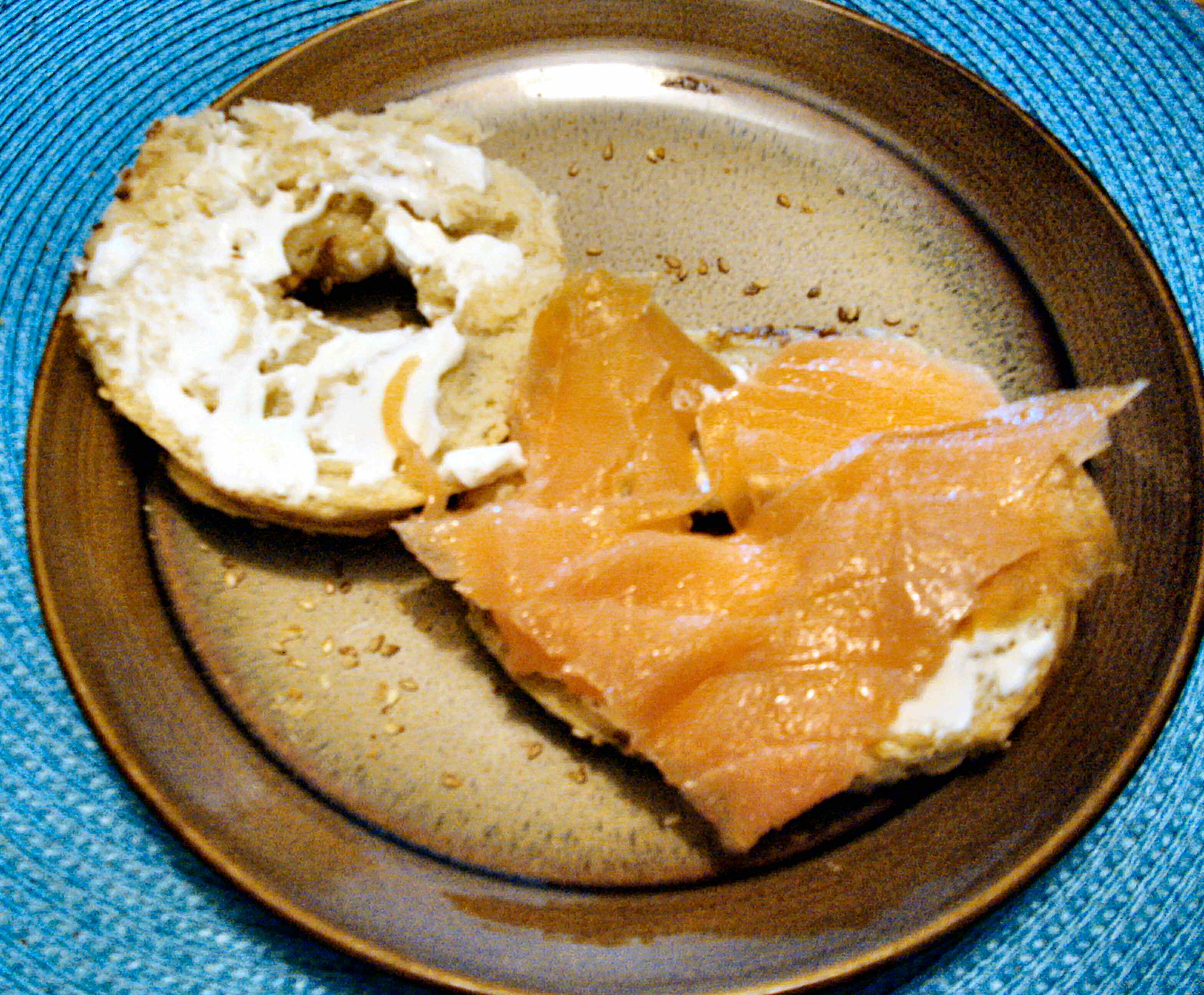
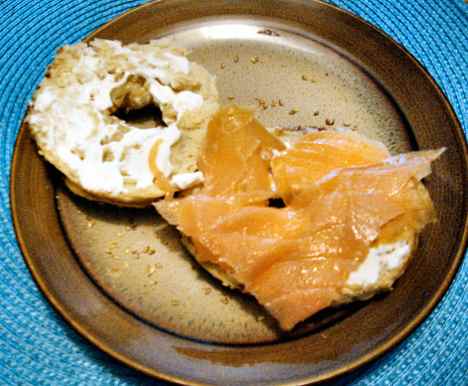
bagel with nova lox

Homemade bagel with nova from a local Los Angeles smoked fish company


For its annual Mother’s Day brunch, the Men’s Club at our synagogue always serves a surprisingly lavish spread with the woiks–lox, bagels, fruit salad, eggs and mimosas. Although I’m not a huge fan of big and slightly-kitschy gatherings featuring big and slightly-kitschy piano acts, I really deserved someone else making me a lox-and-eggs Sunday brunch right about then. But at the last minute I had to miss it in order to hock my kid about her last oversized ridiculous semester projects for 8th grade (due the next day, naturally). Better mothers complained to the principal, who just smiled nicely but did nothing useful. I just figured we’d get through it all so my daughter never had to be an 8th grader again. It worked–salutatorian, even–so, moving on but not required to give a speech: win/win.

But the lost lox! and the not having to cook or do dishes for Mother’s Day! Then I agreed to chaperone a school science camping trip the last week before graduation and  ended up with sand, grime, KP duty, outdoor showers, iffy Boy Scout Camp-style food, and not just one but 32 whole teenagers preoccupied with their hair and late to class.

So now that it’s all over I’m in serious need of payback.

My local Armenian greengrocer has locally-smoked nova lox (they have sable, too–I was tempted) and I had a bowl of dough in the fridge just sitting there waiting to be used up–so I made a few impromptu bagels the last Sunday morning of the school year, as soon as I’d gotten all the sand back out of everything and my kid was done with classes for the year. The bagels weren’t quite as dense as they ought to be because I used my standard pizza/pita/calzone dough instead of the genuine classic, but they did well enough because the dough was several days old, cold-proofed and straight from the fridge, and I boiled them before baking. And there was lox. Throw in a few once-over-medium eggs and some shmear and some fruit and hot coffee and you’ve got the ideal late-spring/early-summer breakfast, even if you have to make it yourself.

Now I know lox is a high-salt item–even the Nova. I anticipate it not for the salt, which I always think we could do with a little less of, but because it’s lox. A delicacy. Something to enjoy on the rare occasion when you get to celebrate. Something to treat with respect.

I’m not going to apologize for enjoying it, either. In the modern world of food publishing, people are forgetting how to do that. Even Jews. Maybe especially Jews, some of whom act as though our traditional deli and “appetizing” (bagels, cream cheese and smoked fish of all kinds) is suddenly something to shove under a rug or apologize for liking on the grounds that it’s not organic or locally sourced or Whole Foods or food-mag-trendy enough, and because it doesn’t include bacon or pancetta. Or kale.

The idea that enjoying lox simply because it’s lox isn’t cool enough anymore has gained a lot of traction in the past few years of foodieism. A couple of years ago, Martha Rose Shulman committed a serious travesty in the New York Times with “Lavash Pizza with Smoked Salmon” (she didn’t even call it lox). Toasted lavash is perfectly good for other things, but not for lox. Too fragile, and frankly too flavorless. I mean, why not rice cakes, as long as you’re being tasteless? But it wasn’t just the bread choice.

Somehow Shulman had abandoned the Joy of Lox. Shulman actually called her lox on lavash “a great way to work more salmon, rich in omega-3 fats, into your diet.” I have to ask, are most of us really having that much trouble “working in” more salmon? More to the point, does any lox fanatic really want to be thinking about fatty acids of any kind while eating it?

But at least she wasn’t agonizing over it as too Jewish. Mark Bittman pulled this inexplicable self-flagellation-in-print a few weeks ago in the New York Times, apologizing publicly for eating lox and bagels on a Sunday morning. In New York, yet. (Maybe it’s because he moved to Connecticut?) He’s kvetching about skipping his morning run, his usually-so-virtuous-but-betrayed-just-this-once-by-shameful-genetic-temptation stance on (gasp) farm-raised salmon, his devouring of shmear, which he says is too bland for the calories to like officially. He even had the nerve to blame his decision to eat it all on a sudden mental breakdown. And then he went further and called bagels and lox “comfort food.” As though it were in the same low-grade category as mac and cheese or mashed potatoes from a box.

Vey ist mir! I mean, come on. I’m pretty sure Woody Allen still eats lox without apologizing for it.

Bittman should be apologizing for being ashamed of enjoying lox (all the while glupping it). Along with apologizing for promoting pancetta and guanciale while professing a greener and more affordable diet. And for forgetting to add garlic to his recipes. That’s almost worse than deprecating lox.

More recently, Melissa Clark met with one of the scions of Russ & Daughters, which by now you’d think was the only serious lox and whitefish emporium left–it’s the subject of a documentary I just missed at the last LA Jewish film festival. The two laid out a spread for at least thirty or forty very lucky people, by my standards, but I think they were doing it mostly for a few family and friends–maybe 10-15 people–and posing it all on the table for the camera. It was beautiful but way too much. At least, though, she was both thrilled and nostalgic, the right way to be when faced with a complete beauty pageant of smoked fish.

Altogether, I could only think Shulman, Bittman and Clark all grew up in big cities with too much lox around. Because when I was a kid in the small-town South, we could only get lox twice a year when one or another set of grandparents came down from New York.

Other people’s grandparents bring toys. Ours brought pastrami, corned beef, half-sour kosher dills, pickled green tomatoes, real bagels, serious breads you just couldn’t get down South, and lox. All of them were special, not just to us but to our grandparents–real deli was part nostalgia, part roots, part pride, part simply great eats.

Pastrami and corned beef to go with the pickles and the tough, chewy pumpernickel and rye with the union label pasted on the end (you were supposed to fight for it)–these were the working people’s foods of their youth on the Lower East Side and the Bronx,  and they still loved them. And so did we.

My mother’s parents, born in the shtetls of Poland and Ukraine, came to America as children and, thank G-d [only instance of poverty being worthwhile], couldn’t afford to go back when their parents got homesick.

Fast forward to the ’70s: My Grandma Thel, short, plump but ladylike, coiffed, and wearing those pale oxford pumps I used to think of as librarian shoes, would step off the little regional plane in Charlottesville loaded down with huge grocery bags full of chewy, crackle-crusted bagels, Jewish kornbroyt or “corn bread” (a heavy European wholegrain sourdough; no actual cornmeal except what’s dusted on the baking sheets to keep the loaves from sticking), rye bread laced with bitter caraway seeds, sometimes a babka, and always, a huge half-wheel of her own light chocolate-flecked sponge cake (for which I’ve inherited the recipe but haven’t tried it yet–will post when I get it right). I hope the other passengers were smart enough to be jealous. The aromas alone should have clued them in. Grandpa Abe, of vishniak fame, was a lucky man.

On the drive home from the airport, Grandma Thel would tell me and my sister how she just managed to argue another customer at Andell’s or Goodman’s out of the last loaf of kornbroyt with seeds because she was bringing it down to her very special grandchildren so we would grow up knowing the real thing, and that the other lady Continue reading

Post-Kiddush: our leftovers are better than yours

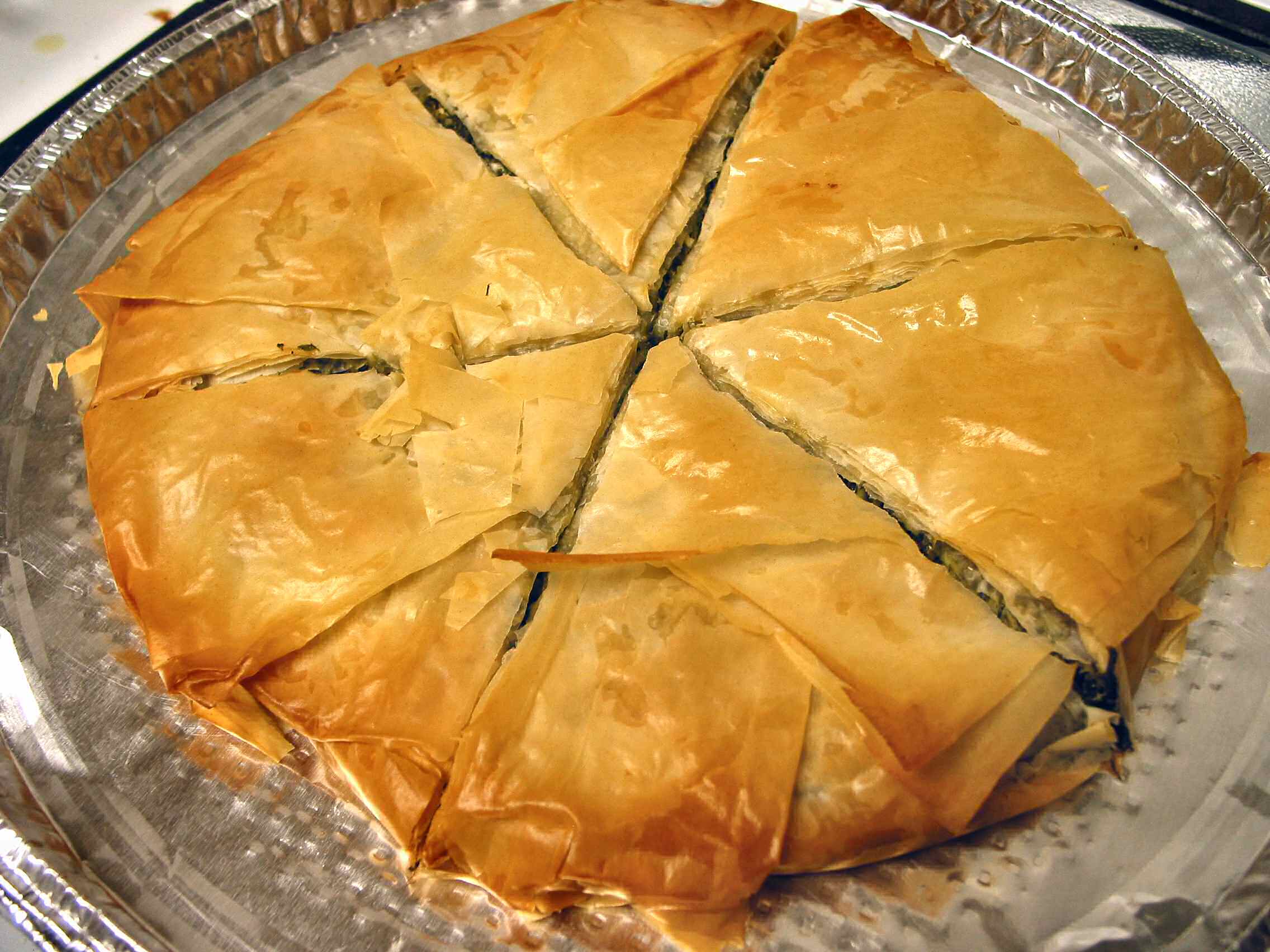
Round spare spanakopita just for us after the big kiddush

Round spare pinwheel-style spanakopita just for us at home. The big ones for the brunch had three pounds of spinach apiece (and were cut in small diamonds), but they still went together pretty fast–except for squeezing all that spinach dry…

This weekend I did it again–I made the kiddush, or in common speech a lunch buffet, for my congregation’s Saturday morning service. My husband kind of volunteered us for this week and because he doesn’t cook, most or all of the cooking, shopping, chopping and schlepping landed on my shoulders.

Last time he volunteered us, it was for our anniversary, and  I was ready to skip ahead to the divorce until I got over it, because it’s a lot of work to cook for 60 or so people who like to eat. And kibbitz. Especially when the 60 suddenly turns into 80-plus and having to use the synagogue kitchen with the more complicated and confusing rules on only a week’s notice. As they did this time…..

Soooo….a two-day hell of shopping and then marathon cooking-and-juggling in my little galley kitchen. The microwave got a serious workout. So did the food processor and the oven. Sometimes all at once. And it was raining hard for three days, so bringing things over to the synagogue kitchen as I went got a little tricky. I triple-wrapped the chocolate cake and stuck it in a USPS Priority Mail box so it wouldn’t get left out in the rain. Same idea for the spanakopita trays.

A few hints about cooking big and real for a synagogue brunch, learned the hard way by moi and passed on for your edification and safety (and sanity):

1. You can buy a 6-lb can  of chickpeas for massive half-gallon batches of hummus (Mid-East brand, maybe Goya as well). Cost? about $5. But–as I found out, and I’m glad no one was filming the process–industrial-sized can equals industrial-strength steel. A dinky hand-operated can opener is no match for such an item. I got just far enough to be able to pry open a kind of spout but there were tears and long-fluent-repetitive-all-throughout-the-house swearing sessions involved.

Still….

2. If you have a good corner greengrocer, you can buy quantities of eggplant for cheap–eleven or twelve eggplants made for a large tray of roast eggplant and onion slices (with garlic slivers and za’atar sprigs and olive oil) plus a large vat of baba ghanouj. Only the five eggplants I nuked for the baba ghanouj didn’t feel like cooperating fully when it was time to peel them. Might have been easier to peel first, then nuke, since it was all going into the food processor eventually. Next time…

3. Whole smoked whitefish for whitefish salad comes two ways–cold-smoked or hot-smoked. What’s the difference? I asked the counter guy at my favorite Armenian grocery. “Cold-smoked is a little less hard,” he said. So I bought it, thinking he meant the hot-smoked was tough as shoeleather and twice as chewy. I was wrong. Cold-smoked actually means the fish is smoked raw, like lox, only a little drier and tougher. But you don’t necessarily want to put it in whitefish salad that way. Man, it still had the scales on too. I couldn’t get it off the bones for love or money, and there were a lot of bones.

However, the microwave came to the rescue. I cut the fish in half and Continue reading

Baking with “Inside the Jewish Bakery”

A few weeks ago I reviewed Stanley Ginsberg and Norman Berg’s new book, “Inside the Jewish Bakery” for my local Jewish book festival committee by testing out the key recipe: bagels. Ginsberg and Berg give the inside scoop on what bakeries do and don’t do to make things work better than you usually can at home. Along the way–and the most interesting part for me–they give a huge helping of Jewish Bakery history. Not just nostalgia (“Weren’t those marble ryes worth wrestling over?”) but the fascinating cultural developments that gave rise to such things the Bagel Maker’s Union (local 338 [number corrected thanks to Stan Ginsberg]) in Brooklyn, and they’d break your legs if you tried to make nonunion bagels, at least through the 1960s.

Ginsberg’s the son of a baking family and Berg is a professional baker; between them they tell the story of Ashkenazi baking and the inside story of what it’s like to start work at 10 pm and head for home around 7 in the morning, all the while giving what turn out to be great technical baking notes.

And yet the recipes themselves are full of errors–and yes, this is the print edition we’re talking about, not an advance reader’s copy. The authors have a 6-page correction sheet (errata) up on the book’s web page, so if you’re going to get to it and try it out–and why not, if you’re ambitious about baking–check it out carefully against the recipe in the book, read everything over very carefully first, and then get to it in a way that won’t send you scurrying for specialty ingredients. NOTE: per Stan Ginsberg (see comments below) the 2nd edition’s recipes have been corrected so things should be easier.

If you can read between the lines and have some experience with bread under your belt, you’ll find the recipes do work (once corrected). My bagels came out very well, with that crunchy crust and dense, chewy bite all of us ex-New York types have missed for decades out here in California (actually, I’m posting this from Montreal, where the bagels are lighter and sweet? have to try, probably won’t love them).

I do have pictures to post (once I can get home and edit them down) of the bagels proofing slowly overnight in the fridge and one of the last remaining survivors–my daughter still had it in her bookbag when we came east this week. Ten days, obviously not still fresh, but not spoiled either. As tough as the dough it came from (which, again with the asides, is very tough compared with regular pizza or challah doughs, and you have to knead it by hand unless you have the dough hook of the century. If not, you’ll develop the right hook of the century.)

So here are my notes to the local Challah Club, which was interested in trying out some of the other recipes. Good luck and eat nice!

Notes for the Challah Club members up for a challenge:

1. Read all the instructions several times first and double-check the errata sheets. It’s 6 pages of corrections for the whole book and it’s up at the Inside the Jewish Bakery web site under a top menu link on the right (Errata). Hopefully we can get the second edition in soon.

The book web site also has lots of info, interviews, links to other related stuff.

Also check notes on special ingredients in the front for unfamiliar names–diastatic malt in the bagels and elsewhere is defined up front; it’s just malt. I think they get a little technical on flour grades–they’re tied in with an aggressively technical bakers web site/forum (NY Bakers, you don’t expect them to be laidback, do you? but most of it’s just futzing around with professional stuff). Chernushka seed is nigella seed–available here at the Armenian groceries. And then do whatever makes best common sense and doesn’t have a huge cash layout just for one loaf!

2. The recipes in this book are weighable on a food scale in grams, which is how I did the bagels (just this once, just to see if it needed me to be that nerdy). Some of the flours are technical grades beyond what you can easily get in the grocery store; you can mix flours to get the right consistency. For example, bread flour is 13% protein, but I added a teaspoon of vital wheat gluten to bring it up to the 14% protein specification for the bagels, and for something that really needed stretch, like rye, maybe, I would have added a little more. Don’t know that you really need to, but if you’re gonna be nerdy, a food scale and a calculator are handy tools.

3. If you go for the pastries, some have a mix of butter and shortening-plus-butter-flavoring. I’m not a shortening fan; I’m just not; I prefer butter or margarine. The laminated doughs add these things in stages, so read the errata pages and double-check the recipe instructions for how much fat to put into the pastry dough when. Gets confusing occasionally.

4. One thing that’s not in the corrections pages: watch the salt. You do not need as much as they throw in for the breads–not for flavor, not for texture. The bagels I made with only half the salt in the recipe because the original would have been 400-500 mg. of sodium per bagel, which is getting up into Campbell’s Tomato Soup territory (or half a South Beach Diet frozen microwaveable “lunch”). And they tasted fine without it and did most of the right things without me having to join the bagel-makers’ union.

Lightening up homemade scones

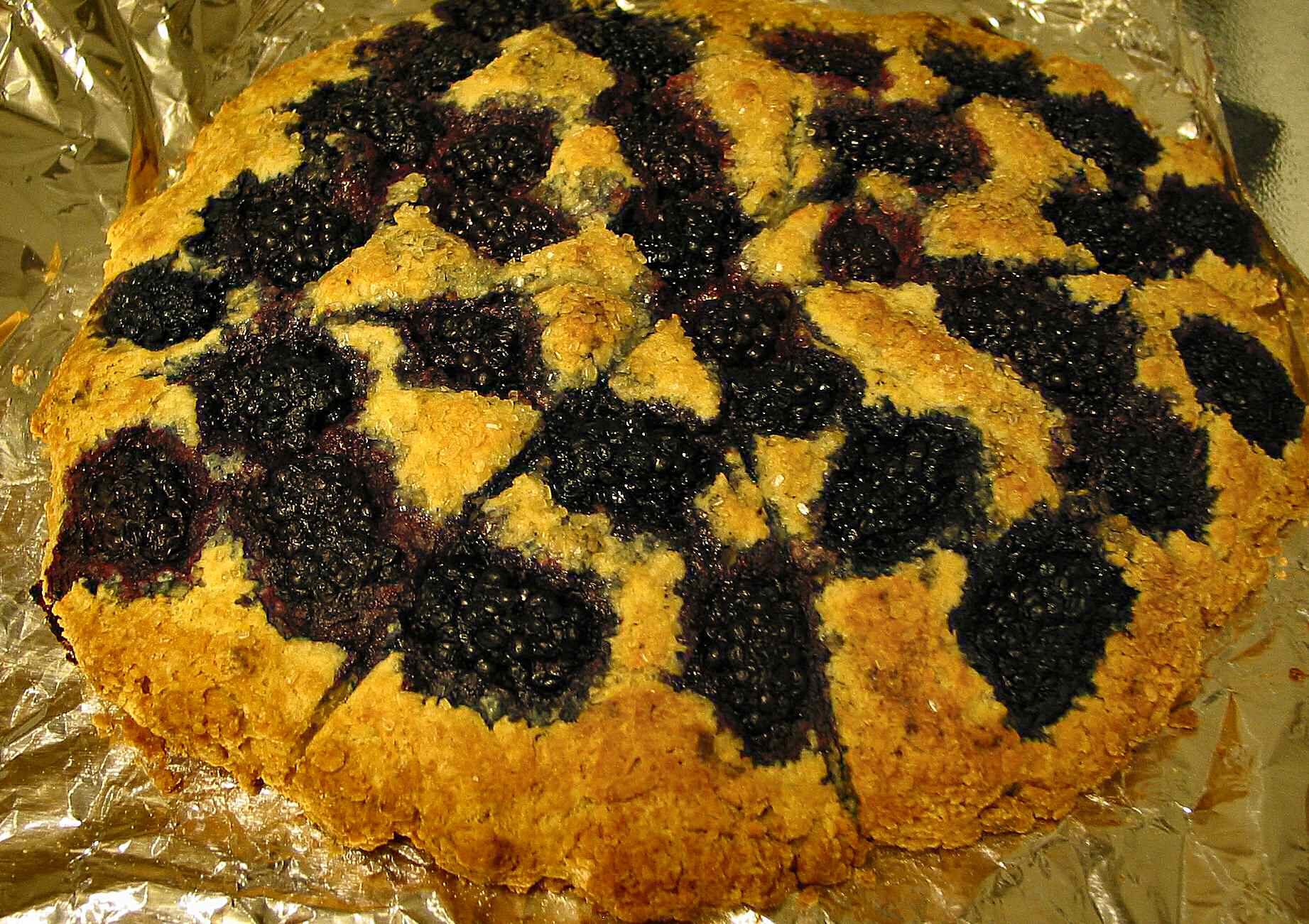
Blackberry scones for brunch

I’ve been wanting to post my favorite scone recipe for some time, but it seems to me that most food blogs start out with good intentions and end up maxing out on the desserts-and-starches end of the food spectrum.

The reason is pretty simple: if you’re a food blogger,  a baking recipe and a pretty picture (or any picture of an aggressively-frosted cupcake) will never put you wrong, even if the real result tastes kind of blah. I mean, cupcakes? Isn’t that what Duncan Hines is for? But if you do feature cupcakes, somebody’s sure to repost it or call it awesome, particularly if you figure out how to add bacon to it. Somehow people just don’t flock to posts about green beans in droves unless you’re redoing the Thanksgiving-straight-from-the-can classic, complete with canned fried onions.

There are way too many variations for every kind of baked good, none with a clear and permanent advantage, and people take them all literally (see under, my New Year’s apple pie insecurities).

So as I say, I’ve been reluctant to put up too many baking posts. Scones, though they’re not exactly the staff of life, are very easy to make and actually taste best when you make them from scratch–much better than buying them in a store and definitely not at your local Starbucks. The question I have is whether it’s a good idea to do it very often–I usually don’t, even on the weekend, but partly that’s because I live in southern California and heating the oven for more than five minutes in my little galley kitchen is often a Very Bad Idea. The other reason is that I keep remembering something Valerie Harper once said (maybe in the role of Rhoda Morgenstern; can’t remember): “I don’t know why I bother to eat this piece of chocolate cake. I should just apply it directly to my hips.”

Most quick breads (i.e., raised with baking soda or powder, or beaten egg whites, not yeast) do fine in a microwave as long as you don’t need them to brown. So lemon-poppyseed cake is okay, as is gingerbread. Scones, which to my mind require a deep and crunchy crust, need a regular oven to do well, but I make the sacrifice (90-degree weather makes it a genuine sacrifice) once in a while on Sunday mornings, because they taste terrific and they’re not exactly rocket science to make.

So if they’re that easy, should I really be posting about them–haven’t you already seen too many wide-eyed, “Look, Ma, I made SCONES!” kinds of posts?

Let’s face it. You can make great scones in a food processor from a very short list of ingredients for cheap, in about half an hour including baking time, and flavor them simply or exotically. Fruit or chocolate chips or chiles and herbs and cheese–all optional. I stick with berries and turbinado sugar, which makes the crust crunchy and glittery. Continue reading

A Handful of Farina Breads

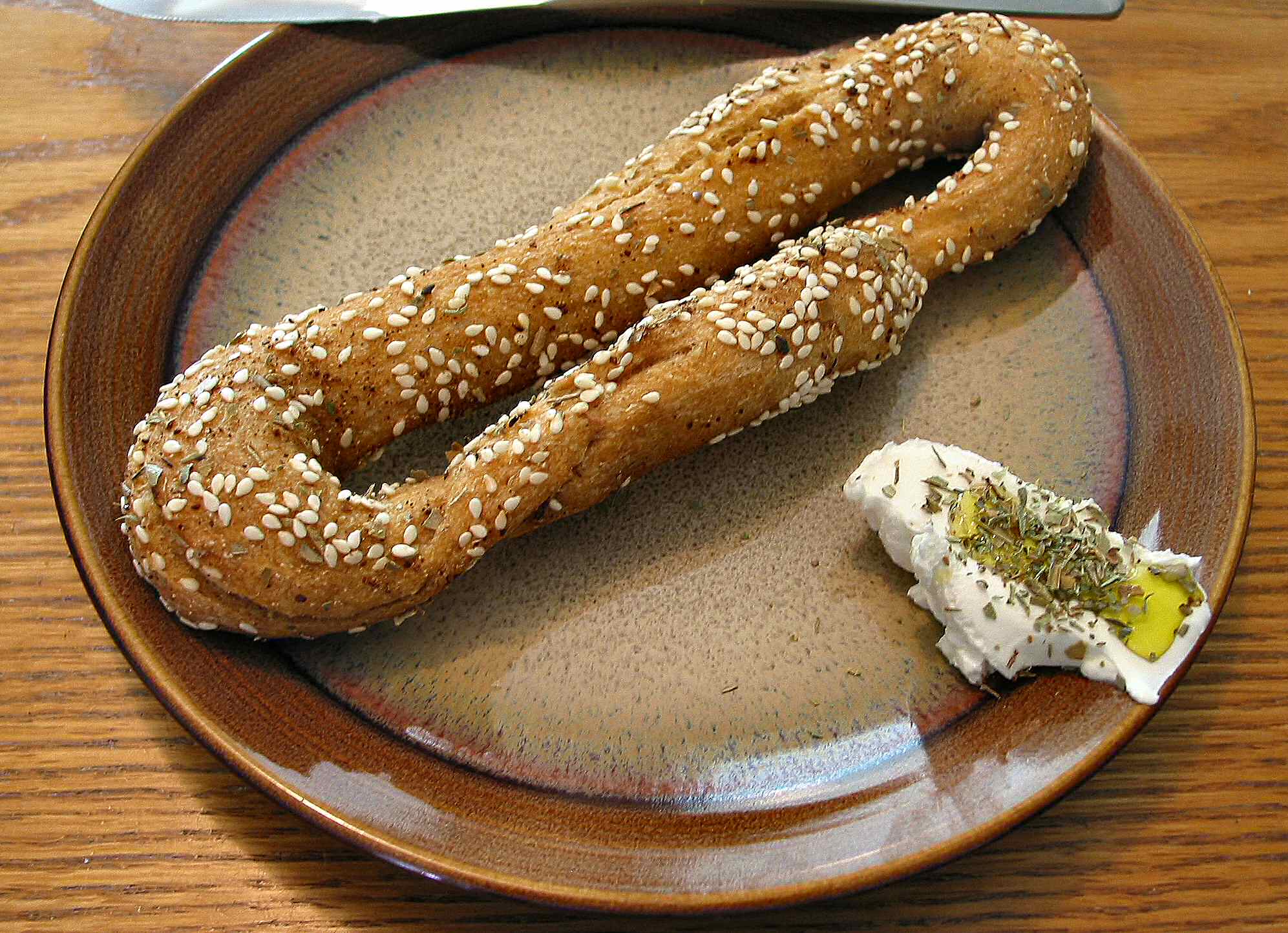
Simit bread or "beigele" with labaneh and herb spread

It’s been a couple or three weeks since my last post. I am currently in the desperate process of using up as much hametz, which is flour-yeast-bread-beans-lentils-rice-pasta-fillo-dough-oatmeal-etcetera, as possible before Passover. Right after Purim  I discovered I still had about 5 sacks of dried beans and lentils cleverly saved up and a sack of whole wheat flour and a 2-lb. bag each of bulgur AND farina! And a pound of wild rice. And a new bag of soy flour. Most of all which I couldn’t donate to the food shelter because it was either bulk or partly opened. Yeesh. What’s a girl to do?

Well…we’re certainly going to find out in the next couple of posts, aren’t we?…Even my suddenly-vegetarian daughter–yes, the very same one who kept bugging me about why I wasn’t cooking enough chicken for her last year–is wondering whether she has the stomach for more black bean burritos in the next two or three weeks (her conclusion: as long as there’s chipotle salsa around, what’s the problem?) My husband is looking at both of us cross-eyed.

Okay, then. Project #1 (well, after the pot of black beans, anyway; those were pretty standard and don’t call for a post): bread.

Long, long ago, in a kibbutz kitchen far, far away, I made some bread for my parents, who were coming to Israel for a visit during the year I was there. December in Israel–drizzly and cold some days, bright and cool others. You never know what you’re going to get.

But I’d missed my parents dearly for half a year. To celebrate seeing them I had in mind something like one of the blackish poppy-filled strudel I’d seen in a Romanian bakery in the middle of Haifa’s downtown “Hadar” shopping district amid the felafel stands and bookstalls. Only I wanted something not sweet, and with a better dough. A savory bread, like a bialy but with poppy seeds. So onion and maybe a little parsley or dill, now that I’d worked in the side kitchen for 5 months and knew the Hebrew names for both herbs.

I decided on a basic bread dough, flour-water-yeast-salt with a bit of oil. I rolled it out flat into a long rectangle and filled it with chopped, fried onions, parsley, dill, thyme and salt (it actually had too much salt, to my embarrassment, but my mother loved it anyway) and a couple of handfuls of poppy seeds. Then I rolled up the column of bread, twisted it around itself into a longish double rope, glazed it with egg yolk and baked it. It was pretty good and looked impressive. And it was really easy. My mother ate it all week sightseeing while my dad was at his conference.

Those days are gone, but a recent trip my husband took brought back the memory along with a couple of loaves of multigrain herb bread from a traditional German bakery he discovered in Tehachapi. The breads lasted an entire week at room temperature (of course, our humidity’s so low in Pasadena that this may be an exception) without seriously high salt in the dough, and every time we passed the dining room table, the aroma of dill and thyme and scallions and sourdough made us want to tear off a chunk to eat just as-is.

Two weeks ago was Purim, the feast of lots (as in drawing lots to determine someone’s fate, not lots as in lots-of-hametz-to-use-up). It’s the holiday from which we get the term “the whole Megillah”–the Megillah being the Scroll of Esther, a long Scheherezade-style story set in Persia and very long to read out loud in one sitting to a large congregation while they cheer the heroes and boo the villain (also Scheherezade-style, it’s the wicked vizier–am I giving anything away? It’s always the wicked vizier, except when it isn’t. And did I mention it’s kind of long? Okay, then).

So anyway, I decided to make some of this scrolled bread to give as Purim shalachmones–food baskets sent to friends, but didn’t get that far this year. Hamantaschen was about the limit of my ability, since it’s also get-your-kid-into-a-decent-school-for-next-year lottery time.

Usually these days the mishloach manot (same term, without the Yiddish accent) are candy bars, bagged snack foods, and maybe some raisins or an orange to round out the “3 different foods” custom. Occasionally you still see hamantaschen but the junk food factor has really taken over very sadly, I gotta say, even if it’s Israeli junk food. I mean, okay, felafel-flavored Bisli is fun once, but it’s really not much better than Cheetos, except that the wrapper is a good exercise for my daughter’s Hebrew reading skills (especially once she figured out which word meant “carbohydrates” on the nutrition label).

Nobody on the west coast even makes poppy seed hamantaschen anymore, to say nothing of prune lekvar filling, the two classics of my childhood. It’s a cultural deterioration I aim to remedy. Maybe next year–but for now, this weekend, with a container of poppy seeds still in the freezer, I’m thinking about making the bread, since it’s delicious, also involves poppy seeds and is unlike anyone else’s. And because I have flour and yeast to use up before Pesach, which is now right around the corner.

So I started pulling the flour off the shelf and realized I’d used up all the bread flour for hamantaschen but I still had a good 3-4 pounds of whole wheat, which wouldn’t make a good bread all by its lonesome. And on the other hand, I had both bulgur and farina–bulgur for tabbouleh or a wheat version of polenta, but farina–2 pounds of it. Well…it’s wheat and fairly fine. Maybe if I ground it up a bit further in the coffee grinder? I did, though the end result seemed less than convincing that I’d made any difference in it at all. Still pretty grainy. Dumped it into the food processor anyway along with an equal amount of whole wheat flour, some yeast, a little salt, and enough water for a fairly stiff but elastic ball of dough once it was processed.

The dough was pretty heavy to lift out and the farina absorbed a lot of water but it did seem to be developing some stretch, at least. I let it rise overnight in the fridge and started testing it out the next day. Continue reading

Raw Dough Carbs: Playing for Pizza, Calculating for Calzone

calzone

Calzone–one of my favorite Italian dishes–is extremely easy to make once you’ve got some basic pizza or bread dough risen and ready to shape. Flatten out individual rounds of dough, mix up a ricotta-based or roasted vegetable filling, fill and fold the dough over into half-moons, crimp the edges, brush with olive oil, and bake on a sheet in a hot oven until they’re puffed and golden. A satisfying but fairly light supper dish, especially if you have a good thick spicy tomato sauce to go with it and a salad on the side.

But even if you don’t, they’re a good consolation on a Sunday night for a kid with frustratingly advanced math homework the teacher didn’t quite prepare himself or the class for (11th-grade precalculus techniques popping up in a sheet of homework for 11-year-olds? The dangers of pulling your homework handouts from a math site on the internet. I keep reminding myself that he’s young yet). All I can say is, you know you’re in trouble when the heartburn is coming from the homework and not the food.

Grrrr. I’m almost over it. Anyway, here’s a much easier calculation trick that doesn’t require factorials…

The trick about making dinner from homemade dough is that the kid in question is diabetic and needs to know how many grams of carb she’s going to get in her calzone. Pizza, calzone, any kind of handmade entrée with dough plus noncarb ingredients, is tricky to calculate carbs for because you can’t easily tell by eye how much bread you’re getting in a serving. Check out any of the commercial pizza companies’ nutrition stats per slice–they’ll often state carbs as a range rather than a set value. How thick the dough is, how large the slice, etc, can really throw things off. Most people don’t need to know more precisely than “35-50 grams per slice”, but diabetics really do. Fifteen grams is a pretty big variation.

So how do you deal with it at home? If you’re making lasagne or stuffed shells or spanakopita, you can calculate the carb by counting the noodles or sheets of fillo dough you use and looking on the package nutrition label, then figuring a total carb count for the tray and dividing by the number of portions. A little tedious, but manageable.

Bread that’s already baked is also easy enough to calculate for–just weigh it out on a food scale in grams and figure 50 percent carb by weight. Most nonsweetened bread is pretty consistent, whatever density its texture. Weigh out a 70-gram piece of bread, and you’re usually looking at 35 grams of carb.

But for calzone or pizza you’re dealing with a bowl of wet dough to start, and once the dish is baked, it’s got lots of other stuff on or in it so you won’t be able to weigh it cooked and really know what carbs you’ve got. You need to test a portion of your raw dough, only raw dough is heavier than it will be once baked. Depending how wet the dough is, the proportion of carb could vary from a little less than half to a lot less.

Weighing a sample of raw dough to figure carbs after baking

Weighing a sample of raw dough to figure carbs after baking

The only thing to do is test a bit of dough by weighing it out raw, then reweighing it once it’s baked. Doing this in a conventional oven just for a single test ball of dough can be time-consuming unless you’re already heating it for the main event. Still, you want to get ahead with making the actual calzone so dinner will be sometime before midnight.

Enter the microwave. Yes, really. A nectarine-sized ball of dough, say 100 grams raw weight, will cook through lightly in 40-50 seconds in the microwave if you put it on a saucer and punch the “nuke” button. It’ll still be white and pale, but it’ll have risen fairly well to the size of a large dinner roll and won’t have gooey raw spots (you can check by breaking it open, just watch out for steam). Then just pop it in the toaster oven for about 5 minutes and it’s browned and baked through. When you reweigh it, you’ll know how much a 100-gram ball of your dough weighs cooked, and then figure 50 percent of that weight for carbs.

Aside: This nuke-and-toast scheme works pretty well for making a fast sandwich roll from a bowl of dough in the fridge. When I first came up with the idea, it was with great reluctance, because my only previous experience with microwaving bread had been the horrible, horrible mistake of Continue reading