
• Enter your email address to subscribe to this blog and receive notifications of new posts by email.

    Join 241 other subscribers
  • Noshing on

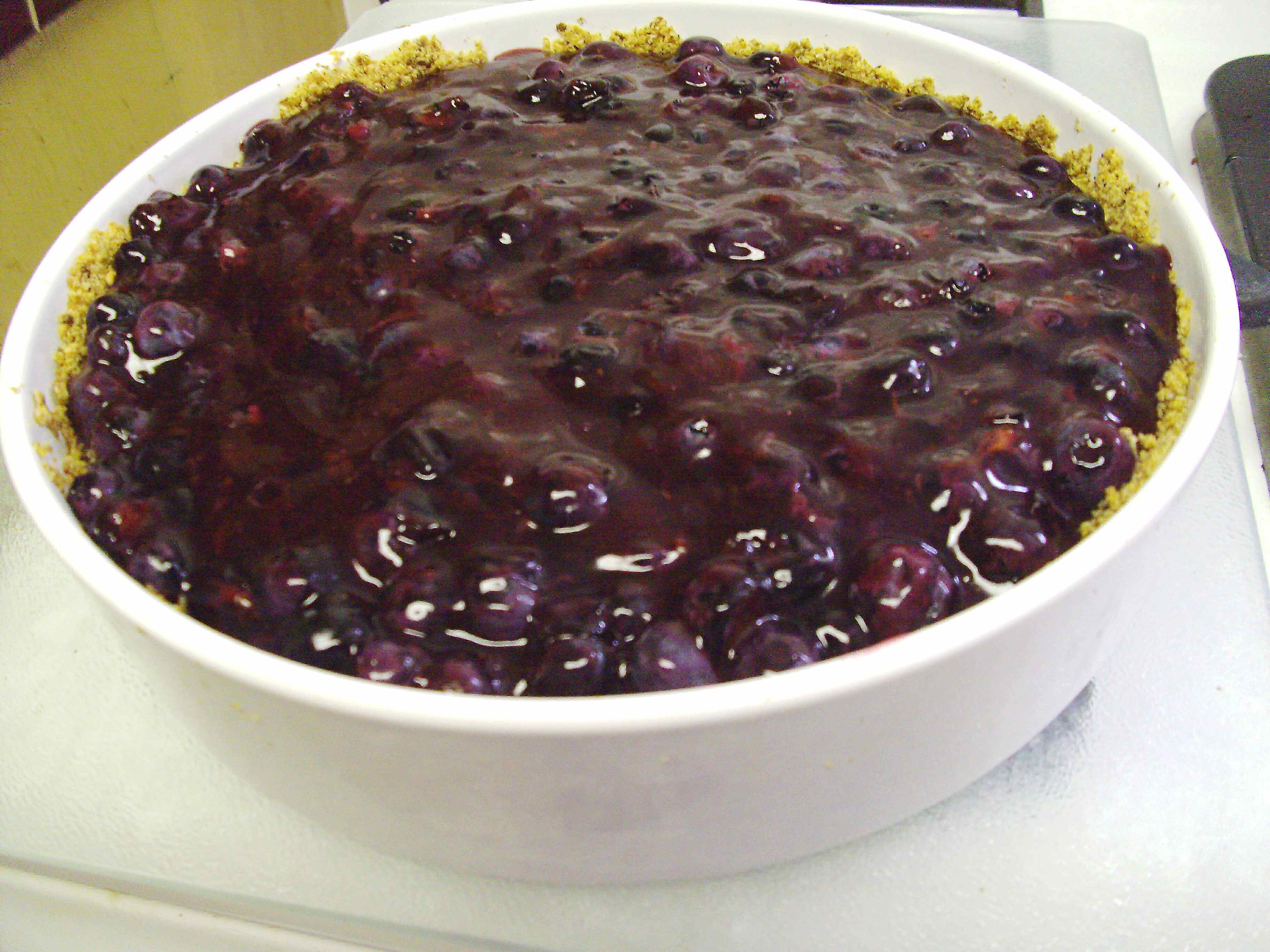
    raw blueberry pie with microwaveable filling and graham cracker crust

    This mostly-raw blueberry pie is a snap to make and very versatile--the filling microwaves in a few minutes, and you don't even have to bake the zippy gingered graham cracker crust--perfect for a hot Fourth of July and all summer long.

  • Recent Posts

  • Contents

  • Archives

  • Now Reading

  • See also my Book Reviews

  • Copyright 2008-2024Slow Food Fast. All writing and images on this blog unless otherwise attributed or set in quotes are the sole property of Slow Food Fast. Please contact DebbieN via the comments form for permissions before reprinting or reproducing any of the material on this blog.

  • ADS AND AFFILIATE LINKS

  • I may post affiliate links to books and movies that I personally review and recommend. Currently I favor Alibris and Vroman's, our terrific and venerable (now past the century mark!) independent bookstore in Pasadena. Or go to your local library--and make sure to support them with actual donations, not just overdue fines (ahem!), because your state probably has cut their budget and hours. Again.

  • In keeping with the disclaimer below, I DO NOT endorse, profit from, or recommend any medications, health treatments, commercial diet plans, supplements or any other such products.

  • DISCLAIMER

  • SlowFoodFast sometimes addresses general public health topics related to nutrition, heart disease, blood pressure, and diabetes. Because this is a blog with a personal point of view, my health and food politics entries often include my opinions on the trends I see, and I try to be as blatant as possible about that. None of these articles should be construed as specific medical advice for an individual case. I do try to keep to findings from well-vetted research sources and large, well-controlled studies, and I try not to sensationalize the science (though if they actually come up with a real cure for Type I diabetes in the next couple of years, I'm gonna be dancing in the streets with a hat that would put Carmen Miranda to shame. Consider yourself warned).

Stuffed Eggplants with Quince, A Vegetarian Odyssey

Stuffed Eggplant with Quince and Stuffed Onion Rolls

I did it. It was 90+ degrees outside yesterday afternoon and felt a lot hotter inside when I started cranking the oven to try this dish right away rather than wait for the weekend, but I’m just no good with delayed gratification.

If I have the mini-eggplants and I have the quinces and I have the tamarind concentrate (homemade! two days ago! it’s practically crying out to be used already!) and I have the “hashu” filling for the vegetables sitting in the fridge smelling wonderful, then it just doesn’t matter that Rosh Hashanah dinner is in what, maybe 3 hours, and I still haven’t braided the challot, to say nothing of baked them. Obviously I’ve gotta try this extra-credit dish out RIGHT NOW.

Actually, I figured the house was going to be heating up anyway once I started baking the challot, so why not get it all over with at once?

There was a more serious reason to try it. Today in services I was still thinking about Dweck’s book and her recounting of her parents’ horror in 1947, when, about to return from a vacation in Europe, they learned the government back home had started massacring whole Jewish communities in reaction to the announcement that the UN had accepted Israel as a Jewish state.

The Syrian Jewish community fled wherever they could–just as my family did under the pogroms in the Ukraine back in the 1880s and 1920s. Dweck maintains that the reception the Syrian Jews got in the US from those of us who were already here was so aloof–they didn’t speak Yiddish, they didn’t look the same, they did a few things differently for kashrut and prayers–that her community kept to themselves ever after.

I can believe it, unfortunately–the period right after World War II and the Holocaust was one of paranoia and circling the wagons for American Ashkenazim.

Eastern and Western Jews had similar discomfort with each other in postwar Europe. Reading between the lines a little in Claudia Roden’s and Colette Rossant’s memoirs, the two, who had just lost everything, thought their new Ashkenazi neighbors were cold and inhospitable and indifferent to their exile; the Ashkenazi neighbors and relatives, meanwhile, thought the wealthy young Egyptian arrivals were horribly spoiled and indifferent to the European disaster they had just missed. Altogether, the Ashkenazi, Sephardi, and Mizrahi communities were in closer touch before World War I than they were after the 1940s.

I can only hope that now, 60 or 70 years on, we have more in common and more regard for each other, no matter where we came from. Israel’s great mix of cultures has been a good influence, even though it originated in hardship, and perhaps today we are in better shape to appreciate what we have in common than we have been for nearly a century.

When I look through Dweck’s family’s photos, I see so many people who look astonishingly like several members of my family–my dad and my sister especially. The dignified lady presiding at the seder table on the front cover is a shockingly exact adult version of a girl I knew from my synagogue’s youth group–it’s the sturdy mouth and chin and the set of the eyes, certainly, but also the irrepressibly thick and curly hair (the 1920s formal chignon has it all over my friend’s 1970s braids, which took her hours to corral her hair into). The formal photographs of families in the 1920s, all the daughters dressed beautifully but in the same fabric the mother is wearing, sailor suits on the boys, stern dignified expressions all–I’m pretty sure each of my grandmothers had at least one of those in her collection. The 1930s-era engagement portrait with pearls and bobbed hair–so modern! Pin it up next to the one of my dad’s parents, who married in 1939 and looked so incredibly naive and young then. The family gatherings at Pesach, grandma presiding over the white lace tablecloth and all the seated cousins glancing behind them at the camera from over their shoulders–there’s probably one or two with my mother as a toddler on someone’s lap in Brooklyn and another of her as a teen, whipping her glasses off and blinking myopically for the photo. It could be any of our families. It could have been us in Syria and Egypt and Turkey, it could have been them in the Ukraine or Germany or Poland. We none of us have entirely safe histories, and none of us are entirely separate.

In any case, Dweck’s book is important to me not only for capturing her community’s traditions, tastes and history but for reaching out to the rest of us and giving us a chance to share it, compare it with our own, and reconsider what it means to be part of the Jewish world now.

So–and this is not to trivialize but to explain, since we sometimes live and remember through food, especially at the holidays–it was a great time to try out a challenging dish (challenging for me, anyway) from her book and serve it last night to my family for Erev Rosh Hashanah. I cook from scratch, I cook a lot, but I’ve never really done  the legendary great-aunts-at-Pesach kind of slow cooking where everyone groans in pleasure and declares “nobody does it like this anymore” when they taste it. I’ve only once cooked a whole turkey, and I’ve rarely tried anything else that took more than an hour and a half to cook. It’s a transformative experience, one that teaches me a lot about my great-aunts and great-grandmothers, both in the shtetls with the wood-fueled pripitschoks and communal ovens, and here in America with modern kitchens and big lace-covered tables. Trying this long-cooked dish gave me the chance to experience both my family’s past celebrations and Dweck’s at the same time.

To my very great pleasure, her recipe worked the way it was supposed to on the first try and tasted like the effort was worth it, even though her instructions are pretty simple and brief. That’s a huge achievement.

So–if you’re ready for this, keep reading–otherwise, glance at the pictures and skip to the bottom…

The “Stuffed Eggplants with Quince” Experience

First of all, let me just say that I LOVE my local Armenian corner grocers for a lot of reasons, but the fact that they have all the ingredients for Dweck’s dishes (other than kosher meat, that is) is a big, big plus.

I would have tried microwaving–and I still will–instead of a 2-hour braise, but I wasn’t sure how it was supposed to taste, whether microwaving would cook the raw rice in the filling well enough, and how the sauce was supposed to interact with the stuffing and the eggplants. I knew from a previous hard-luck experience that quinces don’t do especially well (or even well at all) in the microwave and really need long stewing under conventional heat to get tender and turn bronzy pink and sweet. So all in all, I decided following the directions in Aromas of Aleppo might be the wiser course for a first try. Even though, from my usual 15-minutes-tops perspective on conventional-heat cooking, Poopa Dweck’s method is glacially, almost outrageously, slow.

Basically, you core the baby eggplants, stuff them with hashu (beef-and-rice filling, rice and tomatoes, or in my case lentils-and-rice), and layer them in a saucepan with quince slices. Then you dilute some tamarind concentrate and add a bit of sugar and salt, pour the sauce over the pan and heat for 10 minutes on the stove until the eggplants start to sweat, add water to come about 3/4 of the way up , simmer half an hour to reduce the liquid and cook the rice in the filling, then transfer to the oven to braise covered for about 40 minutes and then uncovered for another 30. It’s a lot like making brisket, actually.

Dweck gives two allspice-laden recipes for the filling, one for ground beef with rice, the other a rice-and-tomato filling that’s close to what I use for dolmas. I opted to follow the ground beef recipe but substitute an equal weight of cooked green lentils for the meat and add a little garlic. It would work, I was pretty sure, and in fact it turned out to be the best, most delicious part of this recipe–which, skipping to the punchline, was pretty terrific and worthwhile, even for the work Continue reading

The Birthday Project: New Year, New Food

I was born halfway between Rosh Hashanah and Yom Kippur, so on any given year, I could be stuck eating honeycake or none at all on my birthday. I think I’ve had maybe two actual birthday parties in my life. It’s a concept my daughter, born in June, doesn’t get.

But occasionally I luck out–and this year was one of the best. My husband asked what I wanted and I had a real answer–a cookbook I’ve been lusting after at the library and that costs only slightly more than my probable library fines if I don’t return it.

So this is it–feast your eyes, I’ll turn the pages:

Aromas of Aleppo by Poopa Dweck

And this is the project that sold me on it:

Stuffed Eggplant with Quince

Stuffed Eggplant with Quince

Poopa Dweck, a cousin by marriage to Claudia Roden, has edited the New York Syrian Jewish community’s version of a sisterhood cookbook (every synagogue in America’s sisterhood seems to have put out at least one of those) for something like 20 years, only people in her community actually used it frequently. My birthday gift is the 2007 culmination of Dweck’s experience, and it’s just a very beautiful cookbook to leaf through–visually but also for the possibility that when you try the dishes, they’re actually going to work.

It doesn’t take much reading for me to realize that despite the unfamiliarity of some of the flavors–allspice in meat stuffings, tamarind-based sauces–this is the best kind of traditional Jewish home cooking, the kind that has your favorite great-aunts outdoing each other for Pesach, Rosh Hashanah, and other big celebrations. So, somewhat exotic in flavoring but utterly familiar in spirit. (And actually, as I discovered in another Syrian Jewish cookbook, A Fistful of Lentils, by Jennifer Felicia Abadi, a few dishes, like stuffed cabbage with a sweet-and-sour sauce, and manti, a kind of ravioli, are pretty similar to Ashkenazi holishkes and kreplach.)

Like all Jewish great-aunt dishes for the holidays, this dish of stuffed eggplants and quinces comes with two required homework items: the beef and rice stuffing, and tamarind concentrate. The beef I’m not worried about–my first try on this is going to be vegetarian, because I’m not planning on heading out to the kosher butchers in the Valley. I can use a green lentil and rice filling that I already know will taste fine with those flavorings of allspice and cinnamon and onion. Maybe a hit of garlic too, and maybe a bit less salt than for the beef–as I discovered a few weeks ago, with the green lentil sausages, lentils don’t hide the salt flavor as much as beef might.

The other item, tamarind concentrate, turns out to be inexpensive but somewhat unlovely to make–though still something of an adventure. Especially for a blog called Slow Food Fast.

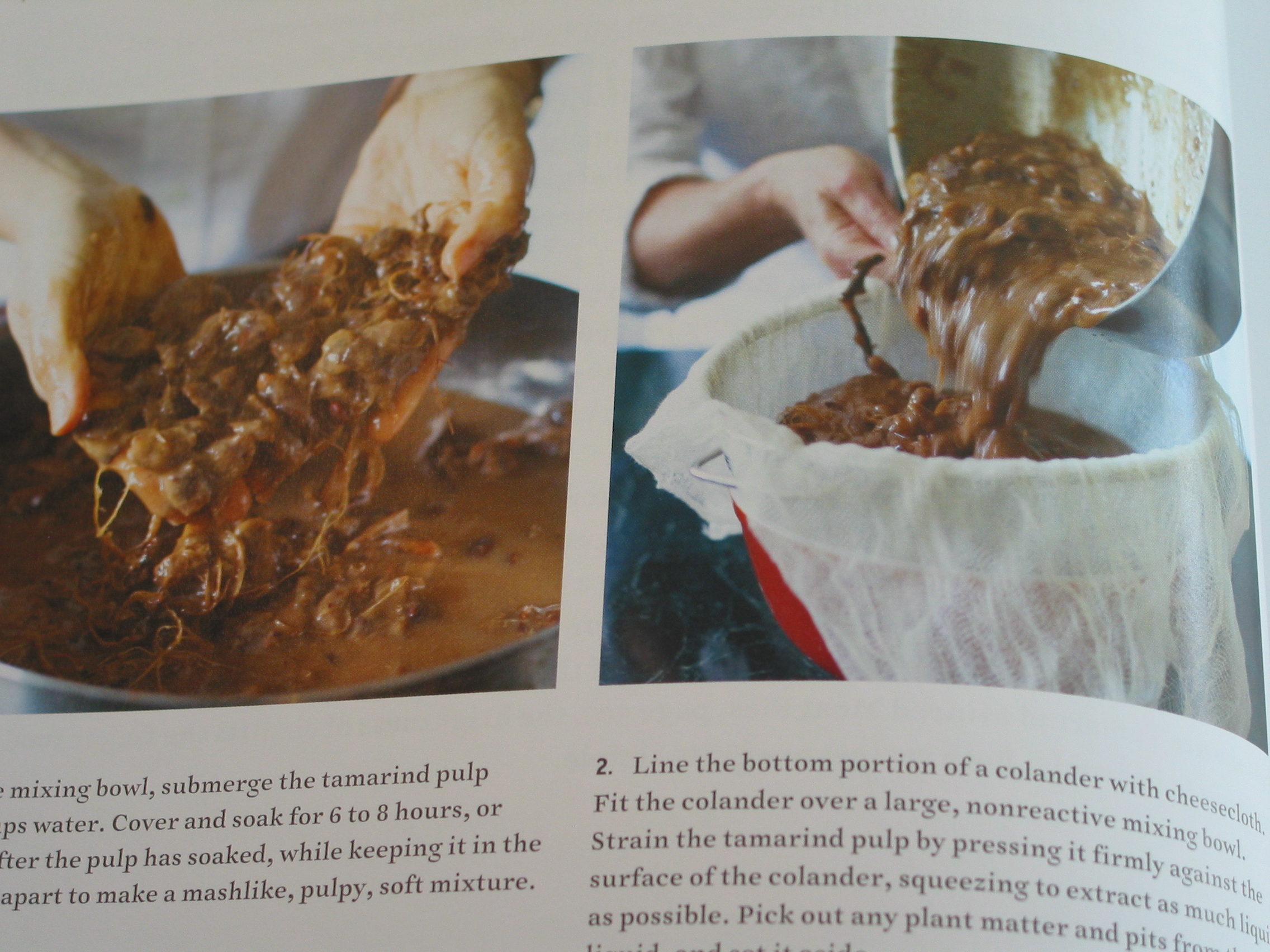
Here’s what’s on page 42 of Aromas of Aleppo for how to work the tamarind pulp into something that will give up its flavor to a sauce:

Poopa Dweck's Aromas of Aleppo--instructions for making tamarind concentrate

Working the tamarind pulp

Now, I’m not all that squeamish, but bleaaghhh. First ya gotta soak the stuff overnight, then ya gotta get in there and mish around–I dunno. I decided to speed it up where I could…

I thought about the little 1-lb. brick of pressed seedless tamarind pulp I’d bought from my Armenian greengrocers for this dish. It just seemed like a tougher version of dried prunes or apricots, which I usually soak up successfully enough in a few minutes by heating them with water in the microwave. Would it work here or would it ruin the flavor? I cut off a chunk, submerged it in water in a microwaveable bowl, and tried it.

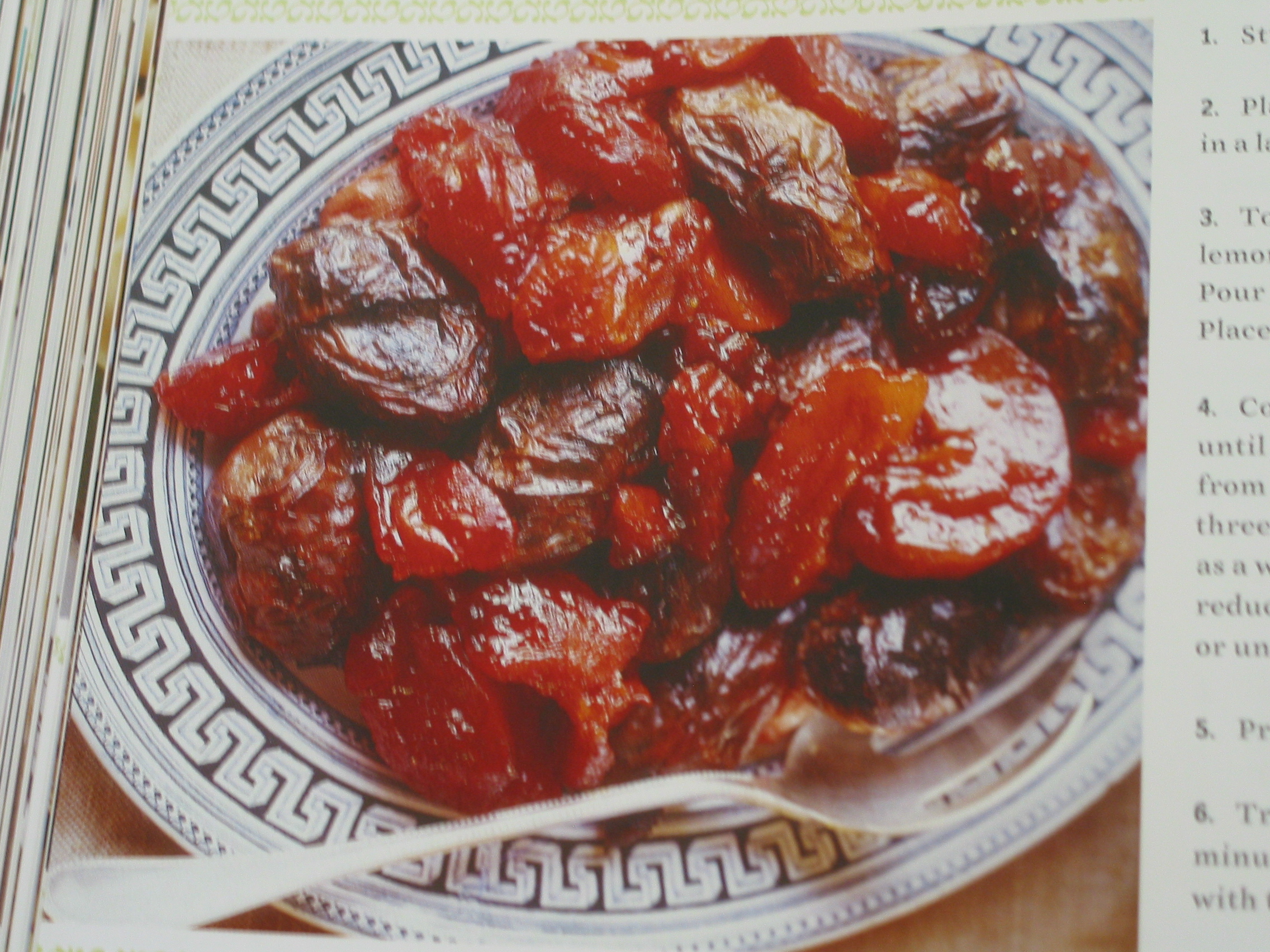
Tamarind pulp rehydrated in the microwave

Five minutes of microwaving, covered, plus about 20 minutes sitting time–it was definitely done. And really, really incredibly tart, a surprise given tamarind’s distinctly plummy aroma. Success! But no wonder they call it “ouc” (pronounced OO-rgh, according to Dweck)–that was my immediate reaction when I tasted a tiny sip. It’s THAT sour. My second reaction was that I should probably say Shehekheyanu–the blessing for any new venture, especially for holidays and the first taste of a new fruit in the year.

I realized only afterward that I should have done the whole brick while I was at it–I was about to discover why Dweck calls for preparing three pounds of pulp at a time, not a couple of ounces.

Next step–squishing the pulp in the water to extract as much flavor as possible before filtering through cheesecloth and reextracting the pulp left behind in fresh water…no. Just no. I am not a cheesecloth girl–it never, never cuts neatly, even with Fiskars shears.

So, I was thinking, I have a microwave for a reason. I also decided I have a food processor for a reason, and this is definitely it. I stirred once with a fork first to make sure there really weren’t any pits in there, as advertised on the package front. Then I poured it all into the food processor, and gave it a whirl. That worked too. I seemed to be on a roll with the speed-it-up-immensely daydream.

Filtering the tamarind liquid

Filtration–I’ve used overlapping coffee filters in a colander whenever I make paneer in the microwave, and it worked pretty well here too–maybe better than Dweck’s photos, which show a cloudy filtrate coming through the cheesecloth. Mine was clear and amber–maybe too clear? Was it going to taste authentic without the silty stuff? I could only hope. It sure was sour, even dilute as it was. Continue reading

Green Lentil Sausages

A month or so ago I had been intrigued with a recipe on “Is This My Bureka?” (see sidebar for link) for Romanian mititei, a spicy cross between meatballs and sausages, and wondered whether I could make a vegetarian version with green lentils. Not because I can’t eat beef–I can if it’s kosher–but because I generally don’t like handling meat. (I don’t mind fish nearly as much; don’t ask about the logic, it’s just a preference.) All my meat dishes are still in storage, four months after the move. That’s not accidental–I hate switching over the dishes even more than I dislike handling meat.

So in any case, I tried it. Green lentils are on my list of easy-to-microwave, ultracheap nutritious staples. I cooked up about half a pound of dried lentils in water to substitute handily for a pound or pound and a half of ground beef. The mixture I made was heavy on garlic, pepper, and a variety of spices ground in the coffee mill. It was a lot lower on salt than BurekaBoy’s because I tasted it with a couple of pinches of salt–between 1/4 and 1/2 teaspoon–in the mix and that was more than plenty. Scared to think what a teaspoon and a half would have done. Maybe ground beef requires more, or maybe the lentils don’t absorb and hide the salt flavor as much.

The green lentil mixture was delicious even before cooking–with vegetarian sausage, burger or meatloaf recipes, unless you have raw eggs or uncooked flour in your mix, you can taste for seasonings pretty safely. If you do have eggs or raw flours in the mix or are making a sausage recipe with meat, poultry or fish, cook a spoonful first in the microwave and then do the taste test.

Unfortunately, though, the paste didn’t hang together as well as I’d hoped–cooking it didn’t help much. It was still delicious and spicy, but it just crumbled. And although I could live with it, I’ve been thinking about it ever since.

So my recent purchase of a bag of vital wheat gluten and my first foray into the mysterious world of seitan set me off. What if I added a little gluten to the lentil mix instead of the other way around? That way it would stick together and still be mostly lentils. The proteins would be balanced better by combining a pulse (lentils) with a grain (wheat). It would have loads of flavor without needing soy sauce or salty broth. It would be microwave-steamable, and probably fryable or grillable too. And I could still taste it safely before cooking to ensure there was the right amount of excessive garlic present.

And–half a cup of gluten wasn’t quite enough for the three or four cups of cooked lentils I used. Still kind of dry and crumbly when I made a few small patties and cooked it two ways (microwave and frying pan). I added a little more gluten to the rest of the uncooked mixture. Three-quarters of a cup of gluten per 3 or so cups of lentils was better–I could see the threads of gluten forming as I kneaded it together in the bowl.

The patties were still dryish and of course lentil gray-green, though this version hung together better when cooked. It still tasted good, very peppery and garlicky, with a hint of the allspice, fennel, coriander seed and other spices I’d put in. But because of the dryish texture I wasn’t sure I could recommend it fully–it was definitely a case of “Dance 10, Looks 3” at that point.

I cooked up the rest of the mix by microwave steaming, followed by a light pan fry in olive oil, and bagged them into the fridge. The next day, there they were–still a bit soft and crumbly, but hanging together better with a little more chewiness to them. Still not pretty but they tasted good. Waste not, want not, I thought. Pretty is for some other day. Continue reading

Stolen!

Toucan-beaked finjanim (coffee pots) from the Ethnographic and Folklore Museum in Akko, Israel

Brass finjanim (coffee pots) and tin plates from the pioneer days in Israel. Exhibition at the Ethnographic and Folklore Museum, Akko, Israel

Can’t decide whether I’m more heartbroken or flattered–maybe just surprised?

The Wall Street Journal 

a) has a food section (who knew?)

b) which is currently featuring a 4-part series of recipes by Yotam Ottolenghi.  (I’m actually in favor, and hoping for his book Plenty for my birthday–my husband  floated the suggestion a few weeks ago and I was really flabbergasted that he’d even heard of Ottolenghi. Must have been listening to  something on NPR.) Why is Ottolenghi favoring the WSJ, though, of all food column venues?

c) Said series is calling itself “Slow Food Fast” — the goniffs; can I charge them for it? wouldn’t you? — but it probably shouldn’t.

I’m not just saying that for my own sake (though that’s a big part of it, don’t get me wrong. I’m–the heck with neutrality–too annoyed to be giving a link to this).

Ottolenghi’s recipes aren’t really either slow-slow (stews, beans from scratch, etc.) or incredibly fast (microwave)–a lot are lightly fried or grilled, with a sharp mix of flavors, a lot of herbs, middle Eastern sauces and a tossed salad of some kind on the side. Soft-boiled eggs in a salad, corn latkes with a salad, pan-grilled mackerel on a pita with pistachio pesto and Greek yogurt (bet he’d rather have labaneh but can’t find it in New York or London)–etc.

Which makes them good eating, Israeli and Arab style. But not really slow food done fast.

Most Israeli cooking that’s still Israeli (and not nouveau-Italian, complete with oversized bowls of pasta and seven different cappuccino/macchiato/etc. kinds of coffee drinks) falls into three categories.

The old-fashioned stuff is long-cooked roasts or stews for meats and poultry, maybe stuffed vegetables or an eggplant or spinach casserole or couscous or pilaf. Traditional Romanian, Hungarian, and Moroccan restaurants and some home chefs (usually older women) serve these sorts of long-cooked dishes, but there’s no real shortcut for them.

Israeli street food (not western, engineered “fast food” like McD’s) mostly appears at lunch counters and road stops that specialize, but again the ingredients are real. Felafel, shawarma (even though they’re mostly using a mixture of turkey and beef instead of lamb these days), lahmajoun (ground-meat pizzas). Or else burekas, trays and trays of puff-like flake pastry layered with cheese or eggplant or potato or mushroom filling, and you stop in for lunch and have a huge slab of one with maybe a bit of salad on the side and some tea. All of these take some preparation–the fast part is you walking up to the counter and getting takeout.

In between these extremes are cafés that serve individually-cooked dishes–more informal than casseroles and stews, less casual and more varied than street food. Grilled or fried vegetables (peppers, onions, eggplants, tomatoes, zucchini, pumpkin? potatoes?–more eggplant) and beans, grilled fish or chicken, hummus and baba ghanouj, assortments of cooked salads,with a fresh salad and dishes of olives, turnip and eggplant pickles. A lot of olive oil and garlic and lemon and cumin, yogurt, vegetables, and water-flour-yeast-salt kinds of flatbreads. Street food stand sauces like tehina, salat turqui, harissa, and hilbe (sour yellow fenugreek sauce, kind of mustardy) are still part of it, but so are vinaigrettes and more complex flavorings, and a lot of fresh herbs make an appearance.

This is Ottolenghi’s kind of cooking, and I love it, but it’s neither slow food nor slow food done faster. It’s rustic, village-style food, even though he’s dressed up his version for London diners. At its best you feel like you could walk into the restaurant and fit in fine whether dressed for a theater evening or still dusty from hiking with a water bottle still hanging off your backpack. As though if you walked to the back you wouldn’t be that surprised to see the chefs squatting down over a little pine fire in the courtyard, grilling the food Bedouin-style,  on the back of a broad, battered skillet or skewered on a long thin stick.

They’re not really doing that in Tel Aviv or Haifa, of course, but desert camp cooking is still a key part of the local food lore. People still grill things like chicken hearts and livers outside on little pine fires in their courtyards at home with great pride. Or char eggplants and peppers directly on the gas stove–sort of smelly but undeniably authentic. They point out  za’atar, hyssop and other forageable herbs on wilderness hikes; they know how to make a quick camper’s flatbread of flour and water and a few sprigs of foraged maluakh (a salty plant found in the Negev) over the back of a frying pan. And they know how to brew botz — Turkish coffee–with a flourish.

It’s a part of Israeli life I fervently hope won’t disappear with all the new software companies and car dealerships and cappuccino joints that have popped up over the last couple of decades.

As for the use of my blog’s name, I’m thinking I should take the attitude Monty Python did one time when Margaret Thatcher made free with their Dead Parrot Sketch in a political speech for the Eastbourne by-elections: they announced that given the results of the elections, they thought it not only served her right, but that she had suffered adequately and publicly from her folly that they could save themselves the barristers’ fees for a lawsuit.

Me? I’m waiting til Tuesday. Somewhere else in the WSJ online was an editorial actually praising John Boehner’s plan for the debt ceiling. Feh.

Who’s dissing the lentil?

red lentils

One more point on reactions to the new USDA MyPlate icon, this from foodnavigator.com:

Whether the new food icon was an ‘economic plate’ however, remained to be seen, said Drewnowski. “It’s great that dietary guidelines say we should eat fresh , minimally processed fruits and vegetables, fresh fish and lean meat, but these cost money. Are we asking low income people to adopt a high income diet?

“It’s easy for people to say that people on low incomes should boil up a big lentil and vegetable soup and make it last all week, but who wants to do that?”

Actually, I would. Because it’s really cheap and easy, and you can do it in a microwave, or at least partly. Also because most people used to make some kind of lentil or bean soup on a weekly basis, and in Los Angeles, particularly among the Latino and Armenian communities, a lot of families still do, and do it well. Here are three of my earlier posts, including the first of the infamous “War and Prunes” trilogy (I got a little carried away last summer. What can I say?)


Chickpea Crepes: Protein Inside-Out

Ever since Thanksgiving I’ve been thinking about the challenge of coming up with a proper vegetarian centerpiece for major celebrations–one with a single, unified dish cut up to share, something with protein, not just vegetables or grains, something with great complex flavor and no artificial ingredients.

This is apparently a tall order. For months now I’ve scoured vegetarian and vegan cookbooks in hopes of some serious suggestions and come up nearly blank. Perhaps it’s because most vegetarian cooking in America is based on southeast Asian vegetarian cuisines, which don’t emphasize centerpiece or “main” dishes as much as assortments of several smaller ones, none of which necessarily take the lead. Or because a lot of the nondairy, non-egg vegetarian cooking consists of beans, rice, tofu, seitan and vegetables–not a bad thing, but not usually pretty or convincing as a centerpiece and occasionally incomplete on protein or complex flavor (there’s an awful lot of salt or soy sauce in some of these cookbooks). The few centerpiece dishes with a meatloaf-style filling wrapped in puff pastry or phyllo or potatoes seem to include premade seitan (high in salt) and/or things like mushrooms or eggplant or spinach and nuts with a fair amount of starch for binder, which means you’re repeating starches between the filling and the wrapper and not providing much protein.

One solution might be to put the protein, or at least some of it, in the wrapper itself, so the filling can be flavorful vegetables and so on but not have to come up to the concentrated protein level of meat.

Chickpea flour crêpes are one such possibility, and they’re very easy to make. A bit stronger in flavor than ones made with wheat flour, they hold together well in the frying pan and come out thin, springy and wrappable without the need for eggs. They also take well to a Continue reading

Microwave Tricks: Melts and other Hot Sandwiches

Microwaving the cheese and eggplant while the bread is toasting makes homemade panini a lot quicker

Microwaving the cheese and eggplant while the bread is toasting makes homemade panini a lot quicker--though not necessarily neater

Last year for his birthday my Italophile in-laws gave my husband the ultimate kitchen gadget. Because they loved theirs so much, they gave him…a panini press. I gawked. My husband is almost famous for not cooking. At all.

In more than 20 years of life together, I’ve rarely seen him make an actual sandwich for himself–does shmear on a bagel half count? I’m sure he believes in his heart that he still remembers how to flip one piece of bread on top of the other and seal the deal, but I’ve yet to see evidence of an attempt. Even without grilling.

Somehow I don’t in my heart of hearts believe this panini press is going to be removed from the box and used. Not by my husband, and not by me. It’s not that we’ve never been to Italy or eaten actual panini (we have, on both counts). It’s not that we hate panini or toasted sandwiches in general (we actually like them quite a bit).

It’s that the free-standing real, authentic, Michael Chiarello-approved-and-branded panini press weighs even more than the professional-grade waffle iron my in-laws gave us 10 years ago (and which we’ve used a total of 10 times since, because it’s such a pain to clean). The panini press also takes 3-4 times as long to preheat before you actually get to make the panini. Somehow a grilled cheese sandwich of whatever nationality just shouldn’t take 45 minutes to make. Which it did, when my in-laws, with all the innocent gadget-happy enthusiasm of Toad and his motorcar in Wind in the Willows, brought theirs out to demonstrate.

As a cheese-and-toast fanatic of some standing, I have a few very specific criteria for my grilled cheese sandwiches, grinders, melts, etc., etc.:

1. They have to be substantial and taste good–classic or adventurous, they have to be worth eating. That means the bread, the cheese, and any other fillings under consideration.

2. The toasted bread must be crisp. It must not crush, mush, squash, crumble or absorb tons of cheese grease. It must stand up to the fillings.

3. The cheese must have body and flavor even when melted–it shouldn’t run away, sink into the bread, turn into a pile of salty but otherwise flavorless grease, swamp everything else on the plate, or become a rubber eraser.

4. The whole sandwich must not take longer than about 7 minutes to put together and toast.

Normally you’d say panini fit the bill for an ideal toasted cheese sandwich, and I’d agree–if I were eating out and didn’t have to put up with preheating the grill. If you’re running a corner grill in a touristy Italian city, you’ve got a hot press at the ready and you’re turning out panini by the score for large crowds of passersby, an individual panino probably doesn’t take more than 5-10 minutes. At home, though, all you want is your d–n sandwich. You don’t want to heat an expensive and cluttersome gadget 45 whole minutes just to get there.

You’d also say that the standard white-bread-and-Velveeta fried cheez sandwich was out of the running. You’d be right there as well. No exceptions or passes.

However, in my kitchen, with its limited counterspace and my dislike of extra washing-up, waiting, or fussing, I sometimes get impatient even with the toaster oven classics of good bread, good cheese, and foil underneath to catch the drips.

A quesadilla is obviously no trouble in the toaster oven. Practically designed for it. Neither, really, is a simple sandwich-bread-and-cheddar grilled cheese. But for anything more complicated, or any thicker, more substantial filling, sometimes melting the cheese is the longest part of waiting, and in the meantime you’ve either pretoasted the bread so it stays crisp (in which case it burns around the edges waiting for the cheese to melt) or else you didn’t pretoast the bread and it remains too soft underneath the cheese (and maybe absorbs some of the grease while it’s doing that). Sometimes the other filling ingredients–tomatoes or tomato sauce, mushrooms, lentils, artichoke hearts, etc.–make the bread soggy while you’re trying to melt the cheese on top. Sometimes they don’t cook all the way through.

Here, surprisingly, the microwave comes to my rescue, particularly with fillings that aren’t just cheese but rather cheese melted onto vegetables or sauce or lentils or tuna or some combination. Continue reading

Superfoods and Magic Beans

“Top 10 (or 7, or 5, or whatever) Superfoods” lists seem to be popping up on the covers of all the in magazines this month. If I didn’t get a headache every time I tried it, I’d be rolling my eyes.

The classic bloated diet article with the even more classic bloated promise of magic beanhood is nothing new, I realize. But “superfoods”…

The premise of calling something a superfood is that if you eat this one special food, or at least shop your way down the list of 5, or 10, or whatever’s in the article, you’ll be so much healthier than someone who eats a regular food. Right?

Usually the items on these lists of so-called superfoods turn out to be expensive exotics like dried acai berries and pomegranate juice. Both of which just happen to have heavyhitter funding and marketing efforts behind branded packaged versions of them, and the companies that have started branding and marketing them have both recently come under FDA scrutiny for overinflated and unsubstantiated health claims.

Of course you don’t have to go branded to run into wide-eyed, breathless claims about supposed superfoods. More mundane choices like the sunflower seeds, green peas and garlic touted in this LA Times food section article are also now being highlighted as the new great green hope for America.

But not for the reasons that make the most sense–that these foods are relatively unprocessed vegetables, fruits, whole grains, nuts and seeds (occasionally someone remembers to add something from the beans and pulses category too). All of this vegetation has almost disappeared from the current mostly-processed, mostly restaurant diet of the American public. The general categories now touted as superfoods contain protein, fiber, vitamins and minerals. They’re wholesome and varied if you buy them fresh (or dried) and cook them yourself. Some of them are green (and they’re supposed to be!)

That’s in stark contrast to the now-standard and really dreary burger, ketchup, fries and soda that are all made out of the same three or four overused industrial ingredients (wheat, soy, corn and salt, with a little beef scrap or so thrown in for the burger, some leftover tomato paste for the ketchup, and much less potato than you’d think in the fries). I understand how something that’s actually recognizably plant-based would seem exotic and ultrahealthy in comparison. I do. Because frankly, you could take your soy-based green crayons and color a piece of all-natural bamboo-fiber cardboard and eat that and it would be healthier than the fast food special.

But does that mean vegetables, fruits, whole grains and nuts and seeds are suddenly superfoods?

What are superfoods supposed to be, exactly? Look at the captions for what’s so great about each featured food Continue reading

More things to fry in olive oil

Thanksgiving has barely ended and Hanukkah is already upon us–which means more food! This time with olive oil to commemorate the rededication of the Temple in Jerusalem after a war in which the Assyrian Greeks trashed and piggified it in hopes that we’d be so abashed we’d immediately convert and become a convenient tribute-paying way station for their marches around the edge of the Mediterranean to Carthage.

I know the official story credits Judah Maccabee, but really, it happened like this:

The Assyrian Greeks thought we’d be too frightened to complain when they marched through Israel, taking what they wanted and getting their muddy footprints everywhere. They hadn’t yet heard of chutzpah. They also hadn’t reckoned with a little-known secret force:  Jewish grandmothers. These bubbies could out-argue G-d. Weekly. And the lectures? …

“Carthage, schmarthage!” the grandma said. “Wipe your feet already, what are you, a Hannibal?”

Then she hefted a mighty frying pan at the intruders and that’s all she wrote.

So the real hero of this geschichte is clearly not Judah Maccabee, aka “The Hammer” — but Judith ha-Machvat, or “Judy with the Frying Pan Handy” — a woman who could really scare off the goniffs! And so in her memory, we fry up all kinds of goodies for Hanukkah and none of the calories stick to our hips at all. Really. It’s a miracle.

So…enough bubbe meises. Back to the present day.

Last night I made latkes without benefit of a food processor–after a slight kitchen drawer reorganization last spring, I forgot where I put the shredder disk. But for a smallish batch for the three of us–only two spuds and half an onion–it’s not so difficult to grate them by hand, as long as you use a fork to hold the stubs (of the potatoes, not your fingers, I hope) to avoid getting extra “proteins” in there…

The Obligatory Latkes (very basic, but tasty in a good way)–about 12 or so 2-3-inch latkes, enough for 3 people for supper, so scale up as needed

Carbs: 2 big potatoes weighed 480 g total on the food scale before peeling. An estimated 1/6th of the weight of nonsweet potatoes is carb–so about 80 g carb total for this recipe. A 4-latke serving would be about 20-25 g carb.

  • 2 big russet potatoes, scrubbed, peeled, shredded on large holes of grater/food processor blade
  • 1/2 medium onion, grated on fine holes into the same bowl OR chopped finely in the food processor BEFORE changing to the shredder blade and doing the potatoes on top of the onion
  • 2 eggs
  • spoonful of olive oil
  • 1-2 t. flour
  • pinch of salt
  • pinch of baking soda (which I completely forgot last night, so it’s optional)
  • olive or vegetable oil for frying

Grate the potatoes and onions by hand or food processor into a big bowl. The grated onions will help prevent discoloration in the potatoes. Take handfuls of the mixture and squeeze them nearly dry, and pour off most or all of the liquid that collected in the bottom of the bowl. Return the potatoes to the bowl, add the eggs, spoonful of olive oil, flour, salt and baking soda and stir until evenly mixed.

Heat several tablespoons of oil in a nonstick pan until shimmering and dollop soupspoonfuls of the latke mixture in, flattening them as they start to fry. Swirl the pan a little to get the oil touching each latke and maybe keep them from sticking to the pan. Wait until you see brown edges at the bottom of the latkes, then flip and fry the other side, swirling the oil a little or adding another spoonful in droplets where the pan seems to need it. You want these really brown and crisp on the outside, not pale yellow.

Drain on napkins or paper towels on a plate, and at the end, if no one’s snatched them as they cooked, you might want to reheat them all together in the pan or microwave them on the plate for half a minute on HIGH. Serve with applesauce and sour cream or labaneh or plain yogurt.

–  –  –  –  –

That’s the only recipe I’m giving here with set quantities–latkes are more like pancakes, everything below is like a stir-fry.

Non-Latke Options

Even with mechanical assistance in the form of a food processor, I’m a one-latke-night-per-year-is-enough kind of person. I want something other than potatoes if I’m going to be frying stuff in more than a spoonful or so of olive oil. Therefore I look for other maybe less starchy and more flavorful (one can always hope) things to fry:

Pre-nuked (microwaved) eggplant slices, fried in a couple of spoonfuls of olive oil after heating a little garlic and curry powder, maybe a dab of z’khug, for a few seconds first. Onion and red bell pepper are good in this mix too.

Marinated artichoke hearts, perhaps drained slightly and shaken in a plastic bag with a spoonful or so of flour or almond meal or chickpea flour and a little grated cheese and/or some oregano or thyme–no extra salt needed

Pre-nuked cauliflower, breaded as for the artichoke hearts

or–pre-nuked cauliflower, stirfried in a spoonful or so of olive oil with a dab of z’khug if you like things hot, with red bell peppers, onions, and another Continue reading

No-Furkey!

In the freezer case at Whole Foods this month you’ll find big boxes announcing Turtle Island’s Tofurky Feast, Field Roast’s Celebration Roast, and VegeUSA’s Vegan Whole Turkey –this last shaped and glazed brown like a large chicken, drumsticks and all. I’m not sure how I feel about this concept–I thought the idea of being vegetarian when you have enough money for a choice was not only not to eat meat, but not to want to be eating meat either.

Not that I’m against decent vegetarian meat substitutes for Thanksgiving or any other time of the year. As someone who’s kept kosher since my college years, and often in places where there was no kosher meat (or I didn’t have the budget for it), tofu or wheat gluten “mock chicken” have made eating in Chinese restaurants a lot more fun, and the good restaurants make their vegetarian dishes as serious and well-balanced as their meat dishes–sometimes better. But they generally don’t try to disguise them this far or process them this much.

Still, to each her own. But $42.99 for the big VegeUSA box at Whole Foods. The box states that it feeds 25 at 2.5 oz/serving, which is probably enough protein but only about half the volume most adults would expect. And it’s kind of expensive for something that looks very much like a well-browned rubber chicken. What’s in it? I scan the nutrition panel and don’t really notice anything but the sodium–everything else is low or moderate, especially for a holiday meal.

But the salt! 450 mg for the “turkey”–double it to 900 mg if 2.5 oz isn’t enough for you and you want seconds.  1400-plus mg for the stuffing–huh? a whole day’s worth of sodium for one serving of stuffing?  Is it that bad for conventional stuffing mix as well? You’d do better to make your own from scratch.

At this point I didn’t even look at the gravy.

Tofurky isn’t much different–650 mg sodium per serving, including stuffing. Field Roast–in the same range too. They also sell separate tubs of frozen “giblet” gravy.

Of course (full disclosure here), I’ve never actually liked gravy, and I doubt it would really go well with anything tofu, not even tofu in a rubber chicken costume.

Why do I think you could do a better and probably a lot cheaper and more festive vegetarian Thanksgiving with some kind of authentic, fresh-made main dish? Because very clearly you could. Do you want it to taste good? Or do you just want it to look like an imitation turkey?

Of course, the main thing about these frozen concoctions, even the simple cylindrical “roasts”,  is that they look like centerpiece dishes, and there’s really no knocking that desire to serve something impressive and festive and most of all, shareable at Thanksgiving. It’s important. Thanksgiving feasts demand a monument to plenty, and an inedible cornucopia with gourds and Indian corn doesn’t really cut it. Nor does a big pasta salad (although a timbale, as in Big Night…)

Surprisingly–sadly?–enough, very few vegetarian cookbooks, not even the big tomes like Mark Bittman’s How to Cook Everything Vegetarian or Veganomicon, really try for a vegetarian centerpiece dish that looks and feels like an important dish. Mollie Katzen’s title dish from The Enchanted Broccoli Forest is about the only intentionally designed centerpiece vegetarian dish I’ve ever seen. A very long time ago I actually was served this thing once at a friend’s house, with very sadly overcooked broccoli stalks stood upright in a flat casserole of brown rice. Oy, is all I can say. Not a moment of pride. Both Katzen’s and my friend’s cooking improved in later years.

None of the currently hot vegetarian cookbooks out there have an index listing for “Thanksgiving”–very telling. A lot of them have portions for 2 or 4 or just one person. Only vegetarian chili and pasta dishes are intended to serve a crowd of any size.

So vegetarian centerpiece dishes deserve some consideration. Tara Parker-Pope of the New York Times blog “The Well” has been edging around this topic for a week or so, but I don’t feel she’s really gotten to the heart of the matter–neither has anyone else. Perhaps it’s because she’s not thinking like a vegetarian?

What makes a dish a centerpiece dish? Think about the turkey, then, or a whole salmon, or a rack of lamb or the like. It’s big. It’s unified–one big item before you cut into it for serving. It’s elegant and impressive. It’s sliceable. It’s savory enough to draw people into the dining room with a sigh of Continue reading