
• Enter your email address to subscribe to this blog and receive notifications of new posts by email.

    Join 241 other subscribers
  • Noshing on

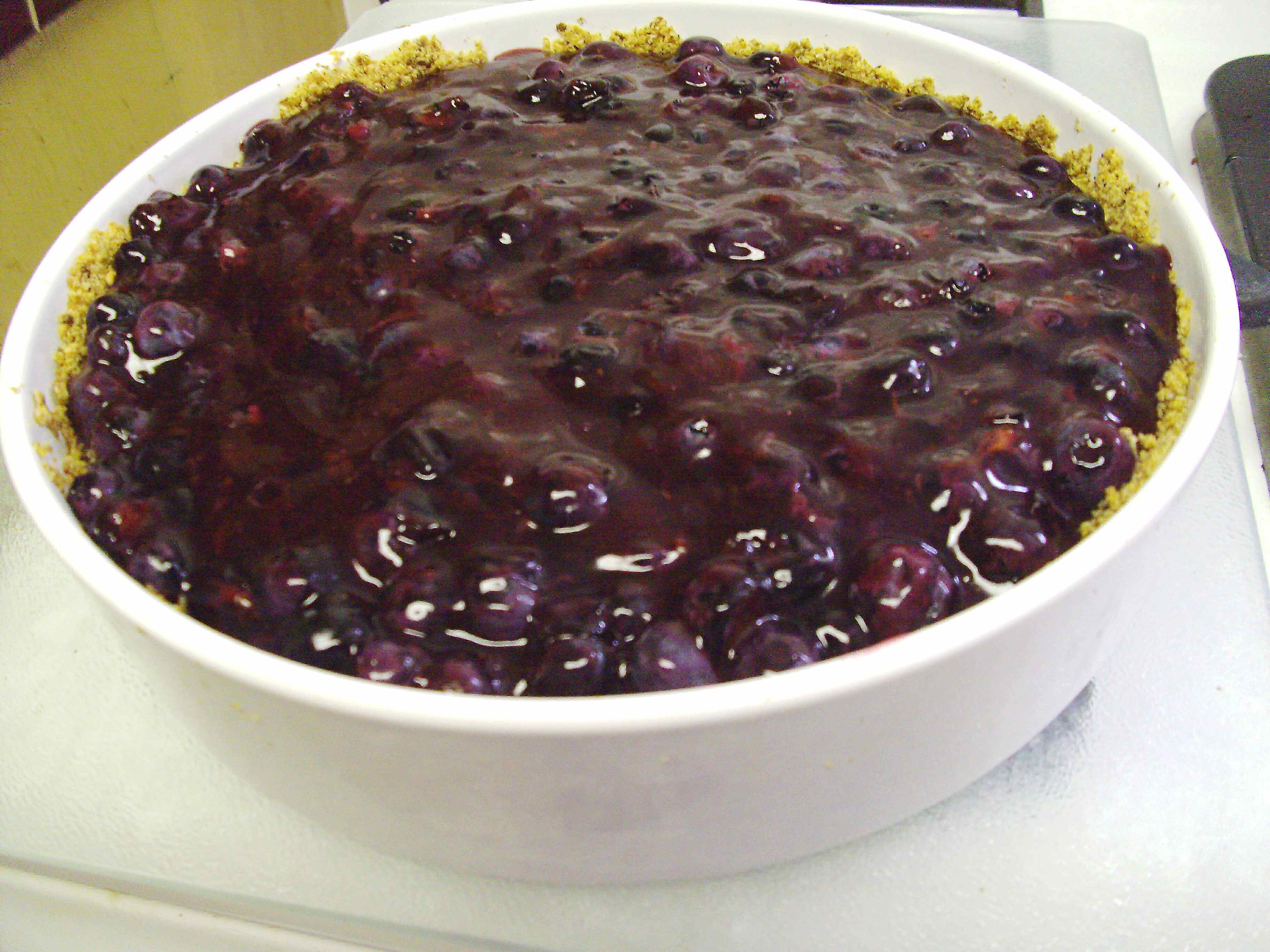
    raw blueberry pie with microwaveable filling and graham cracker crust

    This mostly-raw blueberry pie is a snap to make and very versatile--the filling microwaves in a few minutes, and you don't even have to bake the zippy gingered graham cracker crust--perfect for a hot Fourth of July and all summer long.

  • Recent Posts

  • Contents

  • Archives

  • Now Reading

  • See also my Book Reviews

  • Copyright 2008-2024Slow Food Fast. All writing and images on this blog unless otherwise attributed or set in quotes are the sole property of Slow Food Fast. Please contact DebbieN via the comments form for permissions before reprinting or reproducing any of the material on this blog.

  • ADS AND AFFILIATE LINKS

  • I may post affiliate links to books and movies that I personally review and recommend. Currently I favor Alibris and Vroman's, our terrific and venerable (now past the century mark!) independent bookstore in Pasadena. Or go to your local library--and make sure to support them with actual donations, not just overdue fines (ahem!), because your state probably has cut their budget and hours. Again.

  • In keeping with the disclaimer below, I DO NOT endorse, profit from, or recommend any medications, health treatments, commercial diet plans, supplements or any other such products.

  • DISCLAIMER

  • SlowFoodFast sometimes addresses general public health topics related to nutrition, heart disease, blood pressure, and diabetes. Because this is a blog with a personal point of view, my health and food politics entries often include my opinions on the trends I see, and I try to be as blatant as possible about that. None of these articles should be construed as specific medical advice for an individual case. I do try to keep to findings from well-vetted research sources and large, well-controlled studies, and I try not to sensationalize the science (though if they actually come up with a real cure for Type I diabetes in the next couple of years, I'm gonna be dancing in the streets with a hat that would put Carmen Miranda to shame. Consider yourself warned).

Prunes and Lentils II: Prune Sauces for Savory Dishes

Following on from Sunday’s post (have you recovered yet? Should I be selling Tums futures?) I should add that NOWHERE in Karen Page and Andrew Dornenburg’s The Flavor Bible can a mention be found of prunes paired in any way, shape, or form with lentils. Don’t have the faintest why not. They do state that plain old green lentils have more flavor than red or brown.  They also pair prunes with olives, mushrooms, gorgonzola and walnuts as well as sweet spices and red wine. Somewhere in that crossroads there’s got to be some confluence of flavor, but wherever it is, they haven’t considered it.

Others have, however–notably Nathan Lyon of the Discovery Channel, ABC’s “Beat the Chef” show in Australia from a few years back, Hello! magazine (OK, copying straight from the California Prune Board’s UK division–wait a minute, they HAVE a UK division?!–and borrowing its press photo)…Oh well.

The benefit to considering prune sauces is that you can serve them with a lentil dish if you’re ready for that or to lift a more familiar savory dish with meat, fish or poultry.
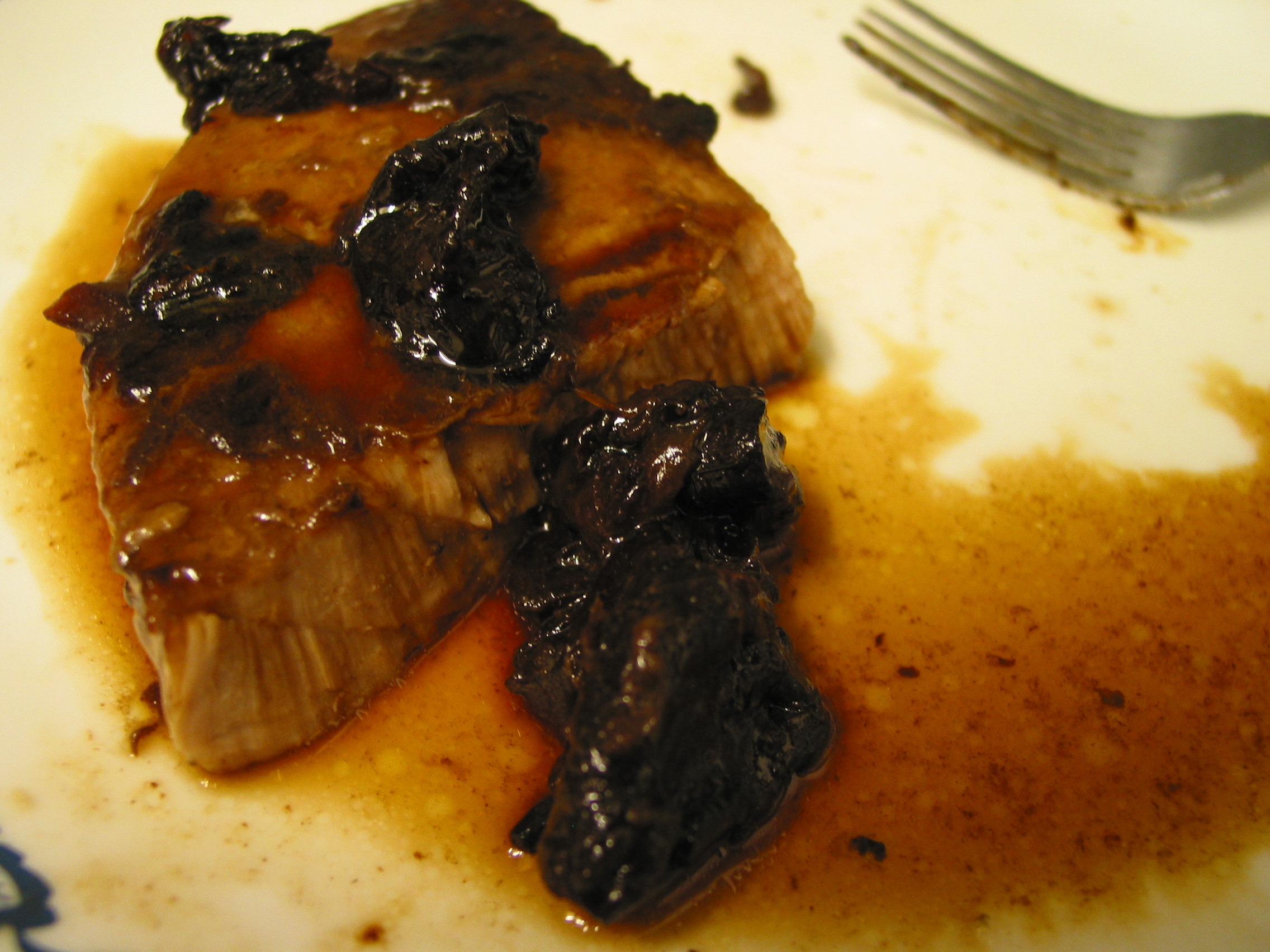
Pan-seared tuna steak with microwave prune and wine chutney

Pan-seared tuna steak with microwave prune and wine chutney

And yes, I said “lift”. Make of it what you will, but any one of the sauces below is better than whatever Hello! magazine has to offer, even if it were original.

Stéphane Reynaud’s Prune Sauce (excerpted for consideration from French Feasts, 2009)

This was designed to go with a simply pan-fried foie gras for six–probably 3-4 oz per person, which seems like a hefty kind of serving, even though I do like liver.  But the sauce–why 18 prunes? 3 per person? and it seems a heavy load of spice for a small amount of wine. Also he has you rest the stuff overnight at room temperature before finishing it. Not sure why–to thicken up, probably, like Elizabeth David’s recipe for peach jam, which also sits out overnight after the first boil-up before resuming.

  • 18 pitted prunes
  • 1 c red wine
  • 1 t ground cinnamon
  • 1 t quatre-épices
  • 2 star anise pods
  • 2 T light brown sugar
  • 2 1/2 T butter, chilled

Boil the prunes 5 min with the wine, spices and sugar, cover and leave O/N at RT. Remove the prunes and reduce the spiced wine to a syrupy sauce. Whisk in the butter, then return the prunes to the sauce.

Microwave Prune Chutney with Wine

My microwave version started out as Reynaud’s wine-based sauce and suddenly morphed, as I was grabbing things out of the fridge for it, with a half-remembered cranberry chutney recipe my mother-in-law served a number of years ago at Thanksgiving. This turns out to be a potent combination, aromatic and sharper, no doubt, than Reynaud’s sauce, with a definite suggestion of saltiness about it–but no actual salt. I don’t recommend eating it straight–too pungent for me, though it’s uncannily close to the relish my mother-in-law served and pretty decent with poultry and stuffing or rice and so on–but cooking 5 minutes or so extra in a saucepan over direct heat or with the food you’re saucing and some extra wine turns it into something pretty special. The whole cloves in particular (which you can take out before using the sauce) do something incredible for any meat or steaky fish you cook with this sauce. Like brisket but just…better, more sophisticated, elevated to the level of cuisine. In fact, put some of this prune sauce with cloves in your next brisket too. 

Makes about 1 cup

  • ½-1 c leftover dark red wine–syrah, aglianico, something inexpensive but rich
  • 8-10 pitted prunes, quartered
  • grating of fresh ginger (1/4 t)
  • grating of 1/2 decent-sized clove garlic or 1 small clove
  • 1/4 red onion, chopped
  • 1-2 t. wine vinegar
  • sprig of thyme
  • pinch of fennel seed
  • 4-5 whole cloves, loose if you can stand picking them out or else stuck through a scrap of onion

Toss the onions with the vinegar and let sit a few minutes while chopping the prunes into quarters–it cuts down on the bite. Mix the onions, prunes, and the rest of the ingredients except the cloves in a soup bowl with a microwaveable lid that can placed on with a gap for steam to escape. Poke the cloves into a larger scrap of onion and add that to the bowl so you can fish them back out easily after cooking. Microwave 1-2 minutes loosely covered on HIGH or until it’s boiling, let sit 5 minutes, stir, microwave again. The prunes will have taken up a lot of the liquid, the onions should be cooked through and garnet-colored, and the wine should be reduced and a bit syrupy.

.  .  .  .  .

From France to China, then:

One year I was determined to make a low-sodium substitute for fermented black bean sauce with roast salmon. I soaked some prunes in a little boiling water and mashed them to a paste, then dressed them up with garlic, ginger and a few other things. It turned out, to my surprise, like homemade hoisin–-dark, glossy, tart and aromatic, less sweet than the commercial stuff, a little smoky from the sesame oil and scallions, with the suggestion of salt Continue reading

Prunes, Lentils, and “Cookin’ Cheap”

When I was a kid, PBS, which had made a gourmet name for itself with The French Chef, decided that if one chef was good, six or seven had to be better. Suddenly the public and cable airwaves were  bursting with the Frugal Gourmet, the Galloping Gourmet, Yan Can Cook, Cookin’ Cajun, various shows with Pierre Franey and Jacques Pépin, and one…ummm…less glamorous show called Cookin’ Cheap.

This was hosted by Larry Bly and Earl “Laban” Johnson, Jr. out of Roanoke, VA–-not too far from where I grew up–and featured two viewer-submitted recipes per episode, which the guys bravely cooked and sampled on the air. At the end of each show, just like Julia Child, they sat down at the table for the tasting… and decided whose recipe had come off worse.

Now, Cookin’ Cheap was not for tenderfoots–if you couldn’t handle ingredient lists that included whole sticks of margarine and self-rising flour, or bring yourself to shop in one of the ordinary supermarket chains that had never heard of organic anything (this was the South in the ’80s), you would have done better not to watch. But if down-home cooking delivered with a touch of schadenfreude was your thing, it was a great little show.

Unfortunately, my favorite early episode doesn’t seem to be available anywhere on the ‘net. But the clip above, the Cookin’ Cheap 2.0 (YouTube) version of about a third of Episode #609, will give you some idea. (see copyright disclaimer below…)

In my actual favorite episode, Bly and Johnson hit their personal limit with a recipe that had them both making faces and apologizing to the audience that “there’s cheap… and then there’s too cheap.”

The dish in question was “Lentils ‘n’ Prunes” (you can guess the entire ingredient list). And it was indeed cheap. Unfortunately lentils, though incredibly cheap and nutritious, cook up kind of gray, especially on a semi-rural public TV station with early-’80s (i.e., yellow-ocher) set lighting. Trust me when I say the addition of mashed prunes did nothing for them aesthetically or otherwise. How on earth could they have put this on the air?

Of course, these guys didn’t have to take the blame for the recipe, and it was great entertainment to see some of the strange things your neighbors might be cooking at home and writing in to the show about with high hopes of being selected. I understand the Food Network is now copying Bly and Johnson’s reality-cooking formula shamelessly for the fall lineup…

[Actually, I didn’t realize the show had such a good run, but it started locally in 1981 and only ended its nationally syndicated run in 2002. Johnson passed away a few years before the end, but he managed to publish the Cookin’ Cheap Cookbook in 1988. Bly kept the show going with Johnson’s friend and successor Doug Patterson and has since made a couple of rescued episodes available on DVD. And the show still has fans on YouTube and — surprisingly just this March–in the New York Times.

Disclaimer: YouTube removed the first clip I linked to for copyright violation–so my apologies to Bly; the intent in linking here isn’t to rip anyone off but to highlight a too-little-known show. Because the original Roanoke station managers were too shortsighted to save the episodes (they apparently trashed them!), Bly was only able to rescue a couple of episodes for the DVD, and I think some of the others posted at this point were recorded at home from TV.]

Ah, well. Times change, horizons broaden, and we aim to challenge our palates in a sophisticated world beat kind of way even with limited cash and ingredients. The wolf may be at the door, we may be on the rice and beans yet again to make up for unreimbursed conference travel, but we are determined to do it in style–that means Indian, Moroccan, Mediterranean–French? Well, at least by not mixing plain lentils and prunes together in a hideous gray mash.

…I’m not actually sure how the French feel about lentils with prunes, or what they’d do about it if you suggested it. But I have a huge bowl of cooked lentils to deal with from a 1-lb. bag at $1.29. And a 1-lb. bag of non-sorbate pitted prunes at $2.99. Less than $5 total. And a number of ideas about how to deal with each of them, separately or together. Enough ideas that I’m probably going to have to split this post so it doesn’t turn into War and Prunes.

This, I think, is going to become my How to Cook a Wolf Challenge, 21st Century Edition.

Because I have fantasies (not many, and relatively tame though entertaining) of the Iron Chef America and Top Chef hosts announcing, for the next quickfire competition, a challenge to find three or four good ways to combine lentils and prunes in dishes where they’re the main ingredients and for which the total bill for the tasting menu comes to something like $10, including spices (prorated as used…) Can’t you just see the contestants’ faces? Take a moment to enjoy their obvious panic. The restaurant industry hasn’t trained them for this.

But seriously. What was actually behind this Cookin’ Cheap dealbreaker, other than the obvious frugality factor plus the even more obvious digestive humor that follows prunes and lentils wherever they roam?

Is there any way on earth that prunes and lentils could really go together?

Well…yes, as a matter of fact. You don’t run across prune and lentil recipes everyday, but good-tasting and intriguing variations, or at least the components of them, exist in a number of respected cuisines around the globe. Even French. For very little more than it cost the Cookin’ Cheap guys, Continue reading

Bistro + Cartoons = Stephane Reynaud’s French Feasts

French Feasts by Stephane ReynaudFrench Feasts: 299 Traditional Recipes for Family Meals and Gatherings by Stéphane Reynaud (2009 Stewart, Tabori & Chang, $40.00)

It’s a huge book. Daunting. Heavy as a couple of bricks. Padded cover, even, with a zillion miniphotos of intimidating French bistro classics in their raw and cooked forms (an octopus, a roasting tray of vegetables with leeks, a crème caramel, and several red-checked tablecloths, for that seemingly effortless retro chic, laid out under rustic-looking pot-au-feu types of stews. And a cutting board with six stuffed marrow bones stood on end.)

Flip open the front cover and you get a classic bistro menu with way too many choices (luckily it’s printed with a little English and page numbers, not handwritten on a chalkboard across the room, so you don’t have to squint). Read down the page (continue inside the back cover) and you start to dig up little puns and odd bits of humor here and there. They finally bubble up into something definite in the introduction, where the author, a medium-youngish guy seated in front of a casserole with a chef’s knife and a two-pronged barbecue fork, reminisces about a childhood stuffed with too much good food on family Sundays with his grandmère. Replete with escargot-burping uncles.

And from then on, you realize why this book is so fat: not only is there a heavy emphasis on meats and charcuterie (and six or seven different preparations for foie gras, 12 or so variations on soft-boiled eggs and omelets, etc.), but every other page is a photograph, or a profile of a couple who run one or another bistro, a venerable Lyonnaise sausage maker, vintner, baker, or cheese affineur…

Or — quite frequently — a cartoonist’s demonstration, only a little less improbable than Rube Goldberg’s, for making wine or cheese, or canning preserves (watch out for the orange tabby in the “catsup” jar). Check out the last chart, next to the Armagnac and Cognac page, which presents  increasing girths and grades of cigars appropriate for the increasing girths and ages of the smokers. Is it by way of including the classic end to a classic meal, never mind the known risks, or a subtle message the other way–that these days it’s more savvy to laugh at the cigar nostalgia die-hards than become one?

And speaking of nostalgia…There are even songsheets for Moulin Rouge classics so you can join in with your French friends after dinner. You kind of need those. You definitely need those.

Just what kind of cookbook have we lugged home?

Actually, Stéphane Reynaud is a well-regarded restaurateur on the outskirts of Paris and the well-trained son and grandson of a line of pork butchers. His previous book, Pork & Sons, arrived in the US a couple of years ago, and this one was published here in English sometime last fall. Despite the fact that I don’t eat pork and don’t think it’s a glorious profession to “break down a pig” or any other large animal, as glamorized on adventure cooking shows, French Feasts is well worth the read. Because Reynaud clearly knows his stuff, and not just about meat.

I’m not sure whether he got a translator to help, or he’s just really fluent in English–if so, my hat’s off to him, because his sense of humor really comes through fairly naturally, and it probably meant rewriting a fair amount of the text to come up with accurate and still funny equivalents for English speakers. Translating (and having to explain!) puns from French to English would be a job and a half for just about anyone. Most people would rather scrub dishes than have to explain a joke. Even me.

The recipes themselves are classics–untrammeled and unfutzed-with–and unexpectedly instructive in their simplicity.

Most have fewer than 10 ingredients, and often fewer than six. Here there are no dishes calling for 20 different special vinegars or sweeteners, as in American food-glam magazines and cookbooks. Not too many luxury ingredients, other than that many of the “proteins”–shellfish, goose, duck, game, foie gras–are hard to find in the US and kind of chi-chi expensive these days outside of Europe, but you could probably substitute with some success. And the titles are simple too–English translations of the classic French names, not mile-long lists of every special new “twist” ingredient it’s been tweaked with to up its audience appeal. Or advertiser appeal.

And the food photos. Nice photography but no attempt to make restaurant-pretty “tall food” plates with lots of garnishes. These are stews and soups and unsliced terrines–unstyled, many of them, or at least not overstyled with voguish background blur and enhanced color and gloss on every dish. Cooked cabbage looks like cooked cabbage. Turnips look like turnips, not like  flaming purple orchids turned suddenly solid. The stews look like stews you’d make at home–well, except for the lobster one, or the terrine with the crossed strips of fatback over it, or the baked fish in a glossy brown flake pastry crust. That’s just showing off, right there.

But really, most of these dishes are photographed while still in the cooking pots–which aren’t the bright shiny brand-new brand-name items you can order directly by clicking on the picture. They’re well-used, old, blackened, ugly even. Not glamorous. They don’t go with the brushed steel decorator kitchens we’re used to seeing in all the glossy cookbooks on our shelves. They have a bit of grime and wear about them, and make us feel better about our own dowdy day-to-day kitchenware that we’ve been using since we got out of school umpty-nine years ago and haven’t replaced because it’s reliable.

And now what I thought at first was a detour:

To my great surprise, given the author’s “slow food” cred, Reynaud’s recipes don’t contain any of the rote “1 teaspoon of salt” in each recipe that most recent American cookbooks have fallen into. Few of his recipes are seasoned more than once if at all, and usually just the sauce, or just the surface, right before serving. He doesn’t dictate how much, but from the context it’s obviously closer to a pinch than a spoonful, and often he skips it altogether.

He also doesn’t boil his vegetables in salted water, which is very chic right now in the US just because Thomas Keller said he does it and Michael Ruhlman trumpeted it as gospel. With only one exception–in fact, the only recipe in the book with a specified teaspoon of salt–even the desserts in French Feasts, including all of the pastry doughs from shortbread to puff pastry, are almost entirely free of added salt. The sheet cakes have baking powder, and a handful of the pastries call for salted butter rather than plain, but neither comes anywhere close to a contemporary American version’s salt content.

It’s not that Reynaud never uses salt or salted ingredients like capers or sausage or parmesan. But unlike American recipe developers, he doesn’t throw extra salt on top of them, and in fact he warns against it in one of the smoked pork-plus-sausage-plus-three-other-preserved-meats kinds of dishes.

SO—If these are the classics and the methods American chefs and recipe test kitchens have been aping and trying to bring to the table in our best restaurants for decades, French Feasts makes it clear there’s been more than a little “tweaking” or “drift” going on, particularly for the increasingly popular baked goods. Almost every American version of the classic French desserts, from mousse to napoleon to baba to charlotte and crêpes and on to cannelés, has had an automatic teaspoon or worse of salt dumped into it before it went to press. In comparison with the traditional style of French Feasts, we seem to be pickling ourselves. You have to wonder who put it there and why, and what our sorta-French desserts are really supposed to taste like when you skip the commercial interest that seems to be behind all the routine, mindless oversalting.

And you have to ask–in romanticizing Slow Food but presenting commercially tainted, overly fussy, overly expensive and oversalted versions of traditional European dishes, how far has American foodieism drifted away from reality? How badly have we lost the thread?

In contrast to the younger wave of foodie restaurant chefs and specialty purveyors in the US, most of the folks profiled in French Feasts are not sporting extensive surfer tattoos or orange clogs to proclaim their indy cred. They’re also not Glamorous-Looking French People With Scarves ™, except Continue reading

Oranges as a savory

Artichoke-Orange Salad

Oranges in a savory compote with artichoke hearts

A few weeks ago, I ran across a food article by Amanda Hesser, in which she recounted her recent experience of being served a green salad with red onions, Greek olives, and oranges in it. What struck me was the way she fumed at length over having missed out for so long on this simple culinary classic.

I grew up in a Jewish household in the early 1970s, at about the time when felafel and hummus and tabouleh started making their way west into American Jewish cooking. These, along with pita, tomato-cucumber-pepper type salads and eggplant everything, were part of the larger Jewish cultural revival after the Six-Day War. Jewish cookbooks started embracing the Lebanese, Sephardic, North African, and Persian influences on Israeli food as a complement to the more familiar Ashkenazi fare. Orange salads just seemed to fit in.

In any case, orange salads have been published in Jewish and Mediterranean-leaning cookbooks for at least 25 years–notably Paula Wolfert’s Couscous and Other Good Food from Morocco, one of my first cookbook purchases once I came back from my own year as a kibbutz volunteer.

Three orange salads

The simplest orange salad I make is a basic green salad with oranges rather than tomatoes, and it goes well with oil-and-vinegar or mustard vinaigrette. Another, more of a fruit salad, is orange and/or grapefruit segments or slices mixed with a dressing of a cup of yogurt, a spoonful of ordinary red wine vinegar, a spoonful of sugar, and curry powder to taste, maybe half a teaspoon or so, enough to make it yellow-orange and aromatic, not enough to be bitter.

Another more elegant take on the green salad is something I made a few times in my early cooking days for buffet lunches at my synagogue–orange slices sprinkled sparingly with orange blossom water and a grinding of cardamom, laid down in overlapping rows on a bed of vinaigrette-dressed romaine in a tray, and red onion rings, sliced Kalamata olives, red bell pepper rings, crumbled feta, and chopped fresh basil strewn over the oranges. It was a bit much for serving at home, but it made a beautiful buffet dish, and it always got eaten.

So oranges can serve quite nicely in fresh salads, but what about in hot dishes? There’s the rub.

Orange peel I have no trouble imagining in hot savories–a number of Chinese classics use it (beef with orange peel, etc.), and so does duck à l’orange. Cooked oranges, on the other hand, always disappoint me–somehow the structure collapses, the color fades, and so does the bright acidity. They end up pulpy and stringy and less than half as good as fresh raw pieces would have been. But people persist in cooking with them–so I thought I would give a different Paula Wolfert cookbook a try.

The Slow Mediterranean Kitchen: Recipes for the Passionate Cook
(2003) features one really unusual orange-based savory: an Algerian Jewish sweet-and-sour compote of artichoke hearts and orange sections glazed in orange juice. With garlic and olive oil. Hard to imagine–does garlic go with oranges?–but so close to my standard marinated artichoke hearts, at least theoretically, that I decided to chance it and see. Continue reading

Not Gefilte

For most American Jews, gefilte fish is one of the standard, unchanging preludes to the actual dinner part of the Passover seder. And normally I have no problem with that, especially with hrein, or horseradish. By the time the recitation of the Haggadah and the explanation of the items on the seder plate are done, everyone is joking about (or egging on their kids to pipe up and ask) the Fifth Question: When do we EAT??? And gefilte fish is the first answer.

It’s worthwhile to be hungry enough for once to feel, rather than just nodding as someone tells you self-righteously, that such a modest dish, made with fresh fish in the days when most of our grandparents and great-grandparents were too poor to eat it often, can be something to look forward to.

Gefilte fish is basically an oversized quenelle of ground whitefish and pike, filled out with eggs, onion, and matzah meal to stretch it. Simmered in fish stock for a couple of hours with or without added sugar, cooled to let the broth gel, served room temperature or cold, with horseradish as contrast.

But since most of us don’t make our own gefilte fish at home anymore, it’s usually bland, salted (and sometimes sweetened) ovals of stuff pulled from a pricey store-bought jar–no longer what you’d consider fresh, and no longer economical. And it’s usually about twice as big as any normal/sane appetizer for a meal that’s going to include brisket, chopped liver, meatballs, eggs, chicken and/or turkey, and other big proteins.

Can it be made well fresh? Yes, actually, and a number of Jewish cookbooks–Joan Nathan’s among the leaders–tell you how. But do I want to cook it myself, or eat it any other time than at someone else’s seder? No. Flat out, no. Not only is it a two-hour-plus process, it’s a big chore. All for a mediocre, bland kind of fish dumpling.

The other problem this year is that my daughter is now diabetic, and for the first time I’m going to have to help her count carbs so we can give her the right amount of insulin for a seder meal that will probably last over two hours. It’s tricky enough to do that accurately for a restaurant meal–desserts, which come last and for which the menu isn’t usually even presented until you’ve already eaten the meal, are by far the hardest foods to estimate by sight.

But traditional Ashkenazi-style seder dishes like gefilte fish and matzah ball soup are stuffed full of surprise carbs too, and you can’t be sure how much they contain unless you’re the cook. And that’s not counting the mandated matzah and haroset. All you can say is, all that matzah meal really starts to add up. Will my daughter overrun her carb count before she ever gets to the meal itself, with a chance to risk it on (more matzah-filled) desserts?

If I cook some kind of fish during Pesach week, I want it to be fresh and without much in the way of carbs. Most of all, I want it to taste good. Actively good. Continue reading

Knives at Dawn: Bringing Heat to the Kitchen

"Knives at Dawn" by Andrew FriedmanSo much of TV-chefery these days has to do with blood sport that it’s inevitable someone would start covering cooking competitions by following underdog contestants as though they were Olympic figure skating hopefuls. And although it’s been done before, both on Top Chef and in many, many of the star chef bios of the past 5 years, Knives at Dawn by Andrew Friedman gives one of the most detailed personal and critical inside views yet of the strange pursuit of haute cuisine for haute cuisine’s sake. Part sports dramalogue, part Judgment of Paris, Knives at Dawn trails a handful of American chefs attempting to compete for one of the highest honors in European cooking.
The Bocuse d’Or is one of the most prestigious cook-offs in the world and garners contestants from all over Europe and a few of the US’s top restaurants. The costs of training run the price of a small house, and the US team has had no government or corporate sponsorship, unlike many of the European competitors.

Throughout three months of preparation which Thomas Keller and Daniel Boulud oversaw in 2008-9, a team (1 chef, Timothy Hollingsworth, and 1 commis or prep chef assistant, Adina Guest) from Keller’s French Laundry are coached to represent the US in Lyon. They have to cover the training and travel bills at their own expense, and continue working their day jobs for more of the time than their European opponents.

As Hollingsworth designs and revises his competition entries, suggested garnishes get more and more elaborate–sometimes without anything that’s likely to make them taste better. Onion tuiles. Things wrapped in Swiss chard leaves or carrot ribbons. Savoy cabbage as a “fun” garnish for beef cheeks (here I confess I pictured cafeteria kale as a “fun” accompaniment to the legendary dish, chair mystère–Mystery Meat). And lots of things made with mandoline-sliced potatoes crisped to perfection between silpats. In fact, the word perfection, followed by perfectionistic and culture of perfectionism, keep repeating throughout the section on Hollingsworth and Guest’s training period. It’s a bit unglamorous, to tell you the truth.

The exactitude of discussion over details like garnish, plating, and the like for one fish dish and one meat dish is the kind of technical overdose patter that puts people to sleep at any time other than the actual routine that will count for scoring. Something like the perennial Dick Button and whichever female commentator could be roped in to join him,  talking rinkside about the difference in a triple-lutz made by putting pressure on the inside versus the outside edges of the blade.

Comes the week of competition and things start to take on the frenetic tone of a typical Top Chef episode, but Friedman has a knack of lifting the description Continue reading

Low-Carb Hamantaschen Without Artificial Sweeteners

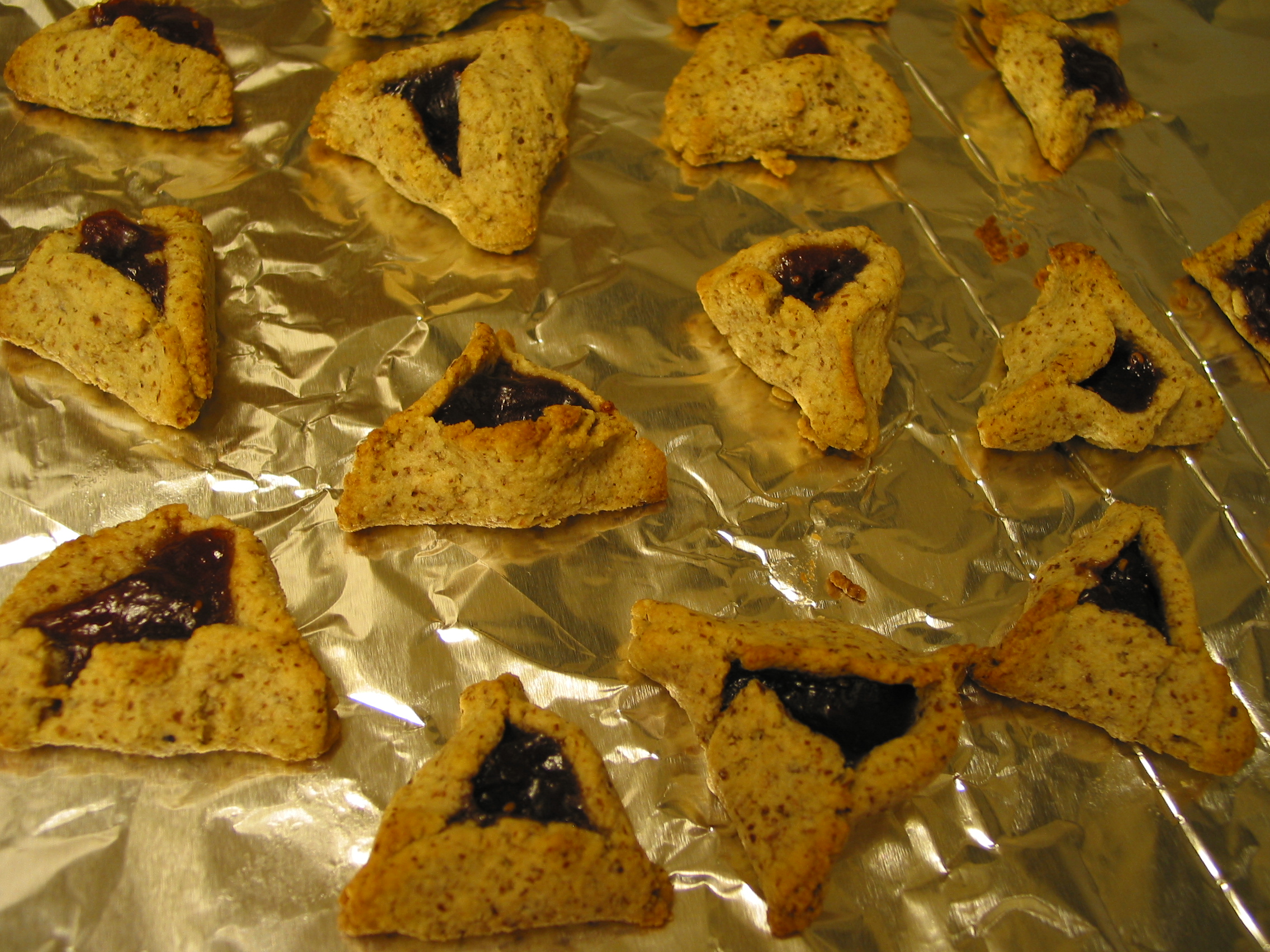
Almond meal-based low-carb hamantaschen

The first batch didn't roll out so easily, but these coin-sized minis tasted pretty good. The next batch rolled out thinner and held together better for a larger cookie with a delicate crust.

Baked goods are a big part of Jewish holidays at this time of year. Purim, being celebrated this weekend, is the last big baking bash before Passover, and hamantaschen (named for the hat, ears or purse of Haman, the villain of the story of Esther) are the cookie of choice. But with a diabetic kid in the house, the usual prospect of baking them takes on a bitter edge.

Hamantaschen–in fact, most cookies–have enough grams of carbohydrate that just two medium-sized cookies contain about half of what she’s supposed to have in any given large meal, twice what’s recommended for a snack, and they don’t have enough fiber or protein to slow down the sugars and avoid a spike in blood glucose. In short, not high-quality nutrition (not that we expect cookies to be). A grownup would have trouble dealing with the prospect of leaving them alone when everyone else gets to have them, but a kid faced with Purim celebrations at school or synagogue is bound for a certain degree of heartbreak.

It’s made me rethink our whole attitude toward things like Girl Scout cookies (this is also the season for that), chips, M&Ms, in fact any casual snack food that gets handed out innocently at school (our current woe–apparently my daughter’s teacher does this kind of thing at least weekly). The snack habit–anytime, anywhere, any or no reason–has become so ingrained in daily life we hardly think about whether it’s appropriate or not. Certainly the handouts are happening more and more frequently in class than I remember when I was a kid–did teachers even hand out treats back then? Not in my elementary school. It’s especially hard for a kid to “just say no” (and we already know how well that advice works in other contexts) when everyone else is taking a cookie or some M&Ms as a reward for answering a question (can they even keep their minds on the subject)? And even worse when it’s the teacher handing them out, because the teacher’s supposed to know whether it’s ok to eat or not.

Maybe we shouldn’t be handing these things out so casually or so often? Because while most people can handle surprise extras like these, they’re probably not all that good for anyone to eat indiscriminately at just any time of day. If they’re spiking a diabetic kid’s blood sugar, you can be sure they’re doing the same thing to your kid’s blood sugar too, only his or her body is responding with extra insulin to cover it. We get to see the results directly every couple of hours with our daughter–complete with sudden attacks of giddiness or tears if things peak and crash too quickly. But the same kind of thing happens to some degree to a lot of kids who aren’t diabetic, and they probably get reprimanded for it. Probably happens to a lot of adults, too.

Still, it’s the holiday, and total deprivation from treats is not really my aim today. So I’ve been trying to figure out a revised recipe for hamantaschen with a more manageable carb count, and preferably one without artificial sweeteners since my kid is still a kid. And neither of us wants it to taste like chalk. Very important.

I start most years with Joan Nathan’s cookie-dough hamantaschen recipe from The Jewish Holiday Kitchen because it’s the best dough I’ve ever tasted for these, even though it’s pareve (non-dairy, non-meat) and doesn’t have butter or cream cheese or the like. It’s not too sweet or too dry, and it doesn’t look or taste chalky or pasty like some of the dead-white offerings at the Purim carnivals. It tastes like a pretty good cookie, and it works really well for rolling out.

Looking at the carb count breakdown for that recipe, at about 12-15 g each, it might not be so bad to do regular hamantaschen, but my daughter would need to eat one or at most two with something protein or fiber, and she’d need insulin for it, so she couldn’t just grab one in between the planned meals. Kind of a pain, no doubt about it.

I was hoping for something closer to carb-free so she could eat hers with impunity when everyone else is eating theirs. This year I scanned the web for low-carb hamantaschen recipes and found only one Continue reading

Not Your Parents’ Mom & Pop

Mom & pop stores–the little independent family-run corner grocery, hardware store, café, bakery, or barber shop–are, like local farmers’ markets, neighborhood gems just waiting to be rediscovered by a new generation. Some are the old-fashioned kind, limping along in the recession but fostering a friendly atmosphere and clientèle. Others mix old-fashioned personal service with cutting-edge specialties. Within five minutes of my house are five worth spending time in.

The bike shop at the other end of my block sells and fixes everything from used kids’ bikes with training wheels (which they’ll adjust for you) to the fancy $4000-plus professional racing bikes (ditto). Around the corner, beyond the Starbuck’s, is a young-chic type all-day café with arty rectangular plates, pretty good coffee–and outlets for every patron’s laptop. Down the street is a British pub owned by the chef and his wife, with the world’s crispest, most astonishing fish & chips and dozens of artisan beers on tap. No outlets here, but you can play darts on the bar side of the pub. The coffee shop across from my daughter’s school hosts tutoring sessions and keeps a frequent customer card file for regulars as well as a shelf of books  you can buy or just borrow while catching a break. And the fifth, my personal favorite, is an Armenian corner grocery with great deals, lots of unusual ingredients and spices, actual ripe tomatoes and one or another family member always willing to discuss the best way to cook something–or debate the merits of the latest Rose Parade.

These businesses are always under siege from the chain restaurants and big box price cutters, which pop up and then close suddenly whenever something better comes along for the long-distance investors, undercut the locals while they’re here, and leave a trail of mistreated minimum-wage employees and other forms of exploitation in their wake.  And yet often the mom & pop stores offer a better deal, unique merchandise, and certainly better service.

Most important is the way local shops change the way we interact when we come in to buy something. The owners treat everyone like a neighbor or a member of their congregation (in the case of the corner grocery, they usually are). The staff are usually the sons and daughters and grandchildren of the owners. Even shy customers come in ready to say hello, ask questions, compliment the new light fixtures, complain about the state budget cuts or the new parking meters near the center of town and generally catch up on the latest. They don’t ignore or avoid the staff the way everyone does at the big box stores, and they don’t feel ignored or pestered either. Kibbitzing and schmoozing are almost lost arts everywhere else, but the better mom & pop businesses have a way of restoring that sense of belonging to neighborhood shoppers.

So it’s with pleasure that I recommend two fairly recent books on the mom & pop phenomenon, with a side dish of a newly released French film.

Dough (2006), by Mort Zachter, is a well-told cautionary tale about working for family, especially if that family’s roots are in the Great Depression. Zachter, a former tax lawyer, learned the hard way that his uncles’ family bread business wasn’t exactly what he’d assumed as a kid. One day a phone call from his uncles’ stockbroker revealed that while his uncles almost never closed the shop, lived together like paupers in a dingy run-down tenement apartment, and certainly never paid Zachter’s mother anything for helping out, they had been sitting on a multimillion dollar account balance for decades. How they came by such wealth and why they never used it to better their lives or anyone else’s in the family is the riddle Zachter works to solve. Although there’s a bitter line of frustration Continue reading

Cutting the salt in Indian cuisine

India with Passion by Manju Malhi

Last week I got a Chanukah package in the mail from my sister. In it was India with Passion: Modern Regional Home Food by Manju Malhi, a British food writer with a popular UK cooking show, Simply Indian, on home-style cooking. One of my sister’s food-savvy friends had tried out the recipes and raved about it.

Indian food is becoming more popular in America and non-Indians like me are finally getting to taste a broader variety of regional cuisines (though I’ve yet to get down to Artesia, the “Little India” section of west LA, and really dig in). But learning to cook these dishes at home is another matter.

Yamuna Devi, Maddhur Jaffrey, and Julie Sahni were the first major Indian cookbook authors in the U.S. But their classic books and most of the ones published since then don’t give you a way to make sense of the laundry lists of spices given for each recipe. They give a rote answer as to why Indian cooks don’t use the standard yellow jar of generic curry powder that the supermarkets stock, but there’s no serious discussion on the balance of flavorings and how to vary it within a meal for any one particular regional cuisine. And perhaps there really is no great way to explain it. You really have to read through the book and see how the spices  and proportions change from one dish to another–something most Western readers aren’t used to noticing.

If I had my wish, I’d want general notes like “red lentil dal is better with twice as much cumin as coriander seed and a fair amount of both–we’re talking teaspoons to a tablespoon for 6 portions–but palak paneer should have much less of both–half-teaspoons– in equal amounts and include cardamom–preferably the black smoky kind–as the signature ingredient.” I want to know why you have onions cooked down to a paste in one dish but no garlic, and in another use fennel instead of cumin. What’s essential and what can I leave out if I don’t have it in the house? How can I vary the dish with the vegetables or beans that I have on hand at the moment and still have it come out tasting good? And what’s authentic and what’s modern?

A crop of recent cookbooks published in the US and UK attempt to deal with these problems a little more systematically–sometimes more for recent Indian emigrés and students than for the larger non-Indian community. Monica Bhide has simplified the spice lists in her recipes–sometimes to the point where you wonder if the food bears any resemblance to the original. Suvir Saran, lauded by Mark Bittman and the first Indian restaurant chef to join the American name-brand-chef pantheon, has also simplified ingredients lists and incorporated some American ingredients–like ketchup–with reasonable reasons (ketchup’s origins lie in British-controlled India of a century or so ago). And cooking teacher Raghavan Iyer has just come out this year with a big, bright paperback tome, 660 Curries, which logically ought to be more than you could or would want to cook in a couple of years.

One new trend is an attempt to make Indian food heart-healthier by cutting down on saturated fats,  substituting unsaturated vegetable oil for ghee and tofu for paneer cheese. What they haven’t yet done, and probably should, is cut back the salt as well. (So should everybody else, of course.)

Nearly every Indian cookbook I’ve ever seen uses screamingly high salt–rarely less than a teaspoon for a dish that serves 4-6, often a tablespoon or even more. Continue reading

A Bowl of Dough in a Book

For anyone who’s read my previous post, A Bowl of Dough in the Fridge, a quick recommendation:

Artisan Bread in Five Minutes a Day, by Jeff Hertzberg and Zoë François, is gaining a big following among people who’ve tried out the recipes. This bread book, developed by an avid home baker and a professional pastry chef, uses the same basic strategy I do, but they’ve worked out quite a number of variations on a couple of master recipes, and they’ve come out with a general formula that works pretty well.

They have a basic white boule with a crunchy crust–something to shape a variety of classic ways, French through Italian, with or without olives or olive oil. They have several whole wheat and pumpernickel and rye versions with a thinner shiny crackled crust. They have challah AND brioche, and they have classic bagels AND Montreal sweet bagels. And they have chocolate babka. And they have demonstration photos and tips at the right points in the recipes to be helpful.

Among the differences between their basic white boule recipe and my typical  dough are much more yeast for the amount of flour and water–they use a packet and a half for 6 cups of flour and 3 of water–and a lot more salt as well–a tablespoon and a half. The initial rise is faster–about 2 hours instead of 5 or so–but I’m not sure what the true effect of the salt is other than taste and reflexive habit–François is CIA-trained, and that school tends to emphasize salt, judging from the chefs who’ve graduated from there and gotten into print.

The other factor that’s different is they don’t call for kneading at all–once you’ve stirred the flour into the liquids and everything’s more or less uniform, that part’s done. Rise and chill.

That’s solid enough for the chewy hard-crusted no-knead bread style of bread, but will it work for challah, which usually calls for extensive kneading to develop the classic long feathery crumb? Inquiring minds want to know.

So I’m going to try their white boule and their challah (though here I’ll cut the salt back for my own taste) and let you know how it goes. I’m looking forward especially to see if the challah crumb can really be achieved without the 10-minute knead and multiple rises.