


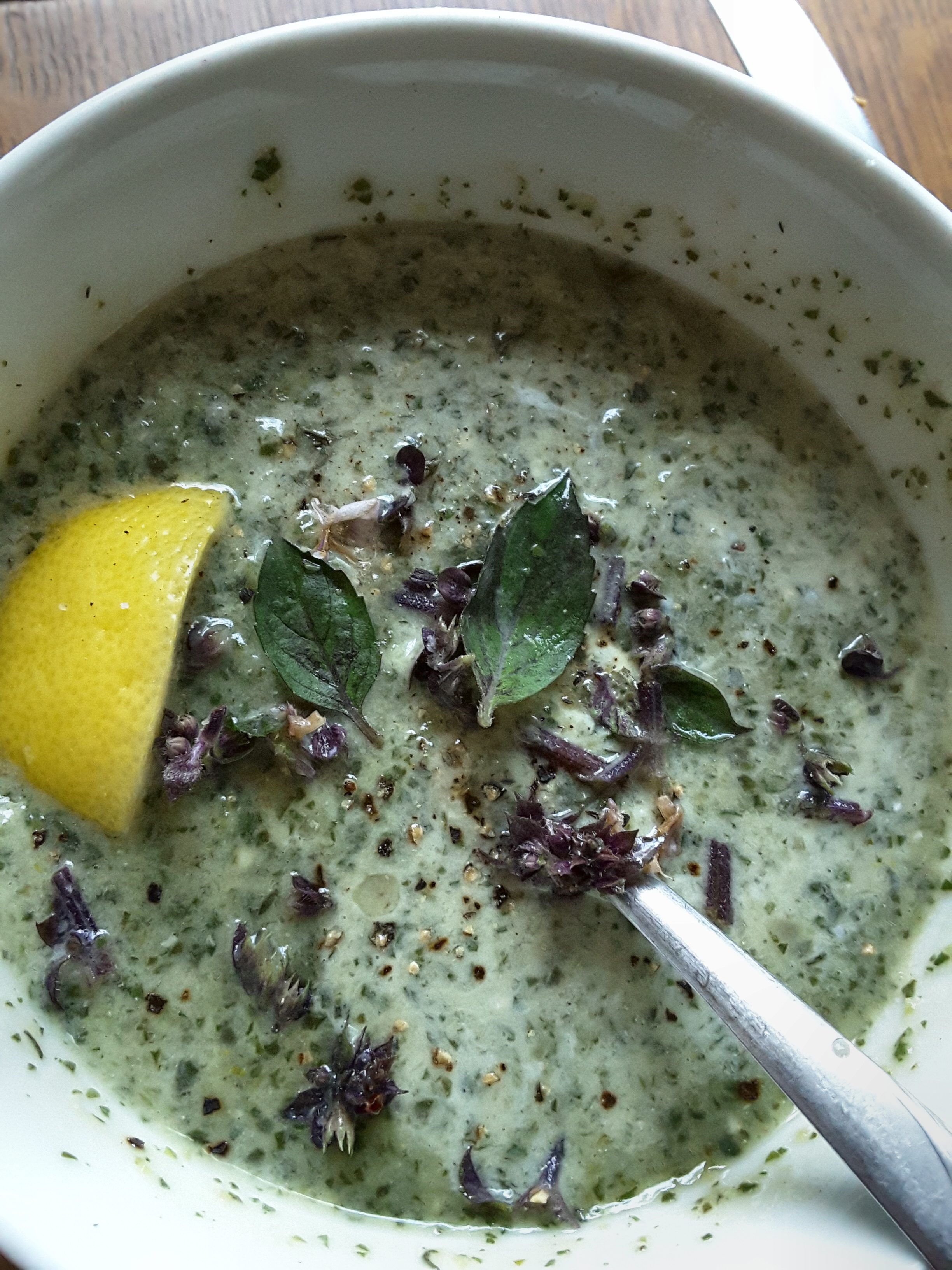
Sargent’s infamous ballroom portrait of Madame X is today’s inspiration for a soup that, like his subject, breaks a few stodgy rules and dares to produce an elegant but fresher, bolder, more nutritious–and certainly lighter–version of a classic French soup in a few minutes flat. It’s smooth but svelte. And it still keeps you in suspense.
So before we get to today’s featured mystery vegetable (herb? green? Let’s settle on green)–let’s talk about breaking the rules.
Most classic veloutés–vegetable-based cream soups–rely on thorough boiling-into-submission of the vegetables, generally mostly potatoes, to soften them for blending, which used to be done by hand through a mesh sieve back in Madame X’s and John Singer Sargent’s day. They also add a heavy dose of cream to mask any individual or strong flavors so nobody could possibly get upset that they can actually taste the vegetables.
All that cooking softens things but also breaks down most of the vitamins. Reliance on potatoes for bulk makes things starchier and blander as it crowds out the greens as the main ingredient. And I don’t have to tell you what I think about cream–you’re free to disagree but I take statins for a reason, and I’m an inveterate cheese freak. Also chocolate.
So I say save the high-ticket calories for something that packs a bigger punch tastewise even in small, expensive, memorable bites–goat cheese, bittersweet chocolate ganache. Not soup. Make it count.
Method counts too. The modernized French restaurant-approved cookbook methods for veloutés and blended soups in general are stupid, cumbersome and unsafe. There’s no good enough excuse anymore for telling inexperienced cooks–or any cooks–to boil up a vat of something and then try to pour it into a food processor or blender hot–very dangerous, and not the edge we’re seeking here. Scald marks are not chic. Nor is hot flying soup all over the kitchen walls.
In today’s world, you have a blender or food processor AND you probably have a microwave, no matter how many TV chefs may rail against it. You can do this smarter and safer and lighter and faster.
Common sense says blend your veg of choice first, then heat it. If it isn’t soft enough raw to blend smooth before cooking, steam it through first with minimal water and a lid in the microwave for a couple of minutes or, failing that, in a nonstick frying pan or stockpot with a drizzle of water, maybe a quarter-inch off the bottom of the container or pan, and a lid, also for a few minutes. Take it off the heat, pulse a few times in your blender or food processor without most of the liquid to get it started, then add cold liquid gradually as it blends further until it gets to the consistency you’re aiming for. You’re a lot less likely to generate big steam and pop the lid that way.
Then pour it into a microwaveable container with a lid to cook or reheat the soup in a few minutes without destroying every possible vitamin or losing all the color. You won’t scald yourself and you won’t be furious and frustrated and wishing you’d never heard of it before you even get to taste it (this does happen, you know, and cookbooks never mention it)… You’ll be fabulously unruffled (well…at least for this) and ready to dine when it’s ready to eat.
So, enough with the cooking hock-I-mean-hack. What’s with the purslane? What is purslane, anyway?
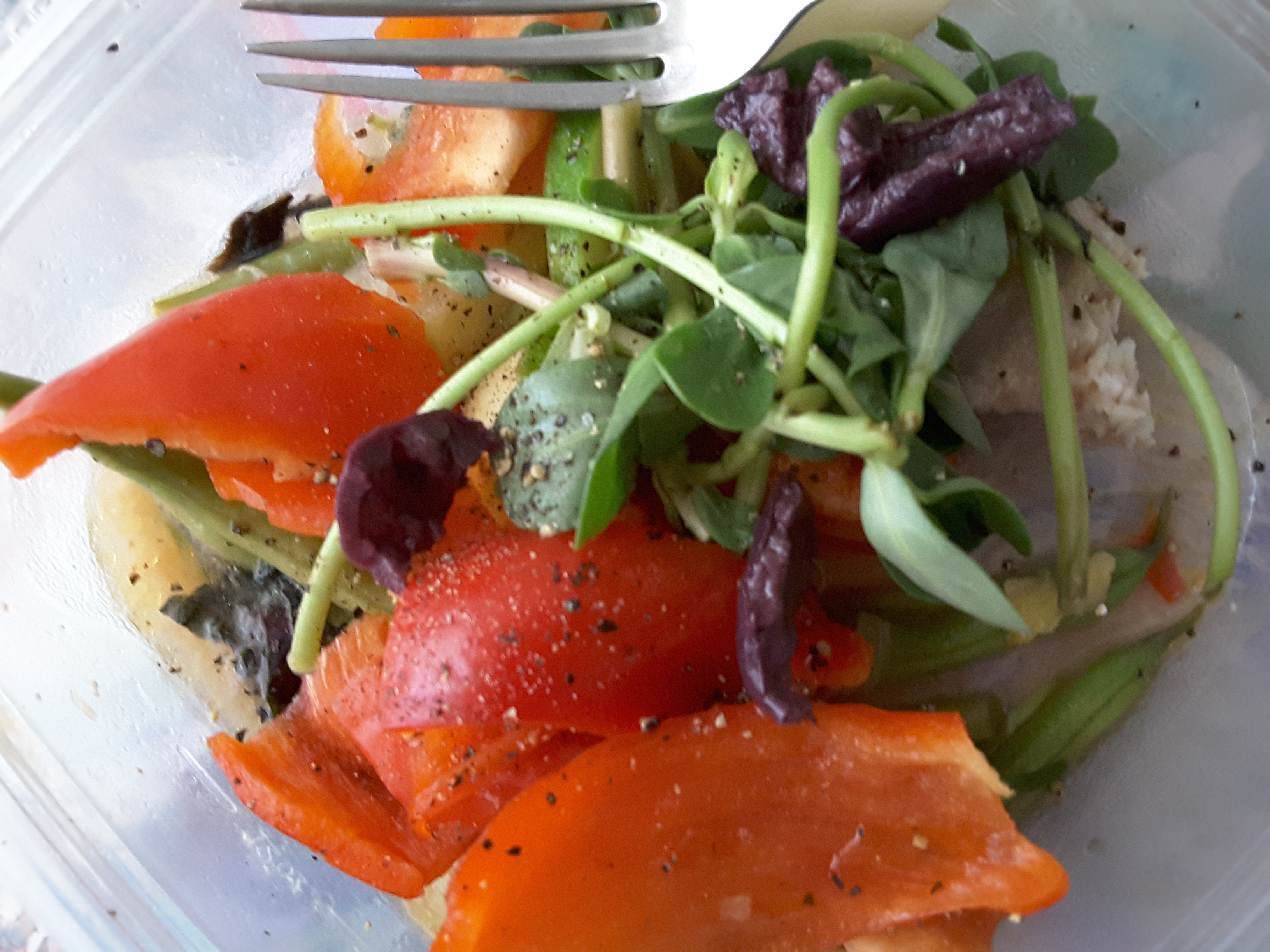
You’ve been wading patiently through my diatribe, and the suspense is killing you (but a nice distraction from worrying about the election totals, yeah?)

Purslane, or verdolagas in Spanish, is a slightly tart fresh herb that tastes like a lemony version of watercress or spinach–sorrel? Texture- and looks-wise, it’s a cross between a fresh green herb like basil and a succulent like…like…well, like a jade plant (despite the fact that jade plants are not edible, I’m pretty sure). That is, the leaves are smallish but sort of fleshier than normal herbs. At least when they’re at their peak freshness. Most people who buy and eat purslane put it into a fresh salad and eat it raw. Some stirfry it or chop it and put it into spinach-type dishes. And it’s pretty nutritious–high in vitamins A and C, potassium and other minerals, surprisingly for a vegetable, highish in omega-3 fatty acids if you’re still into those. Grows pretty much throughout the world.
After a week in the fridge, though, it loses a little of its puff and starts to wilt a bit–is it going bad? can you still do something with it?
As long as it’s still green, the stems are okay and nothing’s going slimy, yes. Won’t be perfect raw, but you can wash and cook it. And it will still taste decent.
I picked up an end-of-the-day bargain bag of 5 bunches, or about 2 lbs., of purslane from my corner greengrocer for under a dollar. Maybe under 50 cents. I twisted the lowest inch of stem off each bunch, removed the rubber bands, rinsed everything well in a colander and decided to make a cream-of-X style of soup with it in the microwave.
Cream-of-X, where X=vegetable of choice and cream of does not actually equal cream per se, was the college cooking staple of one of my housemates the year I learned to cook inexpensive but decent vegetarian student meals for myself. Usually X stood for zucchini in her book–cheap, bland, easy to deal with and easy to vary.
Blend it up with milk, a little flour, a little grated cheese like parmesan, maybe some onion and garlic, a few herbs if you have them, and heat it up while stirring until it thickens and the cheese melts. That’s it. If you don’t have zucchini, cauliflower or broccoli are fine, spinach is fine, mushrooms are fine, and, as demonstrated below, purslane is pretty good too.
Besides Madame X, who in fact hailed from New Orleans rather than France, my second inspiration for using purslane in this soup was a pesto-sauced slice of veal I once had with my grandparents in an Italian restaurant in Greenwich Village. The sauce was more lemony than ordinary basil pesto, something in between, and much more memorable than veal. This soup comes surprisingly close–so maybe that sauce also had purslane in it? In any case, for a touch of drama and some hint of pesto flavor, I’ve used the purple basil flowers on a plant I’d rooted this summer from a stalk in my last bunch from the corner greengrocer. Basil flowers, purple or not, are more intense than the leaves, so if you’re growing basil at home, don’t throw them out when you pinch them off! Use them!
Basil is not just there to be pretty, either. Purslane is a bit lemony but with a grassy edge to it, even after cooking in the microwave, so a squeeze of lemon does it favors. The spicy almost-sweetness of the basil, added fresh after cooking the soup, complements both the lemon and the green edge, and a dollop of Greek yogurt stirred in at the table gives it body without adding fat.
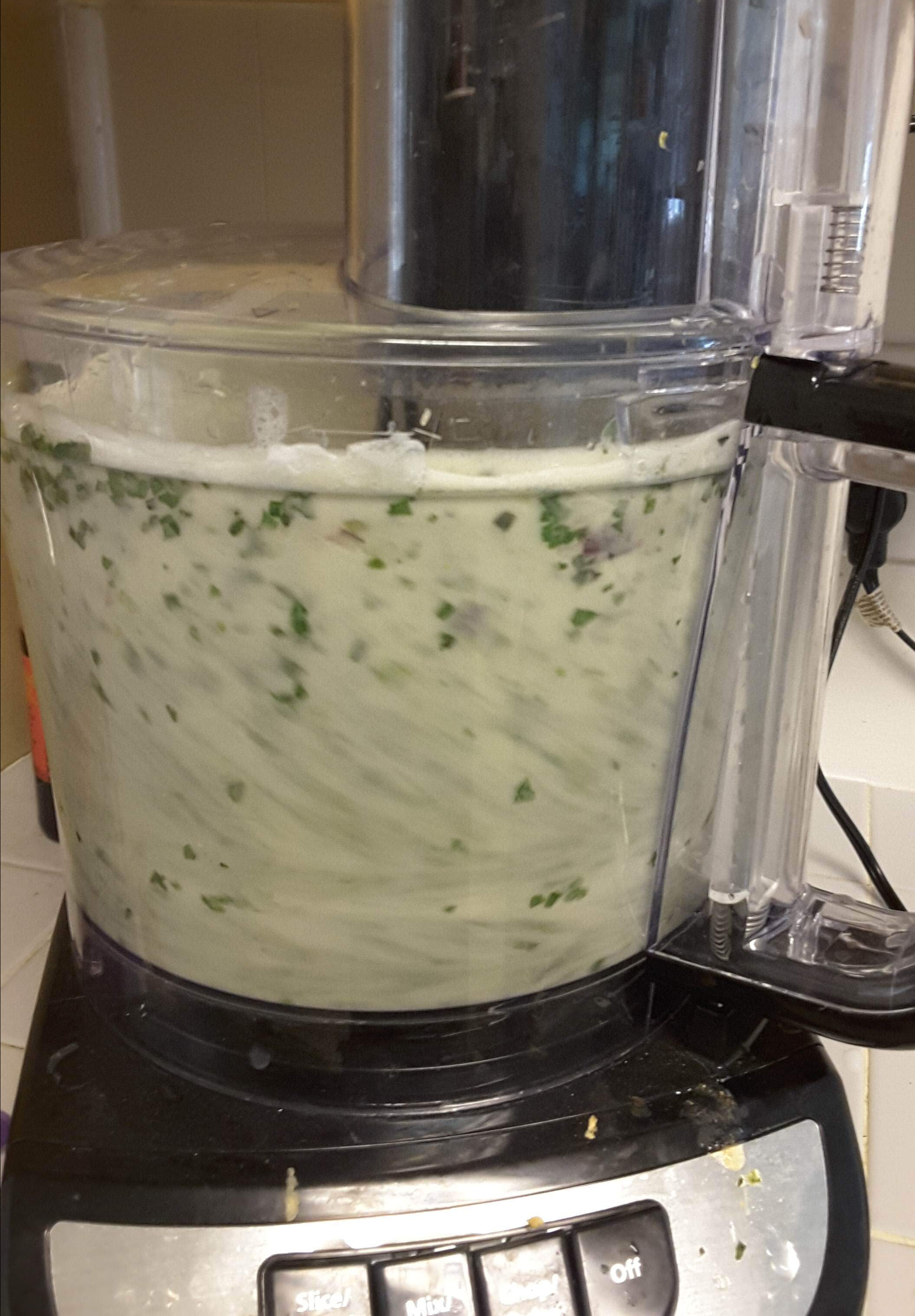
The last thing to mention–the purslane soup really whipped up to a high volume in my food processor as I was blending it with milk. It looked creamy and impressive with very few ingredients and extremely little fat, and if it had been something I was prepared to freeze as-is for a sorbet, I’d have been elated. As it was, though, I had to stir it down and deflate it a bit to get the whole thing into a 2.5 qt/l container so I could microwave it.
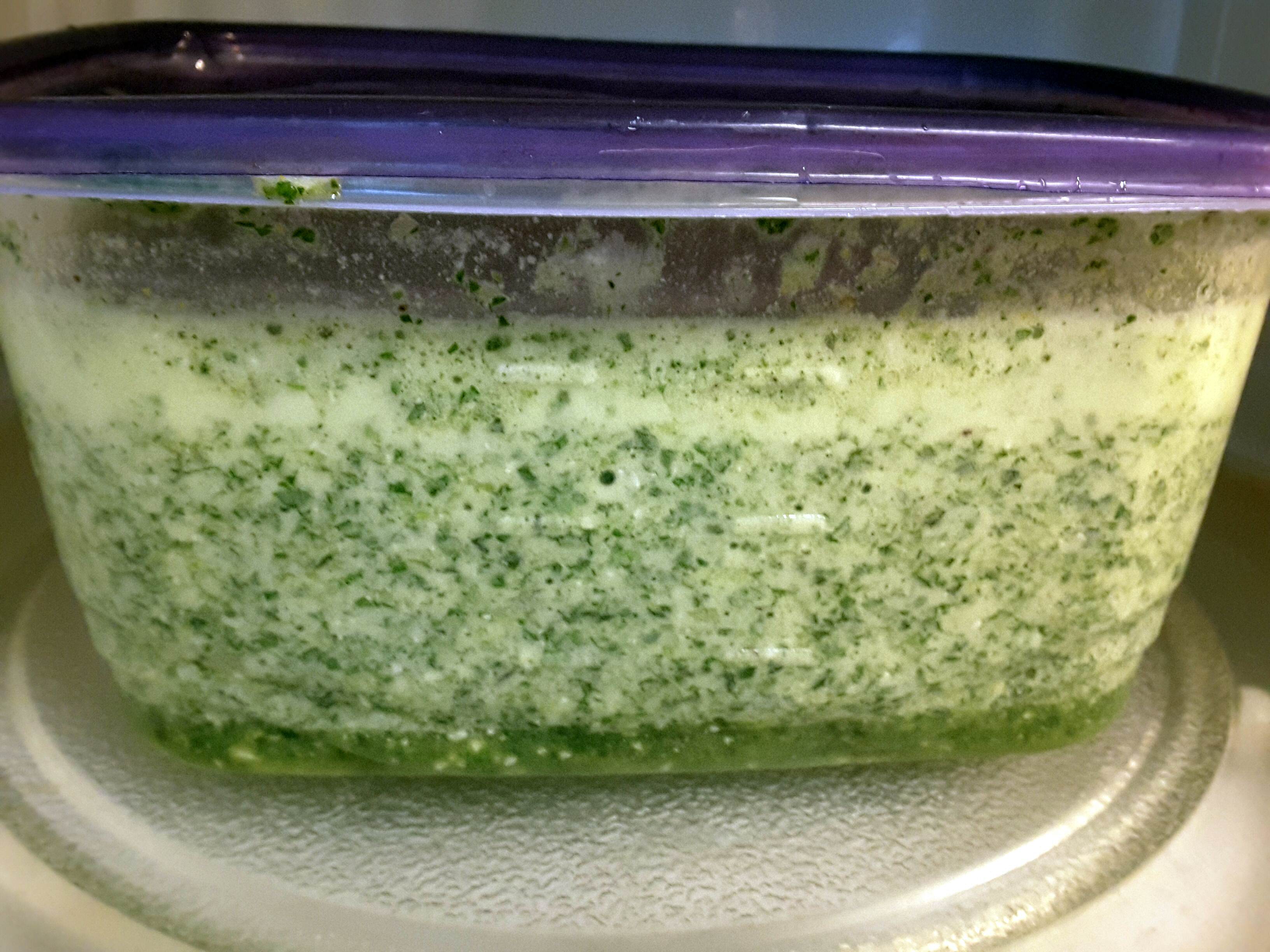
The acidity eventually breaks the milk as you heat it, and the purslane gives off its own juices as it cooks, so a bit of flour is a must to keep it all from separating too much. But only a bit of flour–maybe 2-3 tablespoons, less than an ounce, for over a liter of soup. As it cooks further, stir it well a few times and eventually the flour thickens and reincorporates everything.
Crème-de-X Purslane and Basil Velouté
Makes about 6-8 servings, or 1.5-2 qt/l
- 3-4 bunches of purslane, about 1.5-2 lbs., stems trimmed slightly, stalks rinsed well in cold water
- 1/4 medium onion
- 1 lg. clove of garlic, minced or grated
- 2 oz. feta or queso fresco cheese, or 1 oz. grating cheese
- 2 heaping T. flour
- 1-2 c. skim milk, as needed
- juice of half a large lemon or 1 medium lemon, plus wedges to serve
- plain nonfat Greek yogurt, to serve
- 2-3 stalks fresh basil leaves or, better if you have them, broken-up buds and flowers to garnish
Chop or break the trimmed purslane stalks, which are probably about 8-10″ long, into 2-3″ lengths and pulse them in a food processor or blender with the wedge of onion, garlic, cheese, flour and lemon juice to start. Gradually pour in the milk until everything starts moving and blending finer and the container is mostly filled.
Let it blend to a pale, creamy green with a finer texture and higher volume, then stop, pour or scoop it out into a 2.5 qt/l microwaveable container or old-Pyrex bowl with a lid. You may have to stir it down a bit.
Microwave on HIGH for 7-8 minutes or until it’s heated through and thickening. Stop and stir it well with a fork or whisk after 4 minutes and every minute or so after until it seems about right to you–no more raw onion flavor, purslane starting to mellow, it’s thickened and not separating out anymore, but still green.
Taste, add maybe a small pinch of salt and a little more lemon if you’re not serving those at the table. Garnish with basil leaves or flowers and a dollop of Greek yogurt to stir in.
Filed under: cooking, frugality, haute cuisine, high-speed soup, kitchen safety, Microwave tricks, Revised recipes, soup | Tagged: food, recipes, vegetarian |
 Slow Food Fast