
• Enter your email address to subscribe to this blog and receive notifications of new posts by email.

    Join 241 other subscribers
  • Noshing on

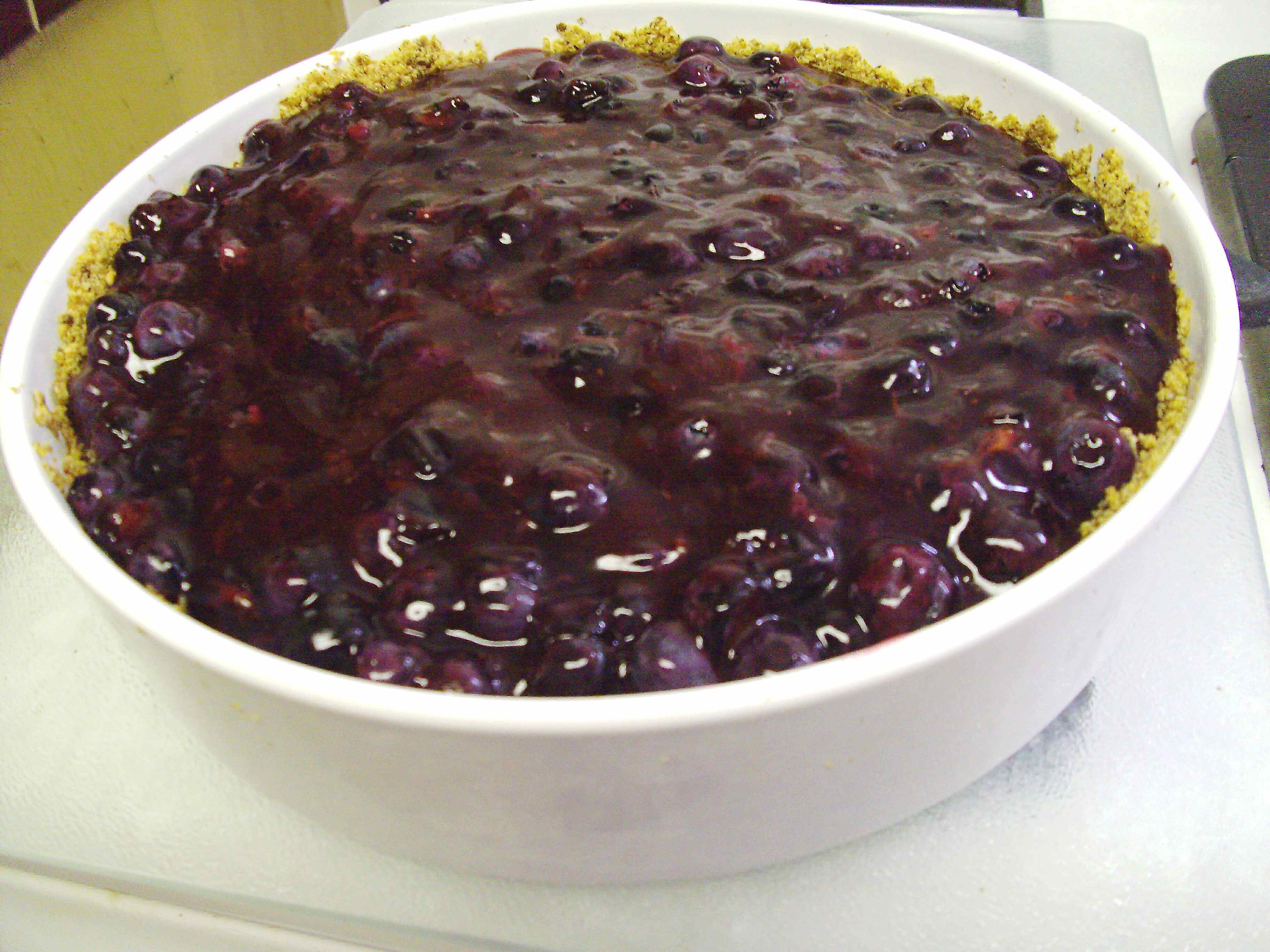
    raw blueberry pie with microwaveable filling and graham cracker crust

    This mostly-raw blueberry pie is a snap to make and very versatile--the filling microwaves in a few minutes, and you don't even have to bake the zippy gingered graham cracker crust--perfect for a hot Fourth of July and all summer long.

  • Recent Posts

  • Contents

  • Archives

  • Now Reading

  • See also my Book Reviews

  • Copyright 2008-2024Slow Food Fast. All writing and images on this blog unless otherwise attributed or set in quotes are the sole property of Slow Food Fast. Please contact DebbieN via the comments form for permissions before reprinting or reproducing any of the material on this blog.

  • ADS AND AFFILIATE LINKS

  • I may post affiliate links to books and movies that I personally review and recommend. Currently I favor Alibris and Vroman's, our terrific and venerable (now past the century mark!) independent bookstore in Pasadena. Or go to your local library--and make sure to support them with actual donations, not just overdue fines (ahem!), because your state probably has cut their budget and hours. Again.

  • In keeping with the disclaimer below, I DO NOT endorse, profit from, or recommend any medications, health treatments, commercial diet plans, supplements or any other such products.

  • DISCLAIMER

  • SlowFoodFast sometimes addresses general public health topics related to nutrition, heart disease, blood pressure, and diabetes. Because this is a blog with a personal point of view, my health and food politics entries often include my opinions on the trends I see, and I try to be as blatant as possible about that. None of these articles should be construed as specific medical advice for an individual case. I do try to keep to findings from well-vetted research sources and large, well-controlled studies, and I try not to sensationalize the science (though if they actually come up with a real cure for Type I diabetes in the next couple of years, I'm gonna be dancing in the streets with a hat that would put Carmen Miranda to shame. Consider yourself warned).

Bourekas, Pastry Crust…How Low Can You Go? A Lower-Fat Flake-Off

Borekita "flakeoff" tests two types of dough

I know bourekas aren’t health food, they’re party food, but it doesn’t stop me from wanting to make and eat good ones in (small, sane, occasional) quantities.

Key to the desire for bourekas of worth is my never-ending hunt for a pastry dough with all the right qualities–lighter, tenderer, massively flaky, and oh, while we’re at it, much less heart-stopping than puff pastry or most pie dough, but still capable of flaking and puffing up nicely. I almost had it a couple of years ago with an Armenian dough that calls for a little vegetable oil in with the butter, a bit of cider vinegar for tenderness and an egg to help out the puff. But with butter, there’s automatically a lot of saturated fat, plus it takes more work than I like.

Enter the nondairy, oil-based borekita dough. Israeli (Turkish, Bulgarian, Sephardic…) bourekas, nowadays usually made with commercial puff pastry and sold in characterless boxes or plastic-wrapped trays from the supermarket, are nonetheless wildly popular with almost everyone in The Land whether they voted for Bibi or Benny. The boureka is not in doubt.

Puff pastry is nice enough in most circumstances–after all, it is what I’m aiming toward, or would ideally like to be aiming toward, if I can get away with something lighter. But after a while the packaged versions of puff-pastry bourekas all start to taste the same–salted potatoey stuff, indistinguishable through the mouthful of flakes, and not exactly fresh.

Homestyle boureka dough is much less puffy, more like the dough for sausage rolls. But still–less rich, usually made with oil rather than butter, so it’s both nondairy, to go with meat meals if you keep kosher, and lower in saturated fat (unless you go big on cheese fillings, anyhow) and lower on fat percentage generally. It’s also more economical, more delicate and less oversalted, and it doesn’t overwhelm the fillings.

But the real tests of how low on fat you can go–how well does it flake? How does it taste?–require a head-to-head comparison of different doughs with different fat content. Since it’s down in the 80s I decided to do small batches of each type and see how they worked.

There are two common versions of this home-style boureka dough, a more-oil version and a more-water version.

More oil than water

Al HaShulchan (“On the Table,” the Israeli food magazine) editor Janna Gur‘s recipe on her English-language site is very simple especially if you weigh everything out on a digital food scale (easier and more accurate than trying to juggle dry vs. wet measuring cups and scooping and sweeping and sifting). By weight, it’s about 50% fat to flour–four parts flour, two parts salad oil, one part water, a little but not too much salt. Her recipe makes about 50 borekitas; I decided to quarter that for this test because I’m not stupid and I know myself, and what was I going to do with 50?

Janna Gur borekita dough with more oil than water

The dough for this version has the texture of shortbread or playdoh, very short, and oil will definitely coat your hands when you pinch off walnut-sized balls to roll out for the borekitas, but at least it’s polyunsaturated, not solid fats. Because it’s so oily and you handle it so lightly, there’s no gluten built up. The dough is a bit fragile and rolls out a little ragged as you can see above, but you can roll, fill and bake right away.

Less oil, more water

Bureka Boy, whose Is-that-my-bureka blog, with its wealth of Sephardic and other Jewish recipes, paused for posterity in 2009 (though recently it looks like he may have shifted to Facebook or Instagram or both), has a smoother dough with the proportions of oil and water reversed, so about 25% oil to flour by weight. The water is added very hot when you stir it in (much like jao tze dough), so the dough develops gluten and needs an hour’s rest after mixing and kneading. It’s still quite oily when you go to pinch off individual balls for the borekitas, but it’s more elastic, with a smooth surface and better strength to roll it thin without breaking. You can handle it more and get neater pinched edges on the seal.

BurekaBoy's borekita dough with more water added hot to build gluten


So…on to the Flake-Off! Continue reading

New Year, New Food: Cabbage Rolls with a Greco-Ottoman Twist

Cabbage rolls with giant fava beans and tehina sauce


I always have such good intentions–and end up writing about them much later than I should. Let’s face it, it’s almost Thanksgiving. But not quite yet.

In late September, at the start of the High Holidays, we were finally starting to feel fall weather in Pasadena–one week quite cool, the next hot again, but at least for a while we were generally out of the 90s, so it was time to experiment in the kitchen, doing things I’ve wanted to try out for years.

Only it’s been a surprisingly busy month or two, so I’m just getting back to posting now. We traveled several times this summer visiting family, taking our kid back to college on the east coast, and heading up to Portland for a wedding–very impressive hotel with actual good food (it is Portland, after all) and its own kitchen garden with massive tomato vines.

Then I came home to articles due and a life-changing decision to make: after 25 years with the last of the noncomputerized Corollas, which I loved with or without adequate suspension and shocks, it was finally time to get on it and buy a new(er) and hopefully more fuel-efficient hybrid at a reasonable price if at all possible.  (Note to the Resident: who in their right mind would want a new car that gets worse mileage? Get real.) But I’m going to miss the crank windows of my old car something fierce.

But on to new food for the New Year–this is still occasionally a food blog!

I had a 25-oz (1.5 lb or 700 g) bag of giant fava beans, gigantes in Greek, and decided, what the heck, it would be nice to have a large batch I can eat cold or hot during the week for lunch or a casual-elegant side with some salad at dinner. Once my kid was off at school, you know, I could count on supper leftovers to stay uneaten until I took them back out of the fridge. I like to cook but really, it’s been handy doing the “cook once, eat at least twice more” thing.

So I microwaved the whole thing in two batches, switching two snaplid containers in and out of the microwave for a couple of rounds, letting one cook a few minutes in water to cover while the previous one sat to let its beans absorb hot water. Once both were done and the beans were tender, I drained them and started pinching off the loose dark gray skins. Great–well, I had enough for two different recipes. One was going to be the marinated beans with rosemary and rosé. The other batch–well, I could freeze it for later. Or…

And then I thought about two striking recipes I’ve meant to try for years, both for cabbage rolls very different from the sweet-and-sour stuffed cabbage my great-aunts used to make, and which I don’t really like very much even now that I’m a supposed adult.

One version from Rena Salaman’s The Greek Cook: Simple Seasonal Food (Anness, 2001) has a chunky filling of smoked pork and an avgolemono sauce, which I’ve wanted to do a vegetarian or at least kosher riff on for years. Combining lemony sauce with a smoky filling is right in line with my love for Middle Eastern food…and speaking of,  the other cabbage rolls, the ones that first stopped me in my tracks, came from The Turkish Cookbook: Regional Recipes and Stories by Nur Ilkin and Sheilah Kaufman (Interlink Books, 2010) and were vegetarian to begin with.

What makes a cookbook worth trying are the foods and flavors you don’t already know. The first photograph I saw the first time I opened The Turkish Cookbook, from somewhere in the middle of the book and the region of Marmara, was a beautiful plate of vegetarian cabbage rolls so translucent you could see the filling–roasted chestnuts and rice. These were flavored with cinnamon and allspice, mint, parsley and dill, stewed in olive oil and served cold, like most dolmas, with lemon wedges. Quite a combination of flavors, and unexpectedly beautiful.

Here was something I’d never seen in another Turkish or Middle Eastern cookbook, but I could tell from the description that the flavors would work. My imagination started running away with me and when I first saw them, I thought…chestnuts? Can I get them? It is fall–maybe they’re in my greengrocer’s this week. If not, is there something a little less expensive that tastes similar–a little potatoey, tinged with sweet–how about those giant dried fava beans? But it took me more than five years to try it. Now (meaning, back in September) seemed a pretty good time.

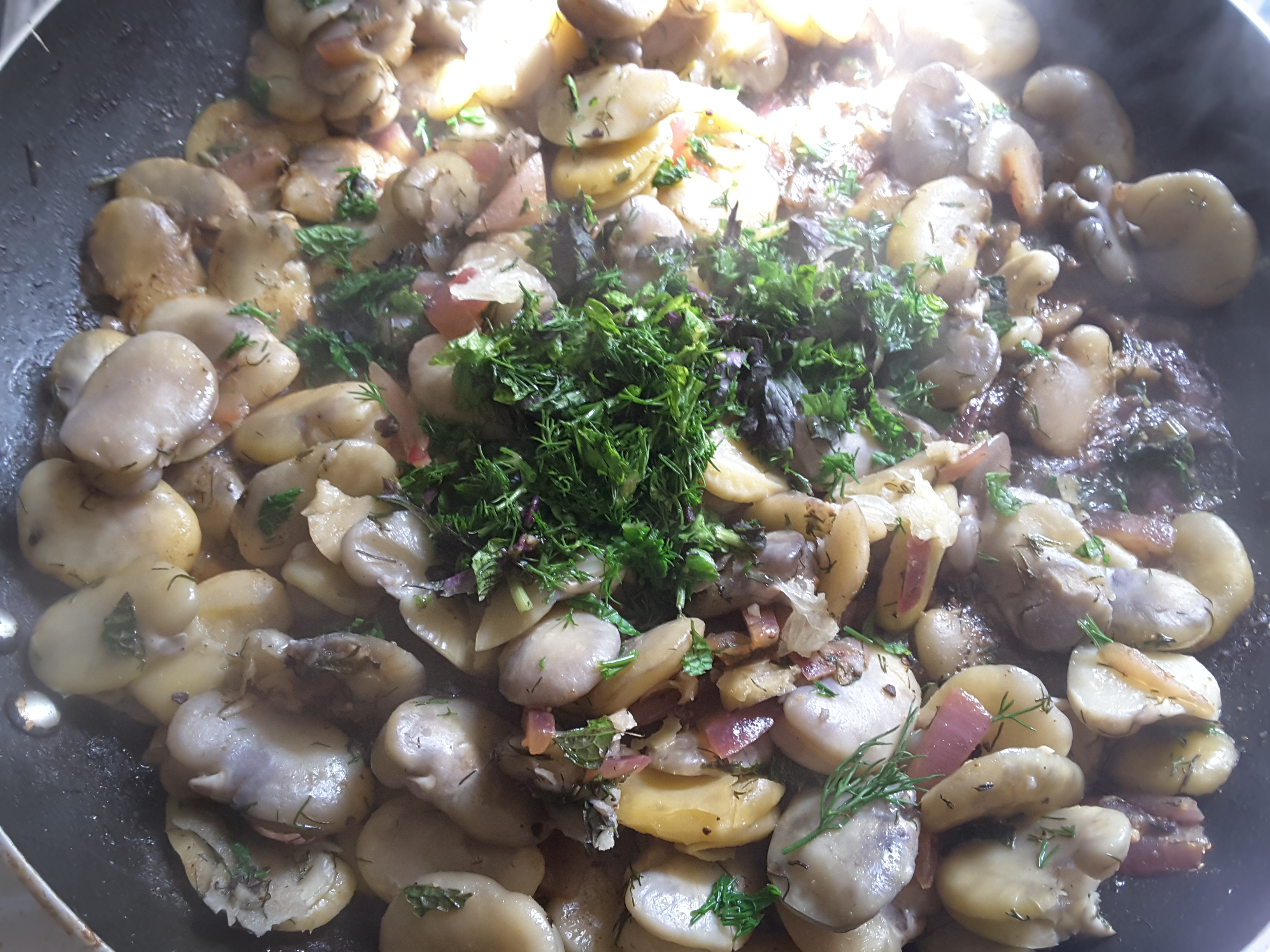
Bridging the gap between the two versions–Greek and Turkish–I decided to make a fava filling and flavor it more or less as for the Turkish version, but add the lemon and smoke factors of Rena Salaman’s cabbage rolls by saucing mine with tehina and sprinkling with paprika and caraway seed.

And of course, I was going to do most and frankly all of it in the microwave. Except for the rolling–microwaves don’t make that step shorter! But steaming the cabbage leaves, cooking the beans (already done), and stewing the cabbage rolls in sauce–all nicely microwaveable.

The only thing I didn’t do was add rice or currants and pine nuts to the bean filling. The rice might have held the cabbage rolls together a bit better when trying to eat them. But they were pretty delicious hot or cold and lasted me a couple of days.

Cabbage Rolls with Giant Favas and Tehina

Loosely adapted from The Turkish Cookbook and The Greek Cook Simple, Seasonal Food as noted above. You might want to stir in a bit of cooked plain rice to help keep the rolls together.

Filling (flexible on amounts here, but let’s say for a couple of cups of cooked beans):

  • cooked, peeled giant fava beans
  • chopped onion
  • Allspice, cinnamon, coriander, fennel seed, black peppercorns, (salt)
  • Mint, dill–chopped fresh if possible, about a small handful each, 2-3 sprigs
  • Garlic–minced/mashed/grated, 1 fairly sizeable clove or to taste
  • Olive oil
  • Lemon juice

Heat a couple of tablespoons of olive oil in a nonstick pan with about half a chopped onion, a teaspoon each of ground allspice and cinnamon, half a teaspoon each of coriander and fennel seed and a good grinding of fresh-ground black pepper. Stir occasionally until the onion starts to brown. If needed, add a quarter-cup of water, stir, and let cook down to keep things from sticking and to get the onion cooked so it can start browning. Squeeze on a bit of lemon juice, then add the cooked, peeled favas and more juice and more olive oil. Add the garlic and the chopped fresh herbs and continue to stir/toss in the frying pan until the beans are coated but not swimming in liquid, and they’re quite tender–you can add bits of water once or twice and let it all cook down. Taste for salt before adding any. Continue reading