• Enter your email address to subscribe to this blog and receive notifications of new posts by email.

    Join 241 other subscribers
  • Noshing on

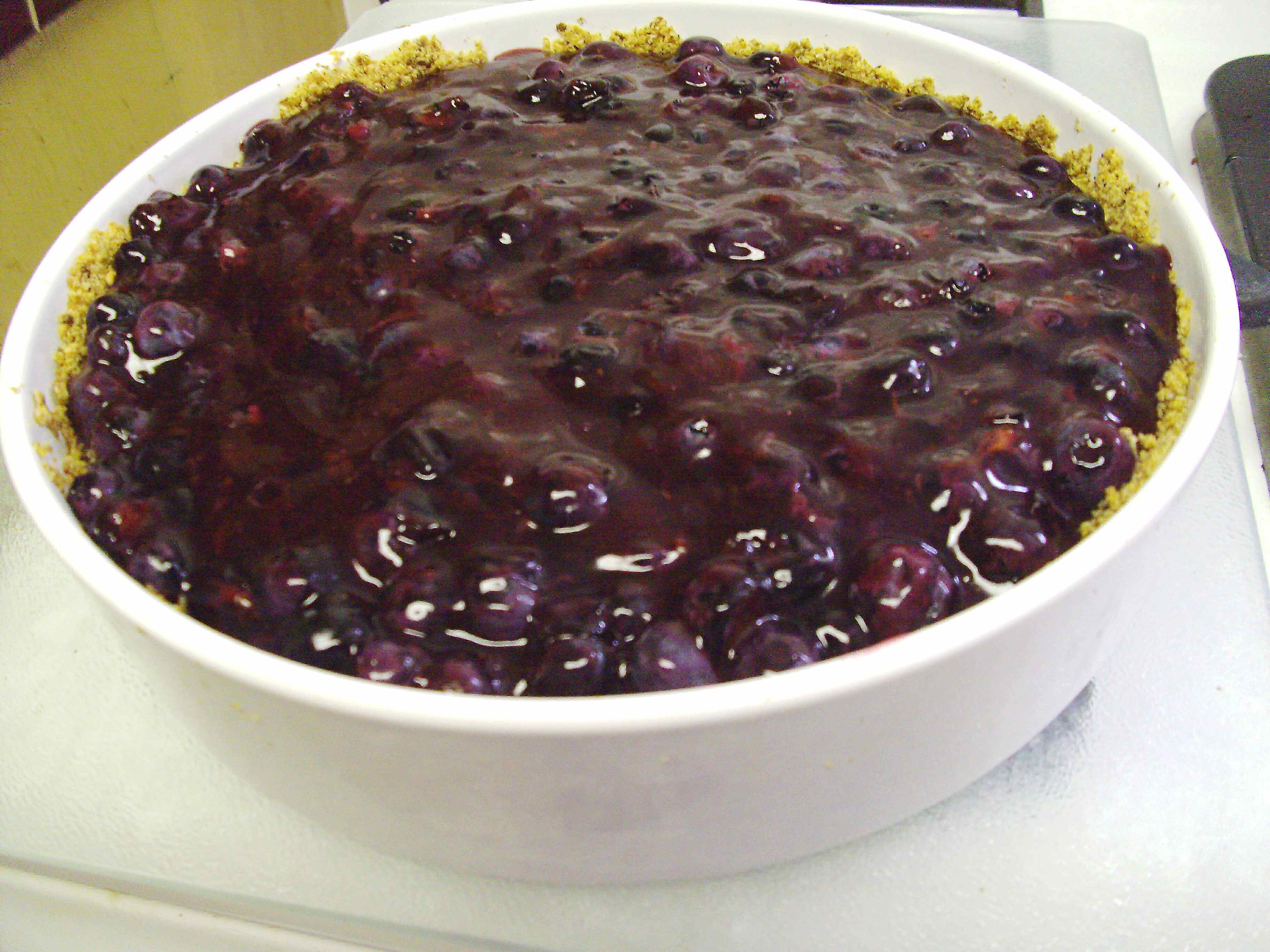
    raw blueberry pie with microwaveable filling and graham cracker crust

    This mostly-raw blueberry pie is a snap to make and very versatile--the filling microwaves in a few minutes, and you don't even have to bake the zippy gingered graham cracker crust--perfect for a hot Fourth of July and all summer long.

  • Recent Posts

  • Contents

  • Archives

  • Now Reading

  • See also my Book Reviews

  • Copyright 2008-2024Slow Food Fast. All writing and images on this blog unless otherwise attributed or set in quotes are the sole property of Slow Food Fast. Please contact DebbieN via the comments form for permissions before reprinting or reproducing any of the material on this blog.

  • ADS AND AFFILIATE LINKS

  • I may post affiliate links to books and movies that I personally review and recommend. Currently I favor Alibris and Vroman's, our terrific and venerable (now past the century mark!) independent bookstore in Pasadena. Or go to your local library--and make sure to support them with actual donations, not just overdue fines (ahem!), because your state probably has cut their budget and hours. Again.

  • In keeping with the disclaimer below, I DO NOT endorse, profit from, or recommend any medications, health treatments, commercial diet plans, supplements or any other such products.

  • DISCLAIMER

  • SlowFoodFast sometimes addresses general public health topics related to nutrition, heart disease, blood pressure, and diabetes. Because this is a blog with a personal point of view, my health and food politics entries often include my opinions on the trends I see, and I try to be as blatant as possible about that. None of these articles should be construed as specific medical advice for an individual case. I do try to keep to findings from well-vetted research sources and large, well-controlled studies, and I try not to sensationalize the science (though if they actually come up with a real cure for Type I diabetes in the next couple of years, I'm gonna be dancing in the streets with a hat that would put Carmen Miranda to shame. Consider yourself warned).

Persian Posh and Jewish Soul: Two Veg-Friendly Cookbooks for Spring

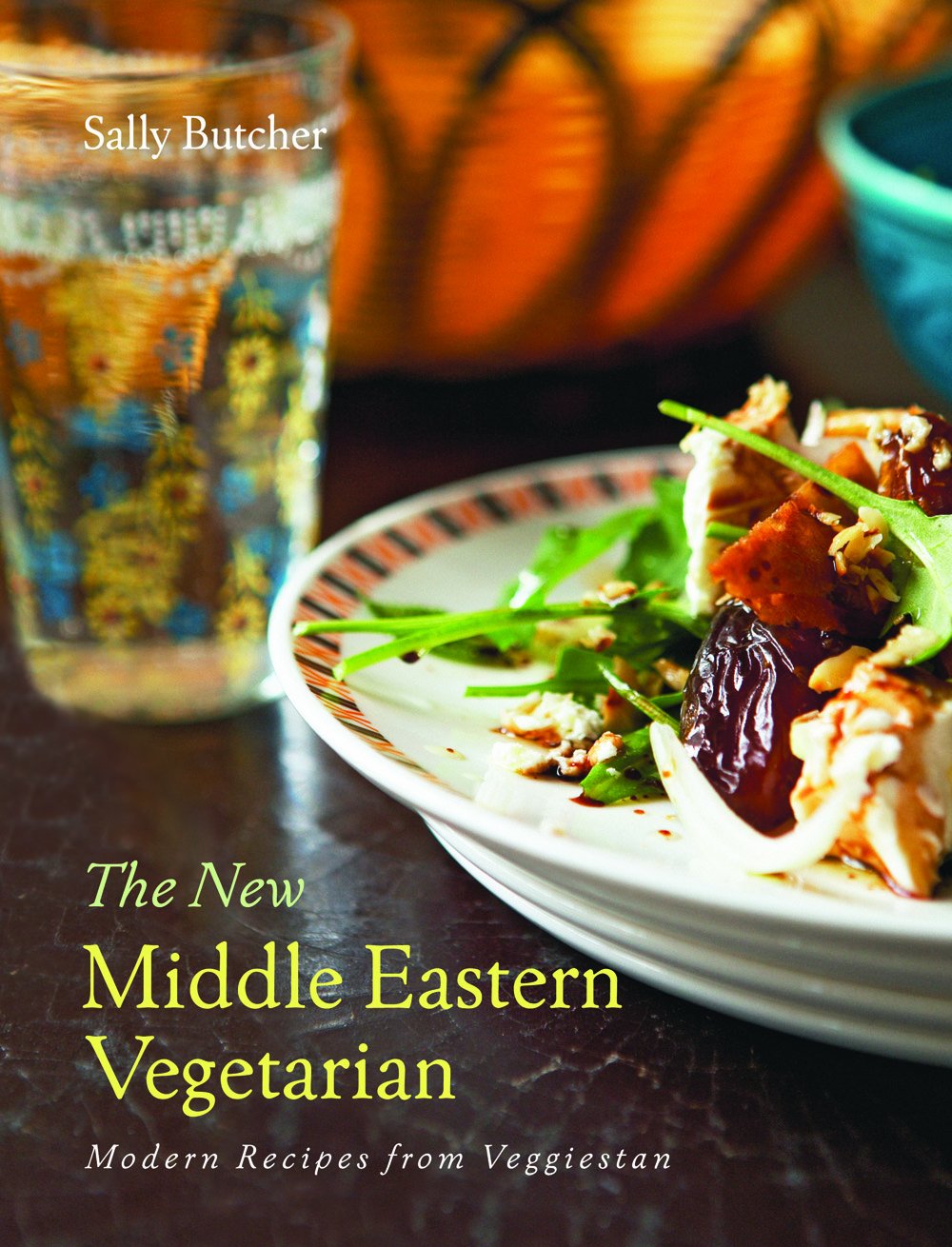
"The New Middle Eastern Vegetarian" (aka "Veggiestan" in the UK) by Sally Butcher, cover photo from amazon.co.uk "Jewish Soul Food: From Minsk to Marrakesh" by Janna Gur. Cover photo from amazon.com


Passover week didn’t exactly go the way I’d hoped, with loads of new vegetable dishes to play with and experiments in microwave gastronomy that would wow the most cynical reader…

After the optimistic start with the chocolate almond torte and the microwave shakshouka for one, I suddenly caught a bug–my husband caught it first, suffered a day or so, got better and then kindly passed it to me, and I ended up sick for the better part of the week. We all agree we got it from a kid he was sitting next to at seder. Now that our kid’s a teenager, we’re no longer used to it. Clearly we’ve gone soft.

So I was–shall we say–less than enthusiastic about cooking the last week or so, and ended up with lots of ideas that stayed in my head while I stayed in bed, attempting to keep up on tea, rice, poached eggs and applesauce. And feeling really embarrassed that every time I opened the fridge and saw all the beautiful vegetables I’d bought for the week, I peered at them suspiciously–how much trouble would they cause me? Was it really a crappy virus or was it maybe secretly food poisoning, even though everyone else was able to eat? Maybe tomorrow–and closed the fridge door again and groaned. It took a couple of extra days to start looking at vegetables with any enthusiasm at all.

This, I thought, is what most of the country thinks about fresh vegetables if a dolled-up superstar chef isn’t holding one on the cover of a glossy magazine (or even if he is). Maybe with a little less queasiness or dizziness than I experienced, but with that lurking suspicion that vegetables have dirt on them, that you have to wash them off and then cut them up and do something to them, that they’re not sterile and wrapped in plastic for your protection, and that it’s all too much bother. What a lousy, paranoid way to live.

So anyway, now that I’m better the vegetables are looking good again, and the (four or five) leftover matzah boxes have been relegated to a top shelf for sometime when I’m not sick of them and want to experiment a bit for next year.

Two bright and sun-filled new (or newish, anyway) cookbooks that make lavish and hearty use of vegetables were languishing on my desk for the entire week of Passover (and two weeks before that, when I was too busy to do more than look at them wistfully). Sally Butcher’s Veggiestan is a collection of pan-Middle Eastern vegetarian recipes that centers on her husband’s family Persian cuisine and their experience as the proprietors of a Persian specialty grocery in London. Jewish Soul Food: From Minsk to Marrakesh is Israeli food writer/editor Janna Gur’s second major English-language cookbook, and it focuses on Jewish “grandma” food from all the cultures Israel is home to.

Both books run something along the lines of Yotam Ottolenghi’s approach to food–appealing, vegetable-filled, exotic, and fun to cook and eat. But the food is generally simpler and homier, more traditional and with fewer trendy/haute touches or UK-specific ingredients like salsify or seabeans that you just can’t find most places in the US. Butcher and Gur each have a foot in both professional and home cooking, which may make the difference. The recipes here are not chefly so much as cookable. Eminently cookable, and they make me want to run right out and try so many things (especially if I can stuff any of the steps into the microwave) that I’m just going to have to get them both and give back my overdue library copies.

The authors share an approach to traditional and modern Middle Eastern food that is enthusiastic, knowledgeable, ecumenical and–I’m not sure how to say it exactly, but  neighborly comes close. Reading these books is like hanging out in the farmer’s market and the kitchen with a friend who knows how to make all the dishes your grandmother might have made but never showed you.

Veggiestan is the original 2011 UK title of Butcher’s mid-sized cookbook, now out in trade paperback,  but the publishers thought that title would be too controversial for the US (land of “freedom Continue reading

Microwave Tricks: Shakshouka

IMG_0458

Marinara plus a pepper makes a good start.

Sometimes during Passover you just can’t take any more matzahnola. Or matzah with jam, or matzah brei. Or cake. Or macaroons. Anything for breakfast that doesn’t involve at least one vegetable (other than yourself, before coffee). Your tolerance for sweet stuff has been exhausted, and as for the leftover gefilte fish and hrein…no. We are not going there. No matter how much my husband insists it’s “perfectly good” (and I notice he hasn’t schlepped the rest of the jar with him to the office!)

Forget all that. There’s a pretty good cure for the Pesach blahs–you need some chile peppers and you need them now. Not in 20 minutes, no major cooking involved. You have a microwave, some cheap microwaveable soup bowls or the like, and you’re not afraid to use ’em for an increasingly popular Israeli brunch dish–shakshouka. Which is basically the Jewish version of huevos rancheros, only without beans or potatoes. Or lard.

Yotam Ottolenghi has made shakshouka popular and photogenic in at least one of his famous cookbooks, probably prettier than what I’ve got here. But it takes longer too, and I’m impatient.

To make shakshouka, you usually need a frying pan, olive oil, some tomatoes, peppers and onions, plus garlic, cumin, chile peppers, maybe a couple of oregano-or-thyme-and/or-cilantro-type herbs–sounds like the makings of salsa, no?–and some fresh eggs to crack into the resulting sauce. The sauce takes some 20-30 minutes to cook down, the eggs another 5-7 to cook more or less sunny-side-up in the middle of the sauce. That’s a lot of time for breakfast. I wanted a shortcut this morning.

Most jarred salsas are not kosher for Passover–it’s the distilled vinegar thing. That’s okay, because yesterday in a fit of domestic planning (uncharacteristic, I swear) I decided to make a batch of microwave marinara from some unsalted canned tomatoes. I don’t have a kosher-for-Passover food processor this year, though, so I decided, after trying to chop up some pretty tough Roma tomatoes (even with the skins off!) that I should just do as the Sicilians do and break them up with my hands as Tony Danza advises. A little chunkier than usual, but just fine. And actually ideal as a base for shakshouka–both its readiness for a mid-morning fridge scrounge and its rusticity made for a good start. A good dollop in a microwaveable soup bowl.

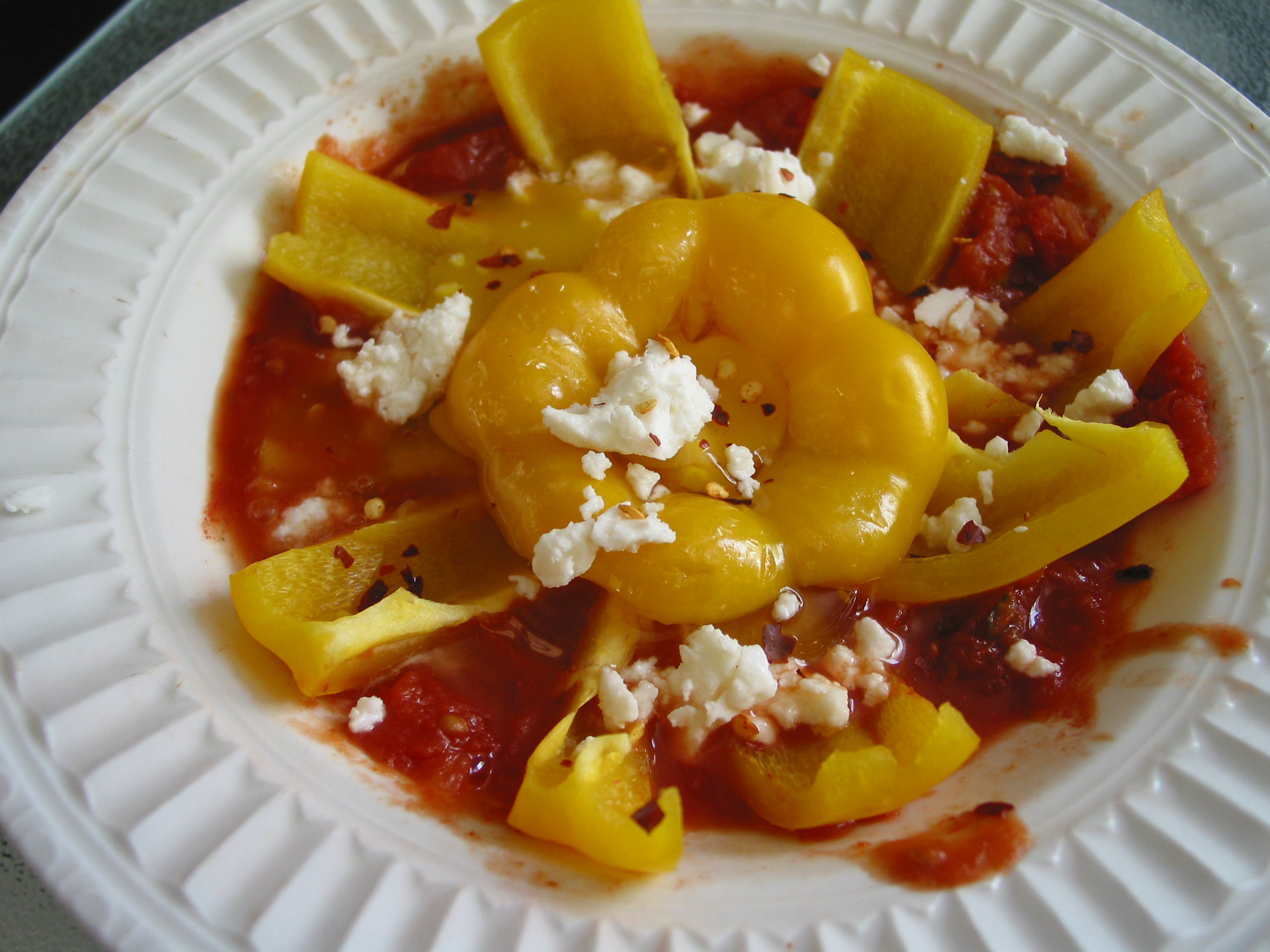
What else do you need? Maybe a bell or Anaheim-type pepper that needs to get used up. Cut it up (I got whimsical, you don’t have to potschky around with flower shapes). Add more onion if you feel like it; I didn’t. Stick it in the microwave for a minute or two to wilt the pepper and possible onion pieces.

IMG_0461

Then crack an egg or two into it, sprinkle on a bit of feta or panela or queso fresco as desired, maybe a pinch or so of chile pepper flakes or z’khug (I’d run out) and/or chopped cilantro as desired.

IMG_0463

Put another soup bowl on top as a lid, and microwave another minute or two until the eggs are cooked to your liking–check and add 30 seconds if you think it’s still got a raw spot somewhere, and/or leave the lid on for a few minutes and let it finish cooking in the residual heat of the sauce.

Obviously if you’re having people over for brunch, the standard frying pan method is better and quicker–more eggs and salsa means more time in the microwave, and no one wants to sit around as you microwave individual portions. But if it’s just you, or you and your partner, the microwave method works pretty well. Just add a little time (maybe another minute or so in 30-second increments) for four eggs as opposed to two.

IMG_0464

Hafla! (celebratory remark when there’s something good on the table and you didn’t have to wait an hour for it) Grab some matzah and a cup of hot coffee and b’te’avon (mangia bene/bon appétit/eat nice)!

Passover Dessert Challenge: No Eggs!

 Passover-eggless-chocolatealmondtorte-halfsheet

Bear with me, I’m still a little hyper (see below). Three days before the first Passover seder, and I’ve been asked to bring a non-fruit, non-macaroon dessert. With a few caveats.

This is the ultimate, I think: a fresh dessert, preferably deep chocolate, with no dairy (serving at a meat meal), no fake stuff (because I can’t stand it) and obviously for Passover, no chametz (forbidden grains like wheat, barley, oats, etc.) or kitniyot (legumes, corn, rice, peas and green beans, some seeds, nuts and spices, plus some vegetable oils derived from them, like sunflower…). Also, for reasons of the requesting family’s allergies, no pistachios, hazelnuts or cashews, or cinnamon.

Or, and here’s the kicker for Passover desserts–eggs. No eggs! And it’s got to be moist and fabulous, or at least obviously better than the standard choke cake box mix, and prettier than the all-real-but-undecorated apple-almond cake I served a couple of years ago. And it’s got to rise and still be kosher for Passover under Orthodox Union rules. Which I had to look up on line for some of the possibilities I had in mind.

It’s not dread in my heart, surprisingly, but a little tinge of excitement at another chance to mess around and come up with something decent.

I’ve done a few home desserts that weren’t bad and that didn’t contain most of the forbidden items. My first best hope is something as close as possible to my favorite, Sacher torte (because I’m unoriginal and because at least I’ll like it). I’ve been working on this for a while and I thought, I can get by without eggs as long as I have some other way to raise the cake and keep it from turning into a rubber brick.

And eggs aren’t the only way to raise a cake or make a cookie without violating the kosher-for-Passover rules. It turns out that some brands of baking soda, including Arm&Hammer and a number of smaller and store brands, are processed under sufficient supervision so there’s no contamination from cornstarch or grains or the like, and are now considered kosher for Passover under O-U rules–it’s worthwhile looking them up. So is all unflavored bottled soda water, even without a kosher certification mark. That one I remember from my student days, when somebody said you could pour seltzer into matzah ball mix to lighten it.

Another item that turns out to be okay is linseed–aka flax. So if you grind linseed and bring it up with water, you could do a kosher-for-Passover dessert without eggs for the kinds of things flaxmeal works for. Consult a vegan dessert book (aside: a lot of the authors are Jewish! Maybe not so surprising), use matzah cake meal and/or almond meal instead of standard flour, and you might be in like Flynn (or at least like Feldman).

Other key ingredients to check are K-leP (kasher lePesach; kosher for Passover)…

The chocolate, obviously. Elite makes so-so quality but certified pareve kosher for Passover bittersweet bars, and they can definitely be put to work. Hershey’s plain (not Special Dark) non-dutched cocoa powder is accepted by the O-U even with just its regular certification mark. Some cider vinegar is probably certified–but fresh lemon juice or orange juice might work too, in case I can’t find an O-U-labeled version. And unflavored raw almonds, walnuts, pecans and almond meal from Trader Joe’s are also all approved, at least this year. Also white cane sugar and non-iodized salt with a regular year-round O-U certification mark.

Other items:

Plain dried fruits as long as they’re not coated with vegetable oils or the like.

Plain fresh fruits other than raspberries and their kin, which are hard to inspect for tiny bugs among the drupelets (but which the O-U has a whole procedure for inspecting at home to make them okay–it boils down to washing and looking carefully. So much for the mystery…).

Spices are more of a pain–some, like caraway and fennel, are considered kitniyot, even though very similar ones in the same family, like anise, are acceptable. Not that I was going to put any of these in a chocolate cake, mind you, but I like to keep my options open for other, non-chocolate, possibilities. Ground spices need to be certified for Passover, and most of the supermarket store brands aren’t.

Finally there’s the taste/texture issue, the 11th commandment: Thou Shalt Serve No Choke Cake (not even before its time, and thank you so much Paul Masson).

You want something raised with seltzer or baking soda and no eggs, you’re taking your chances on a pretty dry item. Almond meal contributes oil and moisture without making things oily as long as you remember to cut down on oil ingredients to compensate. But depending on how light or springy you want your cake, you may need more matzah cake meal for structure, which really dries things out if you go too far with it. Weighing the matzah meal is better than measuring into a cup because it’s dryer–already baked–so it’s denser than regular flour. You need more liquids if you use matzah meal–hence the usual eggs. Without eggs, you want something that will retain moisture in the cake and still give a bit of structure. Apples or applesauce would be my best bet, substituted for whatever oil, margarine or butter your cake recipe calls for, just slightly lower volumes to avoid making the batter too wet.

Pumpkin I’ve also tried in my callow youth. While it’s fine and occasionally impressive for a non-chocolate dessert and for plenty of savory dishes, something about it suppresses the essence of chocolate. The one time I tried canned pumpkin for fat-free brownies, the texture came out near-perfect, but it mysteriously sucked all the chocolateness out of the air while the brownies were baking. And then there was a serious blank in the chocolate department when I tasted, even though the texture was good and I’d put in a lot of cocoa powder. Life is unfair. And on the other hand apples won’t let you down, and even a little applesauce works beautifully instead of oil both in chocolate box mixes and in from-scratch cakes. Should work for Passover versions too.

Lest you wonder whether it’s possible to do a decent pareve frosting suited to a Sacher Torte Occasion, which–no surprise here–is what I’m aiming for, I’ve just done a test run (Wednesday) on the whole cake recipe I had in mind, thinking I might have to adjust before Friday.

This cake is a cocoa-flavored version of the basic gingerbread (cake, not cookie) recipe from the Silver Palate cookbooks. I’ve used it for honeycake at Rosh Hashanah with good results—even in the microwave. I almost always substitute unsweetened applesauce or grated apples for any oil in standard cake recipes or box mixes.

Here I’m also increasing the baking soda a little to compensate for the lack of an egg and substituting almond meal for most or all of the flour (and not adding molasses or ginger, obviously). From the typical nutrition label, I estimate the almond meal is about fifty percent oil by weight, most of it polyunsaturated fats. You really don’t need any more fat in the cake. It’s not low-cal even so, but the advantage healthwise is that most of the oil is polyunsaturated and monounsaturated, plus the almonds have fiber and protein. Beats adding sticks of butter.

The Silver Palate gingerbread method is pretty classic: you mix the dry ingredients together. Stir in the egg and oil (in most recipes) or in this case just the apple or applesauce and extra baking soda. Then you pour on fresh hot coffee or boiling water and stir quickly to get things just mixed to a batter. A little vinegar or in this case, a squeeze of fresh lemon juice, stirred in at the last minute before pouring into a sheet pan and sticking it in the oven, helps the coffee activate the baking soda.

The pareve, egg-and-butter-free chocolate cake didn’t rise a ton, probably because I included exactly zero matzah cake meal, and just a tiny token bit of potato starch, probably not quite enough to keep the rise. The cocoa powder itself provides a little backbone as it cooks, but probably next time I’ll add either another two or three spoonfuls of potato starch or a single sheet of matzah, crumbled into the coffee grinder and turned into fine grind cake meal.

But even as it was, first time around, this cake came out like you wouldn’t believe. Excessively fudgy cake, insanely good, and the attempt at a completely nondairy ganache without nasty creamer or margarine-type additions went so well I’m going to have to patent it or something.

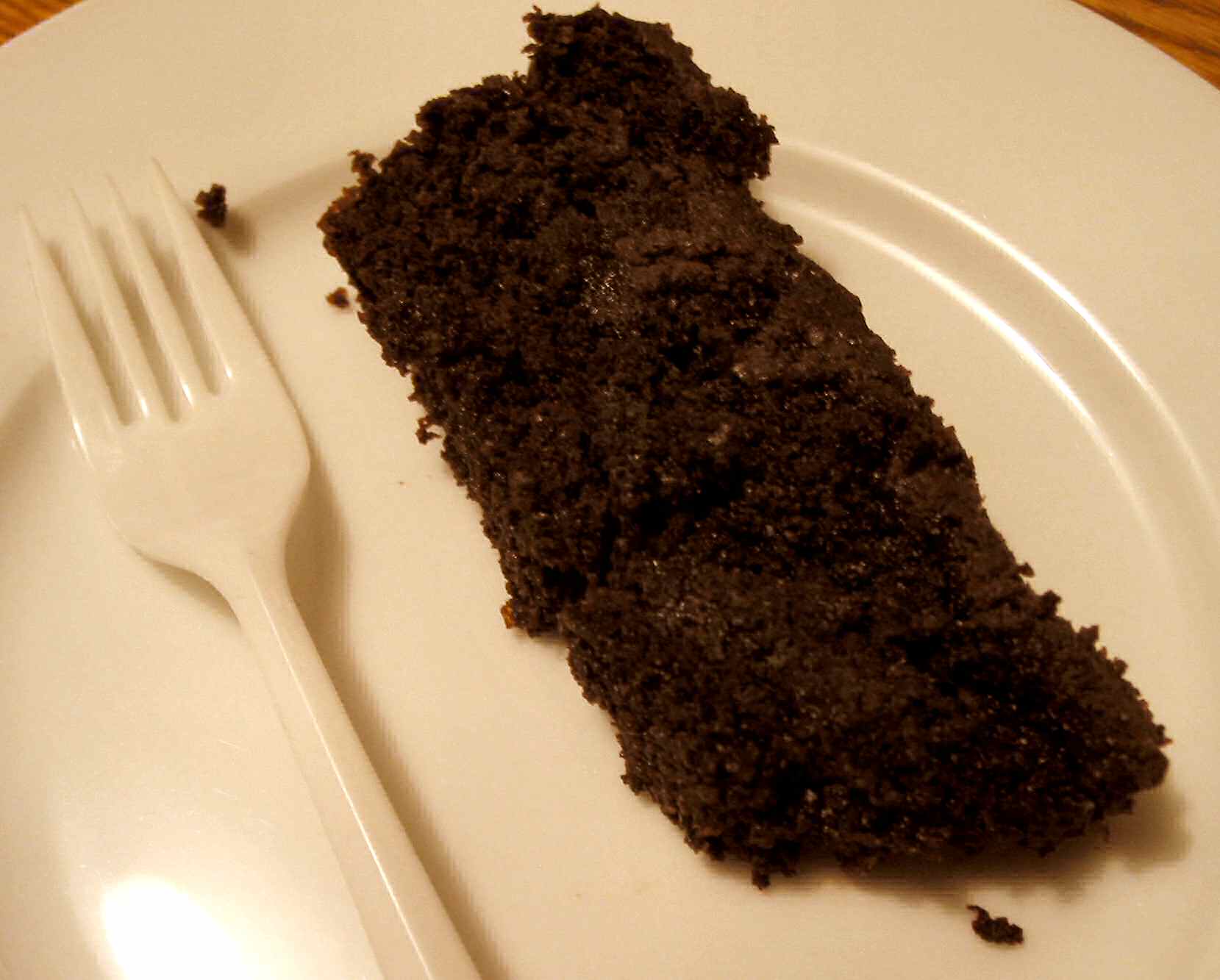
As I’m sure (and sorry) is apparent, due to the serious cocoa-and-hot-coffee content, plus the elation that it wasn’t a flop, I found myself on a caffeine high and completely unable to shut up about it while driving my kid home from school. She discovered I wasn’t wrong. We both recommend thin (half-inch) slices to avoid shock, caffeine highs, and that feeling afterward like you’ve just eaten Monty Python’s wafer-thin mint. You will be satisfied–a little goes a long way.
This half-inch slice is seriously enough for a serving. It's that rich.

This half-inch slice is seriously enough for a serving at the seder. It’s that rich.

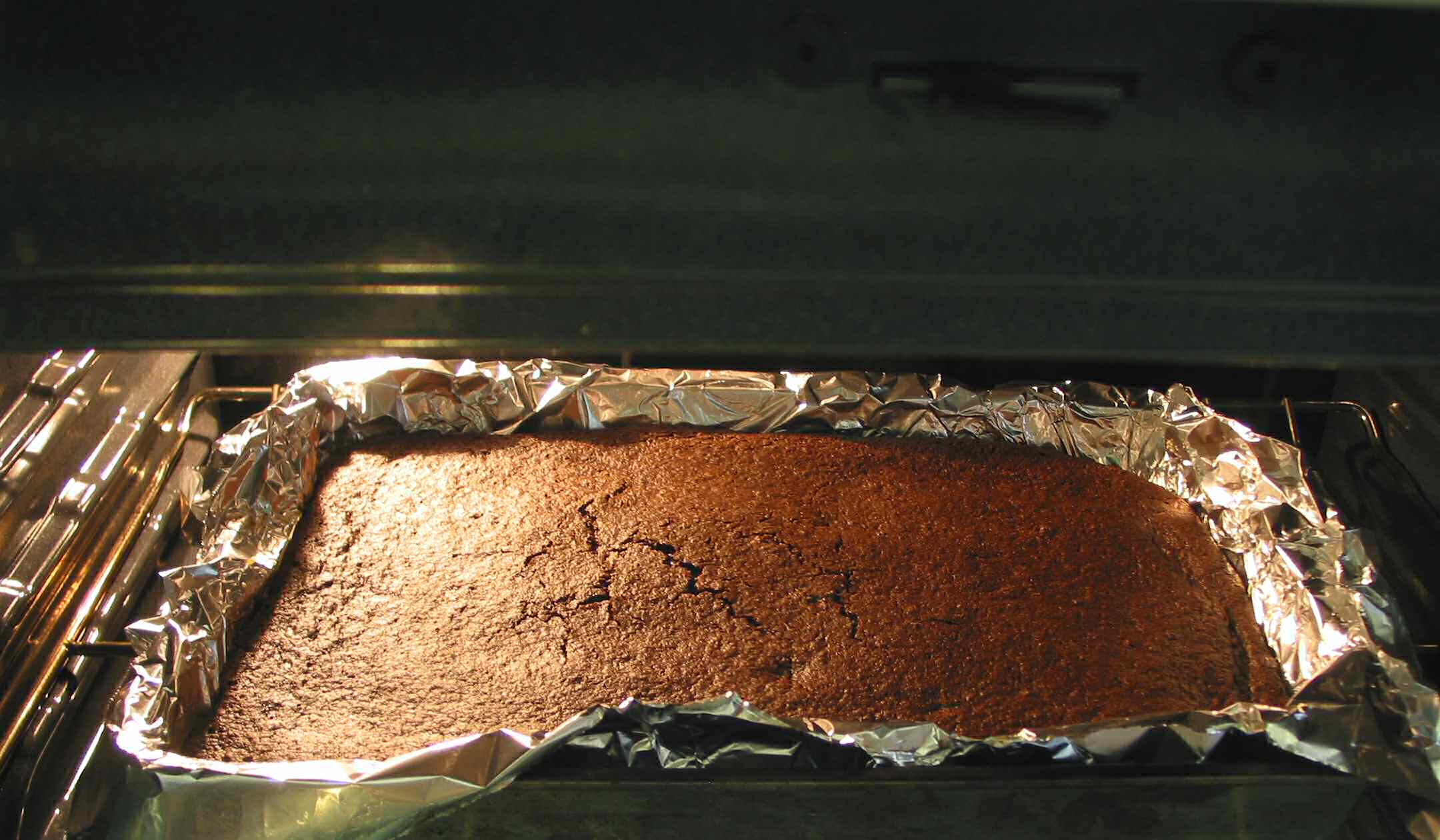
Anyway, this is going to work and it is SIMPLE. And tastes fabulous. Fabulous, very definitely. If you like flourless chocolate cake and ganache, try this at home. Even though, as I say, it has no butter. No eggs. And no crap. And it’s not too slow (though the baking time kind of is; 40-45 minutes because it’s very moist and stays that way after it collapses back down and shows light cracking–see photo at top of post). Continue reading