

• Enter your email address to subscribe to this blog and receive notifications of new posts by email.

    Join 241 other subscribers
  • Noshing on

    raw blueberry pie with microwaveable filling and graham cracker crust

    This mostly-raw blueberry pie is a snap to make and very versatile--the filling microwaves in a few minutes, and you don't even have to bake the zippy gingered graham cracker crust--perfect for a hot Fourth of July and all summer long.

  • Recent Posts

  • Contents

  • Archives

  • Now Reading

  • See also my Book Reviews

  • Copyright 2008-2024Slow Food Fast. All writing and images on this blog unless otherwise attributed or set in quotes are the sole property of Slow Food Fast. Please contact DebbieN via the comments form for permissions before reprinting or reproducing any of the material on this blog.

  • ADS AND AFFILIATE LINKS

  • I may post affiliate links to books and movies that I personally review and recommend. Currently I favor Alibris and Vroman's, our terrific and venerable (now past the century mark!) independent bookstore in Pasadena. Or go to your local library--and make sure to support them with actual donations, not just overdue fines (ahem!), because your state probably has cut their budget and hours. Again.

  • In keeping with the disclaimer below, I DO NOT endorse, profit from, or recommend any medications, health treatments, commercial diet plans, supplements or any other such products.

  • DISCLAIMER

  • SlowFoodFast sometimes addresses general public health topics related to nutrition, heart disease, blood pressure, and diabetes. Because this is a blog with a personal point of view, my health and food politics entries often include my opinions on the trends I see, and I try to be as blatant as possible about that. None of these articles should be construed as specific medical advice for an individual case. I do try to keep to findings from well-vetted research sources and large, well-controlled studies, and I try not to sensationalize the science (though if they actually come up with a real cure for Type I diabetes in the next couple of years, I'm gonna be dancing in the streets with a hat that would put Carmen Miranda to shame. Consider yourself warned).

A salad in winter: counterintuitive comfort food
box of winter salad

If you skip the lettuce and choose more robust vegetables, you can make a big box of salad in minutes and keep it crisp several days in the fridge.

It’s gotten cold here. Ok, so no one else is pitying us; we had 80-plus degree weather only last week, but now there’s a very dry, sunny cold spell setting in, it’s in the 50s daytime, 40s at night, and Southern California doesn’t do insulation that well. Or ski jackets. Or wool.

On the upside, it’s been cold enough so that I can run the oven and bake–a rarity in Pasadena this year. [OK again: prepare for a couple of digressions from the main topic]

I made a big round spanakopita for a Chanukah party, quick pizzas for my daughter and her friends and calzones for me and my husband, rosemary and sesame bread, and rye bread–which is still in the attempt stage; I didn’t have a properly developed sour and wasn’t scrupulous about weighing out and getting the hydration and gluten ratios right and all that the first time around, and it collapsed in the oven…

I’m determined to get the sour and the rise textures right, so now I’m following the Inside the Jewish Bakery instructions more closely, having met and been impressed by one of the authors. It’s a matter of some urgency: my grandmothers are no longer alive to schlep good deli or bread out here on a visit, Trader Joe’s has broken ties with the really good bakery that made serious “pain miche” half-rounds that tasted like kornbroyt, none of the commercial rye breads in SoCal (or most of the country) are anything more than tanned white bread, and I’m desperate for the real thing–tough, chewy, tangy, caraway-laden, with a serious crust. Before my genes start going beige and I start deciding Bing Crosby was a really good singer.

[True unexpected fact here: a church choir director I know says that because of all the practice sessions, she and all her colleagues get serious carol fatigue by about two weeks before Christmas every year. I thought it was just me avoiding the mall, but no.]

In the meantime, I’ve been thinking about comfort food, because winter cold brings on the desire for heavier dishes–stews, starches, cheeses, meat and potatoes, and more starches, and the winter holidays bring their own calorie-laden version of cheer to the table with abundant puff pastry, eggnog, latkes (potato pancakes), sufganiot (jelly doughnuts), cookies, fruitcake, and all the rest of it.

Not too many people think about salad as a comfort food this time of year. Potato salad, maybe.

And yet…it’s really not very comfortable to find you’ve gained five or ten pounds in a month when you didn’t mean to, and New Year’s is coming with an actual dress-up-like-a-grownup-with-a-life party invitation. If I’ve managed not to succumb to the excess so far this year, it’s only because I’ve been cautious-to-paranoid about eating latkes and sufganiot last week and even my typical penchant for cheese and dark chocolate (not together!) has me thinking twice. I don’t know about you, but I can’t afford to regain the weight I lost last year–even though it was “only” ten pounds, it was hard enough, and like many people, I could use another ten down before spring without having to work too hard.

So salad is what I have in mind at the moment. Yes, there will also be stew–this week, spicy vegetarian eggplant and chickpea stew, because I made a vat of it and stuck it in the fridge. Very hearty, filling, warming, and all that winter-holiday-recipe-talk, yet not very devastating diet-wise, and doesn’t make you feel like you need another nap pronto. Plus once it’s made, it’s really fast to reheat in the microwave. As I discovered yesterday, a mug (nuked less than 2 minutes and eaten on the run) can power me through a rushed non-cook evening–something I don’t do often or well–of ferrying my kid to the movies at the mall with her friends. During the very unpleasant after-Christmas sales season. What can I say–when put to the test, it was faster than fast food and twice as effective.

If only salad were like that [finally back on topic]. I’m not generally a cook-for-the-month kind of person, but it seems to me that if a restaurant salad bar can get away with making blah bulk salads that sit out for hours, surely I can do a bulk salad that looks and tastes lively and stores nicely for a couple of days in the fridge without going bad. Chop once, eat twice, right? Continue reading

2000-calorie meals in pictures

The New York Times has just posted a very clear picture-it chart of how people get to 2000 calories in a single meal, sometimes even a single dish, without realizing it when they eat out. Not just at Burger King, Denny’s or IHOP, either–some of the upscale chains’ ordinary dishes are just as devastating. If you’re having trouble figuring out your own diet, you might take a look and see What 2,000 Calories Looks Like.

One thing I like about the restaurant-by-restaurant feature is the breakdown of calories for each item in the meal, so you can see how you might do better while eating out.

One obvious takeaway–so to speak–is that fries, shakes, full dinner plates of pasta with cream sauce (or any sauce, really), and slices of cake as big as your head–topped with caramel goo!–are a bad deal for excess calories, lack of nutritional value, and are basically not really necessary.

The other obvious takeaway is that for things like sandwiches, burritos, burgers and similar protein-containing main dishes, you probably don’t want to be eating more than about 500 calories at lunch or maybe 600ish at dinner. Preferably 350-450, to give yourself some room for a salad or fruit. So the hoagies and double cheeseburgers at 900-1100 calories should really be split in two–maybe three. Share one with a friend unless you’re actually a linebacker in training. Or else get rid of the cheese, the excess meat, the bacon, the mayo-based sauces. Go back to a single burger with ketchup and mustard and a couple of pickle slices. And maybe you shouldn’t eat anything else with one of those but a plain apple or orange or some tomatoes or carrot sticks.

The other thing I like is the set of pictures at the bottom–whole days’ worth of decent food from home that are worth 2000 calories per day, and they look a whole lot better than what you get at the restaurants. For the same money or less, and with a microwave, maybe even in less time. A lot more vegetables and fruits, a decent amount of meat and fish and dairy, a lot less in the way of french fries, milkshakes, salad dressing, breadings, special sauces, burger buns and unlimited pasta.

OK, Fried PLUS Dairy for Chanukah

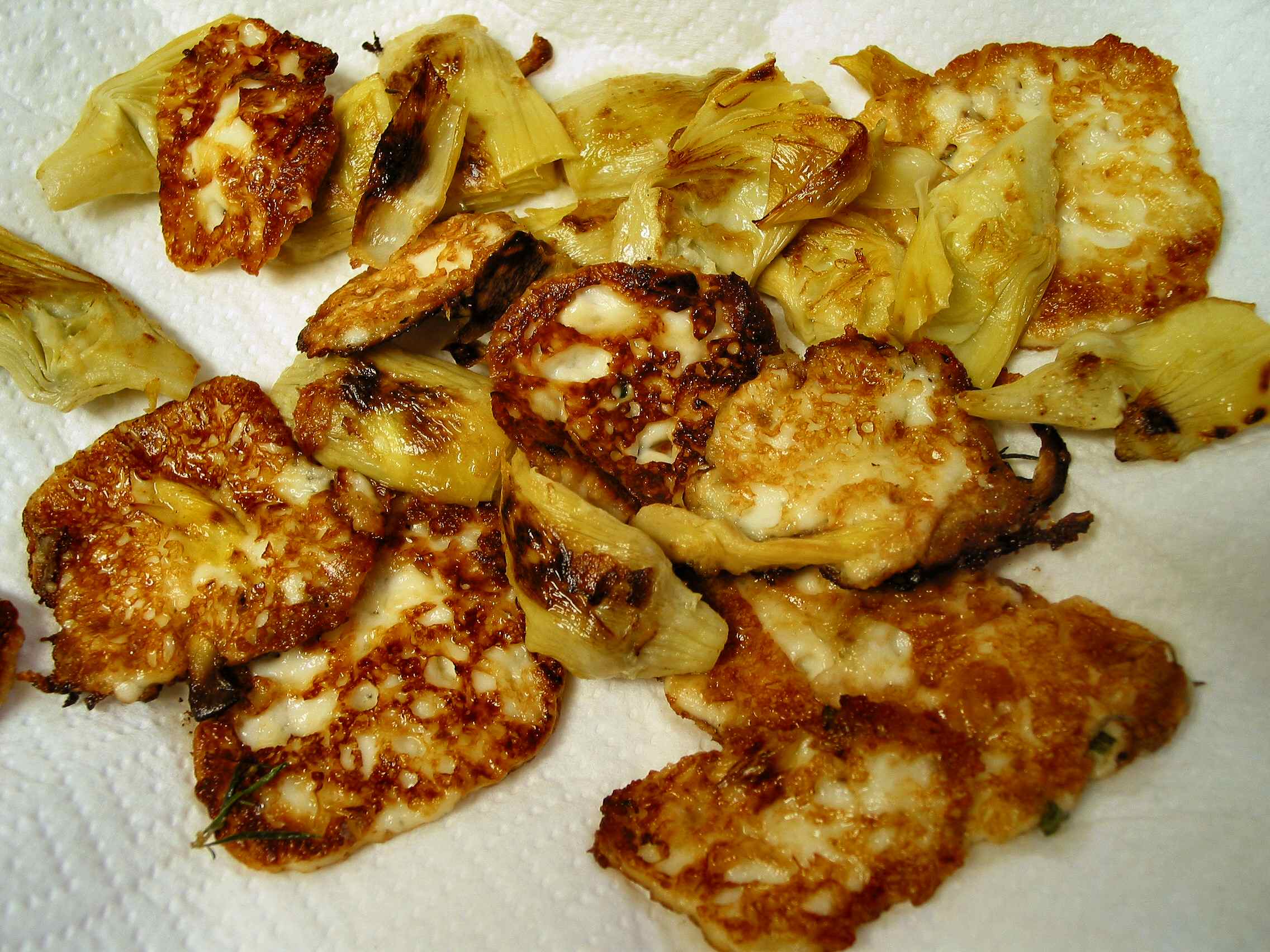
fried-panela-and-artichokes

Another good version from a previous fry-up: slices of panela browned with marinated artichoke hearts (bonus: a hit of garlic and lemon flavor from the artichoke marinade, plus the lemon juice increases the browning)

Well…I figured out something quick to fry for the first night of Chanukah: slices of panela cheese, a white rubbery fresh cheese that’s almost exactly like halloumi. Only it’s Mexican rather than Greek, so it’s a locally abundant variety (along with queso fresco) and about half the price per pound here in Pasadena.

I decided to do something a little different with it though. While the spoonful of olive oil was heating in the nonstick (very important) pan, I pressed the slices of panela into about a tablespoon mixture (not shown in above photograph; we ate these too quickly to take a picture of any worth) of pre-toasted sesame seeds, crumbled oregano, sumac, a pinch of ground caraway, and Aleppo pepper–essentially za’atar mix, only without added salt. It didn’t stick incredibly well to the cheese but I was able to press it in on both sides long enough to get it into the pan.

When I started frying the cheese, some of the whey immediately bubbled out into the oil, but although the slices softened up and started melting a little, they mostly kept their shape and I was able to flip them with a wide spatula to fry the other side. Halloumi firms up again as it cools–a little flatter, but pretty tasty, especially with the za’atar mix I improvised. I served it on top of our salad, but in restaurants it goes by itself, with its own bed of greens, maybe a bit of chopped tomato and onion, or with bread and olive oil. It’s only a few minutes of work for something unusual and delicious.

Lightening up for Hanukkah (aka Chanukah)

Tonight’s the first night of Chanukah, and not only haven’t I thought of presents, I haven’t thought of dinner. It’s also the night before my kid starts semester finals. So we’re probably going to do something fairly standard for supper and easy on the chef. As we have been all week, really (one of us–wonder whom?–got sick right after Thanksgiving and didn’t feel like getting fancy).

Typical Chanukah fare is known for two things: frying things in oil, like latkes (potato pancakes) and sufganiyot (filled jelly doughnuts), and cheese or sour cream-based dishes. Healthy, no? Once a year, whether you need it or not…

I know, the oil’s a symbol of a miracle and the cheese represents a key military victory, but–oy. Fried foods and rich cheese dishes are a good way to get indigestion. Also enough poundage to start a new battalion. So as they say it would take a miracle and some military strategy to figure out something that fits the bill, tastes like a treat, and doesn’t impose a full-on doughnuts-and-hash-browns diet.

One of those miracles, as I see it, is the invention of Teflon, as in nonstick frying pans. Just being able to use a spoonful of oil instead of half-an-inch for the latkes is a huge improvement.

The other (you’re not surprised) is the invention of the microwave oven. The military strategy comes into it when you combine the two methods to make something brown easily and quickly in a lot less oil than the usual recipe. I’ve managed to do that for fish (fry on both sides first to brown, then nuke between plates to cook the middle gently), onions and mushrooms for omelets (nuke first to wilt, then fry), green beans and broccoli (for Szechuan stir-fries), and larger vegetables like red squash, eggplant or peppers (slice and nuke to cook through, frying optional if you want it to look browned). Any of those things might happen tonight as the frying requirement portion of the meal.

As if being sick weren’t enough, though, last week my microwave died–or at least the control panel did. Two years after I bought it. Not a miracle–as I discovered by looking it up online, Panasonic’s inverter models have had more than a few complaints on this score.

A typical lifespan for a modern 1000+ watt magnetron should be about 2000 hours, or 6 years at about maybe 45 minutes or an hour a day max of microwaving at full power. My other microwaves in the past decade–Sharp, Samsung–have lasted about 3-4 years each, which is also pretty disappointing, but given how aggressively I used them, I wasn’t so surprised. Still, they gave me 3-4 years of high use each. Certainly not two. And it wasn’t clear that it was the magnetron in this case.

The price for a new microwave is just less than the price of repair, not to mention the time without a working microwave oven. So I did something I’m not happy with, because it seems wasteful to just throw out a microwave after two years, and bought a new one from Sears–Sharp, not Panasonic again. About 1.8 cubic feet inside, and 1100 W. And it’s huge on my shrimpy kitchen counter, but at least I can cook bigger items in it than I would have been able to with the dinky models Target had.

Here’s what I learned in a week without a microwave oven:

1. I get a little dysfunctional for a day or so.

2. I can make basmati rice a lot more easily than I thought by the conventional 20-minute method of rinse-rice, bring-to-boil, cover-and-simmer-on-low. It comes out fine, I just have to pay more attention and not walk away.

3. I can make a slab of salmon or other fish almost as well on the stovetop as with my standard “indoor grilling” method (brown on both sides with garlic etc., then stick it between two plates and nuke for 1-2 minutes to cook the middle gently). The nuking part I substituted for by covering the frying pan after browning both sides, and turning the heat down to low or just above low, and it came out really well. But it took 15-20 minutes extra for a pound of fish. If you have the time, it’s fine. But if you’ve got an emergency dinner for your kid and her project partner, and the mother’s picking the other kid up in only 45 minutes, a microwave would be so much nicer.

4. I hate, absolutely hate, heating milk for coffee on the stove. Or  reheating coffee. Or reheating just about anything in a regular stainless steel pan. Not because heating it’s such a pain, but because scrubbing the pot afterward is.

5. You can’t reheat anything quickly on the stove without having to dirty a pan. Microwaving really does save on dishwashing, and it keeps things from scorching on the pans or plates you use.

6. It’s a good thing it’s winter here and cold (for LA, anyhow–60s daytime, 30s-40s nighttime) or I wouldn’t have been able to cope at all. I managed to cook a few things in the oven instead of the nonfunctional microwave last week, but it was a relief to be able to get back to microwaving. Just in time for Chanukah.

Here are a few links to my earlier Chanukah posts (with recipes or at least good-tasting ideas).

Not strictly for Chanukah but probably a good idea:

  • Ganache because chocolate is also clearly a Chanukah food
  • Spinach fritadas (a version with zucchini was listed in a post on Passover, but it works fine with spinach, and with flour instead of matzah meal if you want it for Chanukah)

Sometime this week I have designs on posting a chocolate devil’s food cake in the microwave, which I tried a couple of weeks ago, plus an attempt at sufganiyot, which I haven’t made since my kibbutz days.

Also rye bread–I made a dough Thursday just to try it and didn’t get a chance to bake it until Saturday evening because we had guests (the good part of this week). Because the dough was old it came out a little flatter than ideal, more like a heavy dark ciabatta, but it was crusty, covered in toasted sesame, and still slices and tastes pretty good after a few days. And it isn’t any harder to make than regular bread. I’ll try again with a younger dough, or maybe use a sourdough starter plus some extra yeast and flour, and see what happens.

In the meantime, Happy Chanukah! light the lights, sing the songs, dance around the table and don’t worry like this guy about dreidel being a too-simple game of tops that takes too long to finish. I mean, War and Spit (the card games, not actual war and spit) aren’t exactly for geniuses either, and kids like those.

What happens when you age champagne?

A couple of weeks ago on a Friday evening, the week before our anniversary, my husband and I were scrambling to find a bottle of kosher wine in the house for the Shabbat blessings and coming up empty. We didn’t even have grape juice. I took one more look in the last-chance box and realized one of the bottles was kosher after all. It was a bottle of Yarden 2000 champagne I’d picked up on an after-Passover sale several years ago (our local Kroger affiliate supermarket has a not-quite-tuned-in approach toward Jewish holiday ordering; sometimes the matzah boxes arrive and disappear a week before Passover; sometimes they hang around for months, and sometimes they sell good wines at a fire-sale bargain because of the kosher label).

I’d saved that bottle for a special kosher-requiring occasion that never quite arrived. Vintage 2000–definitely the oldest bottle I’ve ever opened at home. As old as our daughter. Has it really been that long since 2000???

(OK, given the sorry yet predictable result of the mid-term elections, I have to say it hasn’t been long enough. But still.)

The bottle was QUITE dusty–almost a prerequisite for experimentation.

Neither my husband nor I are usually all that impressed with champagne–even the expensive mid-level ones, at $40-100 a bottle. Not that we’re usually in a position to sample those at home, but sometimes people splurge on them at Thanksgiving, New Year’s, etc., and we wonder why. They’re usually not as good as the cheaper Spanish cavas–if I had to buy champagne-style wine, I’d rather go with something like Freixenet, not to be cheap but because it’s closer to that bone-dry, yeasty, buttered-toast style I prefer to all the more acidic and flat-flavored mid-level champagnes out there. Taittinger and Moët et Chandon both come to mind as severe disappointments at the $45ish level. Their top-level champagnes might be quite different, but these just seem to be trading on the brand name and pricetag for the naive American market.

For that kind of money, I’d rather have a good, deeply-flavored still chardonnay than almost any of the usual fizzy lifting drinks, and you can get a pretty decent bottle of chard for under $20. Actually, most of the time I’d rather have a decent red.

And frankly nothing is as good as the (once-only) bottle of Dom Perignon my husband brought home 17 years ago, when we finally decided to get engaged after all those years of dodging family and friends, celebrating with some couples and outlasting others. After a lackluster and slightly glum Sunday afternoon discussion that ended with, “Well…okay,” we called each other at work the next morning and agreed we should probably do a little better than that. We were getting married, after all. Oy. We clearly needed some bolstering before we broke the news and faced the inevitable hocking from our families.

A really nutritious dinner consisting solely of Dom Perignon and a (smallish) box of Godiva truffles, each of which looked exactly like Miracle Max’s big chocolate pill from The Princess Bride, seemed to do the trick.

Of course, under the influence of the DP and chocolate, we decided we could do the parts of the wedding we liked (huppah, food, klezmer music, line dancing, ketubbah signing, friends and family, more food, more dancing) and just skip the stereotypical parts we found laughable, uncomfortable or downright detestable in other people’s weddings and wedding-themed tv ads (tux, white puffy dress, veil, speeches, first waltz, which neither of us knew how to do, tiered wedding cakes, arguing with either of our mothers over invitation fonts, color-coordination of any sort or description…)

We ended up having fun at our own wedding, which never really seems to be the primary goal somehow, we only decided where to go on our honeymoon the next morning while sitting around in our pjs, and I maintain that we’ve just kept getting weirder ever since.

Which brings us back to the Yarden 2000. To be fair, Yarden has been making some very decent kosher wines the last 10-20 years. But kosher or not, 14 years for any champagne below the DP level?

Champagne is supposed to be the only white wine that can age–maybe it’s all the trapped carbon dioxide fending off oxidation, but I’d never gotten close enough to try it out. The chemist in me has been waiting for another crack at mad scientist status for a couple of years now, so this was it. Plus it was getting after sunset already and we were hungry and there was no regular grape juice in the house.

Well…if we were daring enough risk our stomach linings and our eyesight by trying mead that had been sitting around for more than a year, we could probably risk a 14-year-old bottle of kosher champagne, once I got the major dust coat off it, anyhow. I found a deep enough pot to improvise an ice bucket but didn’t really have enough time or patience to chill the bottle well.

“Do you want a towel for the cork? It’s probably lost all its zuzz, you know,” my husband said.

Just in case it hadn’t, I opened the bottle carefully and with approved champagne-opening technique (the point-away-from-people-and-twist-the-bottle-gently-away-from-the-cork routine, not the find-the-Napoleonic-era-saber-up-in-the-attic version). The cork actually made a proper popping sound and the usual CO2 fumes rose up. It wasn’t dead after all! (“It was only mostly dead,” I hear you chime in. Stop digging around in that Godiva box already, willya? We already took the good ones.)

Then we poured it, and it foamed up–zuzz intact. So we made the blessing over the wine, and my husband very generously said he’d let me take the first sip. Which I did, but…

“You haven’t gone blind yet, have you?”

I glared at him. Or at what I thought was his general direction.

Continue reading