• Enter your email address to subscribe to this blog and receive notifications of new posts by email.

    Join 241 other subscribers
  • Noshing on

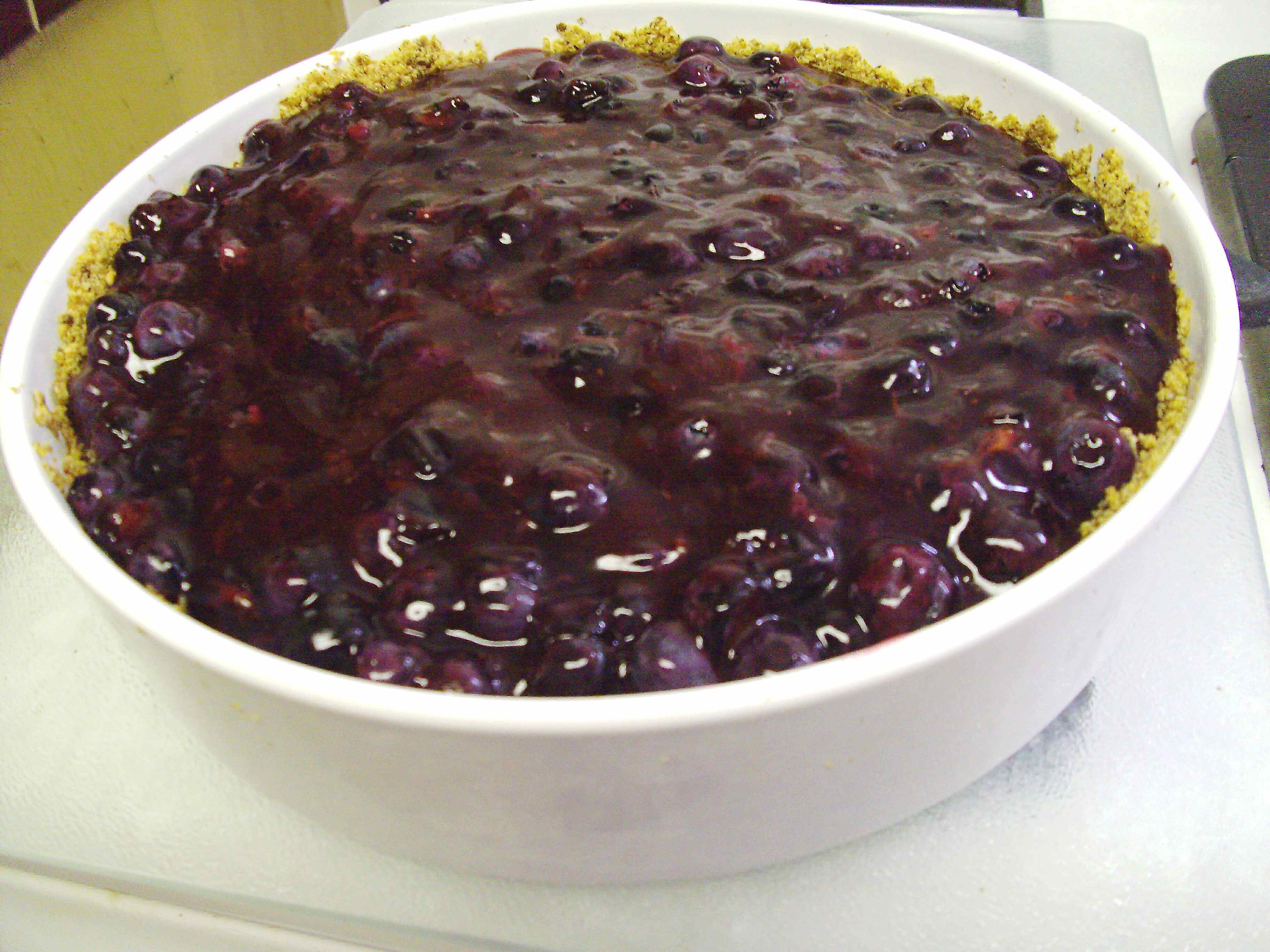
    raw blueberry pie with microwaveable filling and graham cracker crust

    This mostly-raw blueberry pie is a snap to make and very versatile--the filling microwaves in a few minutes, and you don't even have to bake the zippy gingered graham cracker crust--perfect for a hot Fourth of July and all summer long.

  • Recent Posts

  • Contents

  • Archives

  • Now Reading

  • See also my Book Reviews

  • Copyright 2008-2024Slow Food Fast. All writing and images on this blog unless otherwise attributed or set in quotes are the sole property of Slow Food Fast. Please contact DebbieN via the comments form for permissions before reprinting or reproducing any of the material on this blog.

  • ADS AND AFFILIATE LINKS

  • I may post affiliate links to books and movies that I personally review and recommend. Currently I favor Alibris and Vroman's, our terrific and venerable (now past the century mark!) independent bookstore in Pasadena. Or go to your local library--and make sure to support them with actual donations, not just overdue fines (ahem!), because your state probably has cut their budget and hours. Again.

  • In keeping with the disclaimer below, I DO NOT endorse, profit from, or recommend any medications, health treatments, commercial diet plans, supplements or any other such products.

  • DISCLAIMER

  • SlowFoodFast sometimes addresses general public health topics related to nutrition, heart disease, blood pressure, and diabetes. Because this is a blog with a personal point of view, my health and food politics entries often include my opinions on the trends I see, and I try to be as blatant as possible about that. None of these articles should be construed as specific medical advice for an individual case. I do try to keep to findings from well-vetted research sources and large, well-controlled studies, and I try not to sensationalize the science (though if they actually come up with a real cure for Type I diabetes in the next couple of years, I'm gonna be dancing in the streets with a hat that would put Carmen Miranda to shame. Consider yourself warned).

Couscous, its own fine self

Fine-grained couscous made directly from farina

When I’d just come back from a year in Israel after college, I read through Paula Wolfert’s Couscous and Other Good Food from Morocco several times. Her descriptions of the market stalls, the kitchens of the aristocrats, and the very down-to-earth cooks making tricky components like warka leaves for bistilla or rolling and sieving different sizes of couscous from farina and flour fascinated me. They filled in parts of the culture I hadn’t understood in the Moroccan Jewish community I’d just left.

Two of the dishes in the book, two only, have I actually made in all the time since. But if you get the right two, two is enough.

I first ate couscous in Ma’alot, up in the north of Israel in the western Galilee. On my first night in the volunteer program, my new roommates brought me to a tiny 4-table restaurant in the town center after a very miserable and cold trudge up to the top of the hill in a January downpour. The restaurant would have been a real hole-in-the-wall anywhere else, and even here it seemed to cater to the few single men who had neither hope nor prospect of a girlfriend, and whose mothers had finally nudged them out the door. Israel’s amenities–grocery stores and the like–are still often a grade or so down in appearance from what we’re used to in the US, and I’d been there half a year already, so I was used to ignoring it and discovering what was good. Still, even 25 years ago, most restaurants in the larger towns were not this dowdy. This was card tables and folding chairs. My heart sank. Where had I come to?

Not 5 minutes after we’d been seated, however, the lady who ran the kitchen fetched us out a huge platter mounded with couscous and chicken legs and vegetables, steaming hot and smelling incredible. The chicken was delicious (everybody sing; I’ve just been subjected to another showing of Sherlock Holmes’s Smarter Brother at our in-laws’ over Thanksgiving weekend) but the couscous itself was so light and fine it was like eating hot curried snowflakes. What was it? How do you do that? And in half a year of eating at Continue reading

Going retro for real croissants

I’m not really a follow-the-recipe-in-the-cookbook kind of person. But I love looking through cookbooks that have interesting techniques. Learning to cook means, for me, being willing to eat your mistakes or half-good attempts and try again with tweaks. It also means playing with your food until it works for you.

So croissants are one of those things I try out again every once in a while, because the dough is really not as much trouble to put together as it sounds. Most of the time is just letting the dough rest in the fridge.

Mostly I keep trying because I’d really like it to work well eventually, as opposed to half-right. It’s something about the baking that’s always giving me trouble–the outside will be hard and the inside will be steamed and still doughy. Or else the things will puff up  enormously but will be more like a popover with absolutely no layering inside because the butter layers melted away into the dough during the long rise. Or if I roll them and bake them right away straight out of the fridge they won’t rise at all in the oven and they’ll be tough. Or they’ll be gummy. Or flat tasting. Or even a little bitter.

None of this would be so bad if it were just my own fault for noodling around with a classic. But the last few times I’ve tried to follow Dorie Greenspan’s instructions from Baking with Julia more dutifully than usual, and it just hasn’t worked out right at all. Worse, in fact, than some of my offhand attempts a couple of years ago when I changed nearly everything there was to change, starting with cutting the fat in half and ending with an almond-flour attempt that actually didn’t come out so far off. Except, of course, for the gummy insides.

Julia Child, "The French Chef" DVD from PBSBut last week I stumbled across the elusive two-part The French Chef series of DVDs from…not PBS, which is probably still out of stock, but…my local library. The disks (2 and 3 disks, respectively) are a bit scratched up and tend to halt at awkward moments unless you fast-forward or skip or rewind or whatever tricks I could come up with.

But there was a croissant episode from the late 1960s in black-and-white, just as I remembered the show from when I was 4 or 5 years old. So I watched it, wondering how dated it was, whether the old recipe was anything like the one she lent her cachet to in the mid-1990s with all her guest expert bakers, and what the results would be like. At the time of this early show, she’d been home in the States less than 10 years, had just delivered Mastering the Art of French Cooking a few years before, and was still extremely rigorous about everything. Or was she?

For the croissant show, she discusses different flours, the toughening effect they might have on the dough and how to counteract it with a bit of salad oil or by mixing 2 parts pastry flour to 1 part all-purpose. But then she includes a frozen commercial bread and pizza dough as a possible alternative to making your own yeast dough. Not the tenderest choice, she says, but for someone who doesn’t yet feel at ease making their own, it’s an encouragement to try making croissants at all, and it works all right. She’s astoundingly practical in these early shows even though some aspects of her cooking aren’t (exaggeratedly rich sauces for sole, for example). And I remember that back in those days, you couldn’t get real croissants in American bakeries. If you wanted them, you had to make them at home.

Dorie Greenspan’s modern, supposedly streamlined, layering process calls for cutting the butter into cubes and mixing them into the dough before rolling out, doing six “turns” with three rests in the fridge, cutting, stretching and rolling the croissant triangles in an elaborate way with some extra scrap dough in the middle for shaping, rising them for 2 1/2 – 3 hours, gilding with egg wash and baking at 350 F for about 20 minutes.

Julia’s 1960s version is somewhat different–more aggressive, and probably much closer to classic boulangerie technique. It’s also simpler. She makes a very simple milk-based yeast dough in a bowl with her hand and kneads it a couple of minutes, picking it up and slapping hard on the work surface, all while talking flour grades (you could talk Yankees versus Red Sox if you want–she probably could have too, come to think of it).

She takes a stick of butter and bashes it into a softened flat mess with a big solid rolling pin, then scrapes it up and flattens it into a square and rechills it. She lets the dough rise until double on a heating pad, then chills the dough. Then she takes the butter and the dough out of the fridge, wraps the square of butter in the larger piece of dough and then rolls and folds and turns and chills for a full 2 hours each time, but only for a total of 4 turns–2 sets of 2–before rolling and cutting out the croissants.
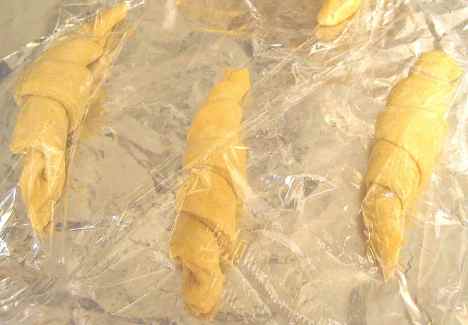
She doesn’t put an extra lump of dough in the middle when she rolls the croissants. She doesn’t stretch them a lot. And she does let them rise in a relatively cool room, but only for an hour or hour and a half until just Continue reading

No-Furkey!

In the freezer case at Whole Foods this month you’ll find big boxes announcing Turtle Island’s Tofurky Feast, Field Roast’s Celebration Roast, and VegeUSA’s Vegan Whole Turkey –this last shaped and glazed brown like a large chicken, drumsticks and all. I’m not sure how I feel about this concept–I thought the idea of being vegetarian when you have enough money for a choice was not only not to eat meat, but not to want to be eating meat either.

Not that I’m against decent vegetarian meat substitutes for Thanksgiving or any other time of the year. As someone who’s kept kosher since my college years, and often in places where there was no kosher meat (or I didn’t have the budget for it), tofu or wheat gluten “mock chicken” have made eating in Chinese restaurants a lot more fun, and the good restaurants make their vegetarian dishes as serious and well-balanced as their meat dishes–sometimes better. But they generally don’t try to disguise them this far or process them this much.

Still, to each her own. But $42.99 for the big VegeUSA box at Whole Foods. The box states that it feeds 25 at 2.5 oz/serving, which is probably enough protein but only about half the volume most adults would expect. And it’s kind of expensive for something that looks very much like a well-browned rubber chicken. What’s in it? I scan the nutrition panel and don’t really notice anything but the sodium–everything else is low or moderate, especially for a holiday meal.

But the salt! 450 mg for the “turkey”–double it to 900 mg if 2.5 oz isn’t enough for you and you want seconds.  1400-plus mg for the stuffing–huh? a whole day’s worth of sodium for one serving of stuffing?  Is it that bad for conventional stuffing mix as well? You’d do better to make your own from scratch.

At this point I didn’t even look at the gravy.

Tofurky isn’t much different–650 mg sodium per serving, including stuffing. Field Roast–in the same range too. They also sell separate tubs of frozen “giblet” gravy.

Of course (full disclosure here), I’ve never actually liked gravy, and I doubt it would really go well with anything tofu, not even tofu in a rubber chicken costume.

Why do I think you could do a better and probably a lot cheaper and more festive vegetarian Thanksgiving with some kind of authentic, fresh-made main dish? Because very clearly you could. Do you want it to taste good? Or do you just want it to look like an imitation turkey?

Of course, the main thing about these frozen concoctions, even the simple cylindrical “roasts”,  is that they look like centerpiece dishes, and there’s really no knocking that desire to serve something impressive and festive and most of all, shareable at Thanksgiving. It’s important. Thanksgiving feasts demand a monument to plenty, and an inedible cornucopia with gourds and Indian corn doesn’t really cut it. Nor does a big pasta salad (although a timbale, as in Big Night…)

Surprisingly–sadly?–enough, very few vegetarian cookbooks, not even the big tomes like Mark Bittman’s How to Cook Everything Vegetarian or Veganomicon, really try for a vegetarian centerpiece dish that looks and feels like an important dish. Mollie Katzen’s title dish from The Enchanted Broccoli Forest is about the only intentionally designed centerpiece vegetarian dish I’ve ever seen. A very long time ago I actually was served this thing once at a friend’s house, with very sadly overcooked broccoli stalks stood upright in a flat casserole of brown rice. Oy, is all I can say. Not a moment of pride. Both Katzen’s and my friend’s cooking improved in later years.

None of the currently hot vegetarian cookbooks out there have an index listing for “Thanksgiving”–very telling. A lot of them have portions for 2 or 4 or just one person. Only vegetarian chili and pasta dishes are intended to serve a crowd of any size.

So vegetarian centerpiece dishes deserve some consideration. Tara Parker-Pope of the New York Times blog “The Well” has been edging around this topic for a week or so, but I don’t feel she’s really gotten to the heart of the matter–neither has anyone else. Perhaps it’s because she’s not thinking like a vegetarian?

What makes a dish a centerpiece dish? Think about the turkey, then, or a whole salmon, or a rack of lamb or the like. It’s big. It’s unified–one big item before you cut into it for serving. It’s elegant and impressive. It’s sliceable. It’s savory enough to draw people into the dining room with a sigh of Continue reading

Cranberry Sauce Without the Fuss

Cranberry sauce in the microwaveI love homemade cranberry sauce, and not just at Thanksgiving. It makes a pretty good jam for breakfast and (should the need arise) a pretty good tisane for a congested sore throat if you heat a dollop in a mug of water and sip it hot, berries and all. Despite the fact that it’s tart, which you’d think would make your throat hurt more, the cranberries actually contain something soothing that will give you at least temporary relief when you’re in the throes of Los Angelitis and the Tylenol hasn’t kicked in yet (you can trust my expertise on this one, unfortunately). But hopefully you won’t need it for anything medicinal this winter and can just enjoy fresh-made cranberry sauce for its own sake.

A lot of people are convinced that just opening a can is the easiest and least scary way to go. They must have read the package directions and decided it was too much work to make the syrup first (very intimidating-sounding) or that adding the berries and letting them pop was likely to spatter the stove until it looks like a magenta Dalmatian.

But really, you can just microwave cranberry sauce and it works fine. Throw all the ingredients (berries, sugar, water) into a 3-cup pyrex bowl, slap a lid on partway, and nuke it for 5 minutes. That’s it. No preboiling. Don’t even bother mixing it. In five minutes, you’ve got standard fresh-made cranberry sauce in a bowl that can go straight to the fridge once it’s cool. And no saucepan or stove top to wash before your guests arrive.

You can dress it up with some orange peel or juice, or a pinch of clove and cinnamon. You could add a chopped, peeled granny smith apple or a well-scrubbed chopped organic seedless orange with the peel to the berries for cooking, or else stir in a spoonful of Cointreau or Triple Sec after the jam cools, and you’d have something a little more sophisticated, but the basic recipe is worth having as a first run.

And most helpfully, if you’re looking for something less sugared, you can cut the typical cup of sugar per 12-oz bag of cranberries in half and it’ll still gel decently. Or you can do it with no sugar at all, let all the berries pop and thicken up just in water, and sweeten it with your preferred artifice after it’s cooled. It won’t be completely carb-free per tablespoon or so even with no added sugar, but it’ll be pretty low.

Approximate carb counts (total and per tablespoon, counting 1 T as ~1/16th c.):

Cranberry-only version without apple or orange

  • With 1 cup of sugar: 242 g carb per 2.5-3 c. cranberry sauce  or 5-6 g/T.
  • With 1/2 c. sugar: 142 g carb/recipe or ~3 g/T.
  • Artificially sweetened only: 42 g carb/recipe or ~1 g/T.

Cranberry sauce with apple or orange

With a good-sized apple or orange chopped in, figure 25 extra grams of carb per recipe or 0.5 gram extra carb per tablespoon.

Any way you go with it, though, homemade cranberry sauce has a good deal less carb per spoonful than other kinds of commercial jams, and probably a good deal less than the stuff in a can. It’s a lot better tasting too.

Microwave Cranberry Sauce

  • 12-oz package fresh cranberries, washed well
  • 1 c. water
  • 1 c. sugar (standard Thanksgiving back-of-package recipe), 1/2 c. sugar (my version this week, which was plenty sweet enough for me), OR no sugar during cooking but artificial sweetener added afterward to taste

optional additions: chopped peeled apple, finely chopped whole scrubbed organic orange, pinch or so of powdered cloves and/or cinnamon, a little grated orange or lemon peel, or a spoonful of orange liqueur or brandy

Put the cranberries, sugar if using, water, and apple or orange if using in a 3-cup pyrex bowl, cover loosely with a microwaveable lid so steam can escape but it won’t spatter, and microwave on HIGH 5 minutes. (If you’ve added an apple or orange, you might need an extra minute to account for the extra fruit.) Keep an eye on it toward the end, but it probably won’t boil over.

The mixture should already be thickening to a sauce/jam consistency (it’ll thicken more as it cools), and most of the berries should be popped. Stir well and microwave a minute or so more with a vented lid if you want it thicker. Let cool to room temperature and, if using artificial sweetener, sweeten to taste. Other flavorings–you could add grated lemon or orange peel (sparingly) or clove or cinnamon before cooking, but save any alcohol-based flavorings for after the jam has cooked so they don’t just evaporate in the microwave.

Fastest Pie in Town

Pumpkin pie in the microwave

On the energy downswing from a departed sleepover guest, my daughter suddenly declared she wanted pumpkin pie, we had two cans of it and I’d said I would make it soon and I still hadn’t, why wasn’t I making it, it wasn’t fair, she hadn’t had any all year and it was past October so it was in season. This last argument was just for good measure, given the pumpkin was in a can, but still, give her points for it–it’s a new crop after all those shortages.

With ears ringing, I said, but it’s already 5:30. “So? I can help!” You’ve been there, I’m sure.

Pumpkin pie is a slow-food-slow kind of dish–not much way around it. Even with a premade crust and a can of “pumpkin pie mix” rather than just packed steamed pumpkin, the filling needs 45 minutes to an hour to bake. Then it needs another hour or more to cool enough to eat. And if you’ve got a tiny kitchen and your kid is helping, the elbows factor is bound to add some time and confusion.

Also, normally, with a diabetic kid, you don’t just think, “Hey! Let’s make pie for dessert!” Especially since the filling calls for 3/4 cup of sugar per pie.  But pumpkin pie, if it’s made from scratch and isn’t just a frozen ready-made version, is kind of reasonable on carbohydrates for a dessert–about 25 grams for 1/6 of an 8″ shallow pie, according to the ADA guidebook, or in our case, 35 grams for 1/8 of a standard 9.5″ deep-dish pie (calculated from the ingredients). And pumpkin may be a fruit and not a vegetable, but it’s still got a respectable serving of vitamin A and fiber. And I also like it, which helps.

Still, the time is a killer. But I had such a surprise success with spinach quiche in the microwave a while back that I started thinking. The standard filling for pumpkin pie is also based on a custard, more or less–a couple of eggs, a cup and a half of milk per deep dish pie. It’s half the eggs of a quiche, but it might well still work in a microwave. That part would take something like 5-7 minutes and leave enough time for the pie to cool while we got dinner together.

Actually, I’d wanted to try this for a while, and not with company in tow, just in case it flopped. The weather here was 97 degrees most of the week but dropped to the low 70s today and was promising an actual chill for evening. So doing the crust in the regular oven for 15 minutes or so wouldn’t actually make life miserable.

It was almost looking like a decent idea considering the fact that it was and still is totally nuts to make an entire pumpkin pie from scratch right before dinner (or at least everything from scratch short of hacking up a raw pumpkin and dealing with the seeds). So I decided to go for it, and I made my daughter deal with the filling while I made the crust and parbaked it. We just about managed not to step on each other or crowd into the same corner at the same time, but both parts went well. And then the real test came–time to nuke. Continue reading

Somewhat Scary Food

Today’s topic is particularly revolting, because it’s never too late to start considering what lies ahead at the end of this month I mean, tonight–and yes, we’re already late for the door. Yes, buying bags of generically sorta-chocolate Hershey’s and Mars brand mini candies is the accepted, sterile, utterly safe way to go on Halloween. But really, it’s not very interesting. Especially not for kids. And it’s gotten a lot more expensive in the last year, as far as I can tell.

(Though if you’re going that route–or your kid is going out trick-or-treating elsewhere–check out the Buzzle.com comprehensive candy carbs list if you need to know about that kind of thing in detail, or the little rule-of-thumb chart at the bottom of my Carb Counts page. If nothing else, it’ll keep you away from the communal candy dish at work.)

When I was a kid we went out trick-or-treating with the exhortation to touch nothing, TASTE NOTHING, until we got home and my mother could inspect it all for razor blades or dimes or other nasties that might unimaginably (except to my mom; dimes are not something most people will part with these days except for a venti with extra whipped cream and a cherry on top) be stuck in things like apples. It was an annual ritual of paranoia that lent that unnameable something–a hint of danger and excitement–to the otherwise blatantly fake costume horror. Because, of course, we were usually walked strategically to the homes of families our parents knew, just as they walked their kids to ours.

Then there was the time a friend invited me to her church’s haunted house–the activities mostly consisted of blindly sticking our hands in bowls of cold spaghetti or reaching out for something that turned out to be grapes with the skins peeled off. We were getting too old for it, really, and it was more icky than scary. But still. Somehow the innocent days of bobbing for apples and sticking your hand in cold spaghetti have gotten lost in the too-adult fear of sharing germs or getting pneumonia from having to plunge your head into a bowl of cold water.

Kids don’t get to help set up anything but the store-bought decorations anymore, and if they have any say in what treats to hand out, it’s through the universally accepted point-and-whine technique at the supermarket Halloween aisle. Reading the teeny-tiny fine print on the ingredient lists for all those mini candies, spooky and mysterious as the 4-syllable chemical names may be,  just doesn’t cut it for scariness or adventure. Nor do the huge blowup animatronic decorations–the creepy hand, the dancing skeleton, the vampire rising from the coffin to a boogie-woogie soundtrack like so many Halloween versions of the Singing Trout–is this Robert Pattinson’s future?

Most kids can’t even make their own toast these days. How are they supposed to cope with creating pickled porcupine quills or tarred hornet brittle?

Fortunately, a number of cookbooks (from before the sterilized-and-wrapped-for-your-protection era) are available from the ether or at your local library with answers to just these sorts of dilemmas. If you have a stove and a freezer and possibly a food processor or electric mixer, you stand a good chance of rescuing your young innocents from the debilitating descent into middle-aged indifference, incapacity and accountancy.

I refer here, first and foremost, to the slim but venomous contents of Roald Dahl’s culinary imagination (and that of his widow, Felicity Dahl, who unearthed these books and made sure they saw light of day). To be absolutely sure I’m doing it right, I’m starting with Volume II, Roald Dahl’s Even More Revolting Recipes (Penguin Putnam, 2001), because Volume I, Revolting Recipes, clearly wasn’t revolting enough. Only the best for my child!

What could such books possibly contain? Roald Dahl’s Even More Revolting Recipes is a fair mix of candies, sweet drinks, desserts and actual non-sweet food–this last is the real surprise. But no vegetables, unfortunately, other than a bit of decorative tomato and some oddly Martian-looking potatoes (I fervently hope they don’t sing).

In keeping with modern ideas about kids and cooking, a number of the recipes call for prefab products (the one for Tongue Rakers, a kind of onion-and-garlic-laced bread shaped like a pitchfork, calls for a “packet” of your favorite pizza dough mix rather than the basic flour-water-yeast-and-salt), and several involve the strategic use of food coloring (Hornets Stewed in Hot Tar, a black-dyed pumpkin- and other-seed brittle) or fluorescent paint Continue reading