• Enter your email address to subscribe to this blog and receive notifications of new posts by email.

    Join 241 other subscribers
  • Noshing on

    raw blueberry pie with microwaveable filling and graham cracker crust

    This mostly-raw blueberry pie is a snap to make and very versatile--the filling microwaves in a few minutes, and you don't even have to bake the zippy gingered graham cracker crust--perfect for a hot Fourth of July and all summer long.

  • Recent Posts

  • Contents

  • Archives

  • Now Reading

  • See also my Book Reviews

  • Copyright 2008-2024Slow Food Fast. All writing and images on this blog unless otherwise attributed or set in quotes are the sole property of Slow Food Fast. Please contact DebbieN via the comments form for permissions before reprinting or reproducing any of the material on this blog.

  • ADS AND AFFILIATE LINKS

  • I may post affiliate links to books and movies that I personally review and recommend. Currently I favor Alibris and Vroman's, our terrific and venerable (now past the century mark!) independent bookstore in Pasadena. Or go to your local library--and make sure to support them with actual donations, not just overdue fines (ahem!), because your state probably has cut their budget and hours. Again.

  • In keeping with the disclaimer below, I DO NOT endorse, profit from, or recommend any medications, health treatments, commercial diet plans, supplements or any other such products.

  • DISCLAIMER

  • SlowFoodFast sometimes addresses general public health topics related to nutrition, heart disease, blood pressure, and diabetes. Because this is a blog with a personal point of view, my health and food politics entries often include my opinions on the trends I see, and I try to be as blatant as possible about that. None of these articles should be construed as specific medical advice for an individual case. I do try to keep to findings from well-vetted research sources and large, well-controlled studies, and I try not to sensationalize the science (though if they actually come up with a real cure for Type I diabetes in the next couple of years, I'm gonna be dancing in the streets with a hat that would put Carmen Miranda to shame. Consider yourself warned).

And you wondered why it was bad for you

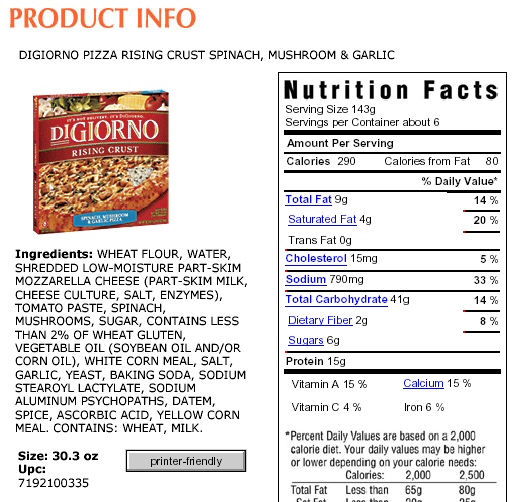
Kraft's DiGiorno Spinach and Mushroom frozen pizza ingredient list

Is it me, or was it that late-night rewind of Young Frankenstein? Kraft’s DiGiorno Spinach and Mushroom frozen pizza appears to have a few A.B. Normal ingredients. Is this what they mean by “killer preservatives”? (image source: accessed 1-26-10 from Kraft’s DiGiorno nutrition facts web page)

Salt reduction vs. hypertension meds–which would you choose?

One of the big complaints processed food companies, physicians in clinical practice, and the great gourmet media all have in common is that cutting back on salt would make food taste flat, and you as an individual wouldn’t necessarily get a big drop in your personal blood pressure from doing it. They argue that only “salt-sensitive” people have to worry about their intake, and anyway, a few points lower, they all say, isn’t really impressive enough to give up your 300-mg serving of sodium in a bowl of Kellogg’s raisin bran or 390 in a slice of La Brea sourdough. And don’t, for g-d’s sake, ask your favorite name brand celebrity chefs to stop salting early and often in each dish!

A big statistical modeling study in the New England Journal of Medicine this week knocks all this wishful thinking on the head, and does it very nicely. The study looked not at individual blood pressure drops but the health and cost benefit of dropping average salt intake by 3 grams a day over the entire U.S. population.

The researchers found that if everyone drops their salt intake back down, the benefits start to look like the ones from quitting smoking, cutting cholesterol and saturated fat, and losing weight to get to a normal BMI.

That’s because even when individual blood pressures drop by only a few points, they’re not going up (as they are today), and when a small average drop happens in a very large group, the big bell curve of disease shifts toward lower risk of consequences and later starts for developing heart disease and high blood pressure. After the first national cholesterol lowering guidelines were issued in the late 1960s, the nation’s heart disease and stroke risk dropped by about a third, and at least until obesity and blood pressure started to cause a back-reaction, the average age for a first heart attack went from 50 to 60 in men. That’s a huge kind of benefit.

The combined drop in heart disease and stroke deaths from cutting salt would be something like 200-400,000 people per year, a lot more than can be saved by simply putting everyone on blood pressure medications–the study made that comparison directly.

Altogether, a solid recommendation for dropping sodium levels in processed and restaurant foods, which make up about 80% of today’s sodium intake. And for not imitating processed food and chain restaurant thinking in your professional or home cooking, as Francis Lam seems to in his Salon.com commentary on the new NYC Department of Health initiative. And if there was any doubt that the Culinary Institute of America has been training Continue reading

Putting Pie Crust on a Diet

From a recent LA Times special on savory pies comes a classic calorie-bomb–only, it’s not even the pie. It’s the pie dough itself:

Basic savory pie dough No. 2 (cream cheese)

Servings: 1 double-crust (9-inch) pie or 6 individual hand pies

  • 1 (8-ounce) container cream cheese, at room temperature
  • 1 cup (2 sticks) butter, at room temperature
  • 1/4 cup cream
  • 1 teaspoon salt
  • 2 2/3 cups (11 1/2 ounces) flour

Each of 6 servings: 638 calories; 9 grams protein; 44 grams carbohydrates; 2 grams fiber; 48 grams fat; 29 grams saturated fat; 137 mg. cholesterol; 1 gram sugar; 518 mg. sodium.

Now come on. 638 calories before you ever get to the filling? Who wants to eat that much pie dough at a time, especially one so rich? OK, don’t answer that, but really. Gag.

Except for the extra cream and the teaspoon of added salt (and why do you even need those with a cream cheese dough anyway?) this is really just a classic rugelach dough–you mix the fats together and then stir in the flour a little at a time by hand. Only, rugelach dough is meant to be rolled out as thin as physically possible–1/16 inch thick or even less–before spreading with jam and nuts and chocolate and cinnamon and so on and rolling it up into a crescent shape. And a good thing too, because cream cheese doughs are notoriously rich. More dough per rugelach and you’d soon feel like you’d eaten an airline Danish–it would sit like lead in your stomach for hours.

I compared the recipe above with the one in my much-used spiral-bound 1984 edition of Joan Nathan’s The Jewish Holiday Kitchen (thank you, Hadassah rummage sale!) It was probably the one cookbook that influenced me most as a college student, and I still use it for the classics, especially baked things like rugelach and hamantaschen that I can’t just wing (note–her cookie-style hamantaschen recipe is the best I’ve ever tasted, a far cry from the usual chalky white horrors on the Purim carnival bake sale table).

Based on Nathan’s rugelach recipe, which is the same recipe everyone everywhere seems to use, the quantities in the LA Times recipe above should make something like 40 rugelach, so figure about 15-20 realistic servings, not six. The cooks at the LA Times must be rolling the dough out the standard 3/8 inch thick for their pies, but it seems like a complete waste of this dough’s particular talents. Continue reading

Getting the Salt Out: NSRI and Voluntary Compliance, Again

In the wake of its city-wide diabetes reduction and restaurant nutrition labeling initiatives, the New York City Department of Health is leading yet another dietary health campaign, this time one that involves a national coalition of cities, states, and medical organizations. My hat’s off to them, even though I think the demands they intend to make of the food industry are much too light and much too toothless.

The National Salt Reduction Initiative, announced on Monday, will  encourage “voluntary compliance” from the processed food and restaurant industries to lower their sodium content by about 20% over the next 5 years. That’s pretty modest considering that both industries have doubled the standard sodium content of many common foods in the past 20-30 years, and that the national obesity epidemic seems to have coincided pretty nearly with that trend.

The UK’s national salt reduction campaign, which started in 2003 and serves as a model for NSRI, has government backing and its goal is 40% reduction of sodium in processed foods within 5 years, not 20%. They seem to be getting there, too.

NSRI’s coalition includes the Los Angeles Department of Health and a variety of medical organizations like the American Heart Association and the American College of Cardiology. What it doesn’t include this year, to my surprise–and, frankly, dismay–is involvement, funding or guidance from the National Heart, Lung and Blood Institute at NIH.

Ten years ago the NHLBI would have participated one way or another in encouraging this sort of initiative, but that was before the Bush years. NHLBI has been reorganized several times in the last decade. Two of its key diet-related outreach and education programs–the National Cholesterol Education Program and the National High Blood Pressure Education Program, which would have been the leading outreach proponent for NSRI–have receded from view, with perfunctory descriptions on the agency web site, no functioning links to current activities if there are any or to updated program pages, and no clear leadership or place in the agency’s organizational chart. But the need for them certainly hasn’t ended.

Voluntary compliance programs don’t have a great track record in the processed food industry. Look at the recent Smart Choices nutrition labeling program fiasco (see under, Froot Loops) from October.

Starting a national  program like this with voluntary compliance as a key component means the designers don’t think there’s much way to enforce the changes other than persuasion. It also means the government doesn’t have the tools, the money, or–and here is the crux of it–the will to enforce even modest limits on sodium content. Both the AHA and the AMA have been working on the FDA for years to get salt off the “generally harmless Continue reading

A Year of Artichoke Hearts

“Top 10 Recipes” lists are a big thing at the new year, a way to look back and figure out which dishes made a hit and which ones were just so-so. But sometimes, after an entire year, the top-10 judging criteria can get a little distorted. How do dining section editors compare five quasi-Asian stir-fried noodle-and-greens dishes, most of them mysteriously pumped up with bacon crumbles (2009’s star ingredient), and decide all five really belong in the top 10 for the year?

In one of my early posts, I was thinking about toasted cheese sandwiches (grilled cheese, hard to believe, was a Top 100 Dishes entry for Bon Appétit at that point). At the end, I threw in a quick little recipe for marinated artichoke hearts done in a microwave as an antidote to all the middle-American boredom. Yesterday I ran across an artichoke and potato salad from the LA Times‘s 2009 top-10 list and realized my artichoke hearts would probably make it better. Because they make everything better, or almost.

Marinating your own artichoke hearts takes five minutes, is less expensive than buying a jar of prepared ones, tastes fresher, and has a short list of real ingredients. A ~12-oz batch lasts more than a week in the fridge, where it’s  ready to serve as a pick-me-up for sandwiches, pasta, fish, omelets, salads, and hot vegetable dishes. I use these artichoke hearts so often that whenever I get to my Trader Joe’s and they’ve run completely out of bags of plain frozen artichoke hearts in the freezer and won’t get any in for weeks, I feel horrible and deprived, like someone who’s just been told not to talk with her hands.

That puts it in MY top 10.

You don’t need more than a dash of salt in this recipe to make the artichoke hearts taste intense and bright. The fresh lemon juice and garlic do it for you, and something about the artichokes themselves makes the combination work. Continue reading

Not a shock: Nutrition labels understate calories

Not a shock: According to diet researchers from Tufts who did calorie calculations and direct caloric measurements,

Nutrition labels for common restaurant menu items and supermarket frozen meals consistently understate calories by up to 18 percent.

Real Soba

Happy New Year! The LA Times just published a feature on New Year celebrations in Japan. The  December 30th article on making your own soba or buckwheat noodles has instructions and demo pictures from a professional soba chef–and the traditional recipe contains…no salt. At all. Contrast that with any of the store-bought brands here in the U.S. It also has a lot more buckwheat than the store-bought types, using a ni-hachi (2:8) proportion of wheat to buckwheat, so it probably has a lot more buckwheat flavor. Worth a try, and if you’re not sure you know how to knead to the right texture by hand, you might be able to knead the dough in a food processor to get it very smooth and elastic before rolling it out.  Traditional Soba from the LA Times

The dipping sauce recipes that accompany the soba article are no bargain sodium-wise, and they contain a lot of sugar as well as a lot of soy sauce mixed in with the dashi stock, but at least the noodles themselves aren’t adding to the problem. You could use low-sodium soy sauce and less of it; you could also decide not to follow tradition and use a different dipping sauce with more substance and less reliance on salt and sugar for flavor. Here are two possibilities (quantities are loosely something like half a cup to a cup). Neither is Japanese but they both taste good with soba.

Dipping Sauce for Jao Tze (why not, it’s good with soba too)

  • 1/4 c. low-sodium soy sauce
  • 1/4 c. vinegar–red wine, apple cider, or rice vinegar
  • dollop (~1-2 T.) dark molasses–this takes some stirring to mix with the thinner liquids
  • ~1/2 t. grated ginger
  • 1 scallion fairly finely chopped
  • few drops toasted sesame oil
  • 1/4 t. dab of z’khug or a bit of minced garlic, some hot pepper flakes to taste, and a bit of chopped cilantro if you have it

Peanut Curry Sauce

Serve this sauce cold or at room temperature to avoid the yogurt breaking down. If you add some lightly nuked or steamed fresh brussels sprouts (they look nice cut in halves) or other cruciferous vegetables and some hard-boiled eggs or tofu on the side, you have a pretty substantial lunch or a light supper.

  • 1-2 T. chunky unsalted natural peanut butter (peanuts only)
  • 1/2-1 c. plain nonfat yogurt (milk and cultures only)
  • 1 t. curry powder (unsalted)
  • 1 clove garlic, mashed/grated/minced
  • 1/2 t. mashed or grated ginger
  • 1-2 T. low-sodium soy sauce
  • juice of half a lime (best), lemon (ok), or 1-2 T. vinegar to taste
  • hot pepper flakes to taste
  • optional additions: scallion, finely chopped; few drops toasted sesame oil; pinch or so of sugar