
• Enter your email address to subscribe to this blog and receive notifications of new posts by email.

    Join 241 other subscribers
  • Noshing on

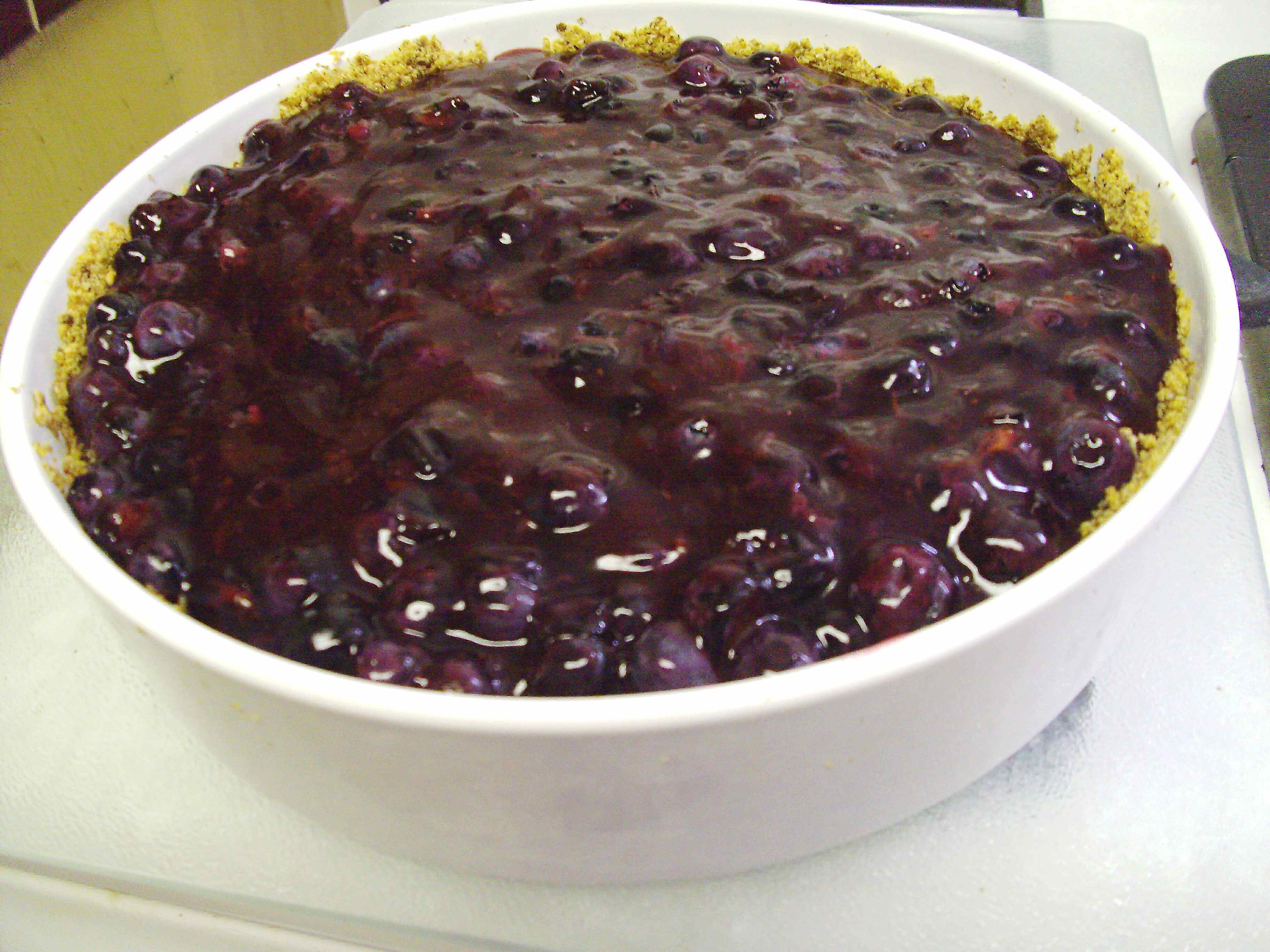
    raw blueberry pie with microwaveable filling and graham cracker crust

    This mostly-raw blueberry pie is a snap to make and very versatile--the filling microwaves in a few minutes, and you don't even have to bake the zippy gingered graham cracker crust--perfect for a hot Fourth of July and all summer long.

  • Recent Posts

  • Contents

  • Archives

  • Now Reading

  • See also my Book Reviews

  • Copyright 2008-2024Slow Food Fast. All writing and images on this blog unless otherwise attributed or set in quotes are the sole property of Slow Food Fast. Please contact DebbieN via the comments form for permissions before reprinting or reproducing any of the material on this blog.

  • ADS AND AFFILIATE LINKS

  • I may post affiliate links to books and movies that I personally review and recommend. Currently I favor Alibris and Vroman's, our terrific and venerable (now past the century mark!) independent bookstore in Pasadena. Or go to your local library--and make sure to support them with actual donations, not just overdue fines (ahem!), because your state probably has cut their budget and hours. Again.

  • In keeping with the disclaimer below, I DO NOT endorse, profit from, or recommend any medications, health treatments, commercial diet plans, supplements or any other such products.

  • DISCLAIMER

  • SlowFoodFast sometimes addresses general public health topics related to nutrition, heart disease, blood pressure, and diabetes. Because this is a blog with a personal point of view, my health and food politics entries often include my opinions on the trends I see, and I try to be as blatant as possible about that. None of these articles should be construed as specific medical advice for an individual case. I do try to keep to findings from well-vetted research sources and large, well-controlled studies, and I try not to sensationalize the science (though if they actually come up with a real cure for Type I diabetes in the next couple of years, I'm gonna be dancing in the streets with a hat that would put Carmen Miranda to shame. Consider yourself warned).

Pack your own lunch

It’s almost time to head back to school, and my daughter’s finally old enough to pack her own lunch. Not that she wasn’t actually old enough last year. But now she wants to.

When I was nine, I’d been making my own school lunches for at least a year, if only to save my sandwiches from my mother’s clutches and keep her from adding butter to the jam–something that did, and still does, make me absolutely nauseous. Emergency grossout prevention is the mother of lunch-making independence.

As many of my friends with same-age kids do, I worry that I haven’t been pushing my daughter hard enough toward independence by having her fix her own lunch. Is it too late to impart the mysteries of the toaster oven? But all is not lost–the other morning she figured out how to cut up her own apples (she has braces and our orthodontist “charges extra for stupidity-related bracket repairs”). She doesn’t appear to have lost any fingers. So we’re good to go!

Which is fortunate because lately I’ve been seeing a slew of new books on how to pack your kid’s lunch–they range from “here are all the vegan-friendly brand-names that look just like everyone else’s school lunch, only cooler” to Alice Waters insisting that the first step is growing your own school garden (which I’m actually in favor of, but not if it means waiting 6-8 weeks for your lunch to germinate).

Few of these fabulously sophisticated new books even consider the things I took to school every day as a kid–peanut butter and jelly, apple, carrots and celery. Or peanut butter and jelly, orange, carrots and celery. My mother was dull. My sister and I had no cool foods like Ho-Hos or Cheetos to distract us, and we usually ate at least some of the vegetables and the apple. Actually, so did most of the other kids in our school. It was that or suffer the cafeteria kale. And almost no one was fat. I’d like to point that out.

Hip mamas today (mostly those still in their 30s) look horrified at my daughter’s lunches because out there in hipland PBJ on whole wheat is so…so ’70s. It doesn’t contain any of the seventy-two essential nutritional supplement buzzwords (like selenium and phytoestrogens and antioxidant) they’re convinced all healthy food has to have (well, it’s true you have to have those things on the label to compete in the ads). And it has fat. And sugar!

But you know what? A decent peanut butter and jelly sandwich on whole wheat is a lot better deal nutritionally than most of the prepackaged, often self-righteously labeled, crap the hip kids bring to school these days. Much of it is along the lines of Kraft Foods’ “Lunchables”–a processed meat and cheese cracker kind of thing packed with some ersatz juice and faky side items like jello and  candies (not even, as I check belatedly, a tiny tin of applesauce–and check out the Lunchables nutrition and ingredient stats!). But you know how popular these things are–because they’re a kit. Buy five boxes, throw one  in your kid’s backpack each day. They stack neatly in the pantry.

Very few of these children ever bring a substantial serving of fresh vegetables or actual fruit–not even apples. Those require washing, peeling–maybe even cutting up. And sometimes the apples turn a little brown on the cut sides. Organic fair-trade labeling aside, any remotely fruit-like substances in the hip-kids’ lunch bags arrive in a rectangular cardboard box with a plastic overwrap, a plastic straw attached, and a sanitized-for-your-protection seal. No wonder they stare.

Anatomy of a PBJ:

Straight-up peanuts-only butter (no salt, no sugars, no mono- and diglycerides, no emulsifiers or BHT or “natural flavoring” or any of the rest of it) has about 16 grams of fat per 2 T (1 oz) serving. True. Absolutely true. But it’s not the same as the heart-stopping blubber you find on a piece of meat, so stop shrieking. Most of the oil in natural peanut butter is polyunsaturated (the “good fat” kind of fat). And it separates (because of the lack of fakery and emulsifiers) so you can pour off a good bit of it if you want to when you first open the jar.

Furthermore, the same peanuts-only peanut butter contains 8 g protein, 3 g fiber, almost no sodium, and about 210 mg potassium. And a little iron. It’s a pretty good deal for a kid’s lunch item at about 200 calories.

Two slices of whole wheat bread without too much sodium or garbage ingredients gives you another 200 calories–we’re up to 400, but only 3 g. saturated fat, another 3-7 g fiber, another 4-6 g protein, and with a little care preferably less than 400 mg sodium (all from the bread). Add a spoonful of all-fruit jam with 8 g sugar, at about 35 calories, and you have something that will get your kid through school without tears or big sugar highs and lows.

It doesn’t have big vitamin- and calcium-fortified labeling. It doesn’t have a label. It’s not supposed to do it all on its own. Your kid will eat about half, maybe the whole thing if he or she is growing fast or running around a lot that week. But he or she will get the vitamins and calcium from the other things in the lunchbox–some crunchy raw vegetables and an apple or orange and a thermos or carton of plain unsweetened milk. That’s it and that’s enough.

Do your kid a huge favor and leave out all the chips, chocolate, go-gurt (real milk-and-cultures yogurt is ok, not the fake tapioca- and gelatin-stretched stuff), cookies, jello, sorta-applesauce, and fluorescent boxes of juice. School is hard enough without sugar crashes or cavities, and they don’t need any of it to have a good day.

Oh yeah. And for crying out loud, please skip the sushi. Your kid does NOT need to be that hip in the school cafeteria. Or that sick, if the sushi doesn’t stay cold enough.

(Why yes, I live in Southern California. What gave it away?)

How to Eat Vegetables and Lose Weight and Save the Planet (Without Really Trying)

One of my favorite stops at the New York Times online is Mark Bittman’s “The Minimalist” column, a series of 5-minute videos in which he demonstrates simple but pretty good cooking with clear and manageable directions and an easy close-up view of the pots and pans in action.

I’d say he takes a no-nonsense approach to cooking, but that would be misleading. He takes a full-nonsense, marble rye approach to the patter while doing some very basic common sense things like cutting up, mixing, and sauteing. And he features vegetables prominently.

Bittman,  recently seen schmoozing around Spain in a top-down convertible,on PBS yet, with Gwyneth Paltrow and Michael Stipe and occasionally Mario Batali and trying to look interested in the food (which somehow got upstaged, can’t imagine how), is the author of several big yellow cookbooks, notably How to Cook Everything in both meat-eater and vegetarian editions.

This year he’s come out with a new, slimmer volume called Food Matters: A Guide to Conscious Eating* (and the asterisk leads to: *With More than 75 Recipes).

Unfortunately, we have to disregard the fact that Bittman’s title manages to evoke both Phil McGraw’s Self Matters and David Reuben, M.D.’s 1970s classic romp, Everything You Always Wanted to Know About Sex* … *But Were Afraid to Ask (or, more happily, Woody Allen’s movie send-up of same). This is a Serious Book. And like many Serious Books today (and anything at all with a “go green” theme), it’s a hybrid vehicle.

Between the asterisks on the cover sits a Granny Smith apple photoshopped with a map of the world and a red label, “Lose Weight, Heal the Planet.” The back blurb reads, “…the same lifestyle choice could help you lose weight, reduce your risk of many long-term or chronic diseases, save you real money, and help stop global warming…”

Food Matters is Bittman’s argument for getting the lard out and the greens in, for the sake of health, looks, and planet (quick, look holistic and place your hands reverently over your heart, if you can find it). The first half of the book is a set of essays reporting on the state of Big Food in the U.S., the state of obesity, the state of greenhouse gases and the global cost of raising a serving of beef as opposed to a serving of broccoli or tomatoes or whole grains.

Following Michael Pollan’s now-famous dictum “Eat food. Not too much. Mostly plants,” and citing him heavily, Bittman sets out to encourage readers to replace at least some of the earth-taxing meat and dairy in their daily eating with…plants. Which makes sense, of course.

The second half is a primer, with recipes, on how to eat more vegetation. Given that his pitch is geared at least partly to a male audience (he also writes a food column for Men’s Health, and the tone here is similar), you’d think his advice on the quickest route to getting vegetables into one’s diet would involve the least fuss: just wash and nosh. But no.

Bittman used to edit Cook’s magazine and the cookbooks he writes today do tend to feature recipes. It’s a common downfall, but what can you do? Continue reading

Brand Me! Or, How to Commercialize Cabbage

Earlier this year I made a joke about the marketing campaign for fresh bulk vegetables, along the lines of “Red Cabbage. It’s What’s For Salad.” I was thinking how nice it would be if people could be motivated to buy ordinary fresh bulk vegetables–no brand names, no packages–every week as a matter of habit the way they did 30 years ago, instead of the way they now fill their carts with brightly colored boxes of processed stuff. I thought it would probably take a satirical approach like the Ad Council’s Got Milk? public service ad campaign.

Clearly I wasn’t thinking hard enough about the real issue driving the relentless replacement of food with boxes. As with the Internet, it’s branding. And not surprisingly, there’s an awful lot of spam out there (hints of The Viking Song in the background…and a word of caution: as with many Monty Python sketches, this one contains more than a few off-color lines and screeching in addition to the main ingredient.)

The packaged food industry is way ahead of me and has been for years. They’ve figured out how to put brand names on cabbage or broccoli or carrots so they can charge more for it–several times more per pound. And they’re doing enormously well with this ploy.

Ordinary shoppers — your neighbors, your co-workers, your mom, and you too, I bet— have in the past week or so bought a little packaged bag of pre-washed spinach, Euro Salad Mix, baby-cut carrots, or broccoli and cauliflower florets. To save time, you tell yourself. Because it’s more gourmet, perhaps. And you’re getting your vegetables in, you think. But it becomes a habit, and a needlessly expensive one.

This kind of thinking about vegetables is becoming dangerously ingrained among American shoppers. People think they’re eating healthy without the fuss, but then they complain how expensive vegetables are. And no wonder, if they shop like this.

Because the few vegetables you get in the precut packs in pristine plastic bags are less than a pound. 12 oz. is typical for broccoli and cauliflower florets, 5-6 oz. for pre-washed mixed lettuces. Prices are at least $2.00 per bag, and often on up to $3.50 or more. Yes, Virginia, that’s anything between $3 and $9/lb for the “convenience” of just opening a bag.

I bring this up here because packaged, pre-shredded cabbage, an 8-oz. bag no less, was listed, actually listed, as a key ingredient in a recent (and no I didn’t really mean to be picking on them again so soon) Bon Appetit feature recipe online. One for “Fishcakes and Coleslaw”. It was part of a slideshow series illustrating “gourmet cooking on a budget”, glossy photos with convincing price tags included–but this one recipe cost $14 for four servings!

Continue reading

Sweet Potato Ravioli

A couple of posts ago I mentioned wanting to try making pumpkin tortelloni at home. For some reason, reasonably large butternut squash seem to be evading my usual grocers this season, and they’re fairly expensive. Similarly, no fresh pasta sheets under $5 a packet…and I didn’t know how to make my own very well or want to spend that kind of time. But yams are in, and some of them are nearly the size of footballs. And I found a packet of round gyoza (alternate spelling for jao tze?) wrappers next to the squares for wontons and eggrolls in the supermarket. With my usual impatience, I decided to go for it.

The result was pretty good–a bit simpler than Colosseo’s tortellini in saffron cream, and certainly a little less rich, but definitely good, and not too much work once I figured out what I wanted. From start to finish, including all the dithering, it took me about an hour to prepare and assemble everything. And I cooked it successfully in the microwave, always a plus in my book.

So here goes:

Sweet Potato Ravioli (or yam; everyone gets those mixed up, even the grocers, and it really doesn’t matter that much)—4 big servings or 6 small ones

Packet of Gyoza/Jao tse or won ton wrappers, or your own pasta dough cut in 2″ diameter circles or squares, as you prefer.

Filling:

  • 1 huge yam or two normal baked-potato-sized ones
  • 1/4 medium red or yellow onion, chopped reasonably fine
  • small clove of garlic, minced or grated
  • few sprigs of thyme or sage
  • grating of nutmeg and lemon peel (~ 1/8 to 1/4 t. each, or a bit more)
  • 2 T or so goat cheese, ricotta, or feta, optional

1. Scrub the yam(s). Peel and if not too hard to cut, cube the flesh. Place in a covered pyrex bowl or microwaveable container with 1/4″ water in the bottom. Microwave on high about 5 min. The yam(s) should be fork-tender. If they’re still tough, turn them, cover again, and give them another minute or so. Then drain off the water and mash them a bit.

2. Fry the chopped onion and herbs in a little olive oil to start browning them, add the garlic and the yam, and toss to brown a little more. Take off the heat, stir in the cheese if using, and grate nutmeg and a bit of lemon peel into the mixture.

Cheese Sauce:

  • 1 T (heaping) flour
  • 1 T olive oil
  • 1-2 c milk (I use skim, use what you have)
  • 1 clove garlic mashed, minced or grated
  • 1-2 T shredded basil
  • 2 oz lowfat mozzarella, in small pieces
  • grated nutmeg and lemon peel to taste

1. Make a roux with the flour and olive oil in a nonstick frying pan–stir them together while heating for a minute or so until the mixture bubbles slightly.

2. Turn off the heat and add the milk a very little at a time while mixing with a spatula to make a smooth paste that eventually thins out without lumps.

3. Reheat the pan, stirring in the mozzarella, basil, nutmeg and lemon rind. The mixture should thicken as it nears a boil and the cheese should melt and incorporate. Turn off the heat.

Assembly and cooking:

Have a pyrex pie plate or casserole with a microwaveable lid ready to hold the ravioli. Put water in a soupbowl and separate the wrappers out on a plate.

1. To stuff the wrappers, dip a wrapper in the bowl to wet it on one side, then place a heaping teaspoon of filling in the middle of the wet side and fold the wrapper into a half-moon, pinching the edges together to seal them and squeezing out any air as you go around. Set each filled ravioli with the curved, pinched edge standing up in the pie plate. Fill as many wrappers as you can–it might be about 20 ravioli or so–and arrange them as best possible in a single layer in the pie plate. Store any remaining wrappers in a plastic sandwich bag in the freezer.
2. To cook, carefully pour a scant 1/4″ of water into the bottom of the pie plate between the ravioli. Cover the pie plate with a microwaveable lid and microwave on high for 2 min. to steam the ravioli somewhat and prevent raw dough on the bottom–never a nice surprise. If your lid is thick pyrex, you might need a little extra time, but check first–the dough should be turning translucent and cooked-looking. If it needs more time, take a soupspoon and run it with a little water over the tops of the ravioli to prevent scorching before covering and microwaving another 30 seconds or so.
3. Then uncover and spread the thickened cheese sauce over the entire plateful of ravioli, filling in the cracks where possible. Cover again and microwave 5 min. on high.

High-speed soup–tomato vegetable

This is something I came up with about 10 years ago. It’s disgustingly easy to make, dirt cheap, vibrant in flavor, filling, entirely real, salt-free, and completely microwaveable. Also diet-smart: eating this every day for lunch, along with a veggie burger or a half-cup of beans for protein, helped me lose 20 pounds in a couple of months. And I’m not naturally good at that.

This vegetable soup has no salt, but it has lots of flavor and lots of vegetables–not a coincidence. The flavor of the vegetables melds with the dill and pepper and garlic, and there’s no salt to drown it out. So instead of being insipid, it, like many homemade soups, gets better the next day. And it takes maybe 15 minutes from start to finish for about 2 quarts of soup, fully cooked.

The trick to getting the most flavor from the vegetables without salt? Wilt the “aromatics” (onion, celery, and carrots) together first, with a little olive oil and nothing else for a few minutes, and then add the liquids and herbs. The order really makes a difference: your aromatics will release a lot more flavor this way than if you added them raw to the liquid ingredients and cooked it all together from the start (see, sometimes the French are right). The small amount of olive oil also helps draw out and trap the flavors (some flavors are fat-soluble) without adding a lot of calories.

High-speed Tomato Vegetable Soup

  • 3 big carrots, peeled and chopped bite-size
  • 3 stalks celery in bite-size pieces
  • 1 big onion, diced
  • drizzle (1-2 T) olive oil
  • 1 28-oz can or 2 15-oz cans salt-free tomatoes in their own juice (e.g., Trader Joe’s or Whole Foods)
  • 1 big clove garlic, grated or minced
  • 2-3 T fresh chopped dill or 1 T dried dill
  • 12 or so whole black peppercorns

1. In 2.5 qt pyrex bowl (or the like), mix onions, carrots, and celery. Drizzle olive oil over and stir lightly to mix. Put the lid over (I use a Corelle dinner plate, how chic) and microwave 5 min. on HIGH.
2. Pour the tomatoes and juice over the wilted vegetables, and break up the tomatoes to bite-size pieces as best possible. Add water to within an inch of the top, stir.
3. Add garlic, dill, and peppercorns, cover and microwave 5 min. to heat through.
4. Serve immediately or refrigerate overnight to meld and sweeten the flavors.