
• Enter your email address to subscribe to this blog and receive notifications of new posts by email.

    Join 241 other subscribers
  • Noshing on

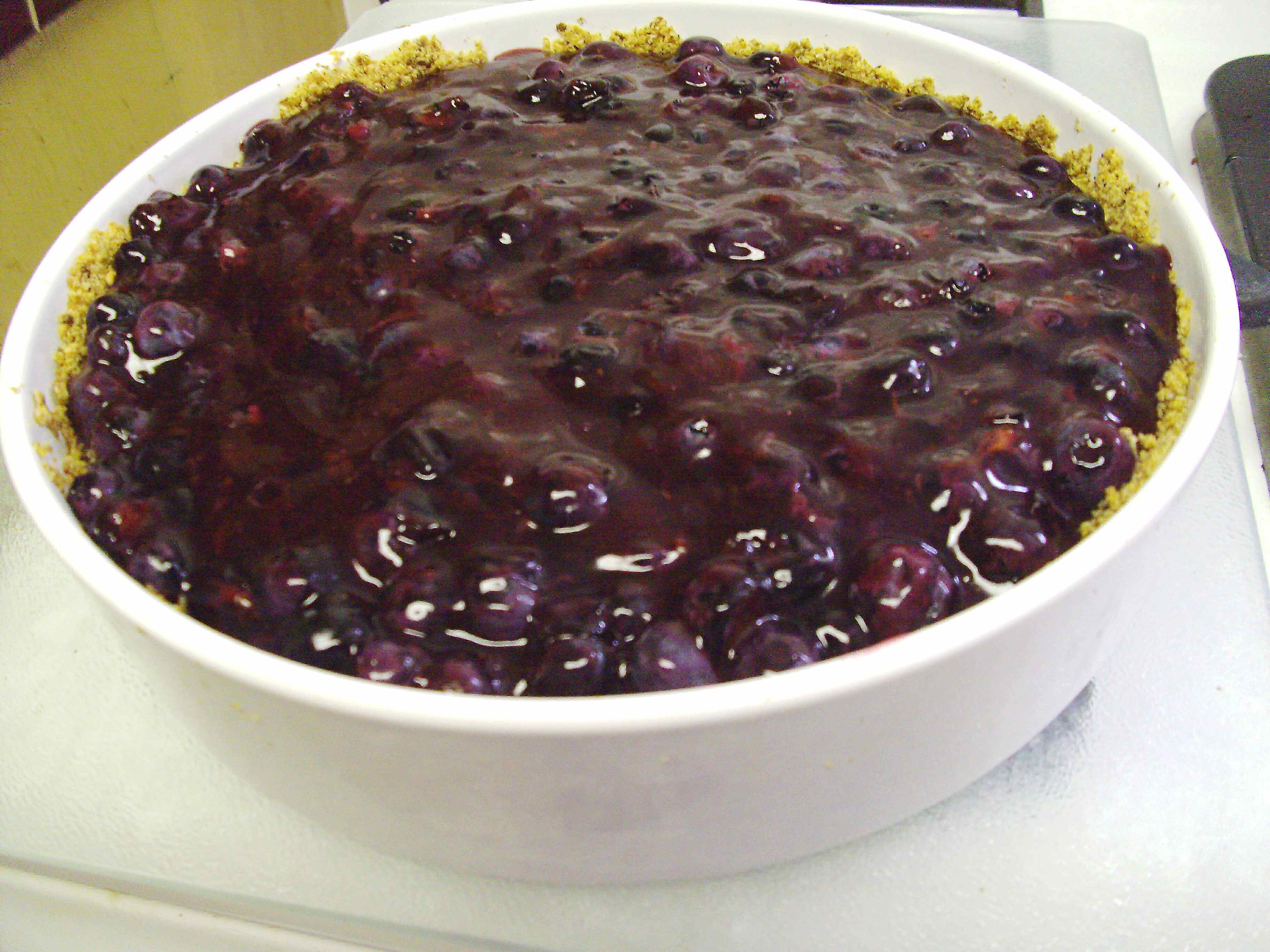
    raw blueberry pie with microwaveable filling and graham cracker crust

    This mostly-raw blueberry pie is a snap to make and very versatile--the filling microwaves in a few minutes, and you don't even have to bake the zippy gingered graham cracker crust--perfect for a hot Fourth of July and all summer long.

  • Recent Posts

  • Contents

  • Archives

  • Now Reading

  • See also my Book Reviews

  • Copyright 2008-2024Slow Food Fast. All writing and images on this blog unless otherwise attributed or set in quotes are the sole property of Slow Food Fast. Please contact DebbieN via the comments form for permissions before reprinting or reproducing any of the material on this blog.

  • ADS AND AFFILIATE LINKS

  • I may post affiliate links to books and movies that I personally review and recommend. Currently I favor Alibris and Vroman's, our terrific and venerable (now past the century mark!) independent bookstore in Pasadena. Or go to your local library--and make sure to support them with actual donations, not just overdue fines (ahem!), because your state probably has cut their budget and hours. Again.

  • In keeping with the disclaimer below, I DO NOT endorse, profit from, or recommend any medications, health treatments, commercial diet plans, supplements or any other such products.

  • DISCLAIMER

  • SlowFoodFast sometimes addresses general public health topics related to nutrition, heart disease, blood pressure, and diabetes. Because this is a blog with a personal point of view, my health and food politics entries often include my opinions on the trends I see, and I try to be as blatant as possible about that. None of these articles should be construed as specific medical advice for an individual case. I do try to keep to findings from well-vetted research sources and large, well-controlled studies, and I try not to sensationalize the science (though if they actually come up with a real cure for Type I diabetes in the next couple of years, I'm gonna be dancing in the streets with a hat that would put Carmen Miranda to shame. Consider yourself warned).

More “breathable foods” weirdness

A couple of days ago, Entertainment Tonight posted a new video tidbit on “breathable” food  from the same Harvard professor, David Edwards, who invented the AeroShot “breathable caffeine” cartridge that has drawn some serious FDA attention of the negative sort.

ET’s anchor breathlessly posed the  question, could this become The Next New Diet Fad in Southern California, when what the LeWhaf vaporizer was invented for was the “aesthetic experience” of breathing food flavors. This according to Edwards, whose Paris-based design lab, Le Laboratoire (names aren’t really his thing?) offers a number of vaporized cocktails at a small sit-down bar.

When I wrote about the first set of inventions, I said I thought it might be an interesting molecular gastronomy-style taste experiment (at least if the flavors were something more sophisticated than “lime,” the flavoring in the AeroShot cartridge), depending on what was being used to create and propel the vapor.

The ET video presents an interview with a young up-and-coming chef who’s offering cocktails of various kinds served in the Le Whaf vaporizers–to be inhaled through a special straw. The accompanying visual looks, frankly, like someone about to use a bong or snort a line of coke, but that could just be the way ET’s camera crew are used to shooting bar scenes…

The chef they interviewed doesn’t serve these vaporized cocktails, not all of which are standard drinks in the daily repertoire (some of them look like beef broth) as a low-cal diet offering but rather as a sideline to enhance some other dish. Very molecular gastronomy. Still he concedes, when pushed, that he can’t see how it would have calories.

(From his doubtful expression, they must have edited out the part where the Barbie Doll reporter shoved a mike in his face repeatedly and insisted with desperation that the vapor must make it calorie-free, it just MUST. She’s the one who tried the AeroShot caffeine spritzer on-camera in the studio to demonstrate the concept, and quickly uttered the dutiful “Mmmm”,  but the video jumped at that point, so I wonder if she really sampled it or not. At least she didn’t start coughing…unless they cut that part too…)

And yet I wonder if ET hasn’t hit on something here–no, not the diet fad. One can’t live on pâté-flavored air alone. One must also vaporize some champagne to go with it, preferably Krug. Could possibly clog the nozzles otherwise.

No. In the frenzy to discover the new French technology that magically removes all calories, ET seems to have let the chef describe the mechanism at the bottom of the vaporizer. Here you are, at a cocktail bar, leaning over the open mouth of a carafe, straw in mouth, ready to inhale cocktail-flavored vapor…produced, about 12 inches from your face, by three ultrasound probes at the bottom of the carafe. Continue reading

Whif? Whaf? The Wonka of breathable food faces FDA review

It looks like a sleek, avant garde  lipstick or  a purse-sized cologne atomizer–one designed by Halston or Calvin Klein. Atomizer is the right word. Only these AeroShot canisters, which got their start at Harvard’s The Laboratory Art/Science project under David Edwards and became available in the US last fall, are packing “breathable caffeine” (plus a couple of B vitamins).

The previous model, aka “le Whif”, packs “breathable” chocolate powder. It was a moderate success in Paris, where Edwards’ Bauhaus-like other lab center (named Le Laboratoire) produced and promoted the experimental chocolate inhalers as an aesthetic experience at celebrity events, and in London, where its spinoff company Breathable Foods now holds court.

Where did this strange, possibly ludicrous idea come from, that it’s a better aesthetic experience to inhale a shpritz of caffeine (please note: flavorless though with a kick, and definitely a drug-I-have-worked-with-in-the-lab-because-it-blocks-G-protein-coupled-receptors) than drink a long, hot cup of intense coffee while reading this blog and contemplate the degree to which your barista still favors you by regarding the temperature and the decoration in the steamed milk foam served on top? Why is it better to puff a little chocolate-flavored powder on your tongue than eat actual chocolate? Somehow, I don’t think the “calorie-free” argument really plays into the decision very strongly, so what’s driving this?

Do we not still have taste buds? Do we not long to extend our coffee break as far from our cubicles as it will stretch? Do we really want our hearts to suddenly kick into overdrive after we have to get back to the office, just when we’re stuck behind the counter, attempting to explain that glitch in the irate customer’s bill? For that matter, do we really want to ingest B vitamins with our caffeine? Or figure out which recycling bin the little plastic aerosolizer goes in when it runs out? Will the aerosolized flavors or food components even still be interesting if we have a stuffy nose?

Do we want to miss out on the gustatory satisfaction of real food?

In the public demos for Le Whif, (according to Edwards’ book, anyway) the French surprisingly enough didn’t mind the fact that many of the chocolate inhalers didn’t work well, or that they started coughing whenever the chocolate powder went the wrong way. They didn’t mind being used as impromptu guinea pigs–or perhaps realize that they were–despite the fact that these products were being tested informally and some of them demonstrated the adverse health risks right away, and that just possibly breathing chocolate-flavored particulates into your lungs might not be all that smart, particularly if you have asthma.

These things obviously didn’t bother the French too much. The packaging was chic, the concept ultramodern, and the activation gestures analogous enough to lighting up a (now-forbidden) cigarette with one’s coffee at a sidewalk café table. And, so the company promised, it was a calorie-free chocolate experience.

Even more surprisingly, it didn’t really matter what kind or quality of chocolate was in the little gadgets, or how it actually tasted in comparison with ordinary solid chocolate. This was closer to participating in Modern Art, or at least in fashion’s idea of modern art. Like a visit to the now-closed El Bulli, which paired some dishes with a side beaker of aromatic vapor, only much less expensive, disposable, and with a simple popular flavor everyone understands. Molecular gastronomy for the common man. Or woman.

Americans of my generation–which also happens to be Edwards’–are a little less sure than the French about the chic value of shpritzing odd substances onto one’s tongue, much less as a high-class cultural or intellectual activity. Our references include tacky mouth spray breath fresheners (made fun of in numerous movies and tv shows over the decades), Bic lighters, Pez dispensers, and asthma inhalers. Kind of low on chic.

So Breathable Foods found the right marketing paradigm–“buzz”–for its target audience:  college students cramming at exam time, athletes who want that Continue reading

Food that’s fit to print–but is it fit to eat?

It’s the next “brilliant” thing. In the wake of Grant Achatz, Ferran Adrià et al, the now common your-photo-in-icing cake decorations made using an inkjet printer and soy-based and other edible inks have given way to 3D printable food–or at least that’s what the researchers at Cornell are calling it.

Hydrocolloid Printing: A Novel Platform for Customized Food Production (PDF)

Hydrocolloids are suspensions of fine particulates in liquids–in common terms, gels. Also pastes, like cake frosting or masa. Basically uniform goos. The Solid Freeform Fabrication (SFF) unit squirts the stuff through a computer-programmable injector needle onto a platform based on the design you feed in, and it goes in layers so you get an engineered form. Cool, right? Food, any shape you want, and they contend it can be any flavor too.

But it has to be made of goo. And it can’t clog the needle. And it’s not all that new–the Italians have been extruding pasta shapes for over a century. French pastry chefs did all the heavy lifting with choux paste and fondant flowers even longer ago. And in modern times Wilton makes all those fancy-looking metal tips for pastry bags that they sell in the craft chain stores and that will likely be tried out once and then sit forever in the back of your kitchen drawer.

But pastas, pastries and frostings are all about goo as a starting material. These guys are talking about fish.

Most of all, it isn’t all that appetizing, particularly when you see that they’re trying to sell you on a machine that can make what they’d like you to think of as a tomato with a goo composed of 1% gelatin, 8% xanthan gum and some tomato flavoring. Haven’t we had enough of synthetic tomatoes? Isn’t that what the heirloom movement is all about?

Apparently not. Here are the last couple of paragraphs of the paper I linked to above. See what you think.

It should be noted, however, that even if subtle differences are perceptible, it is not necessary in all cases to perfectly reproduce the original food; there is still great value in simulating the original food.

Regardless of whether a hydrocolloid approach is taken to food-SFF, or some other molecular gastronomic platform is employed, the potential future applications of food-SFF remain the same. From culinary professionals to laypeople, individuals from all walks of life will be drastically affected by food-SFF. Artistic boundaries will be pushed in fine dining and industrial producers will explore mass-customization. Laypeople will have housework time reduced and benefit from direct culinary skill injections. Web 2.0 will tackle the next great frontier as people from all over the world experience food in new ways, while forming social bonds and mass-collaborating.

Now that major barriers have been broken, such as high printer cost and proprietary restrictions, the stage is finally set for tremendous growth of food-SFF. Few things are more central to humanity than food, and therefore [it] should come as no surprise when food-SFF gains prominence as one of the 21st century’s important domestic technologies.

excerpted from:

Hydrocolloid Printing: A Novel Platform for Customized Food Production
Daniel L. Cohen, Jeffrey I. Lipton, Meredith Cutler, Deborah Coulter, Anthony Vesco, Hod Lipson

http://creativemachines.cornell.edu/sites/default/files/SFF09_Cohen1_0.pdf, accessed 9/12/11

Now tell me, is this future palatable to you? Or do you somehow, almost inconceivably, not relish the thought of a xanthan gum conglomerate taking over the world’s food supply and driving us fresh-food conspiracists underground? Dan Brown, where are you?