
• Enter your email address to subscribe to this blog and receive notifications of new posts by email.

    Join 241 other subscribers
  • Noshing on

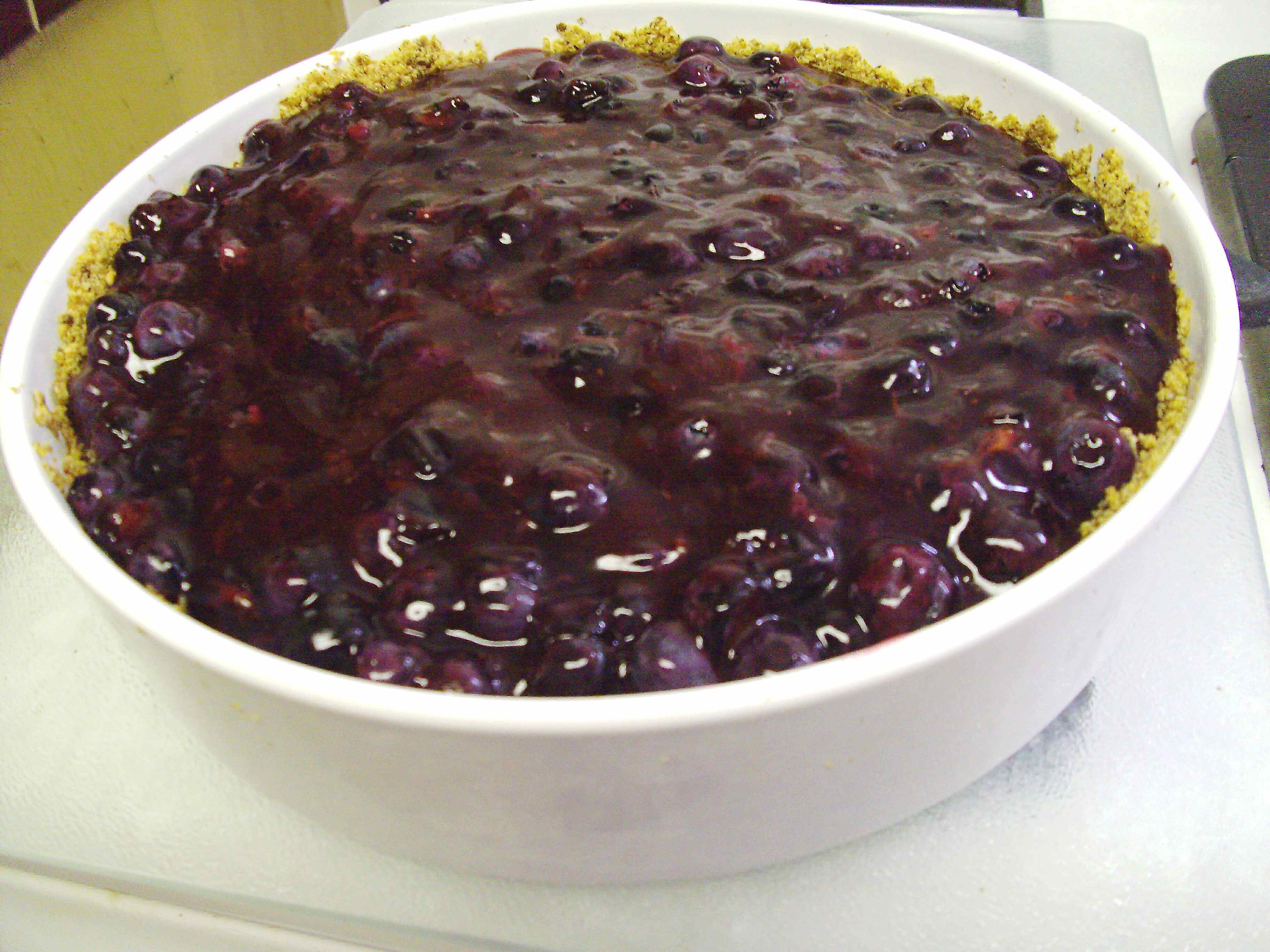
    raw blueberry pie with microwaveable filling and graham cracker crust

    This mostly-raw blueberry pie is a snap to make and very versatile--the filling microwaves in a few minutes, and you don't even have to bake the zippy gingered graham cracker crust--perfect for a hot Fourth of July and all summer long.

  • Recent Posts

  • Contents

  • Archives

  • Now Reading

  • See also my Book Reviews

  • Copyright 2008-2024Slow Food Fast. All writing and images on this blog unless otherwise attributed or set in quotes are the sole property of Slow Food Fast. Please contact DebbieN via the comments form for permissions before reprinting or reproducing any of the material on this blog.

  • ADS AND AFFILIATE LINKS

  • I may post affiliate links to books and movies that I personally review and recommend. Currently I favor Alibris and Vroman's, our terrific and venerable (now past the century mark!) independent bookstore in Pasadena. Or go to your local library--and make sure to support them with actual donations, not just overdue fines (ahem!), because your state probably has cut their budget and hours. Again.

  • In keeping with the disclaimer below, I DO NOT endorse, profit from, or recommend any medications, health treatments, commercial diet plans, supplements or any other such products.

  • DISCLAIMER

  • SlowFoodFast sometimes addresses general public health topics related to nutrition, heart disease, blood pressure, and diabetes. Because this is a blog with a personal point of view, my health and food politics entries often include my opinions on the trends I see, and I try to be as blatant as possible about that. None of these articles should be construed as specific medical advice for an individual case. I do try to keep to findings from well-vetted research sources and large, well-controlled studies, and I try not to sensationalize the science (though if they actually come up with a real cure for Type I diabetes in the next couple of years, I'm gonna be dancing in the streets with a hat that would put Carmen Miranda to shame. Consider yourself warned).

Saving summer

Between the continuous stream of political, humanitarian, economic and diplomatic firestorms set by the Trump administration and the actual forest fires here, it’s been a long, hard, hot summer in California and much more stressful than summer should be. I water cautiously, keep moving forward, and try to keep my family healthy and myself from letting it take over.

I’m also looking for an effective civil rights and humanitarian aid group to contribute to–the Southern Poverty Law Center is one; there are also several mothers’ groups raising funds for legal representation for immigrants separated from their children. As I discovered last year during hurricanes Harvey and Maria, making donations for humanitarian aid is an important way to help yourself as well–it’s something concrete you can do that will actually make a difference, and it makes you feel less overwhelmed and powerless as an individual.

Whenever I step back from the newspapers for a bit, though, I look around me and see the brighter side. I consider that my daughter has finished high school with both honors and friends, and for a change doesn’t have summer homework. She’s working in a job she loves, is learning to drive and is nearly on her way to college, which we are all looking forward to. She’s ready and I’m proud of her (although I’m still not quite ready to see Ladybird).

I’m working for a community book festival this fall that promises some fun and challenging authors, I have some interesting new freelance assignments, and my first e-book project is nearly ready for publication. And I’ve started experimenting again in the kitchen–something I really didn’t have the time or concentration for during graduation and its immediate aftermath.

The heat wave is a big factor in my cooking; Pasadena tends to get over 90 F most days of summer (and plenty of times from September to April too), and the past few weeks have seen temperatures in the 100s midday. So the freezer and microwave are essentials in my book. So is eating or preserving enough of the bounty of summer produce while it’s at its best to keep it from going to waste even in the fridge. Because I always tend to go overboard at the greengrocer’s–last year or the year before it was nectarines (this year too). This year it’s plums, strawberries, any other berries I can get at a good price.

Instant Frozen Yogurt

Most berries are good if you just wash and freeze them while they’re still in decent shape. Mix three or so ounces of frozen blueberries or blackberries with a 4-ounce/half-cup dollop of plain nonfat Greek yogurt and a teaspoon of sugar in a small plastic cup or snaplock container (the plastic is a better insulator than ceramic cups or glass) and you have nearly instant all-real and nicely purple frogurt–the small berries get the yogurt freezing the right way, right in the cup, within about 30 seconds as you stir.

But what if the berries are going a bit ugly and soft–like strawberries?

There’s nearly no point in trying for homemade strawberry frogurt or ice cream unless you really personally like it. Sorbet, I can definitely see, but for my money, strawberry ice cream is generally an insultingly pale pink, not terribly fresh, and tastes duller than plain vanilla. It would be a lot better to stick some actual fresh strawberries or a not-too-sweet fresh strawberry purée on the side of some good-quality plain vanilla because you’d have a real contrast between two actual flavors, not one mediocre pink in-between.

Well, what about jam?

Strawberries are one of my favorite fruits—fresh and raw or else frozen, unsweetened. But I actively dislike most strawberry jam—the cooked, oversweetened blandness bears no resemblance to the fresh, tart wild-tasting fruit I love.

Commercial strawberry jam is not only unbearably sticky-sweet and gluey but the fruit itself, when you encounter it, is usually a slimy dull gray lumpette with five o’clock shadow, something to pick out cautiously rather than savor. It’s not the best of the fruit to start with, and it’s now overcooked and showing it.

But there are still some really heavenly strawberries out there going overripe on the market produce shelves, and I had about half a pound left just a little too long in my fridge after a party. I discovered by fooling around that strawberry jam or at least compote that still tastes like strawberries is  possible to do at home if you microwave it lightly instead of cooking it to death. And I even liked it.


microwave fresh strawberry jam


Could I keep the tartness intact? Could I keep it lightly cooked enough to still taste fresh and like strawberries to me? Could I keep it from being slimy?

Based on a few of my other impromptu microwave fruit spreads (peach, plum, apricot, kumquat) and fruit-rescue attempts (faux sour cherry, nectarine sorbet) I decided I’d give it a quick try in the microwave Continue reading

Microwave tricks: 5-Minute Plum Jam for Fall

Italian prune or blue plums

These Italian prunes are some of the fresher, better-looking specimens from my greengrocer’s bin this week. But overripe plums work fine too.

Italian blue or prune plums are probably the last round of plums to appear at my local greengrocers for the year (well, until they start getting in carboys of plums and peaches from Chile). Prune plums aren’t much to look at–well, okay, they have a graceful enough elongated shape, but cut into one and you won’t be terribly impressed–the peel is thick and slightly bitter, the flesh is yellow-brownish, not very juicy, and a bit stickier and less brilliantly flavored than the red and black plums of summer, to say nothing of the gorgeous green and mottled dinosaur and Santa Rosa plums we can get here in LA. Many of the fresh prunes end up overripe and still untaken at the end of the day.

Which, I’ve discovered this week, is actually quite a shame. Because if you buy them early and firm, while there’s still a tint of reddish purple about them, they’re closer to regular plums–crisper, juicier and livelier tasting raw. Still not the ideal eating plum, but not bad.

And if you take the ones that are fully ripe and disappointing and bland and not too pretty, cut them up and microwave them, suddenly everything transforms. Italian prune plums make a gorgeous, rose-red, vibrantly flavored low-sugar jam. A lot like cranberry sauce in both color and flavor, but somehow a little mellower, with the bitter edge off, and a hint of spicy perfumed depth.

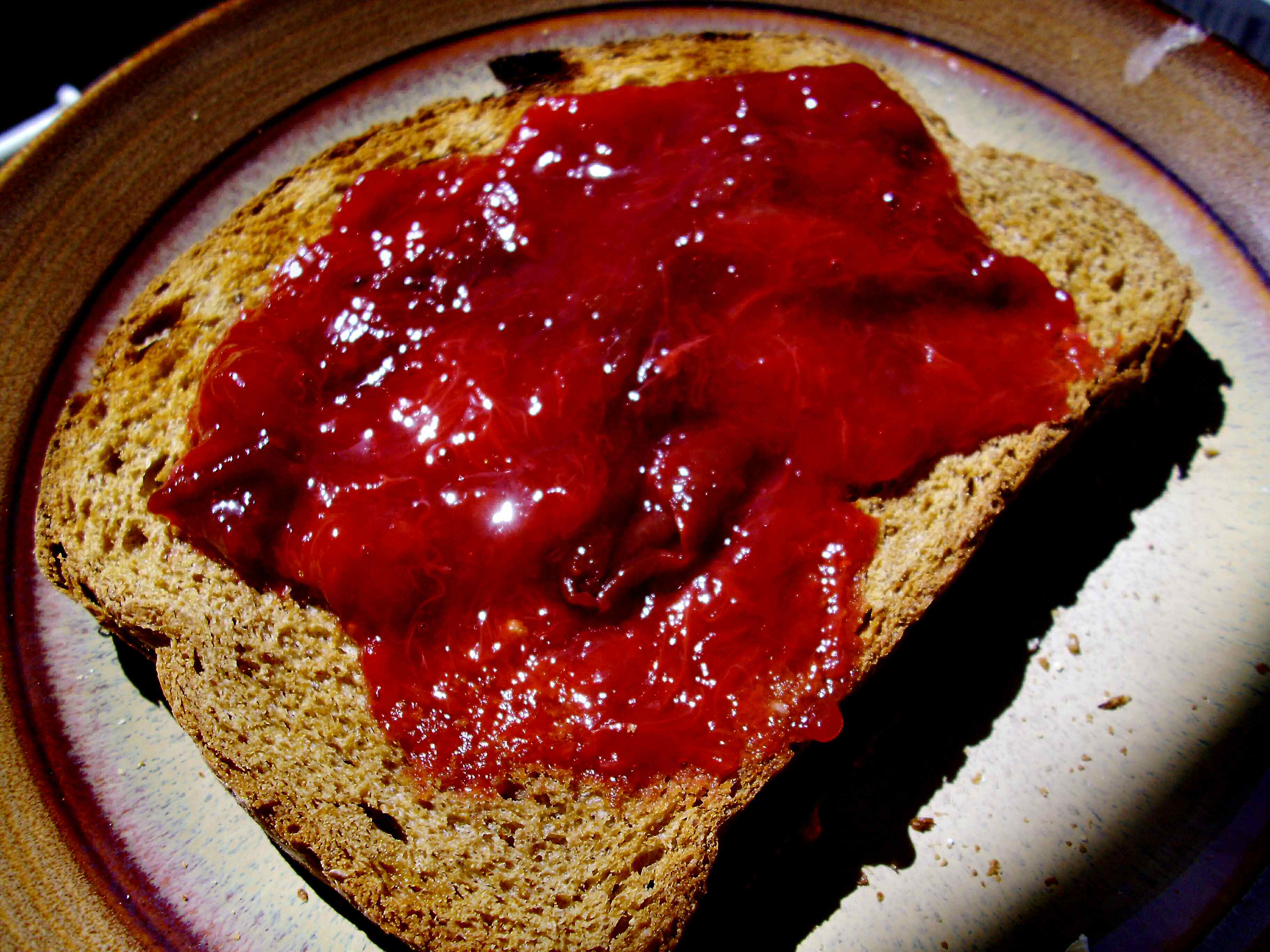
Microwave plum jam on wholewheat toast

Five minutes in the microwave, and everything changes.

Many stone fruits react this way to heat–sometimes sugar too, but mostly it’s the heat. Even very bland, mushy pale apricots seem to bloom into vibrant flavor and acidity when baked or simmered, and sour cherries go from slightly bitter and dull raw to world-famous classic pie filling with a strong almond aroma. I’ve rescued bland, spongy supermarket nectarines and peaches by microwaving them into fruit spreads with real flavor, but obviously good fruit makes even better jams and compotes. It’s just that when the fruit is good raw, I’d usually rather eat it raw, because the season is short.

The prune plums I bought this past week don’t provoke that dilemma of choice; they’re definitely better turned into a quick fruit spread, and maybe I’ll freeze a second batch for later. These plums would also make a great pie filling, like the zwetchgenkuchen that Joan Nathan first published as a traditional German Jewish dessert for Rosh Hashanah in The Jewish Holiday Kitchen. Baked conventionally, the quartered prune plums would probably hold their shape somewhat in the crust and look beautiful.

In the microwave, the plums quickly break down to a bubbling mass and gradually take on color from the peel–at first, bronze with a hint of pink, and after a minute or two the color spreads and deepens to cranberry red (as does the flavor). Sugar just to taste, a tiny squeeze of lemon, and a pinch each of clove and ginger balance out the tartness, and after a day in the fridge, the jam has mellowed and integrated beautifully.

The accents of brandy, cinnamon, nutmeg and lemon peel in Nathan’s recipe make me want to run back to the store and try it this instant, but after a week of baking challah for the high holidays and prospects for 100 degree temperatures yet again, I’m not sure today’s the day. Maybe for Sukkot, which starts later this week.

But the combination of plums with aromatic spices is right on, and if you’re adventurous you could always take this fruit spread one step further and add a small spoonful of brandy, a few shakes of cinnamon and an even tinier hint of nutmeg, even a little grated lemon peel. The simple version below is good on toast, delicious with Greek yogurt and plenty complex enough for me before or after the second cup of coffee.

However, the full-on dressed-up version would probably be a wonderful accent for goat cheese tartlets or a baked brie if you were doing swanky appetizers for a dinner party. I’d test-taste a small batch of the jam first just to make sure it wasn’t too rich with the brandy and nutmeg, because a little goes a long way, but otherwise, let ‘er rip. The plum-jam-with-cheese appetizers would also be an unexpectedly good accompaniment to mead, sherry or other apéritifs for fall.

5-Minute Microwave Plum Fruit Spread (makes about a cup)

  • 5-6 ripe Italian blue or prune plums (or any other plums), washed, pitted and cut up
  • 2-3 T sugar (or more to taste–I like mine less sweet, more fruit)
  • squeeze of lemon juice
  • pinch of cloves (maybe 1/8 t, probably a little less)
  • pinch of powdered ginger (a little less than 1/8 t)

Put all ingredients in a microwaveable ceramic bowl big enough to hold them with a couple of inches to spare, because the plum mixture will bubble up as it cooks. Remember to handle the edges of the bowl with a towel or oven mitt or something (folded paper sandwich bags also work okay in a pinch) because this will heat long enough for the bowl itself to get hot.

Microwave 1-2 minutes on HIGH (I have an 1100 W oven, so adjust times to whatever works for you if yours is older and lower power). The plums should be starting to break down and just starting to color pinkish. Stir the mixture and microwave another minute or so, stir again. If it’s not cooked as much as you think it should be, microwave another minute or so but be prepared to hit the stop button if you see it start to boil over. If it’s fully colored and broken down to a fruit spread, take a small spoonful, let it cool, and taste carefully. It will probably taste a lot like not-very-sweetened cranberry sauce. If it’s not sweet enough for you, add a little more sugar to taste, and maybe another squeeze of lemon, then let it cool all the way covered and refrigerate. It will thicken a little further and mellow overnight and taste more like plums, especially with the clove and ginger notes.

You can, obviously, also boil the ingredients a few minutes in a saucepan on the stovetop if you prefer. If you want it completely smooth, cool it and put it through a food mill or food processor.

This isn’t canned, so store it in the fridge for up to a week or freeze it for later. When you thaw it, taste it again–you might need to add another squeeze of lemon and/or reheat in the microwave just a minute or so to refresh it.

Breakfast without Matzah Overload

Last night we were very much in the spirit of Pesach–a total rush job at home, to the point where I realized I was supposed to have a boiled egg somewhere on the seder plate just as it was getting pretty far past sundown. Organization isn’t always our strong suit, especially on school nights. Last year I posted my Bart Simpson-style Passover Chalkboard Litany of kvetches and survival tips. This year: how to deal with matzah when they won’t sell you anything less than enough for 70 people for $2.99–such a deal! (well, okay, it is). You could feed nearly the whole Sanhedrin (because in our family, everyone argues about everything and I’m sure my 13-year-old is ready for law school as we speak. Good thing I can’t afford it yet!)

As with any style of food, too much of a good thing is still too much. I think I learn that the hard way every Passover. How to eat mostly vegetables and lean proteins and fresh fruit and yogurt…and not just sit there eating matzah like it’s going out of style? There’s more than enough matzah to go around–even in gefilte fish, especially in gefilte fish, which I’ve lost my taste for over the years since discovering how to cook regular fresh fish well, aka “not-gefilte”  (though I still buy a jar for my noncooking husband for lunches during the week.)

I don’t do matzah kugel, sweet or mushroom (a waste of mushrooms in my jaundiced opinion). I’m not a huge fan of matzah brei (exception: matzah brei “blintzes”), matzah lasagne, mina de espinaca, or any of the other matzah-plus-egg-heavy adaptations of regular food. Although I have seen one attractive-enough looking picture of a mina de espinaca, I’d still do it without the matzah sheets…

I try hard these days not to make matzah balls either, though this year I might make an exception–once–for my poor daughter who never gets any because she’s vegetarian and the “not-chicken” soup at Shabbaton this March didn’t have any flavor and there were no matzah balls in it like there were in the yes-chicken soup. Oy! Maybe it’ll be a weekend project to figure out a good from-scratch version–we have school and taxes this week. A lot of school and taxes.

My mother, who is famous for not cooking more than necessary, taught me how to make pretty-good fresh-tasting haroset Russian Jewish style (’cause that’s what we were). Apples, walnuts (though almond flakes are also just fine with me), cinnamon, sweet wine or grape juice, maybe or maybe not honey, chopped coarsely so it stays crunchy. But I’ve been to a couple of community seders out here in Pasadena where the haroset was mashed down like baby food and to add insult, had matzah meal in it. I know, matzah bits probably started out as a less expensive alternative to nuts, and I can’t blame anyone for that in their own homes. A professional caterer is quite another story. There’s really no excuse in California, where nuts are pretty plentiful (both the human and the arborial kind).

Well, anyway. Second seder is tonight, but what about the rest of the week–after taxes, as it were? Passover brings on a lot of nutritional challenges if you eat dairy or vegetarian. How not to eat too many eggs in a single week? How to stay away from the canned coconut macaroons and other assorted “Kosher for Passover” horror sweets my husband brings home because he thinks that the kashrut labeling makes up for the “nutrition” labeling (which really oughtta say, “WHAT nutrition?! This is pure sugar and potato starch, buddy! And palm oil! And artificial colors and flavors! Almost as good as Froot Loops!”) I’m pretty sure I’ve already mentioned this, but it’s because he’s a boy, and there’s nothing much to do about it except shudder, put the box of “goodies” in some inaccessible place on a low shelf, preferably behind the broccoli, which is merely green and mysterious or better yet, okra (which he fears more than taxes, and that’s saying something).

Note it down: ALL the packaged cake and cookie substitutes are a bad deal for anyone diabetic or even marginally thinking about becoming diabetic–very, very spiky, and almost never worth it. Also guaranteed to induce repetitive eating and the false sensation that you’re “starving” about three seconds after you eat them. And in the last 20 years, they’ve been faked-up further–even the kichel, a dry, stiff, barely-sweet puff halfway between an empty creampuff shell and a biscotti, has had artificial flavorings added recently–why bother?

Do we really even need such matzah-filled “delights”? Nowhere is this poverty of product more evident than in the kosher-for-Passover cake “mixes” (for which I always hear Julia Sweeney’s line “Where are yer mixes, hon?” from God said, Ha!). Last year’s example, which I’m not letting happen again: the Manischewitz Blueberry Pancake mix box my husband proudly brought home one day “on sale! it was 99 cents!” And naïvely suggested I could make for breakfast–this upon seeing that I’d just finished making cheese blintzes from scratch with real ingredients, and real raspberries. Don’t squint at me like that–he’s still breathing. I just decided his sudden brainfreeze in the wife department had been caused by jetlag, and contented myself with reading the ingredient box back to him.

The man is not a cook and is pretty happy not to be. Still, he does like to eat. And read. Somehow it never occurred to him to read in service of eating by checking what’s actually on and in that pancake mix box. It had 20 ingredients, no nutrition, and no blueberries. “Blueberry bits” contained–are you ready?–food coloring, sugar, artificial flavor, and sodium alginate. So suddenly you can’t tell the difference between berries and blue goo?

I had to go into extra innings with the cauliflower and broccoli and eggplant and asparagus and tomato/artichoke heart salads just to overcome the unusually high crap factor, even though I didn’t use the mix. Just reading it was enough to require emergency grapefruit. I was too ashamed to donate it to a food pantry, either.

So….real is definitely the best way to go with food for the week. Breakfasts can be tricky–matzah and jam, matzah and cream cheese, matzah and almond butter…it gets pretty tired pretty quick. And on the other hand, blintzes are for weekends only and frankly? I’m still annoyed about that pancake mix incident a year later! Nu…

Three relatively low-crap, moderately-low matzah alternative breakfasts that are (most important!) low-labor for those post-Seder mornings when you are Done and Off Duty to your nearest and dearest (except for coffee):

1. Matzah-nola, what it sounds like, ingredients straight from the cupboard or freezer. There is actually a product out commercially this year called “Matzahnola”; my version I invented a year or two ago out of desperation against the nutrition-free Passover version of Cheerios my husband brought home, but I didn’t think it was that good a name–who knew? Anyway, I’m not bitter (though the fresh-grated horseradish is still stinging my sinuses from last night).

2. The old-style Israeli breakfast, not the modern endless hotel breakfast buffets–more like the kibbutz specials where you’re expected to get out there and weed a cotton field right afterward. Which I have actually done in my less cynical youth.

3. The bonus “I can haz CAKE?” breakfast, a favorite of fridge-scrounging champions everywhere Continue reading

Cranberry Sauce Without the Fuss

Cranberry sauce in the microwaveI love homemade cranberry sauce, and not just at Thanksgiving. It makes a pretty good jam for breakfast and (should the need arise) a pretty good tisane for a congested sore throat if you heat a dollop in a mug of water and sip it hot, berries and all. Despite the fact that it’s tart, which you’d think would make your throat hurt more, the cranberries actually contain something soothing that will give you at least temporary relief when you’re in the throes of Los Angelitis and the Tylenol hasn’t kicked in yet (you can trust my expertise on this one, unfortunately). But hopefully you won’t need it for anything medicinal this winter and can just enjoy fresh-made cranberry sauce for its own sake.

A lot of people are convinced that just opening a can is the easiest and least scary way to go. They must have read the package directions and decided it was too much work to make the syrup first (very intimidating-sounding) or that adding the berries and letting them pop was likely to spatter the stove until it looks like a magenta Dalmatian.

But really, you can just microwave cranberry sauce and it works fine. Throw all the ingredients (berries, sugar, water) into a 3-cup pyrex bowl, slap a lid on partway, and nuke it for 5 minutes. That’s it. No preboiling. Don’t even bother mixing it. In five minutes, you’ve got standard fresh-made cranberry sauce in a bowl that can go straight to the fridge once it’s cool. And no saucepan or stove top to wash before your guests arrive.

You can dress it up with some orange peel or juice, or a pinch of clove and cinnamon. You could add a chopped, peeled granny smith apple or a well-scrubbed chopped organic seedless orange with the peel to the berries for cooking, or else stir in a spoonful of Cointreau or Triple Sec after the jam cools, and you’d have something a little more sophisticated, but the basic recipe is worth having as a first run.

And most helpfully, if you’re looking for something less sugared, you can cut the typical cup of sugar per 12-oz bag of cranberries in half and it’ll still gel decently. Or you can do it with no sugar at all, let all the berries pop and thicken up just in water, and sweeten it with your preferred artifice after it’s cooled. It won’t be completely carb-free per tablespoon or so even with no added sugar, but it’ll be pretty low.

Approximate carb counts (total and per tablespoon, counting 1 T as ~1/16th c.):

Cranberry-only version without apple or orange

  • With 1 cup of sugar: 242 g carb per 2.5-3 c. cranberry sauce  or 5-6 g/T.
  • With 1/2 c. sugar: 142 g carb/recipe or ~3 g/T.
  • Artificially sweetened only: 42 g carb/recipe or ~1 g/T.

Cranberry sauce with apple or orange

With a good-sized apple or orange chopped in, figure 25 extra grams of carb per recipe or 0.5 gram extra carb per tablespoon.

Any way you go with it, though, homemade cranberry sauce has a good deal less carb per spoonful than other kinds of commercial jams, and probably a good deal less than the stuff in a can. It’s a lot better tasting too.

Microwave Cranberry Sauce

  • 12-oz package fresh cranberries, washed well
  • 1 c. water
  • 1 c. sugar (standard Thanksgiving back-of-package recipe), 1/2 c. sugar (my version this week, which was plenty sweet enough for me), OR no sugar during cooking but artificial sweetener added afterward to taste

optional additions: chopped peeled apple, finely chopped whole scrubbed organic orange, pinch or so of powdered cloves and/or cinnamon, a little grated orange or lemon peel, or a spoonful of orange liqueur or brandy

Put the cranberries, sugar if using, water, and apple or orange if using in a 3-cup pyrex bowl, cover loosely with a microwaveable lid so steam can escape but it won’t spatter, and microwave on HIGH 5 minutes. (If you’ve added an apple or orange, you might need an extra minute to account for the extra fruit.) Keep an eye on it toward the end, but it probably won’t boil over.

The mixture should already be thickening to a sauce/jam consistency (it’ll thicken more as it cools), and most of the berries should be popped. Stir well and microwave a minute or so more with a vented lid if you want it thicker. Let cool to room temperature and, if using artificial sweetener, sweeten to taste. Other flavorings–you could add grated lemon or orange peel (sparingly) or clove or cinnamon before cooking, but save any alcohol-based flavorings for after the jam has cooked so they don’t just evaporate in the microwave.