
• Enter your email address to subscribe to this blog and receive notifications of new posts by email.

    Join 241 other subscribers
  • Noshing on

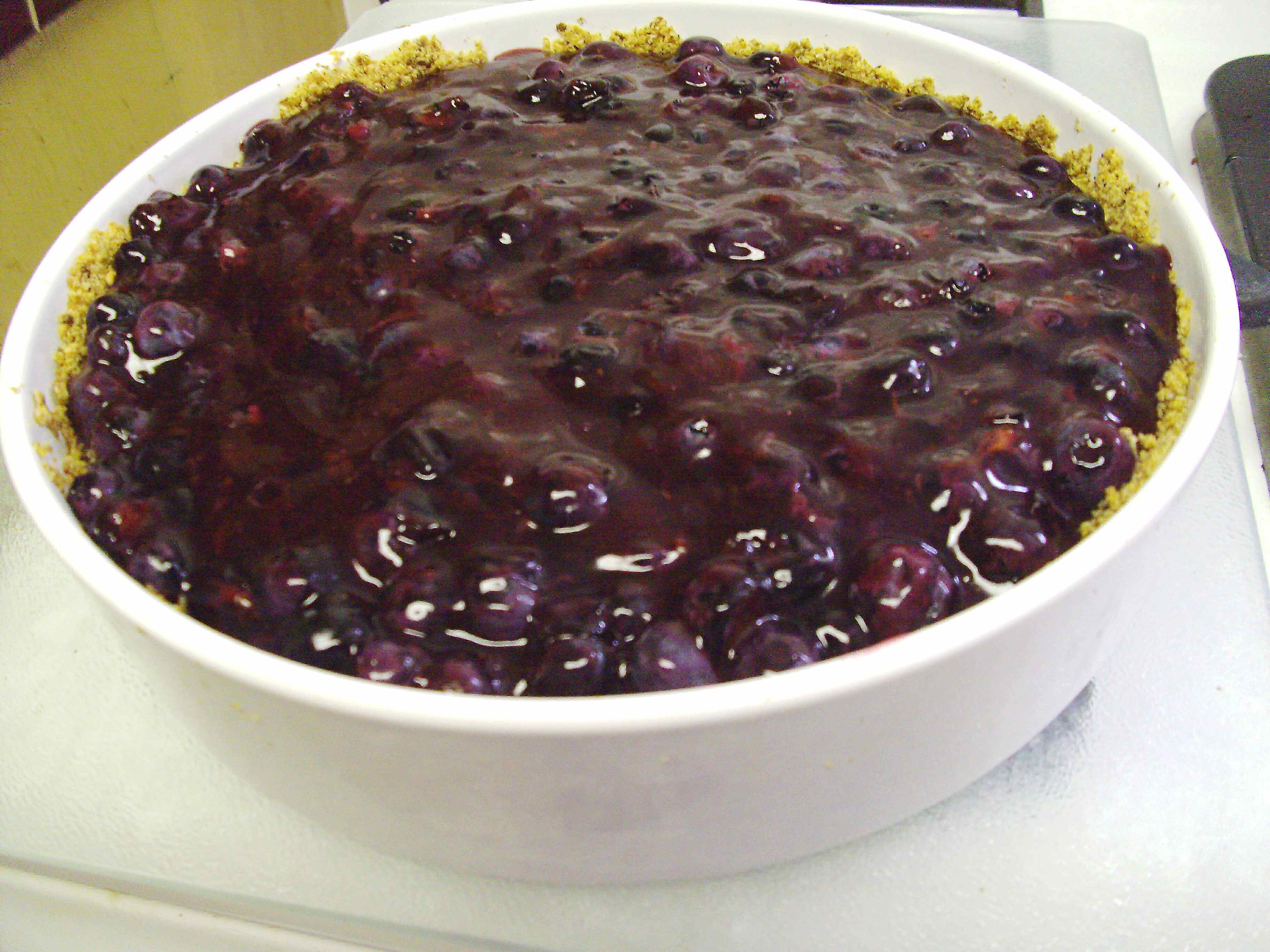
    raw blueberry pie with microwaveable filling and graham cracker crust

    This mostly-raw blueberry pie is a snap to make and very versatile--the filling microwaves in a few minutes, and you don't even have to bake the zippy gingered graham cracker crust--perfect for a hot Fourth of July and all summer long.

  • Recent Posts

  • Contents

  • Archives

  • Now Reading

  • See also my Book Reviews

  • Copyright 2008-2024Slow Food Fast. All writing and images on this blog unless otherwise attributed or set in quotes are the sole property of Slow Food Fast. Please contact DebbieN via the comments form for permissions before reprinting or reproducing any of the material on this blog.

  • ADS AND AFFILIATE LINKS

  • I may post affiliate links to books and movies that I personally review and recommend. Currently I favor Alibris and Vroman's, our terrific and venerable (now past the century mark!) independent bookstore in Pasadena. Or go to your local library--and make sure to support them with actual donations, not just overdue fines (ahem!), because your state probably has cut their budget and hours. Again.

  • In keeping with the disclaimer below, I DO NOT endorse, profit from, or recommend any medications, health treatments, commercial diet plans, supplements or any other such products.

  • DISCLAIMER

  • SlowFoodFast sometimes addresses general public health topics related to nutrition, heart disease, blood pressure, and diabetes. Because this is a blog with a personal point of view, my health and food politics entries often include my opinions on the trends I see, and I try to be as blatant as possible about that. None of these articles should be construed as specific medical advice for an individual case. I do try to keep to findings from well-vetted research sources and large, well-controlled studies, and I try not to sensationalize the science (though if they actually come up with a real cure for Type I diabetes in the next couple of years, I'm gonna be dancing in the streets with a hat that would put Carmen Miranda to shame. Consider yourself warned).

Going retro for real croissants

I’m not really a follow-the-recipe-in-the-cookbook kind of person. But I love looking through cookbooks that have interesting techniques. Learning to cook means, for me, being willing to eat your mistakes or half-good attempts and try again with tweaks. It also means playing with your food until it works for you.

So croissants are one of those things I try out again every once in a while, because the dough is really not as much trouble to put together as it sounds. Most of the time is just letting the dough rest in the fridge.

Mostly I keep trying because I’d really like it to work well eventually, as opposed to half-right. It’s something about the baking that’s always giving me trouble–the outside will be hard and the inside will be steamed and still doughy. Or else the things will puff up  enormously but will be more like a popover with absolutely no layering inside because the butter layers melted away into the dough during the long rise. Or if I roll them and bake them right away straight out of the fridge they won’t rise at all in the oven and they’ll be tough. Or they’ll be gummy. Or flat tasting. Or even a little bitter.

None of this would be so bad if it were just my own fault for noodling around with a classic. But the last few times I’ve tried to follow Dorie Greenspan’s instructions from Baking with Julia more dutifully than usual, and it just hasn’t worked out right at all. Worse, in fact, than some of my offhand attempts a couple of years ago when I changed nearly everything there was to change, starting with cutting the fat in half and ending with an almond-flour attempt that actually didn’t come out so far off. Except, of course, for the gummy insides.

Julia Child, "The French Chef" DVD from PBSBut last week I stumbled across the elusive two-part The French Chef series of DVDs from…not PBS, which is probably still out of stock, but…my local library. The disks (2 and 3 disks, respectively) are a bit scratched up and tend to halt at awkward moments unless you fast-forward or skip or rewind or whatever tricks I could come up with.

But there was a croissant episode from the late 1960s in black-and-white, just as I remembered the show from when I was 4 or 5 years old. So I watched it, wondering how dated it was, whether the old recipe was anything like the one she lent her cachet to in the mid-1990s with all her guest expert bakers, and what the results would be like. At the time of this early show, she’d been home in the States less than 10 years, had just delivered Mastering the Art of French Cooking a few years before, and was still extremely rigorous about everything. Or was she?

For the croissant show, she discusses different flours, the toughening effect they might have on the dough and how to counteract it with a bit of salad oil or by mixing 2 parts pastry flour to 1 part all-purpose. But then she includes a frozen commercial bread and pizza dough as a possible alternative to making your own yeast dough. Not the tenderest choice, she says, but for someone who doesn’t yet feel at ease making their own, it’s an encouragement to try making croissants at all, and it works all right. She’s astoundingly practical in these early shows even though some aspects of her cooking aren’t (exaggeratedly rich sauces for sole, for example). And I remember that back in those days, you couldn’t get real croissants in American bakeries. If you wanted them, you had to make them at home.

Dorie Greenspan’s modern, supposedly streamlined, layering process calls for cutting the butter into cubes and mixing them into the dough before rolling out, doing six “turns” with three rests in the fridge, cutting, stretching and rolling the croissant triangles in an elaborate way with some extra scrap dough in the middle for shaping, rising them for 2 1/2 – 3 hours, gilding with egg wash and baking at 350 F for about 20 minutes.

Julia’s 1960s version is somewhat different–more aggressive, and probably much closer to classic boulangerie technique. It’s also simpler. She makes a very simple milk-based yeast dough in a bowl with her hand and kneads it a couple of minutes, picking it up and slapping hard on the work surface, all while talking flour grades (you could talk Yankees versus Red Sox if you want–she probably could have too, come to think of it).

She takes a stick of butter and bashes it into a softened flat mess with a big solid rolling pin, then scrapes it up and flattens it into a square and rechills it. She lets the dough rise until double on a heating pad, then chills the dough. Then she takes the butter and the dough out of the fridge, wraps the square of butter in the larger piece of dough and then rolls and folds and turns and chills for a full 2 hours each time, but only for a total of 4 turns–2 sets of 2–before rolling and cutting out the croissants.

She doesn’t put an extra lump of dough in the middle when she rolls the croissants. She doesn’t stretch them a lot. And she does let them rise in a relatively cool room, but only for an hour or hour and a half until just Continue reading

Bistro + Cartoons = Stephane Reynaud’s French Feasts

French Feasts by Stephane ReynaudFrench Feasts: 299 Traditional Recipes for Family Meals and Gatherings by Stéphane Reynaud (2009 Stewart, Tabori & Chang, $40.00)

It’s a huge book. Daunting. Heavy as a couple of bricks. Padded cover, even, with a zillion miniphotos of intimidating French bistro classics in their raw and cooked forms (an octopus, a roasting tray of vegetables with leeks, a crème caramel, and several red-checked tablecloths, for that seemingly effortless retro chic, laid out under rustic-looking pot-au-feu types of stews. And a cutting board with six stuffed marrow bones stood on end.)

Flip open the front cover and you get a classic bistro menu with way too many choices (luckily it’s printed with a little English and page numbers, not handwritten on a chalkboard across the room, so you don’t have to squint). Read down the page (continue inside the back cover) and you start to dig up little puns and odd bits of humor here and there. They finally bubble up into something definite in the introduction, where the author, a medium-youngish guy seated in front of a casserole with a chef’s knife and a two-pronged barbecue fork, reminisces about a childhood stuffed with too much good food on family Sundays with his grandmère. Replete with escargot-burping uncles.

And from then on, you realize why this book is so fat: not only is there a heavy emphasis on meats and charcuterie (and six or seven different preparations for foie gras, 12 or so variations on soft-boiled eggs and omelets, etc.), but every other page is a photograph, or a profile of a couple who run one or another bistro, a venerable Lyonnaise sausage maker, vintner, baker, or cheese affineur…

Or — quite frequently — a cartoonist’s demonstration, only a little less improbable than Rube Goldberg’s, for making wine or cheese, or canning preserves (watch out for the orange tabby in the “catsup” jar). Check out the last chart, next to the Armagnac and Cognac page, which presents  increasing girths and grades of cigars appropriate for the increasing girths and ages of the smokers. Is it by way of including the classic end to a classic meal, never mind the known risks, or a subtle message the other way–that these days it’s more savvy to laugh at the cigar nostalgia die-hards than become one?

And speaking of nostalgia…There are even songsheets for Moulin Rouge classics so you can join in with your French friends after dinner. You kind of need those. You definitely need those.

Just what kind of cookbook have we lugged home?

Actually, Stéphane Reynaud is a well-regarded restaurateur on the outskirts of Paris and the well-trained son and grandson of a line of pork butchers. His previous book, Pork & Sons, arrived in the US a couple of years ago, and this one was published here in English sometime last fall. Despite the fact that I don’t eat pork and don’t think it’s a glorious profession to “break down a pig” or any other large animal, as glamorized on adventure cooking shows, French Feasts is well worth the read. Because Reynaud clearly knows his stuff, and not just about meat.

I’m not sure whether he got a translator to help, or he’s just really fluent in English–if so, my hat’s off to him, because his sense of humor really comes through fairly naturally, and it probably meant rewriting a fair amount of the text to come up with accurate and still funny equivalents for English speakers. Translating (and having to explain!) puns from French to English would be a job and a half for just about anyone. Most people would rather scrub dishes than have to explain a joke. Even me.

The recipes themselves are classics–untrammeled and unfutzed-with–and unexpectedly instructive in their simplicity.

Most have fewer than 10 ingredients, and often fewer than six. Here there are no dishes calling for 20 different special vinegars or sweeteners, as in American food-glam magazines and cookbooks. Not too many luxury ingredients, other than that many of the “proteins”–shellfish, goose, duck, game, foie gras–are hard to find in the US and kind of chi-chi expensive these days outside of Europe, but you could probably substitute with some success. And the titles are simple too–English translations of the classic French names, not mile-long lists of every special new “twist” ingredient it’s been tweaked with to up its audience appeal. Or advertiser appeal.

And the food photos. Nice photography but no attempt to make restaurant-pretty “tall food” plates with lots of garnishes. These are stews and soups and unsliced terrines–unstyled, many of them, or at least not overstyled with voguish background blur and enhanced color and gloss on every dish. Cooked cabbage looks like cooked cabbage. Turnips look like turnips, not like  flaming purple orchids turned suddenly solid. The stews look like stews you’d make at home–well, except for the lobster one, or the terrine with the crossed strips of fatback over it, or the baked fish in a glossy brown flake pastry crust. That’s just showing off, right there.

But really, most of these dishes are photographed while still in the cooking pots–which aren’t the bright shiny brand-new brand-name items you can order directly by clicking on the picture. They’re well-used, old, blackened, ugly even. Not glamorous. They don’t go with the brushed steel decorator kitchens we’re used to seeing in all the glossy cookbooks on our shelves. They have a bit of grime and wear about them, and make us feel better about our own dowdy day-to-day kitchenware that we’ve been using since we got out of school umpty-nine years ago and haven’t replaced because it’s reliable.

And now what I thought at first was a detour:

To my great surprise, given the author’s “slow food” cred, Reynaud’s recipes don’t contain any of the rote “1 teaspoon of salt” in each recipe that most recent American cookbooks have fallen into. Few of his recipes are seasoned more than once if at all, and usually just the sauce, or just the surface, right before serving. He doesn’t dictate how much, but from the context it’s obviously closer to a pinch than a spoonful, and often he skips it altogether.

He also doesn’t boil his vegetables in salted water, which is very chic right now in the US just because Thomas Keller said he does it and Michael Ruhlman trumpeted it as gospel. With only one exception–in fact, the only recipe in the book with a specified teaspoon of salt–even the desserts in French Feasts, including all of the pastry doughs from shortbread to puff pastry, are almost entirely free of added salt. The sheet cakes have baking powder, and a handful of the pastries call for salted butter rather than plain, but neither comes anywhere close to a contemporary American version’s salt content.

It’s not that Reynaud never uses salt or salted ingredients like capers or sausage or parmesan. But unlike American recipe developers, he doesn’t throw extra salt on top of them, and in fact he warns against it in one of the smoked pork-plus-sausage-plus-three-other-preserved-meats kinds of dishes.

SO—If these are the classics and the methods American chefs and recipe test kitchens have been aping and trying to bring to the table in our best restaurants for decades, French Feasts makes it clear there’s been more than a little “tweaking” or “drift” going on, particularly for the increasingly popular baked goods. Almost every American version of the classic French desserts, from mousse to napoleon to baba to charlotte and crêpes and on to cannelés, has had an automatic teaspoon or worse of salt dumped into it before it went to press. In comparison with the traditional style of French Feasts, we seem to be pickling ourselves. You have to wonder who put it there and why, and what our sorta-French desserts are really supposed to taste like when you skip the commercial interest that seems to be behind all the routine, mindless oversalting.

And you have to ask–in romanticizing Slow Food but presenting commercially tainted, overly fussy, overly expensive and oversalted versions of traditional European dishes, how far has American foodieism drifted away from reality? How badly have we lost the thread?

In contrast to the younger wave of foodie restaurant chefs and specialty purveyors in the US, most of the folks profiled in French Feasts are not sporting extensive surfer tattoos or orange clogs to proclaim their indy cred. They’re also not Glamorous-Looking French People With Scarves ™, except Continue reading

Uneasy fusion: cooking, then and now

I don’t know if I’m looking forward to this Friday’s release of the movie Julie & Julia or not. I’ve read both of the books it’s based on and liked them both, and I’ve been an avid fan of Julia Child as a person if not as a chef since I was four years old (this was 1968 or so) and the only one in my family to watch her show to see her cook rather than to laugh at her voice. Even then I recognized how sure-handed and direct she was. When she cooked, cooking was a skill, an honorable and challenging form of work. There was nothing domestic or dopey about it.

Julie Powell, in her recent blog-based book on taking Mastering the Art of French Cooking as a personal mission, rediscovered how serious Child was. As she found out the hard way, learning to cook as thoroughly as Child did is like learning to be a Zen master or a swordsmith. And yet it’s not beyond you to do, as long as you’re willing to do the hard work.

I also, oddly enough, read one of Nora Ephron’s early books, Crazy Salad–-this was back in the early 1970s, the days of the ERA and Billie Jean King–-from the far corner of my parents’ bookshelves, and unbeknownst to them. The essays in it, which skewered everything misogynistic in society from porn to politics (and memorably specified the difference between liberal and libertine) were particularly inspiring to a word-hungry 10-year-old looking toward feminism from the sidelines of childhood. The attitude, if not the material, seems to fit both of Ephron’s ambitious subjects in Julie & Julia, the movie.

I’m just not sure it all belongs in a movie, particularly not one that boils two gritty memoirs down into something of a chick flick, as this is being advertised. Or one with a movie star like Meryl Streep, whose undoubted talent is, as with most female movie stars, still forced to subordinate to her looks. Wig or no wig, when it’s her on the screen, you never completely forget you’re watching Meryl Streep. It’s not her fault, but I don’t know if I want to see her standing in for someone as vivid as the real Julia Child.

Amy Adams is almost certainly going to be cuter, younger and a lot simpler than the real Powell, who is currently working on a book about a 6-month stint she did learning the butcher’s trade in the wake of her first book’s success. Julie Powell is young but older-–we hope also somewhat wiser–-than when she started her blog. She can represent herself–-very interestingly, in a longish interview on Borders Media and elsewhere–-in contrast to the movie adaptation of her, which she seems not to mind.

Both Child’s book and Powell’s are now being reissued with covers showing scenes from the movie with pictures of Streep and Amy Adams as Child and Powell, rather than Child and Powell themselves. It’s what all the major publishers do when they ink a movie deal. I don’t know why it bothers me so much, but it seems fundamentally creepy for autobiographical works to supplant the author–the actual author–with an actor.

Beyond the chick-flick reservations, I wonder how the two memoirs are likely to mesh onscreen. My Life in France is ultimately a more important book than Julie & Julia. It’s centered less on food–-and “food porn”–-than on history, and less centered on self than on the outside world. And Child was eminent even before her cooking career in ways that Powell probably won’t get to be, if she’s lucky.

Julia Child, who belonged to my grandparents’ generation, describes day-to-day life in Paris right after World War II in a way American generations since have not  experienced. It’s an unsentimental and un-chickish view of how things really were on the ground before Europe had a chance to rebuild. Child calls up a memory of ordinary people–not fashionable, not attractive, just neighborhood people–who simply got used to passing piles of rubble that only a year or so before had been familiar buildings, and she observes the grinding postwar poverty in the city that she, like us, probably grew up romanticizing in her mind. It’s a fascinating context in which to discover a love of good food and the tenacity to learn everything about it.

Child’s sometimes raw sense of humor and her frankness about the conditions of postwar Europe are backed by years of experience working in the intelligence service during the war. It’s something she doesn’t really discuss in the book, but which was detailed at some length in an earlier authorized biography, Appetite for Life, by Noel Riley Fitch. She and Paul met while working for the OSS in Ceylon, where she developed a complex, database-like filing system for cross-referencing intelligence reports. The couple were transferred, flown over the hump (the Himalayas), to Kunming, China, where they became part of a field intelligence team that advised against the U.S. hastening to take sides between Mao Tse Tung and Chiang Kai Shek, both of whom were essentially regional warlords. That advice was disregarded by the hawks advising Truman, and many OSS members, Paul among them, were later persecuted and blacklisted under McCarthyism as the new rival CIA sought to supplant and discredit them.

Child, whose more public masterwork remains on a lot of kitchen shelves but largely untested because it does call for actual work, was not a glamorous person like Streep has to be. She was a roll-up-your-sleeves-and-speak-your-mind kind of person, and looks were not the point. Read My Life in France and you’ll find a sharp and demanding intelligence, curiosity about everyone around her, frustration at ineptitude–her own or others’–a lively sense of humor, a bone-deep but realistic regard for her husband, and something else that just transcends the physical impression she made on television audiences in America.

I hope Streep can do it–has done it. I really hope I forget it’s her when I see the movie. I really hope Ephron has done it as well, and that the movie trailers that smell of chick flick cha-ching aren’t the best scenes. I want the movie to live up to both of the books, and I’m afraid of seeing too little of either.