
• Enter your email address to subscribe to this blog and receive notifications of new posts by email.

    Join 241 other subscribers
  • Noshing on

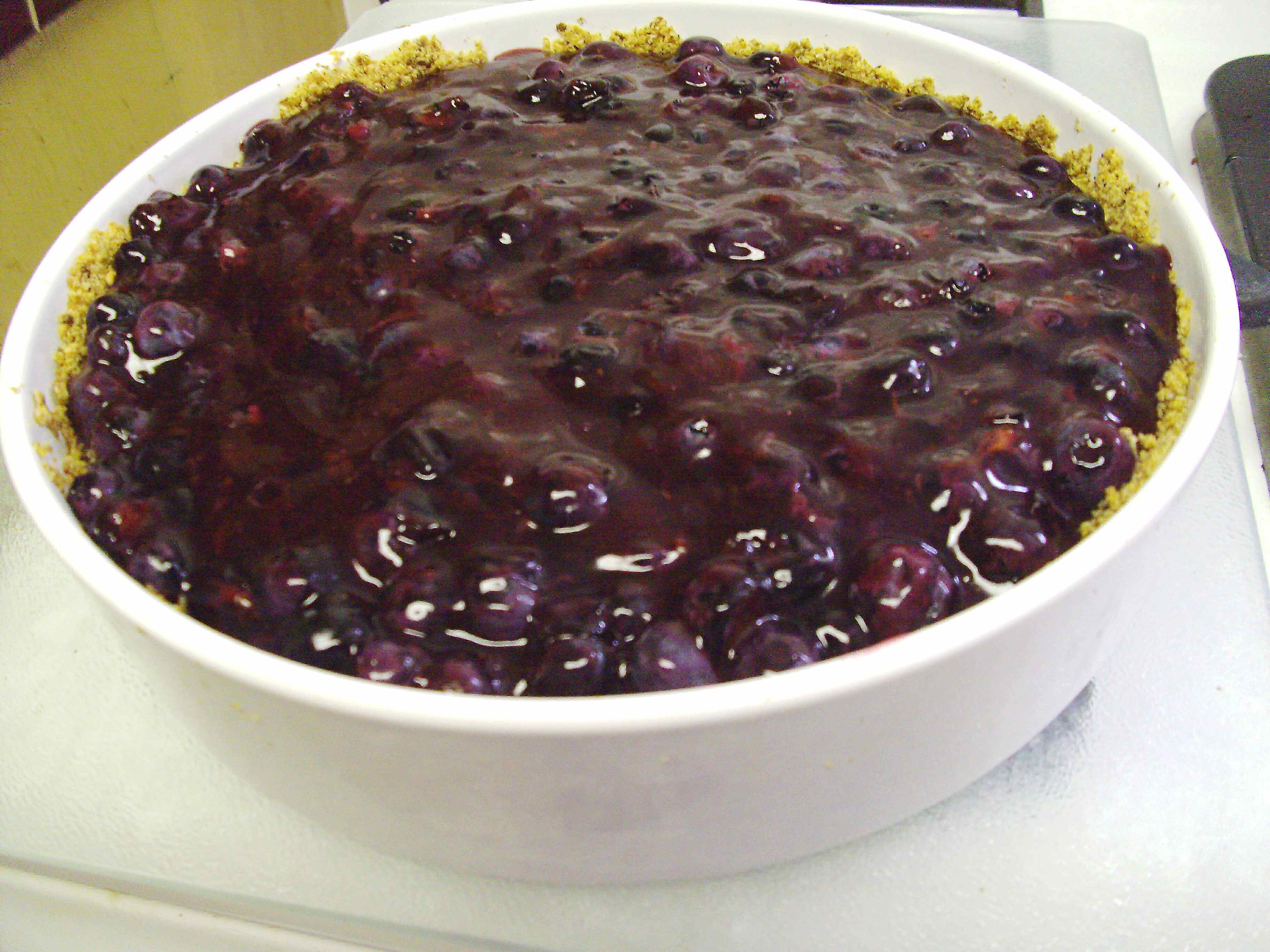
    raw blueberry pie with microwaveable filling and graham cracker crust

    This mostly-raw blueberry pie is a snap to make and very versatile--the filling microwaves in a few minutes, and you don't even have to bake the zippy gingered graham cracker crust--perfect for a hot Fourth of July and all summer long.

  • Recent Posts

  • Contents

  • Archives

  • Now Reading

  • See also my Book Reviews

  • Copyright 2008-2024Slow Food Fast. All writing and images on this blog unless otherwise attributed or set in quotes are the sole property of Slow Food Fast. Please contact DebbieN via the comments form for permissions before reprinting or reproducing any of the material on this blog.

  • ADS AND AFFILIATE LINKS

  • I may post affiliate links to books and movies that I personally review and recommend. Currently I favor Alibris and Vroman's, our terrific and venerable (now past the century mark!) independent bookstore in Pasadena. Or go to your local library--and make sure to support them with actual donations, not just overdue fines (ahem!), because your state probably has cut their budget and hours. Again.

  • In keeping with the disclaimer below, I DO NOT endorse, profit from, or recommend any medications, health treatments, commercial diet plans, supplements or any other such products.

  • DISCLAIMER

  • SlowFoodFast sometimes addresses general public health topics related to nutrition, heart disease, blood pressure, and diabetes. Because this is a blog with a personal point of view, my health and food politics entries often include my opinions on the trends I see, and I try to be as blatant as possible about that. None of these articles should be construed as specific medical advice for an individual case. I do try to keep to findings from well-vetted research sources and large, well-controlled studies, and I try not to sensationalize the science (though if they actually come up with a real cure for Type I diabetes in the next couple of years, I'm gonna be dancing in the streets with a hat that would put Carmen Miranda to shame. Consider yourself warned).

Pinned for Purim!

Thanks to Yael Shuval for choosing my Low-Carb Hamantaschen for her board at Pinterest.com.

Three years ago I developed almond-meal based hamantaschen for my daughter, who had been diagnosed with Type I diabetes only a couple of weeks earlier and needed something that was low enough in carb that (at the time, anyway) she could actually have one or two when all the other kids were having theirs and without having to get an extra shot of insulin.

Almond meal has only about one-fourth as much carbohydrate per cup  as wheat flour, so it seemed like a good substitute. To our surprise, although the dough was a little finicky to work with, the hamantaschen came out tasting pretty good, and they were indeed pretty low carb, about 4-5 grams per mini-hamantaschen. Granted, they were also pretty small, but it was a symbolic triumph in the first few weeks and made us all feel like being diabetic wasn’t going to be the end of having fun.

Now that my daughter is on an insulin pump, getting an extra shot is no big deal, though in our experience the pitfall is that it’s now just a little too easy, especially for a preteen, to “eat anything you want, at any time, without thinking about it, as long as you program the insulin for it” which is one of the less responsible marketing messages in Medtronic’s brochure for teenagers (note: the pump itself is pretty good, but it still doesn’t mean you don’t have to be careful about what you’re eating). Those sour gummy heart candies the teacher handed out for snack earlier this week and left on my daughter’s desk, for instance….well, candy never seems like as much food as it really is, and I think my daughter gained a valuable lesson when she added up what she’d really eaten…she wouldn’t be the first one.

It’s always good to have a general plan in place for holiday eating so you don’t overdo the treats or eat an entire meal’s worth of carb in just a few cookies or candies or whatever…what can I say, we’re working on it.

Still. In the last year or two I’ve mostly gone back to making standard hamantaschen based on Joan Nathan’s classic cookie-dough recipe, which I like a lot and which looks and tastes much, much better than the dry, pasty-white horrors at the annual Purim carnival.
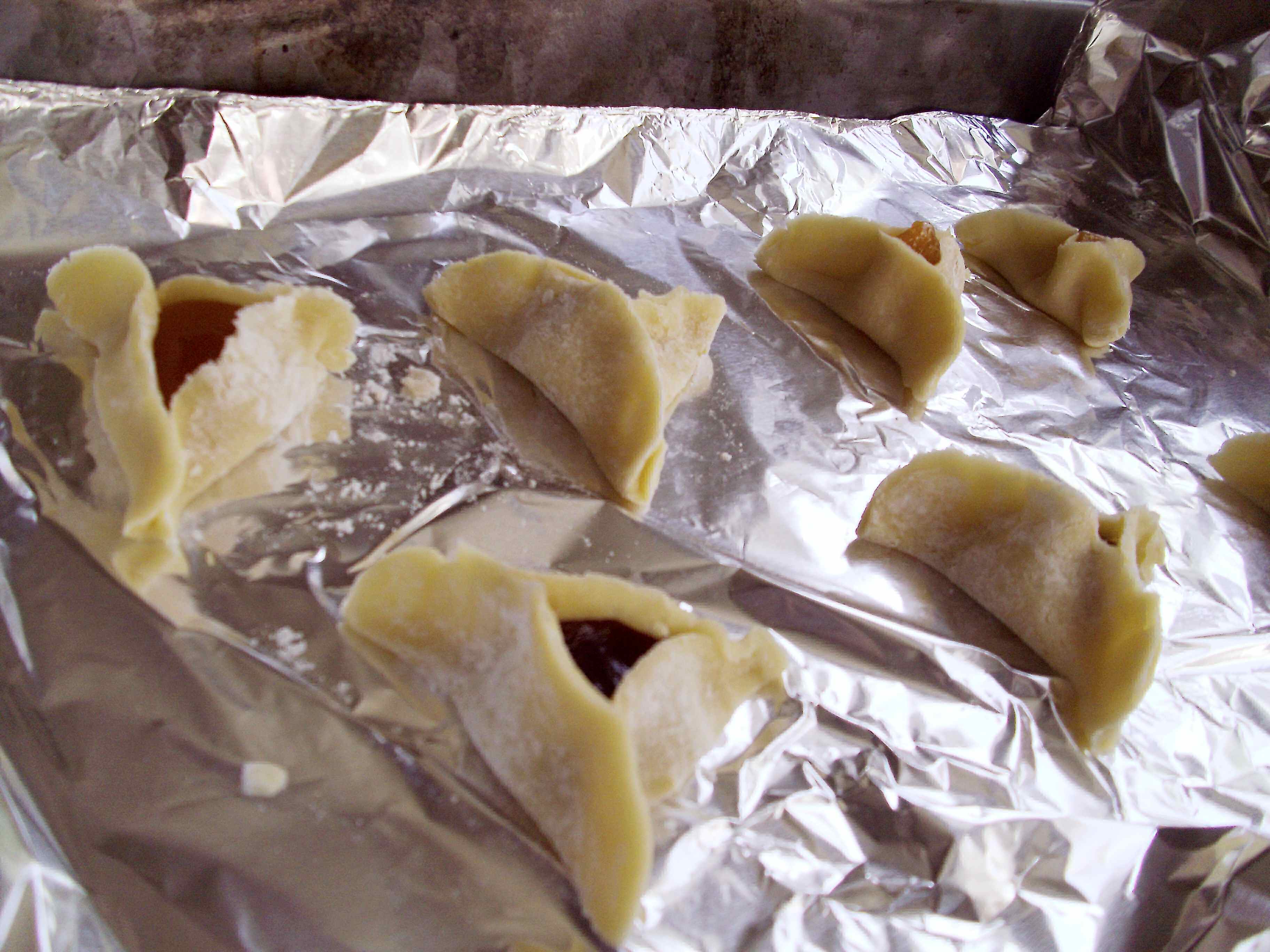
hamantaschen1

What I like about the standard flour-based recipe, other than that it tastes and looks good and is easy to work with, is that I can roll the dough out very thin and get crisp, delicate hamantaschen that are a decent cookie size but still hold together nicely and are not extravagantly carb-laden, particularly if the fillings are reasonable and you don’t eat ten at a time (the big challenge). They’re not as low-carb as the almond meal ones, but they still work out okay–about 7 grams apiece for a 1.5-2″ cookie. They taste good even made with pareve (nondairy) margarine instead of butter.

The LA-area idea of hamantaschen usually involves M&Ms, colored sprinkles, anything completely artificial. I bet gummy sour hearts (this afternoon’s culprit) would be a huge hit too. I don’t think they’ve heard of either prune or poppyseed out here in at least a generation.

Traditional fruit or nut fillings are a much more decent bet for carb, and they taste better (and look nicer too, because I’m not 6 years old and don’t insist on rainbow colors anymore). They’re also easy to make from scratch in a microwave or on the stove top so that you can decide how much sugar to put in them. Continue reading

French Food with Jewish Roots (and vice versa)

Joan Nathan's "Quiches, Kugels, and Couscous" (Alfred Knopf, 2010)About…a month ago, already? Two? Oy! I decided my next serious food post was going to be a review of Joan Nathan’s current bookQuiches, Kugels, and Couscous: My Search for Jewish Cooking in France (Alfred Knopf, 2010). And I’ve been looking through this book for much of that time, trying to figure out what to say first and what I’d want to cook from it that I haven’t tried before.

An initial read attracted me very much: Nathan, who worked as an aide to Teddy Kollek back in the 1970s, when he was still the gregarious and widely-admired–in fact the last widely admired and liked–mayor of Jerusalem, came back to the States as interested in people as in food, and has balanced the two focuses in most of her cookbooks ever since.

In this book, she starts out by visiting her French cousins and branches out to meet all sorts of people–deli owners, a gefilte fish maven, Holocaust survivors and one of the farm women who sheltered some of them during the war, the new wave of North African Jews from Morocco to Egypt who arrived in France after the mass expulsion from Arab countries in the 1950s;  the Provençal Jews who trace their ancestry back to pre-Inquisition Spain and Portugal, the Alsatian Jews whose dishes, despite coming from the heart of the original Ashkenazi community, are not as familiar as I would have expected.

Throughout the book she’s collected personal stories of all kinds, visiting home cooks, restaurant chefs, purveyors of spices and other specialty items that Jews initiated and led the European trade for–particularly chocolate and coffee. And she has dug up a few surprises as well.

Paul Bocuse, for example, is widely considered the grand old man of French haute cuisine, so much so that a major international competition is named for him. Nathan discovered that he keeps one stockroom Continue reading

Excuses, excuses

Sorry everyone, I’ve been out of it for 3 weeks this time, due to:

1. Moving (last week)

2. Illness (started with tonsils, ended with a swollen ear from cellulitis, a strep infection of the skin when you get too rundown), right the day of the move. You go in expecting them to hand you a packet of smelly antibiotic capsules and they take one look at your red ear and the redness is starting to march across your cheek hour by hour like Attila the Hun invading Europe, only redder, and instead they sweep you up on a gurney in the ER and hook you up to an iv with the big-guns antibiotics pronto and tell you you’re lucky it hasn’t reached your eye yet and you’re in the observation unit for the night. Verdict:  get more sleep and don’t send your kid into the mountains for two retreats (one regional, one school) in one week right before you move.

3. Moving some more–the movers took only about 3/4 of our stuff the first time around because my husband didn’t have what it took to pack it all himself and he didn’t call them to move the date or ask for extra help when I ended up in hospital. I was flat on my back with an iv in my hand and a phone bleating my husband’s panic at being stuck with it all himself and what should he do with the…I was actually GLAD not to be on the scene. But he took me there the minute I got home so I could see how bad it was and calm him down. Usually it’s the other way around–he’s the calm one in the family. Mostly. So a week later some of the movers came back on their own to finish for pickup work. Still ended up less than we were expecting to pay.

4. Garage full of boxes–where are my daughter’s dress clothes? where’s the other piece of the vacuum cleaner? whose pots are those and are they milk or meat?

5. Cleaning out whatever passes for our old townhouse is like Hercules mucking out the stables of the gigantic horses. Only with fewer shovels and more muck. But we’ll do it to get what we can of our old deposit back. Don’t ask about the local, woman-owned maid service we tried (twice!) to engage for this work and whose owner blew it not once but twice. We tried. Next! Molly Maids.

6. It’s still Pesach come Monday night. Advantage: new kitchen is tiny and unsettled, so we don’t have that much hametz to get rid of. And we’re paying someone else to clean the fridge at the old place.  (but I still did a preliminary scrub yesterday because it would be too cruel, and too expensive, for the maid service to have to face that fridge without help).

7. Freedom? No, it’s not just another word for nothing left to lose. It’s the taste of matzah and parsley and horseradish and haroset after I’m finally done with the antibiotics and can stand to eat anything more exciting than toast and eggs. Even though that’s mostly what matzah balls are made of, I’m really, really looking forward to it.

Up next, as soon as I can actually read my way through it, Joan Nathan’s newest book, “Quiches, Kugels and Couscous” about looking for the Jewish foodways of France and the Jewish roots still discernible in French food today. I’m kind of excited about it because Nathan is a friendly as well as intrepid explorer in the world of food and culture, and she finds ways to visit people in their homes and see what they really cook and eat. So the food may not be highbrow but the stories are looking good so far.

Have a great weekend if I don’t post before then and Chag Pesach Sameach!

Putting Pie Crust on a Diet

From a recent LA Times special on savory pies comes a classic calorie-bomb–only, it’s not even the pie. It’s the pie dough itself:

Basic savory pie dough No. 2 (cream cheese)

Servings: 1 double-crust (9-inch) pie or 6 individual hand pies

  • 1 (8-ounce) container cream cheese, at room temperature
  • 1 cup (2 sticks) butter, at room temperature
  • 1/4 cup cream
  • 1 teaspoon salt
  • 2 2/3 cups (11 1/2 ounces) flour

Each of 6 servings: 638 calories; 9 grams protein; 44 grams carbohydrates; 2 grams fiber; 48 grams fat; 29 grams saturated fat; 137 mg. cholesterol; 1 gram sugar; 518 mg. sodium.

Now come on. 638 calories before you ever get to the filling? Who wants to eat that much pie dough at a time, especially one so rich? OK, don’t answer that, but really. Gag.

Except for the extra cream and the teaspoon of added salt (and why do you even need those with a cream cheese dough anyway?) this is really just a classic rugelach dough–you mix the fats together and then stir in the flour a little at a time by hand. Only, rugelach dough is meant to be rolled out as thin as physically possible–1/16 inch thick or even less–before spreading with jam and nuts and chocolate and cinnamon and so on and rolling it up into a crescent shape. And a good thing too, because cream cheese doughs are notoriously rich. More dough per rugelach and you’d soon feel like you’d eaten an airline Danish–it would sit like lead in your stomach for hours.

I compared the recipe above with the one in my much-used spiral-bound 1984 edition of Joan Nathan’s The Jewish Holiday Kitchen (thank you, Hadassah rummage sale!) It was probably the one cookbook that influenced me most as a college student, and I still use it for the classics, especially baked things like rugelach and hamantaschen that I can’t just wing (note–her cookie-style hamantaschen recipe is the best I’ve ever tasted, a far cry from the usual chalky white horrors on the Purim carnival bake sale table).

Based on Nathan’s rugelach recipe, which is the same recipe everyone everywhere seems to use, the quantities in the LA Times recipe above should make something like 40 rugelach, so figure about 15-20 realistic servings, not six. The cooks at the LA Times must be rolling the dough out the standard 3/8 inch thick for their pies, but it seems like a complete waste of this dough’s particular talents. Continue reading