
• Enter your email address to subscribe to this blog and receive notifications of new posts by email.

    Join 241 other subscribers
  • Noshing on

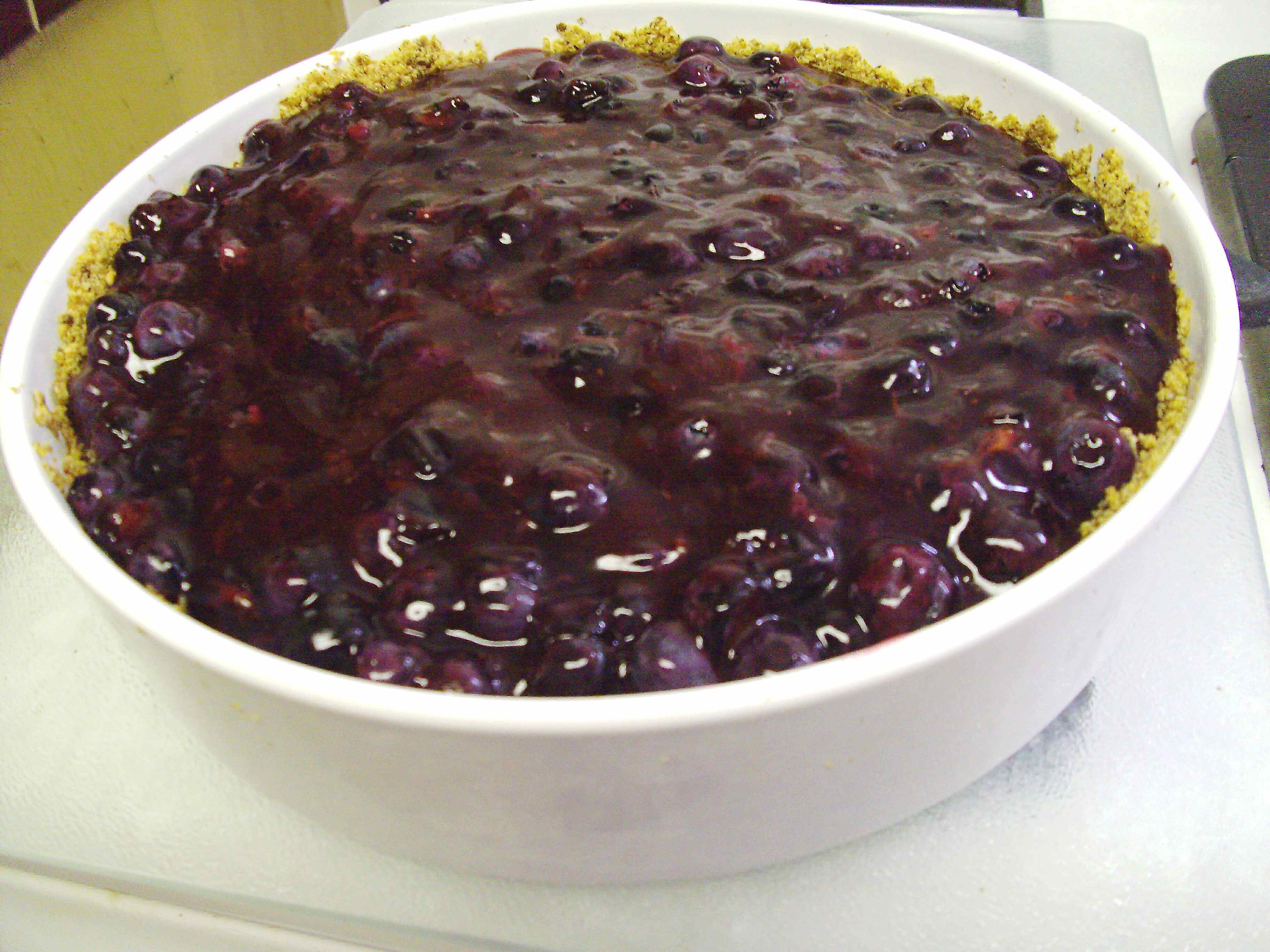
    raw blueberry pie with microwaveable filling and graham cracker crust

    This mostly-raw blueberry pie is a snap to make and very versatile--the filling microwaves in a few minutes, and you don't even have to bake the zippy gingered graham cracker crust--perfect for a hot Fourth of July and all summer long.

  • Recent Posts

  • Contents

  • Archives

  • Now Reading

  • See also my Book Reviews

  • Copyright 2008-2024Slow Food Fast. All writing and images on this blog unless otherwise attributed or set in quotes are the sole property of Slow Food Fast. Please contact DebbieN via the comments form for permissions before reprinting or reproducing any of the material on this blog.

  • ADS AND AFFILIATE LINKS

  • I may post affiliate links to books and movies that I personally review and recommend. Currently I favor Alibris and Vroman's, our terrific and venerable (now past the century mark!) independent bookstore in Pasadena. Or go to your local library--and make sure to support them with actual donations, not just overdue fines (ahem!), because your state probably has cut their budget and hours. Again.

  • In keeping with the disclaimer below, I DO NOT endorse, profit from, or recommend any medications, health treatments, commercial diet plans, supplements or any other such products.

  • DISCLAIMER

  • SlowFoodFast sometimes addresses general public health topics related to nutrition, heart disease, blood pressure, and diabetes. Because this is a blog with a personal point of view, my health and food politics entries often include my opinions on the trends I see, and I try to be as blatant as possible about that. None of these articles should be construed as specific medical advice for an individual case. I do try to keep to findings from well-vetted research sources and large, well-controlled studies, and I try not to sensationalize the science (though if they actually come up with a real cure for Type I diabetes in the next couple of years, I'm gonna be dancing in the streets with a hat that would put Carmen Miranda to shame. Consider yourself warned).

Persian-ish grill ideas for Purim
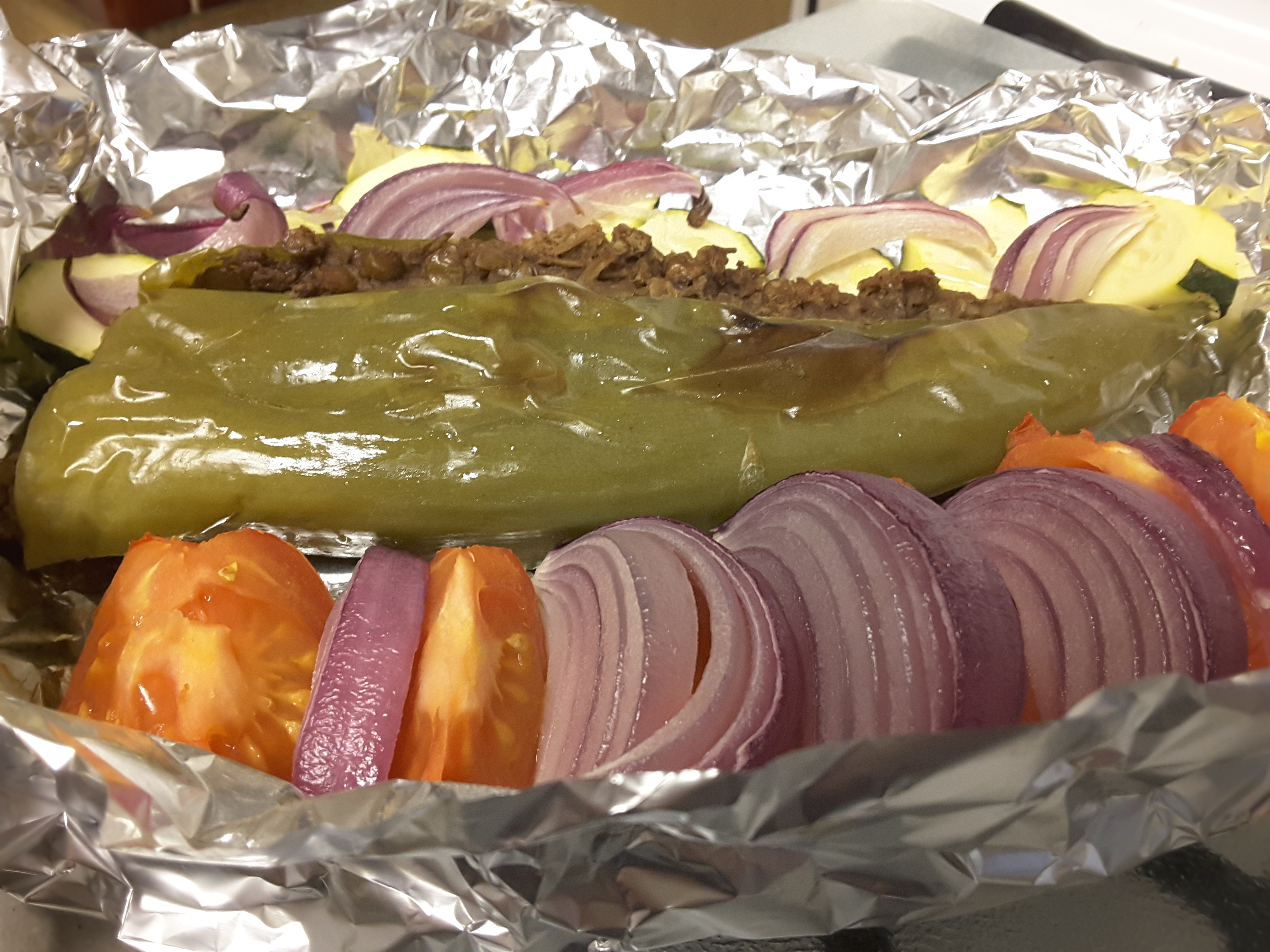
Lentil-stuffed Anaheim chile with zucchini, tomatoes and red onion in a Persian-style vegetarian platter grilled in the toaster oven.
Microwave-to-toaster-oven version

Last year our synagogue signed up for a catered Persian grill dinner (served takeout-style for pickup) from a restaurant on the West Side of LA, and this year they’re doing it again from a restaurant with kosher meat options. Last year, we weren’t sure so we went with a vegetarian option that turned out to be a little bleak–just grilled but dry unsauced vegetables, including some very-middle-American-style broccoli and babycut carrots that looked like they’d just been thrown in with the more traditional eggplant, pepper, zucchini, onion and tomato. The trays were filled out with huge heaps of bright-yellow basmati rice and a little tub of fesenjan sauce–toasted ground walnuts cooked down with grated onion and pomegranate molasses. No actual protein, though, so I pan-browned triangles of tofu to go with it. It was still all pretty bland, though, except for the charred tomato and pasilla pepper and onion.

Even though we’re going to have a meat version tonight–presumably better, I hope!–before the Megilla reading, the story of Queen Esther is very specific about one of her virtues. Unlike all the other girls who were hauled up to Ahashverosh’s palace for a year of preparation for a beauty contest (only, as with most, without a desirable prize). Most of the contestants dined on all the delicacies of the palace kitchen, but Esther refused any of the expensive meats and ate chickpeas instead. She didn’t tell anyone she was Jewish, but she didn’t eat the meat, claiming she was in mourning. It may have been a factor in why she was chosen as queen–she wasn’t being a glutton while the getting was good.

In Esther’s time, Ahashverosh had allowed his wicked vizier Haman to convince him to send out a decree allowing anyone to attack the Jews. But once Esther exposed Haman’s plot and her own Jewishness, he couldn’t cancel his own decree, so he sent out a second decree allowing the Jews to arm themselves in their own defense.

The celebration of Purim, while joyous and relieved, maybe a little exaggerated, is always mixed with acknowledgement of poverty and violence around us; this year most notably caused by the horror Putin has committed in Ukraine. The parallels are pretty harsh and very timely; there are always people like Haman and Ahashverosh willing to do harm or make excuses. So I have mixed feelings about meat vs. vegetarian for Purim, and about celebration in the midst of and despite the everpresent harsh realities.

The best I can do is to say that yes, especially now, we need to commemorate and to celebrate the triumph of good over evil–but without losing perspective or forgetting. May we have more people like Esther and Mordechai–be people more like them, people who step up. And in the meantime, remember to give tzedakah and g’milut hasadim–not charity, but the justice of providing for those in need. This is the season for that too.

Back to food and cooking:

One thing I’ve been thinking about since last Purim is how to make a somewhat better-tasting vegetarian Persian grill-style platter at home. I did like the restaurant’s grilled vegetables, just not the broccoli and carrot bits that were completely out of place or the tofu I made as a last-ditch effort.

If you have a microwave and a toaster oven or a nonstick frying pan with a lid, you can do something good and vegetarian fairly quickly and get some of the vibe without a lot of work. And grilling will improve winter tomatoes, onions, zucchini, (full-size, sliced) carrots, cauliflower, whatever you have where you are.

You can make a tray of quick-grilled vegetables as a side dish, or you can take the long, stuffable peppers and put in rice-and-tomato, as for dolmas (stuffed grape leaves), grillable white cheese like panela or queso fresco plus a sprinkle of nigella seed or thyme and some minced onion, or my personal and higher-protein/flavor choice, lentil hashu as for stuffed baby eggplants and mehshi basal (stuffed onions), which are Syrian Jewish, but adaptable and delicious and not too far off. The lentil and rice stuffing is flavored with allspice and cinnamon and it grills up nicely, especially in a nonstick pan with a bit of olive oil to create a light, crispy, char on the surface. It also makes light, delicate felafel-like fritters.

Continue reading

Oy, Chanukah, Already!

Artichoke-Olive spanakopita for Chanukah
Artichoke and olive spanakopita tastes authentic even though it’s
completely nondairy. The party round is pretty quick to put together, too.

Haven’t we just finished one holiday? Are we really ready to rummage through the candles and see if we have enough for tomorrow night? Do I really want to cook or fry anything at all today or tomorrow? I mean, I just got my booster shot and it’s starting to hit home. So I’m feeling a bit wrung out. But yes.

If you’re kind of in the same boat, and you’re also trying to behave a little–not too much–just enough so you won’t be size-challenged for party clothes by the time we hit New Year’s… well, I hear you. My husband and I are actually going to a potluck party for the first night of Chanukah tomorrow, and I’m making spanakopita again–why? because it’s got olive oil but not a ton, I’ve done it a number of times for Chanukah parties in the past several years and now I have it on the brain as Chanukah food. And it tastes good and looks like party food, but it’s a lot easier and quicker than you’d think, and folding fillo is a bit like origami or paper airplanes, which is always fun. And you can do the spinach in the microwave…so. Beats standing over a pan of oil frying latkes while everyone gets impatient–we’ll let our friends do that part since they said they would. And someone else promised a salad, so I’m happy.

If I can just pick my wilting carcass up tomorrow and put it together, and then remember where we put the candles from last year and my much-neglected party clothes (of course, here in California that could just mean a clean pair of jeans, I’d go for that) we can get it to our friends’ and have an actual celebration without too much trouble. Maybe.

I just have to convince myself. I have to convince my husband. Most of all I have to convince my cat that yes, I’m going to bed early tonight and that does not mean she should start poking her nose under my chin and trying to dislodge me just so I’ll pay attention. I used to have a similar problem with my kid, but now she’s grown up, mostly…

So–for anyone who needs a few mostly-fresh Chanukah ideas using olive oil–not too stodgy, and not too oily either–here’s the quick list to date, with a few fractured fairytales mixed in (I was always a fan of Rocky & Bullwinkle on Saturday mornings as a kid, and I just haven’t forgiven Robert deNiro and co. yet for the live-action dud).

But first, a (short, considering it’s me) health hock from your slightly wiped-out host:

—–HOCK—–

Give yourself the immense benefit of living! Get your COVID vaccines and/or boosters asap! A day or so of feeling schvach after getting your shot is nothing compared to being hospitalized or, worse, ending up with a long, hard aftermath that can include Type 1 diabetes, which is on the rise because of the huge spread of this virus. Type 2 may be caused by being a bit zaftig, but Type 1 is an autoimmune reaction to viral infection, and it’s for life. And no we didn’t know that either until my daughter was diagnosed in the wake of H1N1 bird flu 11 years ago. So take it from me, because I’m telling you you DO NOT WANT to try and “immunize” yourself or your kids by catching COVID or any other virus. Step up and get your shots and keep getting them as needed until this is actually over.

—-End hock—-

…and now, the ever-expanding Chanukah food list, which unlike all the newspaper food sections, Kosher.com and so on, actually features a few fresh vegetables here and there. Plus, as promised, a few geschichtes and bubbe meises…

OK, Fried PLUS Dairy for Chanukah

Posted on December 17, 2014 by DebbieN | Edit

Well…I figured out something quick to fry for the first night of Chanukah: slices of panela cheese, a white rubbery fresh cheese that’s almost exactly like halloumi. Only it’s Mexican rather than Greek, so it’s locally abundant.

Lightening up for Hanukkah (aka Chanukah)

Posted on December 16, 2014 by DebbieN | Edit

Tonight’s the first night of Chanukah, and not only haven’t I thought of presents, I haven’t thought of dinner. Here are links to Chanukah-worthy dishes from my previous posts.

Rugelach and the Chanukah Fairy

Posted on December 23, 2012 by DebbieN | Edit

You may be asking what on earth rugelach have to do with Chanukah. However, let me warn you, they’re entirely relevant to the holiday treats vs. self-control dilemma. Old-style rugelach are designed to prevent both tameness and pigging out.

Microwave Tricks: (Passover Haste and) Fresh Apple Sauce (which was actually from last Chanukah and very handy…)

Posted on March 26, 2021 by DebbieN | Edit

(What? no pictures of apples? How could this be?!! Somehow I’ve never taken any during Passover–maybe Tuesday…) I know, I know, it’s already Friday afternoon, Passover starts tomorrow night after sundown, and have I cleaned out my fridge? Have I found the all-important kosher-enough-for-me chocolate and kosher-enough-for-anyone cocoa powder? Um…no. I did just bake the […]

Artichoke-olive spanakopita for a party crowd (the big round pan done easily, vegan without seeming vegan, and taka with a fancy slideshow and everything)

Posted on January 2, 2015 by DebbieN | Edit

If you can’t have feta cheese in your spanakopita, this is definitely a good way to go. And making a big festive round tray is a lot easier than it looks. So I’ve put in a slideshow demonstration along with the recipe.

Cauliflower pakoras, lightened up (oh, yeah)

Posted on December 30, 2017 by DebbieN | Edit

By the time I was ready to start lighting candles and sing I had made two extra credit (but simple) sauces for the cauliflower pakoras. I was in the groove and feeling righteous and like I could do no wrong because the pakoras were smelling good. There has to be some time when it’s fun to be in the kitchen, right?

How to fly with a pie (for the 10-minute microwave-to-pan-browned brussels sprouts with hazelnuts recipe)

Posted on December 7, 2015 by DebbieN | Edit

How to fly with a pie…In which yours truly finds herself invited to a magazine-worthy Sonoma idyll for Thanksgiving and feels totally outclassed. Luckily Thanksgiving is about cooking together as much as eating, and we all got down to both pretty handily. I even got the honors of being up to my elbow prepping the turkey (the food glam magazines somehow never show that part; too much like an episode of “ER”).

More things to fry in olive oil (because)

Posted on December 3, 2010 by DebbieN | Edit

Even with mechanical assistance in the form of a food processor, I’m a one-latke-night-per-year-is-enough kind of person. I want something other than potatoes at Hanukkah if I’m going to be frying stuff in more than a spoonful or so of olive oil. Therefore I look for other maybe less starchy and more flavorful (one can always hope) things to fry.

And also….

Continue reading

A Lighter Take on Coconut Macaroons

Not really macaroons–or even macarons. These are basically coconut-almond meringues.

Newsflash: I didn’t buy any macaroons this year for Passover. They’re…ok, in very limited quantities, preferably with actual fruit to lighten things up. But they’re so heavy and doughy and overly, throat-burningly sweet, and the cans from the major manufacturers–Manischewitz, Gefen, etc. etc.–all basically taste identical. Worse, they’re designed to feed a whole seder table with in-laws and more in a regular year. This year, with only two 3-D people at our table and not kibbitzing on Zoom, they would just hang around the table all week whether you really want any more or not.

I have made my own coconut macaroons once or twice before, and they came out lighter and better and different, not so packed-down. So this evening before supper I decided to try again. I needed something desserty and light and slightly impressive, at least to myself.

Why? Why in mid-Passover? Because.

Because I signed up for a COVID vaccine today. It’s April 1st, the first day I’ve become eligible in California…and within minutes, my HMO assigned me a slot for tomorrow. Tomorrow! My first reaction was “Ack! Tomorrow?! Wait, I just clicked to see what was listed on that date… I was hoping maybe next week or so, to give me a chance to get used to the idea!”

…I know perfectly well that I am lucky not to have to scramble for a shot, and that there is no real alternative if we want to get through this pandemic and end it. I also know perfectly well that I’m less nervous and more adamant about much less effective vaccines like the annual flu shot. Anything that’s 90+ percent effective is almost unheard-of and nearly a miracle. But a few minutes to get used to the idea would really help…well, I decided, that could start right after hocking my husband to get on and sign up quickly before all of next week’s spots get snatched up. And he did.

So once I calmed down again, because I knew I was being more apprehensive than the situation deserved, I decided to calm down further by trying to make something just tricky enough to keep me focused and not thinking about the shot. Also something that wouldn’t make huge amounts or take a lot of time.

And here’s what came of it–better than I expected. These lightened-up coconut…you can’t really call them macaroons. They’re closer to “macarons,” only with coconut instead of almond meal. Basically, coconut meringues.

Actually, I’ve seen an awful lot of meringues on Passover recipe rosters this year–pavlovas, coffee-tinged meringues, berry swirl meringues, plain ones…all kinds.

But I didn’t really think this was going to be one of them. The first time I made this kind of recipe, it came out like a slightly lighter, sweet-but-not-achingly-sweet version of a coconut macaroon with toasted almond chunks embedded in it. Pretty good, but it turned out tricky to reproduce. The last time I tried it, something weird happened when I folded the coconut into the beaten egg whites and they collapsed. I think it’s because I tried to rehydrate the coconut shreds before adding them. Or maybe I added the sugar all at once and then tried to beat it. Not certain…see, though, this is why this project was going to be slightly tricky and keep me occupied.

Continue reading

Take two on pears

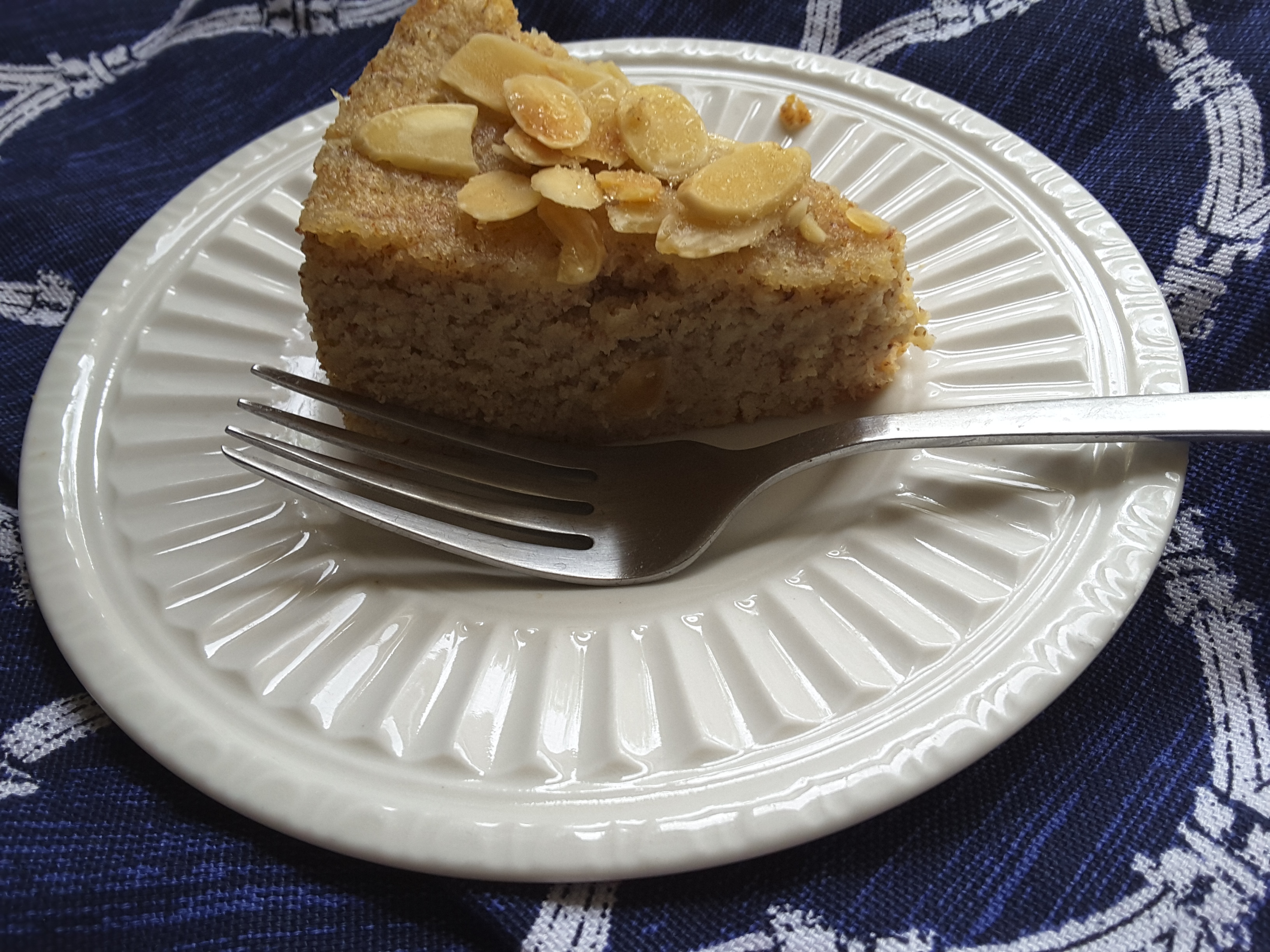
pear almond torte

When pears are good, at the peak of ripeness and aromaticity, they’re very very good, and biting into one will see the juice roll down your chin. When they’re not at their peak, or even when they’re frankly over the hill, you can still use them to advantage.

Slightly underripe pears slice thin and stay crisp in salads or on a cheese platter, something like jicama or underripe watermelon. They’re just barely sweet, not unctuous enough to upset the balance with a sharp vinaigrette or an aged cheese.

Ripe pears can substitute well in a variety of desserts for either apples (when still firm) or bananas (when very ripe, or even overripe and getting mushy).

And they lend a note of European sophistication to many desserts (and salads, and even main dishes) thanks to a dry aromatic twist to their sweetness–not exactly bitterness, more like something that plays well with the bitter notes of almonds, hazelnuts, bittersweet chocolate and dry red wine. These are flavors that don’t mesh as well with most apples due to their more overt sweetness and higher acidity, and probably not so well with bananas either due to the novocaine factor. (Although I’ve never actually tried to pair bananas with cabernet, I can just imagine it. Not promising.)

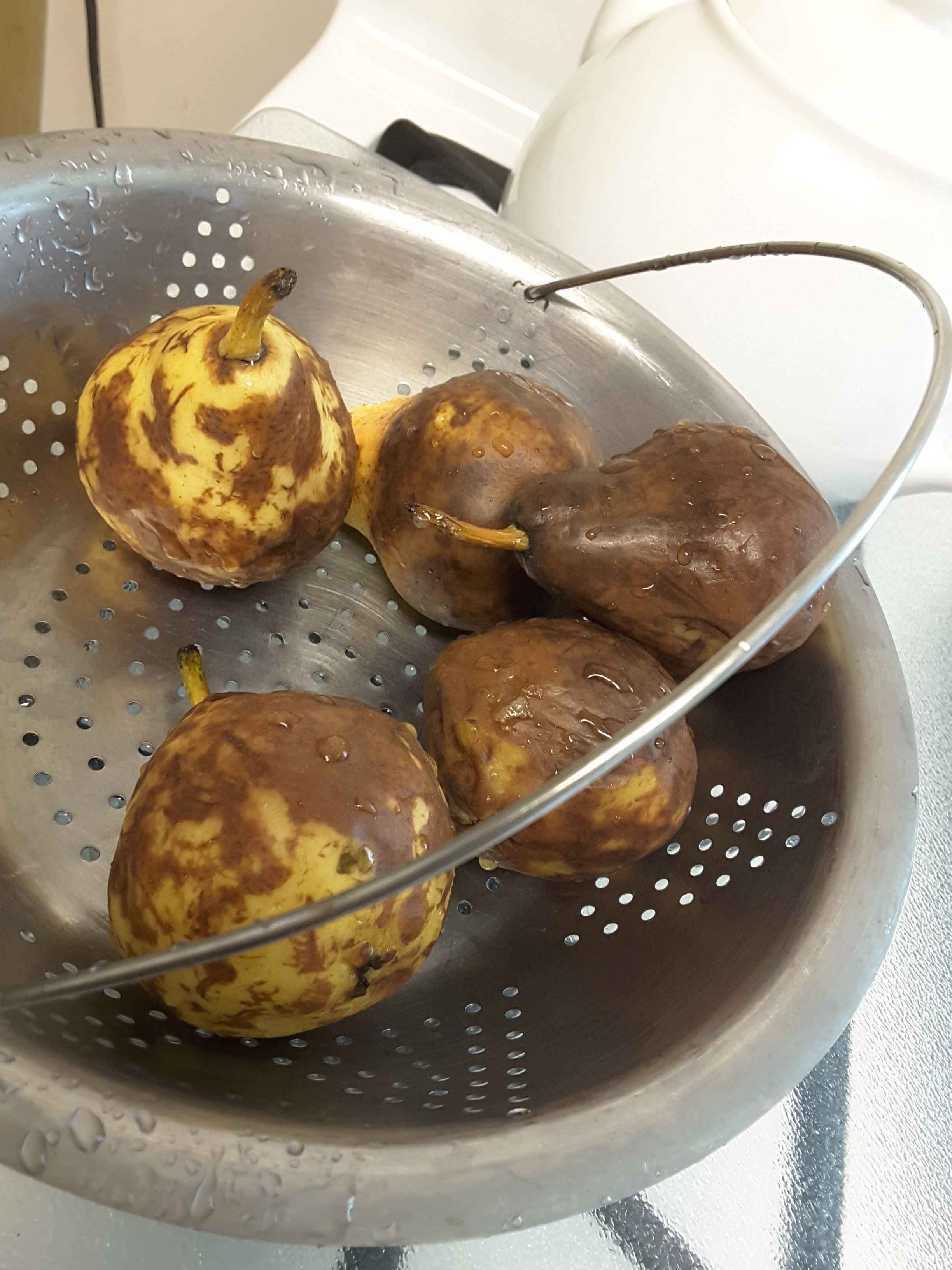
So even if you’re not a big fan of raw pears, the occasional bargain bag may be worth considering for desserts. If you can get them organic at a decent price, do, because pears are on the “dirty dozen” list for absorbing pesticides. Trader Joe’s sells bags of 6-8 small to medium (3.5-4 oz.) organic pears for about $3 at this writing. But what if, as happens occasionally, the child who insisted she wanted them instead of apples yet again has eaten two, and the rest have sat neglected in the fridge for long enough to turn?

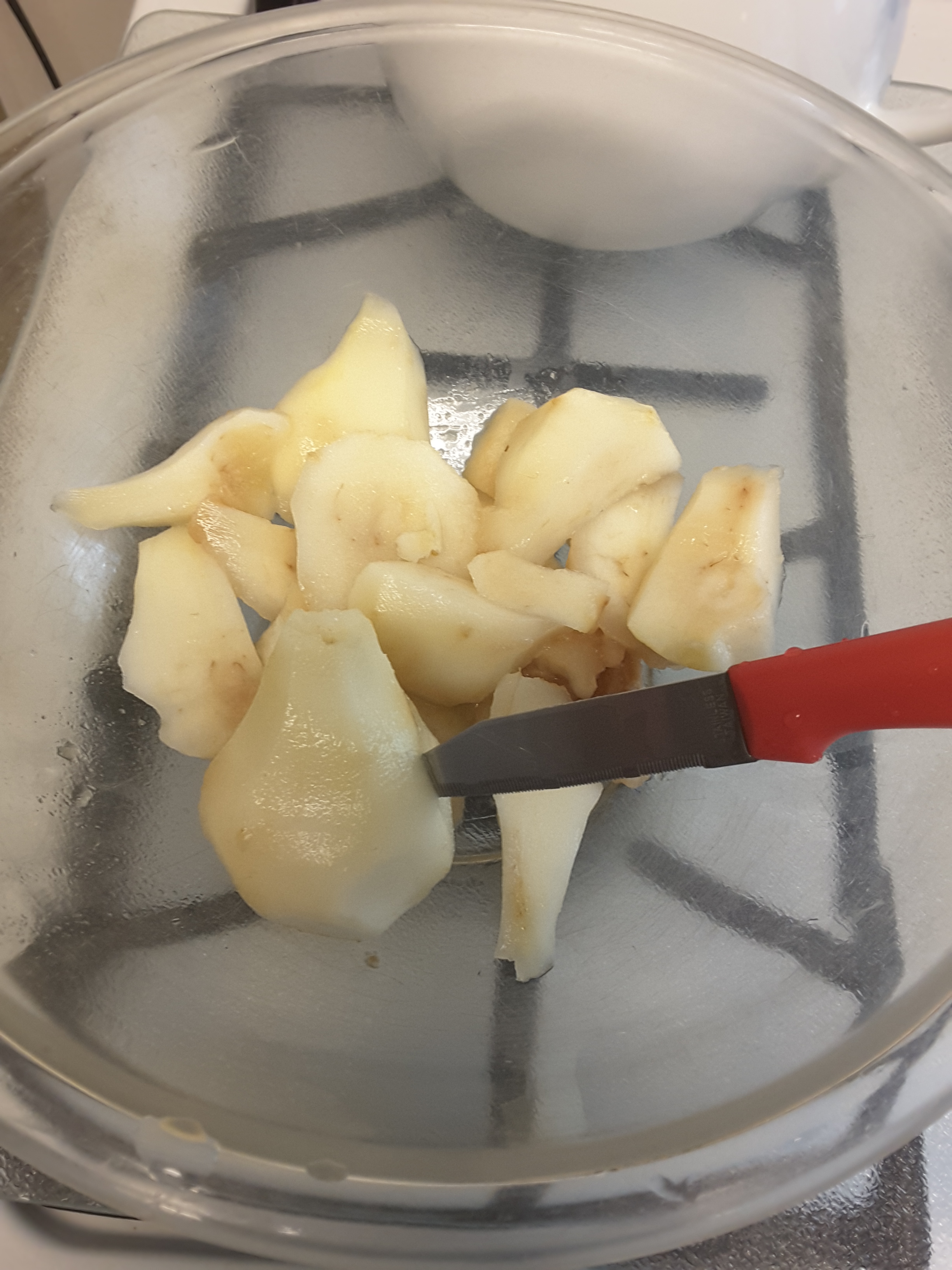
Overripe pears don’t look very nice on the outside and may have gone bland and/or brown, but they’ve still got what it takes if you peel them and cut away actual bad spots. If they’re only a little overripe and still flavorful, use them for a sorbet or microwave them for a minute or so to turn them “micro-poached.” If they’re really soft and going brown, peel and core them, remove all the brown bits and then mash or blend them as you would ripe bananas to give body and moisture to a cake or torte.

Here are two easy microwaveable desserts that use ripe to overripe pears and are Passover-worthy but can work anytime.

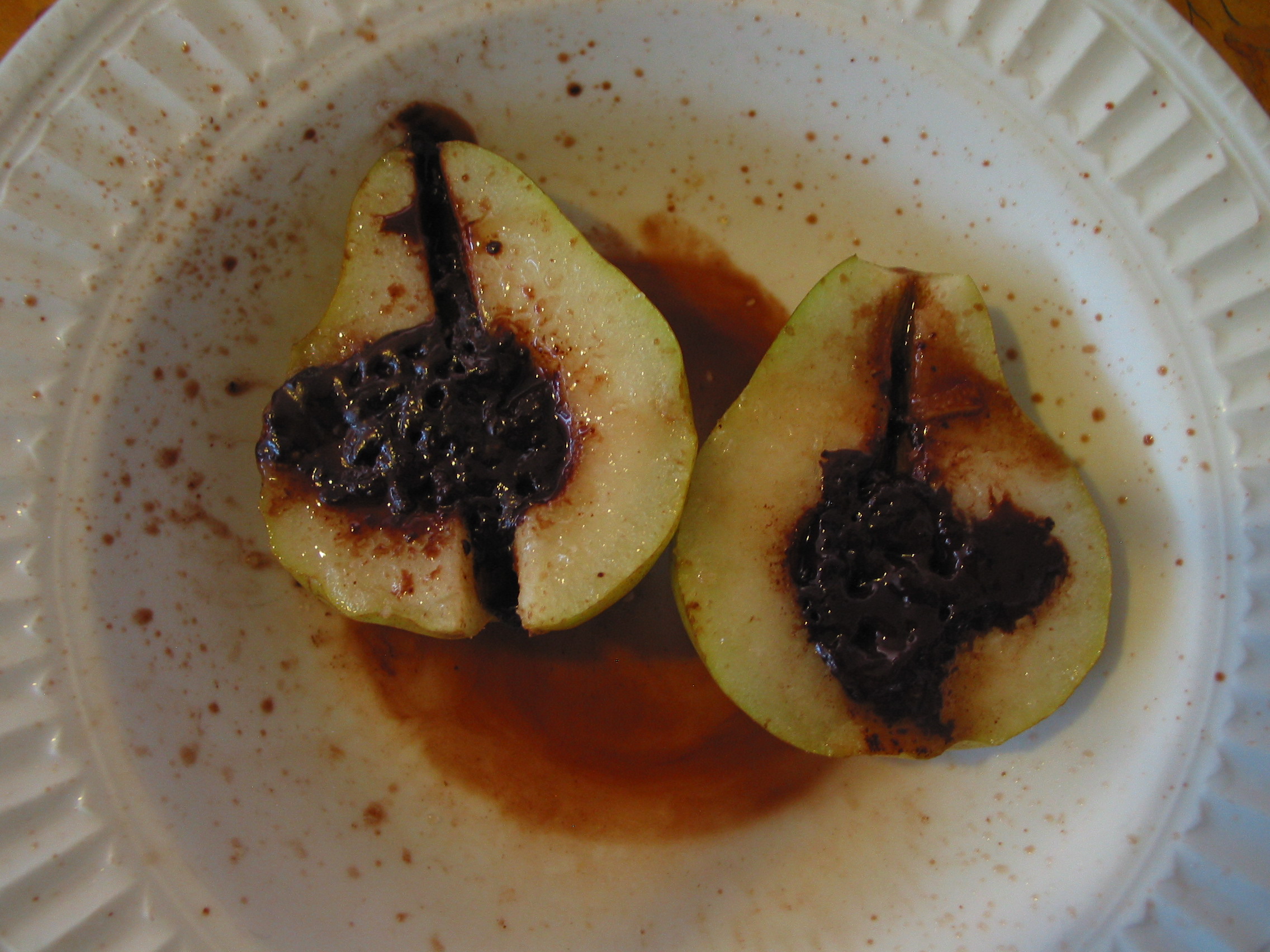
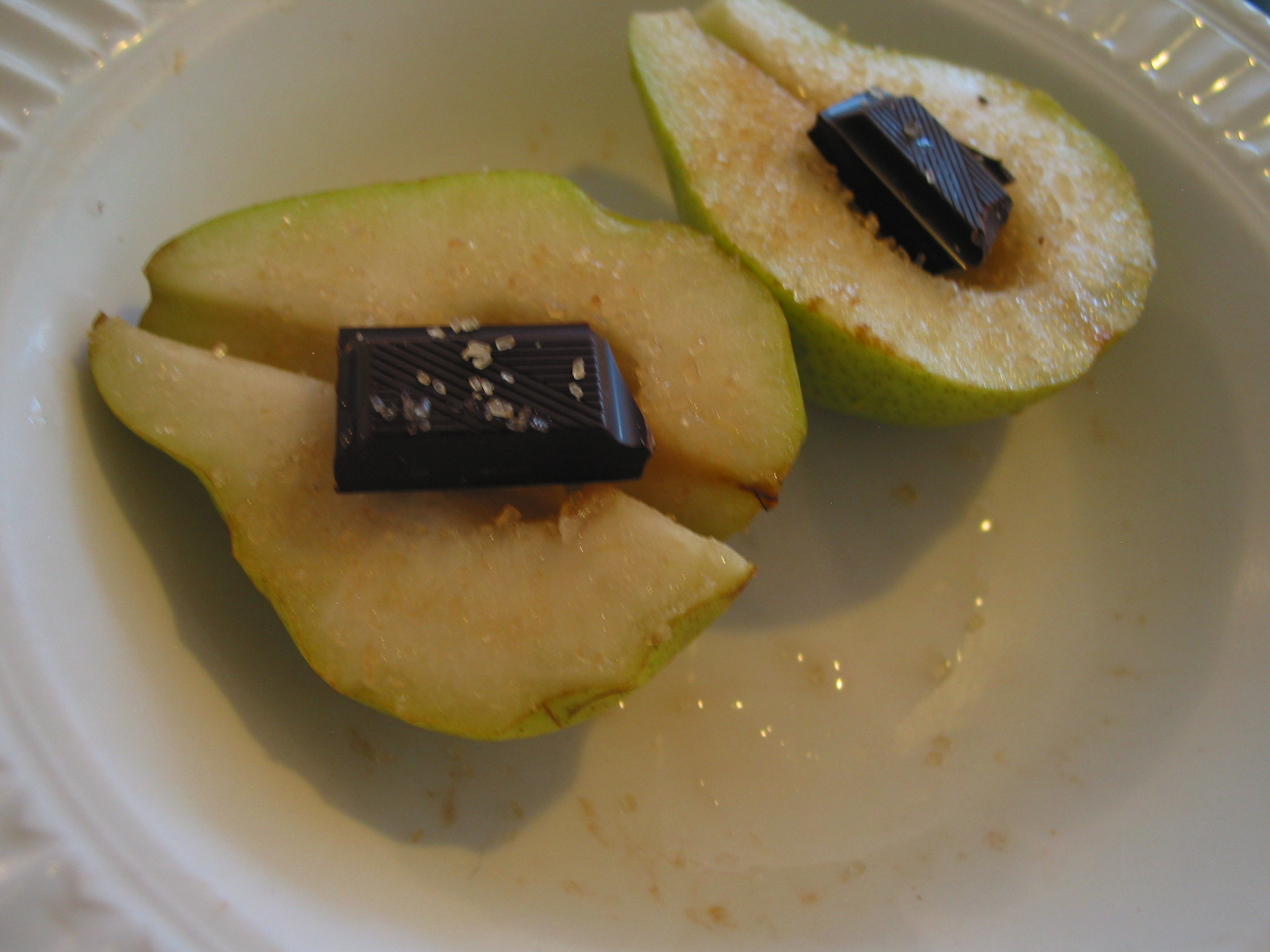
microwaved pear with chocolate

Micro-Poached Pears with Chocolate

This one’s very fast and impromptu–make just one pear or a few at a time and add a little time just as needed.

It can be hard to find chocolate that’s labeled kosher for Passover. Depending on your level of observance, consult the Orthodox Union’s Passover Guide, which changes year to year but  lists brands with kosher certification or acceptability even without a mark. If you eat kitniyot (beans, legumes, corn and peas, some spices, seeds and nuts) you can probably eat most chocolate that contains soy lecithin and vanilla. If not, look for the specially marked Elite chocolate bars that are kosher certified for Passover–for the Orthodox Union in the US, it’s the regular OU symbol (a capital U in a circle) but with a capital P superscript at the right. Other kosher certification at the Orthodox level is most likely to be the Hebrew letter kaf and/or a paragraph of Hebrew text naming the certifying rabbinical authority and location, sometimes with a circular seal containing the text (usually this is if it’s an Israeli product). There may be other certified or acceptable chocolates made with vanilla beans rather than extract (or without vanilla at all) and without lecithin–some of the high-end organic brands, for example.

  • Ripe to very ripe pears
  • Dark chocolate, your preference for cocoa percentage, brand, etc.
  • optional: turbinado or regular granulated sugar, cinnamon, powdered ginger etc. for sprinkling (check the OU site if you need to; regular granulated sugar is certified as-is but brown sugars aren’t always, and ground spices need to be certified for Passover)

Wash the pears, split in half and trim out the seed core and stem threads.

Lay the halves face up on a dish or plate that can go in the microwave. Place a square of chocolate on each half about where the core was.

Microwave 1-2 minutes per pear, just until the chocolate starts to melt and bubble and the pears are tender. Sprinkle with turbinado or other sugar and spices as desired before or after microwaving.

Eat with a knife and fork–add blackberries or a dollop of yogurt on the side if you want. Let it cool a little before digging in–I’m never that good and the roof of my mouth sometimes suffers for it.

Making the best of bad pears

The second recipe is yesterday’s riff on the Banana Ginger Almond Torte (from the I can haz cake?! Passover breakfast menu scheme…) crossed with my lightened-up version of Nigella Lawson’s “Damp Apple Almond Cake.”

five overripe pearstrimmed pears

Only, obviously, I had 5 small way-overripe pears to deal with. Brownish to quite brown on the outsides. But good enough inside to yield about 1 to 1 1/2 cups of pear once they were trimmed. And the result was seriously delicious.

pear almond torte slice

Continue reading

Passover mid-week: what’s for lunch?

With the best will in the world, there is only so much matzah anyone really wants to eat in a day. Even whole wheat. Yes, it’s crunchy. No, you don’t have to run the toaster oven. Yes, you should eat something else, and not just macaroons or gefilte fish from a jar. Or more hard-boiled eggs. Yeesh. Something lighter, please.

Salad

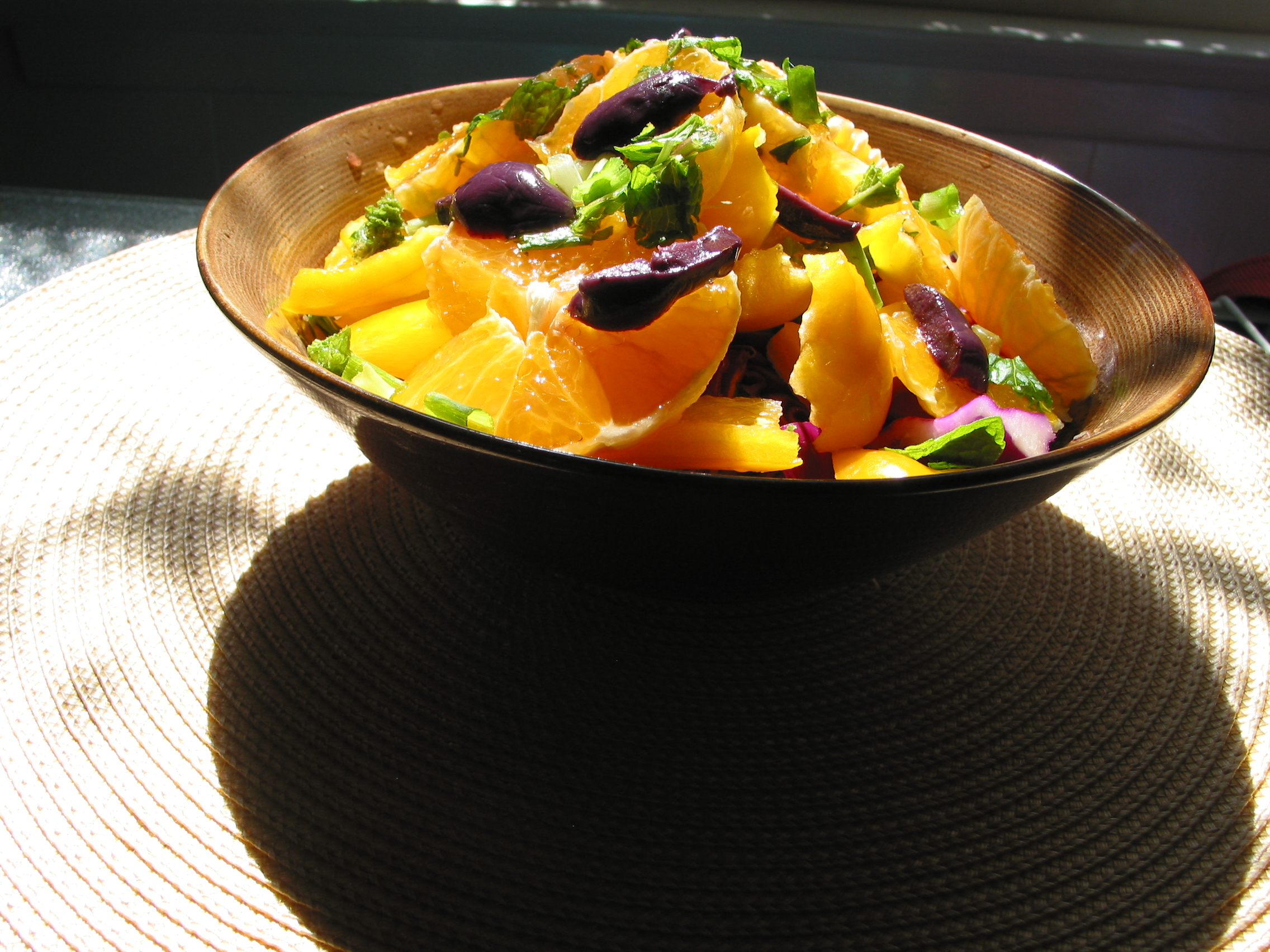
If you can get tomatoes of worth yet (it’s been a pretty long winter across much of the US), cut up some tomatoes and cucumbers, some red bell pepper, splash a bit of olive oil and vinegar on, maybe some Greek yogurt, some dill or basil, a bit of scallion and some feta or an olive, If good salad veg is scant but you can get cabbage, shred it and toss with some fresh or dried dill, thyme or oregano, maybe mint, oil and vinegar, a bit of lemon juice if you’ve got it, a couple of Greek-style olives. Or make a mix of oranges–slice them and serve with vinaigrette and lettuce or chopped cabbage, maybe a scallion and an olive or so, to brighten the last of winter and the first of spring.

Microwave melts and other vegetable and cheese combos

My standard eggplant microwave “melt” combo, with peppers and/or artichoke hearts and mozzarella/feta sandwiched between two slices of microwave-steamed eggplant. Salsa or shakshouka or even plain tomato sauce if you’ve got it, but jazz it up with hot pepper flakes and/or smoked paprika, or if you don’t have sauce then at least some hot pepper flakes, paprika, and basil or oregano–something.

Fish

Tuna salad is pretty classic, obviously, even though if you keep kosher it means scouting out kosher-for-Passover mayonnaise, making your own, or using plain yogurt instead (my current preference; my experience making mayo from scratch is more vast than I care to admit, and I don’t even like the stuff).

But if you have leftover cooked fish, especially tilapia or salmon, or you’re willing to cook a pound of it specifically for a batch of quick fake-smoked-whitefish-style fish spread, go ahead and microwave it a couple of minutes until cooked through, then drain off the liquid and mix with fat-free plain (!!!) Greek yogurt (add cautiously by spoonfuls so you don’t get too much and make it gloppy), plus or minus tehina if you eat it at Passover and like it, plus some lemon juice and grated or finely chopped onion or scallion, a bit of garlic and dill, and either a couple of drops of liquid smoke or a good dash of smoked paprika, with salt just to taste at the very end. Let it chill and it’ll solidify a bit overnight in the fridge. Good again with Greek olives and some salad (and okay, a little–but only a little–matzah). If you’re going for a meat meal and want to keep it nondairy, do a little more lemon juice and some olive oil as the binder and leave out the yogurt.

Fake-smoked tilapia salad on matzah

Fish Salad Rellenos?

But you can take it further, as I discovered. I’ve never actually loved gefilte fish, and even though Joan Nathan swears that fresh homemade gefilte fish is much better, I have chosen all these years not to believe her because it’s a big to-do and an even bigger mess, plus all the matzah meal and eggs mixed in–it’s basically a fish meatloaf full of stretchers. No. In my book, if you can get real fish, you should eat real fish as a main course and treat it with respect.

Leftovers, maybe, if you don’t just want to eat them straight–but not with yet more matzah and eggs. For crying out loud.

And all leftovers have to be good enough to eat on their own merits. Whatever you do to them should improve them or at least not degrade them.

I live in warm–sometimes way too warm–territory near Los Angeles, so the Armenian and Latino corner greengrocers always have good veg for cheap. Both are into peppers of varying shapes, sizes, colors and burn factor, a plus in my book. Passover can really use a hit of ta’am (flavor) and some vegetabalia to go with it.

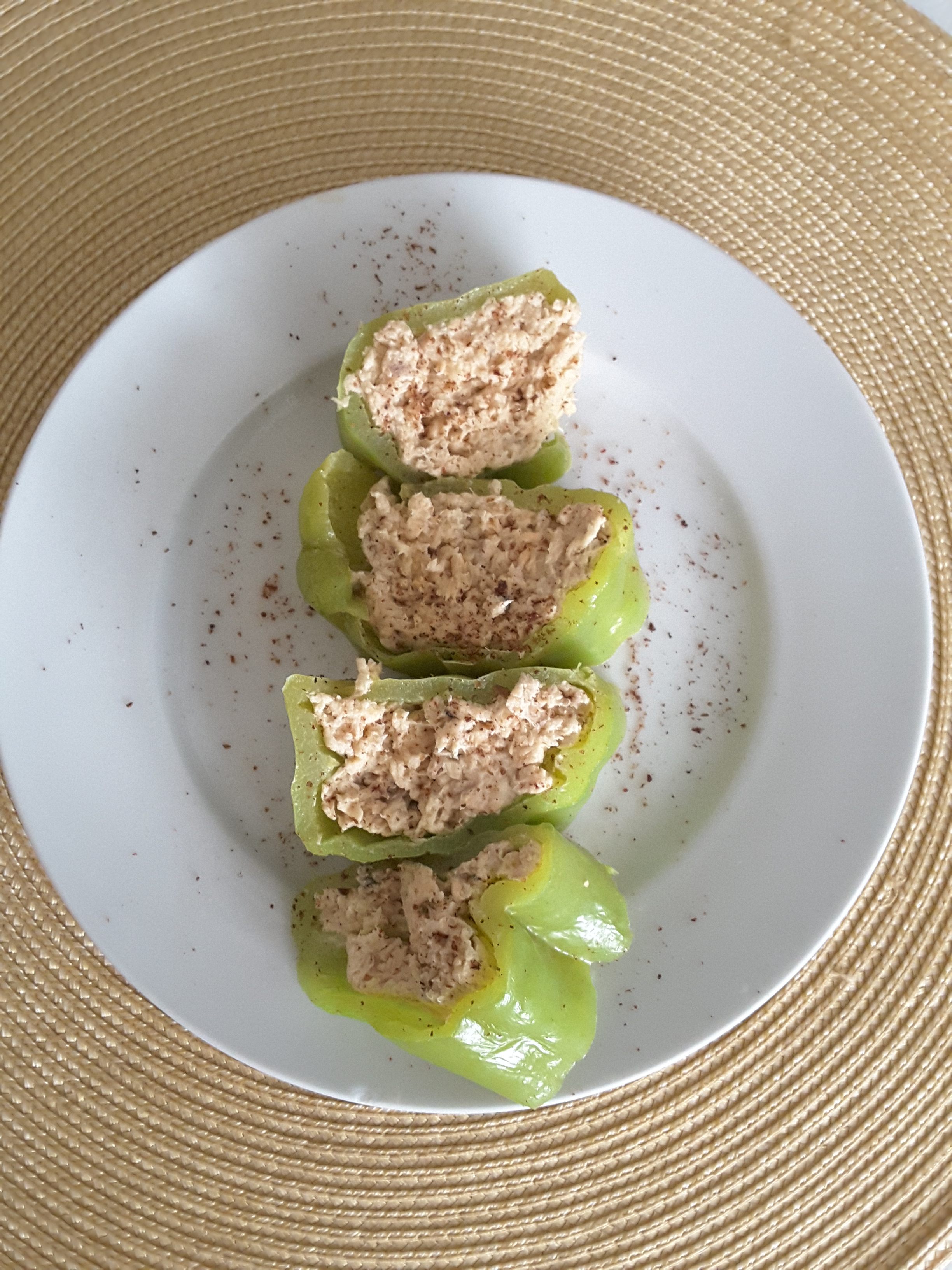
A bag of Hungarian peppers–pale green, mostly-mild, thin-walled, good for quick-pickling–was going for 50 cents a pound this week, and they’re long like Anaheims but nice and boxy at the stem end, not flat, so they’re easy to core and stuff without parcooking first. Fill them with the fish salad, I discovered, and you can microwave them a couple of minutes on an open plate or in a snaplock container with a lid until the peppers are cooked just to tenderness on both sides. I sliced one of them crosswise into inch-thick pieces and got this:

salmon-stuffed peppers

A decorative sprinkle of smoked paprika over it and not only was it good for a hot lunch, it would also be a quick and pretty southwestern take on gefilte fish as an appetizer, one or two slices per person, without all the traditional filler or grating and boiling and carp in the bathtub and so on, but with some actual flavor and freshness.

B’te’avon (bon appétit, mangia bene, eat nice) and Chag Sameach (happy Passover)!

A Microwaveable Passover, 5778 (2018) edition

Spinach matzah balls in the microwave

No matter how many times I vow I’m not going to work too hard this year, I always end up cleaning the fridge some time in the small hours the night before Passover, swearing creatively to get all the vegetable bins and shelving back in the way they came out. Between packing out the unkasherable dishes and appliances like the toaster oven, shopping for the week, and kashering the silverware, dishes and pots for Passover, it always ends up about 5 to 6 or so in the evening before I can actually cook.

Passover started Friday night, and it was just us at home this time around for the first seder. So I didn’t have to make a huge menu, which was good. Because I did have to kasher the kitchen–starting after a 3-hour stint at the DMV (my third this month) to help my kid finally get her learner’s permit. Type I diabetes throws a monkey wrench into the proceedings and requires extra time, paperwork, and hocking to make sure one office actually sends the other office the fax within your lifetime…so it was a bit on the late side that I actually got to start, and by the time sunset rolled around, I was kind of wiped and ready to skip it. Not a great frame of mind for experimenting in the kitchen, certainly not that night. Although the fridge IS still astonishingly clean and sparkly.

We don’t always get fully past the rush to the enjoyment of the seder, especially those of us who are doing the cooking. But the first bite of parsley dipped in saltwater always signals the start of the holiday for me, and the first bite of matzah tastes like freedom. (The thirty-fifth bite or so, perhaps not so much…)

By now I’ve played around enough to have quite a number of simple Passover-worthy dishes that can be microwaved, some of them start to finish. That can be handy when you’re either short on cooking time after getting home from work on Friday or just short on patience and yet you still want to do a simple–but still nice–small seder. It might even provide a save at least for the side dishes if you’re doing a bigger one.

Some things you can’t help cooking on the stove–hard-boiled eggs for the seder plate and for the table of hungry guests.  And some things like charoset take some hand work to chop if you don’t have a food processor around.

However.

Even if you’re serving something long-cooked like chicken or brisket as a main dish, a couple of easy microwaveable vegetable dishes, appetizers and desserts–even soup–might benefit from not having to compete for stovetop and oven space, particularly if a heat wave is headed your way. And microwaving reaps big benefits for reheating or supplementing leftovers quickly during the next several days if you keep kosher for Passover, or even if you don’t.

Vegetabalia

Fresh vegetables really matter for Passover. Salad, yes. It’s spring, after all (even though my mother said they were expecting another snowfall this week in Boston). And also cooked greens. I’m a big believer in microwaving them lightly and last-minute wherever possible, so that they’re just-cooked, fresh-tasting and still green when you serve them–at least, if they’re supposed to be green.

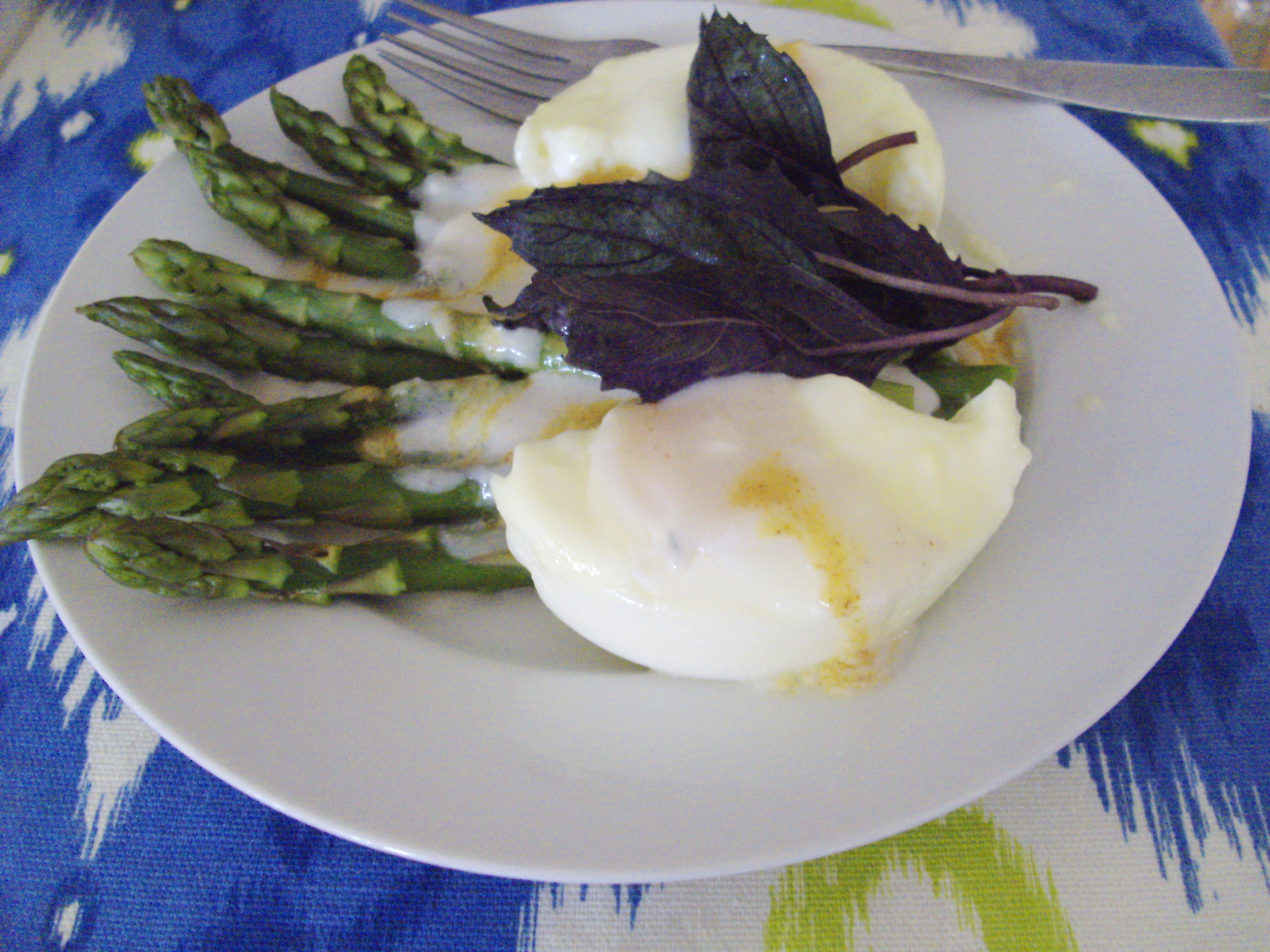
microwaved asparagus with a poached egg

Lightly-microwaved asparagus stays green even the next day. It’s good either cold or reheated with light vinaigrette and a poached egg (regular or microwaved) and some basil or other spring herbs.

Asparagus is traditional, and as long as you don’t abuse it the way my mother [probably] still does, by boiling the regulation seven minutes, shocking in ice water, and then letting it sit around in the cold water for ages until the stalks start shredding into floaty olive-green kelp-like bits, because she’s too busy with the soup, and dinner’s not for another whole hour…..skip all that and microwave the stalks instead for 2-3 minutes and you can be a winner.

Snaplock containers that are about the same size as the amount of vegetable you’re microwaving make it easy to prep ahead and store raw trimmed, washed asparagus, broccoli, brussels sprouts or other greens in the fridge, ready to nuke and go. When you’re ready for them, just add a drizzle of water, maybe a quarter-inch, to the container, put the lid back on, shake once or twice over the sink (in case of drips), and microwave them 2-3 minutes for a pound–you can let them sit a minute or so afterward and they’ll continue to steam. If you’re doing 2 pounds in one container, double the time, but stop and stir gently halfway through so the less-cooked ones on the bottom get moved to the top, and keep an eye on it the last minute or so–that is, stop the microwave again and check with a fork for doneness–so you don’t overcook.

Once the vegetables are just fork-tender and still green, drain them carefully and either serve right away or take the lid off and lay it back on loosely with an  air gap–you can probably get away with letting it sit this way for 10 minutes or so without it cooling too much, and the veg will stay green. But obviously, it’s best to serve it fairly quickly.

Vegetables you plan to roast or pan-brown can get a very quick head start in the microwave before tossing quickly with olive oil, garlic and rosemary in a frying pan or, if you’ve already got it going anyway, the oven. The precooking definitely cuts down the browning time. Brussels sprouts, fresh fennel, new potatoes, carrots, and red squashes are easy to microwave with just a bit of water in the bottom of a covered container to help steam them quickly.

Not-Chicken Soups

Microwaveable not-chicken soups, good for a vegetarian, vegan, or fish dinner,  can be made ahead in a couple of minutes (well, 5 to 15, including prep time) and reheated. They’re also good to have on hand if you’re doing a big meat dinner with the standard chicken soup in a stock pot but you also have a few vegetarian guests.

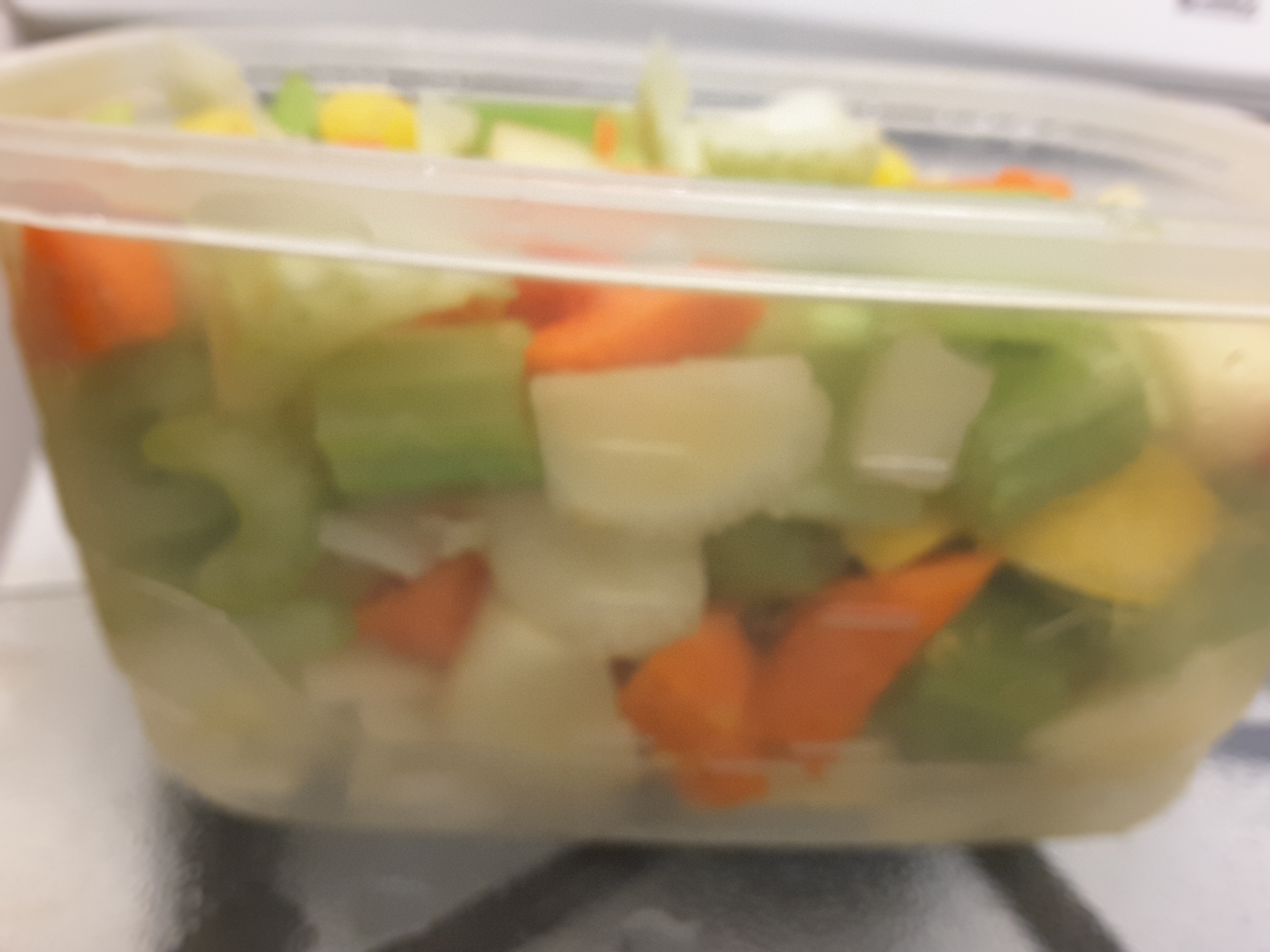
vegetables for microwaveable not-chicken soup

Basic not-chicken soup (about 2 1/2 quarts or 8-10 servings)

  • 3-4 full-sized carrots
  • medium or large onion
  • 4 long stalks of celery
  • drizzle/spoonful of olive oil
  • fat clove of garlic, minced, mashed or grated
  • handful of fresh dill or 1-2 T dry
  • 12-20 black peppercorns
  • lemon juice and salt to taste at the table

Fill up a 2.5 quart microwaveable bowl or container nearly to the top with chopped (bite-size pieces) vegetables. Stir in a spoonful of olive oil, and microwave-wilt the veg for 5 minutes on HIGH with the lid on. Add a fat minced or grated clove of garlic, a handful of dill and a few black peppercorns, plus water to cover and reheat another 5-6 minutes or until steaming hot, then let it sit with the lid on. Your soup will be pretty flavorful after letting it steep half an hour, if possibly a bit sweet (just one of those leftover mongo onions from last week’s “gifting” weighed a full pound on average). A squeeze of lemon and a dash of salt–not Campbell’s or Lipton’s level salting, salt-shaker-at-the-diner’s-discretion salting–and a grinding of pepper will work it out.

Pan-browned not-chicken soup

The pan-browned minimal carrot-onion soup is a little more hands-on, but very convincing and full-bodied. The basic setup is the same as for plain, but after wilting, pan brown the veg in a nonstick frying pan until you see actual browning, about 10 minutes. Add a grated or minced fat clove of garlic, a sprig of thyme, and a splash of white wine, and cook it down to dry. Put the veg back in the microwave container, swirl a bit of water around the empty pan to pick up the browning (i.e., deglaze), add it to the veg, fill the container up to the top with water, and microwave 5-6 minutes to heat, then let it steep.

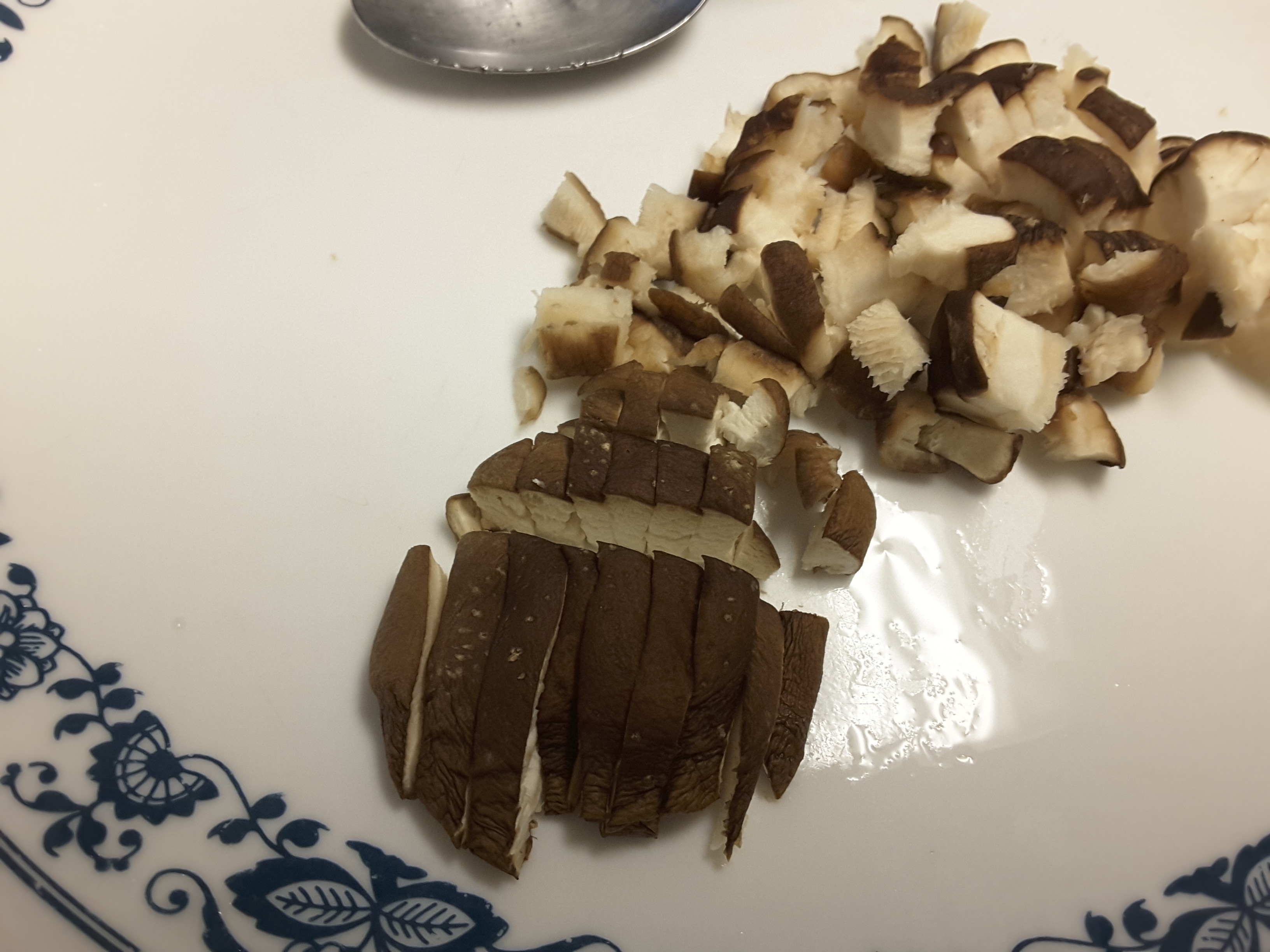
My current version (since I was gifted with celery as well last week) includes a couple of chopped stalks of celery with again, a very large onion. I also added in a bit of dill plus–chop ’em if you’ve got ’em–one or two finely-diced shiitake mushrooms, fresh or dried and soaked in half a cup of hot water,  for added not-chicken potency.

diced shiitake mushrooms

A squeeze of lemon and a dash of salt and fresh ground pepper at the table makes it even better than actual chicken soup. And you never have to skim any scum.

If you want to surprise people, go with bok choy broth but skip the soy sauce (contains wheat) and add extra shiitakes and fresh brown mushrooms, plus scallions, garlic and ginger. Use apple cider vinegar. We think sesame oil is fine for Passover but a lot of people don’t; it’s okay even without it.

Whatever soup you offer, keep the vegetables in. I never really understand the appeal of throwing out good veg just to have a 1950s-style “clear consommé”.

Microwave matzah balls?!

You can, actually, but not the conventional way, at least not in water to cover, mimicking the usual stovetop boiling. I tried it one afternoon last week just to see, using the classic back-of-box recipe just to be sure (I try these things so you don’t have to…). Continue reading

Last-Minute Sweets for Rosh Hashanah

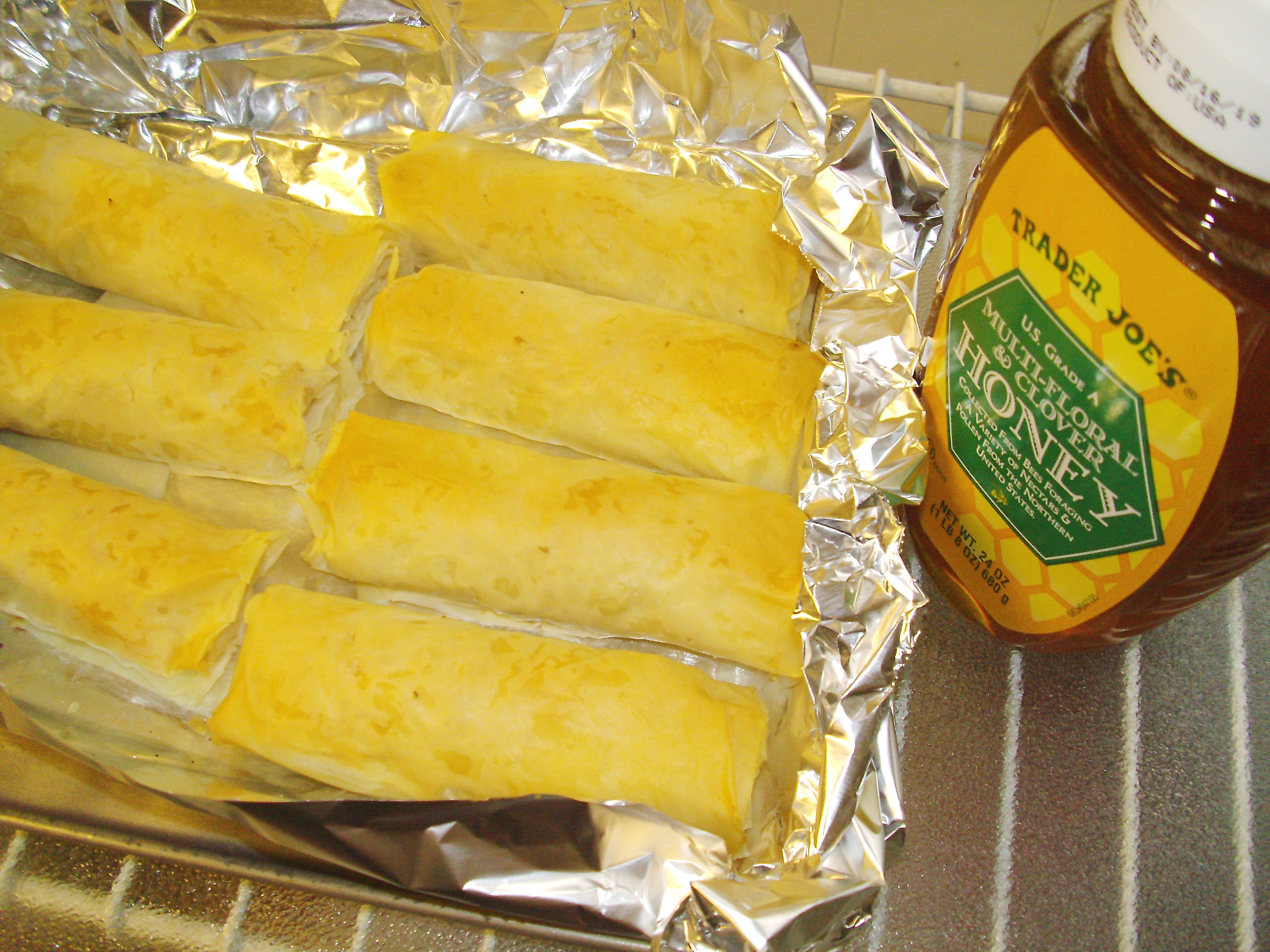
toaster oven baklava rolls with honey

A quick last-minute wish for peace and a sweet and prosperous New Year to everyone. I know it doesn’t look that likely, between the physical and political versions of “weather” in the news, but I try to remember that it begins with us in our own neighborhoods and that we can make a difference by our own actions. If you haven’t yet, please make an effort to donate aid–even a couple of bucks–to the victims of Hurricanes Harvey, Irma and Maria and to the victims of the earthquakes in Mexico. If you have neighbors and friends waiting to hear from loved ones caught in these disasters, do what you can to support them.

In the meantime, if you’re stuck for a last-minute dessert that works along the theme of “honey”–try baklava. I’m not actually kidding–if you have a toaster oven (for smaller amounts, 7-10 portions) and a microwave, and you have the makings of baklava (a roll of fillo, a bag of walnuts, some sugar and sweet spices and some butter or light-flavored vegetable oil), plus a bottle of honey, you’re in business. Of course, you could do apples instead of walnuts and make a strudel instead–also good and pretty easy. Peel and slice up or chop the apple (s), stick the pieces on a plate and microwave a minute or so to cook through and drain the juices before sprinkling on sugar, spices, and crushed nuts or breadcrumbs and/or raisins, and rolling up in fillo.

Toaster Oven Baklava Rolls

These are kind of like “ladies’ fingers” Moroccan fillo pastries, only with walnut filling rather than almond paste. Rolling individual fillo sheets is easy and a lot  quicker (and more fun, frankly) than layering several sheets flat and neat and then cutting pieces and baking and pouring a big jar of cold syrup over the hot pan. Plus the traditional syrup soak is a huge overload of sweet that’s admirable in its own odd way but very rich and hard to deal with–very sticky–right before you have to head off to synagogue. This is kind of a modular recipe–make just a few rolls if you feel like it, drizzle a bit of honey over the rolls at will.

  • roll of fillo dough , thawed (uses 1 sheet per roll; if you have extra left over, rewrap carefully and store in the fridge or freezer)
  • about 1 ounce walnuts per roll (I used about 6-7 ounces for 7 rolls)
  • 1 T sugar per 3-4 oz walnuts (I used 2T)
  • cinnamon or ground cardamom, about 1/2 t for 6-7 oz walnuts)
  • 1 t orange blossom water, optional, or orange or lemon juice or rind–you don’t want the mixture wet, this is for aromatic flavor
  • 2-3 T butter, melted, or vegetable oil, or a mixture, as needed
  • honey to drizzle over the top once baked, about 1/2-1 t per roll
  1. Slice the butter thin and melt in a ceramic or other microwaveable bowl, about 2 minutes.
  2. Put the walnuts in a plastic bag with some room and roll over them with a rolling pin or wine bottle to break them up fairly fine with a few 1/8th-1/4 inch bits, or if you feel like it, chop them in a food processor, not too fine. Add the sugar, spices and orange blossom water or juice to the bag and mix them into the nut meal.
  3. Unroll the fillo carefully onto a clean flat surface (lay down plastic wrap first as needed).
  4. Put a plastic sandwich baggie over your hand and dip it lightly into the melted butter. Dab on the top sheet of fillo.
  5. Fold the fillo sheet in thirds lengthwise. Grab a small handful of the nut mixture (2 T-ish), squeeze, and place at one end of the fillo strip. Tuck the side edges over it by 1/4-1/2 inch, then roll the end over and around the nut filling to enclose it. Dab a bit more butter on the rest of the strip and roll it up. Place on tin foil. Repeat with the rest of the fillo sheets until you run out of nut filling. If you run out of butter or oil, you can slice a bit more to melt quickly. You don’t need much per roll and the sandwich baggie should help spread it without absorbing any.
  6. When all the rolls are made, dab the last of the butter or oil on the tops, wait a minute to let it sink in a bit, and place the sheet in a toaster oven (or your regular oven preheated to 350F). For the toaster oven, set to bake on 350-400F, not “toast”, for about 8-10 minutes and keep an eye on it so nothing burns.
  7. Bake until the rolls are a deep golden brown and smelling baked. Remove from the oven, cool and squeeze on a drizzle of honey to taste–about half to one teaspoon per roll is enough for flavor without submerging it in syrup.

Baklava rolls browning in the toaster oven–don’t forget to set the temperature a little lower than for toasting so the tops don’t burn

L’Shanah Tova Tikatevu!

Finding heart

Right before the inauguration, a woman I didn’t know wished me a happy new year as we passed each other in the library. Something about the cautious way she said it made me wish it back to her with a wry twist we both acknowledged: neither of us felt we had much to look forward to in the coming administration, and both of us were worried for our families, our children, our community, ourselves. “We’ll keep on,” she said and I nodded. Both of us were a little grim.

And although it’s spring and Passover started Monday night, I am still a little grim and on standby. Every so often I feel a bit lighter in spite of the news, but to tell you the truth, I still often feel like hiding under a table. With a big tablecloth on it. In another, better, saner country. I kind of wonder if Iceland’s available. Are there Jews in Iceland? I hope so. Do they have enough matzah? I could lend them some…

But it’s spring. You can’t just hibernate for 4 years (or 2, hoping for a reversal in Congress in 2018 and a brain transplant for pretty much everyone in the White House, starting not with Trump–may not be possible–but perhaps Spicer? no, again, not possible–stick the oversized bunny suit back on him, make him hop around the WH lawn–would you be able to tell the difference?)

Ahem! As I was saying, you have to get back out there and see how your neighbors are faring and talk to them. If you’re not naturally extroverted and you work alone (double-ahem!), it’s even more important to take a breather and reconnect in the real world.

Despite my wariness about the immediate future of American government and my repeated incredulity at the daily headlines, there is reason for hope in this country. All kinds of people, business leaders and employee groups, religious leaders and congregations, public officials, judges, entertainers, and most of all, ordinary citizens have started speaking up and donating money and time to support the safety and rights of threatened and persecuted minority groups, whether their own or someone else’s. Citizen or not. Same religion or gender or race or not. California’s not the only place where this is happening. If it can happen in North Carolina, in Kansas, in Pennsylvania, in Texas–it can happen anywhere.

These surprising oases of sanity, civil contribution and decency give me heart that we can take steps in our own neighborhoods and states to protect the progress and community we’ve recovered since 2008.

But I do have to ask, is there really still room for a food blog like mine? Is this what I should be doing this year? Can I help anyone by talking about food and trying to seek pleasure in it when we’re all worried about bigger things? It’s taken me four five whole months to get to the point where I can say I think so.

A few weeks ago, still wondering, I went to Shabbat services for the first time in a while and tried hard to find heart and figure out what to do with it. And I did. I looked around at my neighbors and friends, I joined in the prayers and singing, sat with my husband, said kaddish for my brother and father and grandmother, whose yahrzeits all fall in the same week, got an aliyah, heard my daughter chanting the longest possible maftir in the book (usually we’re tawkin’ 3 verses at the end of the Torah reading, this time it was 20-plus). I found myself thinking both how proud I was of her, how beautifully she sang it, and how rusty my Hebrew reading had gotten through neglect these past months.

Being with my community and my family, seeking something not posted in the daily news headline deathspiral, put me in a more expansive frame of mind.

I decided not to let the current occupants of the White House and their make-America-hate-again tactics continue to ruin my or my neighbors’ life and drain all the color out of our days. I decided not to hide under the table–it was too much like duck-and-cover, and that’s only good for ducks, and only if it’s Wabbit Season.

We can be better and more powerful together than our current representatives in Washington think. Although I would personally like to thank MY congressional representatives, Judy Chu and Adam Schiff, as well as my senators Kamala Harris and Dianne Feinstein. Keep doing the right thing, and Chazak v’Amatz (strength and courage).

Living well and supporting each other is the best revenge.

(Chasing recalcitrant rightwing congressional reps down with pitchforks or at least cellphones at various town halls and telling them to do their jobs is starting to be tempting too, don’t get me wrong. Plus it’s aerobic.)

So anyway, back on track. Because Civility 101 demands community, and community includes good food. Even if it occasionally has to be served up with a pitchfork. And, as I mentioned somewhere up in the wilderness above, it’s Pesach. Time for a taste of freedom.

Passover Links

Passover Pareve, Eggless Chocolate Torte (Sacher Torte) with Dairy-free Ganache

Assorted Passover cakes (apple/almond, banana ginger) and breakfast schemes

Macaroons, mandelhorns and almendrados

Homemade Horseradish (but I’m not bitter)

Not gefilte–better fish options

Microwave shakshouka

Not-chicken soup

Israeli spinach-feta casserole

How to fly with a pie

Happy Chanukah–tonight was the first night–and as per usual, a belated Happy Thanksgiving too. I hope everyone ate nice, had fun, enjoyed and helped do the dishes wherever you gathered.

Now that it’s over, I have a few more additions to the list of things I’ve learned–good or bad–about How To Travel With Food ™. Because my in-laws, who usually host Thanksgiving, are traveling in Africa (!!!–think elephants coming up to their cabin porch), my ex-brother-in-law invited all the rest of us to join him for the weekend instead. In Sonoma. At what turned out to be not a cabin with or without elephants, but a luxurious private residence he’d booked for the group as a vacation rental. And it was out and out marvelous. If a little weird and unsettling in its own way.

Sonoma-Kenwood.jpg

When we were still deciding how to reach Sonoma from Pasadena, we realized with dismay that it’s about 10 or 11 hours by car at the best of times, and Thanksgiving week is not the best of times. When we lived on the east coast, a trip like that would have us thinking airplane automatically, but out here we usually just suffer. My niece and her boyfriend drove up from San Luis Obispo, usually 4 hours north of us, and it took them 9 hours instead of 5 or 6. So I was really grateful to my husband for finding affordable plane tickets for an hour’s flight into Oakland. So far, so good, and it took a lot of the strain out.

But all those airline rules. And we were the ones bringing pumpkin pie. In carry-on. My ex-BIL offered to pick up a couple of big stalks of brussels sprouts for me up there (I don’t think we even had any more at down here by this time; Trader Joe’s was out of them by weeks) as well as a green cabbage for Greek cabbage salad. These are big heavy scary-looking items you just don’t want to schlep on a plane unless you’re auditioning for the live version of Shrek. As the shopping list got longer, I decided to just bake the pies at home, cool them, freeze them as far as possible, and take them in a stiff box with some ice packs stuffed in the corners and hope for the best.

Continue reading

Persian Posh and Jewish Soul: Two Veg-Friendly Cookbooks for Spring

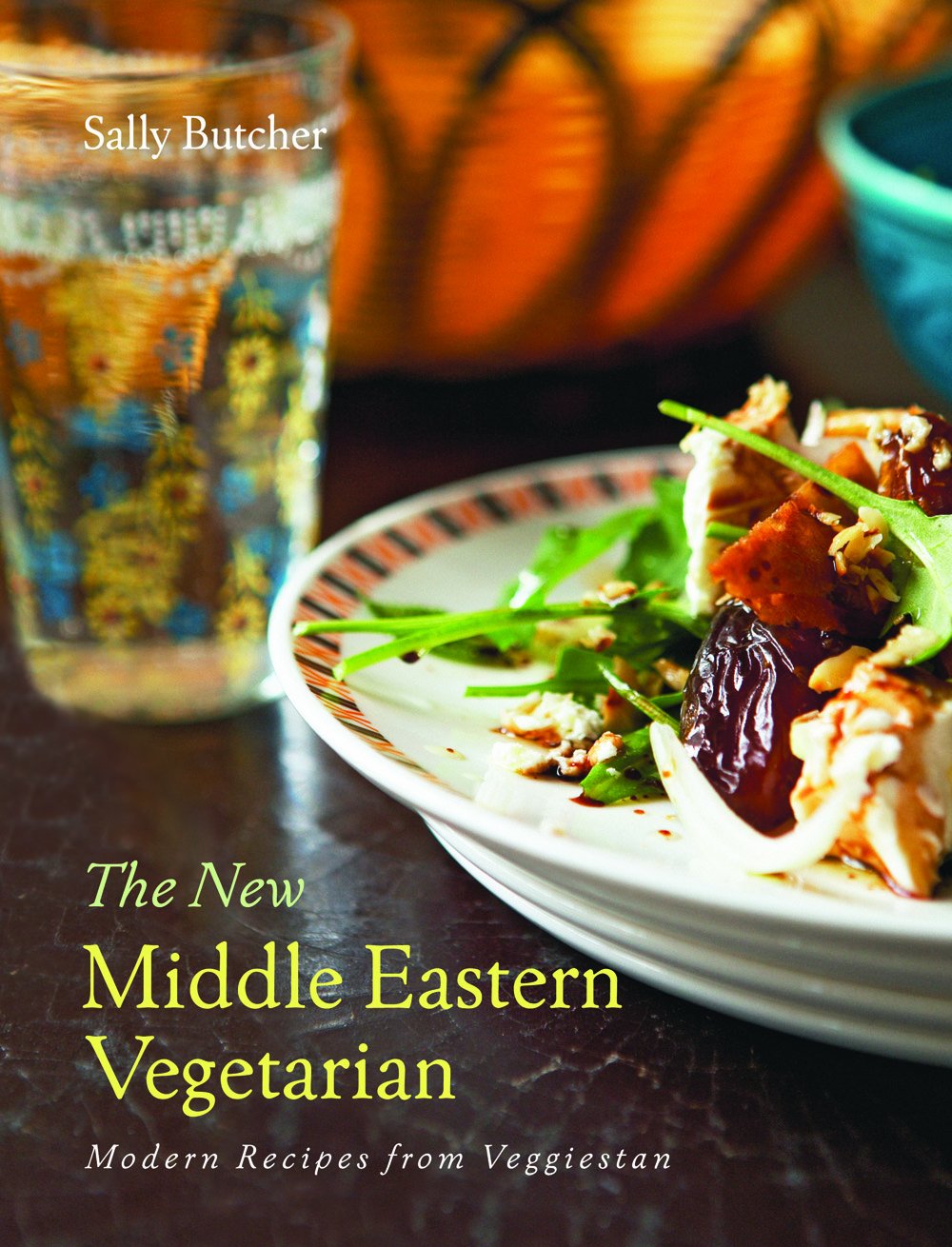
"The New Middle Eastern Vegetarian" (aka "Veggiestan" in the UK) by Sally Butcher, cover photo from amazon.co.uk "Jewish Soul Food: From Minsk to Marrakesh" by Janna Gur. Cover photo from amazon.com


Passover week didn’t exactly go the way I’d hoped, with loads of new vegetable dishes to play with and experiments in microwave gastronomy that would wow the most cynical reader…

After the optimistic start with the chocolate almond torte and the microwave shakshouka for one, I suddenly caught a bug–my husband caught it first, suffered a day or so, got better and then kindly passed it to me, and I ended up sick for the better part of the week. We all agree we got it from a kid he was sitting next to at seder. Now that our kid’s a teenager, we’re no longer used to it. Clearly we’ve gone soft.

So I was–shall we say–less than enthusiastic about cooking the last week or so, and ended up with lots of ideas that stayed in my head while I stayed in bed, attempting to keep up on tea, rice, poached eggs and applesauce. And feeling really embarrassed that every time I opened the fridge and saw all the beautiful vegetables I’d bought for the week, I peered at them suspiciously–how much trouble would they cause me? Was it really a crappy virus or was it maybe secretly food poisoning, even though everyone else was able to eat? Maybe tomorrow–and closed the fridge door again and groaned. It took a couple of extra days to start looking at vegetables with any enthusiasm at all.

This, I thought, is what most of the country thinks about fresh vegetables if a dolled-up superstar chef isn’t holding one on the cover of a glossy magazine (or even if he is). Maybe with a little less queasiness or dizziness than I experienced, but with that lurking suspicion that vegetables have dirt on them, that you have to wash them off and then cut them up and do something to them, that they’re not sterile and wrapped in plastic for your protection, and that it’s all too much bother. What a lousy, paranoid way to live.

So anyway, now that I’m better the vegetables are looking good again, and the (four or five) leftover matzah boxes have been relegated to a top shelf for sometime when I’m not sick of them and want to experiment a bit for next year.

Two bright and sun-filled new (or newish, anyway) cookbooks that make lavish and hearty use of vegetables were languishing on my desk for the entire week of Passover (and two weeks before that, when I was too busy to do more than look at them wistfully). Sally Butcher’s Veggiestan is a collection of pan-Middle Eastern vegetarian recipes that centers on her husband’s family Persian cuisine and their experience as the proprietors of a Persian specialty grocery in London. Jewish Soul Food: From Minsk to Marrakesh is Israeli food writer/editor Janna Gur’s second major English-language cookbook, and it focuses on Jewish “grandma” food from all the cultures Israel is home to.

Both books run something along the lines of Yotam Ottolenghi’s approach to food–appealing, vegetable-filled, exotic, and fun to cook and eat. But the food is generally simpler and homier, more traditional and with fewer trendy/haute touches or UK-specific ingredients like salsify or seabeans that you just can’t find most places in the US. Butcher and Gur each have a foot in both professional and home cooking, which may make the difference. The recipes here are not chefly so much as cookable. Eminently cookable, and they make me want to run right out and try so many things (especially if I can stuff any of the steps into the microwave) that I’m just going to have to get them both and give back my overdue library copies.

The authors share an approach to traditional and modern Middle Eastern food that is enthusiastic, knowledgeable, ecumenical and–I’m not sure how to say it exactly, but  neighborly comes close. Reading these books is like hanging out in the farmer’s market and the kitchen with a friend who knows how to make all the dishes your grandmother might have made but never showed you.

Veggiestan is the original 2011 UK title of Butcher’s mid-sized cookbook, now out in trade paperback,  but the publishers thought that title would be too controversial for the US (land of “freedom Continue reading