

• Enter your email address to subscribe to this blog and receive notifications of new posts by email.

    Join 241 other subscribers
  • Noshing on

    raw blueberry pie with microwaveable filling and graham cracker crust

    This mostly-raw blueberry pie is a snap to make and very versatile--the filling microwaves in a few minutes, and you don't even have to bake the zippy gingered graham cracker crust--perfect for a hot Fourth of July and all summer long.

  • Recent Posts

  • Contents

  • Archives

  • Now Reading

  • See also my Book Reviews

  • Copyright 2008-2024Slow Food Fast. All writing and images on this blog unless otherwise attributed or set in quotes are the sole property of Slow Food Fast. Please contact DebbieN via the comments form for permissions before reprinting or reproducing any of the material on this blog.

  • ADS AND AFFILIATE LINKS

  • I may post affiliate links to books and movies that I personally review and recommend. Currently I favor Alibris and Vroman's, our terrific and venerable (now past the century mark!) independent bookstore in Pasadena. Or go to your local library--and make sure to support them with actual donations, not just overdue fines (ahem!), because your state probably has cut their budget and hours. Again.

  • In keeping with the disclaimer below, I DO NOT endorse, profit from, or recommend any medications, health treatments, commercial diet plans, supplements or any other such products.

  • DISCLAIMER

  • SlowFoodFast sometimes addresses general public health topics related to nutrition, heart disease, blood pressure, and diabetes. Because this is a blog with a personal point of view, my health and food politics entries often include my opinions on the trends I see, and I try to be as blatant as possible about that. None of these articles should be construed as specific medical advice for an individual case. I do try to keep to findings from well-vetted research sources and large, well-controlled studies, and I try not to sensationalize the science (though if they actually come up with a real cure for Type I diabetes in the next couple of years, I'm gonna be dancing in the streets with a hat that would put Carmen Miranda to shame. Consider yourself warned).

Pinned for Purim!

Thanks to Yael Shuval for choosing my Low-Carb Hamantaschen for her board at Pinterest.com.

Three years ago I developed almond-meal based hamantaschen for my daughter, who had been diagnosed with Type I diabetes only a couple of weeks earlier and needed something that was low enough in carb that (at the time, anyway) she could actually have one or two when all the other kids were having theirs and without having to get an extra shot of insulin.

Almond meal has only about one-fourth as much carbohydrate per cup  as wheat flour, so it seemed like a good substitute. To our surprise, although the dough was a little finicky to work with, the hamantaschen came out tasting pretty good, and they were indeed pretty low carb, about 4-5 grams per mini-hamantaschen. Granted, they were also pretty small, but it was a symbolic triumph in the first few weeks and made us all feel like being diabetic wasn’t going to be the end of having fun.

Now that my daughter is on an insulin pump, getting an extra shot is no big deal, though in our experience the pitfall is that it’s now just a little too easy, especially for a preteen, to “eat anything you want, at any time, without thinking about it, as long as you program the insulin for it” which is one of the less responsible marketing messages in Medtronic’s brochure for teenagers (note: the pump itself is pretty good, but it still doesn’t mean you don’t have to be careful about what you’re eating). Those sour gummy heart candies the teacher handed out for snack earlier this week and left on my daughter’s desk, for instance….well, candy never seems like as much food as it really is, and I think my daughter gained a valuable lesson when she added up what she’d really eaten…she wouldn’t be the first one.

It’s always good to have a general plan in place for holiday eating so you don’t overdo the treats or eat an entire meal’s worth of carb in just a few cookies or candies or whatever…what can I say, we’re working on it.

Still. In the last year or two I’ve mostly gone back to making standard hamantaschen based on Joan Nathan’s classic cookie-dough recipe, which I like a lot and which looks and tastes much, much better than the dry, pasty-white horrors at the annual Purim carnival.
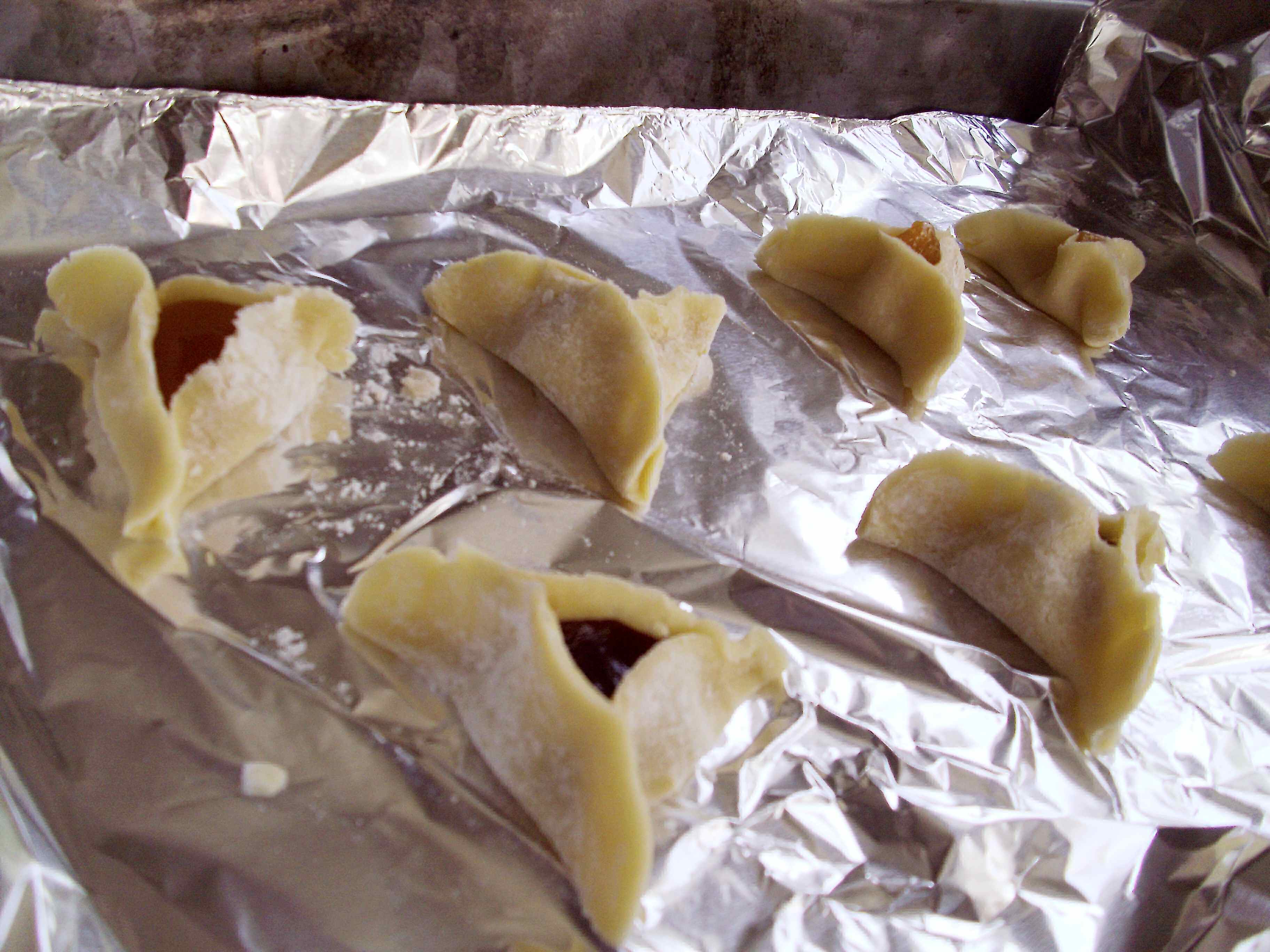
hamantaschen1

What I like about the standard flour-based recipe, other than that it tastes and looks good and is easy to work with, is that I can roll the dough out very thin and get crisp, delicate hamantaschen that are a decent cookie size but still hold together nicely and are not extravagantly carb-laden, particularly if the fillings are reasonable and you don’t eat ten at a time (the big challenge). They’re not as low-carb as the almond meal ones, but they still work out okay–about 7 grams apiece for a 1.5-2″ cookie. They taste good even made with pareve (nondairy) margarine instead of butter.

The LA-area idea of hamantaschen usually involves M&Ms, colored sprinkles, anything completely artificial. I bet gummy sour hearts (this afternoon’s culprit) would be a huge hit too. I don’t think they’ve heard of either prune or poppyseed out here in at least a generation.

Traditional fruit or nut fillings are a much more decent bet for carb, and they taste better (and look nicer too, because I’m not 6 years old and don’t insist on rainbow colors anymore). They’re also easy to make from scratch in a microwave or on the stove top so that you can decide how much sugar to put in them. Continue reading

Roden, with Reservations

This week, after reading through Claudia Roden’s The New Book of Middle Eastern Food (Alfred Knopf, 2000) I decided it was so good I wanted to go ahead and buy a copy for myself. Another cookbook? These days I start my searches at the library rather than the bookstore, not only to save money but to save space for the ones I really want to use a lot.

Claudia Roden, "The New Book of Middle Eastern Food" at Amazon.com

Claudia Roden, "The New Book of Middle Eastern Food", Alfred Knopf, 2000

The New Book of Middle Eastern Food by Claudia Roden (Alfred Knopf, 2000)

Claudia Roden’s The New Book of Middle Eastern Food was a big hit in 2000, a major revision and expansion of her first cookbook from 1968. She included new instructions for food processors and quicker and lower-fat cooking methods, and reintroduced the original authentic spices and other specialty ingredients for many dishes where she’d had to list Western substitutes 30 years earlier.

So why review it again? Ten years later, I find myself doing a thing I almost never do: reading the introduction. It’s an amazing piece of writing, and a full chapter in length. Roden combines scholarship and a look back at the history of the Middle East–politically and gastronomically–with personal notes about her Jewish family’s life in pre-revolutionary Cairo and their eventual exile to Europe. She also looks back at the younger, exuberantly naïve 20-something self who sought out authentic recipes for the original edition from relatives, restaurant chefs, farmers’ market vendors, street hawkers and private cooks of all kinds. In honor of her younger spirit, she decides to leave some of the earlier, more emotional writing in the revised edition rather than smoothing it all out.

But as a mature scholar, she delves into cooking techniques for the major classes of Arab, Turkish, Persian and North African food, the medieval sources of dishes that haven’t changed very much in centuries, and the trade routes and Crusader voyages that brought so much of Middle Eastern cooking back to Europe to be integrated into what we think of today as French.

The book itself is beautiful, with good photos but not that distracting excess of tabloid-sized food-glam that dominates today’s coffee table cookbooks. This is a working cookbook, sized right for the kitchen counter, with emphasis on the recipes.

Even though the basics are familiar by now, Roden includes enticing variations I haven’t run across elsewhere, and she makes them accessible and reader-friendly. While authentic technique and ingredients matter to her, Roden focuses on what counts most about these dishes to the people who make and eat them, and on the social experience of hosting guests and eating happily.

The recipes are generally simple, without huge laundry lists of ingredients or elaborate descriptions of technique. Roden groups  similar recipes like fillo appetizers or eggplant salads from different countries so you can see how each has migrated, and for dishes with a wide following (fava purée, grilled meat skewers) she provides regional and national variations on flavorings or dressings at the end of each recipe, where they’re most useful. Roden’s writing really comes through here as she explains the differences in a way that makes me want to run, not walk, to my fridge and then to my greengrocer so I can try out something new.

Folk tales, poems and memories of her childhood in Egypt appear between recipes and three insert sections of color photos are supplemented with black-and-white drawings for specific techniques such as folding fillo triangles. Even though I’ve done more than my share of folding fillo and may not be the right person to judge, I think in comparison with what I’ve seen elsewhere the drawings in Roden’s book manage to look very doable and kind of adventurous rather than intimidating for someone new to these techniques. My only complaint, really, is that she doesn’t use a microwave for any of it.

So I was looking forward to seeing the same generosity of spirit and depth of connection in her encyclopedic-rated The Book of Jewish Food, which came out in 1996, four years earlier. Rosh Hashanah is nearly upon us (Wednesday evening already) and I was eager to see what she had made of her ambition to cover Jewish food styles world-wide.

Roden was born into a wealthy Syrian Jewish merchant family in Cairo. They had servants, cooks, and cordial relations with local shopkeepers, spoke French and Italian in preference to Arabic, were “modern” (secular and didn’t keep kosher) and enjoyed a broad and lavish culinary repertoire. It did not all suddenly come to an end when Nasser threw the Jews out of Egypt in the 1950s–the family maintained its ties to other Egyptian and ex-Ottoman Jewish exiles in Paris and London, and they seemed to thrive.

Eventually, Roden shocked her family by marrying an Ashkenazi Jew, because her well-heeled family had always considered Ashkenazim beneath contempt–provincial, downtrodden, poor, too religious, pathetically lousy cooks, with women who were too loose or who–gasp–worked, and otherwise socially inferior. And that’s where things start to unravel in this book. Continue reading