


Just before we left for Boston (22 degree weather, anyone? anyone?–too much Ferris Bueller on the first week of school break), I revisited the Halvah Conundrum: how to make halvah that has the right texture when no one’s ever described it properly in a recipe. Last time’s attempt, which made use of a food processor, wasn’t too bad but the texture was still crumbly and tough–overworked, most likely.
Then I read a comment on another food site that recommended working the tehina/sugar syrup mixture like fudge by kneading the mixture in one direction as it cooled to get it to the right semicrystalline texture. I’d seen footage of a career fudge maker paddling the mass of chocolate and sugar syrup on a marble slab until it stiffened up, and thought the Syrian halvah manufacturing process (mechanized boxing glove in a vat of tehina and hot syrup) looked like a similar idea. So I thought kneading the mixture might strike the right balance between halvah that came out too limp and oily and the meringue-like stuff I’d produced last time–too aerated, and when pressed together, too tough and crumbly.
So this time I skipped the food processor for blending the sugar syrup with the tehina and flavorings. I stirred the vanilla and lemon juice and powdered clove into the tehina while the syrup was cooking in the microwave. I’d forgotten to scale down the amount of lemon juice for a smaller amount of tehina–maybe this helped a bit, actually, because adding a small amount of water-based liquid to tehina stiffens it and makes it a bit doughy. Maybe that little bit of extra lemon juice helped give the mixture a start on developing the volume it needs without overworking or drying it out too much?
I stirred the hot, thickened sugar syrup into the tehina mix in thirds using a hand whisk, thinking that maybe not all of the syrup would become overworked if I did it in stages. After all the syrup was in the mixing bowl, I folded the limp oily brown mass (my heart was sinking when I saw this, but I bravely continued) back onto itself several times with a fork, essentially kneading it in the bowl, 10-20 turns, maybe half a minute worth of time, just until it turned a little lighter and stiffer, but not as stiff as meringues. I started with only a third of a pound of tehina, so for a full recipe, it would probably take a bit longer.
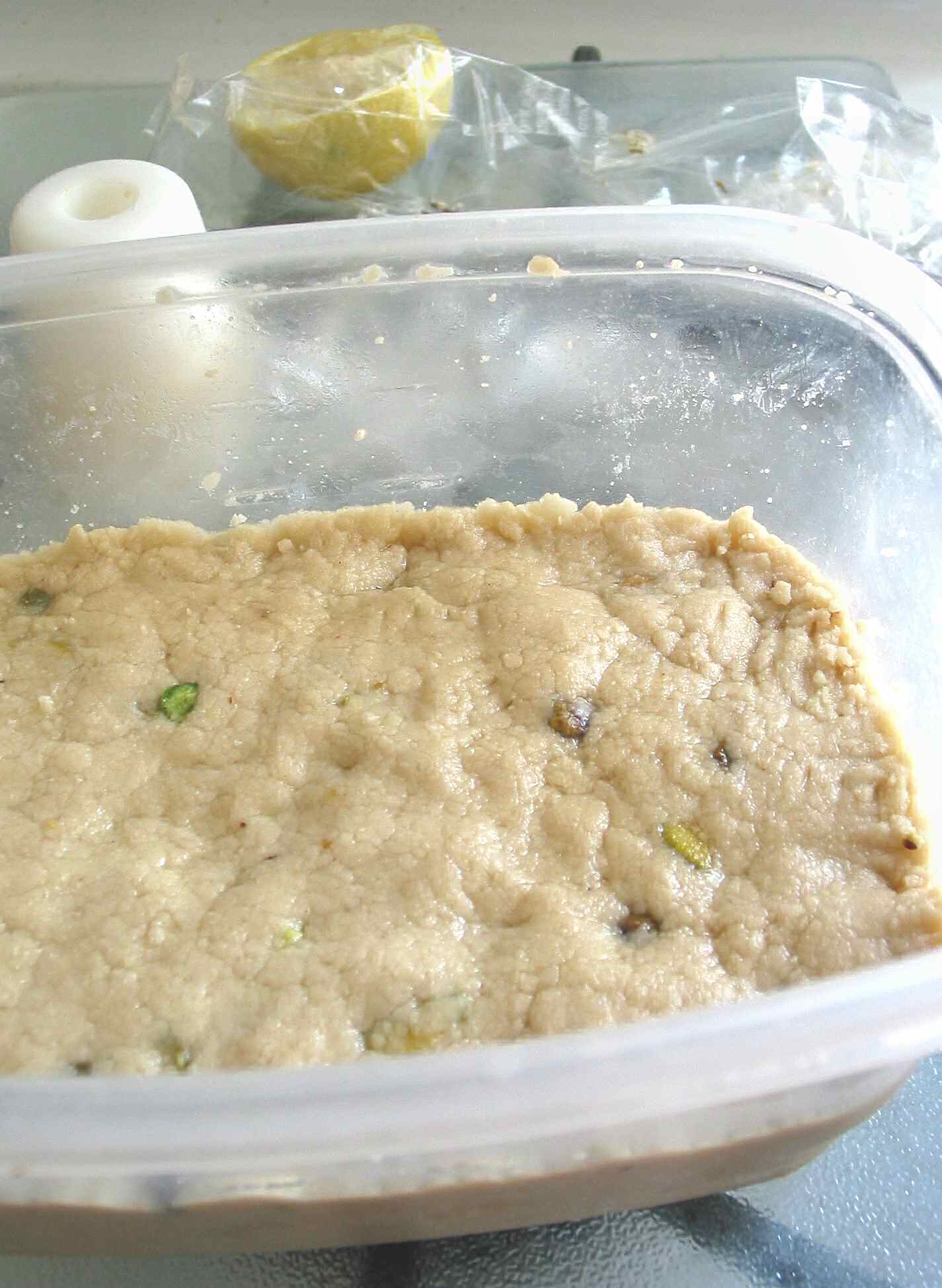
Then I pressed it flat into a container with a lid and stuck it in the fridge overnight. The next day I cut into it–I could cut thin slices! and it was almost like deli halvah! It’s still not quite as light and crystalline, it’s still a bit chewier, but it’s definitely closer. Next time: try the egg whites beaten in with the tehina, and then the hot syrup mixed in…
[April 20, 2014: A new question on halvah, with a few updates from me]
Debbie, I have been down a similar path in trying at times over several years to create halvah like Achva’s (my fave). But it has been textural failure after textural failure. Each time, the result is worth eating and tasty, but that elusive texture…can’t get it. So, I am thinking that the saponaria may be an important detail. The problem is, I have been unable to find it in reasonably small amounts (an ounce or two would prob. last a long time, but I see it for sale only by the 1lb container and it’s not cheap). And, if I did find some, it’s not clear how much should be used–1/4 to 1/2 tsp for a pound of halvah? If you know where I might buy small quantities, please let me know. I live in the San Fran. Bay Area, and usually about anything can be found around here, but saponaria (powder, I presume) is a tough one.
Oh–and the lemon juice: I don’t see that ingredient listed in commercial halvahs. Is it just for flavor, or is it a functional ingredient?
Achva’s ingredients for vanilla halvah: Sesame Seeds, Glucose Syrup, Sugar, Vegetable Fat (Palm), Natural Spice – Saponariae Root, Natural Identical Vanilla.
Btw, I have tried using glucose instead of regular sugar, and no luck. The Achva above is a mix of glucose and sugar. Odd that more fat is added!! It’s not as if sesame paste is a low-fat product to start with. I wonder if this is palm kernel oil, added for its solidity? I don’t recall seeing this ~10 years ago on their label.
Thanks for your detailed blog–it’s reassuring to know others are struggling with this too.
Hi David! Thanks–I’m never sure whether I fall into the “interesting experiment” category of foodieism or the “just plain weird”, but I appreciate it.
I’ve finally managed to find a YouTube video on a Turkish (I think) halvah maker who shows the saponaria root extract mixed in with the hot syrup first–it makes a very white, thick ribbony foam like Swiss (or Italian) meringue (that’s probably why some halvah recipes I’ve seen use whipped egg whites, come to think of it) or marshmallow. Then they pour a large dollop of that mixture (in the half-gallon or 2-liter range) over a big working vat of tehina that must be 3 or 4 gallons (12-16 liters) and start folding it in with his hand–looks like a real workout for the guy doing it. He has a silicone hot glove on his mixing hand and keeps turning the work bowl as he mixes. It takes about 5-10 minutes for him to incorporate all of it gently and it starts cooling down to thick ribbons of stuff that dissolve back into the mass before the whole thing suddenly starts to look like bread dough.
That said, I’ve also seen a few recipes lately with no saponaria or egg white and that use a blender or food processor and the pictures of the resulting halvah look fine with a lot less work–as did the stuff in “Aromas of Aleppo”, so I think they either found the sweet spot on how long to boil the syrup or they were lucky and someone showed them or they don’t mind if it’s not deli-perfect in texture. Or maybe they’re lying and bought their perfect 3-inch-high slabs from a local deli. (jealous, moi?)
What else–oh. The lemon juice is for flavor, so taste and see if you like it, I suppose. I think it tastes pretty good with the ground clove and the vanilla and keeps it from being too blandly sweet. It’s not detectable as “lemony” unless you double or triple the amount, which I have done just to see if adding a little more juice to the tehina and stirring would stiffen it and give it a little more structure ahead of adding the syrup. Even then, it wasn’t bad. The palm oil is a very inexpensive fat/filler ingredient that’s gaining ground in processed food everywhere, mostly in baked goods but sometimes in spreads as well. I disapprove on principle because it dilutes the tehina flavor, plus it’s high in saturated fat, even though it’s vegetarian. One reason (other than simple interest in playing with my food…) why I wanted to try making it from scratch.
— DebbieN
[December 9, 2013: This question came in too late to post as a comment to this page, but I thought it was worth adding here–DebbieN]
Hi, Debbie!
I want to try a home-made halva too. and I have all ingredients ( include soapwort), but I would prefer to create some sugar-reduce variation. What do you think – is it possible to reduce quantity of sugar syrup in your recipe?
On 2013/12/9
Hi Elena,
I don’t know–I don’t have instructions for a version with soapwort (I’m impressed that you can get it where you are). I’m still struggling to get the texture of my halvah right even this much later, and I still haven’t tried a version with whipped egg whites folded into the tehina before adding the syrup. Without egg whites or soapwort, just sugar syrup and tehina and flavorings, I wouldn’t try substituting for all the sugar–something tells me you need some sugar there to create the microcrystalline structure. But on the other hand, the Israeli brand Achva does make an artificially sweetened version that sells in our local Armenian grocery alongside their regular halvah, the standard cans of Joyva, and the (to my palate) slightly-too-sweet Cortas and Ziyadi (I think?). So theoretically it’s possible to go lower-sugar.
One way would be just cutting down on the sugar proportion and perhaps cooking the syrup to a slightly higher stage (ie a little beyond soft ball)–though it might seize up when you stir it into the tehina, unless you heated the tehina somewhat before mixing. Some recipes do call for heating the tehina to 120 F, which might keep the hot syrup from “shocking” and seizing up hard. Or else you might cut down a little on sugar syrup for the amount of tehina and add artificial sweetener to the tehina mixture before stirring in the syrup.
With soapwort, you might get more structure with less sugar syrup, so you could probably add artificial sweetener more effectively, but I don’t have a recipe for it and don’t know how to work with it. If it’s not too expensive and you’re willing to risk it or you’ve made halvah successfully before, try reducing the sugar syrup by 1/3 and adding sweetener to the tehina, keeping everything else the same. I would do this for a sample recipe amount, maybe just half a cup of tehina and proportional sugar syrup. Don’t risk a whole pound of tehina and 2 cups of sugar!
One thing I have discovered (yesterday, in fact) is that if the halvah comes out too soft and sticky, like limp caramels, you can put it in a microwaveable bowl, microwave it a minute or two until it just foams up and turns a lighter creamier color, and then beat air into it a few times with a fork until it just begins to stiffen like mashed potatoes. Unfortunately mine seized up and turned to sandy crumbs just after that point, but it still came out closer to right once I packed it together and let it cool.
Best of luck–DebbieN
Filed under: cooking, Desserts, nuts, Revised recipes | Tagged: candymaking, halvah, homemade fudge, sesame candy | Comments Off on Halvah update–I think I’ve got it
 Slow Food Fast