


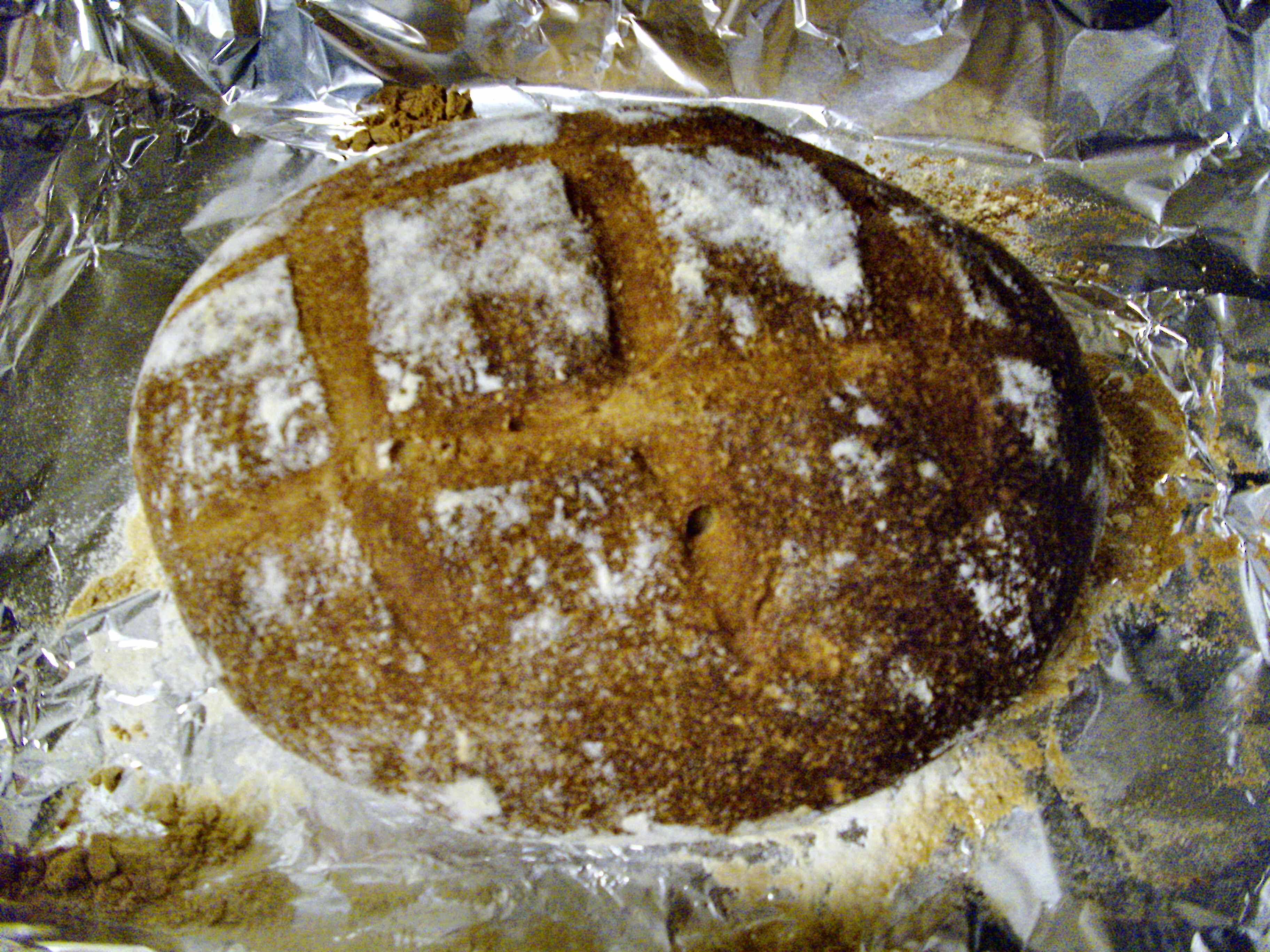
I love sourdough–eating it, anyway. Baking? That’s enough of a challenge that I’m elated when it turns out relatively edible. Because even with my standards, which are a bit loose, there are times when the outcome is decidedly not up to expectations. I have trouble getting the dough risen well enough and into the oven before the acid chews up all the gluten. In other words, it tends to overproof and then flop. Few of my loaves–I can face it–have ended up risen enough to consider serving other people, and most of them are a bit coarse inside–partly because I want rye or whole wheat rather than just white bread.
The other challenge is the perennial one for sourdough cultures–it takes several days to build a decent-tasting and stable mix of flour, water, wild yeast and lactobacillus culture with no undesirable bugs or off-flavors and odors. And in the meantime most instructions tell you to take a small bit of the mixture, feed it fresh water and flour, and toss the majority. Wasteful–both of ingredients and time.
So for the past year or so I’ve wondered whether I couldn’t somehow just get a running start past all that by using commercial yeast (a big no-no according to sourdough experts) with some commercial lactobacillus culture–yogurt, maybe?–and flat-out cheating. As in, faux dough. Well, more precisely, perfectly real dough, with a real-enough sourdough taste and texture, only about 4 2/3 days faster. At least. Without just caving and paying 6 bucks at Whole Foods for a small decorator loaf.
Yesterday I wondered it strongly enough to hunt around online and see if the yogurt idea had occurred to anyone else–and it had.
Ladyandpups.com is the food blog of a sometimes cranky, sometimes poetic, impressively prolific and creative baker named Mandy Lee. She has a “fraudulent easy sourdough” recipe that uses more than a cup of plain yogurt with a small amount of yeast and 3.5 cups of bread flour–no added water, apparently–and some salt for a firm dough that rises either 18 hours at room temperature (1/4 t active dry yeast) or 6 hours (3/4 t. yeast) and comes out tasting right and looking beautiful and crackle-crusted via the Jim Lahey no-knead-but-preheat-the-dutch-oven method.
And that’s all to the good.
But I’m even more impatient than that, and most of my sourdough faux pas have to do with letting the dough sit too long before baking. Even a 6-hour rise seems like too much. I also wanted a whole-wheat sourdough (so half whole wheat, half bread flour), which means it’s already comparatively gluten-challenged. So I wanted a really short, sharp rise that would get the dough puffed up and bakeable before the acid got to the gluten too badly. With luck, the yeast would win out just enough to outpace the acid buildup and resulting hopeless flop, but still allow enough to develop a good tang, which is the whole point of sourdough in the first place.
That meant changing things a bit:
1. Less yogurt, only about half what Lee calls for–half would still have plenty of lactobacillus culture to reproduce, but wouldn’t contribute as much acid right up front.
2. Some water to dilute the initial acidity further to delay the inevitable gluten-chewing effect. More water also gets the dough smoother and the gluten developing more quickly even when there’s no acid-producing bacteria to worry about. That’s an added benefit since I was going whole-wheat.
3. Not too much yeast either. Normally, adding more yeast means getting a faster rise. But even 1/4 t. is about what I usually go with for a slower-rising dough with 5-6 cups of flour, and that only takes 3-4 hours to more than double in my kitchen, at least with a hot rise. I didn’t want so much extra yeast at the start that it outcompeted and inhibited the lactobacilli from the yogurt altogether, because no sour culture equals no sour flavor. Continue reading
Filed under: baking, breads, Dairy, Food Blogs, Grains, haute cuisine, Revised recipes | Tagged: baking, food, hacks, recipes | Comments Off on Three-Hour Sourdough
 Slow Food Fast