

• Enter your email address to subscribe to this blog and receive notifications of new posts by email.

    Join 241 other subscribers
  • Noshing on

    raw blueberry pie with microwaveable filling and graham cracker crust

    This mostly-raw blueberry pie is a snap to make and very versatile--the filling microwaves in a few minutes, and you don't even have to bake the zippy gingered graham cracker crust--perfect for a hot Fourth of July and all summer long.

  • Recent Posts

  • Contents

  • Archives

  • Now Reading

  • See also my Book Reviews

  • Copyright 2008-2024Slow Food Fast. All writing and images on this blog unless otherwise attributed or set in quotes are the sole property of Slow Food Fast. Please contact DebbieN via the comments form for permissions before reprinting or reproducing any of the material on this blog.

  • ADS AND AFFILIATE LINKS

  • I may post affiliate links to books and movies that I personally review and recommend. Currently I favor Alibris and Vroman's, our terrific and venerable (now past the century mark!) independent bookstore in Pasadena. Or go to your local library--and make sure to support them with actual donations, not just overdue fines (ahem!), because your state probably has cut their budget and hours. Again.

  • In keeping with the disclaimer below, I DO NOT endorse, profit from, or recommend any medications, health treatments, commercial diet plans, supplements or any other such products.

  • DISCLAIMER

  • SlowFoodFast sometimes addresses general public health topics related to nutrition, heart disease, blood pressure, and diabetes. Because this is a blog with a personal point of view, my health and food politics entries often include my opinions on the trends I see, and I try to be as blatant as possible about that. None of these articles should be construed as specific medical advice for an individual case. I do try to keep to findings from well-vetted research sources and large, well-controlled studies, and I try not to sensationalize the science (though if they actually come up with a real cure for Type I diabetes in the next couple of years, I'm gonna be dancing in the streets with a hat that would put Carmen Miranda to shame. Consider yourself warned).

The Altered Cheese Project

I know. It sounds like the name of a really, really bad ’80s art rock tribute band. Not that there’s anything wrong with that. (Well, actually there is; I survived the ’80s by stubbornly ignoring everything from the Talking Heads onward, especially after I went to one of their concerts and heard the drummer. Maybe it was just a bad night, but I thought only David Byrne was allowed to be that far off.)

Altering cheese also sounds like the ultimate DIY, grow-your-own, cure-your-own, grind-your-own, fill-in-the-blank foodie optimism project. Weird, more work than it’s worth, but a good experiment to try once (if you’re under 30) so you’ll appreciate the effort that goes into it all when you go back to buying the professionally made version.

You might have noticed that all the nicer cheeses that get newspaper and food magazine reviews cost upwards of $15/lb and even though I’m a cheese freak, I’m just not in that league more than once a year, perhaps on my birthday. I deserve nicer cheese than I can get at the supermarket, I just know I do.

So let me just say it: I’m nobody’s idea of a dedicated cheesemaker or affineur. Mostly because I can’t stand heating and clabbering and then pressing large amounts of milk just to get the starting curd. I also hate scrubbing everything to death before and after, and the idea of cleaning scorched milk off the bottom of a soup pot is my idea of wrong. I’m not authentic. And I don’t wanna be. Even clabbering by microwave is probably not my idea of a good time when it comes to anything more complicated than paneer or yogurt–I’m not sure it wouldn’t destroy the cultures for hard cheeses.

Last year I got the idea to start with something already in cheese form–a lot less waste of both milk and time. After all, standard bland goat cheese is pretty inexpensive–an 11-oz log is about $5, about a quarter of the price of the goats’ milk you’d need to produce it (4-5 quarts at about $4 each). So are other fresh white cheeses. And you can get inexpensive domestic brie and bleu cheeses in supermarkets and–my preference–Trader Joe’s. They’re not bad, they’re just bland compared with the European originals. But they have the requisite blue or white mold cultures you need to add flavor to other cheeses, if the cultures will take.

Last year’s achievements may give you some idea of where I’m going with this:

  • Bucheron (fresh chèvre log, bit of white mold rind from inexpensive, bland Trader Joe’s Canadian brie, sealed in a sandwich baggie with some air for about 2 months in the fridge until it ripened)
  • Bleu de chèvre or Goatgonzola (another fresh chèvre log, this time with some crumbled cheap gorgonzola in the baggie, also about 1-2 months in the fridge)

and the accidental but serendipitous

  • Marbled Feta (the byproduct of storing above-mentioned source gorgonzola next to ziplock bag containing a block of feta cheese)

But ever since I posted these first attempts at turning boring American supermarket cheese into something more flavorful and interesting, I’ve been haunted by the thought that I’d only scratched the creative surface of cheap cheese transmogrification. So I’ve been cheating with cheese yet again.

A Fungus Among Us

Goat cheese and feta are both fairly wet fresh cheeses that take mold pretty well if you do it on purpose. What about drier standard American varieties–cheddar, for instance, or brick mozzarella? These are bound to be more difficult to persuade, but if you have a bit of patience, it might be worth a try.
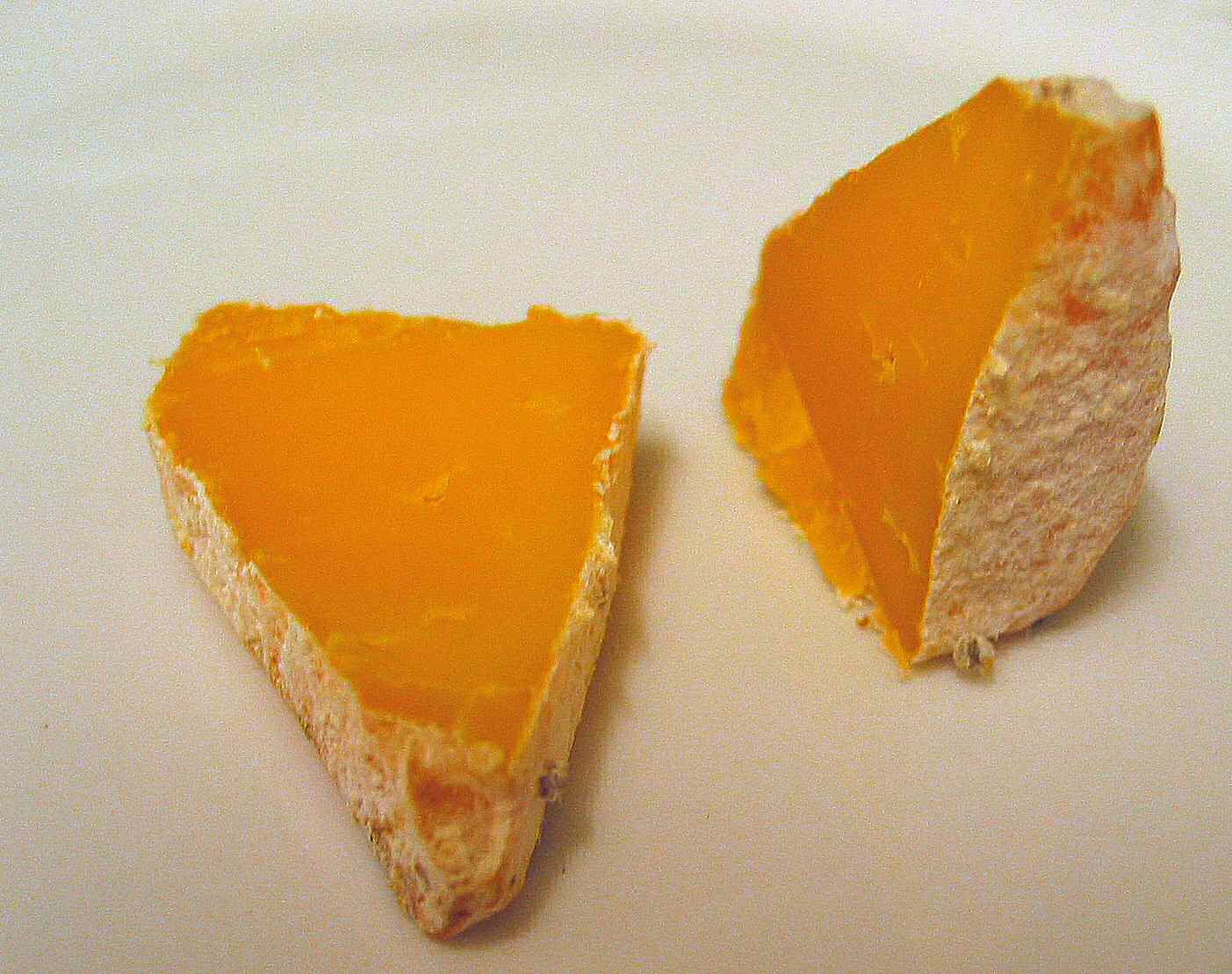
 

Cheddar after aging with bleu cheese mold

Cheddar after aging with gorgonzola starter


Now I know, normally you look to cut any developing mold spots off your cheddar–it’s what we’ve all been taught for decades. But the blue and white mold cultures are key to developing flavor and–I shouldn’t even be spelling this out–when it comes to flavor, America’s standard supermarket cheeses are in dire need of help.

Four or five weeks ago, I put a small end piece of Bel Gioioso gorgonzola in a ziplock bag with a couple of ounces from a brick of ordinary Trader Joe’s extra-sharp yellow Wisconsin cheddar and some air and kept it in an isolated part of the fridge to see what would happen. I’d actually diced the cheddar into bite-sized pieces to increase the surface area and maybe decrease the culturing time if the bleu mold managed to take.

Nothing much seemed to have happened except that the cheese looked a bit drier. No visible culturing going on at the surface. The gorgonzola crumbs had shrunk and dried out as well. But I took a cube out and cut into it with a knife, and the flavor had stopped being tangy standard cheddar and was moving toward Morbier or Emmenthal–something nuttier and more subtle. All I could think was that the cheddar was aging without actually culturing and growing the blue mold. But because the mold is a penicillium strain, what there was of it might have inhibited unwanted bacterial intrusion and helped steer the cheese toward a more nicely controlled aging process.

And then again, a week later, the mold had taken on the remaining cheddar cubes, and the taste, once I cut into it, was like a mild cheddar heading toward blue. Still not very potent, but encouraging. Continue reading

Adventures with Cheese

A year or so ago, I saw a show on PBS about how PR consultants test and choose keywords to influence public opinion on everything from political campaigns to new foods. Most memorable–other than the use of a statistics-wielding ad consultant for the Swiftboat smear campaign–was a French marketing expert in his late 60s who discussed the key difference he’d found in food attitude focus groups between Americans and French:

“In America,” he declared, “Cheese is dead. I can assure you of that.” The key positive words that arose in his group discussions about cheese were “sterile” and “safe”. That is, as long as the cheese was processed, uniform, free of visible mold, refrigerated, odor-free, pasteurized and–most important–wrapped in plastic so nothing could possibly escape, cheese was okay.

Otherwise, he said–you could hardly miss the sneer–Americans considered cheese unsafe. They–we–were culturally afraid of it.

In France, he maintained, “Cheese is alive.” The French focus groups brought out  words like culture, flavor, and the names of many, many specific types of regional cheeses that were their personal favorites. The French still buy much of their cheese at small local shops whose owners’ main job is to present their cheeses for sale at the optimum point of ripeness. The customers take home a wedge or small round of cheese and keep it on the counter or a dedicated shelf in the fridge, depending on the type, and they have their own fixed ideas and traditions for storing it so as not to ruin its flavor or texture–two words that did not really come up in the American discussions as much as “Velveeta”.

Are we Americans really that ignorant about cheese? The food my husband brought home from the aforementioned brunch included three or four stacks of precut sliced cheese–yellow-orange, whitish with an orange edge, and whitish again with tiny flecks of red and green throughout. Cheddar, muenster, and pepper jack? I looked at them, wondering were they real or processed–hard to say by looks alone, so I peeled off a corner of a slice on each of them to try them. They all tasted exactly alike. Although the one with the flecks was a little bit spicy, the basic flavor was Velveeta: salt, starch or gum, cooking oil. Something stale–maybe milk solids–but no culture, no tang, no fresh dairy flavor. There wasn’t even much of a smell. The French guy was right.

I started to toss the packets in the trash and my daughter asked why–so I let her taste them. “They’re not that bad,” she said. “They’re not that good,” I replied, and handed her a small chunk of sharp cheddar we had in the house for comparison. “Which would you rather eat?” ‘Nuff said.

I bring this up because I really do have a thing for cheese (damn my cholesterol-packin’ genes), but good artisan-type cheeses are often pretty expensive–$15 and up per pound–and the more affordable varieties of things like brie or gorgonzola usually lack something in the way of flavor, especially if they’re made in Canada or the U.S. Plus I have a thing for playing with my food.

For the last couple of years I’ve been playing around with the idea of taking a fresh cheese and culturing it further to get to something approaching the aged artisanal cheeses. We have lots of generic chèvre and feta and ricotta and so on these days–as well as increasingly easy-to-find inexpensive (but bland) brie and bleu cheeses made with cows’ milk. And that’s sometimes the problem: we don’t have a lot of goat’s or sheep’s milk available to ordinary consumers in the U.S., and the French-style cheeses we do have are kind of bland, maybe even oversterilized, even though as a former biochemist I’m a big fan of pasteurization, especially for any dairy that has scaled-up production. To that end, READ THE SAFETY NOTE AT THE BOTTOM OF THIS POST if you’re going to give this a try.  Continue reading