
• Enter your email address to subscribe to this blog and receive notifications of new posts by email.

    Join 241 other subscribers
  • Noshing on

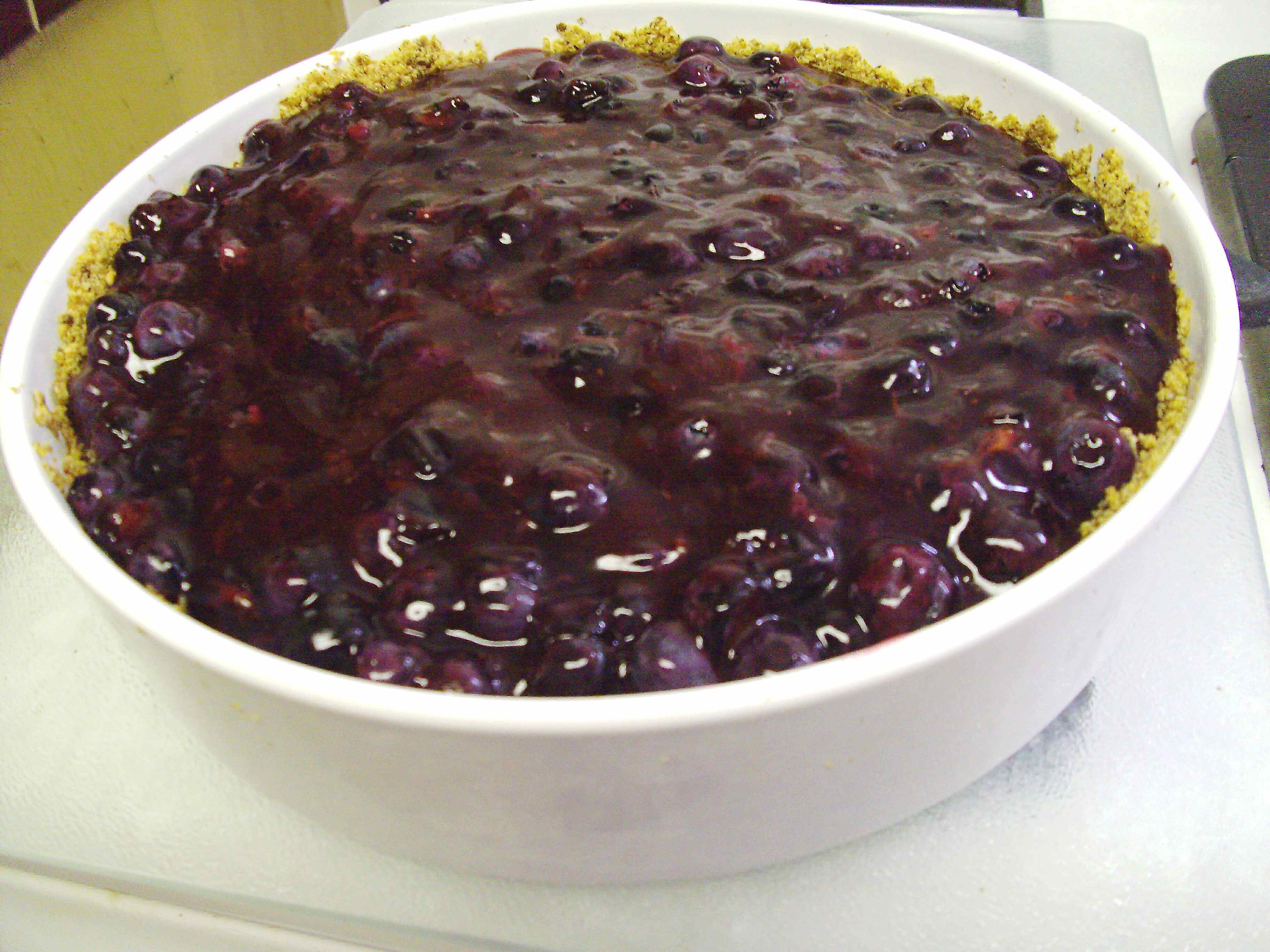
    raw blueberry pie with microwaveable filling and graham cracker crust

    This mostly-raw blueberry pie is a snap to make and very versatile--the filling microwaves in a few minutes, and you don't even have to bake the zippy gingered graham cracker crust--perfect for a hot Fourth of July and all summer long.

  • Recent Posts

  • Contents

  • Archives

  • Now Reading

  • See also my Book Reviews

  • Copyright 2008-2024Slow Food Fast. All writing and images on this blog unless otherwise attributed or set in quotes are the sole property of Slow Food Fast. Please contact DebbieN via the comments form for permissions before reprinting or reproducing any of the material on this blog.

  • ADS AND AFFILIATE LINKS

  • I may post affiliate links to books and movies that I personally review and recommend. Currently I favor Alibris and Vroman's, our terrific and venerable (now past the century mark!) independent bookstore in Pasadena. Or go to your local library--and make sure to support them with actual donations, not just overdue fines (ahem!), because your state probably has cut their budget and hours. Again.

  • In keeping with the disclaimer below, I DO NOT endorse, profit from, or recommend any medications, health treatments, commercial diet plans, supplements or any other such products.

  • DISCLAIMER

  • SlowFoodFast sometimes addresses general public health topics related to nutrition, heart disease, blood pressure, and diabetes. Because this is a blog with a personal point of view, my health and food politics entries often include my opinions on the trends I see, and I try to be as blatant as possible about that. None of these articles should be construed as specific medical advice for an individual case. I do try to keep to findings from well-vetted research sources and large, well-controlled studies, and I try not to sensationalize the science (though if they actually come up with a real cure for Type I diabetes in the next couple of years, I'm gonna be dancing in the streets with a hat that would put Carmen Miranda to shame. Consider yourself warned).

Parsley Doesn’t Count

It’s nearly June, the big northeast snowfest that lasted into April is pretty much over, and all the May and June issues of the big food magazines are showing…almost no fresh vegetables on the covers. Or inside. Oh, you do see some green–but it’s garnish. Flat-leaf parsley, a little cilantro, a sprig of basil maybe, chopped or torn over the cover dish to make it pretty. But very few actual vegetables–take a little walk with me down the newsstand for a sec.
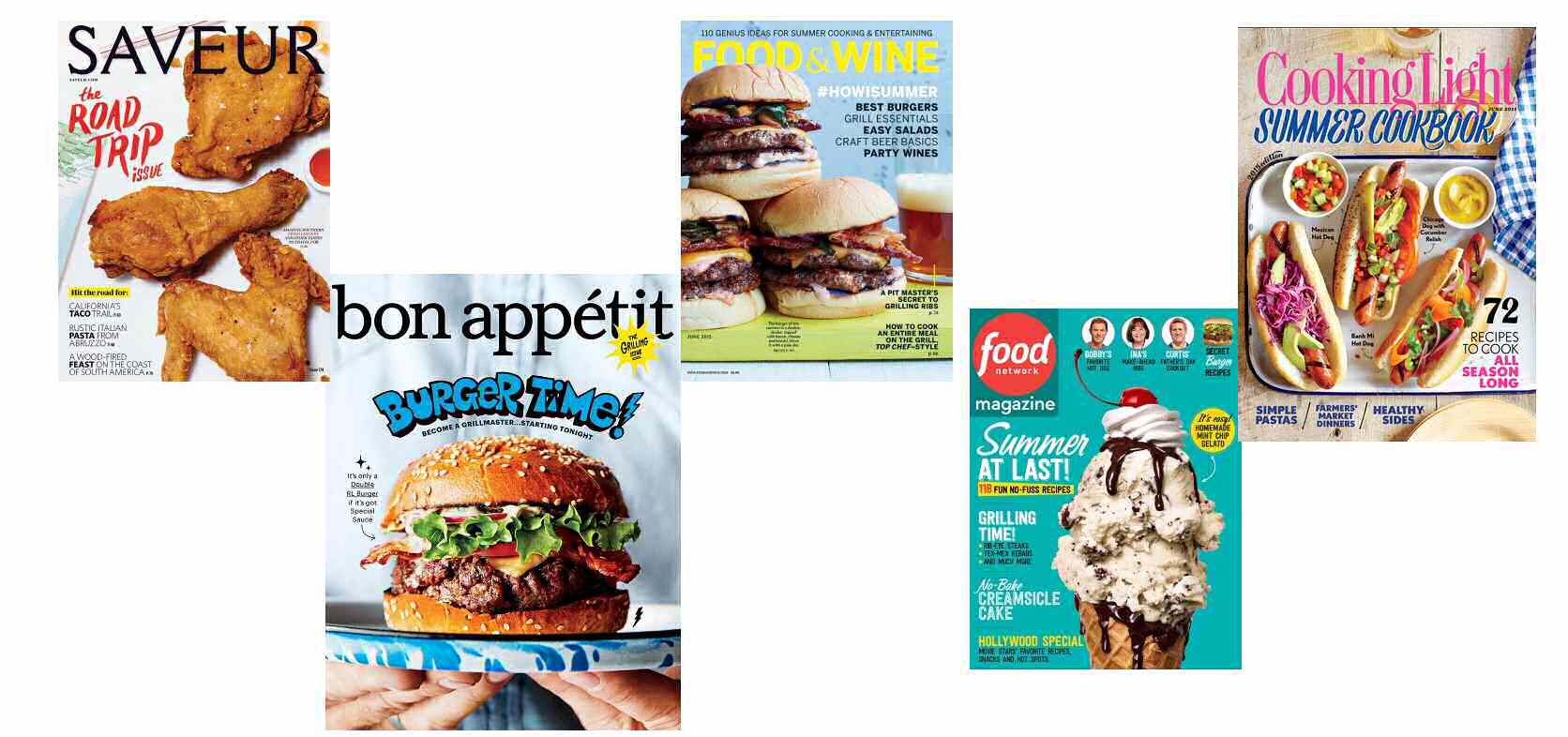
magcovers

All magazine cover thumbnails shown have been lifted shamelessly–they’re not mine, they’re the property of their respective publishers–and pasted together here solely for parody value and critical review of the food literature.

Saveur? Fried chicken. Seriously. Cooking Light? Hotdog special–one with a slice of pickle and tomato, another with avocado, to represent Vietnamese and Mexican, respectively.  Whoo-don’t you feel like a world traveler now. Food and Wine? Burgers by Bobby Flay. Bon Appétit? Another burger. Food Network? They don’t even pretend. Ice cream cone. With whipped cream and a cherry on top. On a cone.

The women’s mags are leaning toward desserts: Martha Stewart–cake. Southern Living, Allrecipes–pie. Better Homes & Gardens and BHG Diabetic Living both feature watermelon and ice cream or sorbet assortments. All of it very pink.

Eating Well cover Vegetarian Times cover

But even EatingWell and Vegetarian Times aren’t doing all that much vegetabalia on their green-looking covers. EW has a vegetable serving platter with a nice looking bunch of raw green beans and tomatoes at the bottom, but more than half of the platter is canned  beans or dip. Not that I’m against those, but they really aren’t fresh veg.  VT has a grilled veg and quinoa salad platter that looks wholesome enough, but if you zoom in for a closer look you realize it’s not mostly veg either. If you took a quarter of it for yourself, you’d only get 3 or 4 thin slices of pepper and zucchini on your plate along with the grain. Most of the green you see in the picture is a token sprinkling of arugula and basil sprigs strewn over the top–a strategy that’s being used and abused in the less veg-forward pubs to make steak or pork loin or mac ‘n’ cheese look like they have something fresh and healthy about them.

Lucky Peach and Cook’s Illustrated both go for graphics rather than photos. LP has a cartoony poster graphic of garden lushness for “The Plant Issue”–do they really have vegetabalia inside? Cook’s Illustrated has a pastel of radishes.

It’s as though they all decided to try to look summery without  including actual bulk greens–the signature of summer (well, other than watermelon). I’ve complained about this before, I know, but back then I was talking about friends who don’t cook much and are somewhat veg-phobic, not about upscale food media. For years the food glam world has been touting local sourcing, farmers’ markets, heirloom this and that, Provençal and Spanish and Italian and Middle Eastern cuisines, which are full of vegetables one way and another. But they really are no longer practicing what they preach. They’ve shrunk their focus down to the meager American fast food paradigm while pretending otherwise. And charging you between 4 and 10 dollars an issue.

But vegetables are so easy to ruin, you say. The green ones turn brownish olive if you hold them too long after cooking. If you’re going to hang around a whole hour waiting for the photographer to get the right shot, you’re going to have to cook a couple of batches in a row. Strewing a couple of sprigs of cilantro or parsley over something is so much easier!

The other reason we’re not seeing vegetables on the magazine covers: editorial production lag. Monthly magazines typically take anything from 2-6 months to produce from start to finish, so they work ahead. The May and June issues probably went to press two months ago, when it had barely stopped snowing in the northeast (per my mother and sister). Summer vegetables are not bountiful in March and April under those conditions–at least not in New York and Boston. But the editors could have put together something decent and thematic for the covers if they wanted to–I’m pretty sure I could have sent them a likely looking CARE package from my local greengrocer’s if they’d only asked and were willing to foot the overnight shipping.

A weekly haul from my greengrocer's comes in under $30 even with coffee, spices and special items.

Eat your heart out, foodie magazines! Time to gloat. A typical weekly haul from my greengrocer comes in at under $30 even with a pound of coffee or tehina or yogurt (not shown, obviously), bagged spices, dried beans, and  specials on fruit or nuts. When the tomatoes are better I stagger out the door with 5-10 lbs. at a time, but on the other hand the snow peas were a serious bargain this time around.

There are plenty of good vegetables around. Fresno tomatoes are back in my Armenian grocery (for which, oh! be joyful), we have green and romano beans, we have lettuces and purslane and bunches of fresh basil and dill and mint and za’atar (and yes, parsley, Continue reading

Superfoods and Magic Beans

“Top 10 (or 7, or 5, or whatever) Superfoods” lists seem to be popping up on the covers of all the in magazines this month. If I didn’t get a headache every time I tried it, I’d be rolling my eyes.

The classic bloated diet article with the even more classic bloated promise of magic beanhood is nothing new, I realize. But “superfoods”…

The premise of calling something a superfood is that if you eat this one special food, or at least shop your way down the list of 5, or 10, or whatever’s in the article, you’ll be so much healthier than someone who eats a regular food. Right?

Usually the items on these lists of so-called superfoods turn out to be expensive exotics like dried acai berries and pomegranate juice. Both of which just happen to have heavyhitter funding and marketing efforts behind branded packaged versions of them, and the companies that have started branding and marketing them have both recently come under FDA scrutiny for overinflated and unsubstantiated health claims.

Of course you don’t have to go branded to run into wide-eyed, breathless claims about supposed superfoods. More mundane choices like the sunflower seeds, green peas and garlic touted in this LA Times food section article are also now being highlighted as the new great green hope for America.

But not for the reasons that make the most sense–that these foods are relatively unprocessed vegetables, fruits, whole grains, nuts and seeds (occasionally someone remembers to add something from the beans and pulses category too). All of this vegetation has almost disappeared from the current mostly-processed, mostly restaurant diet of the American public. The general categories now touted as superfoods contain protein, fiber, vitamins and minerals. They’re wholesome and varied if you buy them fresh (or dried) and cook them yourself. Some of them are green (and they’re supposed to be!)

That’s in stark contrast to the now-standard and really dreary burger, ketchup, fries and soda that are all made out of the same three or four overused industrial ingredients (wheat, soy, corn and salt, with a little beef scrap or so thrown in for the burger, some leftover tomato paste for the ketchup, and much less potato than you’d think in the fries). I understand how something that’s actually recognizably plant-based would seem exotic and ultrahealthy in comparison. I do. Because frankly, you could take your soy-based green crayons and color a piece of all-natural bamboo-fiber cardboard and eat that and it would be healthier than the fast food special.

But does that mean vegetables, fruits, whole grains and nuts and seeds are suddenly superfoods?

What are superfoods supposed to be, exactly? Look at the captions for what’s so great about each featured food Continue reading

Food for thought?

According to MediaFinder.com, 193 new magazines launched in the US during 2010, while 176 folded. Closures were down from 596 defunct magazines in 2009–most famously including Gourmet, whose November 2009 final issue with the huge stuffed glazed turkey is still sitting forlornly on our local library branch’s magazine stand a year later.

But from MediaFinder’s other trends, it seems the closure of this flagship food magazine has only spurred the launch of a (not literal, at least I hope not) thousand to take its place. While more B2B titles folded than launched, food magazines represent the most launches of any single category.

What does it mean? Are they just trying to fill the void, capture some of the market share that Gourmet commanded? Or do they really think there’s room for growth and that more and more people will pick up food magazines at the checkout counter and then subscribe for an ever more splintered and specialized set of food topics?

Are Americans really that obsessed with food, given that fewer cook regularly than even 10 years ago? Or are we using food as a relatively noncontroversial substitute topic for everything else of importance that scares us more? Like the fact that our banks got bailed out but they didn’t reinvest in America by creating more loans or more jobs (where’s the surprise)? That our biggest corporations are undercutting the political power of the citizenry and our Supreme Court is granting them effective status as citizens even though they don’t pay proportional taxes to support the welfare of the nation? Worse, that we’re still stuck wasting billions and billions on a moribund set of wars in Iraq and Afghanistan, and that our troops and national reserves have been turned into indentured servants unable to exit service when their agreed-upon term is over, and it’s been swept under a rug? And that we’re still “processing” and foot-dragging our way through the Guantanamo cases Bush’s administration left behind, with less and less plausibility for holding those prisoners without trial, and the “Patriot Act” is still in force–mostly for what? More abuses of citizen privacy have been committed under it than actual terrorist plots detected.

Maybe it’s time to get off our couches after all as we head into the new year.


Food Mags Rethinking Salt

For years, lobbyists and nutrition pundits have insisted–hopefully or despairingly–that government public health campaigns to cut sodium in processed and restaurant foods wouldn’t really do much good, that the public wouldn’t pay attention, that they wouldn’t care enough or that they’d resent the guidelines advice so much that they’d never change their habits.

But the past year has brought the brining of America into the headlines and people are starting to pay attention. Especially with state-led nutrition labeling laws for restaurant chains, large diet/health studies, and citizen/government coalitions to pressure the food industry to reformulate down to sane salt levels.

Gourmet-leaning media have been especially slow to come around from the enthusiasm of exotically named and sourced salts and imitation of the aggressive restaurant-style use (and overuse) of salt as a texturizing chemical rather than for flavor. As late as January, I was still seeing frequent “famous chef” defense commentaries, on food shows and in publications from Salon.com to the New York Times, on the absolute necessity of salting food at every turn.

I hope it’s not just a one-issue fluke, but a quick scan of the July issues of Bon Appétit and Saveur shows that both have cut out the insidious, automatic “1 teaspoon of salt” they used to list in most of their recipes. Sunset magazine doesn’t seem to have caught on yet, but Good Housekeeping appears to be ditching the extra salt, so maybe we’re on the cusp of a better trend. And maybe next year I’ll have nothing to kvetch about.

It could happen.

Thanksgiving Vegetariots, or, How Can You Have Any Pudding If You Won’t Eat the Meat?

Newspapers all over the country are sweating to include vegetarian main dishes in their annual Thanksgiving features. But they’re not doing all that well. This week the LA Times food section proudly listed a whole bunch of Thanksgiving vegetable side dishes as if to say, “See how much there is for you vegetarians to eat without your hostess making any changes just for your special status?” Only, as readers quickly pointed out,  1) none of the dishes contained any noticeable protein, 2) most of them were overloaded with butter and salt and 3) two of them contained chicken broth or pancetta. Someone had forgotten to re-edit them for a vegetarian audience.

I pick on my local paper because we’re talking Los Angeles, with great produce available all year round and a very large vegetarian population–and a lot of ethnic groups with significant roles for vegetarian dishes in their traditional cuisines. We have less excuse for this kind of simple ignorance than most cities.

But it isn’t simple ignorance. Running very close to the surface of most food publications’ features on vegetarian fare at the big showdown holidays is a distinct tone of hysteria. How can anyone not want to eat meat? Nothing tastes like turkey, and nothing sells like it either! We don’t know anything about vegetarian proteins! they panic. Do vegetarians eat Durkee Fried Onions or Empress Yams? Do they eat marshmallows? They don’t even like pancetta! What’s wrong with them?

These are home questions for newspapers and food mags, because you know the real survival question is, “How are we going to sell advertising for chickpeas and lentils, for chrissakes?” That probably goes double or more for food shows on tv. If they don’t advertise, they don’t stay on the air.

It’s not like tofu has a big marketing presence in the nation’s newspapers or brand recognition outside of local markets. There are only so many brushed-steel and cherrywood designer kitchens anyone is willing to buy in a down economy, especially once they discover how badly brushed steel shows fingerprints. And cooking mags don’t get a lot of help from PepsiCo and CocaCola, Ralston-Purina or the many cigarette and pharmaceutical companies.

What’s left? Bacon, turkey, and processed food companies featuring starches and microwaveable tv dinners. This might not be such a problem for food pubs if they’d found a way to keep their features a little more independent of their ad base. Bacon is showing up these days as suddenly gourmet in so many inappropriate dishes–ice cream? chocolate bars? popcorn?–precisely because it’s relatively inexpensive, widely available in supermarkets, and sold by a few recognizable national namebrand companies that still advertise reliably in a down market. Young food bloggers who go for it think it’s something new and daring, but you have to wonder whether they realize how hard the commercial food media are pushing it and why.

In any case, the November and December issues or episodes really need to push meat for all they’re worth because American bacon is basically the same everywhere and straight-up turkey isn’t all that popular the rest of the year, and the companies know it. Meanwhile, vegetarianism in all its variations, and with a growing political undercurrent, is gaining ground among younger Americans, or at least those not too obsessed with bacon. What to do?

Apparently the answer is, panic and get mad at the vegetarians for wanting non-meat dishes that are worth something, but try hard not to admit it in front of the camera. Continue reading

Brand Me! Or, How to Commercialize Cabbage

Earlier this year I made a joke about the marketing campaign for fresh bulk vegetables, along the lines of “Red Cabbage. It’s What’s For Salad.” I was thinking how nice it would be if people could be motivated to buy ordinary fresh bulk vegetables–no brand names, no packages–every week as a matter of habit the way they did 30 years ago, instead of the way they now fill their carts with brightly colored boxes of processed stuff. I thought it would probably take a satirical approach like the Ad Council’s Got Milk? public service ad campaign.

Clearly I wasn’t thinking hard enough about the real issue driving the relentless replacement of food with boxes. As with the Internet, it’s branding. And not surprisingly, there’s an awful lot of spam out there (hints of The Viking Song in the background…and a word of caution: as with many Monty Python sketches, this one contains more than a few off-color lines and screeching in addition to the main ingredient.)

The packaged food industry is way ahead of me and has been for years. They’ve figured out how to put brand names on cabbage or broccoli or carrots so they can charge more for it–several times more per pound. And they’re doing enormously well with this ploy.

Ordinary shoppers — your neighbors, your co-workers, your mom, and you too, I bet— have in the past week or so bought a little packaged bag of pre-washed spinach, Euro Salad Mix, baby-cut carrots, or broccoli and cauliflower florets. To save time, you tell yourself. Because it’s more gourmet, perhaps. And you’re getting your vegetables in, you think. But it becomes a habit, and a needlessly expensive one.

This kind of thinking about vegetables is becoming dangerously ingrained among American shoppers. People think they’re eating healthy without the fuss, but then they complain how expensive vegetables are. And no wonder, if they shop like this.

Because the few vegetables you get in the precut packs in pristine plastic bags are less than a pound. 12 oz. is typical for broccoli and cauliflower florets, 5-6 oz. for pre-washed mixed lettuces. Prices are at least $2.00 per bag, and often on up to $3.50 or more. Yes, Virginia, that’s anything between $3 and $9/lb for the “convenience” of just opening a bag.

I bring this up here because packaged, pre-shredded cabbage, an 8-oz. bag no less, was listed, actually listed, as a key ingredient in a recent (and no I didn’t really mean to be picking on them again so soon) Bon Appetit feature recipe online. One for “Fishcakes and Coleslaw”. It was part of a slideshow series illustrating “gourmet cooking on a budget”, glossy photos with convincing price tags included–but this one recipe cost $14 for four servings!

Continue reading