• Enter your email address to subscribe to this blog and receive notifications of new posts by email.

    Join 241 other subscribers
  • Noshing on

    raw blueberry pie with microwaveable filling and graham cracker crust

    This mostly-raw blueberry pie is a snap to make and very versatile--the filling microwaves in a few minutes, and you don't even have to bake the zippy gingered graham cracker crust--perfect for a hot Fourth of July and all summer long.

  • Recent Posts

  • Contents

  • Archives

  • Now Reading

  • See also my Book Reviews

  • Copyright 2008-2024Slow Food Fast. All writing and images on this blog unless otherwise attributed or set in quotes are the sole property of Slow Food Fast. Please contact DebbieN via the comments form for permissions before reprinting or reproducing any of the material on this blog.

  • ADS AND AFFILIATE LINKS

  • I may post affiliate links to books and movies that I personally review and recommend. Currently I favor Alibris and Vroman's, our terrific and venerable (now past the century mark!) independent bookstore in Pasadena. Or go to your local library--and make sure to support them with actual donations, not just overdue fines (ahem!), because your state probably has cut their budget and hours. Again.

  • In keeping with the disclaimer below, I DO NOT endorse, profit from, or recommend any medications, health treatments, commercial diet plans, supplements or any other such products.

  • DISCLAIMER

  • SlowFoodFast sometimes addresses general public health topics related to nutrition, heart disease, blood pressure, and diabetes. Because this is a blog with a personal point of view, my health and food politics entries often include my opinions on the trends I see, and I try to be as blatant as possible about that. None of these articles should be construed as specific medical advice for an individual case. I do try to keep to findings from well-vetted research sources and large, well-controlled studies, and I try not to sensationalize the science (though if they actually come up with a real cure for Type I diabetes in the next couple of years, I'm gonna be dancing in the streets with a hat that would put Carmen Miranda to shame. Consider yourself warned).

Little Green Footballs

…and Other Lessons from the Fillo Stratum

cheese and pesto triangles

Two or three weeks ago I got a frantic email from the assistant at my daughter’s Hebrew school: could I lead a cooking session for the 8th graders for an hour that Sunday?

Teens and preteens are not my specialty–I have a friend who’s really terrific with them; she’s an 8th grade and high school teacher and would rather deal with kids than write. I’m the other way around, and my own kid’s turning 13 very soon. Very soon.

Suffice it to say, my answer probably should have been, “Who me? Are you off your nut? Cook with preteens in only an hour?”

And then I thought–but wait. Fillo. It’s inexpensive (a big plus), it’s  easy enough to fold, it’s almost (if you squint) kind of a craft.  Like origami. Make some tasty and quick fillings for it (though no nuts–schools have gotten annoyingly leary of anything with nuts. How are you supposed to teach baklava? Eh? Eh???) and let the kids go to town, a couple of sheets of fillo apiece in the synagogue kitchen. An hour should do it, and it’s a cool, sophisticated food to know how to make–very different from the standard summer camp challah with blue or green food coloring.

So…I bought a couple of packets of fillo (about $2.69 for a roll of 20-24 sheets), a couple of pounds of loose-frozen spinach, an onion, some garlic, a bottle of olive oil and another bottle of canola oil (for the sweet fillings), a packet of dried apricots, a packet of dried figs, some farmer cheese (mistake, doesn’t taste that good; stick with ricotta) and some feta. And some dill and scallions I had at home. Also a lemon or two. I left the fillo in the fridge overnight to thaw slowly the way you’re supposed to, and not the way I usually do (i.e., take the thing out of the wrapper and let it sit an hour on the counter and then wonder why it cracks when I rush to unroll it).

I made the fillings the Sunday morning in a microwaver’s frenzy of immense efficiency:

  1.  Nuke a stick of unsalted butter in a bowl, pour it into a snaplock container.
  2. Thaw the spinach on a plate–4 minutes on HIGH. Take it out.
  3. Dump the dried apricots in a bowl with water to cover and a saucer on top–3 minutes. Meanwhile, start squeezing the spinach dry, and I mean dry, in handfuls over the sink. Nothing worse than soggy spanakopita. Except maybe soggy pizza.
  4. Take the apricots out, put in the bowl of figs with the stems cut off, some water and a lid, 3 minutes for them.
  5. Blend the apricots with a little sugar and water and lemon juice to make a thick paste. Get it out of the food processor and pack it in a disposable container with a lid.
  6. Do the same thing for the figs, only no sugar necessary.
  7. Rinse out the food processor, stick the scallions, wild thyme, fresh dill and basil in and chop them fine, drop in the spinach, a fat clove of minced garlic, and the feta. Pack that too.
  8. Grab all the bags with the goods and don’t forget the oils and the butter and the fillings and the extra feta and farmer’s cheese just in case there’s time to make some cheese-only filling there and somebody wants it. …

I hustled, I got to the synagogue kitchen on time, I set up stations around a stainless steel work table–foil sheets at each place, paper bowls with a dab of melted butter and a pour of oil, plastic baggies to go over everyone’s hands instead of pastry brushes, the carefully unrolled fillo under plastic wrap. The oven–on. The fillings–ready to rock. And then I waited. And waited.

An hour really would have been enough time for that class. But none of the kids showed up for the first 20 minutes because it was also the day the photographers were herding all the classes out into the basketball court area for graduation photos. So when they finally straggled in, all eight–and surprisingly, three of them were boys–I made them wash their hands and then set them to work.

The first thing I did was hand out individual sheets of fillo and pointed out that they were nearly as thin and tearable as tissue paper. They were all surprised when they saw it. None of the kids, who’d been cooking all year and who had attended a lot of bar and bat mitzvah celebrations, had seen fillo “in the raw”.

I got them started on spanakopita triangles–also known sometimes as bulemas (Greek root found here; you’ve heard of bulimia, right? Didn’t mention that connection, of course. You would never want to get into that with a batch of preteens. Don’t get too disturbed, though. The rough translation as used in Hebrew is “appetizers” or “things to gobble”. Of course, in Israel “bulmus” is also what they call anything like the American after-Thanksgiving shoppers’ frenzy or otherwise a run on the stock market…so much for appetites gone hog wild…)

I naturally thought fillo triangles would be a cinch for the boys especially–you do it the same way you fold a paper football and try not to get caught in class. Only with a little more butter and olive oil involved, and hopefully no punting in the kitchen, because I wasn’t gonna clean it up for them when the spanakopita went flying.

Here came the second generational surprise, though: none of the kids, not even the boys, had any idea how to fold a basic paper football! They’d never done it. Paper airplane? I asked desperately.  Continue reading

Medieval in LA: Sweet Spinach Tart

sweetened spinach tart for medieval feast

My daughter’s middle school social studies class has been preparing for this all month: today was the Medieval Feast. Lords, ladies, jesters, knights–and she chose to be the master chef. Others brought bags of apples and peas.

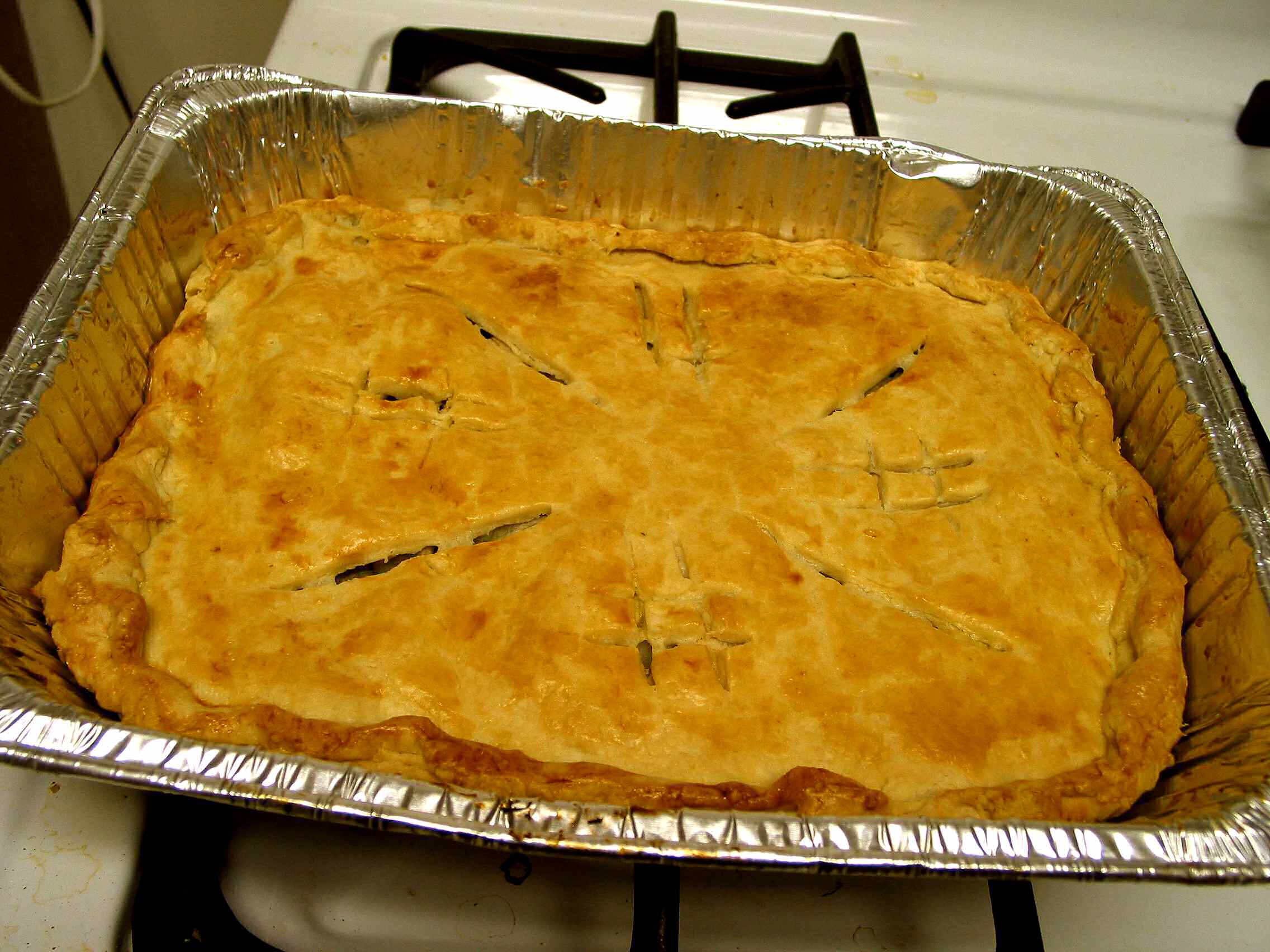
We baked a big Tart of Spinnage (courtesy of The English Huswife, 1615, by Gervase Markham) with adaptations. 1615–that’s Shakespeare and Elizabeth I, the early modern era, not the medieval. Still, some of the recipes were probably conserved, and some of the styles of flavoring as well. The fact that sugar is added to this one is reminiscent of Elizabeth I’s infamous sweet tooth, but it also makes the normally savory spinach a dish more in keeping with the earlier recipe collections so favored by Renaissance Faire participants.

Medieval recipes from the 1300s and 1400s indicate heavy use of cinnamon, ginger, mustard, pepper, galingale, and grains of paradise for the aristocratic classes, at least for their feast dishes. Fruits were routinely added to both meat and fish “Parma” tarts–those tarts, full of eggs, were probably much like today’s quiches.

But the recipe my daughter’s teacher e-mailed me had no eggs. The binder, an interesting choice, was “cast cream” or sour cream. Sour cream bakes up well in cheesecakes–labaneh, a Middle Eastern/Near Eastern version, is a lot thicker and bakes up even more nicely. I’ve made mini-cheesecakes from nothing but labaneh, sugar and lemon rind stirred together and baked in cookie crusts, and they came out beautifully. So I wasn’t too worried about the tart filling firming up enough.

The original recipe also contained no spices other than sugar (maybe I mean “flavorings” rather than “spices”), pepper and salt. Spinach, sour cream, sugar, pepper, salt…bland? Odd? Would the signature combination of vegetable and sweet get lost in the mix? No knowing. But for a medieval version, especially for a classroom tasting, we were going to have to do something slightly different, more purposeful.

A spinach tart with sugar? It was going to be a gustatory challenge for the class and its guests, a flavor combination we no longer encounter very much. Might as well make it interesting, and preferably good.

Which is why I adapted it to a sweetened tart of greens like Swiss chard. Versions of this are still served today in Nice (tourte de blettes or Swiss chard tart) and parts of Italy (torta di verdura or tart of greens) as a dessert. The filling often contains raisins and pine nuts as well as Parmesan cheese, and the pastry is often sweet and dusted with confectioner’s sugar before serving.  If it were awful, surely people like David Lebovitz wouldn’t be putting versions of it on their blogs. Novelty value can take you only so far. And his version contains a layer of apples on top of the chard…

The last thing I thought about was the learning experience for my daughter, the nascent (though not Re-nascent) master chef. The recipe her teacher sent home indicated “pastry shells”. As though you could go to the store and buy them.

No baking powder or soda allowed in the medieval era. No food processor. So my daughter cut up the butter and cut it into the flour with a pastry blender–once she realized the blades weren’t actually sharp–and then mashed it together with her hands, which was a lot more efficient. She made the spinach filling we decided on–very close to the assigned recipe, but with a bit of cinnamon and nutmeg, and a grating of lemon peel. In place of raisins, she put the extra bits of apple in the filling.

patting out the filling

She fit the pastry to the pan, pricked it out, filled it, and topped the spinach with a layer of finely sliced Granny Smith apples–most apples were probably tarter in those days than they are now.

slicing apples for the spinach tart

Dame Felidae demonstrates her knife skills

Then she placed the top layer of dough onto the tart, pinched it shut, slashed it in her own design and “endored” or gilded it with egg yolk/water glaze. We baked it in a (horrors! modern!) oven and thawed the “spinnage” out in the microwave before squeezing it, but other than that I think we were pretty much in the spirit. Continue reading