
• Enter your email address to subscribe to this blog and receive notifications of new posts by email.

    Join 241 other subscribers
  • Noshing on

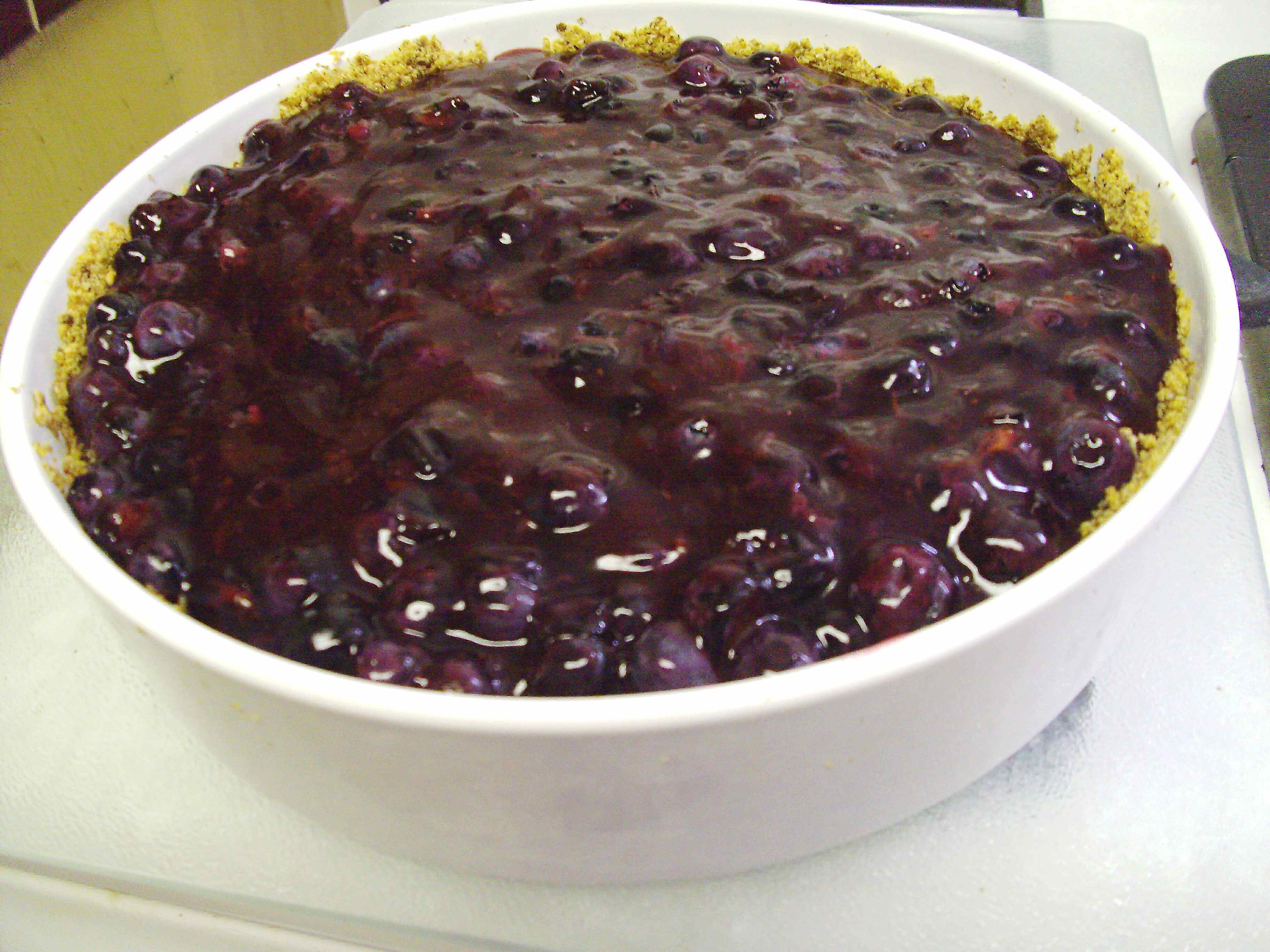
    raw blueberry pie with microwaveable filling and graham cracker crust

    This mostly-raw blueberry pie is a snap to make and very versatile--the filling microwaves in a few minutes, and you don't even have to bake the zippy gingered graham cracker crust--perfect for a hot Fourth of July and all summer long.

  • Recent Posts

  • Contents

  • Archives

  • Now Reading

  • See also my Book Reviews

  • Copyright 2008-2024Slow Food Fast. All writing and images on this blog unless otherwise attributed or set in quotes are the sole property of Slow Food Fast. Please contact DebbieN via the comments form for permissions before reprinting or reproducing any of the material on this blog.

  • ADS AND AFFILIATE LINKS

  • I may post affiliate links to books and movies that I personally review and recommend. Currently I favor Alibris and Vroman's, our terrific and venerable (now past the century mark!) independent bookstore in Pasadena. Or go to your local library--and make sure to support them with actual donations, not just overdue fines (ahem!), because your state probably has cut their budget and hours. Again.

  • In keeping with the disclaimer below, I DO NOT endorse, profit from, or recommend any medications, health treatments, commercial diet plans, supplements or any other such products.

  • DISCLAIMER

  • SlowFoodFast sometimes addresses general public health topics related to nutrition, heart disease, blood pressure, and diabetes. Because this is a blog with a personal point of view, my health and food politics entries often include my opinions on the trends I see, and I try to be as blatant as possible about that. None of these articles should be construed as specific medical advice for an individual case. I do try to keep to findings from well-vetted research sources and large, well-controlled studies, and I try not to sensationalize the science (though if they actually come up with a real cure for Type I diabetes in the next couple of years, I'm gonna be dancing in the streets with a hat that would put Carmen Miranda to shame. Consider yourself warned).

Sorry, Starbucks, no doughnut

On Sunday mornings, my daughter likes to drag her father out around the corner without me to the local Starbucks so he can buy himself coffee and get her some kind of small baked good that I’m not supposed to know about. Because I am, in fact, generally opposed to “doughnuts for breakfast” and both of them know it. It’s a ritual that had to be suspended for a while this spring, until we could figure out what kind of treat had how many grams of carbohydrate and how much of it she could eat and still eat something else more nutritious as the majority of breakfast.

Most of the pastries will never be what I consider top baking, but it’s not me who’s going to eat them. And my daughter wanted a doughnut, or part of a doughnut, if she could make it work out.

So–I went online to the Starbucks web site to try and hash out the vagaries of “petite” mini scones, mini doughnuts, coffee cake slices, and all the rest of it. Starbucks markets itself to the upscale, the midscale, and the would-be midscale of my town with all kinds of brochures about fair trade and global responsibility, and their web site is not much different. The do-right message is right up there with the latte of the week, and you’d expect the nutrition info to be present and helpful without the usual twisty chain-restaurant disguises and trickery.

Or would you? Starbucks got its tail caught several years ago when numerous commentators, among them its own employees, let the public know that some of the lattes and other mixed coffee drinks were topping out at over 700 calories per, with more fat than some burger chain offerings. Since then Starbucks has offered more health-conscious choices below the pastry case and taken a pro-active posture on nutrition and informing the customer and so on. But how do they really feel?

The nutrition info page falls under the “menus” navigation item at the top. OK. It’s readable, not a shrunken PDF file–good. You find a long scrolling list of each of the bakery items with calories, fat, carbs, and proteins. Doughnut, doughnut–old-fashioned glazed doughnut…440 calories, 21 grams of fat (10 saturated), 57 grams of carb…Ouch. Well, she could have half of one, I suppose, with a small bowl of oatmeal and some milk, and eat something better at lunch…but wait a minute. Where’s the sodium info?

All I could find about sodium was a little note about “healthy choices”, in which the Starbucks nutrition page asserts that such items have fewer than 10 grams of fat and fewer than 600 mg sodium. A stunner–that’s more than the classic 500-mg bowl of Campbell’s Tomato Soup that caused all the corporate protests against the NIH dietary salt guidelines in the 1980s. Who on earth would claim 600 mg sodium for a single snack or breakfast item was “healthy”–especially with the growing public and government concern over excessive salt in restaurant food?

And I still couldn’t find any specific sodium stats for doughnuts or mini scones or the other things my daughter was hoping for, much less an ingredients list. So I searched a variety of diet and nutrition web sites that catalog such things. The closest I could get to a current verified  standard nutrition label was from livestrong.com (accessed 5/3/10):

Starbucks Top Pot Old-Fashioned Glazed Doughnut

Serving Size: 1 Pastry (113g) Calories 480 Calories from Fat 210

  • Total Fat 23g 35%
  • Saturated Fat 9g 45%
  • Trans Fat 0g
  • Cholesterol 20mg 7%
  • Sodium 410mg 17%
  • Total Carbohydrate 64g 21%
  • Dietary Fiber 0.5g 2%
  • Sugars 39g
  • Protein 4g 8%
  • Vitamin A0%
  • Vitamin C 0%
  • Calcium 2%
  • Iron 10%

Est. Percent of Calories from: Fat 43.1% Carbs 53.3% Protein 3.3%

These stats are higher than what’s stated at the Starbucks page (see below). And the sodium in a single doughnut is pretty high. So’s the carb. So’s the fat. So’s the increase in size and calorie stats and so on from the glazed doughnuts they were offering in 2006, according to archived nutrition labels on a number of older diet web sites. Continue reading

Measuring when you have to be right

I’ve been cooking by hand for most of my adult life, and I cook by eye as well. This mostly comes out in the form of measuring by pouring things like baking soda or ginger into the palm of my hand rather than fishing around in the silverware drawer for a quarter-teaspoon or tablespoon. Too much fuss, I always thought, and it was a point of pride to be able to do without it.

It turns out a lot of people think measuring by hand is the mark of a chef: almost every one of the rising food stars who’ve broken into print insists in their “restaurant hints for home cooks” that you should measure salt “by feel” or the like while seasoning food in several stages during cooking.

But suddenly having to calculate in grams of carbohydrate per serving for my daughter has meant buying a new set of cup and spoon measures as well as an electronic food scale and really measuring, the official kind of measuring, instead of just eyeballing.

In making the comparison, I’ve discovered a number of unpleasant truths about the by-hand method. Most of which boil down to IT’S NOT ACCURATE. AT ALL. And I’m not talking a little 20 percent error here.

Try the following:

Cup your hand and pour a pre-measured level quarter-teaspoon of table salt into it. Go on and look hard, try to memorize how high it rises on your palm, what a quarter-teaspoon of salt looks like. Now dump it, wipe off your hand, Continue reading

Rethinking everything

I’ve been away from my desk, my notebooks, this blog for two weeks now. I never expected to be–it’s become a weekly adventure to seek out new topics in food, food politics, nutrition, and alternate methods for cooking real food faster. And then last week my daughter was diagnosed with Type I diabetes.

Diabetes is one hell of a verdict when you think your kid is just growing, and then just has a simple stomach virus, and it turns out to be neither of those things. It was also one of those strange fairytale paradoxes by which a cursed or poisoned feather turns out to save the princess in rags. She’d come home from school three weeks ago with what seemed like a routine stomach bug, but it wasn’t. Instead of a bit of fever, antsy impatience at having to rest and then bouncing back, she was cool, sleeping around the clock, drinking a lot even when she couldn’t stand to eat, and losing weight fast. Taking her back to the doctor the second week, we were thinking anemia, mono–afraid to think anything worse. Thank god our doctor threw in a glucose test along with the usual suspects. By afternoon he’d called and told us to get her down to the ER.

A night in the hospital is no picnic, even if all they’re doing to your kid is putting her on an i.v. and pricking her fingers with a lancet for testing once in a while. The second night is no fun either–everything the doctors have been telling you goes in one ear and slides right out the other as you wonder what your kid will ever be able to do normally again, and how much you’ll have to worry for her the rest of her life, and how you’re going to keep from laying those worries on her. And yet–at some point in the middle of the second night, unable to sleep much between nurse interruptions–I started to realize my daughter’s legs and arms and face were already filling back out, and in fact she had spent a good part of the second day sitting up reading Charlie and the Chocolate Factory for all she was worth, reading me her favorite bits in a silly voice  and cackling every once  in a while. More energy than I’d seen in three weeks. Whatever they’d done to lower her sugars and balance her electrolytes again was really working. She was reappearing before my eyes. I had no idea how to feel anymore except shocked, grateful and slightly absurd.

Furthermore, every time the orderly came by to pick up a menu or leave a meal, my daughter tucked into the food as though it had been catered by Daniel Boulud. (Of course, most of the meals featured meat, which she loves but I don’t make very often.) It is fairly humiliating to have your kid announce that the hospital meals are better than those at home…

Then she started talking about which kinds of potatoes she likes or doesn’t, whether and how soon she can have pizza, how will she ever be able to go to a birthday party and stand not having cake or candy or ice cream without having to figure out the carbs and the insulin beforehand, what about Valentine’s Day and on and on.  Somehow oatmeal raisin cookies became the benchmark of whether she was going to be able to eat like a person or not–and she hasn’t even had a taste for them in at least six months.

The shrinkage, the re-blossoming, and the total fixation on treats and sweets, all within a few days in a hospital bed–suddenly Charlie Continue reading