
• Enter your email address to subscribe to this blog and receive notifications of new posts by email.

    Join 241 other subscribers
  • Noshing on

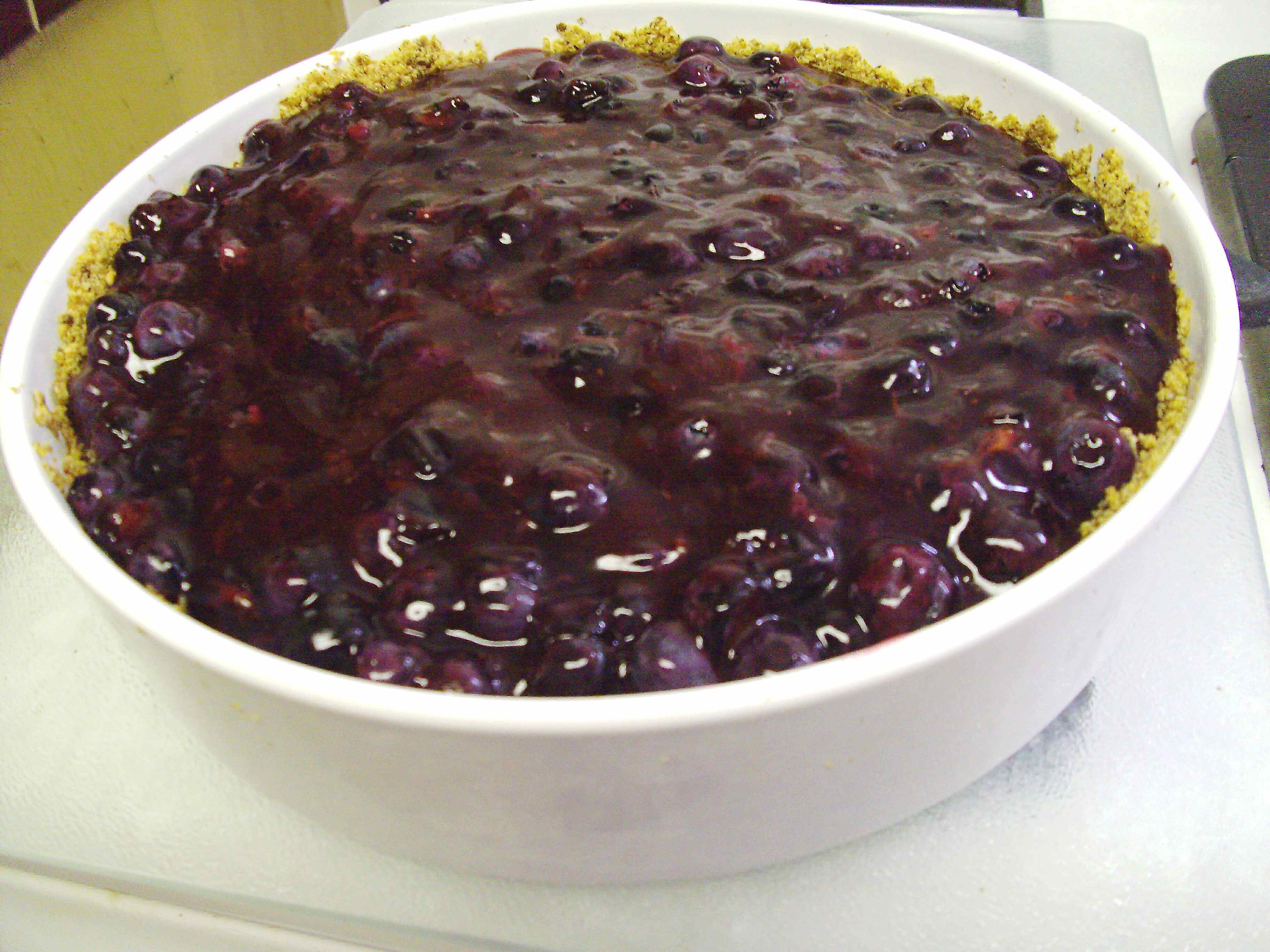
    raw blueberry pie with microwaveable filling and graham cracker crust

    This mostly-raw blueberry pie is a snap to make and very versatile--the filling microwaves in a few minutes, and you don't even have to bake the zippy gingered graham cracker crust--perfect for a hot Fourth of July and all summer long.

  • Recent Posts

  • Contents

  • Archives

  • Now Reading

  • See also my Book Reviews

  • Copyright 2008-2024Slow Food Fast. All writing and images on this blog unless otherwise attributed or set in quotes are the sole property of Slow Food Fast. Please contact DebbieN via the comments form for permissions before reprinting or reproducing any of the material on this blog.

  • ADS AND AFFILIATE LINKS

  • I may post affiliate links to books and movies that I personally review and recommend. Currently I favor Alibris and Vroman's, our terrific and venerable (now past the century mark!) independent bookstore in Pasadena. Or go to your local library--and make sure to support them with actual donations, not just overdue fines (ahem!), because your state probably has cut their budget and hours. Again.

  • In keeping with the disclaimer below, I DO NOT endorse, profit from, or recommend any medications, health treatments, commercial diet plans, supplements or any other such products.

  • DISCLAIMER

  • SlowFoodFast sometimes addresses general public health topics related to nutrition, heart disease, blood pressure, and diabetes. Because this is a blog with a personal point of view, my health and food politics entries often include my opinions on the trends I see, and I try to be as blatant as possible about that. None of these articles should be construed as specific medical advice for an individual case. I do try to keep to findings from well-vetted research sources and large, well-controlled studies, and I try not to sensationalize the science (though if they actually come up with a real cure for Type I diabetes in the next couple of years, I'm gonna be dancing in the streets with a hat that would put Carmen Miranda to shame. Consider yourself warned).

In search of good rye bread

I’ve been attempting rye bread and kornbroyt (Jewish sourdough whole wheat bread) on and off since about last Chanukah–almost a whole year! You would think this was unnecessary, since I live close enough to North Hollywood/Valley Village, the eastern hub of LA for Jewish bakeries and delis (the older western hub is “the Fairfax” neighborhood and the Pico/Robertson area). The rye bread you can get at these places isn’t terrible; my synagogue orders it regularly along with 6-braid challahs for big events, and it’s okay. It just isn’t much better than Arnold’s or Sara Lee, the lightweight commercial supermarket versions I grew up with in the south when we couldn’t get the real thing from New York more than once or twice a year.

Last spring I bought the big crusty half-boule loaves of wholewheat sourdough from Trader Joe’s to sub in for kornbroyt at a big synagogue brunch and they were wonderful–and also not screamingly high in sodium as most hard-crust sourdoughs are (Whole Foods, most bakeries, certainly La Brea and friends). Certainly less per serving than the French loaves and ciabattas and other items on the gourmet bread stand at TJs. The Pain Mich’ demi-boule was a very good deal all the way around, and I’ve bought it weekly for years.

But shortly afterward, TJs switched bakers and the new ones produced something that only looked similar. The crust was flabby and the crumb was like the stuffing of old office chairs–crumbly and weak, lacking flavor, not springy and full of moxie like the real thing. What could have happened to my favorite shortcut to the good life? They still haven’t fixed the problem. Which is probably at least partly due to an inferior use of sour culture. Or CUL-choo-ah as my mom says (Brooklyn accent hard to miss).

So I was going to have to figure it out for myself if I didn’t want to remain a deprived child.

For the past 30-40 years, according to Stan Ginsberg and Norm Berg in their book Inside the Jewish Bakery, the flavor and texture of commercial rye bread  have really been watered down as companies went national and American-style with it. It became paler and lighter in texture, with less rye flour and more additives–oils, conditioners, salt. And they used commercial dry yeast instead of sourdough culture, which takes too long and for a long time wasn’t generally considered reliable or controlled enough a process for mass production–probably not for FDA and local health inspectors either. So most commercial rye bread lacks the true rye sour starter flavor, and is no longer really chewy or dark. Or crusty. Which is how I want mine.

All of those lost characteristics from my childhood memories of real New York rye bread and kornbroyt, made by local union bakers and brought down to Virginia once or twice a year by my grandparents, have now regained popularity in the US foodie arena. Well, not rye bread as such, but “old world” artisan wholegrain sourdough breads that seek to copy Poilâne’s legendarily crusty round loaf. Enthusiasts bring up a lot of sinister-sounding bakers’ terms: levain, cloak, slash, hydration percentage, etc. And they’ve come respectably close. But they’re still lacking the sign of authenticity: the union label pasted on the endpiece!

One major American bakery to achieve similar cult status to Poilâne is Tartine. Complete with three lengthy baking manuals so far on how to build a sour, incorporate all kinds of grains and let the sour culture digest them for the right number of days until they’re ready to set up as loaves.

The books are filled with gorgeous, crusty loaves that cost a fortune at gourmet bakeries if you can find them at all in your town. But it’s like looking through the bakery window, hungry, with your nose pressed up against the glass. Most people don’t have the singlemindedness to follow all the steps at home more than once, much less for more than one or two varieties of more-expensive, Whole-Foods-only, alternate grain breads.

The books are also filled with testimony as to just how many years it took each baker on the team to fulfill his or her apprenticeship and perfect the technique.

Years, though. That’s a lot of time to get yourself a decent home-baked loaf of rye bread that tastes like it could stand up to corned beef. Which makes me wonder whether a mere cookbook can really teach it.

So why bother (except for the perverse curiosity that drives me to mad-scientist-like experiments that probably won’t win the Nobel this year, or any year)? Because once in a while you want good rye bread even if you live on the West Coast.

Looking at the pictures and even reading the instructions can’t give you the exact right sour or air temp or humidity or other conditions that make Tartine’s bread award-winning. Your yeast may vary. You may not have the same sensitivity in your hands or know exactly how moist or elastic or heavy or whatever the dough needs to feel like at each stage. You have to be willing to experiment and fail a couple of times and pay attention to how it looks, feels, smells, and be willing to fiddle around and adjust the next time.

That’s okay. Perfection is not a Jewish ideal, so much, and rye bread is not so hard to improve with practice. Our great-(great-etc.) grandmothers were making rye bread pretty often in the shtetls with whatever starters they had and could keep going throughout some pretty challenging winters. And every spring they’d have to get rid of their sour cultures right before Passover and start over from scratch as soon as it was over. In Russian-Polish spring weather. (My grandfather always said you knew it was spring when the first oxcart got stuck in the mud. It meant the ground had finally thawed.)

So you could probably figure that the women in the shtetls weren’t always overjoyed to have to throw away their sour cultures every spring, and the first loaves of bread in the shtetls after Passover ended might not have been a lot of good for a week or so extra. Or they could have turned out like my first one, especially if it took an extra week for the miller to supply new rye and wheat flour.

To tell you the truth: getting a rye sour started is no big deal–I seem to have done it on the first try, even while taking the onion shortcut (see the bottom of the post) and being much too casual with the flour and water proportions in Ginsberg and Berg’s rye bread instructions from Inside the Jewish Bakery. It’s just that getting the sour ready for baking takes a while–like 3 to 5 days. And then it gets more refined and hopefully consistent as you feed it sequentially over time. Professional bakers guard their established sours like gold.
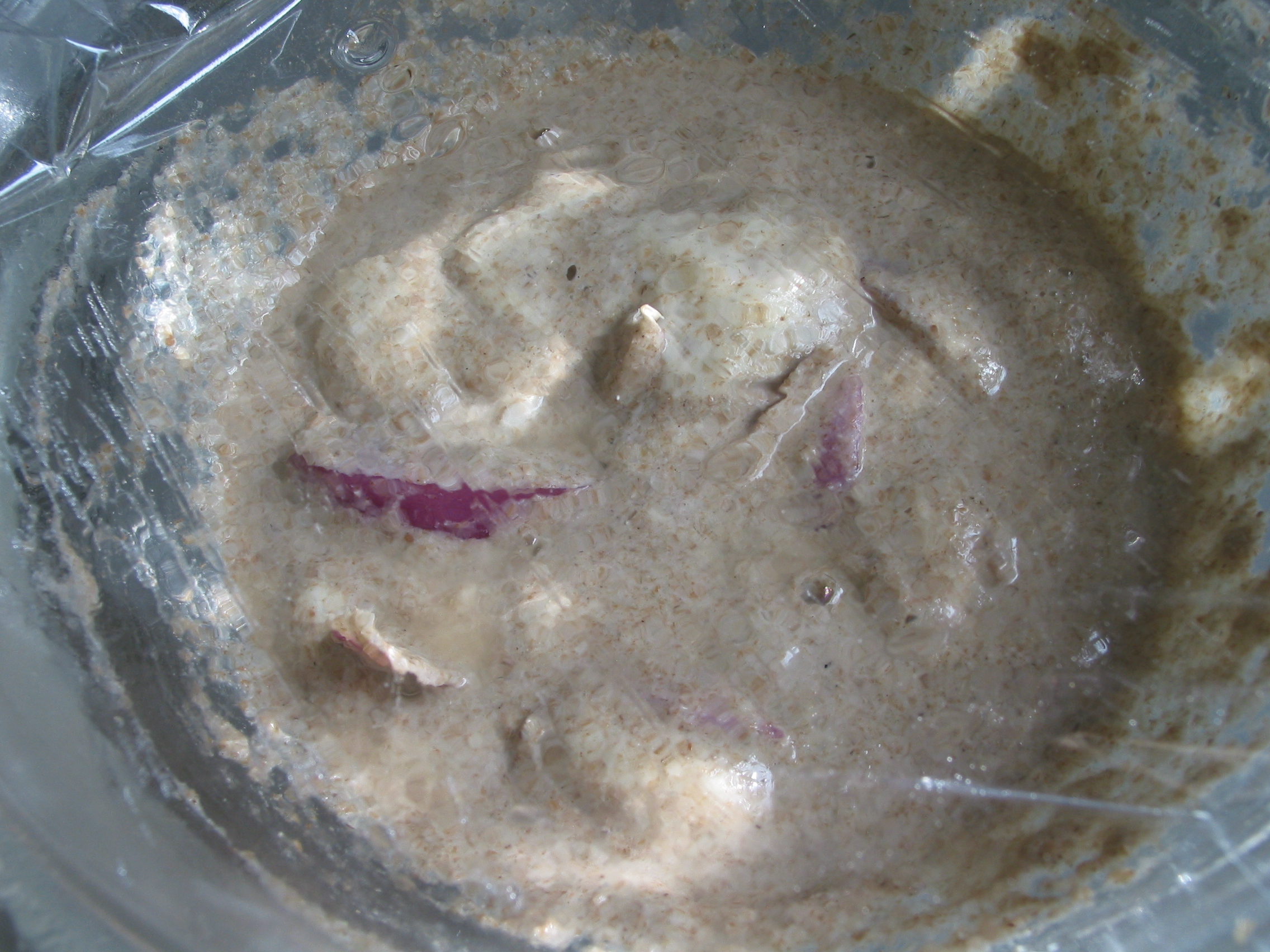
Rye sour getting started with raw onion

Rye sour getting started with raw onion

What went wrong on my first try, right before New Year’s, was that I didn’t put in quite enough wheat flour for the final dough. I was still thinking loose, elastic, relatively wet dough like my usual pizza dough or challah dough, and this needed to be stiffer to match the picture in the book, which showed an actual spherical ball of dough. I figured my usual dough would be a little moister and give nice, big ragged holes–however… Continue reading

A Handful of Farina Breads

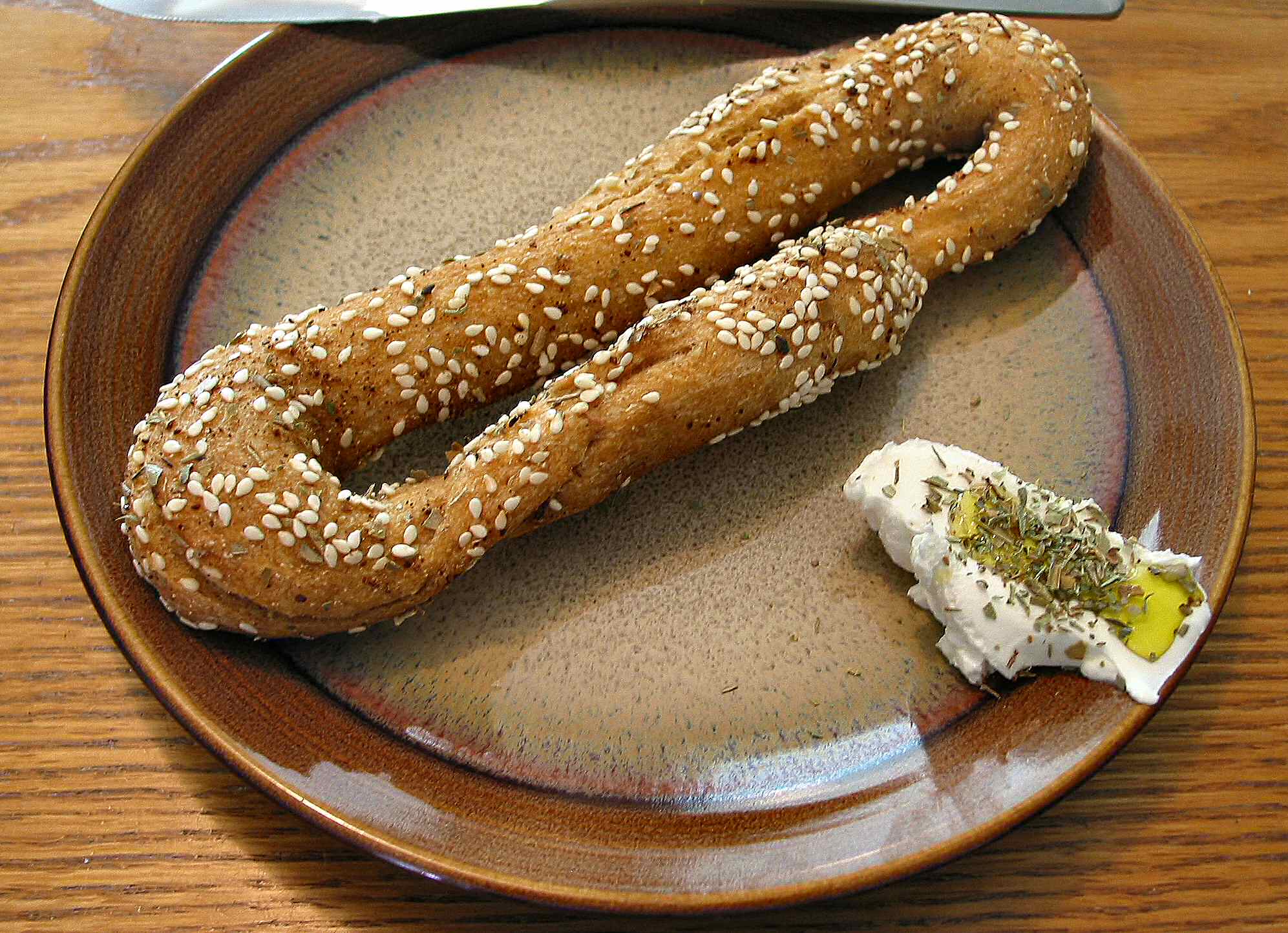
Simit bread or "beigele" with labaneh and herb spread

It’s been a couple or three weeks since my last post. I am currently in the desperate process of using up as much hametz, which is flour-yeast-bread-beans-lentils-rice-pasta-fillo-dough-oatmeal-etcetera, as possible before Passover. Right after Purim  I discovered I still had about 5 sacks of dried beans and lentils cleverly saved up and a sack of whole wheat flour and a 2-lb. bag each of bulgur AND farina! And a pound of wild rice. And a new bag of soy flour. Most of all which I couldn’t donate to the food shelter because it was either bulk or partly opened. Yeesh. What’s a girl to do?

Well…we’re certainly going to find out in the next couple of posts, aren’t we?…Even my suddenly-vegetarian daughter–yes, the very same one who kept bugging me about why I wasn’t cooking enough chicken for her last year–is wondering whether she has the stomach for more black bean burritos in the next two or three weeks (her conclusion: as long as there’s chipotle salsa around, what’s the problem?) My husband is looking at both of us cross-eyed.

Okay, then. Project #1 (well, after the pot of black beans, anyway; those were pretty standard and don’t call for a post): bread.

Long, long ago, in a kibbutz kitchen far, far away, I made some bread for my parents, who were coming to Israel for a visit during the year I was there. December in Israel–drizzly and cold some days, bright and cool others. You never know what you’re going to get.

But I’d missed my parents dearly for half a year. To celebrate seeing them I had in mind something like one of the blackish poppy-filled strudel I’d seen in a Romanian bakery in the middle of Haifa’s downtown “Hadar” shopping district amid the felafel stands and bookstalls. Only I wanted something not sweet, and with a better dough. A savory bread, like a bialy but with poppy seeds. So onion and maybe a little parsley or dill, now that I’d worked in the side kitchen for 5 months and knew the Hebrew names for both herbs.

I decided on a basic bread dough, flour-water-yeast-salt with a bit of oil. I rolled it out flat into a long rectangle and filled it with chopped, fried onions, parsley, dill, thyme and salt (it actually had too much salt, to my embarrassment, but my mother loved it anyway) and a couple of handfuls of poppy seeds. Then I rolled up the column of bread, twisted it around itself into a longish double rope, glazed it with egg yolk and baked it. It was pretty good and looked impressive. And it was really easy. My mother ate it all week sightseeing while my dad was at his conference.

Those days are gone, but a recent trip my husband took brought back the memory along with a couple of loaves of multigrain herb bread from a traditional German bakery he discovered in Tehachapi. The breads lasted an entire week at room temperature (of course, our humidity’s so low in Pasadena that this may be an exception) without seriously high salt in the dough, and every time we passed the dining room table, the aroma of dill and thyme and scallions and sourdough made us want to tear off a chunk to eat just as-is.

Two weeks ago was Purim, the feast of lots (as in drawing lots to determine someone’s fate, not lots as in lots-of-hametz-to-use-up). It’s the holiday from which we get the term “the whole Megillah”–the Megillah being the Scroll of Esther, a long Scheherezade-style story set in Persia and very long to read out loud in one sitting to a large congregation while they cheer the heroes and boo the villain (also Scheherezade-style, it’s the wicked vizier–am I giving anything away? It’s always the wicked vizier, except when it isn’t. And did I mention it’s kind of long? Okay, then).

So anyway, I decided to make some of this scrolled bread to give as Purim shalachmones–food baskets sent to friends, but didn’t get that far this year. Hamantaschen was about the limit of my ability, since it’s also get-your-kid-into-a-decent-school-for-next-year lottery time.

Usually these days the mishloach manot (same term, without the Yiddish accent) are candy bars, bagged snack foods, and maybe some raisins or an orange to round out the “3 different foods” custom. Occasionally you still see hamantaschen but the junk food factor has really taken over very sadly, I gotta say, even if it’s Israeli junk food. I mean, okay, felafel-flavored Bisli is fun once, but it’s really not much better than Cheetos, except that the wrapper is a good exercise for my daughter’s Hebrew reading skills (especially once she figured out which word meant “carbohydrates” on the nutrition label).

Nobody on the west coast even makes poppy seed hamantaschen anymore, to say nothing of prune lekvar filling, the two classics of my childhood. It’s a cultural deterioration I aim to remedy. Maybe next year–but for now, this weekend, with a container of poppy seeds still in the freezer, I’m thinking about making the bread, since it’s delicious, also involves poppy seeds and is unlike anyone else’s. And because I have flour and yeast to use up before Pesach, which is now right around the corner.

So I started pulling the flour off the shelf and realized I’d used up all the bread flour for hamantaschen but I still had a good 3-4 pounds of whole wheat, which wouldn’t make a good bread all by its lonesome. And on the other hand, I had both bulgur and farina–bulgur for tabbouleh or a wheat version of polenta, but farina–2 pounds of it. Well…it’s wheat and fairly fine. Maybe if I ground it up a bit further in the coffee grinder? I did, though the end result seemed less than convincing that I’d made any difference in it at all. Still pretty grainy. Dumped it into the food processor anyway along with an equal amount of whole wheat flour, some yeast, a little salt, and enough water for a fairly stiff but elastic ball of dough once it was processed.

The dough was pretty heavy to lift out and the farina absorbed a lot of water but it did seem to be developing some stretch, at least. I let it rise overnight in the fridge and started testing it out the next day. Continue reading

A Bowl of Dough in a Book

For anyone who’s read my previous post, A Bowl of Dough in the Fridge, a quick recommendation:

Artisan Bread in Five Minutes a Day, by Jeff Hertzberg and Zoë François, is gaining a big following among people who’ve tried out the recipes. This bread book, developed by an avid home baker and a professional pastry chef, uses the same basic strategy I do, but they’ve worked out quite a number of variations on a couple of master recipes, and they’ve come out with a general formula that works pretty well.

They have a basic white boule with a crunchy crust–something to shape a variety of classic ways, French through Italian, with or without olives or olive oil. They have several whole wheat and pumpernickel and rye versions with a thinner shiny crackled crust. They have challah AND brioche, and they have classic bagels AND Montreal sweet bagels. And they have chocolate babka. And they have demonstration photos and tips at the right points in the recipes to be helpful.

Among the differences between their basic white boule recipe and my typical  dough are much more yeast for the amount of flour and water–they use a packet and a half for 6 cups of flour and 3 of water–and a lot more salt as well–a tablespoon and a half. The initial rise is faster–about 2 hours instead of 5 or so–but I’m not sure what the true effect of the salt is other than taste and reflexive habit–François is CIA-trained, and that school tends to emphasize salt, judging from the chefs who’ve graduated from there and gotten into print.

The other factor that’s different is they don’t call for kneading at all–once you’ve stirred the flour into the liquids and everything’s more or less uniform, that part’s done. Rise and chill.

That’s solid enough for the chewy hard-crusted no-knead bread style of bread, but will it work for challah, which usually calls for extensive kneading to develop the classic long feathery crumb? Inquiring minds want to know.

So I’m going to try their white boule and their challah (though here I’ll cut the salt back for my own taste) and let you know how it goes. I’m looking forward especially to see if the challah crumb can really be achieved without the 10-minute knead and multiple rises.